Archive for the ‘Gas’ Category
February 22, 2012
If the 19th century was the dawn of the Age of Coal and the 20th century was the Age of Oil, the 21st century seems to be well on the way to being the Age of Gas.
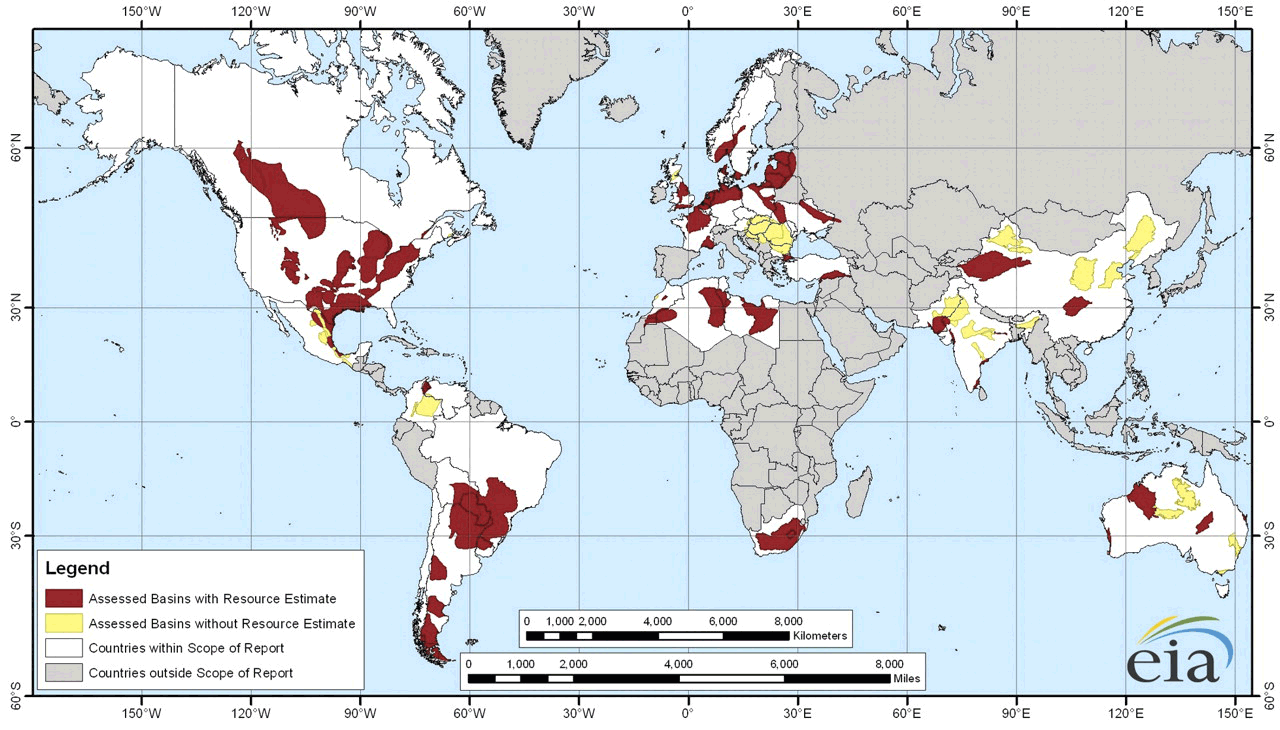
Gas shales are being found all over the globe. The US has reserves of 860 trillion cubic feet of shale gas. In many countries gas-bearing shales have not yet been fully explored but known reserves include; in China (1,275tn cubic feet), Argentina (774tn), Mexico (681tn) South Africa (485tn), Canada (388tn), Libya (290tn), Algeria (231tn), Brazil (226tn), UK (200tn), Poland (187tn) and France (180tn). Exploration is still under-way in Russia, central Asia, India, the Middle East, south- east Asia and central Africa. New finds of Natural gas are being discovered off the coast of East Africa. Exploration is now extending to deposits of methane hydrates in the deep sea (>500m) and under permafrost. For electricity generation and large scale heating (district heating) gas is likely to be the preferred alternative. By 2030, gas will probably overtake coal and oil as an energy source. Compressed gas for transport is already in use. Wind and solar energy will not be insignificant but will remain expensive and just a minor contributor. Even where the renewables are used for political ends, gas will have to provide the necessary back-up.
The IEA called it in their special report: Are we entering a golden age of gas.
Reuters reports that new finds are converting East Africa into a gas hub: Statoil find adds to East Africa gas hopes
Martin Wolf writes in the Financial Times: Prepare for a Golden Age of Natural Gas
… the EIA notes that “the advent of large-scale shale gas production did not occur until Mitchell Energy and Development Corporation experimented during the 1980s and 1990s to make deep shale gas production a commercial reality in the Barnett Shale in North-Central Texas.” But, by now, it adds, “[t]he development of shale gas has become a ‘game changer’ for the US natural gas market.”
Tags:Age of Gas, dash for gas, gas glut, Natural gas
Posted in Energy, Gas | 1 Comment »
February 20, 2012
Oil production from oil shales in North Dakota is increasing rapidly and the much-heralded “peak” of oil production may have to be postponed. Alarmists will not be pleased.
“Peak Oil” and “Peak Gas” are the points in time where the production of oil and gas respectively reach a peak and then decline to zero. The concept is based on the normal production cycle of an individual well extrapolated to all the oil and gas existing. The fundamental flaw in these hypotheses when trying to apply them to “finite” and exhaustible resources of any product is of course that:
- new sources of the product are discovered
- new extraction technologies enhance what can be recovered from existing sources,
- new technologies make non-viable sources viable
- new technologies allow the synthesis or alternative production of the product (price driven)
- consumption is modified by pricing

Moving peaks
In recent times the development of fracking technology and the discovery of huge deposits of gas-bearing shales together with the discovery of new deep-sea sources of natural gas have pushed the “peak” for gas production beyond the visible horizon and into the distant future (a few hundred years). When – rather than if – methane hydrates become available for gas production, the “peak” will shift further into the future.
In the case of oil there are already many feasible alternatives which are technically feasible but where commercial production by these methods can only be triggered by the sustainable price being higher than the production cost. For example bio-diesel costs are commercial with oil prices above about $70 per barrel but there is a hidden cost in decreased or disrupted food production. Coal liquefaction would need oil prices above $120 per barrel while oil extraction from oil shales and oil sands become commercial at about $90 and $100 respectively. Deep sea wells (new exploration) are increasingly commercial as the price increases.
The alternatives are now coming into play:
(more…)
Tags:"Peak" gas, Energy, oil shale, Peak oil, Shale gas
Posted in Alarmism, Energy, Gas, Oil, Oil price | Comments Off on “Peak Oil” hypothesis is following “Peak Gas” into oblivion
February 14, 2012
China has reserves of shale gas at least 50% greater than in the US and is the latest country hopping onto the fracking band-wagon. The Chinese are looking to acquire minority interests in technology companies owning fracking technology in the US and are pushing ahead with their plans for production of shale gas. It seems quite clear now that whenever the global economic recovery finally gets going, the availability of shale gas will be one of the contributing factors. I expect we shall see a boom in exploration for shale gas reserves, in increasing production of shale gas and a boom in gas-fired power generation. There may well be a boom in the sales of gas turbines for power generation within the next 2 -3 years.
“Peak” gas is nowhere in sight. And the fracking technology developments seem to have application even for the recovery of large amounts of gas from methane gas hydrates which are found under deep sea-beds (>500m deep) and even under thick layers of permafrost. While this may take another 10+ years to develop, it makes it even more unlikely that any “peak” gas scenario can develop.

Shale gas reserves: Reuters graphic
Forbes reports:
(more…)
Tags:"Peak" gas, China, fracking, Hydraulic fracturing, Natural gas, Shale gas
Posted in Business, China, Energy, Gas | 1 Comment »
January 18, 2012
The advent of shale gas has moved the peak of “peak-gas” into the future by some 250 years. This together with the fact that gas-fired power plant have the shortest construction times and the lowest investment costs of any form of power generation provides the possibility to hold down electricity generation costs. The increase in generation costs in recent times has been the natural consequence of the subsidy regimes for wind and solar power plants and the opportunistic rush to renewable power. Huge fortunes have been made by “green” developers as the subsidies have been milked – but consumers have only seen rising electricity prices.
Bloomberg reports:
A shale-driven glut of natural gas has cut electricity prices for the U.S. power industry by 50 percent and reduced investment in costlier sources of energy. With abundant new supplies of gas making it the cheapest option for new power generation, the largest U.S. wind-energy producer, NextEra Energy Inc. (NEE), has shelved plans for new U.S. wind projects next year and Exelon Corp. (EXC) called off plans to expand two nuclear plants. Michigan utility CMS Energy Corp. (CMS) canceled a $2 billion coal plant after deciding it wasn’t financially viable in a time of “low natural-gas prices linked to expanded shale-gas supplies,” according to a company statement.
(more…)
Tags:Electricity generation, Energy, gas glut, Gas price, gas turbine boom, Natural gas, Shale gas, Utilities
Posted in Energy, Engineering, Gas | 2 Comments »
November 8, 2011
The Russian gas pipeline bypassing all transit countries to Germany by being routed under the Baltic Sea goes live today.
RT: After 13 years of planning and two years of construction, the Nord Stream pipeline will deliver its first supplies of Russian gas to an estimated 26 million homes in the EU on Tuesday.
(more…)
Tags:Baltic Sea, Dmitry Medvedev, European Union, Gazprom, Germany, Nord Stream, Russia, Vladimir Putin
Posted in Business, Energy, Gas, Germany, Russia | Comments Off on Nord Stream gas goes on-line today
September 22, 2011
“Peak-gas” moves further into the future as recoverable reserves of shale-gas are found in more countries. The coming gas glut is getting ever more real. Now the UK – which was thought to have little shale gas – has found reserves of about 5,700 billion cubic metres of shale gas in Lancashire. Poland -which was thought to be the richest in shale gas resources in Europe has recoverable reserves of about 5,400 billion cubic metres. Till now the British Geological Survey had thought the country possessed only about 150 billion cubic metres.
The map of the world’s shale gas reserves is changing rapidly as exploration for this previously ignored resource intensifies. The gas glut is going to provide relatively cheap options for the use of gas based electricity generation into the foreseeable future. In fact the increase in the cost of electricity which has been driven by the use of renewables and misplaced penalties for fossil fuel could finally be reversed. Needless to say the “environmental” industry – instead of welcoming the finding of new resources – is in a state of denial – and looking for every possible objection to the use of shale gas. The use of intermittent wind and solar power – apart from being so expensive when deployed – always needs back-up capacity and gas fired power generation is the only real option. The gas glut comes just in time for the recovery of the world economy which is now badly needed.
Wall Street Journal: An area in northwest England may contain 200 trillion cubic feet of shale gas, putting it in the same league as some of the vast shale-gas plays that have transformed the U.S. energy industry. The figure for the area near Blackpool, released Wednesday by Cuadrilla Resources, a small oil-and-gas company with operations in England’s Bowland Shale, highlights the U.K.’s emerging position as a new frontier for unconventional gas exploration. But it inflamed environmental groups who say the technology used to extract shale gas is environmentally damaging.
The discovery of such vast resources—200 trillion cubic feet would be enough to meet U.K. gas demand for 64 years—comes at a time when the U.K.’s conventional gas fields are in steep decline and as it is becoming increasingly dependent on imports such as liquefied natural gas from Qatar and piped gas from Norway.
The response from the World Wildlife Fund was predictably alarmist.
In response to Cuadrilla’s announcement, the environmental group WWF called Wednesday for a moratorium on shale-gas production in the U.K. and said the country should be more focused on investing in renewables than increasing its reliance on fossil fuels. “The government should at the very least halt shale gas exploration in Britain until more research can be undertaken on both the climate-change impacts and contamination risks associated with shale gas,” said Jenny Banks, WWF-UK’s energy- and climate-change policy officer.
Tags:"Peak" gas, gas glut, Lancashire, Shale gas, WWF Alarmism
Posted in Energy, Gas, UK | 2 Comments »
September 19, 2011
An estimate of the world’s recoverable shale gas reserves in 32 countries is as at least as much again as the world’s proven natural gas reserves as of 2010. This does not include large parts of Africa and Russia, the Middle East and SE Asia. It does not include known resources within the 32 countries but which have not yet been assessed. Fears of any kind of “peak” gas scenario being attained are rapidly disappearing into the future.

US EIA: The initial estimate of technically recoverable shale gas resources in the 32 countries examined is 5,760 trillion cubic feet. Adding the U.S. estimate of the shale gas technically recoverable resources of 862 trillion cubic feet results in a total shale resource base estimate of 6,622 trillion cubic feet for the United States and the other 32 countries assessed. To put this shale gas resource estimate in some perspective, world proven reserves of natural gas as of January 1, 2010 are about 6,609 trillion cubic feet, and world technically recoverable gas resources are roughly 16,000 trillion cubic feet, largely excluding shale gas. Thus, adding the identified shale gas resources to other gas resources increases total world technically recoverable gas resources by over 40 percent to 22,600 trillion cubic feet.
Outside of the US the recovery of shale gas is being planned in many countries. In Europe the rush to recover and use shale gas is being led by Poland which has been dependant upon its own coal and on Russian gas. The shale is not very deep down and is mainly in thinly populated areas. And now the recovery has started and commercial production should start within 10 – 20 months.

Shale gas is abundant in Poland: map via Wikipedia
Wall Street Journal: Shale gas is burning in Poland after gas firm PGNiG SA torched a flare on one of its rigs. Poland wants to become one of the major players in the European gas market within the next two decades, with the state-controlled natural gas firm starting commercial production in 2014.
PGNiG has begun technical production of natural gas from its shale gas concession in Lubocino, a village in northern Poland, and plans successive drilling as the company hopes to tap the country’s potentially vast unconventional hydrocarbon reserves.
Outside the U.S., Poland is the first country where companies are making a serious effort to develop shale gas, which Polish Prime Minister Donald Tusk has called the country’s “great chance,” as it could reduce Poland’s dependence on Russia for gas, create tens of thousands of jobs and fill state coffers.
PGNiG now plans to drill horizontally and conduct further fracturing procedures on this concession, which may be completed in 10-20 months and will enable commercial extraction. …….
Prime Minister Tusk Sunday said he was “moderately optimistic” commercial shale gas production would begin in 2014, which would by 2035 free it from its overreliance on Russia’s OAO Gazprom for natural gas supplies and allow it to be a major player in Europe’s gas.
“After years of dependence on our large neighbor, today we can say that my generation will see the day when we will be independent in the area of natural gas and we will be setting terms,” Mr. Tusk said. Poland’s domestically produced shale gas should be competitively priced compared to gas imported from Russia, a government official said earlier. Exploration in Poland won’t pose a danger to the environment, he added.
China and India have not yet even fully mapped all the shale gas reserves they have but plans for commercial gas production from the reserves already known to exist are being prepared. With the slow-down expected in building nuclear plant the gas “glut” comes just in time for the gas based power production that will be needed when the economic recovery is established. Moreover all intermittent, subsidised renewable energy (solar and wind) need capacity back-up and the only viable option is gas based power plants.
Tags:"Peak" gas, Energy Information Administration, gas glut, Poland, Shale gas, shale gas reserves
Posted in Energy, Gas, Geosciences, Technology | 2 Comments »
August 14, 2011
That the intermittent nature of solar and wind power inherently limits how such capacity can be installed and despatched seems pretty obvious but has always been underestimated by the renewable energy lobby. As subsidies are reduced in the face of government cutbacks and as the still very high costs of renewable power work their way into electricity tariffs some of the “green sheen” surrounding solar and wind power is becoming decidedly tarnished.
A new study of the UK energy system has been published by the Oxford Institute for Energy Studies
The Impact of Import Dependency and Wind Generation on UK Gas Demand and Security of Supply to 2025
By Howard Rogers
Summary: This paper by Howard Rogers challenges the assumption of UK government policy papers and projections that, as a result of substantial increases in renewable and other low carbon generation capacity, the role of gas in the will decline rapidly over the next decade and beyond. The study suggests that gas will retain a central and undiminished role in the UK power generation sector. Although its role in the power generation sector may change, gas is likely to be particularly important in respect of ensuring security of supply in the context of increasing intermittent wind generation. As a result, additional gas storage will be needed and, given current market conditions, immediate attention needs to be devoted to creating incentives to ensure this will be provided.
The Telegraph writes:
UK Windpower targets are ‘unfeasible’
Howard Rogers, senior research fellow at the Oxford Institute for Energy Studies, said in a study that Britain’s power network is not built for wind power accounting for more than a third of capacity on the system.
He said that any more than 28 gigawatts of wind would mean it is likely that turbine owners would regularly have to be paid to keep capacity off the system. Earlier this year, six wind farms were paid £900,000 to stop generating for one night, because the system became overloaded.
The study challenges the ambitious estimates in a study commissioned by the Government which estimates that 58 gigawatts of wind is likely to be built in a “medium activity” scenario by 2030, out of a total system of 80 gigawatts of capacity. …. Mr Rogers said this does not fully consider the ability of the grid to cope with the intermittency of wind, which often does not blow at all or can be too strong, causing overload.
“It would appear that the more ambitious targets for wind generation in the UK have been formulated without a full appreciation of the costs and complexities caused by the intermittency of very substantial levels of wind generation,” the report says. “The analysis concludes that the maximum feasible level of wind generating capacity is 28 gigawatts.
At higher levels than this, the country faces the prospect of short notice intervention to reduce turbine output with the added complication that forecasts of wind speed beyond six hours into the future are inherently uncertain.”
The Oxford Institute for Energy Studies is allied to three Oxford University colleges but also receives funding from “members” and sponsors, such as gas producers BP and BG Group and companies with huge investments in wind power, including Centrica and Dong Energy. Its gas research is also sponsored by National Grid.
Professor Jonathan Stern writes in the preface to the study: “It is no part of the remit of the Oxford Institute for Energy Studies gas research programme to promote natural gas, either in the UK or more generally. We are gas researchers not advocates or lobbyists. However, our research increasingly suggests that the likely future role of gas in energy balances has and continues to be underestimated.”
Related:
Tags:Business, Energy, Howard Rogers, intermittent power, Jonathan Stern, Natural gas, Oxford Institue for Energy Studies, Renewable energy, wind power
Posted in Energy, Gas, Renewable Energy, Wind power | Comments Off on Wind power has less potential than claimed and the role of gas is underestimated
May 31, 2011
The capital cost of building different types of power plants is a reality that cannot be wished away:
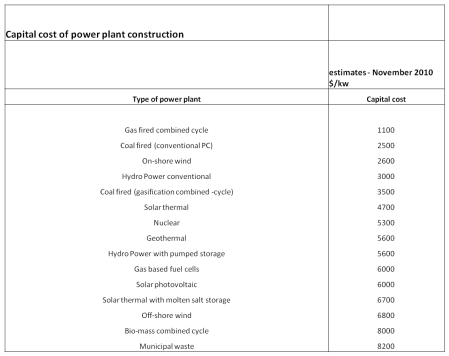
November 2010 Capital costs for power plants
Gas fired combined cycle plant use the least capital of all power generation plants. With shale gas set to become even cheaper than natural gas and with gas fired plants having capacity factors well above 90% compared to the 25% of wind power or the 30% of solar plants, it is a no-brainer to conclude that wherever shale gas is available it is going to be used for power generation.
Where it is not available coal fired plants and nuclear plants will continue to be used.
Intermittent renewable power plants are going to need subsidies for a long time to come to get anywhere near the cost of electricity from gas. At best they could be useful to augment production of electricity but being intermittent cannot really contribute to reliable capacity.
Tags:Electricity generation, Energy, Power plant capital costs, Shale gas
Posted in Energy, Engineering, Gas, Technology | 2 Comments »
May 6, 2011
Shale gas is abundant and now beginning to undercut the price of other sources of natural gas. It is already cheaper than LNG transported around the world which requires both terminals for liquefaction and receiving stations for evaporation. Gas-fired power plants are relatively cheap and quick to build. In simple-cycle operation gas turbine based power plant provide the economic method of choice for emergency power and peak power. In combined cycle operation they provide the highest efficiency of all types of fossil fired electricity generation (around 60%). The ratio of gas price to coal price determines whether this can be cheaper than coal fired power generation.

Shale gas is abundant: map via Wikipedia
Total oil, gas and coal resources in the Earth’s crust are estimated at more than 570,000 exajoules. The world will use about 450 exajoules (billion billion joules) of fossil fuel energy this year.
Exajoule
The exajoule (EJ) is equal to 1018 joules. The 2011 Tōhoku earthquake and tsunami in Japan had 1.41 EJ of energy according to its 9.0 on the Richter magnitude scale. Energy in the United States used per year is roughly 94 EJ.
Matt Ridley:
Quantity is not really the point; price is. Most fossil fuels are impossibly hard to extract at a reasonable price. More than half the reserves consist of methane clathrates hydrated gas found mostly on the seabed near the margins of the continents in vast quantities. Nobody knows how to turn them into fuel except at huge cost, although the Japanese are on the case. So the question is not whether we run out of fossil fuels but whether we run out of cheap fossil fuels.
With oil, the answer may be “yes”. A huge amount of oil is still untapped, but most of it is under deep water or in oil sands and is costly to extract. But with gas, the answer is “no”. Most free methane is found in impermeable rocks such as shale, not in permeable “traps” whence it is easiest to extract. Shale gas was thought to be as inaccessible as clathrates, and when it began to be exploited in the 1990s it looked as if it would still come in at the top of the price range. Now technological improvements have brought the price down so far that it undercuts conventional gas.
The “shale-gas shock” will have far-reaching consequences. It will make gas prices lower and less volatile relative to oil than ever before.
This will cause gas to take market share from coal, nuclear and renewables in electricity generation, and from oil in transport. London buses should follow Washington and Delhi in switching to gas both to save money and to produce less smog.
Shale gas is good news for America and China (which probably has even more of it than America), consumers (cheap fuel means higher standards of living) and farmers (fertiliser is made from gas). It is bad news for Russia and Iran (which hoped to corner the gas market in coming decades), for coal (until now the cheapest fuel for electricity) and for the nuclear and wind industries. The last two had expected to be rescued from dependence on subsidies by rising fossil fuel prices. They may now not be.
The losers are formidable enemies, so there is a movement, whose fans range from Gazprom to Greenpeace, to strangle the shale-gas industry at birth, by claiming that drilling for it contaminates water with carcinogenic and even radioactive chemicals. This turns out to be true only in the sense that coffee is carcinogenic, bananas radioactive and dihydrogen monoxide (water) a chemical.
The use of gas for power generation is perfectly sustainable into the foreseeable future. As the hysteria and alarmism around carbon dioxide causing global warming is debunked and begins to fade away the fashionable and unsustainable focus on bio-gas will also die away. The price of electricity production from gas will be the benchmark for judging whether wind and solar power make any sense. Without artificially imposed penalties on carbon or carbon taxes on fossil fuel, bio-gas can never be more than a marginal fuel of little significance. For bio-gas to have any significance catchment areas become so large that food production is adversely affected. The cost of production is relatively high. Without a carbon dioxide scare and the resulting subsidies, wind and solar power are still not able to compete against any form of fossil fuel power generation or hydro power or nuclear power.
But the success of technologies for the extraction of shale gas ensures availability of significant quantities for a long time to come. These quantities are so large that there is no “peak” in sight and all the alarmist “peak” gas scenarios are rendered meaningless.
Moving peaks: Peak gas will never come
Related: Europe told of potential shale gas bonanza
Tags:"Peak" gas, Electricity production, Energy, Shale gas
Posted in Energy, Engineering, Gas, Technology | 3 Comments »




 The k2p blog