Archive for the ‘History’ Category

Iceland revokes law allowing Basques to be killed on sight

May 2, 2015

In autumn 1615, Ari Magnússon, Sheriff of  Ögur, decided at a meeting in Súðavík  that it was free for Icelanders to kill Basque sailors. It resulted in a bloodbath and 32 Basques were killed. Now 400 years later, this provision is formally being revoked.

Basques can now visit Iceland freely without any fear of being lynched on the streets.

Islandsbloggen has the story:

It has been called Iceland’s only mass murder. But after 400 years Basques and Icelanders will now conclude a symbolic peace. At the same time, a small monument will be raised in Hólmavík to honor the memory of the 32 Basque sailors who were killed in autumn 1615 under the leadership of Ari Magnússon, Sheriff of Ögur. Relatives as well as the Minister of Culture Illugi Gunnarsson will attend the ceremony.

As whaling became increasingly important – both for oil and for meat –  Basque whalers journeyed far from home to chase their prey. Their travels took them, among other places, to Newfoundland on the east coast of Canada and to Svalbard.

In early 1600 Basque whalers found themselves  in Iceland and the Westfjords. However, it was not to become a long-standing tradition. In Autumn 1615, 86 whalers were ready to return home with huge catches loaded aboard three ships. But a sudden storm in Reykjarfjörður in Strandirregionen crushed all their boats. Three sailors died in the storm.

Using a smaller boat they rounded the Hornstrandir to search for ships that could sail home together with their catches. At Dynjandi in Jökulfjörður they stole a bigger boat and captured the former crew.

The news spread like wildfire in the region. Not so very long before, in 1579, pirates had attacked the farm at Rauðisandur in the West Fjords. The attack had led Judge Magnús Jónsson to require all adult Icelanders in the region to bear arms.

He was probably reminded of this fear of the earlier pirates when Ari Magnússon, Sheriff of Ögur, at a meeting in Súðavík decided that it was free to kill the Basque sailors. The Sheriff was in fact a relative of one of the earlier victims, Eggert Hannesson whose home had been looted.

The Basques had made camp at Sandeyri on Snæfjallaströnd. As they were busy with their catches Ari Magnússon went on the attack attack. In all 18 people were killed at Sandeyri and on the island Æðey. The other Basques were killed in Dýrafjörður where they had broken into the Danish trading house in Þingeyri.

In reality, it was a bloodbath. Fifty of the shipwrecked Basques managed to escape to Patreksfjörður. When spring’s first English ship arrived in the fjord, the Basques seized it – and never returned more to Iceland.

File:Painting of Ari Magnusson and his wife.jpg

District Commissioner Ari Magnusson of Ögur and his wife Kristín Guðbrandsdóttir


The memory of those Basques was commemorated at a ceremony in Hólmavík on April 22nd. A memorial stone with a plaque unveiled in honor of the victims is located outside the Witchcraft Museum. Relatives of both perpetrators and victims were at the ceremony. A ‘symbolic reconcillation’ was acted out by Xabier Irujo, descendant of one of the murdered Basque whale hunters, and Magnús Rafnsson, descendant of one of the murderers.

An account of the events is available here: Spánverjavígin – Slaying of the Spaniards

“For Allah” inscribed on a 9th century Viking ring

March 19, 2015

A new paper in Scanning reports on SEM studies of a 9th century Viking ring found in Birka. The contact between the Vikings and the Islamic world (mainly the Abbasid Caliphate) were rather more extensive than is generally admitted. It was not just the occasional tales of Arab historians (Ahmad Ibn Fadlan – “handsome but filthy Vikings”) but quite extensive trade links with traders from both communities often visiting the others. The ring is of high grade silver (94.5/5.5 Ag/Cu) and is inscribed with Arabic Kufic writing, here interpreted as reading “il-la-lah”, i.e. “For/to Allah”The “violet stone” is now found to be glass rather than an amethyst as was once thought. Glass from Egypt and Mesopotamia was prized in ancient Scandinavia as long as 3,500 years ago . The Vikings too prized glass and silver (rather than gold). However the inside of the ring is not much worn which suggests that the woman with whom the ring was buried (who wore Scandinavian dress and was presumably Swedish) had obtained it fairly new and not long before her death.

KTS Sebastian et al, Analysis and interpretation of a unique Arabic finger ring from the Viking Age town of Birka, Sweden, ScanningDOI: 10.1002/sca.21189

Birka viking ring (Statens historiska museum / Christer Åhlin)

Birka viking ring (Statens historiska museum / Christer Åhlin)


Abstract: In this work we used non-destructive SEM imaging and EDS analysis to characterize the material composition of an Arabic finger ring, which was found in a 9th c. woman’s grave at the Viking Age (A.D. 793–1066) trading center of Birka, Sweden. The ring is set with a violet stone inscribed with Arabic Kufic writing, here interpreted as reading “il-la-lah”, i.e. “For/to Allah”. The stone was previously thought to be an amethyst, but the current results show it to be coloured glass. The ring has been cast in a high-grade silver alloy (94.5/5.5 Ag/Cu) and retains the post-casting marks from the filing done to remove flash and mold lines. Thus, the ring has rarely been worn, and likely passed from the silversmith to the woman buried at Birka with few owners in between. The ring may therefore constitute material evidence for direct interactions between Viking Age Scandinavia and the Islamic world. Being the only ring with an Arabic inscription found at a Scandinavian archaeological site, it is a unique object among Swedish Viking Age material. The technical analysis presented here provides a better understanding of the properties and background of this intriguing piece of jewelry.

I have only just started reading Farhat Hussain’s 3 volume The Vikings and the Islamic World which looks at this little addressed area of Viking history across 2 centuries:

The substantive links between the Vikings and the Islamic world resulted in very insightful writings by a number of Muslim travellers, scholars and many others, of the Vikings and many aspects of the Viking Age ranging from physical descriptions of Vikings and their places of habitation in Scandinavia and elsewhere to Viking customs, commercial activity and much else as addressed in this work. Moreover this work provides a vast range of archaeological in addition to historical evidence of the vast links between the Vikings and the Islamic world – a relationship that served to contribute to the Viking Age and served to enrich the Islamic world and the many lands and peoples that were also a part of this unique story. Islamic artifacts unearthed in Iceland, Faeroe Islands, Ireland, Britain, Scandinavia, Russia and the Ukraine all feature in this rich study of the Vikings as masters in trade between the Islamic world and much of northern and western Europe in the 9th and 10th centuries in addition to serving as intermediaries in trade between Byzantium and the Islamic world. ….

Volume 2 provides substantive and rich insight into the significance of Viking links with the Islamic world for Scandinavia itself in a variety of areas from economy to textiles, glass, language and much else. This unique volume also deals with the influence of Islamic civilization upon other parts of northern Europe via the Vikings including Britain, Ireland, Iceland, Greenland and beyond. Indeed volume 2 makes clear that quite aside from the influence of Muslim Spain upon Europe the Vikings served as intermediaries of Islamic civilization via northern Europe. …..

Volume 3 addresses a rich array of subject and issues pertaining to Vikings links with the Islamic world including trade in various goods such as falcons, flow and decline of Muslim silver coins into Russia and Scandinavia and the impact of this decline upon the fortunes of Viking trade centres such as Birka in Sweden and Danish settlement in England, medicine, geography and much else.


The Anthropocene began 400,000 years ago when fire was “controlled”

March 13, 2015

A new paper tries to address when the “age of man” – the Anthropocene – bagan. The authors argue for 1610 when “an unusual drop in atmospheric carbon dioxide and the irreversible exchange of species between the New and Old Worlds” began.

I find this a rather arrogant Eurocentric fantasy which is less than convincing. Animal species – and humans – reached the Americas and Australia and Europe long before that.  The Norsemen took rats over to the Americas 500 years before that. Dog species from India crossed to Australia somehow 10,000 years ago. Darwin did not take wild-life to the Galapagos – they were already there. That the ancient civilizations of Egypt and China and the Mohenjo-Daro Valley were not part of the “Age of Man” seems to me to be just arrogance. That the Greeks or the Romans came before the “Age of Man” borders on stupidity. The Age of Man must begin when the dominance of the species Homo becomes established and sustainable.  While there is no other species which uses tools  as widely as Humans some other species do use tools. But there is no other species at all which can start a fire let alone control it.

Simon L. Lewis, Mark A. Maslin. Defining the Anthropocene. Nature, 2015; 519 (7542): 171 DOI: 10.1038/nature14258

Summary: Time is divided by geologists according to marked shifts in Earth’s state. Recent global environmental changes suggest that Earth may have entered a new human-dominated geological epoch, the Anthropocene. Here we review the historical genesis of the idea and assess anthropogenic signatures in the geological record against the formal requirements for the recognition of a new epoch. The evidence suggests that of the various proposed dates two do appear to conform to the criteria to mark the beginning of the Anthropocene: 1610 and 1964. The formal establishment of an Anthropocene Epoch would mark a fundamental change in the relationship between humans and the Earth system.

The advent and control of fire led – eventually but inevitably –  to the Stone Age transforming into the Bronze Age and the Iron Age. And in due course it has given the Machine Age, the Electrical Age, the Plastics Age and the current Semiconductors Age. All these “Ages” are surely part of the Anthropocene. There is a case to be made for the advent of stone tools defining Man but I think there is a much stronger case to be made for the advent and control of fire being what defines and distinguishes “Man” from all other animals.

Once fire was harnessed, the dominance of Homo Sapiens not just over other species but also over the environment became inevitable. Fire saw humans through the Ice Ages. The Stone Age plus fire gave the Bronze Age. The Bronze Age + fire led to the Iron Age. It was fire in its various avatars (hearths to ovens to smelters, or energy to steam to electricity) which helped transform one Age to the next.

The one single capability which initiated the divergence of humans from all other animals and which has resulted in the inevitable development and domination of modern humans is the control of fire. And that was around 400,000 years ago. The Age of Man began when Homo Erectus learned to produce fire at will and to contain fire in a hearth. I would even speculate that without fire Homo Erectus would not have survived to evolve into Homo Sapiens. Without fire Homo Sapiens would not have thrived through the ice ages or left the tropics to colonise more northern climes.

The Age of Man started long before 1610. Perhaps 1610 is a date of great significance – but that was not the start of the Age of Man. The Anthropocene started with fire 400,000 years ago.


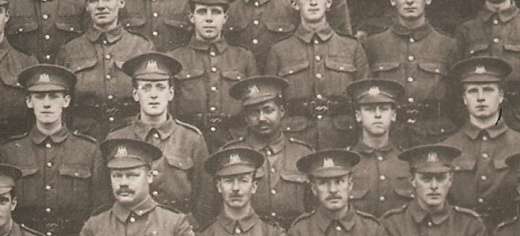
Pvt Jogendra Nath Sen (1887 – 1916) of the 15th West Yorkshire Regiment

March 7, 2015

A rather poignant story about Jogendra Nath Sen of Bengal and Leeds.

JN Sen by Caroline Jaine

JN Sen by Caroline Jaine

Born in Chandernagore in 1887, Jogendra Nath Sen left from Calcutta in 1910 and travelled to Leeds University to study electrical engineering (54 years before I also travelled from Calcutta to the UK though I was on my way to the Midlands and mechanical engineering). He graduated with a Bachelor of Science degree and took up employment with Leeds Corporation at their Electric Lighting Station when the First World War broke out. He was one of the first to volunteer when the 15th West Yorkshire Regiment (Leeds Pals) was formed a month later in September 1914 (service number 15/795). He served first in Egypt and then on the Western front. He was killed during heavy shelling in the trenches of Bus-les-Artois on the night of 22 May 1916 and is buried in the Sucrerie Military Cemetery at Colincamps.

In spite of his education, the colour bar of the time prevented his ever reaching any rank higher than Private. He was not permitted even to be a non-commissioned officer, and to be a regular officer was completely out of the question. Twenty five years later the situation was somewhat changed when my father enlisted for WW2.

15th (Service) Battalion (1st Leeds)
Formed in Leeds in September 1914 by the Lord Mayor and City.
June 1915 : came under orders of 93rd Brigade, 31st Division.
December 1915 : moved to Egypt. Went on to France in March 1916.
7 December 1917 : amalgamated with 17th Bn to form 15th/17th Bn.

Leeds University has published this account of their  former student:

The unlikeliest of Pals? An Indian soldier alone among Yorkshiremen

A shattered pair of spectacles in an Indian museum has helped shed light on the fascinating story of a lone non-white soldier among Yorkshire volunteers fighting on the Western Front.

Jogendra Sen, a highly-educated Bengali who completed an electrical engineering degree at the University of Leeds in 1913, was among the first to sign up to the 1st Leeds “Pals” Battalion when it was raised in September 1914.

He remained the only known non-white soldier to serve with the 15th West Yorkshire Regiment during the First World War. Despite his education, he was thwarted in his attempt to join up as an officer and unable to progress beyond the rank of private. 

Killed in action near the Somme in May 1916, aged 28, the bachelor is thought to have been the first Bengali to have died in the war. Private Sen’s name is on the University’s war memorial. 

His story caught the attention of Dr Santanu Das, Reader in English at King’s College London and an expert on India’s involvement in the First World War. On a visit in 2005 to Sen’s home town of Chandernagore – a former French colony – Dr Das came across Sen’s bloodstained glasses in a display case in the town’s museum, the Institut de Chandernagore.

He said: “I was absolutely stunned when I saw the pair of glasses. It’s one of the most poignant artefacts I’ve seen – a mute witness to the final moments of Sen’s life. It was astonishing that something so fragile has survived when almost everything else has perished.”

A contemporary photograph shows Private Sen relaxing with his fellow Pals – who knew him as Jon – wearing what is thought to be the same spectacles Dr Das found almost a century later. ……… 

……. Known as Jon to his fellow soldiers, he was among the first to sign up to the Leeds Pals shortly after the outbreak of war, while working as assistant engineer at Leeds Corporation Electric Lighting station.

A comrade, Arthur Dalby, told historian Laurie Milner in 1988: “We had a Hindu in our hut, called Jon Sen. He was the best educated man in the battalion and he spoke about seven languages but he was never allowed to be even a lance corporal because in those days they would never let a coloured fellow be over a white man, not in England, but he was the best educated.” 

The battalion had been formed in September 1914 by mayor Edward Brotherton. Some 20,000 people gathered to wave off the first recruits from Leeds on September 25. 

The title “Leeds Pals” is unofficial, but as it suggests, pals battalions were often made up of friends from the same street, school, factory, church or even university. Heavy losses inflicted on such battalions from towns and cities across the country were therefore felt even more keenly back home.

Private Sen ended up in Number 16 Platoon (D Company) of the 15th (Service) Battalion (1st Leeds) Prince of Wales’s Own (West Yorkshire Regiment) – often abbreviated to the 15th West Yorkshire Regiment or 1st Leeds Pals. ….

…. Sen’s personal effects were sent from York back to his brother in India in 1920. Along with a graduation picture, regimental cap badge, notebooks, snaps and a pocket knife was – somewhat tantalisingly – an undated photograph of a well-dressed young woman taken in a Scarborough portrait studio. It bears the inscription “Yours with love, Cis”. 

Nothing more was known about the mystery woman, who also gave the young soldier a book of quotes about the value of friendship inscribed: “With the very best of good wishes in this world + after, To Jogi, my dear brother, From his loving sister, Cis”.

But then researcher Ruth Allison was able to identify her as Mary Cicely Newton (nee Wicksteed), who may have met Sen through her connection with Mill Hill Chapel. Their relationship appears to have remained a platonic one. 

David Stowe also did much research on Jogendra Nath Sen and his account is here,

PTE. JOGENDRA SEN: A LEEDS PAL AND SON OF LEEDS

I first came across the name Jogendra Nath Sen in 2010 when researching the Leeds University Roll of Honour. More recently my attention was drawn to the work of Dr Santanu Das after he had lectured at a Legacies of War event at the University of Leeds.1 Dr Das is an expert on the Indian soldier and his work in that area is impressive. However, as I began to read his work on Jogendra Nath Sen I realized the archive in Chandernagore, where he had located several artefacts belonging to Sen, had caused confusion by mislabeling the collection and mixing Jogendra Nath Sen with his doctor brother who shared the same initials.2

This article seeks to not only correct that confusion, but also answer the question posed by Dr Das: ‘Now, was Dr Sen, a member of the elite Indian Medical Services, fighting as a British imperial subject, or as a Bengali (a member of the ‘non-martial’ race) or as a resident of Chandernagore, which was a French colony, or all three?’3Using both local and national sources it might be impressed that Jogendra Sen had settled into the local community and even joined a local battalion at the outbreak of war. It might be further impressed that Jogendra Sen was a volunteer who had made Leeds his home. ……… 

Nasty, heathen, Asian gerbils were responsible for European plagues

February 24, 2015

It was fleas on the giant gerbils of central Asia which were to blame. Wet springs followed by warm summers caused giant gerbil populations in the heathen wilds of central Asia to boom. The plague carrying fleas they were infested with also boomed. The fleas jumped – as fleas are wont to do – onto domestic animals and onto humans. These thoughtless Asians forced their trade onto hapless, innocent, Christian Europeans along the Silk Road and through European harbour ports. The fleas, which carried the plague bacteria, jumped again to European rats, found the living good and multiplied. This was back in the 1300s. And for 400 years it was waves of Asian gerbils and their fleas which preyed upon the hapless Europeans. The plague outbreaks in Europe came 15 years after the wet springs and warm summers in Asia. The poor innocent European rats were demonised quite wrongly. This we now know by studying tree rings.

It is, in fact, the Asians who must be blamed for gerbils and the plague and also for language, for agriculture and for religion.

Boris V Schmid et al, Climate-driven introduction of the Black Death and successive plague reintroductions into Europe, PNAS, doi: 10.1073/pnas.1412887112

AbstractThe Black Death, originating in Asia, arrived in the Mediterranean harbors of Europe in 1347 CE, via the land and sea trade routes of the ancient Silk Road system. This epidemic marked the start of the second plague pandemic, which lasted in Europe until the early 19th century. This pandemic is generally understood as the consequence of a singular introduction of Yersinia pestis, after which the disease established itself in European rodents over four centuries. To locate these putative plague reservoirs, we studied the climate fluctuations that preceded regional plague epidemics, based on a dataset of 7,711 georeferenced historical plague outbreaks and 15 annually resolved tree-ring records from Europe and Asia. We provide evidence for repeated climate-driven reintroductions of the bacterium into European harbors from reservoirs in Asia, with a delay of 15 ± 1 y. Our analysis finds no support for the existence of permanent plague reservoirs in medieval Europe.

The gerbil theory is not implausible but it smacks a bit of confirmation bias. The 15 year time lag is less than convincing. A gerbil lives for 3 to 4 years. A flea lives 30 – 90 days. Correlation is not causation. That European outbreaks of plague came 5 gerbil lifetimes later than the population boom in Asia, and about 60 flea generations later than the flea which first infested the sorry gerbil, is a little far-fetched.


If you want it to survive, print it out!

February 17, 2015

The Google VP Vint Cerf has been warning of the dangers of the loss of digital material as newer programs become unable to read older files and as digital material is corrupted.

Guardian:

Piles of digitised material – from blogs, tweets, pictures and videos, to official documents such as court rulings and emails – may be lost forever because the programs needed to view them will become defunct, Google’s vice-president has warned.

Humanity’s first steps into the digital world could be lost to future historians, Vint Cerf told the American Association for the Advancement of Science’s annual meeting in San Jose, California, warning that we faced a “forgotten generation, or even a forgotten century” through what he called “bit rot”, where old computer files become useless junk.

Cerf called for the development of “digital vellum” to preserve old software and hardware so that out-of-date files could be recovered no matter how old they are.

“When you think about the quantity of documentation from our daily lives that is captured in digital form, like our interactions by email, people’s tweets, and all of the world wide web, it’s clear that we stand to lose an awful lot of our history,” he said.

“We don’t want our digital lives to fade away. If we want to preserve them, we need to make sure that the digital objects we create today can still be rendered far into the future,” he added.

It’s my birthday today and it comes as a sobering thought as I look around my study, that the only things in here that are older than myself are around 20 books which were published and printed in the first half of the 20th century. There is not a single artefact that is older than me. There is one book here printed towards the end of the 19th century.

If you want any writings or images or presentations to have a chance of surviving 100 years, PRINT IT OUT. That may not be enough but it stands a better chance on paper than as a digital file. (I have a large granite rock – a 2m tall “obelisk” – in my garden and possibly the surest way to leave my mark would be to carve something into it. It will have to be symbols since the alphabet may be long forgotten in 10,000 years).

Mysterious 6,000 year old Neolithic tool

February 15, 2015

Photo: Trond Meling, Universitetet i Stavanger


It is wooden, about 6,000 years old and was found at a stone age settlement at Sømmevågen, near Stavanger Airport in Norway. It is about 20cm long.

The slit which looks to be about 10cm long and about 0.5cm wide suggests to me that its application was connected to the collection/gathering/ sorting and twisting of some kind of fibre material (early rope?). My guess is that this is an early “weaving” tool.

Wooden stone age tools are rare but not unknown. The remains of wooden paddles, handles for axes, lances and even front-weighted throwing spears have been found. Certainly the use of natural fibres to make string/rope would have been known by this time. To “weave” these into early versions of strip and cloth would have required some wooden tools.

Prey-predator relationships 30,000 years ago

November 26, 2014

New research at the paleolithic Předmostí I archaeological site near Brno in the Czech Republic provides a fascinating picture of the prey-predator relationships of that time.

Thirty thousand years ago, humans had domesticated dogs, they hunted mammoths, bison, musk ox and reindeer. They probably did not herd reindeer extensively in central Europe (but they did in the far north as the ice sheets retreated), but they may have occasionally followed reindeer herds. Mammoth meat clearly had a high value and was not fed to their dogs who – instead – had to make do with reindeer or musk ox meat – presumably controlled and provided by their human owners. But the dogs were probably an important participant in human hunts. Lions preyed primarily on musk oxen and reindeer but not on mammoth or much else. Other predators such as wolves, wolverines and bears ate mammoth (human leavings perhaps), rhinos, horse and bison. That lions and humans hunted musk oxen but not so much bison suggests that the musk ox was a little less aggressive (more stupid?) and easier to hunt than bison.

Simplified prey-predator relationships for prehistoric humans and large mammals in Předmostí I 30,000 years ago, deduced from stable isotopic data. Illustration: Hervé Bocherens with credits to: Wooly mammoth, wooly rhino, horse & cave lion: Mauricio Antón/DOI:10.1371/journal.pbio.0060099, Muskox: U.S. Fish and Wildlife Service; Reindeer: Alexandre Buisse; Wolf: Santiago Atienza; Wolverine: Matthias Kabel; Brown bear: Jean-Noël Lafargue; Dogs: Margo Peron; Bison: Michael Gäbler; Prehistoric man: Hervé Bocherens.

Simplified prey-predator relationships for prehistoric humans and large mammals in Předmostí I 30,000 years ago, deduced from stable isotopic data. Illustration: Hervé Bocherens with credits to: Wooly mammoth, wooly rhino, horse & cave lion: Mauricio Antón/DOI:10.1371/journal.pbio.0060099, Muskox: U.S. Fish and Wildlife Service; Reindeer: Alexandre Buisse; Wolf: Santiago Atienza; Wolverine: Matthias Kabel; Brown bear: Jean-Noël Lafargue; Dogs: Margo Peron; Bison: Michael Gäbler; Prehistoric man: Hervé Bocherens.


Anniversaries: Berlin Wall fall – 25 years, Kristallnacht -76 years

November 9, 2014

The fall of the Berlin Wall in 1989 was something I watched unfold, live, on TV 25 years ago. And it is surely something to be remembered and celebrated.

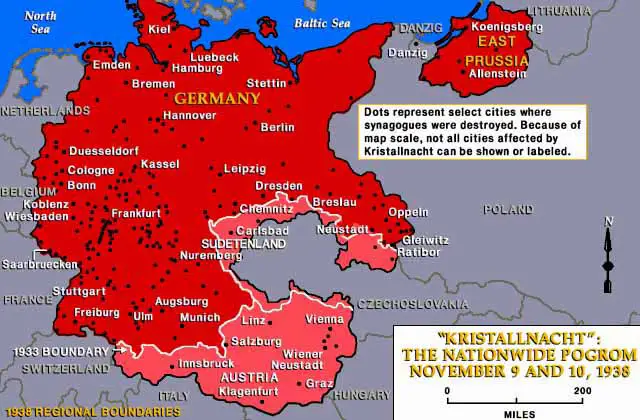
But tonight is also the 76th anniversary of Kristallnacht in 1938 when the Nazis went on their rampage against Jews throughout Germany and Austria and East Prussia. That needs no celebration but it does need to be remembered.

And without Kristallnacht there would have been no Cold War and no Berlin Wall.

Kristallnacht: Over 1,000 synagogues were burned (95 in Vienna alone) and over 7,000 Jewish businesses destroyed or damaged. Martin Gilbert writes that no event in the history of German Jews between 1933 and 1945 was so widely reported as it was happening, and the accounts from the foreign journalists working in Germany sent shock waves around the world. The Times wrote at the time: “No foreign propagandist bent upon blackening Germany before the world could outdo the tale of burnings and beatings, of blackguardly assaults on defenseless and innocent people, which disgraced that country yesterday.”

The pretext for the attacks was the assassination of the German diplomat Ernst vom Rath by Herschel Grynszpan, a German-born Polish Jew living in Paris. Kristallnacht was followed by additional economic and political persecution of Jews, and is viewed by historians as part of Nazi Germany’s broader racial policy, and the beginning of the Final Solution and The Holocaust.

The real Amazons keep their secrets

October 30, 2014
Sarmatian (Amazon) warriior woman (image from RealmsofGold)

Sarmatian (Amazon) warriior woman (image from RealmsofGold)

The stories of the mythical warrior women of central Asia are largely based on the writings of the Greeks and the stories date back to the 8th and the 7th centuries BCE (Homer’s Iliad). By the 5th century BCE, Herodotus refers to a group pf warrior women taken prisoner by the Greeks, who overwhelmed their captors on board ship and then intermingled with the Scythians to give rise to the Sauromatians (6th – 4th centuries BCE) and who in turn evolved to become the nomadic Sarmatians around the 4th century BCE. The Sarmatians  held sway for some 900 years until around 500 CE. If the myths of the Amazon women are based on reality then the reality must pre-date Homer. The original Amazons must then refer to the warrior-women among the ancestors of the Sauromatian peoples who roamed the steppes of southern Russia / central Asia. On horse-back presumably.

By the time of the Sauromatians and the succeeding Sarmatians, the warrior women traditions have also evolved.  There is archaeological evidence from the graves of martial, noble women who were interred together with their finery, their weapons and even their horses. Many graves previously just assumed to be those of male warriors have now been revealed by DNA testing to be of women warriors. More than 25% of such graves are now thought to be of women. Such a wide-spread culture must have originated long before.

Adrienne Mayor has a new book out The Amazons: Lives and Legends of Warrior Women Across the Ancient World which I have been reading over the last few days. It is a fascinating collection of the various myths surrounding the warrior women though it does not bring any light to bear on who they actually were beyond saying they were Scythians. But she does show that many of the myths are just myths and the reality was probably more mundane than the highly erotic, sensationalised version of the Greeks. In fact some of the Greek writings were clearly the tabloid press of their day. Her book is highly readable but it is a compendium of the writings about the Amazons rather than any new theory or hypothesis about their origins. She herself call it her “Encyclopaedia Amazonica”.

The steely women who cut off one breast to accommodate their archery needs was just fiction. There is no evidence that they were “man-eating” – in more ways than one – as the tabloids of the day were wont to narrate. The idea of man-hating, lesbian, hordes, armed to the teeth and rampaging and pillaging innocent heterosexual communities across the steppes made a good story then as it would today. Equally the vision of bands of warrior-virgins ensuring their own extinction was just pulp-fiction. The Persians like the Amazon were enemies who came from the East and many Persian characteristics were attributed to and embellished the Amazon myths. But in Greek – Amazon interactions, the warrior-woman is always conquered by a Greek hero figure!

But there is little doubt in my mind that around 3,000 years ago the Amazons existed.  They were a nomadic community across the steppes of central Asia where women were as likely to be warriors or rulers as men. The had a hierarchical structure but the hierarchy was not based on gender (probably). They were not a horde like the Mongols who came much later. But they were nomadic and they did not allow others to push them around as they rode across their territories. The women were clearly accomplished horse-women. Their economy was based on horses rather than cattle. They used hallucinogenic plant extracts and used tattoos (as marks of status or rank perhaps). They were probably the ancestors of the Sauromatians. They were also arguably the most gender-neutral culture ever to exist – and that includes the present day.

An excellent read.