Archive for the ‘History’ Category

Tony Blair is still trying to justify his Iraq idiocy

April 24, 2014

The Iraq war, where Tony Blair played poodle to George Bush, was prosecuted on a lie. They didn’t like Saddam Hussain and so they got rid of him. They sexed up their dossiers about Weapons of Mass Destruction. They sold the lie to the United Nations. They managed to establish the principle that any state may get involved in regime-change in any other state – whenever it has the desire and the might to do so. Their idiot-behaviour has led to the growth of subsequent terrorism and of large numbers of  radicalised, Muslim, idiot-youth.

The view history takes of Tony Blair will not be pretty. He will – I think – be seen as an opportunistic, money-grubbing, dishonest politician who took advantage of his former high position for obscene personal gain. The growth of radicalised Muslim youth in Europe with their juvenile antics in search of jihad are a direct consequence of the Iraq War and the War on Terror. But Tony Blair is getting worried about his legacy and his place in history and he is at it again. He would like the world to believe that radical Islam – which he helped to create – must be confronted in a new Crusade.

Tony Blair’s speech seeking to rally global support for a confrontation with Islamic extremism generated a storm of reaction, most of it negative and much of it focusing on the messenger rather than the message.

The director of the Council for Arab-British Understanding, Chris Doyle, said the former prime minister had been right to underline the importance of the subject in his Bloomberg speech but was sharply critical of the way he went about tackling it.

Doyle said: “Blair is largely right to highlight the issue. Islamic extremism is not on the wane. It is flourishing in many areas of the world. Nobody should be complacent. “It is his solutions that are very problematic – particularly the idea that people in the Middle East have to choose between dictatorship and Islamic extremism, and in criticising the Muslim Brotherhood he has endorsed the military leadership in Egypt. But the choice the people of the region need is not between dictatorship and extremism but between those systems and pluralist democratic rule. In fact, dictatorships have often been a significant cause of frustration and anger, and a driving force behind the rise of al-Qaida.”

…….  The Palestinian editor of the Rai al-Youm news website, Abdel Bari Atwan, said: “Blair is implying that extremist Islam is a danger for the whole world. But the target is the Muslim Brotherhood. He is a very good friend of Mr Sisi in Egypt and he does a lot of consultancy work in the region so it’s not surprising that he’s speaking out. He had spent years as peace envoy but what kind of peace has he achieved? We have to differentiate between radical Islam and moderate Islam. If you criminalise Islamists like the Muslim Brotherhood then you are pushing them into extremism.”

Much of the commentary focused on Blair’s own credibility on the subject as much as the subject itself, particularly his role in leading Britain into the war in Iraq alongside the former US president George W Bush.

Doyle said: “Before 2003, there wasn’t an issue of al-Qaida in Iraq. There is now. Intervention is highly risky and almost always leads to situations where extremists flourish. They profit from instability, civil war and the inability of states to manage their territories.”

A columnist for the Saudi-owned al-Hayat daily, Jihad al-Khazen, said: “Blair and George W Bush are as responsible for radical Islam as any of its leaders. The war in Iraq caused the death of almost a million Muslims. It gave a reason for every radical in the Middle East to go to war against the west. “I don’t think Blair will absolve himself of responsibility by making this speech. He talks about how the Middle East matters but he says nothing about Israel’s continuing occupation. He is definitely not the right person to be lecturing on this subject – or to be a peace envoy. That’s an oxymoron.”

….. Meanwhile, a columnist on the Israeli newspaper Haaretz, Anshel Pfeffer, tweeted:

“The fascinating thing about Blair’s speech today is that it could have been a Netanyahu speech, word-for-word, they share the same outlook.”

Blair continues to be one of the most successful recruiters for radical Islam.

Perhaps at the root of all of this is the suspicion that those who will welcome Blair’s speech most will be the radical Islamists right across the region and beyond. One aim of the 9/11 attacks was to incite a vigorous military response that that could be represented as a war not just against radical Islamists but against Islam itself. A “clash of civilisations” may be too strong a phrase for Blair’s speech but a clash of beliefs is not too strong a term to use, to which an Islamist response might well be – “bring it on”.

The War on Terror is a crusade gone wrong. Certainly radical Islam is barbaric and uncivilised. But being barbaric and uncivilised against radical Islam, as Blair is and would like others to be, only legitimises and perpetuates the barbarism. Iraq has been followed by Afghanistan, by Libya, by Egypt and now by the fiasco in Syria. Much blood has been shed but all these irresponsible adventures have been spectacular failures in the War on Terror. Abu Ghraib and unmanned drones and State Terrorism and collateral damage have only legitimised the use of terror as a tactic of war. Boko Haram have learned the lesson.

Perhaps Tony Blair needs to be compared with Bernard, Abbot of Clairvaux and his role in the disastrous Second Crusade of 1145:

…. the Second Crusade, launched in 1145, is generally regarded as a disaster for the Christian West. Even those who took part in the Crusade saw it as a failure. According to William of Tyre:   Thus a company of kings and princes such as we have not read of through all the ages had gathered and, for our sins, had been forced to return, covered with shame and disgrace, with their mission unfulfilled…. henceforth those who undertook the pilgrimages were fewer and less fervent. 

…. Brundage claims that the failure of the Crusade to achieve any victories whatever in the east emboldened Muslim military leaders, destroyed the myth of western prowess in arms, and was to be responsible, at least in part, for causing the Muslim states of the east to draw closer together, to unite for further attacks upon the Latin states. He says that the end of the Second Crusade saw the Muslims preparing to unite, for the first time, against the Latin intruders in their midst, while the Latins, for their part, were divided sharply against one another.

Bernard was the Pope’s poodle as Blair was Bush’s.

One of Bernard’s most influential acts, for better or worse, was his preaching of the Second Crusade. The First Crusade had given the Christian forces control of a few areas in Palestine, including the city of Edessa. When Moslem forces captured Edessa (37:08 N 38:46 E, now called Urfa and located in eastern Turkey) in 1144, King Louis VII of France (not to be confused with St. Louis IX, also a Crusader, but more than a century later) was eager to launch a crusade to retake Edessa and prevent a Moslem recapture of Jerusalem (31:47 N 35:13 E). He asked Bernard for help, and Bernard refused. He then asked the Pope to order Bernard to preach a Crusade. The pope gave the order, and Bernard preached, with spectacular results. Whole villages were emptied of able-bodied males as Bernard preached and his listeners vowed on the spot to head for Palestine and defend the Sacred Shrines with their lives.

…. As for the Crusade, things went wrong from the start. The various rulers leading the movement were distrustful of one another and not disposed to work together. Of the soldiers who set out (contemporary estimates vary from 100,000 to 1,500,000), most died of disease and starvation before reaching their goal, and most of the remainder were killed or captured soon after their arrival. The impact on Bernard was devastating, and so was the impact on Europe.

 I don’t much care for Tony Blair.

Camel stories in the Old Testament were made up and long after the purported events

February 4, 2014

I suppose there are some who still believe that the stories of the Old Testament are not just fables and are an historical account.  As fables they are almost as well known as the stories of the brother’s Grimm or Hans Christian Anderson. But they are not at all a bad bunch of stories – though I always thought that a father offering up his son as a sacrifice was a sign of an evil man and not of any kind of faith to be admired. And even as a child I felt that neither the cowardly Abraham nor his tyrannical God came out of that story very well. And the grown-up son (Isaac) who allowed himself to be bound up to satisfy a demented father only comes out as an idiot.

In any event I cannot remember that I ever thought the stories were factual accounts or were anything other than fiction (which itself makes me wonder at what age we come to separate fact from fiction). To “prove” that fiction about the long dead past is not factual is, of course, trying to prove a negative. Researchers have now shown that at the purported time of the Age of the Patriarchs (supposedly 2000 – 1500 BCE), camels did not exist in the purported habitat of the purported Patriarchs (Abraham, Joseph and Jacob). I find it interesting that camels  were actually moved up from Arabia to the Levant apparently to help with a change of copper mining technology. But it is of little relevance to proving or disproving the fictions embodied in the fables of the Old Testament.

Finding Israel’s First Camels

Camels are mentioned as pack animals in the biblical stories of Abraham, Joseph, and Jacob. But archaeologists have shown that camels were not domesticated in the Land of Israel until centuries after the Age of the Patriarchs (2000-1500 BCE). In addition to challenging the Bible’s historicity, this anachronism is direct proof that the text was compiled well after the events it describes.

Now Dr. Erez Ben-Yosef and Dr. Lidar Sapir-Hen of Tel Aviv University‘sDepartment of Archaeology and Near Eastern Cultures have used radiocarbon dating to pinpoint the moment when domesticated camels arrived in the southern Levant, pushing the estimate from the 12th to the 9th century BCE.  …. 

Archaeologists have established that camels were probably domesticated in the Arabian Peninsula for use as pack animals sometime towards the end of the 2nd millennium BCE. In the southern Levant, where Israel is located, the oldest known domesticated camel bones are from the Aravah Valley, which runs along the Israeli-Jordanian border from the Dead Sea to the Red Sea and was an ancient center of copper production. At a 2009 dig, Dr. Ben-Yosef dated an Aravah Valley copper smelting camp where the domesticated camel bones were found to the 11th to 9th century BCE. In 2013, he led another dig in the area.

To determine exactly when domesticated camels appeared in the southern Levant, Dr. Sapir-Hen and Dr. Ben-Yosef used radiocarbon dating and other techniques to analyze the findings of these digs as well as several others done in the valley. In all the digs, they found that camel bones were unearthed almost exclusively in archaeological layers dating from the last third of the 10th century BCE or later — centuries after the patriarchs lived and decades after the Kingdom of David, according to the Bible. The few camel bones found in earlier archaeological layers probably belonged to wild camels, which archaeologists think were in the southern Levant from the Neolithic period or even earlier. Notably, all the sites active in the 9th century in the Arava Valley had camel bones, but none of the sites that were active earlier contained them.

The appearance of domesticated camels in the Aravah Valley appears to coincide with dramatic changes in the local copper mining operation. Many of the mines and smelting sites were shut down; those that remained active began using more centralized labor and sophisticated technology, according to the archaeological evidence. The researchers say the ancient Egyptians may have imposed these changes — and brought in domesticated camels — after conquering the area in a military campaign mentioned in both biblical and Egyptian sources.

……. The arrival of domesticated camels promoted trade between Israel and exotic locations unreachable before, according to the researchers; the camels can travel over much longer distances than the donkeys and mules that preceded them. By the seventh century BCE, trade routes like the Incense Road stretched all the way from Africa through Israel to India. Camels opened Israel up to the world beyond the vast deserts, researchers say, profoundly altering its economic and social history.

Rosling’s health, wealth and statistics

January 31, 2014

Hans Rosling’s tour de force: 200 countries, 200 years, 4 minutes.

This is not new and I think I first saw it about 3 years ago.

But it is worth looking at not just for the content but also for the power of the presentation.

Just a reminder that the world is feeding more people than ever before, we are living longer than ever before, and things are not as black as some alarmists would have us think. And by 2100 total population will be declining.

The glass is more than half-full.

A much longer (20 minutes) presentation is also well worth watching.

Carthaginians were a nasty lot – probably

January 23, 2014

The Carthaginian Empire supposedly came into being with the Phoenician Queen Elissa (better known as Dido) sometime around 813 BCE. It reached its zenith around 500 years later  and by 264 BC controlled the Western Mediterranean.

Carthage in 264 BC (Ancient Encyclopedia)

Carthage in 264 BC (Ancient Encyclopedia)

But they made the mistake of expanding into Sicily and this was the start of their conflict with Rome:

Ancient Encyclopedia:

The Carthaginian trading ships sailed daily to ports all around the Mediterranean Sea while their navy, supreme in the region, kept them safe and, also, opened new territories for trade and resources through conquest.

It was this expansion which first brought Carthage into conflict with Rome. When Rome was weaker than Carthage, she posed no threat. The Carthaginian navy had long been able to enforce the treaty which kept Rome from trading in the western Mediterranean. When Carthage took Sicily, however, Rome responded. Though they had no navy and knew nothing of fighting on the sea, Rome built 330 ships which they equipped with clever ramps and gangways (the corvus) which could be lowered onto an enemy ship and secured; thus turning a sea battle into a land battle. The First Punic War (264-241 BCE) had begun. After an initial struggle with military tactics, Rome won a series of victories and finally defeated Carthage in 241 BCE. Carthage was forced to cede Sicily to Rome and pay a heavy war indemnity.

The Carthaginian Empire effectively came to an end when they lost the third Punic War against Rome

A Roman embassy to Carthage made demands to the senate which included the stipulation that Carthage be dismantled and then re-built further inland. The Carthaginians, understandably, refused to do so and the Third Punic War (149-146 BCE) began. The Roman general Scipio Aemilianus besieged Carthage for three years until it fell. 

It is not surprising that most Roman and Greek writings are quite disparaging about Carthage and the customs of the Carthaginians. It is from these accounts by the victors that we learn that the vile Carthaginians were a very nasty lot who indulged in child sacrifice. Many have put this down as black propaganda and a biased view. But apparently this is still a hot topic among archaeologists with the same bones leading to diametrically opposite conclusions.

(more…)

Human evolution as a braided stream rather than a branching tree

January 4, 2014
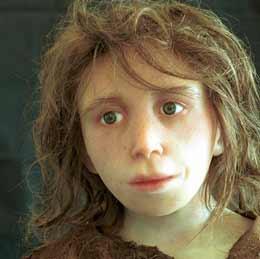
An interspecies love child? from Nature (Christoph P.E. Zollikofer)

An interspecies love child? from Nature (Christoph P.E. Zollikofer)

The genetic history of modern humans is creating a vast jigsaw puzzle. Genetic evidence is mounting that most people today carry some Neanderthal genes, that some carry what have been labelled “Denisovan” genes, that Denosivans and Neanderthals not only had a common ancestor but that there also was admixture between some Denisovans and some Neanderthals and that there was at least one other as yet unnamed archaic honim which interbred with the Denisovans. It now becomes clear that viewing all these various archaic humans as different species could be wrong. They could all well be the same species.

Chris Finlayson reviews the  paleoanthropology advances during 2013:

The conclusion of the Dmanisi study was that the variation in skull shape and morphology observed in this small sample, derived from a single population of Homo erectus, matched the entire variation observed among African fossils ascribed to three species – H. erectus, H. habilis and H. rudolfensis.

The five highly variable Dmanisi fossils belonged to a single population of H. erectus, so how could we argue any longer that similar variation among spatially and temporally widely distributed fossils in Africa reflected differences between species? They all had to be the same species. 

I have been advocating that the morphological differences observed within fossils typically ascribed to Homo sapiens (the so-called modern humans) and the Neanderthals fall within the variation observable in a single species.

It was not surprising to find that Neanderthals and modern humans interbred, a clear expectation of the biological species concept. …. If the fossils of 1.8 or so million years ago and those of the more recent Neanderthal-modern human era were all part of a single, morphologically diverse, species with a wide geographical range, what is there to suggest that it would have been any different in the intervening periods?

Probably not so different if we take the latest finds from the Altai Mountains in Siberia into account. Denisova Cave has produced yet another surprise, revealing that, not only was there gene flow between Neanderthals, Denisovans and modern humans, but that a fourth player was also involved in the gene-exchange game.

The identity of the fourth player remains unknown but it was an ancient lineage that had been separate for probably over a million years. H. erectus seems a likely candidate. Whatever the name we choose to give this mystery lineage, what these results show is that gene flow was possible not just among contemporaries but also between ancient and more modern lineages.

Just to show how little we really know of the human story, another genetic surprise has confounded palaeoanthropologists. Scientists succeeded in extracting the most ancient mitochondrial DNA so far, from the Sima de los Huesos site in Atapuerca, Spain.

The morphology of these well-known Middle Pleistocene (approximately 400,000 years old) fossils have long been thought to represent a lineage leading to the Neanderthals.

When the results came in they were actually closer to the 40,000 year-old Denisovans from Siberia. We can speculate on the result but others have offered enough alternatives for me to not to have to add to them. The conclusion that I derive takes me back to Dmanisi: We have built a picture of our evolution based on the morphology of fossils and it was wrong.

Some time ago we replaced a linear view of our evolution by one represented by a branching tree. It is now time to replace it with that of an interwoven plexus of genetic lineages that branch out and fuse once again with the passage of time

A braided stream rather than the branches of a tree is the better analogy where  – as John Hawkes describes it:

The “braided stream” analogy captures different information about human origins than the usual branching tree. The branches of a tree do not reconnect with each other above the point where they initially separate. A tree will never admit to exchanging sap between its branches, and there are no little xylem hyphae between branches to carry sap anyway. Our evolution was truly a network in which multiple populations existed and contributed to our process of adaptation.

But the braided stream is not quite satisfactory for the picture that is emerging:

promiscuity in the pleistocene

John Hawkes again:

I admit that the braided stream is not a perfect analogy. Diverging rivulets within a valley almost always come together again, forming a complicated network as they form sandbars and islets. None of them flow into a cul-de-sac. Some human populations of the past did become extinct, they did not inexorably flow back into the mainstream of our evolutionary history. Some of them may have flowed back into the mainstream only through very small channels of genetic exchange. When we go far enough back, some populations really did branch off into their own direction. It’s just not clear yet which populations those were. Maybe an evolutionary swamp would be a better analogy, full of algae-covered bayous.

I like the braided stream, and it’s clear that its time has come. Ancient DNA has begun to show the process of genetic exchange was not a minor player in our evolution. All human populations today evidence some mixture of ancient populations that existed well before the “origin of modern humans”. Genetic exchanges between different populations were dominant in the formation of some human adaptations. Some ancient populations can be understood only as the mixed descendants of other, yet more ancient ones. It’s mixing all the way back.

braided-stream-leone

A braided river from http://cloudman23.wordpress.com/ Image – Yann Arthus-Bertrand

The story will most likely become much more complex – as further pieces of the jigsaw are revealed – before the whole picture can be seen But it is already becoming apparent that the origin of modern humans includes genetic exchange with many “species” supposed to have predated AMH and this exchange was not insignificant.

Perhaps the concept of “Anatomically Modern Humans” has to be expanded and pushed back in time. Rather than an origin some 200,000 years ago the start of “modern humans” could need to be pushed back to about 500,000 years ago and has to somehow bring Neanderthals and Denisovans (and some others) back into the fold.

And maybe our ancestors of 20,000 generations ago were just as shocked at a Denisovan-Neanderthal marriage as some in India are today at an “inter-caste” marriage!

Giraffe and flamingo on the menu at Pompeii

January 3, 2014

The Romans were not averse to dining on the meat of exotic animals – when they could get hold of them. Mackinnon (2006) Supplying Exotic Animals for the Roman Amphitheatre Games, suggests that the exotic animals imported and killed in the Roman games were distributed for consumption.

From Mackinnon 2006

From Mackinnon 2006

Now evidence is emerging from Pompeii where it seems leg of giraffe could have been on the menu. Past Horizons has the story:

University of Cincinnati archaeologists are making discoveries in Pompeii that are changing traditional perceptions of how the inhabitants dined; the rich enjoying delicacies such as flamingos and the poor scrounging for soup or gruel.

UC teams of archaeologists have spent more than a decade at two city blocks within a non-elite district in the Roman city of Pompeii, which was buried under a volcano in 79 AD. The excavations are uncovering the earlier use of buildings that would have dated back to the 6th century BC. ….

… The area covers 10 separate building plots and a total of 20 shop fronts, most of which served food and drink. The waste that was examined included collections from drains as well as 10 latrines and cesspits, which yielded mineralized and charred food waste coming from kitchens and excrement. Ellis says among the discoveries in the drains was an abundance of the remains of fully-processed foods, especially grains.

The material from the drains revealed a range and quantity of materials to suggest a rather clear socio-economic distinction between the activities and consumption habits of each property, which were otherwise indistinguishable hospitality businesses,” says Ellis. Findings revealed foods that would have been inexpensive and widely available, such as grains, fruits, nuts, olives, lentils, local fish and chicken eggs, as well as minimal cuts of more expensive meat and salted fish from Spain. Waste from nearby drains would also turn up less of a variety of foods, revealing a socio-economic distinction between neighbours. …..

….. A drain from a central property revealed a richer variety of foods as well as imports from outside Italy, such as shellfish, sea urchin and even delicacies including the butchered leg joint of a giraffe. “That the bone represents the height of exotic food is underscored by the fact that this is thought to be the only giraffe bone ever recorded from an archaeological excavation in Roman Italy,” says Ellis. “How part of the animal, butchered, came to be a kitchen scrap in a seemingly standard Pompeian restaurant not only speaks to long-distance trade in exotic and wild animals, but also something of the richness, variety and range of a non-elite diet.”

Deposits also included exotic and imported spices, some from as far away as Indonesia.

Ellis adds that one of the deposits dates as far back as the 4th century BC which he says is a particularly valuable discovery, since few other ritual deposits survived from that early stage in the development of Pompeii. …… 

Steven Ellis will present these discoveries on Jan. 4, at the joint annual meeting of the Archaeological Institute of America (AIA) and American Philological Association (APA) in Chicago.

DNA sequenced from a 400,000 year old hominin from Spain

December 4, 2013

After developing techniques for extracting and analysing DNA from ancient (c. 40,000 years ago) Neanderthal and Denisovan specimens the Max Planck team have now taken a giant leap backwards in time in extracting and analysing an almost complete mitochondrial genome sequence of a 400,000-year-hominin. The specimen is from  Sima de los Huesos, a unique cave site in Northern Spain. The results show that it is related to the mitochondrial genome of Denisovans, extinct relatives of Neandertals in Asia. DNA this old has until recently been retrieved only from the permafrost.

standard

The Sima de los Huesos hominins lived approximately 400,000 years ago during the Middle Pleistocene. © Kennis & Kennis, Madrid Scientific Films

The result itself is of great interest but it is the development of the techniques for extracting and analysing – without any contamination – and with sufficient confidence, the entire MtDNA sequence in such old specimens that is quite revolutionary. Archaeological evidence – and particularly of of such age – is subject to a great deal of subjective interpretation. But dating techniques and now DNA extraction techniques are removing much of this subjectivity and they are now providing the anchor points around which the evolutionary narrative must be built. And this narrative is now of a much more complex story of hominin expansions and admixture than has generally been thought. Ancient and presumed extinct hominin species are now showing themselves within us.

“Our results show that we can now study DNA from human ancestors that are hundreds of thousands of years old. This opens prospects to study the genes of the ancestors of Neandertals and Denisovans. It is tremendously exciting” says Svante Pääbo, director at the Max Planck Institute for Evolutionary Anthropology.

Matthias Meyer, Qiaomei Fu, Ayinuer Aximu-Petri, Isabelle Glocke, Birgit Nickel, Juan-Luis Arsuaga, Ignacio Martínez, Ana Gracia, José María Bermúdez de Castro, Eudald Carbonell, Svante PääboA mitochondrial genome sequence of a hominin from Sima de los HuesosNature, 2013; DOI: 10.1038/nature12788

Read the whole post in 6,000 Generations


The first string? Man-made, twisted, fibre, cords at least 90,000 years ago

November 22, 2013

The man in question may well have been Neanderthal. Fibre artefacts rot easily and the oldest remains found of a man-made, twisted, fibre “cord” or “string” dates from only about 30,000 years ago. A new paper describes perforations in upto 90,000 year old, stone and tooth artefacts as well as shells from Abri du Maras and other Neanderthal sites in France, indicating they had once been threaded on “strings” and worn as pendants.

This post has beeen shifted to 6,000 Generations

New Denisovan genome indicates inter-breeding with another, unknown, archaic human

November 19, 2013

The period some 30,000 – 50,000 years ago is getting positively crowded with different branches of humans. The direct ancestors of modern humans lived and interbred not only with Neanderthals and Denisovans but also apparently with still another, as yet unknown, branch of humans.

NatureNew genome sequences from two extinct human relatives suggest that these ‘archaic’ groups bred with humans and with each other more extensively than was previously known.

The ancient genomes, one from a Neanderthal and one from a different archaic human group, the Denisovans, were presented on 18 November at a meeting at the Royal Society in London. They suggest that interbreeding went on between the members of several ancient human-like groups living in Europe and Asia more than 30,000 years ago, including an as-yet unknown human ancestor from Asia. ..

… All humans whose ancestry originates outside of Africa owe about 2% of their genome to Neanderthals; and certain populations living in Oceania, such as Papua New Guineans and Australian Aboriginals, got about 4% of their DNA from interbreeding between their ancestors and Denisovans, who are named after the cave in Siberia’s Altai Mountains where they were discovered. The cave contains remains deposited there between 30,000 and 50,000 years ago. 

Those conclusions however were based on low-quality genome sequences, riddled with errors and full of gaps, David Reich, an evolutionary geneticist at Harvard Medical School in Boston, Massachusetts said at the meeting. His team, in collaboration with Svante Pääbo at the Max Planck Institute for Evolutionary Anthropology in Leipzig, Germany, have now produced much more complete versions of the Denisovan and Neanderthal genomes — matching the quality of contemporary human genomes. The high-quality Denisovan genome data and new Neanderthal genome both come from bones recovered from Denisova Cave.

The new Denisovan genome indicates that this enigmatic population got around: Reich said at the meeting that they interbred with Neanderthals and with the ancestors of human populations that now live in China and other parts of East Asia, in addition to Oceanic populations, as his team previously reported. Most surprisingly, Reich said, the new genomes indicate that Denisovans interbred with another extinct population of archaic humans that lived in Asia more than 30,000 years ago, which is neither human nor Neanderthal.

It would seem that when the world was still in the grip of an ice age 30,000 – 50,000 years ago, the reality of human history was not so far away from Tolkien’s Middle Earth.  Ancient history but it was only 1,500 – 2,500 generations ago. Middle Earth was where men could breed with elves and hobbits were an off-shoot of men. The Druedain were also off-shoots of men and some – if not all – orcs were deliberately bred from elves while all trolls and dragons were artificially bred.

From the J.R.R. Tolkien Encyclopedia: Scholarship and Critical Assessment

from The biology of Middle eart - Tolkien Encyclopedia

from The biology of Middle Earth – JRR Tolkien Encyclopedia

Another Sunday, another week — but why?

November 3, 2013

The seven-day week must go down as being one of the most “unnatural” yet persistent creations of man. It is very practical of course, but why do we have it?

There are no discernible periodicities that we have been able to find outside ourselves which take 7 days. There are no periodicities within ourselves either that are 7 days or multiples of 7 days.  There are no celestial or astronomical cycles in tune with 7 days. There are no movements of the sun or the moon or the stars that give rise to a 7-day period. There are no weather or climate phenomena that repeat with a 7-day period. There are no human behavioural patterns that dance to a 7-day tune. There are no living things that have a 7-day life cycle. (There is a branch of pseudoscience which claims that living cells may be associated with a weekly or a half-weekly cycle – a circaseptan or a circasemiseptan rythm – but this is still in the realms of fantasy).

It would seem logical that our ancestors must have first noted the daily cycle long before they were even recognisable as human.  As humans they probably then noted the lunar cycle of about 29 days and the yearly cycle of about 365 days. Our distant ancestors would also have noted that the period of the yearly cycle was a little more than 12 lunar cycles. By about 35,000 years ago we have evidence that the lunar cycle was known and was being tracked. This evidence is in the form of a tally stick with 29 marks – the Lebombo bone.

The development of beliefs in gods of light and separate gods of darkness is not so difficult to understand. The gods of winds and fires and mountains and rivers are equally understandable. The fact that the lunar cycle was rather badly synchronised with the annual solar cycle could well have led to the concept of sun-gods and moon-goddesses, each with their own areas of influence.  (In fact, considering the imperfection of the design of the universe which is manifested in the lack of synchronisation between the various celestial cycles, it is difficult to understand how a concept of a single all-powerful creator ever arose. Why would such a poor design be the product of an all-powerful creator? Surely he could have managed the simple 3-body problem to synchronise the various rotations of the earth, the moon and the Sun?)

The invention of the seven-day week can best be dated to be at least 5,000 years ago to the time of the Babylonians. It was certainly long before the Old Testament came to be written to fit with the 7-day week which had already been invented and established. The story goes that

the seven-day week was actually invented by the Assyrians, or by Sargon I (King of Akkad at around 2350 B.C.), passed on to the Babylonians, who then passed it on to the Jews during their captivity in Babylon around 600 B.C.  The ancient Romans used the eight-day week, but after the adoption of the Julian calendar in the time of Agustus, the seven-day week came into use in the Roman world. For a while, both the seven and eight day weeks coexisted in the Roman world, but by the time Constantine decided to Christianize the Roman world (around A.D. 321) the eight-day weekly cycle had fallen out of use in favor of the more popular seven-day week.

The idea that the 7-days originates from a division of the lunar cycle into 4 seems improbable. The lunar cycle (synodic period) is 29.5305882 days long. Three weeks of 10 days each or five 6 day weeks would fit better. That the annual cycle of 365.2425 days comes to dominate is not so surprising. Our calendar months are now attuned to the annual cycle and have no direct connection to the lunar cycle. But it is our 7 – day weeks which remain fixed. We adjust the length of our months and have exactly 365 days for each of our  normal years. We then add an extra day every 4 years  but omit 3 such extra days in every 400 years to cover the error. We make our adjustments by adding a day to the month of February for the identified leap years but we do not mess with the 7 days of the week.

It is far more likely that the 7 days comes from the seven celestial objects visible to the naked eye from earth and probably known to man some 5,000 to 10,000 years ago. They were familiar with the Sun, the Moon, Mars, Mercury, Jupiter, Venus, and Saturn by then. Naturally each was a god in his own heaven and had to have a day dedicated just to him/her/it. The same 7 celestial objects are used for the days of the week not only in the Greek/Roman Western tradition, but also in Indian astrology. The Chinese /East Asian tradition uses the Sun, Moon, Fire, Water, Wood, Gold and Earth to name the seven days of the week. But this must have come after the 7 day week had already been established elsewhere. (For example, to name up to 10 days they could just have chosen to add days named for the Air, Beasts, Birds ….). Some languages use a numbering system and some use a mixture of all of the above. Rationalists and philosophers and dreamers have tried to shift to 5 and 6, and 8 and 10 day weeks but none of these efforts has managed to challenge the practicality or to dislodge the dominance of the seven-day week.

And now the whole world lives and marches – socially, culturally, politically – to the inexorable beat of the 7-day week.

Just because some long-forgotten astrologer/astronomer decided that he would dedicate each day to one of his seven known celestial gods (and he only had seven)! Even if he (unlikely to have been a “she”) worshipped an Earth-goddess, she must have been considered inferior to the celestial gods. Otherwise we would have had an 8-day week! 

An alien race could be excused for concluding that humans must have evolved from once having seven fingers on each limb. Or that we once had seven limbs and have lost 3. Or that humans have an innate circaseptan rythm requiring extra rest and sleep every 7 days. Or that humans have a physiological need to go binge drinking on the sixth day and need the seventh day to recover!

But if the 7-day week is a Divine creation then the aliens will also have a 7-day week and will not be in the least surprised.

The number seven does have a few special properties:

Not forgetting the Seven Wonders of the Ancient World. But they only came after the seven day week had been invented and introduced.