Archive for the ‘India’ Category

100 days to Mars for ISRO’s Mangalyaan

June 16, 2014

Four days ago

  • The second Trajectory Correction Manoeuvre (TCM-2) of India’s Mars Orbiter Spacecraft was successfully performed on June 11, 2014 at 1630 hrs IST. TCM-2 was performed by firing the spacecraft’s 22 Newton thrusters for a duration of 16 seconds.
  • At present, the radio distance between the Spacecraft and the Earth is 102 million km. A radio signal from the Earth to the Spacecraft now takes about 340 seconds. The spacecraft so far has traveled a distance of 466 million km as part of its total Journey of 680 million km.
  • ISRO is continuously monitoring Mars Orbiter Spacecraft using Indian Deep Space Network (IDSN). The spacecraft and its five scientific instruments are in good health.

And 100 days from today on 24th September, ISRO’s frugally engineered  Mars Orbiter Mission (called Mangalyaan meaning Mars craft) should be inserted into Mars orbit. The highly over-rated movie “Gravity” had a larger budget at $100 million than ISRO’s $75 million for its Mars mission.

Toilets before temples – lack of toilets stunts growth in India

June 15, 2014

I tend to take anything coming out of the UN with a very healthy dose of salt. As long as it is separated from policy, not all information from the UN is worthless. Such as this report from UNICEF India from November 2013. Lack of sanitation exemplified by the lack of toilets and open defecation is strongly correlated with stunted growth of children. If Narendra Modi can make good his promise of “toilets before temples”, he will have done very well indeed. To get past the innate conservatism of rural India and get toilets to take a higher priority than the mushrooming (pun intended) shrines and temples is easier said than done.

Of the 1.1 billion people globally who defecate in the open, nearly 60 percent live in India, which means they make up more than half of the population of India. Around 55% of all households in India have no access to a toilet or even a latrine. (But 63% of all households have telephones.) Children in India are shorter, on average, than children in Africa who are poorer, on average and this paradox is called “the Asian enigma”.

UNICEF Report: Madhya Pradesh is also home to some of the most undernourished children in India with 58 per cent of under three’s suffering from malnutrition (compared with 45 per cent nationally). 50 per cent of children under-five also suffer from stunting, an indicator of long-term persistent malnutrition, associated with a child’s low height relative to its age. Stunting is also associated with an under-developed brain and low IQ.

The effects of stunting are said to result in a 10 per cent decrease in future income over the lifetime of stunted adults – with tragic implications for child survival, growth and development, seriously impeding India’s development. The implications for stunted mothers giving birth to stunted children are very real. 

Economists have long debated the ‘Asian Enigma’ of why Indians are more stunted – shorter in height – compared to relatively poorer children in Sub Saharan Africa for example. Now, new research has shown a correlation between long-term under-nutrition with its resultant stunted children in India, and the lack of access to toilets and hygiene. Provide children with the right nutrition at the right time, and ensure an environment free of excreta, and there will be no Asian Enigma.

“The height of Indians is not simply about genetics or down to poverty – there is a strong correlation to the poor sanitation environment many live in. India’s lack of sanitation with its high population density, stunts its children through both the loss of food, and the reduced absorption of nutrients,” says Dean Spears, of the Delhi School for Economics.

Dean Spears, How much international variation in child height can sanitation explain ?, World Bank Policy Research working paper ; no. WPS 6351, May 2013.

PDF (55 pages)

Summary: Physical height is an important economic variable reflecting health and human capital. Puzzlingly, however, differences in average height across developing countries are not well explained by differences in wealth. In particular, children in India are shorter, on average, than children in Africa who are poorer, on average, a paradox called “the Asian enigma” which has received much attention from economists. This paper provides the first documentation of a quantitatively important gradient between child height and sanitation that can statistically explain a large fraction of international height differences. This association between sanitation and human capital is robustly stable, even after accounting for other heterogeneity, such as in GDP. The author applies three complementary empirical strategies to identify the association between sanitation and child height: country-level regressions across 140 country-years in 65 developing countries; within-country analysis of differences over time within Indian districts; and econometric decomposition of the India-Africa height differences in child-level data. Open defecation, which is exceptionally widespread in India, can account for much or all of the excess stunting in India.

Can Modi break down the Indian millstone of caste and clan?

June 12, 2014

If Narendra Modi manages to break – or even to weaken – the debilitating stranglehold that caste and clan have on Indian life, he stands some chance of releasing the huge potential that is still buried deep in the country. Paradoxically, his brand (now mellowing) of Hindu nationalism may allow him the freedom not only to challenge the shackles of caste and clan but also to keep in check the extravagant expectations engendered by the pampering of minority groups (which was unavoidable with a coalition government).

The caste system in India probably represents the oldest surviving form of institutionalised racism in the world. It predates Hinduism and probably started first by classifying specialists by the virtue of their professions. That was possibly 5,000 years or 250 generations ago. But with sons following fathers in their professions heredity entered into the social classification. In due course – the caste system was probably hijacked by Hinduism and then evolved into a genetic classification defining social status and even “permissible” professions for each caste.

The caste system is so prevalent and so insidious that it can even survive religious conversions. I know of some Christian families – who converted to Christianity some 200 years (10 generations) ago – but where the pre-conversion caste still survives and comes into play when arranging a marriage.

Whatever and whenever the origin, the caste system is still so ingrained that the vast majority of Hindu marriages still conform to caste rules. In many parts of rural India, close to 50% of marriages may be consanguineous (first cousins) but this drops to less than 30% in urban areas. In many communities the level of inbreeding is reaching worrying levels. Development and improvement of living standards has given a slow reduction in these numbers. But very often the castes and clans are perpetuated by the very “affirmative actions” that were supposed to eliminate them. The advantages and privileges afforded by many of these programmes has led to whole communities fighting to retain their caste differentiation. They are committed to protecting – genetically – the purity of their “low caste” to retain the privileged status they enjoy within “affirmative action” programmes for education and employment.. The caste system still dominates political life in many areas and can lead to local and state governments often being dominated by a particular caste or clan. And when one particular caste or clan is in power they regress to a medieval feudalism and see the territory they govern as their fiefdom.

Modi made all the right noises when he addressed Parliament for the first time as Prime Minister and acknowledged that casteism and regional differences had damaged India. But the difficulties he will face in trying to root out the racism inherent in the caste system cannot be underestimated. An entire political party may be dominated by a particular caste or clan. The recent barbarism in central India is a case in point. Currently Uttar Pradesh has a government – it seems  – “of the Yadvas, by the Yadavs for the Yadavs”!!

FirstPost: The rape and murder of two girls in Badaun seems to have triggered a shake-up in the Uttar Pradesh government machinery which even the near-decimation of the party in the recent Lok Sabha election could not do. Not only has Chief Minister Akhilesh Yadav transferred hundreds of officers, suspended more than half a dozen, withdrawn security or armed guards from dozens of individuals and dismissed dozens of nominated officials, but the Samajwadi Party president Mulayam Singh Yadav has disbanded party units at various levels.

But what the SP leadership has been unable to shake off is the popular perception that all the moves are more political in nature rather than an honest effort to actually change the way the state is being governed.  …….. the feeling has grown that the establishment is trying to protect the alleged culprits in the Badaun case despite the international outrage at the rape and murder of two cousins aged 15 and 14, whose bodies were found hanging from a mango tree in a village in Badaun district on 27 May. Preliminary post-mortem investigation had revealed that both had been gangraped and then hanged from a tree, and that the cause of death was hanging.

….. Mulayam’s nephew Dharmendra Yadav is the MP from Badaun and most of the police stations in the district – as well in the state – have Yadavs on the force. This phenomenon is typical of the Samajwadi Party’s reign in Uttar Pradesh and had been seen during the 2004-2007 SP regime also. “The ruling family in the SP has always been protective and supportive of the Yadavs, regardless of the criticism it attracts. The police recruitment in 2004 also reflected this. The perception among the Yadav community is very strong that the ruling family would go to any extent to protect their clansmen,” says a non-Yadav SP sympathizer. “In the Lok Sabha election the party lost all seats contested by non-family members, and it is now critical for it to consolidate whatever Yadav support it has in the community in view of the coming by-elections in the state, including Mainpuri which is close to Badaun.”

Ericsson’s headcount in India now exceeds that at HQ in Sweden

June 11, 2014

Ultimately, adding value as close to the customer as possible is not only inevitable but it is also going to be the critical criterion which determines which companies will survive.

Ericsson the Swedish manufacturer of telecommunications equipment has just passed a kind of milestone when its headcount in India has now exceeded the headcount at its headquarters in Sweden. This will be seen negatively in Sweden especially by the unions, but it is this readiness and ability to get close to the market which actually gives me confidence that they are on the right track. Ericsson, I think, have played this balancing act of changing roles at headquarters while growing close to the market rather well. (Which is why I have Ericsson in my portfolio).

Mobiletor: Ericsson which prides itself as a growing provider of communications technology and services, now has more employees in India than it does in its home country of Sweden, according to the company’s Facts & Figures web page. The headcount is 17,991 staff in India and 17,545 employees in Sweden, with about 80 percent of its workforce being male. In total, Ericsson has 111,383 employees from across the world working for it and has its headquarters in Stockholm, Sweden. …..

India is the fastest growing smartphone market on the globe and 4G LTE is still at its nascent stage, with few operators still appearing to be in the mood for testing the waters before diving right in. Going by an Ericsson report, the country’s mobile broadband users will grow in number to touch four times the present figures by the year 2020. This is directly tied to the 80 percent of consumers who still haven’t adopted smartphones and are yet to experience the mobileweb.

Ericsson have a fairly upbeat view of the mobile market in the latest Ericsson Mobility Report and their own prospects:

The number of mobile subscriptions worldwide grew approximately 7 percent year-on-year during Q1 2014. The number of mobile broadband subscriptions grew even faster over this period – at a rate of 35 percent year-on-year, reaching 2.3 billion. The amount of data usage per subscription also continued to grow steadily. Around 65 percent of all mobile phones sold in Q1 2014 were smartphones. Together, these factors have contributed to a 65 percent growth in mobile/cellular data traffic between Q1 2013 and Q1 2014.

By 2019, global mobile broadband subscriptions will exceed the world population.

Total mobile subscriptions are expected to grow from 6.8 billion in Q1 2014 to 9.2 billion by the end of 2019. Global mobile broadband subscriptions are predicted to reach 7.6 billion by 2019 and will gain an increasing share of the total mobile subscriptions over time.

Mobile broadband users in India will grow in numbers to reach four times the present figures by 2020. In 2013, people accessing data on their mobile devices reached 90 million. The smartphone penetration of 10% or 90 million devices will grow to 45% or 520 million mobile gadgets by 2020. The mobile subscriber base is expected to increase from 795 million last year to 1145 million by 2020.

Indian Monsoon arrives – as forecast but 5 days later than average

June 6, 2014

The long range monsoon forecast predicted that total rainfall would be at around 95% of the long term average and would arrive on 5th June at the coast of Kerala. For a normal monsoon landfall in Kerala is on the 1st of June. One fear was – and still is – that if an El Niño develops this year, then a further shortfall of rain in the 4 months of the monsoon season might occur.

It is still not clear if an El Niño will develop. But the monsoon which was stationary south of Sri Lanka a few days ago has developed rapidly in the last 24 hours and the northern limit has advanced well into southern India. The eastern  end of the northern limit is still relatively static compared to the western end, but is expected to develop in the next 2 or 3 days.

IMD: 

  1. Southwest monsoon has set in over Kerala today, i.e. 6th June 2014. The southwest monsoon has further advanced into most parts of south Arabian sea and Kerala, remaining parts of Maldives-Comorin areas, some parts of Tamilnadu, most parts of southwest Bay of Bengal and some parts of westcentral Bay of Bengal. 
  2. The northern limit of monsoon passes through 12.0°N/60.0°E, 12.0°N/70.0°E, 12.0°N/74.0°E, Kozhikode, Coimbatore, Cuddalore, 13.0°N/83.0°E, 16.0°N/87.0°E, 18.0°N/90.0°E and 21.0°N/92.0°E. 
  3. Conditions are becoming favourable for further advance of Southwest Monsoon into remaining parts of south Arabian sea, some parts of central Arabian sea, remaining parts of Kerala, some parts of south Karnataka, some more parts of Tamilnadu and Bay of Bengal during next 2-3 days. Conditions continue to remain favourable for further advance of Southwest monsoon into some parts of northeastern state during next 48 hours.
Monsoon advance  2014 June 6th - source IMD

Monsoon advance 2014 June 6th – source IMD

Indian Election: All over? Runaway victory for Modi as B/C ratio soars to over 4.6

May 16, 2014

It is definitely all over now. Narendra Modi will be the next Prime Minister and he will not have to depend on any allies for his majority. Even the Shiv Sena will be superfluous. Mamata in W Bengal and Jayalalitha in Tamil Nadu have had landslide wins but Modi will not need to be beholden to them. For the first time in 30 years a coalition will not be necessary. The Aam Admi party made a poor showing, reinforcing the view that they make a lot of noise but are scared of governing. Congress may get less than 50 seats (!!) and be reduced to little more than a rump.

1045: It is less than 3 hours since counting began and it is looking like a runaway victory for Modi and a melt-down for Congress. The B/C ratio is reaching stratospheric heights at 4.6 (318/69).

1030: B/C ratio soars to 4.05 (304/75). An absolute and a very comfortable majority for Narendra Modi is emerging. Post election haggling and sops to regional fanatics may not be needed. Varun Gandhi has won in Sultanpur. Rahul Gandhi is behind in Amethi. 

1015: B/C ratio now at 3.58 (301/ 84). Comfortable majority in sight for BJP. Profit taking apparent as Sensex comes off its euphoric highs. 

0945: B/C at 3.45 (287/83) while Sensex climbs 1400 points (5+%) today

0930: B/C ratio soars to 3.63. Leads Total: 436, BJP+ 243; Congress+ 67, Others 128. BSE Sensex up about 1000 points (4%)

0915: Leads: Total: 318, BJP+ 174; Congress+ 64, Others 80. B/ C = 2.72

0900 IST: Leads — Total: 296, BJP+ 165; Congress+ 61, Others +70. B/C = 2.7

The B/C ratio has been running at 2.5 – 2.7 through the first hour.

If the first hour of vote counting is representative of what is to come BJP will end up with around 2.5 – 2.7 times as many seats as Congress. So if Congress could end up with around 90 – 100 seats then BJP will get around 240 – 260. 

0800: Counting has begun. About 8,000 candidates, 1.8 million voting machines and about 550 million votes to be counted.

The Descent of Air India

May 14, 2014

I have just acquired the ebook “The Descent of Air India” by Jitender Bhargava and which was first published by Bloomsbury Publishing in October 2013. However Praful Patel the former Civil Aviation Minister sued the publishers for defaming him and applied pressure to prevent the distribution of the book. The publisher – without consulting the author – withdrew the book and apologised to Praful Patel.

So much for the courage of publishers.

DNA: Publishing giant Bloomsbury in a decision, unprecedented for its abject surrender, has withdrawn former AI top honcho Jitender Bhargava’s book The Descent of Air India, agreed to destroy copies of the book left in its stocks and tendered an apology to former civil aviation minister Praful Patel, who has been pilloried in the book as the man who caused the downfall of the airline.

I shall review the book in a few days when I have read it through.

Bhargava wrote on his Facebook page:

After the book, ‘The Descent of Air India’ was formally released on October 11, 2013 in Delhi, attempts were made by Praful Patel to obstruct its distribution. Besides ensuring that the books were not sold at airport book stores (he still appears to wield clout with airport operators); had TV channels to drop scheduled programmes relating to the book – in the case of one news channel even after the interview had been recorded; he served a legal notice, alleging that the book contents were defamatory.
He filed a case in the court of the metropolitan magistrate, Mumbai. While I told the judge on January 6, 2014, that everything stated in the book about Praful Patel is true, backed by documented evidence and will be duly justified and contested in the honourable court, the publishers, Bloomsbury, on whom also the notice was served, decided on not pursuing it, and instead agreeing to offer an apology to Praful Patel.
This decision of Bloomsbury was unilateral, and without discussing with me, as an author. Their stand thus naturally came to me as a surprise. And it may surprise you too when you see the apology of Bloomsbury published in the newspapers.
As everything stated in the book is true, based on documents, I will have the book, ‘The Descent of Air India’ reprinted either on my own or through a new publisher. Simultaneous action is being initiated to bring out ‘ The Descent of Air India’, as an ebook. I am told this can take up to four-five weeks.
Please bear the absence of the book from the book stores for a few weeks. I will be back soon because neither can I be bulldozed into submission nor can facts be allowed to be suppressed. In today’s environment, corrupt practices of all people, howsoever powerful, must be exposed.
I look forward to your understanding of the situation and support.

Through the 1970’s and 1980’s Air India was one of my preferred airlines. But since the early 1990’s it has been – for me – an airline to avoid.


Markets surge as Indian exit polls are awaited after close of polls today

May 12, 2014

UPDATE!

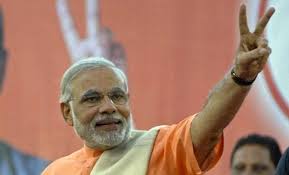
Narendra Modi - The next Indian Prime Minister (photo Forbes)

Narendra Modi – The next Indian Prime Minister (photo Forbes)

The real results have to wait till Friday but early exit poll results suggest that

  • the BJP led alliance (NDA) will get over 280 seats in the Lok Sabha (272 needed for majority) while the Congress led alliance (UPA) will get less than 120 seats. 
  • BJP will be the largest single party
  • the AAP may get 5 seats
  • Narendra Modi will be the next Prime Minister

The markets rose over 3% today.

Turnout was a record at just over 66% (of an electorate of over 800 million voters).

========================================

The Indian markets are reacting to rumours and “inside information” as to what the exit polls will reveal when they are published later today. The Election Commission has confirmed that the results of exit polls – which have been carried out over the last 6 weeks of polling and are prepared and waiting to be released – can be released after the polls close at 1830 local time (1500 CET) on the last day of the last phase of voting today.

Exit polls don’t have a very good record in predicting the result of Indian elections – especially when they are extrapolated. But we have the peculiar situation of markets being driven by the expectations of what the exit polls will say and where the actual results will not be known till Friday. Capital inflow from overseas has been particularly high and there is a feeling that this cannot be just on the advice of local investors without any special knowledge. There is a suggestion – not at all implausible – that some large investors and their overseas partners may well have carried out their own, private, exit polls. And, the story goes, these show that Narendra Modi and the BJP will get close to an absolute majority.

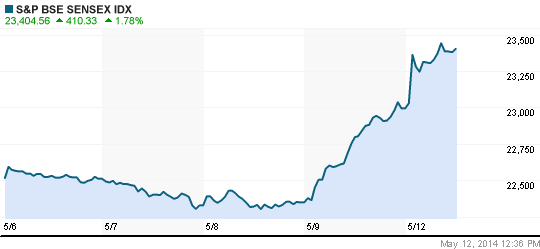
On Friday the BSE Sensex rose over 3% and so far today has risen another 2+%  – over 1000 points in a day and a half of trading.

BSE Sensex 12th May noon

BSE Sensex 12th May noon (Reuters)

NDTV

It seems that investors are betting that the BJP-led NDA will emerge victorious on May 16, when results are announced, analysts say.

“There is a lot of political hope that has got baked in valuations. Markets are factoring numbers close to 230-240 seats for the BJP alone, and if that is the case, the NDA will get a majority on its own. That will lead to pro-growth, right of central, stable formation, which is enthusing for the investors,” said Manishi Raychaudhri, strategist and head of research at BNP Paribas Securities.

Polls have consistently shown the BJP and its prime ministerial candidate Narendra Modi ahead, raising expectations that the opposition party, which is seen by markets as being more investor- and business-friendly, will either win or come close to an outright majority. The surprising part, however, is markets seem to be factoring in the best possible scenario (stable government led by Mr Modi) even before exit poll results, due later in the day. 

 One possibility why markets have not waited for exit poll results might have to do with speculation that big investors have already got a whiff of what results would be. In fact, overseas investors bought shares worth Rs. 1,268.78 crore in the cash market on Friday, their biggest purchase since March 28. Friday’s gains came at a time when markets had shed 2 per cent after hitting a record high of April 25. Clearly, smart money had some information. 

Deven Choksey, managing director of brokerage KR Choksey told NDTV that somewhere from the media, numbers suggesting that the BJP will get 260-270 seats, came out. It was in circulation on social media and markets took advantage of that, he said.


Indian business hoping for/predicting a Modi/BJP landslide

May 10, 2014

The Great Indian Election Tamasha comes to an end on Monday and the results will be announced by the Election Commission on Friday, May 16th.

The Indian Stock Exchange (BSE Sensex) is riding very high. On Friday the index reached record levels and rose almost 3%. Business is looking for a stable and effective government. The last term of the Congress led government was one of the most ineffective terms of any government. Not least due to the coalition government which was virtually paralysed in the arms of its many and varied partners. Each of the regional coalition partners were more interested in cashing-in (politically and economically) than in governing or governance. The BJP in opposition was a party of disruption and their objective was to ensure and show that the government was ineffective. Parliament was more often disrupted than in session.

Insofar as the Stock Exchange reflects the hopes and predictions of the business community, a Narendra Modi / BJP government is certain. Two years ago I would have thought this was not possible but by December 2012, I became convinced that Narendra Modi would be the next Prime Minister.  As the election has progressed and the Modi wave has been sustained, the stock exchange has moved inexorably upwards. The new kids on the block – the Aam Admi Party – had threatened to be a spoiler for Modi (and it could still happen) but they are increasingly looking lost. Their leader’s resignation as Chief Minister of Delhi has only strengthened the view that the party lacks substance. They can make a noise and oppose anybody and anything, but they are scared of – and incapable of – governing.

Back in February this year it became clear that the election would be held at the end of the government’s mandate in April. The actual dates were announced by the Election Commission on March 7th. The optimism in the markets has grown steadily.

Sensex after election announcement 2014 (chart from Bloomberg)

Sensex after election announcement 2014 (chart from Bloomberg)

Indian business, in my experience, is more concerned about the stability and rationality and continuity of government rather than the manifestos of the various parties. They dislike subsidy policies introduced just to woo voters – but are expert at milking subsidies when available. They prefer the slightly more free-market approach of the BJP and are suspicious of ideological socialism and protectionism. But they have had no difficulty with working with Congress led governments as well. What they just don’t want is another government which cannot overcome the internal strains of a coalition and cannot govern. Uncertainty is the prime enemy.

So if the stock exchange is a predictor of the election result then we can expect that Narendra Modi and his BJP will not only win but may even come close to an outright majority. If that happens we can expect a sharp index spike on Monday 19th May – perhaps +4-5%. But if there is no overall majority for Narendra Modi, then we could see the markets fall also very sharply. The Sensex reached 23,000 last Friday. By next Friday it could have crept upto about 24,000. Then depending upon Modi’s majority it could spike to over 25,000. But if Modi has no clear majority and another wishy-washy government is in prospect, it could drop to around 22,000 (-10%).

India has 13 of the world’s 20 most polluted cities with New Delhi as the worst

May 9, 2014

The WHO has released the 2014 update of its Ambient Air Pollution database.

The database contains results of ambient (outdoor) air pollution monitoring from almost 1600 cities in 91 countries. Air quality is represented by annual mean concentration of fine particulate matter (PM10 and PM2.5, i.e. particles smaller than 10 or 2.5 microns).

The database covers the period from 2008 to 2013, with the majority of values for the years 2011 and 2012. The primary sources of data include publicly available national/subnational reports and web sites, regional networks such as the Asian Clean Air Initiative and the European Airbase, and selected publications. The database aims to be representative for human exposure, and therefore primarily captures measurements from monitoring stations located in urban background, residential, commercial and mixed areas.

The world’s average PM10 levels by region range from 26 to 208 ug/m3, with a world’s average of 71 ug/m3.

India has the dubious distinction of having 6 of the ten worst polluted, 13 of the 20 worst polluted cities and 20 of the 50 most polluted. Needless to say New Delhi is the worst. Delhi, Patna, Gwalior and Raipur are the 4 worst polluted cities in the world. 

50 most polluted cities WHO 2014 (pdf)

Delhi’s preeminent position in the pollution stakes was also reported by the Yale 2014 Environmental Performance Index which I posted about in February. I wrote then:

Whether Delhi is worse or better than Beijing is irrelevant. The point is that Delhi is as bad as it is.

I visit Delhi 5 or 6 times every year and it has the worst air quality that I experience. It is dust particles in the main – and a lot of that is from the ubiquitous building rubble and  building materials lying in piles (some small and some large) all over the city. The diesel engine particulates have – I think – reduced after the introduction of Compressed Natural Gas (CNG) for taxis and autos but they build up every night when the long-distance trucks roll through the city (they are banned during the day).

But Delhi is essentially a huge building site. In new building projects (many for domestic dwellings), building materials (bricks, sand, cement, tiles, sewer pipes….) are all brought and dumped in open piles on the street long before any building actually commences. Even completed building projects leave behind their piles of sand and bricks and rubble on the street which are never cleaned up. If a road is dug up for any reason the remaining mud and rubble is never actually cleared up . it is usually just pushed to one side. The last mile syndrome applies and nothing ever gets finally or properly finished.

But the real issue is one of attitude and behaviour. .. 

Delhi’s atmosphere is what it is because the citizens of Delhi do not give any value to it being any better.

I travel to Delhi 5 or 6 times a year and can vouch for the muck and grime both in the air and on the ground. The problem is not one of money or of technology but of attitudes. The population of Delhi – on average – just does not give much value to the quality of the environment they live in. The politicians are followers rather than leaders and none have the courage to follow a vision of what Delhi could be like

The Indian General Election results are due out in a week.

Toilets before temples may win the day.