Archive for the ‘India’ Category

Heigh-ho, ISRO, it’s off to Mars we go

November 30, 2013

UPDATE!!

Trans-Mars injection has been completed successfully.

  • Trans Mars Injection (TMI) operations completed successfully. The liquid engine burn time was 1328.89 sec and the imparted incremental velocity was 647.96 m/sec.
  • Trans Mars Injection (TMI) operation began at 00:49 hrs (IST) on Sunday Dec 01, 2013.
  • Forward rotation of spacecraft, to put it into the right orientation to perform Trans Mars Injection (TMI) operation has been completed successfully at 00:30 hrs IST on Dec 1, 2013

=================

A big night for ISRO and congratulations are due! And not least for ISRO’s coverage of the event – almost live – on their Facebook page. (I have not been too enamoured of the ISRO website but somebody did a great job on the live updates).

The Indian Mars Orbiter (Mangalyaansuccessfully completed its final burn in earth orbit and has been inserted into a Trans Mars Trajectory (to be confirmed). It may just be one small step in Man’s exploration of space but it is a giant leap for ISRO. After spending a month in 6-ever increasing orbits around Earth the craft now has a 300 day journey to get to Mars with the possibility of 3 mid-course corrections before the liquid engine has to be fired up again to enter into orbit around Mars.

So far, so good!

A number of “firsts” for the Indian Space Research Organisation (ISRO) and, no matter what may now happen, a great many accomplishments already in the bag. The lack of a sufficiently powerful rocket necessitated that the craft first enter earth orbit and then the month-long, laborious compared to NASA, procedures where the space craft engine had to be used  to first to increase the earth orbits and then – tonight – be fired for an extended time (23 minutes) to be inserted into a heliocentric Trans Mars Trajectory.

Mission Operations Complex ISTRAC  Bangalore.

Mission Operations Complex ISTRAC Bangalore.

Photo

One hour before the final engine firing the craft was put under the control of its on-board computer which was to carry out the final burn. Forward rotation of the spacecraft to put it into the right orientation for the burn was carried out and completed about 20 minutes before firing. Engine firing started on schedule just before the craft reached perigee. The actual burn of the 440 N Liquid Engine lasted its planned 23 minute long firing entirely under local on-board computer control. The objective was to impart an incremental velocity of 648 m/s and the indications are that that was achieved. The engine firing manoeuver seems to have gone exactly to plan. The orbit determination team have now to confirm now confirmed the trajectory actually achieved.

The new heliocentric orbit is yet to be confirmed. confirmed

The ISRO chorus (with apologies to Walt Disney)

Heigh-ho, ISRO

It’s off to Mars we go

We keep on working all day long

Heigh-ho, ISRO 

Photo: Liquid Engine propels MOM into Mars Transfer Trajectory and India into interplanetary space !Trans-Mars injection has been completed successfully.

Liquid Engine propels MOM into Mars Transfer Trajectory and India into interplanetary space !Trans-Mars injection has been completed successfully. ISRO


Will buying “likes” on Facebook and Twitter translate into votes?

November 29, 2013

Perception can be reality. And fake “likes” are being used to generate fake perceptions of popularity and goodness. Whether humans are dumb enough to be taken in by fake perceptions and whether perceptions can be converted into real voters and customers remains to be seen.

The assumption within the public relations and advertising industry is that  buying “likes” on social media actually leads to some advantage for the person/thing/company being liked. Clearly some companies perceive “likes” as being an effective – if unproven -advertising form. There seems to be no shortage of people offering ways of buying and boosting “likes”. Offers are readily available to arrange “2000 Facebook likes for only $17, or 5000 for $35 or 100,000 for $500”. Carlo De Micheli and Andrea Stroppa have been looking at Twitter and the underground market

De Micheli and Stroppa

De Micheli and Stroppa


We estimated fake accounts make up for 4% of Twitter’s user base

Does this make sense?

  • Facebook makes it harder to create fake accounts yet openly declares: “As of June 30, 2012, we estimate user-misclassified accounts may have represented approximately 2.4% of our worldwide MAUs and undesirable accounts may have represented approximately 1.5% of our worldwide MAUs. 
  • Every account can follow up to 2000 people. 
  • By statistically excluding overlapping fake accounts, just on the 12 main marketplaces (Fiverr, SeoClerks, InterTwitter, FanMeNow, LikedSocial, SocialPresence, SocializeUk,  ViralMediaBoost), it turns out there are around 20M fake followers on sale right now. 
  • Followers are sold at an average price of $18/1000 followers (barracudalabs). 
  • Sellers can make between $2 and $36 per fake account 
  • Multiplying it out definitely shows a multi-million-dollar market

Apart from entertainment figures wanting to boost their apparent popularity, the buying of “likes” has now become a routine matter for politicians facing elections. They are relying on the herd mentality to lead  to an increase of votes in their favour. The risk they take is that humans – when acting as a mob or a herd – don’t like acknowledging or being accused of acting like dumb animals. But the risk of this backlash is being taken as being small. Politicians in India are now all rushing to buy “likes” – as just another legitimate advertising ploy. They have been paying for favourable articles about themselves and negative articles about their opponents in the print media for many years. But even the most socially illiterate politicians – who wouldn’t know a tweet from a twit – are spending a great deal of money to be able to show huge numbers of “likes”!

What part fake likes and dislikes are going to have in the Delhi elections next week and the national elections next year, remains to be seen. It could be quite effective in a city like Delhi where the penetration of social media among the new urban population is high  but among whom political awareness is still relatively new.

FirstPostIn a new sting operation, Cobrapost has revealed how certain IT companies in India are working to manipulate social media campaigns by buying fake FB likes and followers on Twitter, and running negative campaigns against rivals of their clients and also engaging in creating panic among minority groups. The report states that the most of these companies are working on the behest of BJP and Modi, but also work for Congress sometimes, and in addition manage campaigns for multinational firms, corporations etc as well. …….  In a statement to Firstpost, Facebook said that where fake likes and profiles are concerned, “It’s a violation of our policies to use a fake name or operate under a false identity, and we encourage people to report anyone they think is doing this.

CobrapostOperation Blue Virus also makes certain stunning revelations. If the claims of the companies exposed are to be believed, among political parties, BJP is at the forefront in social media campaign, so is its Prime Ministerial candidate Narendra Modi, with scores of companies working overtime for him. This puts a question mark on the claims of the BJP leadership that there is a wind blowing in favour of their party and Narendra Modi. The larger-than-life-image that Team Modi has assiduously carved out for Modi over the past one decade may not be that real, rather invented, and is reminiscent of the Goebbellian propaganda, to sway the opinion of gullible public. It is no surprise then that even a milder criticism of the BJP’s star campaigner invites scathing attacks from his followers on social media, claimed to be in millions in count. 

Paul Joseph Goebbels would have been in his element.


Moment of truth approaches for India’s Mars Orbiter Mission

November 28, 2013

When everything is for the first time,achievements are incremental and there are very many critical “moments of truth” to meet and overcome. But now comes a very large “moment of truth” as ISRO prepares to inject the Mars Orbiter spacecraft into its Trans Mars Trajectory.

India’s Mars Orbiter (Mangalyaan) is currently in its final orbit around the earth and is scheduled to fire its 440 Newton liquid engine at 0049 hours IST on Sunday morning ( 1919 GMT Saturday 30th November).  It entered its final Earth orbit yesterday which has an orbital period of 5575 minutes (just under 4 days) and it should be approaching apogee later tonight (early hours of Friday morning) and the next engine burn will take place at perigee. Currently apogee is about 193,000 km from earth and perigee is around 350km.

The spacecraft must first be manoeuvred into the right attitude using its thrusters for the firing of its main engine which must then be fired to impart the correct change of velocity (delta-vee). Both, an incorrect attitude and/or an incorrect delta-vee are potential sources of error. Three mid-course corrections are planned  (the first on December 11th) but the margin of error allowable is still extremely small. Too low a velocity change could leave the craft in earth orbit or put it into a heliocentric orbit which does not get close enough to Mars. Too high a delta-vee would also put the craft into a heliocentric orbit which would eventually decay into the sun. I believe there is no chance of achieving a velocity high enough to escape the sun. And even if the velocity change is correct but the direction is too far in error then just another orbital path around the sun would result.

NDTV:“The trans-Mars injection- we are planning to depart on December 1, 2013 early hours of 00:49 hours IST and we are going to burn a liquid engine for duration of roughly 23 minutes which will impart an incremental velocity of 648 metres per second consuming a fuel of 198 kgs,” ISRO Scientific Secretary V Koteswara Rao told reporters in Bangalore.

K. Radhakrishnan, ISRO Chairman. (For the) trans-Mars injection and its insertion into the Martian orbit, the firing of the liquid engine is done in a closed loop mode. Here, a precision accelerometer is used to estimate the incremental velocity added as the liquid engine burns and when the accelerometer gives a feedback that the required incremental velocity added to the spacecraft has been achieved, the burning of the liquid engine is automatically terminated. So, minor variations in the performance of the liquid engine will not matter because we are cutting off its burning based on the delta-v that is achieved. That is why we call it closed loop of firing. … The spacecraft’s propulsion system, i.e., the 440 Newton liquid engine, will complete its first phase of operations on December 1. It has to be re-started for its operation on September 24 (2014).

MOM Trans Mars Injection ISRO

MOM Trans Mars Injection ISRO

ISRO: This voyage is achieved by a combination of navigation and propulsion technologies, governed by the gravity of Sun and Mars, and assisted by the 440 N Liquid engine. Further fine tuning of the trajectory is achieved using the Attitude and Orbit Control Thrusters during the Trajectory Correction maneuvers planned en route.

… on December 11, we plan to have one small firing for mid-course correction of the spacecraft. There may be one more mid-course correction during the helio-centric phase, and subsequently, a fortnight before the spacecraft’s arrival near Mars, there will be one more mid-course correction. So there will be three mid-course corrections between December 1, 2013 and September 24, 2014. 

Mangalyaan is eventually to be placed into a Martian orbit, with a periapsis height of 365 km, apoapsis height of 80,000 km and an orbital period of about 77 hours.

So on Saturday I shall have as many of my fingers crossed as I can manage. I suspect there will be many others doing the same across India.

Political statues in India cost more than the Mars Orbiter Mission

November 24, 2013

A very critical moment for the Indian Mars Orbiter Mission (Mangalyaan) comes a week from today when the spacecraft’s engine has to be fired as it reaches perigee in its Earth orbit, to insert  it into  a trajectory to reach Mars some 10 months later.

The Mission has been criticised both in the West and in India (here and here for example) as being too expensive, too elitist and the wrong priority for a developing country like India. I think such criticism misses the point. The Indian Mars Orbiter Mission is primarily a test of technology and capability and self-confidence and self-belief”. The cost pales in comparison with the spend on religious festivities and what other much less productive projects can cost. As an example of what frugal engineering can achieve, the inspiration and ingenuity it can foster is immeasurable.

Manoj KumarPatairiya writes in the New York Times:

If the Mars Orbiter successfully reaches the vicinity of the planet in September 2014, after 300 days’ journey into deep space, it will make India the first Asian country and the fourth in the world to reach the red planet. …. The mission has, however, started an intense debate. While its supporters trumpet its incredibly low cost of around $75 million (a fraction of the cost of a similar American expedition), critics question the logic behind spending any amount when India is dealing with such deep-rooted problems as widespread hunger, poverty and corruption. ……. 

But U. R. Rao, a former chairman of the Indian Space Research Organization, compared the $75 million spent on the mission to the amount Indians spend on Diwali crackers for one day: “For going all the way to Mars, just one-tenth of the money is being spent. So, why are they shouting?”

Part of the reason the mission is so much less expensive is that it is able to take advantage of existing deep space communications systems and navigation support from NASA. But India is becoming known for its low-cost innovations in many diverse fields, including health care, renewable energy, sanitation, mobile technology and tablet computers. Indian scientists like to share this anecdote: “Americans spent millions to develop a pen that will not leak in space, whereas Russians used a pencil!”

The cost of the Indian Mars mission is about $75 million and just to put it into perspective:

  • Mayawati’s park in Noida was constructed at the cost of $130 million, and has 24 huge statues of elephants, and one of herself.
  • the total cost to build the Narendra Modi sponsored “Statue of Unity” is estimated to be about $340 million

Politicians will of course argue that the “feel-good” effects generated by such monuments to themselves or their heroes are well worth the cost!

If the MOM succeeds in its main objectives, there is even a case for using the window that is coming in 2018 to attempt a manned trip around Mars and back in 501 days.

MOM turns its camera on Earth while preparing for critical insertion into Mars trajectory

November 21, 2013

While the MOM spacecraft “Mangalyaan” is in orbit around Earth, its systems and scientific instruments are being tested to prepare for the critical burn at 0036 IST on 1st December (1906 GMT 30th November) to inject it into a Mars trajectory. The colour camera has been turned on Earth during testing and ISRO has released this photograph.

This image was taken yesterday at around 1350 hrs (IST) from a height of almost 70,000 km above earth and has a spatial resolution of 3.5 km.

Earth from MOM 20131120 image ISRO

Earth from MOM 20131120 image ISRO

The spacecraft’s engine has so far been fired as follows:

  • first orbit-raising manoeuvre 416 seconds
  • second orbit raising manoeuvre 570.6 seconds
  • third orbit raising manoeuvre 707 seconds
  • fourth orbit-raising manoeuvre (time not specified, firing curtailed inadvertently)
  • fourth supplementary orbit raising manoeuvre 303.8 seconds
  • fifth orbit raising manoeuvre 243.5 seconds

The next critical burn (the seventh) has to to use the 440 Newton liquid engine again to impart a delta-v of nearly 648 m/s and the engine will have its longest burn time of 1,351 seconds. Three mid course corrections on the spacecraft’s journey to Mars are planned for and the fuel carried has to also cater for finally braking to enter into Mars orbit.

The Hindu carries a long, fascinating interview with  K. Radhakrishnan, ISRO Chairman. The article is a little unusual in its length and technical detail which most Indian newspapers would fight shy of! Some selected extracts below but the entire interview is worth reading:

After the Polar Satellite Launch Vehicle (PSLV-C25) put India’s Mars Orbiter into a perfect earth-bound orbit on November 5, it has been a smooth journey so far for the spacecraft. The Indian Space Research Organisation (ISRO) boosted the Mars Orbiter’s apogee in six complex manoeuvres executed between November 7 and 16. ISRO did this by giving commands from the ground to the spacecraft’s propulsion system, called 440 Newton engine, to fire. A crucial event of the trans-Mars injection of the spacecraft will take place on December 1 by a prolonged firing of the 440 Newton engine.

…. Till now, we have completed six manoeuvres including a supplementary one. Currently, the spacecraft’s apogee is 1,92,915 km. 

In the early hours of December 1, around 00.36 hours, we have the trans-Mars injection of our Mars spacecraft. On that day, we are going to use the 440 Newton liquid engine again to impart a delta-v, that is, an incremental velocity of nearly 648 metres a second to the spacecraft and the engine will burn for 1,351 seconds. It is crucial in the sense that we need to give the exact velocity required to take the spacecraft from the earth-orbit, passing through the sphere of influence of the earth which extends up to 9.25 lakh km from the earth, cruise through the long helio-centric phase, then get into the sphere of influence of Mars, and on its arrival near Mars on September 24, 2014, it has to be put into 376 km plus or minus 50 km above Mars at that point of time. On the same day, the next crucial operation of the spacecraft’s Mars orbit insertion has to take place. When this running of the 440 Newton liquid engine takes place on December 1, we also have eight numbers of 22 Newton control thrusters firing. 

There are two tasks for them. One is the spacecraft’s attitude control. Secondly, if it is required, they will aid the 440 Newton thrusters to augment its thrust-level. Both the functions will be performed and the Mars spacecraft will then be moving towards the helio-centric orbit. Then on December 11, we plan to have one small firing for mid-course correction of the spacecraft. There may be one more mid-course correction during the helio-centric phase, and subsequently, a fortnight before the spacecraft’s arrival near Mars, there will be one more mid-course correction. So there will be three mid-course corrections between December 1, 2013 and September 24, 2014. 

With the velocity imparted to the spacecraft on December 1, 2013, we will have an estimate of its expected position on September 24, 2014. We will be continuously tracking the spacecraft and if there are deviations vis-à-vis the end goal, we will make the corrections. So December 1 will be a crucial operation. The spacecraft’s propulsion system, i.e., the 440 Newton liquid engine, will complete its first phase of operations on December 1. It has to be re-started for its operation on September 24. There is thus a long gap. 

How confident are you that you can re-start the 440 Newton engine after it has hibernated in deep space for about 300 days during the spacecraft’s voyage? 

We have been using the 440 Newton engine for our Geo-synchronous Satellite – GSAT- missions where the spacecraft’s orbit has to be raised about a week after its launch. In the case of Chandrayaan-1, we had to restart the operation after a fortnight. For that, we had qualified the liquid engine in 2008 to restart after one month. 

During the last two years, considering the specific requirements of our Mars Orbiter Mission for re-starting the spacecraft’s 440 Newton engine after it has idled for about 300 days, we had done these two actions. One is we have provided a set of parallel circuits for the propellants’ flow-lines and also provided redundancy in the form of a latch-valve. So what essentially happens is that one portion of the fluid circuit will be closed after December 1. The parallel path will be energised for the operation in September 2014. 

……. In the spacecraft’s orbit-raising manoeuvres, during its trans-Mars injection and its insertion into the Martian orbit, the firing of the liquid engine is done in a closed loop mode. Here, a precision accelerometer is used to estimate the incremental velocity added as the liquid engine burns and when the accelerometer gives a feedback that the required incremental velocity added to the spacecraft has been achieved, the burning of the liquid engine is automatically terminated. So, minor variations in the performance of the liquid engine will not matter because we are cutting off its burning based on the delta-v that is achieved. That is why we call it closed loop of firing. …… 

Up to (925,000) km from the Earth, the spacecraft will be in the sphere of influence of the Earth. Subsequently, it will be moving into the helio-centric phase of its flight. It is a long one, where you have to look at the influence of other planets and the Moon and then the solar radiation pressure acting on the spacecraft. That pressure varies with respect to time because the geometry of the sun and the spacecraft matters here. This is something we have not done so far and this helio-centric phase of the flight is new to us. 

In Chandrayaan-1, we had travelled up to (400,000) km, which was well within the sphere of influence of the Earth. But here for the first time, we are moving out of the sphere of influence of the earth. So how the spacecraft will behave during the helio-centric flight of 680 million km along the arc is new to us. Then the spacecraft gets into the sphere of influence of Mars which is nearly six lakh km from Mars. 

From our understanding of the Mars gravity model, the influence of the atmosphere of Mars, the influence of the two satellites of Mars and the solar radiation pressure there on the spacecraft are very important. This is also a new thing that we are attempting. 

So the navigation of the Mars spacecraft from the orbit of the Earth to the orbit of Mars, passing through all these three phases, is a new knowledge that we are acquiring and validating during the next 300 and odd days.

Read the whole article.

Waiting for a new Tendulkar

November 20, 2013

An almost necessary requirement for anyone to be a credible successor to Tendulkar will be for him to enter into Test cricket by the age of 17 or 18 at the latest (Tendulkar joined the Indian Test team at 16).

Two years ago Arman Jaffer exploded into cricket consciousness with 498 runs for his school Rizvi Springfield in a Giles Shield match. He was only 13 at the time. He was selected this summer when he was still 14 as a probable for Mumbai’s Ranji Trophy squad.  He is still only 15 and remains on course to emulate Tendulkar’s particular brand of divinity.

ToIVeteran opener Wasim Jaffer will welcome the introduction of his 14-year-old nephew Arman Jaffer, who was included in a 30-man probables list named by the new panel of Mumbai selectors, ….. Having scored heavily in junior cricket in the past few years, Arman has already made a name for himself as a batting sensation. He slammed a record 498 for Rizvi Springfield in the Giles Shield final back in 2010, and almost broke that mark by rustling up 473 this February in the Harris Shield final at Matunga Gymkhana. This season, Arman steered the Mumbai U-16 team to the Vijay Merchant title by scoring 1046 runs with four hundreds and eight fifties — in six games. It was the first time a batsman had scored more than 1,000 runs in that tournament.

But there are others who could push Arman Jaffer hard. His record of 498 in schools cricket has already been broken, once again by the captain of Rizvi Springfield.

ToIMumbai’s under 16 and Rizvi Springfield captain Prithvi Shaw created the world record by becoming the first batsman to score 500 runs in inter school tournament. The 14 years old Prithvi achieved the milestone against St. Francis D’Assisi in the Harris Shield tournament match on Wednesday. 
Prithvi’s marathon 546 runs knock that came off 330 balls was studded with 85 fours and five sixes.The Mumbai teenager broke Armaan Jaffer’s record of 498 runs. On Tuesday, Prithvi was unbeaten on 257 to put Rizvi Springfield (Bandra) in command against St. Francis D’Assisi (Borivali).

First Post: …. Shaw has amassed 4000 runs in the last three years across the circuit — mainly in school cricket competitions. …… Shaw has already played abroad in England for the Gloucestershire second team — which is just one level below first-class cricket. ”I am a professional and when I see talent I know it. If he keeps up the work, in five years he will arguably be the best batsman in the world,” former English county cricketer and the founder JW cricket academy Julian Wood said about the teenager.

The vintage Tendulkar will be sorely missed of course – though I think he should have retired 4 or 5 years ago. But his straight driving between mid-on and cover came straight from heaven. But there is new talent making itself known. Jaffer and Shaw will be names to watch and I am quite sure they will not be without rivals.

For all schoolboy cricketers it will be a worthy ambition to try and follow in Sachin Tendulkar’s footsteps. But to actually succeed Sachin will not be easy and it may never happen.

Smooth MAVEN launch followed by flawless insertion into Mars trajectory

November 18, 2013

A very smooth launch by NASA and lift-off exactly as planned.

And with the power of the Atlas V, just 52 minutes 42 seconds after launch MAVEN had separated from the launch vehicle and had been inserted into a Hohmann Transfer Orbit and on trajectory to reach Mars on 22nd September 2014.

NASA:

At 1:28 p.m. EST, NASA’s Mars Atmosphere and Volatile EvolutioN (MAVEN) spacecraft began its 10-month journey to Mars orbit, launching aboard a United Launch Alliance Atlas V rocket from Cape Canaveral Air Force Station in Florida. MAVEN will take critical measurements of the Martian upper atmosphere to help scientists understand climate change over the Red Planet’s history.

The Centaur’s single RL-10A-4-2 engine ended its second burn on time. The next major milestone is the release of NASA’s MAVEN spacecraft.

Separation! Maven is now on its own.

Very smooth and absolutely flawless.

In the meantime the Indian Mars Orbiter Mission’s Mangalyaan has another 13 days in Earth orbit in its current orbit (193,000 km apogee) before one more burn of its motors puts it also into a Hohmann Transfer Orbit which should get it to Mars orbit on 24th September 2014. Spacecraft systems – most being operated for the first (or second) time – will be tested while in earth orbit.

The “poor man’s route” to Mars!

And India and ISRO have some 49 years of US NASA Mars missions to catch up to.

And while NASA is showing live feed of the launch, ISRO’s web-site is down – presumably because it could not handle the traffic. The FB page seems fine.

isro down 20131118

isro down 20131118

Alternate paths to Mars: NASA’s MAVEN compared to India’s MOM

November 16, 2013

Update! 18th November 2013. The launch of MAVEN – in about 1 hour from now – can be seen live on NASA TV.

The Indian Mars Orbiter Mission is primarily a test of technology and capability and self-confidence and self-belief.

With a very limited budget.

The scientific investigations of the planet and the Martian atmosphere are only a secondary or even a tertiary objective. For the Indian mission everything is virtually for the first time. For NASA and the US, the MAVEN mission which is due to launch on Monday 18th November is the 15th Mission to Mars. The first mission (Mariner 3) failed and the second mission, Mariner 4, launched in November 1964 was the first to reach Mars. In the 49 years since there have been a few failures (Mariner 8 in 1971, Mars Observer 1992, Mars Climate Orbiter in 1998 and the Mars Polar lander/Deep Space2 in 1999) and some spectacular successes for NASA with the Mars Global Surveyor in 1996 , the Phoenix Mars Lander in 2007 and the Mars Rover in 2011.

Many Mars missions have failed. Between 1960 and 1971 the Russians (USSR) failed in 11 attempts to send a spacecraft to the vicinity of Mars. The 12th attempt with M-71 in 1971 succeeded in orbiting Mars. Of eight further attempts by Russia, 4 failed to reach Mars. The Japanese Nozomi failed while cruising. Two European missions led to one orbiter (but a failed landing) and one flyby.

On the surface they may both seem to be similar in that both are attempting to get a spacecraft into orbit around Mars. But the missions are, in reality, quite different. MOM is essentially a first-time test of technology and capability whereas MAVEN is primarily a scientific mission utilising the deployment of now well proven US technology. Technology development on the one hand and a scientific investigation on the other.

1. NASA’s Mars Atmosphere and Volatile EvolutioN (MAVEN) is a space probe designed to study the Martian atmosphere while orbiting MarsIndia’s Mars Orbiter Mission (MOM – “Mangalyaan”) is a space probe designed to explore Mars’ surface features, morphology, mineralogy and Martian atmosphere using indigenous scientific instruments while orbiting Mars.

2. MAVEN is expected to have a budget of about $672 million. MOM has a budget of about $70 million.

3. The Atlas 5 rocket to be used to launch MAVEN has the capability to lift about 7,000 kg directly into a Geostationary transfer orbit (GTO). This allows MAVEN (2500 kg) to be injected directly into a Trans-Mars trajectory from launch.

The PSLV to be used for MOM can lift about 1300 kg into a GTO. With the MOM having a mass of 1337 kg, it becomes necessary for a  launch first into earth orbit and then a multi-step transition  through ever increasing earth orbits and finally into a Trans-Mars trajectory.

4. MAVEN is due to launch on an Atlas 5 rocket at 1:28 p.m. EST (1828 GMT) on Monday (Nov. 18) from Florida’s Cape Canaveral Air Force Station. Within one hour of launch MAVEN will be in a Hohmann Transfer Orbit with periapsis at Earth’s orbit and apoapsis at the distance of the orbit of Mars. MAVEN should reach Mars orbit on 22nd September 2014.

MAVEN trajectory - NASA-LASP-JPL

MAVEN trajectory – NASA-LASP-JPL

Because of the relatively low payload capability of the PSLV for an interplanetary mission MOM will spend more than four weeks in earth orbit and has to be equipped with radiation shielding to endure the numerous passages through earth’s radiation Belts. MOM has fired its Liquid Motor six times – always when passing perigee to gradually increase the apogee of the orbit to work its way up to departing Earth orbit in a fuel-efficient manner. The sixth (including one correction) firing yesterday placed the spacecraft in a 600 by approx 193,000 kilometer orbit around Earth and sets up the proper perigee passage for the final engine burn that puts the vehicle onto its Trans-Martian Trajectory using s standard Hohmann Transfer Orbit on 30th November/ 1st December. MOM should reach Mars orbit on 24th September 2014 (2 days after MAVEN).

mangalyaan trajectory

mangalyaan trajectory

5. MAVEN’s body has a cubical shape of about 2.3 m x 2.3 m x 2 m high, spans a total of 11.4 m with its solar panels deployed and has a lift-off mass of  2,454 kg (including fuel) and has a dry payload of 903 kg.

Mangalyaan’s body is a cuboid measuring about 1.5 m per side, a span of 4.2 m with solar panels deployed and an initial mass of 1337 kg of which 852 kg is fuel.

MAVEN - MOM (NASA- ISRO)

MAVEN – MOM (NASA- ISRO)

6. MAVEN is carrying 8 main, highly sophisticated instruments. Neutral Gas and Ion Mass SpectrometerImaging Ultraviolet SpectrographMagnetometerSolar Wind Electron AnalyzerSupraThermal And Thermal Ion CompositionLangmuir Probe and Waves antennaSolar Energetic ParticlesSolar Wind Ion Analyzer

Mangalyaan is carrying a camera, two spectrometers, a radiometer and a photometer. Together, they have a weight of about 15 kg.

7. MAVEN is targeting a science orbit of 150 by 6,200 Kilometers at an inclination of 75 degrees. It will perform measurements from a highly elliptical orbit around Mars over a period of one Earth year, with five “deep dips” at 150 km minimum altitude to sample the upper atmosphere.

Mangalyaan will be much further out and targets an operational orbit of 365 by 80,000 Kilometers with an inclination of 150 degrees and a duration of 76.72 hours from where it will perform its science mission. The MOM mission in Mars orbit is open-ended and is expected to last about 160 days.

8. MAVEN’s science phase features regular communication sessions. The spacecraft points its High Gain Antenna at Earth for high data rate communications twice per week with the exact timing depending on Deep Space Network visibility. Those comm sessions take place on Tuesday and Friday and have a duration of eight hours during which at least five hours of Earth pointing are required to downlink all science data and housekeeping telemetry. 

Mangalyaan is equipped with a 2.2-meter diameter High Gain Antenna which is a parabolic X-Band reflector antenna that is used for data downlink and command uplink. Science data and spacecraft telemetry is stored in two 16Gb Solid State Recorders aboard the vehicle for downlink during regular communications sessions. Low and Medium Gain Antennas are used for low-bandwidth communications such as command uplink and systems telemetry downlink.

As missions go, MAVEN represents a Mercedes “S” class to the Volkswagen that is MOM.

Mangalyaan - MOM (ISRO)

Mangalyaan – MOM (ISRO)

Sources: 

http://www.spaceflight101.com/

http://www.spaceflight101.com/mars-orbiter-mission.html

http://www.spaceflight101.com/maven-mission-profile.html

http://www.nasa.gov/missions/index.html#.UodLu8SkoYE

http://www.space.com/

http://www.isro.org/mars/home.aspx

Final Mars Orbiter orbit increase successfully completed 15th November 2110 CET

November 15, 2013

ISRO has announced via Facebook that the next burn to raise the earth orbit (apogee) to close to 200,000 km will be carried out at 0127 IST (2057 CET 15th November). If this goes as planned the next manoeuver is expected to be to inject the probe into a Trans-Mars trajectory on 1st December.

2130 CET: Just reported to have been successfully completed The observed change in Apogee is from 118642 km to 192874 km”.

Updates here as they become available.

UPDATES:  

  • 2045 CET Forward rotation to prepare for burn completed. 
  • 2058 CET: 440N Liquid Engine started firing to raise the apogee to about 192,000 km in this 5th Manoeuver
  • Craft at perigee. Awaiting post burn report.
  • 2110 Burn reported completed
  • It may be a while before tracking data can confirm the new orbit
  • The fifth orbit raising manoeuvre of Mars Orbiter Spacecraft, starting at 01:27:00 hrs (IST) on Nov 16, 2013, with a burn Time of 243.5 seconds has been successfully completed.The observed change in Apogee is from 118642km to 192874km.

===================================

Tonight is going to be the culmination of the various baby steps MOM has been taking by gradually soaring to higher apogees around Mother Earth. This manoeuver, scheduled at 01:27 hrs IST, will take the spacecraft to – almost half the way to moon – about two lakh (200,000) kilometers.

The distance to the moon is 384,400 km (and I make 200,000 to be a little more than half-way)!

mangalyaan final earth orbit increase - isro

mangalyaan final earth orbit increase – isro

At this distance Deep Space Tracking will become necessary.

The Indian Deep Space Network consists of a 18-m and a 32-m antennae that are established at the IDSN campus, Byalalu, Bangalore. The Network is augmented with a couple of stations in the western hemisphere in addition to the 64-m antenna in Bearslake, Russia to improve the visibility duration and to provide support from the antipodal point. …..

External network stations APL, JPL (Goldstone, Canberra, Madrid), Hawaii, Brazil (Alcantara, Cuiaba) are requisitioned in for the purpose of extended visibility of Launch and Early Orbit Phase (LEOP) operations, as well as to gain the near continuous visibility during the normal phase operations. All the external stations will ensure the required compatibility to communicate with the spacecraft.

The network as used for Chandrayaan and expected to be used for Mangalyaan is shown below.

Indian Deep Space Network used for Chandrayaan - isro

Indian Deep Space Network used for Chandrayaan – isro

India Mars Orbiter Mission Update – 14th November and ISRO is silent

November 14, 2013

In spite of a great deal of ballyhoo about ISRO’s heightened and improved publicity, their website is remarkably short of information or updates. There has been nothing new since they reported that the earth orbit correction had succeeded and that was 48 hours ago. They have not even put out a revised mission plan. No doubt they have to be a typical Indian Government bureaucratic organisation but they have much to learn about public relations. They are still stuck in the paradigm of “No news is good news” and haven’t quite realised that “No news, when news is expected, is bad news”.

I would have thought that they could at least have put out a daily bulletin. The long silence from ISRO suggests that something may be amiss. (The FB page contains virtually no forward looking information – except the pre-mission plans and photographs). 

Indian science journalists apparently just wait for official press releases and have no updates and little background to offer. Their lack of pro-active coverage and apparent lack of interest leaves much to be desired.

The next scheduled burn is supposed to be on 18th November (according to the original mission plan) to raise the orbit (apogee) to about 200,000km. That would then be sufficient for the injection into a Trans-Mars trajectory with the scheduled sixth burn (actually seventh including the corrective burn 2 days ago). But the mission plan must have been revised. Yet ISRO has not released any information. I can understand their fear of putting out a plan and not being able to keep to it but they will one day realise that being up-front with the plan and its critical parts for an R & D program is by far the best way of keeping on top of communications. And in keeping messages on track.

In the meantime the ToI reports that:

After having successfully tackled a momentary glitch in Mangalyaan’s orbital manoeuvres on Monday, Isro scientists have postponed a crucial exercise. The exercise is to test the five instruments aboard the Mangalyaan before the orbiter embarks on its long journey to Mars in early December. The instruments were to be activated on Monday this week for a brief while to ensure that they work fine. But this procedure will now be carried out next week.

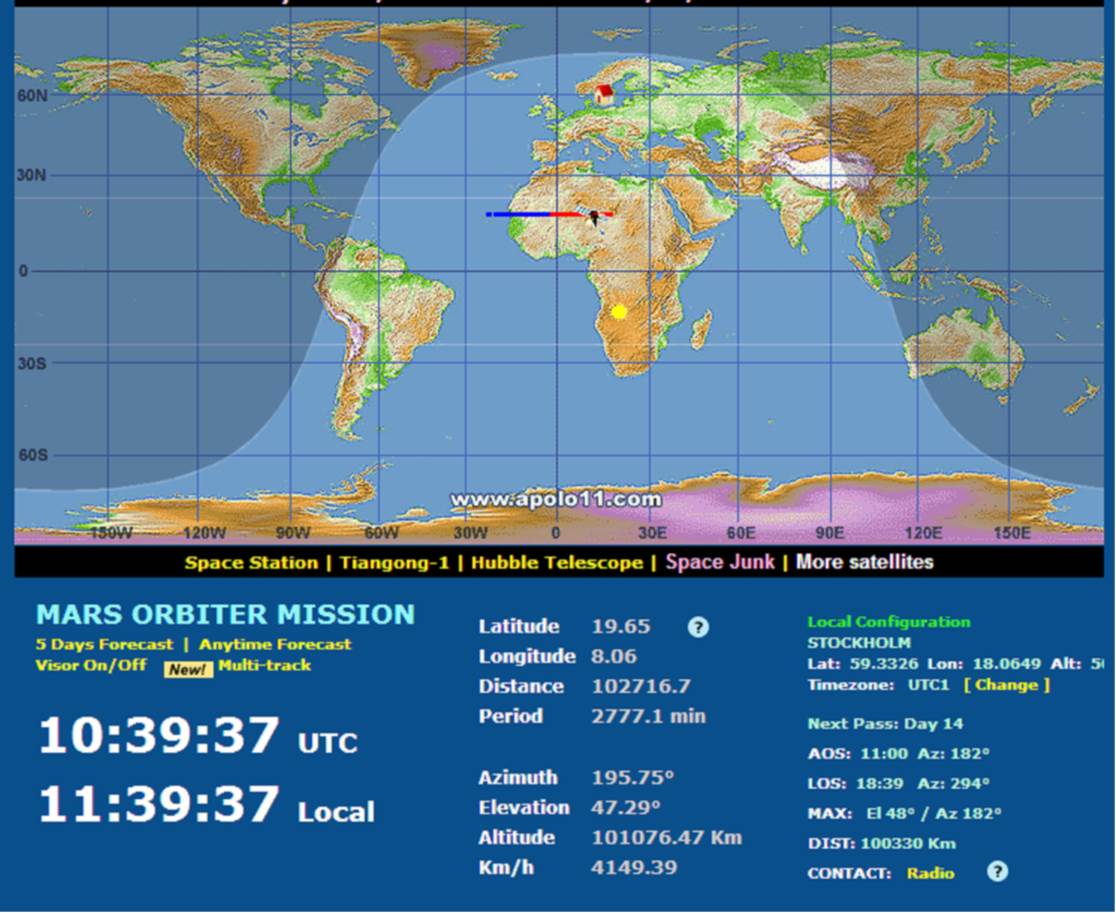
I have been trying to follow the mission via the live satellite tracking websites (satview.org and n2yo.com) but I am a little dubious as to how “live” they actually are. I noted that after the corrective burn 48 hours ago, both sites took almost 24 hours before they showed any change to the orbit.

Right now satview is showing a position over Africa at an altitude over 100,000 km but this data needs to be taken with a pinch or two of salt.

Live track Mars Orbiter satview.org

Live track Mars Orbiter satview.org

n2yo.com also shows the same position and gives the following data. Note that both sites give the same location and now also give much the same altitude. They do not match on “speed”. Satview gives a speed of about 4149km/h which is about 1.15km/s whereas n2yo gives a “speed” of 6.9 km/s. I am not quite sure what “speed” is being reported.

MARS ORBITER MISSION

LOCAL TIME:
12:13:56
UTC:
11:13:56
LATITUDE:
19.09
LONGITUDE:
-0.1
ALTITUDE [km]:
103132.47
ALTITUDE [mi]:
64083.55
SPEED [km/s]:
6.91
SPEED [mi/s]:
4.29
AZIMUTH:
204
SSW
ELEVATION:
+48.9
RA:
14h 45m 32s
DEC:
17° 1′ 12”
The satellite is in day light
PERIOD:  1434m