Archive for the ‘India’ Category

Cyclone Phailin will test Indian preparedness

October 12, 2013

UPDATE!

Saturday 12th, 6:30pm Indian Standard Time: Landfall is expected at any time now. So far some 600,000 people have been evacuated or have moved out of harms way. It has been the largest evacuation in India for 23 years.

______

The Bay of Bengal is no stranger to severe weather and severe cyclonic storms occur almost annually. However super cyclones (corresponding to an Atlantic Category 5 Hurricane) occur every 10 -20 years. Fatalities (direct and indirect by subsequent disease) have been huge in this heavily populated area. Super cyclones are defined as having wind speeds in excess of 220km/h and the current Cyclone Phailin is on the edge of that level with winds currently at about 210km/h. The Indian Meteorological Depratment expects the wind speeds to stay at the 210-220 km/h level.

ToI: Foreign agencies claimed Indian authorities are underestimating Phailin, quoting London-based Tropical Storm and US Navy’s joint typhoon warning centre as forecasting winds up to 315 kmph. Indian agencies, however, said wind speeds are much lower.

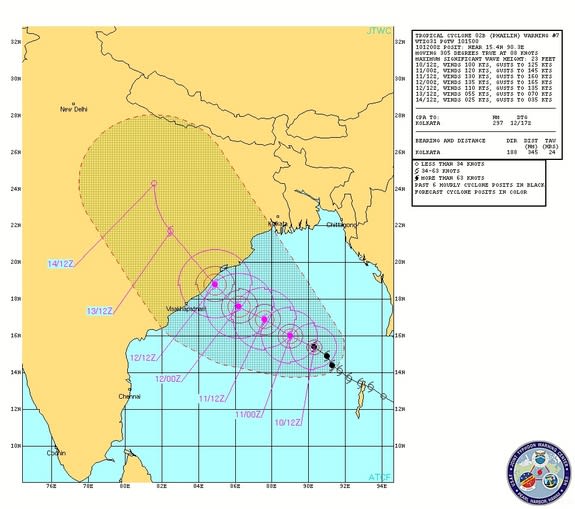
Super or Severe Cyclone Phailin is expected to make landfall this evening (about 6pm local time Saturday 12th October) somewhere along the Odisha coast. Warnings have been issued and about 200,000 have been asked to evacuate their coastal homes. Relief personnel and police are on alert. The Army has been deployed in some areas. Some 200 tourists have been assisted to leave the area and tourist bookings have been cancelled for upto a week.

Large improvements in the early warning and relief infrastructure have taken place since the catastrophic death toll in the super cyclone of November 1970. But Cyclone Phailin could be the biggest test for Indian preparedness since 1999.

Major super cyclones the region have been:

The projected path of Tropical Cyclone Phailin towards India as of 11:30 a.m. ET on Oct. 10, 2013.

Yahoo News: Experts say that the enormous and powerful storm, with maximum sustained winds of more than 160 mph (260 km/h), will bring a “catastrophic” storm surge, the water that a storm’s winds push in front of it and that inundate a coastline as the storm makes landfall, said Hal Needham, a climatologist at Louisiana State University. The storm surge is expected to reach heights of 20 feet (6 meters), Needham told LiveScience. The storm is likely to be “as bad or worse” than a cyclone that followed a similar trajectory in 1999, called Odisha cyclone for the area it hit.

Times of India: Touching wind speeds of 210-220 km an hour, Cyclone Phailin is set to hit the Odisha coast between Paradip and Kalingapatnam with full fury on Saturday evening, whipping up a storm surge up to 10 feet above the tide level posing a threat to low-lying villages.

Anticipating the cyclone’s fury, the state government began Odisha’s biggest ever evacuation of shifting more than three lakh (300,000) people out of harm’s way as chief minister Naveen Patnaik promised there would be zero casualties. The evacuation is expected to be complete by Saturday morning.

Met sources said the cyclone’s exact landfall is likely to be around the popular beach destination of Gopalpur and coastal Odisha as well as inland areas are expected to receive heavy rainfall likely to last till Sunday.

Although the Met is not categorizing Phailin as a “super cyclone” as it is yet to cross the 220 kmph barrier, there is little doubt that Odisha was bracing for a battering with the storm reported just 400 km south east of Gopalpur at 9pm on Friday. ….

….. Ganjam district is likely to be worst-hit. Other coastal districts falling within 75 km radius of the eye of the storm would also be impacted. “The exact landfall destination of the cyclone can be known once it comes nearly 200 km from the coast. Phailin’s movement however indicates that the situation would not be like the 1999 super cyclone during which the storm lay stationery over the coastal areas for nearly 24 hours and caused a sea surge of about 30 ft. This time 10 ft high wave is expected. More so, the expected landfall area being hilly, the impact of the cyclone would be less and weaken quickly,” IMD Bhubaneswar centre director Sarat Sahu said.

Not leaving anything to chance, the state government began evacuating people from coastal districts of Ganjam, Khurda, Puri, Jagatsinghpur and Kendrapada. Those who refused to leave their homes were forcibly taken to safer places. “There are 247 cyclone shelters and 10,000 concrete schools identified to house the villagers. We want to complete the evacuation by Saturday morning, particularly in Ganjam district which is likely to bear the brunt of the cyclone,” special relief commissioner P K Mohapatra said.

The central government has dispatched 10 helicopters, four Cheetah helicopters and two MI-17 and AN-32 planes to help the state government in rescue and relief operations. The government’s measures notwithstanding, thousands of people from the coastal region were rushing to railway stations and bus stops to escape the cyclone.

Finally! Toilets before temples says Modi

October 3, 2013

Narendra Modi may have announced his candidature a little early but he knows what needs to be done. Paradoxically, in spite of his image as a Hindu Nationalist and the support he has from the RSS, he may actually have the clout to break the stranglehold that religious mores and nonsense has on development in India. Certainly, judging from his track record in Gujarat, the RSS and the VHP may find Modi rather too hot to handle if he becomes Prime Minister.

In my estimation at least half – and maybe 90% – of the roadside shrines and mosques and temples that spring up at the slightest provocation are eyesores, worthless structures and illegal occupation of land. They usually have more to do with real estate politics than any religious intention. Nearly all new “religious” structures have a motive other than religion. But nobody dares to demolish them. Anything smelling of religious intolerance brings all the cowardice possible to the fore.

This appeal to urban India by Narendra Modi is quite clever. The same message has been put forward by others and they have immediately been opposed by the shirt-sleeve religious sentiments of the RSS and the VHP. But they will not dare oppose Modi. The appeal may not go down quite so well in rural India – but it may not carry many negatives.

DNA: Speaking at a function organised here for the youth, Modi said he dared to say so even though his image as a Hindutva leader did not allow him.

Build toilets first and temples later, said Hindutva icon and BJP’s Prime Ministerial candidate Narendra Modi on Wednesday.

Speaking at a function organised here for the youth, Modi said he dared to say so even though his image as a Hindutva leader did not allow him.

“I am known to be a Hindutva leader. My image does not permit to say so, but I dare to say. My real thought is– Pehle shauchalaya, phir devalaya’ (toilets first,  temples later),” he said.

The Gujarat Chief Minister’s comment could well stoke a controversy from within his party and sister organisations, which are keen to rake up the “temple issue” again ahead of next general elections.

A similar comment on toilets from Union Rural Development Minister Jairam Ramesh that the country needs more toilets than temples had stirred a row with a large number of women organisations and NGOs protesting against the remark.

Touting the slogan of development that could take the country on the path of speedy progress, Modi said lakhs of rupees were spent on temples in villages, but there were no toilets there.

Invoking Mahatma Gandhi’s thoughts, he lamented that it was ironic that women in the country had to go in the open for easing themselves in the absence of toilets.

Modi said it was the quality of a real leader to have the strength to handle all problems and lead the way forward.

He said that for good governance and speedy progress, it was necessary for planners to focus on outlay, outcome and social audit.


2013 monsoon begins withdrawal across India – Bumper crops after a “good” monsoon year

September 30, 2013

The official 4 month monsoon season ends today and the rains will withdraw across India over the next 3 months. Though monsoon statistics are usually focused on the 4 months from June to September, many parts of the country get significant rainfall during the withdrawal. For example the South-East coast will get significant rainfall during December. The entire monsoon cycle lasts about 7 months and the withdrawal has started. Over the 4 months rainfall has been 5% higher than the long term average and this would class this monsoon as a good monsoon.

Conventional wisdom has it that a “good” monsoon year adds 2% or more to GDP growth while a “bad” monsoon (>15% less than the long term average) can reduce the GDP growth by over 2%. Many industries are directly affected by agricultural growth. Not only fertlisers and pesticides but even farm vehicles and equipment. A good monsoon even impacts consumer goods which the rural population are waiting to get their hands on. With the slowdown in the economy many in the now lame-duck government are hoping for a monsoon boost without any action on their part and in time for the benefits to show before the general election next year. In any event, the monsoon or divine intervention cannot be blamed by ineffective politicians seeking reelection. But there is little doubt that a good monsoon has an enormous “feel-good” effect.

The monsoon is now withdrawing – perhaps a week or so behind its normal schedule (which means that some precipitation will continue to occur in Central India after the official season is over).

Withdrawal of 2013 monsoon September 30th source IMD

Withdrawal of 2013 monsoon September 30th source IMD

Crop yields are expected to be at record levels after this good monsoon.

Reuters: Grains production this summer is likely to be just short of an all-time high, according to a preliminary government forecast on Tuesday, leaving plenty for exports and helping to boost growth and trim inflation ahead of elections due by May. A heavy monsoon has ensured bumper harvests even though rice output could be lower than last year as rains were patchy over the rice-growing areas of some eastern states. The monsoon waters 55 percent of farmland without irrigation.

“Growth in agriculture … will rebound this year because rains are good,” Agriculture Minister Sharad Pawar told reporters as he announced the output forecast, which is usually conservative. “Today’s estimates are the first projections for 2013/14 and invariably we have seen that final estimates are 5-10 percent higher than the first estimate,” Pawar said.

Total output of summer-sown grains is likely to be 129.3 million tonnes in the current crop year from July, Farm Commissioner J.S. Sandhu said on Tuesday, just below the record 131.3 million tonnes of 2011/12 and up 0.9 percent on last year. Bumper output should mean India can continue exporting crops such as cotton, corn, rice and sugar.

Output of oilseeds, which could trim India’s imports of edible oils, should rise around 15 percent. Production of lentils – another foodstuff that India imports – should be up 3.2 percent.

Rice production is seen at 92.3 million tonnes against 92.8 million tonnes in the previous year. That marginal fall in rice output is not a great concern as India’s stocks are 21 million tonnes, more than double its target for September 1.

The government is relying on a bumper harvest to push agricultural growth and help the wider economy, as well as provide ample supplies of rice and wheat to support food subsidy programmes and cool double-digit food inflation. …… 

India may have gone Digital but the bricks and mortar are lagging behind

September 25, 2013

India has leap-frogged into the digital age in a big way.

But the only problem (and it is a debilitating affliction) is that bricks and mortar cannot be dispensed with.  Just hopping over the steps of building up the infrastructure does not help even if mobile and wireless services are as widespread as they are.

indian farmer and mobile

indian farmer and mobile

As I noted during the dot.com boom,

You cannot eat e-food and carry your goods down an electronic highway or use an e-house to keep out the rain. Old fashioned roads and rails and bridges and buildings cannot be replaced by a virtual world.

But the mobile penetration into rural India is extremely high. There may be no good roads to reach the villages and some may have little access to electricity but they all have their mobiles phones.

India Mobile Landscape (IML) 2013 study.

…… the field survey was conducted between May and mid-July 2013 covering 109 urban centres and 196 villages in all the 28 states and 3 union territories in India.

“It (the survey) covered 80 of the 88 regions as classified by the National Sample Survey Organisation under the Ministry of Statistics and Program Implementation. The study sample represents 94.8 per cent of the Indian population and 96.1 per cent of the total Indian households,” he said. Meanwhile, as per the data revealed by sectoral regulator TRAI, there are total 87.33 crore (873.3 million) mobile subscribers in the country. Of this, 73.14 crore (731.4 million) customers were found to be active on a particular date in June. The cumulative revenue of telecom service providers was Rs 54,284 crore (542.8 million) in the January-March quarter as per TRAI data.

There are 55.48 crore (554.8 million) actual mobile users in the country and 14.32 crore (143.2 million) internet users, according to a study by research firm Juxt.

…” More than 29.8 crore, (298 million) about 54 per cent, of these device owners are in rural areas as compared to 25.6 crore (256 million) in cities and towns,” Juxt co-founder Mrutyunjay told PTI. There are total 77.39 crore (773,9 million) functional SIMs with validity but only 64.34 (643.4 million) SIMs are being used by (the) 55.48 crore (554.8 million) mobile devices owners, the study report said.

Read more at: http://ibnlive.in.com/news/india-has-5548-crore-mobile-owners-1432-crore-internet-users/420444-11.html?utm_source=ref_article

Friday 13th, seven sentenced to death and Narendra Modi chosen as PM candidate

September 14, 2013

In Delhi, 4 of the 5 adults accused of the Delhi rape were sentenced to death. The 5th died earlier in custody. It waas as uicide according to the authorities and an “execution” according to the defence lawyers. The 6th accused – a juevenile – received tham maximum 3 year sentence. The odds oh his surviving his sentence must be considered far from certain.

In Madhya Pradesh a court sentenced 3 to death and a 4th to life in prison. Thry were bus employees who in a dispute with another bus driver torched that bus driver’s bus. That bus was packed with passengers and the accused barricaded the doors. 15 died.

And the BJP announcd the selection of Narendra Modi as their PM candidate for the 2014 elections over the opposition of LK Advani. I suspect Advani may be correct in thinkng it a strategic mistake and too early. I think Modi would have been better served by a few more months of speculation without offering a clear target for the Congess and other parties. The opposition to Modi now has time to mobilise.

It was Friday 13th September 2013 yesterday.

it remains to be seen if it was a Black Friday.

Anil Ambani chooses the “selective memory defense”

August 23, 2013

The saga continues.

The potential connection between the Indian 2G scam and the menagerie of companies in the Anil Ambani group (Swan, Tiger, Parrot, Zebra, Penguin and Giraffe.) surfaced in early 2011. But now it is reaching Court and Anil Ambani deposed yesterday. His wife Tina is due to depose today. His ADAG Group has lost much of its former gloss and he may not command the same level of political support and protection that he could a few years ago. He no longer has the unquestioning shareholder admiration his father once had (and which to a large extent his brother still has)

Amban's and friend

Ambani’s and friend

(Commentary removed – October 2014)

In Court, Ambani’s memory has suddenly become remarkably selective as the Hindu reports:

‘I am unable to recall if I was on the board of this company in 2007’

“I am not aware of any company by the name of Swan Telecom (P) Limited. Reliance Telecom Limited is a subsidiary of Reliance Communication Limited and I am non-executive chairman of the latter company. Earlier I was on the board of Reliance Telecom but I do not recall the period. I am unable to recall if I was on the board of this company in 2007,” Mr. Ambani said in reply to a prosecutor’s query, while recording his evidence as prosecution witness in the court of Special Judge O.P. Saini here.

But when he was shown a form for opening a bank account on behalf of Swan Consultants (P) Limited at an ICICI Bank branch in Mumbai and his attention was drawn to the signatures and photographs of persons authorised to operate the account, Mr. Ambani admitted that it bore his signature and that of his wife Tina.

He also admitted that copies of his and his wife’s PAN cards, tagged with the account opening form, bore their signatures. But he refused to identify a document captioned “declaration for promoter owned company.”

“I have also been shown annexure 2 under the caption ‘declaration for promoter owned companies’, which mentions the name of the parent company as Reliance Energy Limited and the names of common promoters as Anil Ambani [myself] and Tina Ambani … I am aware of neither this document nor the contents mentioned therein, as this is a document of the bank,” Mr. Ambani said.

However, he identified three of the accused. “I have been shown photographs of Gautam Doshi, Surendra Pipara and Hari Nair … against their names and I identify them. However, I cannot identify their signatures. I identify these three persons as they are part of the group. However, I cannot recall their designation now.”


(Commentary deleted)

Back in February Tehelka reported:

THE 2G spectrum scam is getting murkier by the day. A well-known Maharashtra politician and a Delhi- based real estate group have now come under the probe agencies’ scanner for their suspected role in the scam.

….

Now evidence is forthcoming from the banks involved in the jungle of transactions  involving the menagerie of companies controlled by Anil Ambani’s ADAG Group and which confirms that Anil Ambani was central to the games being played:

Anil Ambani and wife Tina were the only two individuals with unlimited powers to transfer money and make payments for the sevenAnil Dhirubhai Ambani Group (ADAG) companies that are now under CBI investigation for their links to the 2G scam-linked Swan Telecom, according to the testimony of Amit Khot, deputy branch manager of ICICI Bank’s Nariman Point branch, where these seven companies have their accounts. 

The menagerie included Swan, Tiger, Parrot, Zebra, Penguin and Giraffe.

The 2G Zoo

The 2G Zoo

BRICS is losing BIS as the financial crisis bites

August 20, 2013

Emerging markets have the fundamental problem that their own domestic markets – while promising – are not large enough yet to raise the finances needed to drive their entire economies. They are critically dependent upon foreign investment. And now as funds return to the dollar, India, Brazil, South Africa and other emerging markets are feeling the global financial heat – and some of the heat is intense enough to cause some currency meltdowns.

The Indian economy is shrinking in real terms. Currency controls are on the way though the Indian government is – as usual – doing too little too late. Sovereign ratings of these countries are likely to be degraded which will reduce foreign investment further and raise the cost of foreign borrowing. A vicious downward spiral could ensue.

BRICS is losing BIS.

Economic Times:

A fierce selloff in many emerging currencies shows no sign of abating as the expected withdrawal of US monetary stimulus prompts investors to shun markets seen as riskier because of funding deficits, slowing economies and inflation. 

The rupee fits that bill, as do the Indonesian rupiah, the South African rand and theBrazilian real. The rupiah plunged to four-year troughs on Monday while the rand lost another 1 percent to bring year-to-date losses to almost 17 percent against the dollar. 

Brazil’s real extended last week’s fall of more than 5 percent fall to trade at its weakest level since March 2009 even as the central bank sold nearly $3 billion worth of currency swaps, which are derivatives that mimic an injection of dollars in the futures market. Like the rupee, it has been hammered by doubts over the efficacy of policy actions to stem the rout. 

The rupee and the real, respectively, have been the worst performers in Asia and Latin America since late May when the Fed first signalled that it may begin winding down its monetary stimulus this year. India’s currency has lost 13 percent against the dollar this year while the real has plunged 15 percent in the same period. 

A decline in the Fed’s bond purchases will push government debt yields higher, which should raise the attractiveness of the dollar and dollar-denominated assets. In Brazil, the currency weakness has complicated policymakers’ efforts to rein in inflation, leading many investors to bet the central bank may speed up the pace of monetary tightening next week.  

In India, the rupee’s sell-off threatens to drive Asia’s third-largest economy towards a full-blown crisis. 

“Our primary concern is that the policy authorities still don’t ‘get it’ – thinking this is a fairly minor squall which will simmer down relatively quickly with fairly minor actions,” Robert Prior-Wandesforde, an economist at Credit Suisse in Singapore, wrote in a note on the Indian currency on Monday. 


Indian Navy: The tragic, the good, the bad and the ugly

August 14, 2013

The Indian Navy’s diesel submarine, INS Sindhurakshak, experienced an explosion and fire while at port in Bombay and has sunk with 18 sailors trapped and possibly dead.

The Indian navy's Sindhurakshak submarine in Visakhapatnam earlier this year. Photograph: Kamal Kishore/Reuters

The Indian navy’s Sindhurakshak submarine in Visakhapatnam earlier this year. Photograph: Kamal Kishore/Reuters

Accidents happen, everywhere but there is always the real possibility with accidents in India that institutional or individual “negligence” has a significant part to play. The negligence is often institutional in that processes and routines are lax or ill-defined or incomplete. It is not only in construction and repairs that India often exhibits the “last mile syndrome” where the last 5% of anything just does not get done!. Cost or budget considerations are a very common excuse for not making the final quality checks – whether in processes or in products.

In state owned establishments – like the Navy – institutional weaknesses can also arise because political considerations and politicians can subvert the processes. Individual negligence is not unknown and is usually a case of incompetence at some level. Not least because of the incompetence of the recruitment, training or supervision of the individuals concerned. In the Defense Services (and not just in India), seniority very often overrules competence in the making of appointments. Indian military appointments – and especially senior appointments – have been the subject of much (idiotic) litigation. Unfortunately even the Indian Courts give little importance to competence and have enshrined the appointment of the “most senior”. For fears of being accused of nepotism it is always easiest to appoint the “most senior” rather than the “most competent” or the “best suited” candidate for an appointment.

Of late the Indian Navy has been the subject of many news articles ranging from today’s tragic story to stories of achievement but also of decadence and dissolution.

All these stories are just from the last 30 days:

Navy sex scandal: wife of official arrested

A 25-year-old estranged wife of a navy officer, who rocked the Indian Navy earlier this year by accusing her husband of forcing her to get “sexually involved” with his colleagues, has been arrested by the south Delhi police on charges of cheating and fraud.

First Indian nuclear submarine set for open sea trials

India announced Saturday that its first indigenously-built nuclear submarine is ready for sea trials, a step before it becomes fully operational, and called it a “giant stride” for the nation. India unveiled the 6,000-ton INS Arihant — Destroyer of Enemies — in 2009 as part of a project to built five such vessels which would be armed with nuclear-tipped missiles and torpedoes.

Prime Minister Manmohan Singh said he was “delighted to learn that the nuclear propulsion reactor on board INS Arihant, India’s first indigenous nuclear powered submarine, has now achieved criticality”.

Indian SSBN Arihant Achieves Milestone, Govt Messes Up By Releasing Photo Of US Navy Submarine

The Indian Information & Broadcast Ministry has just released this Youtube clip which contains a single still photograph of what it wants you to believe is the INS Arihant SSBN, which reached a milestone today with its pressure water reactor finally going criticial. Well, guess what. Even on a day like this, the government didn’t mind filching a photograph of a US Navy Ohio-class submarine in an officially released video.

Indian-built aircraft carrier INS Vikrant launched

India has unveiled its first home-built aircraft carrier from a shipyard in southern Kerala state. The 37,500 tonne INS Vikrant is expected to go for extensive trials in 2016 before being inducted into the navy by 2018, reports say. With this, India joins a select group of countries capable of building such a vessel.

Massive Explosion Sinks Indian Submarine At Berth, Salvage On

A huge explosion inside Indian Navy Kilo-class submarine INS Sindhurakshak late last night sunk it in its berth at the Mumbai naval dockyard, with just a tiny portion visible. A major fire spread inside the submarine post the explosion. The navy put out a statement a short while ago to say that 18 personnel were on board when the explosion ripped through the submarine, but doesn’t say yet if they’ve been rescued. Salvage and rescue operations are on right now, and have been through the night.

Launching of INS Vikrant August 12th 2013 – image Livefist

The porter in red

August 7, 2013

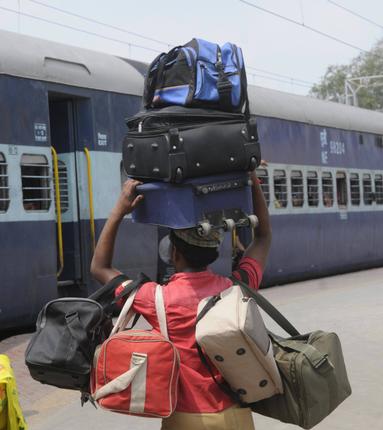
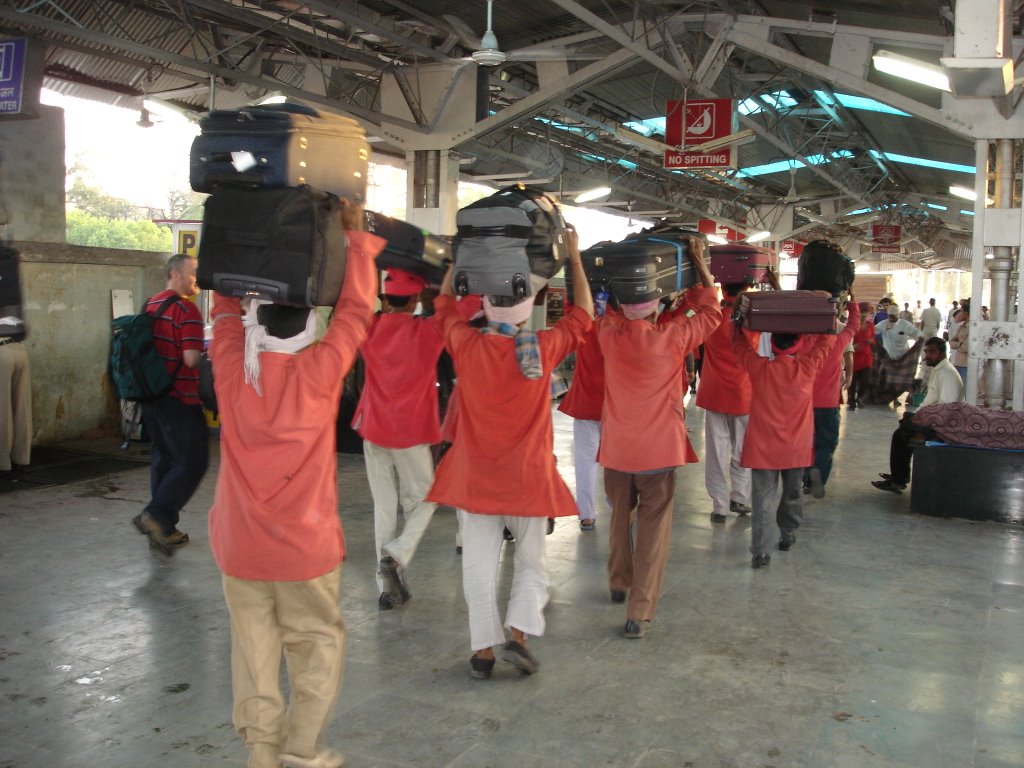
The Hindu carries a story on the tough life of a porter at an Indian Railway Station and it brought back memories from my childhood of travelling the length and breadth of India by train.

An integral part of the memories are about the man in red and his amazing abilities:

  1. first in the number of bags he could carry,
  2. second in the manner in which he got you and your luggage into your reserved seat on an Indian train
  3. while managing to navigate through the crowds ahead of you in spite of his burden
porter at an indian railway station 8The Hindu photo vijaya bhaskar)

porter at an indian railway station (The Hindu photo vijaya bhaskar)

Porters at Jabalpur


Rebranding of Narendra Modi is well under way

July 26, 2013

Back in 2011 I posted about the rebranding of Narendra Modi being orchestrated by Steven King and APCO Worldwide and which had started in 2009. His chances then of overcoming his Gujarat-riots reputation to become the BJP’s candidate for Prime Minister  were small at that time.

That has all changed now and the odds of his being the PM candidate are very high and his chances of becoming the next PM of India must be better than 50%.

Modi is not only the leading candidate to be the BJP’s candidate for PM for the 2014 elections, he has also been appointed the head of BJP’s campaign. He has started his efforts to gain acceptance across the country and regional parties are beginning to position themselves and even if they are not all rushing to show their support for him, they are certainly busy getting onto the fence so that they could support him if it becomes necessary or it could be beneficial. (Indian political parties all strictly follow the ideology of Opportunism).

Steven King – after his plagiarism fiasco – is no longer shown on APCO Worldwides’s website. If APCO are still working for Modi they are not doing it directly. During the floods in Uttarakhand a rather stupid effort was made to show Modi as a hero in the rescue of flood victims. This quickly backfired as in this article in the Times of India. The article mentioned APCO Worldwide  and led to APCO denying that they had anything to do with the rescue story or that they were working for Modi.

India is a big market for APCO and they are going to very careful in the run-up to the election to keep their ties to all political parties alive.  APCO India Brochure

Whatever the truth of APCO’s involvement (and I think the rescue story was a little crude for APCO) some PR group is certainly trying to orchestrate the rebranding of the Modi image. I would not be at all surprised that such a PR Group had – or has – links to APCO.

The latest story about 65 MP’s writing to Obama to ensure that Modi was not granted a US visa followed by 9 MP’s claiming that their signatures on the letter were forged is sufficiently convoluted to make me suspect the guiding hand of a well experienced PR exponent. The result of the circus is that the 65 MP’s look petty and vindictive and are all on the defensive. The Congress Party and the Left parties are busy distancing themselves from the writing of such a letter. Even the BJP has had to point out that they have no significant differences in foreign policy from that of the present government. Modi comes out very nicely with the faint glow of a halo beginning to appear.

Even the reports in the media that Nobel laureate Amartya Sen has stated that he does not believe in Modi’s economics and does not want him to be his Prime Minister are actually working to Modi’s advantage. (Sen’s attack on the real achievements in Gujarat is particularly silly – but I note in passing that it is not at all uncommon for Nobel laureates in Economics to make idiots of themselves). In fact, Sen now being “associated” in the public mind with Rahul Gandhi, is to Gandhi’s disadvantage. In my suspicious mind I see the hand of a skilled PR man again, who has successfully provoked Sen into making a silly – almost stupid – attack on Modi – to Modi’s eventual benefit. If Amartya Sen is really opposed to Modi, he has just scored an own goal – or three.

If the 2014 election becomes a personality contest between Narendra Modi and Rahul Gandhi, it would – I think – be a walk-over for Modi. The real skill of Modi’s PR strategists will show in their ability to marshall the diverse regional parties behind Modi. Exactly how they can mobilise and align the different caste groups will be particularly convoluted and fascinating to watch.