Archive for the ‘India’ Category

New study confirms Himalayan glaciers will not disappear any time soon

January 24, 2011
This NASA image shows the formation of numerou...

Glacial lakes, Bhutan: Image via Wikipedia

Reuters reports:

(Reuters) – Some Himalayan glaciers are advancing despite an overall retreat, according to a study on Sunday that is a step toward understanding how climate change affects vital river flows from China to India.

“Our study shows there is no uniform response of Himalayan glaciers to climate change and highlights the importance of debris cover,” scientists at universities in Germany and the United States wrote in the study of 286 glaciers.

The findings underscore that experts in the U.N.’s Intergovernmental Panel on Climate Change (IPCC) were wrong to say in a 2007 report that Himalayan glaciers could vanish by 2035 in a headlong thaw. The panel corrected the error in 2010.

The report said that 58 percent of glaciers examined in the westerly Karakoram range of the Himalayas were stable or advancing, perhaps because they were influenced by cool westerly winds than the monsoon from the Indian Ocean.

Science News says:

Glaciers largely stable in one range of Himalayas

Dirk Scherler of the University of Potsdam, Germany, and his colleagues report in the January 23 Nature Geoscience. ……. but in Karakoram, 58 percent of studied glaciers were stable or slowly expanding up to 12 meters per year…..

The new findings are consistent with what Kenneth Hewitt of Wilfrid Laurier University in Waterloo, Ontario, has observed, and point to the fact “that the picture of climate change effects in high Asia is much more complicated than most people realize.”

Indeed, for much of the past century Karakoram’s glaciers were in retreat. A 2005 paper by Hewitt described a turnaround that commenced only in the late 1990s. In the new study, Scherler’s team looked for factors that might affect the responsiveness of Himalayan glaciers to regional warming. A rocky blanket quickly emerged as a major one.

D. Scherler, B. Bookhagen and M.R. Strecker. Spatially variable response of Himalayan glaciers to climate change affected by debris cover. Nature Geoscience (in press, online January 23, 2011). DOI: 10.1038/NGEO1068.

Indian Environment Ministry challenges IPCC and CO2 conclusions

January 21, 2011
Cropped from image of Jairam Ramesh the Indian...

Jairam Ramesh: Image via Wikipedia

That there is little love lost between Rajendra Pachauri and the Indian Minister of Environment Jairam Ramesh is no secret. (Pachauri made the ill-advised and stupid remark about “voodoo science” regarding Ramesh and the Ministry’s claims debunking the IPCC ststements on Himalyan glaciers). Now according to the Hindustan Times the Ministry of Envirionment has produced a paper concluding that solar effects on clouds represent about half the warming effects attributed to CO2:

India has once again challenged the UN’s climate science body – the Intergovernmental Panel on Climate Change (IPCC) — through a new scientific paper. The Environment ministry sponsored paper says that human induced global warming is much less than what the R K Pachauri headed IPCC had said. The cause is reduced impact of Galactic Cosmic Rays (GCRs) on formulation of low clouds over earth in the last 150 years, says a paper by U R Rao, former chairman of Indian Space Research Organisation, released by Environment minister Jairam Ramesh. ….

Analyzing the data between 1960 and 2005, Rao found that lesser GCRs were reaching the earth due to increase in solar magnetic field and thereby leading to increase in global warming. “Consequently the contribution of increased CO2 emission to be observed global warming of 0.75 degree Celsius would only be 0.42 degree Celsius, considerably less than what predicted by IPCC,” the paper said to be published in Indian Journal Current Science had said. This is about 44 % less than what IPCC had said.

Ramesh in 2009 had released a similar scientific paper saying that the IPCC’s claim that most Himalayan glaciers will melt by 2035 was wrong. A few months later, after a review the IPCC regretted the error. If Ramesh latest bid gets globally recognition, it can alter the rules of UN run climate negotiations of 200 nations.

Impact of GCRs on global warming had been highly controversial since 1998, when Henrik Svensmark of Danish National Space Center said it was causing global warming. A decade later a joint European study debunked the claim, saying there was no co-relation. …

“I just want to expand scientific debate on impact of non-Green House Gases on climate change,” Ramesh said, when asked whether he was again challenging the IPCC. “Science is all about raising questions.”

International climate science is mainly western driven and collaborates the view of the rich world that gases such as Carbon Dioxide (CO2) are the main contributor for global warming. Any scientific work challenging the view has been debunked as work of a sceptic.

“Climate science is much more complex than attributing everything to CO2,” said Subodh Verma, climate change advisor in the Environment ministry.

And, its first impact has come from IPCC chairperson R K Pachauri, who has told the government, that impact of GCRs on global warming will be studied in depth in the fifth assessment report to be published in 2013-14. In its earlier four assessment reports, IPCC had not studied the impact of GCRs in detail.

The Global Warming establishment does not much like this paper. But they have now been reduced to claiming that everything – even directly conflicting evidence – supports the theory of man-made CO2 on global warming:

V Ramanathan of US based Scripps Institute of Oceanography at University of California said the Rao’s paper strengthens the case for greenhouse a primary driver for global warming. “The observed rapid warming trends during the last 40 years cannot be accounted for (by) the trends in GCRs,” he said, in his comments on Rao’s paper.

Science is indeed all about asking questions.

It seems to have been forgotten that anyone who  is not a sceptic deep down  is not – and can not be – a scientist.

Goldman Sachs cools on China and India

January 18, 2011

The growing inflation in India and China is a clear signal of overheating in their economies and Goldman Sachs (who are credited with inventing the term “BRIC”) are reducing their exposure to the BRIC countries.

The BRIC countries (Brazil, Russia, India, China)

The Telegraph reports:

Goldman Sachs has issued a short-term alert on China and India as inflation rears its ugly head, advising clients to rotate into Wall Street and Old World bourses as a safer bet over coming months.

“We’re not as tactically positive on the BRICs as we have been,” said Tim Moe, the bank’s chief Asia-Pacific strategist, referring to the quartet of Brazil, Russia, India, and China.

“To be frank, we may have held on too long to our overweight position in China last year. We have decided that discretion is the better part of valour and have tactically reduced our weight. Asia is not in the sweet part of the cycle. The longer-term picture of Asia outperforming the US is taking a breather,” he said, speaking at a Goldman conference in London.

The cooling ardour for China is significant shift for the bank that invented the term BRICs and has been the cheerleader of the emerging market story over the past decade.

India is an even bigger worry, with yawning twin deficits, and overheating visible on all fronts. The nation’s central bank warned this week of “surging inflation”.

“India’s current account deficit is running at a record pace of 4.1pc of GDP and it is 100pc funded by short-term portfolio flows, which cannot be relied on indefinitely,” said Mr Moe, describing Mumbai’s bourse as “crowded”.

Read more….

Indian low-cost carrier signs record Airbus deal, plans to fly overseas routes

January 12, 2011

Bloomberg reports:

IndiGo, the Indian low-cost carrier that agreed to a record plane order, may begin overseas flights in August as economic growth stokes travel in the world’s second-most populous nation. The carrier eventually plans to fly to the Middle East, Southeast Asia and other South Asianations, President Aditya Ghosh said in a phone interview today. The New Delhi-based carrier is unable to start international flights before August because of government regulations.

VT-INA - IndiGo - Airbus A320-232: image PlanespottersNet_026313.jpg

IndiGo may consider sale-and-leaseback deals and debt issuances to help pay for the 180 Airbus SAS A320 planes it has signed a preliminary agreement for, Ghosh said. The aircraft, worth about $15 billion at list prices, will boost the carrier’s fleet as it competes with Air India and Jet Airways India Ltd. in Asia’s second fastest-growing major economy.

The new order, which was announced yesterday, builds on the 100 A320s that IndiGo signed up for in 2005, the year before it began services. The carrier was operating 32 planes at the end of November, according to data on Airbus’ website. The other planes in the initial order for 100 are due to be delivered by 2015, Ghosh said. The airline is a unit of closely held InterGlobe Enterprises Ltd., which also runs hotels and offers technology services…..

Deliveries of the next 180 single-aisle planes will run from 2016 to 2025, Ghosh said. These planes will include 150 of Airbus’s revamped A320, which will be fitted with new engines. The carrier is the first customer for this new version.

Indian carriers are buying aircraft and adding overseas routes as rising wages and trade stoke leisure and business travel. Domestic passenger numbers will likely surge fourfold to 180 million a year by 2020, according to a government forecast…..

Airlines in India have to fly domestically for at least five years before they can start overseas services, under government rules.

Development of stealth fighter aircraft moves East

January 10, 2011

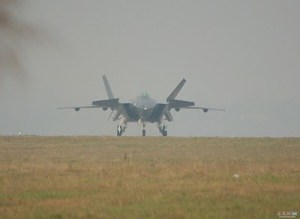
Both China and India are developing 5th Generation stealth fighters; China on its own and India as part of a joint development programme together with Russia.

From http://china-defense.blogspot.com/2010/12/latest-batch-of-j-20-photos.html

Chinese Chengdu J20 - 5th generation stealth fighter: image http://china-defense.blogspot.com

Rumours from China’s Chengdu Aerospace Corporation (CAC) and the adjoining Aircraft Plant No 132 suggest that a flight of a Chinese-developed fifth-generation fighter prototype would take place by the end of the year. Reportedly, two airframes (numbered 2001 and 2002) have been assembled at the 132 plant.

In August 2008 it was reported that 611 Institute was selected to be the main contractor for the development of the fifth-generation stealthy J-20, and that 601 Institute was the sub-contractor. It was rumored that 611 Institute has started to issue manufacturing drawings for constructing the first prototype, which is expected to fly by 2012, even though the full configuration one won’t fly until a few years later. The latest rumor suggested that a full-scale mock-up had been built at CAC.

From http://www.globalsecurity.org/military/world/china/j-xx.htm

File:Pak fa.jpg

Sukhoi PAK FA T50: image wikipedia

Russia and India are jointly developing the Sukhoi PAK FA / T-50 , which first flew in January 2010. In June 2001, India was offered ‘joint development and production’ of this new 5th generation fighter by Russia. Russia had been trying to sell this concept both to China and India for some time. It seems probable that China declined to participate in this project given a belief that Russia stood to gain more from Chinese participation than did China. That is, it would seem that China had determined that it could produce a superior product without Russian help. With the first flight of the Russian stealth fighter in 2010, an arguably superior Chinese steath fighter might be expected to take to the skies not too long thereafter.

Chinese combat aviation has made remarkable strides in recent years, moving from a collection of obsolete aircraft that would have provided a target-rich environment to potential adversaries. Today China flies hundreds of first rate aircraft, and even flies more Sukhoi Flankers [the aircraft the American F-22 was designed to counter] than does Russia. The Chinese stealth fighter has arrived right on schedule. Chinese military technology is generally rated about two decades behind that of the United States. while the advent of a Chinese counterpart to the F-22 fighter might be disconcerting, the first flight of the prototype American F-22 stealth fighter came on September 29, 1990.

From the Hindustan Times:
New Delhi, December 21, 2010: India and Russia on Tuesday finalised a contract for the biggest defence programme in the country’s history — a $30-billion (Rs 1,35,000-crore) project involving the joint production of 200-250 fifth generation fighter aircraft (FGFA). The aircraft, being called the perspective multi-role fighter (PMF), will exploit the basic design of the Russian Sukhoi T-50 PAK-FA prototype, with modifications thrown in to meet the Indian Air Force’s “more stringent specifications”. The 30-tonne aircraft will be a swing-role fighter with stealth features for increased survivability, advanced avionics, smart weapons, top-end mission computers and 360-degree situational awareness. What will put the co-produced fighter in a different league is its ability to supercruise, i.e. sustain supersonic speeds in combat configuration without kicking in fuel-guzzling afterburners. Currently, the US Air Force’s F-22 Raptor is the only fighter in the world that can supercruise.
The contract for the joint design and development of the FGFA was signed between Hindustan Aeronautics Limited and two Russian firms, Sukhoi Design Bureau and Rosoboronexport. The fighter will be jointly marketed to international air forces. The first prototype flew its maiden sortie in January 2010 and has conducted more than 40 flights. The IAF hopes to induct it by 2018.
A joint statement issued by the ministry of external affairs said Prime Minister Manmohan Singh and Russian President Dmitry Medvedev agreed that the December 2009 pact covering bilateral military cooperation during the next decade would lead to a more substantive engagement cutting across joint research and development, manufacturing and marketing activities.
In the meantime DNA reports:
 

HAL Tejas at Aero India 2009

HAL Tejas: Image via Wikipedia

India today joined a select group of nations manufacturing warplanes with the home-grown Light Combat Aircraft ‘Tejas’ moving a step closer to its induction into the Indian Air Force after getting its Initial Operational Clearance (IOC) here. 

27 years after the project was initiated, defence minister AK Antony handed over the IOC certificate to Air Chief Marshal PV Naik at the HAL airport in Bangalore.

“This is only the semi-finals”, Antony said, adding the LCA would enhance national security and build the country’s own fighter aircraft capabilities.

The aircraft, with an investment of over Rs 14,500 crore ($3.2 billion), has been developed by DRDO’s Aeronautical Development Agency after battling technology denial regimes and sanctions for nearly three decades. “After crossing a number of challenges and accomplishing a significant series of milestones including weapon delivery, in over 1500 sorties, the country is poised for a major turning point with the declaration of the IOC,” Antony said.

The IAF has plans to induct a total of around 200 planes of which orders for the initial 40 have already been placed by the IAF.

The aircraft, which costs between Rs 180 to 200  crore ($45 million)  per piece, is presently powered by American GE-F 404 engine and the advanced GE-414 engines have been chosen for powering the LCA Mk II aircraft, which are likely to be developed by 2014.


Northern India shivers: Schools closed in Delhi till Sunday

January 6, 2011

Most homes in Delhi have no insulation and no central heating. Double glazing is almost unheard of. No doubt Pachauri’s home in the prestigious Golf Links area of Delhi is an exception. Current Delhi temperatures are running some 45°C lower than maximum summer temperatures. And from my week in Delhi during December 2010 I can testify that it is a mind and body numbing experience when temperatures inside the home are less than 10°C.

The claims that global warming is responsible and Pachauri’s IPCC must seem like bad jokes.

http://www.bbc.co.uk/news/world-south-asia-12125207

A continuing cold snap has forced authorities in the Indian capital to keep schools closed till Sunday. Delhi has been badly hit by the cold, along with Indian-administered Kashmir, and the states of Haryana, Punjab and Uttar Pradesh.

Temperatures have been hovering around 4°C after dipping to 3.7°C on Tuesday morning, the city’s lowest this winter. The death toll in the cold snap that has disrupted life across northern India has reportedly risen to 47.

http://www.ndtv.com/article/india/north-india-in-the-grip-of-intense-cold-wave-77387

The cold wave intensified further in Kashmir division, including Ladakh region, as the minimum temperature across the state dipped several degrees further, with Leh town freezing at -23 °C.
Leh recorded the coldest temperature in Kashmir division at -23 °C, which was 2.8 degrees lower than the minimum temperature recorded on Tuesday. The maximum temperature recorded in Leh was three degrees below the freezing point. In Srinagar city, the minimum temperature dipped by 1.3 deg C to settle at -5.4 °C. Kargil town witnessed an extremely cold night as the minimum temperature remained -18 °C for the second consecutive night. In Kashmir Valley, the tourist resort of Pahalgam recorded a temperature of – 11.6 °C which was nearly four degrees lower compared to Tuesday’s minimum of -7.7 °C.

http://www.thehindu.com/news/states/other-states/article1032332.ece

Daily wage labourers on their way to work braving the cold and windy condition in New Delhi even as the minimum temperature came below 34 degree the season's lowest, on 04, January 2011. Photo: V.V.Krishnan

Daily wage labourers on their way to work braving the cold and windy conditions in New Delhi even as the minimum temperature dropped below 3.4°C the season's lowest, on 04, January 2011. Photo: V.V.Krishnan


No surprise: “Secret” technical evaluation in Indian MMRCA deal found on the street

January 4, 2011

The Times of India reports on the bizarre story of a confidential file found on the street:

Even as the race for the “mother of all defence deals” enters the last lap, two IAS (Indian Administrative Service) officers of the defence ministry are now under the scanner for the mysterious way in which a “secret” file connected to the $10.4 billion project to acquire 126 new fighters went missing and was then found by a roadside.

There is an intense battle currently in progress to win the $10 billion deal for 126 combat aircraft (MMRCA – medium multi-role combat aircraft) where the final decision is expected to be taken by March. As I have posted earlier, the technical and flight evaluations on the 6 contenders were conducted by the Indian Air Force and their highly confidential and secret report was submitted to the Ministry of Defence  by early November 2010. Many rumours circulated at the time and the word on the street was that the Eurofighter Typhoon had won the technical evaluation. However this evaluation is merely one (but important) stage in the decision making process. The strategic and financial evaluations are under way and political lobbying is building up.  Some of this lobbying is at the highest levels of government and no doubt the recent visits to India by Obama and Medvedev and Sarkozy were utilised fully.

For all the contenders the technical evaluation is what determines what is left to be done to win the contract. The details in the technical evaluation report are most important for a contender to know how to compensate for any perceived failings. I am quite sure that every contender has managed by now to obtain a copy of the technical evaluation report. (To obtain copies of confidential reports from Indian bureaucrats is not in the realm of the impossible. In my experience obtaining reports and confidential documents from clerks in government service is much more effective than any Freedom of Information application and are not subject to any redactions.) I am equally sure that all the six aircraft manufacturers would have by now developed their sales strategies and lobbying plans based on the their weaknesses as recorded in the report. But what may have been missed by some is that unofficial dissemination of the “confidential” report is an expected event. It may even have been a deliberate leakage of the report as part of the Government of India’s buying strategy.

The six are:

  1. Dassault, Rafale, France
  2. Eurofighter, Typhoon, UK, Italy, Germany and Spain
  3. Lockheed Martin, F-16IN Super Viper, US
  4. Boeing, F/A-18E/F Super Hornet, US
  5. Saab, JAS 39 Gripen, Sweden
  6. Mikoyan, MiG-35, Russia

Even though there are only 6 contenders, the number of lobbyists, sub-contractors and foreign embassy officials involved would have led to at least 100 copies of the report having been “sold” by various bureaucrats with access to the file. So I do not find it very surprising that one of the many “unsold” copies was abandoned somewhere. The value of such reports goes down sharply with time. It must have been at its most expensive immediately after it was submitted to government and before the many visits by various heads of state to Delhi. Again from my past experience of such things I would expect that the report probably had an initial “price” of around Rs 10 lakhs (about $20,000) but now some 2 months later, can probably be purchased for less than 1 lakh ($2,000).

Nobody is probably very bothered by this episode since the leakage of the report to the contenders is part of the game and already taken into consideration by the Government. In fact leakage of “perceived weaknesses” to a supplier is one of the best buying strategies to extract improvements in the supplier’s offer. The most senior bureaucrats in the Ministry of Defence are probably congratulating themselves for having managed to disseminate so many copies of the report before this particular slip-up.

But for now all the right noises will be made for public consumption. As the ToI reports:

Ordering an inquiry into the episode, defence minister A K Antony on Monday said he was “very clear that every officer has to be very careful at every stage” while dealing with the huge MMRCA (medium multi-role combat aircraft) project. “We have viewed the incident seriously…the inquiry is in progress,” he said. It was last week that the “secret” file, which was earlier submitted to the MoD by IAF, went missing and was then found later in the day near Khelgaon Marg in South Delhi.

MoD was tight-lipped about the incident but sources said the file was apparently lost by the bureaucrats, one an additional secretary-rank officer and the other a director, while being taken to the Bharat Electronics Limited guest-house on Khelgaon Marg. The file was found by a security guard who then got in touch with the authorities concerned.

Many faculty members involved in fake institute at IIT Kharagpur

December 31, 2010
The Main Building of IIT Kharagpur

IIT Kharagpur: Image via Wikipedia

The Indian Institute of Technology at Kharagpur is one of the original 5 IIT’s and perhaps the one enjoying the highest reputation of them all. But the case of the fake institute  – Institution of Electrical Engineers (I) – being run apparently by a few rogue faculty members is now spreading and revealing that many faculty members were involved. The investigations which were first to be conducted by a panel of academics will now be shifted to the Central Bureau of Investigation (CBI). Many voices were raised against the proposed composition of the panel apprehending a “whitewash”.

The case was first broken in October by the Calcutta Telegraph:

The Centre today asked IIT Kharagpur to give a “factual account” of a professor’s alleged role in running an unapproved institute and duping students into believing it was a branch of the tech school. Amit Kumar Ghosh, the head of the department of aeronautical engineering, has been accused of having a hand in the running of the Institution of Electrical Engineering (IEE) in Kharagpur and offering diploma courses without the approval of the All India Council of Technical Education (AICTE).

The ministry is livid that a senior faculty member could be involved in “fraudulent” activities. “The IIT Kharagpur authorities have been asked to furnish a factual account on the issue,” a ministry official said. A senior IIT official said Ghosh had been removed as aeronautical engineering department head following the allegations. An inquiry has been ordered.

The IEE has been operating from a temporary campus and offering courses such as a diploma in electrical engineering. Ghosh has allegedly been serving as the institute president. J.K. Tiwary has apparently been managing the institute for the last two years and luring students by claiming that the IEE is a branch of IIT-Kharagpur. Trouble started this year after students found out that the IEE had no connection with IIT Kharagpur. It did not even have AICTE approval, mandatory for an institute teaching any technical course.

Furious, the students registered a complaint with the IIT Kharagpur director. “They have spoiled our career. We want justice,” M. Ramu, a student of IEE, said.

In the beginning of December, evidence surfaced that many more faculty members were involved. The Times of India reported that:

IIT-Kharagpur has all along been in denial that its faculty members were involved in the running of fake institute — Institution of Electrical Engineers (I). But the hollow claims now lay in tatters, thanks to a photographic proof showing teachers of the institution along with J K Tiwari, the brain behind the institute, who, incidentally, has nothing to do with IIT-Kharagpur.

Police recovered the photograph during a raid and are soon going to question faculty members — both serving and retired — who are seen along with Tiwari. The photograph shows A K Ghosh, former head of department of aerospace engineering and an ex-chief vigilance officer, who has since been suspended for his alleged involvement in the scam.

The others caught in freeze frame are N K Kishore, professor, department of electrical engineering; Jayanta Pal, head of department, electrical engineering; Pallab Kumar Chattopadhyay, retired professor of agricultural and food engineering; Punyabrata Dutta Gupta, retired professor of electrical engineering; J C Biswas, retired professor of electronics & electrical communication engineering.

Tiwari, who conceived IEE (I), and even managed to get an official quarter for the institute, is seen sitting along with a section of IIT-Kharagpur faculty members. Police sources said they are investigating if the photograph was taken during the convocation of IEE (I) as claimed by many students of the fake institute.

Yesterday, the Indian Express revealed that

The Central Bureau of Investigation (CBI) will probe the fake institute scam that was allegedly run from the Indian Institute of Technology, Kharagpur, by some of its faculty members……. HRD Minister Kapil Sibal is learnt to have decided that a CBI probe was the best course to follow and the issue would be formally referred to the agency in the next few days.

The stench of corruption in the Indian body academic is not restricted to the private “education industry” but is present even in the most respectable institutions.

King Coal: The global battle to control resources

December 26, 2010

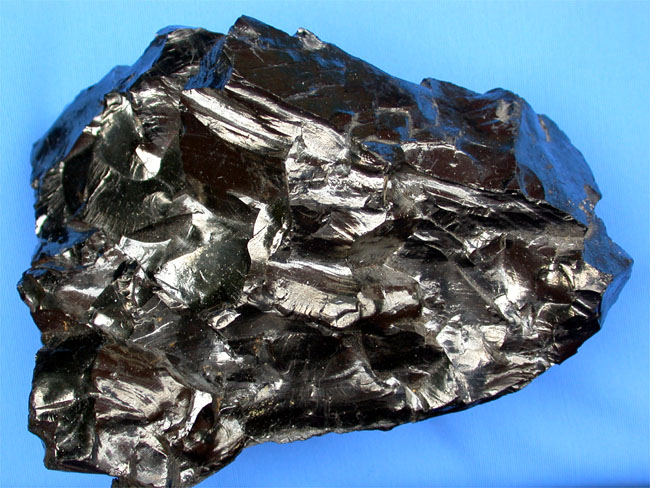
Riversdale Mining Ltd. has 13 billion metric tonnes of known coking and thermal coal reserves in its Benga and Zambeze projects in Mozambique. A global battle is now hotting up for the acquisition of Riversdale and the potential bidders clearly have no doubts about the continued use of coal and are not greatly impressed by the passing fad of Global Warming alarmism.

King Coal: image pitt.edu

Bloomberg reports:

International Coal Ventures Ltd., an Indian state-run joint venture, is studying an offer for Riversdale Mining Ltd. to counter a A$3.9 billion ($3.9 billion) bid from Rio Tinto Group.

ICVL appointed Citigroup Inc. to examine a possible takeover offer for the Sydney-based coal company with mines in Mozambique, the venture’s chairman C.S. Verma said yesterday. London-based Rio yesterday bid A$16 a share for Riversdale, securing 14.9 percent of the company in pre-bid agreements.

Indian companies are seeking coal mines overseas to ensure raw material supplies for producing steel and electricity. Brazil’s Vale SA or Eurasian Natural Resources Corp. may make bids, according to Sanford C. Bernstein & Co., as Tata Steel Ltd., Riversdale’s biggest holder, said it will study Rio’s offer “in the context of other alternatives” available to Tata. “The A$16 cash offer is unlikely to secure acceptance from all of Riversdale’s shareholders,” analysts led by Hayden Bairstow at CLSA Asia-Pacific Markets, said yesterday in a report, raising his price target for Riversdale by 3 percent to A$18. Riversdale’s “Benga and Zambeze coal projects are world class and we believe other suitors may show an interest in Riversdale now a formal bid has been tabled,” he said.

Tata Steel holds 24 per cent stake in Riversdale and is its largest shareholder. Sources say there have been talks between ICVL and Tata Steel for a joint bid or at the very least support from Tata Steel for ICVL’s bid. However, ICVL did not confirm that any talks took place between the consortium and Tata Steel reports The Hindu Business Line.

But more bidders are appearing and it is likely that the shareholders of Riversdale can expect a much higher price than what is on the table now. The Guardian reports that:

The global battle for control of the world’s natural resources flared again when it emerged that Anglo American could gatecrash Rio Tinto’s plans to buy Riversdale Mining, the Australian coking coal group, for £2.5bn.

Headed by chief executive Cynthia Carroll and chairman Sir John Parker, Anglo has joined a list of possible counter-bidders for Riversdale, whose African business produces coal for the fast-growing Asian steel industry.

Evidence of the importance of coking coal to China surfaced recently when Riversdale signed an agreement with Wuhan Iron and Steel to jointly develop Riversdale’s huge Zambeze coal reserves in Mozambique.

Anglo, which is believed to have appointed Morgan Stanley to advise on its options, will face stiff competition, with the Wall Street Journal reporting that Tata Steel of India, which controls 24% of Riversdale, is considering an offer.

Another potential bidder is ICVL, an Indian consortium that has appointed Citigroup as a financial adviser and mandated the bank to report back on the viability of a bid that would top Rio’s promise of A$16 a share.

Tata Steel has just received shareholder approval “for raising of additional long-term resources through issue of securities, including equity shares with differential rights as to voting and dividend, up to Rs 7,000 crore ($1,550 million)”. A company press release said “Tata Steel notes the takeover bid for Riversdale Mining announced by Rio Tinto. Tata Steel will evaluate the takeover bid in the context of other alternatives available to Tata Steel.” Riversdale is important for the long-term coking coal security for Corus. Tata Steel is already entrenched in its Mozambique coal mining project with a strategic stake and long-term supply contract. With Tata Steel’s share of Riversdale valued at almost $1 billion by the Rio Tinto bid it is likely that the final selling price will be significantly higher than Rio Tinto’s bid.

An educated guess would suggest a final selling price of over $5 billion or over A$20 per share.


Review of “3000 Miles to Freedom”

December 25, 2010

I posted in August about my father’s manuscript describing his escape from Singapore after its fall in 1942.

Mark Pillai as a Captain

Three Thousand Miles to Freedom

A review by Abhimanyu Singh appeared in last Sunday’s  New Sunday Express entitled:

Two takes on an obscure, yet epic journey