Archive for the ‘India’ Category

An Indian spelling gene which is triggered by geography?

May 27, 2016

Indian Americans now totally dominate the US Spelling Bee competition. It was the third straight year of joint winners at the 2016 Scripps National Spelling Bee. Nihar Janga, 11, of Austin, Texas, and Jairam Hathwar, 13, of Corning, New York, were declared co-champions at the National Spelling Bee on Thursday.

May 26, 2016; National Harbor, MD, USA; Jairam Hathwar, 13, of Painted Post, N.Y. (L), and Nihar Janga, 11, of Austin, Texas (R), celebrate as co-champions during the 2016 Scripps National Spelling Bee at the Gaylord National Resort and Convention Center. Image : Reuters

Seventeen out of the last twenty one winners (from 1999 to 2016), including all champions for the most recent nine years (from 2008-2016, including 2014, 2015, and 2016’s pairs of co-champions, for a total of twelve champions during this interval), have been Indian Americans, reflecting the recent dominance of students of this community in this competition. Indian Americans make up less than one percent of the U.S. population. In 2016, Nihar Janga from Austin, Texas, became the youngest ever champion when he won the title at the age of 11.

The 2016 Scripps National Spelling Bee featured co-champions for the sixth time in the competition’s history, the previous occurrences having been in 1950, 1957, 1962, 2014, and 2015. (Wikipedia)

It must be genetic. But for some reason the spelling gene does not express itself in India. Obviously some epigenetic factor is in play.

My hypothesis is that all Indians have the spelling gene but it is only expressed when triggered by a geographical factor to be found only in the US.


Related:

Why are Indian-Americans sweeping the US spelling bee?


Indian monsoon should be on time as El Niño dissipates

May 18, 2016

The Indian monsoon is influenced by anomalies in the Niño 3.4 region.

nino regions

nino regions

“El Niño (La Niña) is a phenomenon in the equatorial Pacific Ocean characterized by a five consecutive 3-month running mean of sea surface temperature (SST) anomalies in the Niño 3.4 region that is above (below) the threshold of +0.5°C (-0.5°C).”

In the last 2 weeks the Niño 3.4 region has seen the SST anomaly drop from 1.1°C on April 25 to 0.6°C now. So it does look like that the current El Niño is dissipating and will very soon reach neutral conditions. That comes just in time for this year’s Indian monsoon (official season from 1st June to 30th September).

Both the government Indian Meteorological Department (IMD) and the private Skymet forecast an above average monsoon (about 10% above “normal”). However the IMD forecasts that the onset of the monsoon over the south-west coast will be delayed by about a week (June 6th -8th) but Skymet suggests that it will be on time and maybe even a day or two early (28th -30th May).

The Skymet prediction seems a little more credible to me. Right now a depression in the Bay of Bengal is bringing very heavy rain to the south-east tip of the peninsula and augurs well for the establishment of the monsoon. The formal “onset of the monsoon” is itself a complex matter. Technically the onset is declared when:

at least 60% of the 14 weather stations across Kerala and coastal Karnataka should record 2.5 mm rainfall or more for two consecutive days.  ….. Simultaneously, the depth of the westerly winds should be up to 600 hPa (or 12000 ft high),  from the equator to 10°N Latitude, and between Longitude 55°E and 80°E. The zonal wind speed over the area bounded by Latitude 5-10°N and Longitude 70-80°E should be around 25 to 35 kmph in the lower levels. The OLR value should also be less than 200 Wm-2 in the box confined by Latitude 5-10°N and Longitude 70-75°E.

While Skymet predicts monsoon conditions being established by end-May, IMD sees that about a week later. Possibly IMD have a smaller initial peak than Skymet.

Skymet’s Jatin Singh writes:

Skymet Weather believes that Monsoon will lash Kerala by the predicted dates between May 28 and 30. …..

…. There are high chances that the onset of Southwest Monsoon in mainland of India will coincide with El Niño reaching the threshold neutral stage. The in-built complex characteristics of Southwest Monsoon are also influenced by external oceanic-atmospheric phenomena like Indian Ocean Dipole (IOD) and Madden-Julian Oscillation (MJO). IOD will remain neutral for now and MJO will also traverse through the favorable zones of eastern Indian Ocean. Therefore, I think that the onset of Monsoon will not be hampered by El Niño, IOD or MJO.

monsoon onset 2016 prediction - graphic Skymet

monsoon onset 2016 prediction – graphic Skymet

Farmers, the government and industry are all looking for a good monsoon to kick-start the Indian economy into a steady period of growth. A “good monsoon” adds – directly and indirectly – about 2 percentage points to GDP. In the present climate where, in spite of the boost from lower oil prices, the Indian economy is dithering about taking off, a “monsoon factor” could be what is needed to secure the upward trajectory.


The Raj reversed

March 29, 2016

A UK delegation to India to secure jobs in Wales.

Does not need much further comment.

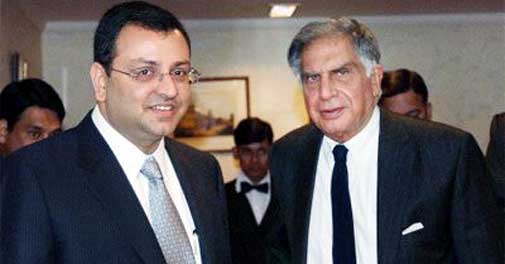
cyrus mistry (chairman) and ratan tata (former chairman) tata sons image - bisinesstoday

cyrus mistry (chairman) and ratan tata (former chairman) tata sons (image – businesstoday.in)

BBC:

UK union leaders have held talks in India ahead of a Tata Steel board meeting that could decide the fate of thousands of workers. Officials from the Community union had “constructive” talks with Tata Steel representatives in Mumbai, where the board is meeting on Tuesday.

The future of thousands of UK steelworkers is at stake. The Port Talbot plant in south Wales suffered most of the 1,000 job losses announced in January. Unless Tata goes ahead with a turnaround plan, the future of the huge plant could be in doubt.

Roy Rickhuss, general secretary of Community, along with Stephen Kinnock, MP for Aberavon, and Frits van Wieringen, chairman of the Tata Steel European works council, met in Mumbai with senior representatives of Tata Steel ahead of Tuesday’s board meeting.

A Community spokesman said the meeting was “open and constructive”, with the European delegates making the case for Tata to continue to support the UK business.

The myth in the UK that India gained more from British rule than the economic benefits squeezed out of India is addressed very well by Shashi Tharoor in his speech at the Oxford Union.

Dr Shashi Tharoor MP – Britain Does Owe Reparations


India stocking up on Foreign Exchange Reserves

March 21, 2016

India’s Forex reserves were $353 billion this week and it seems that the Reserve Bank is stocking up whenever the opportunity arises.

The question of course is whether it is just the RBI being prudent or whether they see clouds on the horizon. Certainly the drop in oil prices has helped. But the RBI is still very apprehensive that they could quickly go up again.

Right now the forex reserves are sufficient for almost 10 months of imports but the RBI is still not quite bold enough to reduce interest rates further. India has every reason to fear high inflation, but the RBI being a little more expansive is probably called for.

India forex 2016 march

India Forex 1998 – 2016 Source: RBI

Business LineBetween the end of February and March 11, $6.5 billion were added to the country’s forex reserves. This has been the trend over the last 12 months; the Reserve Bank of India has been adding to the reserves at every opportunity. …. India’s foreign exchange reserves are close to record highs even as reserves of other emerging economies have declined over the last 12 months.

….  India’s foreign currency reserves (excluding gold) rose close to 6 per cent in the last 12 months. …. China has recorded the sharpest fall (15.7 per cent), while other countries such as Malaysia (13.49 per cent), Indonesia (11 per cent) and Singapore (3.15 per cent) also witnessed depletion of reserves.

The accretion to reserves in the recent past has taken place under tough conditions. The rupee lost more than 6 per cent in 2015-16, and foreign portfolio flows turned negative in this period with an outflow of $15.3 billion. Foreign direct investments have been the saving grace this fiscal year, with a robust 26 per cent increase in the 11 months of FY 16.

The RBI has, however, net purchased $9 billion through forex market interventions between April 2015 and January 2016. While this is just a third of the dollar purchases in the corresponding period of FY 15, it shows the central bank does not want to let go of any opportunity to bolster reserves.


Oil price drop fuelling a surge in Indian car sales

March 18, 2016

It has taken a while coming, but the drop in oil price since mid-2014 is finally making its way into the Indian economy. Fuel consumption is growing at 10%. India has now passed Japan and is now the third largest oil consumer. Soon India will pass even China for energy consumption growth. Refineries which were intended for the export of oil have shifted to production for domestic consumption. Car sales which grew by 6% in the last year are now expected to be 12% in the next fiscal year (April – March).

Hindustan Times:

Underpinned by annual economic growth of 7-8 per cent, India’s fuel demand is seen as a key oil price support over 2016-2017, eating into a supply overhang that has pulled down global crude as much as 70 percent since mid-2014.

India has already pipped Japan as the world’s third-largest oil consumer. By 2040, India will have more than doubled its current oil use to 10 million barrels per day (bpd), according to the International Energy Agency (IEA), about on par with China’s consumption last year.

This roar of motor – as well as power and household – fuel use means some refineries initially planned for exports, such as the 300,000 bpd Paradip refinery on India’s east coast, have been flipped to serve domestic oil demand. …… Reflecting India’s rising importance as a buyer, Igor Sechin, chief executive of the world’s biggest listed oil company Rosneft, was in New Delhi this week to sign several deals with Indian companies such as IOC, Oil India Ltd and Bharat PetroResources Ltd.

…. Over April-February – the first 11 months of India’s current fiscal year – fuel demand rose 10 per cent to about 170 million tonnes (4 million bpd), according to a report this week by the oil ministry’s Petroleum Planning and Analysis Cell (PPAC).

For the next fiscal year through March 2017, the PPAC has forecast fuel demand growth at 7.3 per cent. …. India plans to spend Rs 97,000 crore ($14 billion) in 2016-2017 on expanding and improving the country’s road network, which at 4.7 million km is already vying with China as the world’s second-longest after the United States, although highways make up less than 2 per cent of that figure.

A 23.55 per cent increase in the salaries, allowances and pensions of millions of government employees later this year is also expected to shore up consumer spending, boosting purchases of cars and motorcycles. Sales of passenger cars and utility vehicles in India are expected to grow by as much as 12 per cent in the next fiscal year, up from an estimated 6 percent this year. That translates to around 230,000 new passenger vehicles hitting the roads each month.

The main impact has been on gasoline demand, which the PPAC expects to grow to 24.2 million tonnes (560,000 bpd) by next year, up more than 12 per cent from 21.5 million tonnes estimated for this fiscal year. “Gasoline demand has been growing in double digits and we expect this to continue as it depends on sales of two-wheelers and cars,” said Indian Oil Corp’s Singh.

Other fuels are seeing growth as well, and for similar reasons. To meet rising demand, state refiners are planning a 1.2 million bpd plant on the country’s west coast, adding to current overall capacity of 4.6 million bpd, although a fixed timeline has not been set.

I expect India and China to be key contributors to the recovery of the global economy and

Historically – though it is a relatively crude generalisation – low oil price has usually given – or coincided with – consumer-led growth and stability.

crude oil price history 1970-2014

crude oil price history 1970-2014


The Paris Agreement sanctions a dash for coal

February 25, 2016

Now that the Paris Climate Agreement is out of the way (having actually achieved nothing while seeming to have solved everything), sensible countries that wish to implement their plans to utilise coal can do so without being castigated for it (since Paris has now solved everything). The non-sensible and sanctimonious countries – and Sweden leads all the rest – can refrain from using coal and other fossil fuels to their own self-inflicted disadvantage.

The real winners from the Paris Agreement are, of course, India and China. By using carbon emissions per unit of GDP as the measure, India has ensured that it can treble its coal consumption by 2030 (while GDP increases by a factor of 4) and still show a 30% decrease in emissions/GDP. Similarly China can double its coal consumption by 2030 while GDP increases by a factor of 2.65 and still show a 20% reduction in carbon emissions (based on my calculation from the Indian and Chinese INDC submissions for the Paris conference).

The 2012 global coal consumption (IEA report) was about 8.186 billion short tons of which China consumed 3.887 billion short tons and India consumed 0.745 billion short tons. By 2030, India alone would consume 2.235 billion short tons and still meet their Paris obligations. Similarly China would consume about 7.774 billion short tons and still meet their Paris promises. Effectively the Paris Climate Agreement sanctions that coal consumption in India and China alone will be about 10 billion short tons and exceed today’s global consumption. The global coal consumption in 2030 will then be above 14 billion short tons which is about 70% higher than the 2012 global consumption.

And now Reuters informs us that

A decision by Japan’s environment ministry to abandon its opposition to building new coal-fired power stations casts doubt on the industry’s ability to meet targets to cut greenhouse gas emissions, experts and environmental activists said …..

As Japan gets ready to open up its power retail market in April, companies are rushing to build 43 coal-fired plants or 20.5 gigawatt of capacity in coming years, about a 50 percent increase. ……. Coal is attractive because it is the cheapest fossil fuel source and prices have slumped in recent years. Japan has turned to the energy source in record amounts since the Fukushima disaster in 2011 led to the shutdown of reactors.

A group of 36 power companies, which supply 99 percent of the country’s electricity, have also formed a new body to take measures to trim emissions and meet the industry’s voluntary goal to cut emissions by 35 percent in 2030, compared with 2013.

The Paris Agreement has ensured that all those who wish to use coal can continue to do so.


Anthropogenic effects no threat to Indian monsoon “for a century or two” as Potsdam alarmism is debunked

January 28, 2016

The Potsdam Institute for Climate Impact Research in Germany is the most rabid disseminator of global warming alarm especially about sea-level rise. Stefan Rahmstorf is the Grand Mufti of this religion and most of its”science” is little more than conjecture based on speculation. They have also been forecasting increased variability and catastrophic effects on the Indian monsoon by computer simulations from 20 different climate models (none of which has succeeded in predicting the current temperature hiatus).

A new study now shows that previous Potsdam Institute monsoon forecasts were badly flawed and omitted “a dominant term in the equations of motion” no less. The equations of motion are about as basic as one can get.  The new study goes on to show that both a corrected theory and an ensemble of global climate model simulations exhibit no abrupt shift in monsoon strength in response to large changes in various forcings”. The authors don’t expect any drastic failure of the monsoon for the “next century or two”.

William R. Boosand Trude Storelvmo, Near-linear response of mean monsoon strength to a broad range of radiative forcingsPNAS January 25, 2016, doi:10.1073/pnas.1517143113

Significance

Previous studies have argued that monsoons, which are continental-scale atmospheric circulations that deliver water to billions of people, will abruptly shut down when aerosol emissions, land use change, or greenhouse gas concentrations reach a critical threshold. Here it is shown that the theory used to predict such “tipping points” omits a dominant term in the equations of motion, and that both a corrected theory and an ensemble of global climate model simulations exhibit no abrupt shift in monsoon strength in response to large changes in various forcings. Therefore, although monsoons are expected to change in response to anthropogenic forcings, there is no reason to expect an abrupt shift into a dry regime in the next century or two.

The Calcutta Telegraph reports:

India’s monsoon is in no danger of catastrophic collapse in response to global warming and air pollution, two atmospheric scientists said today, refuting earlier predictions that the monsoon could shut down within 100 years.

The scientists at Yale University in the US who used computers to model the Earth’s atmosphere, land and oceans have found that the expected changes in the monsoon will not abruptly alter their strength or their water volume.

Their results contradict earlier forecasts by scientists at the Potsdam Institute for Climate Impact Research in Germany portending frequent and severe failures and even a breakdown of the monsoon, which is critical to India’s food, water resources and economy.

“Our models show that monsoon rainfall will change smoothly in response to rising greenhouse gas concentrations, air pollution, and changes in land use,” William Boos, an associate professor at Yale University told The Telegraph“We should expect changes in the monsoon rainfall in response to changes in the global mean temperature in the coming decades, but there is no reason to expect those changes to be abrupt,” Boos said.

The earlier modelling exercises had predicted that the monsoon, under the influence of global warming and air pollution, would experience a “tipping point” that would lead to a sharp drop in rainfall over India.

Boos and his colleague Trude Storelvmo have now shown that the theory and models that were used to predict such “tipping points” had omitted a key term in climate behaviour, ignoring the fact that air cools as it rises in the atmosphere. …… 

….. A decade ago, a study by Potsdam Institute researchers suggested that increasing air pollution and forest loss could lead to a sharp reduction in rainfall within a span of decades. And three years ago, another study from the Potsdam Institute predicted a 40 to 70 per cent reduction in rainfall.

The Potsdam Institute is just one of the many so-called institutes which ensure funding by generating alarmist theories which cannot be tested.


French contingent leads Indian Republic Day parade

January 26, 2016

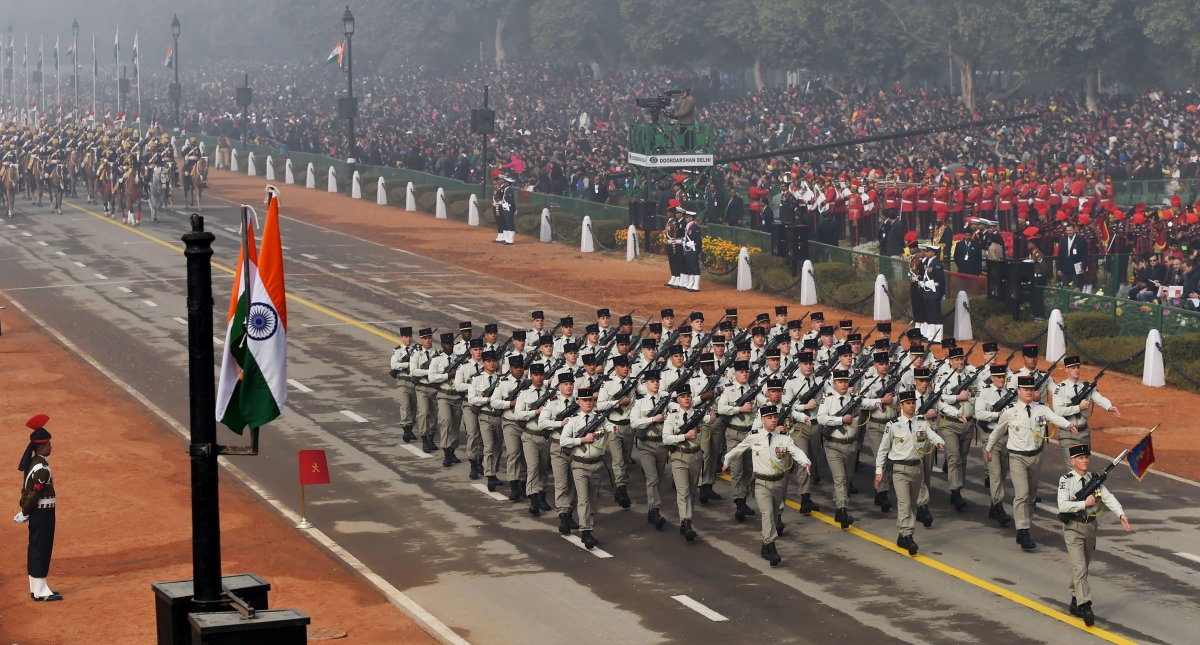
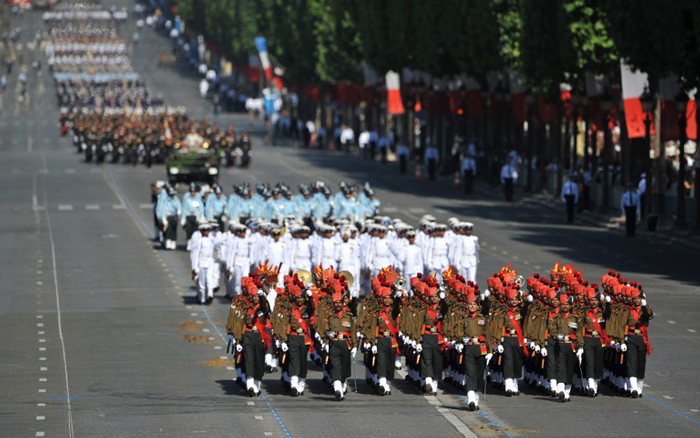
At India’s Republic Day celebrations today in Delhi, and partly since President Hollande is on a visit to India and was the chief guest, a French military contingent led the way at the grand Republic Day parade. It is the first time that foreign military forces have participated in the Republic Day parade. In 2009, a contingent of 400 Indian troops from the three services participated in the Bastille Day celebrations in Paris and led the march down the Champs Elysee. At that time PM Manmohan Singh was President Sarkozy’s guest.

I first visited the Republic Day parades as a child, three or four times, in the late 1950s and then had the privilege of attending three times between 2000 and 2006. It is one of the annual, spectacular highlights of the Delhi calendar and even the invariable, early morning, January mist cannot dim the colour and spectacle and pageantry of the occasion. It is also a strange but unique juxtaposition of cultural and military displays, which works remarkably well for a spectacle. India only became a Republic in 1950 and my fading memory of the early parades is of something much smaller with very little security, but still of the same stirring mix and colour and pageantry. The Republic Day celebrations in Delhi end with a less showy – but much more impressive -Beating the Retreat ceremony, around sunset on 29th January.

India Republic Day Parade

This is the first time that foreign military soldiers have taken part in the parade. ROBERTO SCHMIDT/AFP/Getty Images

IBTimesFor the first time in the history of India’s Republic Day parades, a foreign contingent marched in New Delhi on the country’s 67th Republic Day. A French Army contingent from the 35th Infantry Regiment, one of the oldest active regiments of France, took the historic steps by saluting Indian President Pranab Mukherjee, as chief guest of honour French President Francois Hollande watched and clapped. ….. The contingent led by Lieutenant Colonel Paul Bury had been practising for the parade for more than a week. ……. The choice for the 35th Infantry regiment was not random and kept in tandem with Indo-French military relations dating back to centuries. The 35th Infantry Regiment founded in the 1600’s and now headquartered in Belfort, served in India, joining the army of Hyder Ali, a south-Indian leader, by fighting British troops between 1781 and 1784. The motto of the regiment is “tous gaillards, pas d’trainards”, meaning “all strapping fellows, no dawdlers”.

Indian contingent leading bastille Day march on 14th July, 2009 PHOTO: AFP PHOTO/ERIC FEFERBERG

CatchNews:

The parade – which is touted to be Europe’s oldest and largest military parade – is held to commemorate the birth of the French revolution in 1789.

Indian troops led French military personnel down the Champs Elysee. The Indian contingent of 400 personnel – comprising personnel from the army, the navy and the air force – marched 1.5 km – from the Arc de Triomphe to the presidential stand.

The contingent – led by jawans from the Maratha Light Infantry, one of India’s oldest army regiments – marched to a 90-member Indian band.

Republic Day celebrations

Beating the Retreat 2010 — image Sify News

Jayalalitha and Tamil Nadu government more concerned about image than flood relief

December 8, 2015

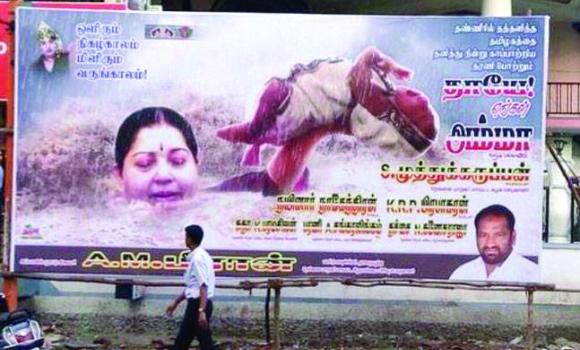
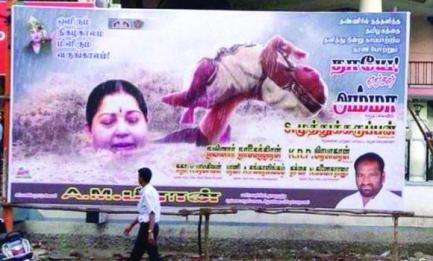
Jayalalitha and her government in Tamil Nadu are being heavily criticised for their absence and their abdication of their responsibilities during the flood relief operations. Instead, the ruling party, the AIADMK, has spent more efforts in producing posters and billboards promoting the Chief Minister. Such as this one where Jayalalitha (Amma) rescues a drowning baby single-handed. The billboard reads “Amma single-handedly saved Chennai city and stranded people from the disaster”and is based on a poster from the movie Bahubali.
Jayalalitha saving baby photo AFP

Jayalalitha saving baby photo AFP

The local media in Tamil Nadu dare not criticise Jayalalitha or her government under the threat of facing expensive and rigged  “criminal defamation” suits. Even reporting opposition politicians who criticise the government is considered “defamation”.  To get any balanced picture of what is happening within the state it is necessary to consult the Indian media outside Tamil Nadu and even media reporting Indian news in other parts of Asia.

Hindustan TimesThere are at least 200 criminal defamation cases pending against journalists and news outlets at the principal sessions court in Chennai for carrying stories deemed critical against the quality of governance in the state. All of these have been filed by the state government. ……. 

On November 30, the Supreme Court questioned the state government’s penchant for filing defamation cases. A bench of justices Dipak Mishra and Prafulla Pant advised the government to stop taking criticism of governance as personal insult.

The Hindu quoted Justice Mishra as saying: “You have to understand that these comments are criticism of a concept of governance. There is nothing against an individual … Why this criminal defamation then.”

Defamation is not the only deterrent to free and fair reportage in the state, according to the ombudsman of a local news channel which is seen as anti-establishment. “The government controls all the cable networks in the state through the TN Arasu Cable TV Corporation Ltd which is headed by the AIADMK’s K Udumalai Radhakrishnan. The channels critical of the government are simply taken off air.”

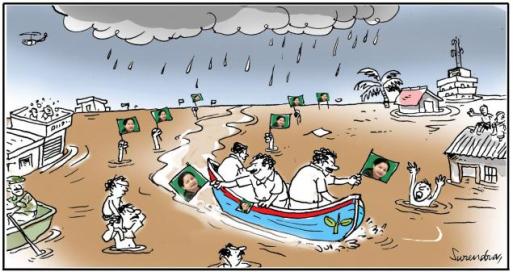
The TN government shambles in the flood relief has had to be made up for by volunteer and national institutions (Army, Navy). In fact the AIADMK party workers have actually hindered relief by their insistence on first putting stickers of Amma on relief packets before distribution.

To find more balanced view we have to go, for example, as far afield as to the South China Morning Post or to Arab News. But I was glad to see this cartoon in The Hindu today (and currently I consider The Hindu, published in Chennai, as the paper of record for India and far more reliable than the ToI). I expect that Jayalalitha’s fawning and apparently inept government will probably sue them for “criminal defamation” and try to harass them in other ways. (I take the liberty to reproduce the cartoon here because I would not be surprised to find that the TN government twists arms to get it taken down.)
The Hindu cartoon chennai floods 20151208

The Hindu cartoon chennai floods 20151208

SCMP: One of India’s most powerful politicians, a former movie star called “Amma” or “Mother” by her followers, is being heckled and abused for going missing in action after floods swept the capital of the southern state of Tamil Nadu, which she rules.

It’s a salutary lesson for Prime Minister Narendra Modi, who at first drew nods of approval when he rushed to Chennai last week, promising to stand by its people in their hour of need.

Yet, within hours, Modi became the object of mockery on social media after his press office released a doctored photo of him inspecting flood damage. For both him and Tamil Nadu Chief Minister Jayalalithaa Jayaram, the image of strong leadership created by their publicity machines was undermined.

Until the floods that ravaged the city of 6 million, the lofty remoteness of Jayalalithaa added to the aura around a leader with an almost hysterical following. Devotees of the 1960s screen idol have immolated themselves in her defence in the past.

Now, she faces a backlash from residents fed up with the sight of her image on billboards, aid packets and her own Jaya Plus TV channel. She has been since in public only twice during the crisis – once with Modi.

Arab News: But longtime Tamil Nadu Chief Minister Jayalalithaa Jayaram faced criticism for attempting to politicize the floods after a billboard appeared of her holding up a baby to save it from the floodwaters. The billboard, apparently erected by a party legislator in Chennai and depicting a scene from a local blockbuster movie, sparked a storm on social media.

Character, they say, shows up in times of stress. It cannot be claimed that the TN government has no character, only that it is fundamentally flawed and quite ugly.

Relief supplies in Chennai being held up by AIADMK party workers for publicity stickers

December 6, 2015

The rains in Madras (Chennai) have been the heaviest in 100 years. Which only proves that the climate is only doing what it has done before. Global warming and climate change have nothing whatever to do with the current situation. The flooding is unprecedented however. But it is the real estate feeding frenzy which has seen the old water bodies disappear as they were drained to satisfy the lust of the building developers. In addition, low lying areas have been paved over to give way to high rise monstrosities to satisfy the growth of the city, but the drainage provided has been at the minimum required by inadequate planning standards. Storm drains have not been given much thought. That water now collects in these low lying areas since there are inadequate run-off possibilities, makes the current flooding almost inevitable. Developers have gotten away with it because such heavy rains don’t come that often. Needless to say that the new IT corridor with its glistening, futuristic offices, is among the worst affected.

There will be much wailing and gnashing of teeth, and many innocent scapegoats will be found as the post-mortem gets under way once the waters recede, and the clean-up begins. I heard this morning that food prices are going through the roof (not unexpected) but at least water supply sources have not been reported to have been contaminated. Water snakes are having a field day but they are, at least, not venomous. Transport is paralysed though the airport opened again today. One unexpected problem is that bodies from deaths quite unrelated to the flooding are accumulating in homes and make-shift “cool houses”, for want of the ability to cremate them. (Normally cremation occurs within 24 – 48 hours of death). The highest risk for disease will probably come just after the waters recede and people become mobile again.

One does not expect, even at the best of times, that political party workers have any ethical standards at all (let alone any high standards). But the reports this morning that AIADMK party workers have been holding up relief packets just so that can first stick on pictures of the Chief Minister (Jayalalitha), must be a new low even for them.

LivemintAll India Anna Dravida Munnetra Kazagham (AIADMK), the ruling party of Tamil Nadu led by J Jayalalithaa, promised to take strict action against party workers who blocked volunteers or forced them to paste her pictures on relief materials meant for Chennai flood victims. ….

The AIADMK party workers’ decision to stick Jayalalithaa’s pictures on relief material and use the rescue efforts for publicity faced severe criticism from Chennai residents and others on social media.

While the rains have subsided, the city and other parts of Tamil Nadu are yet to recover from the flooding caused by the heaviest rains in a century that claimed over 300 lives and forced the National Disaster Response Force (NDRF) to undertake its most massive flood relief operation ever.

The waters are beginning to recede though further heavy rain is again forecast. Hopefully the worst is over and the relief has begun to flow in earnest. But the clean up will take some time.

There is behaviour and there is behaviour, but party political workers are a species unto themselves.