Archive for the ‘India’ Category

Indian monsoon season ends – deficient but no disaster

October 2, 2015

The official 4 month monsoon season (June – September) has ended and the cumulative rainfall falls into the “average” category (from -20% to + 20% of the long-term average), but only just, at -14% for the country as a whole. Rainfall was high in June, quite low in July and August and recovered somewhat in September. Good rainfall continues in October as the monsoon withdraws. Much of this is in deficient regions of Central and South India which will further mitigate the deficiency numbers.

There is some relief that in spite of 2015 being an El Niño year, the overall picture is one of some deficiency but no disaster. Locally there have been wide variations, even between contiguous regions:

  • Jammu & Kashmir recorded 15% excess rains, while next door, Himachal Pradesh was 23% deficient.
  • West Rajasthan recorded 46% excess, while East Rajasthan ended 10% down.
  • Telangana remained rain deficit to the tune of 20% and Andhra Pradesh recorded 10% excess.
  • West Madhya Pradesh recorded normal rains and was at +4% while East Madhya Pradesh was 29% in deficit.
  • West Bengal recorded 8% excess while adjacent Jharkhand was 14% in deficit.
  • Both Marathwada (-40%) and Vidarbha (-11%) were in rain deficit but the variation was large.

From a growth perspective, the 2015 monsoon will be a neutral event (i.e. it will make its “normal” contribution to the economic cycle). The impact will not provide any additional impetus to growth but will not hinder growth either.

As the Reserve Bank has now reduced its reference interest rates by 50 basis points and most of the banks now seem to be passing on about 40 basis point reductions to their lending rates, the cost of lending is likely – for this year – to be have a much greater impact on the economy than the effects of the monsoon. But at least the monsoon will now play its “normal” part in feeding the economic cycle. The monsoon deficiency should not contribute too much to inflation in food prices.

The immediate impact of a good monsoon is increased employment in rural areas (September – October) followed by increased rural consumption of consumer goods (October – December) and even sales of two-wheelers and tractors (November – March). Pesticide sales increase during the monsoon and again in the following pre-monsoon period. Fertiliser sales pick-up strongly in the pre-monsoon period following a good monsoon. The December – June period following a good monsoon is when rural “investments” are mainly made (machinery, equipment, construction, consumer goods). The indirect effects of agriculture on the services and manufacturing sectors are critical. However, even more important is the effect of a good monsoon on food price stability and general economic sentiment.

But I foresee no booms or fireworks in Indian economic activity over the next 6 months. That requires – among other things – the “feel-good” factor that a bumper monsoon brings. Still, 12 months of steady, sustainable growth is probably more valuable than some short-lived volatile balloon of activity.

After the China circus, steady rather than spectacular will be a welcome relief.

Monsoon 2015 - Deficient but no disaster Source IMD

Monsoon 2015 – Deficient but no disaster Source IMD
India still ranks abysmally low in the ease of doing business

September 18, 2015

Two reports have just been issued. The first is the World Bank’s assessment of doing business in India where India’s ranking among countries is depressingly low (considering the size of India’s economy). At 142nd of 189 countries India is in the bottom quartile of all countries. The second report assesses the relative success of the various Indian states in implementing business reforms and is issued by the World Bank and the Indian Government.

  1. Doing Business India 2015 World Bank
  2. State Assessment Report 14 September 2015

The WB assessment is broken down into 10 main areas and they have ranked 189 countries. In most categories the Indian ranking is embarrassingly low. (Even where the ranking is not too embarrassing, I note that there is a downside. Getting credit is apparently not too difficult but the other side of the coin is that the banks are sitting with a great deal of bad debt. Similarly minority interests are well protected but there are many cases of tyranny by the minority). I show the Indian rankings alongside those for Russia, China, Bangladesh and Mexico for reference.

In the overall ranking for Setting up a business India comes in at a lowly 142 of 189 countries. (Mexico 39, Russia 62, China 90, India 142, Bangladesh 173)

The rankings in the 10 main sub-categories are

  1. Starting a business –  Russia 34Mexico 67, Bangladesh 115, China 128, India 158
  2. Dealing with construction permits – Mexico 108, Bangladesh 144, Russia 156, China 179, India 184
  3. Getting electricity – Mexico 116, China 124, India 137, Russia 143, Bangladesh 188
  4. Registering property – Russia 12, China 37, Mexico 110, India 121, Bangladesh 184
  5. Getting credit – Mexico 12, India 36, Russia 61, China 70, Bangladesh 131
  6. Protecting minority investors – India 7, Bangladesh 43, Mexico 62, Russia 100, China 132
  7. Ease of paying taxes – Russia 49, Bangladesh 83, Mexico 105, China 120, India 156
  8. Trading across borders – Mexico 44, China 98, India 126, Bangladesh 150, Russia 155
  9. Enforcing contracts – Russia 14, China 35, Mexico 57, India 186, Bangladesh 188
  10. Resolving insolvency – Mexico 27, China 53, Russia 65, India 137, Bangladesh 147

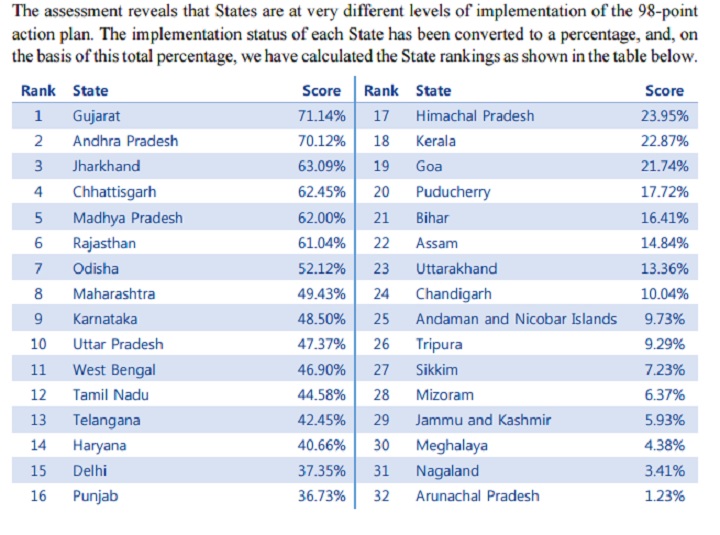
The second report deals with the performance of the different states in implementing reforms. Of course the states ranked high are now crowing over those ranked lower down. The hope of the Indian government is that this league table will enhance competition between states and will add an impetus to development.

State rankings September 2015

The ranking of the NCR of Delhi is almost pathetic and lies even behind an Uttar Pradesh (boosted by Noida) and a Haryana (boosted by Gurgaon). And while Gujarat is crowing over Bihar and Tamil Nadu peevishly questions the data, they all seem to forget that these are just state rankings for a country ranking which is abysmally low. States lying below 50% are at levels comparable to the lowest 10% of the 189 countries that have been ranked.

Indian GDP growth figures at 7.5% flatter somewhat – but are not wrong

August 31, 2015

India since the start of this year has been using a new method of calculating GDP and GDP growth. Basically 3 changes have been made.

  1. the base year has been changed from 2004-05 to now be 2011-12
  2. a “cost of production” based method has been changed to be a “market value” based method, and
  3. a database of just 5,000 corporate entities has been expanded to include over 500,000 entities

It is the use of “market value” rather than cost based data which is the biggest change and actually brings India more into line with the methods used by most other countries. Cost based (bottom up) analyses are always historical in nature, somewhat out-of-date by the time the data are used, and under-estimate real value. “Market value” based data should be more current but have a subjective element and can overestimate “value” especially in times of high inflation. The subjective element can work in both directions but brings in an element of “expectation” into what should be a look backwards. For example a calculation of GDP growth for a quarter consists of “value now” minus “value 3 months ago”. A “value now” estimation in times of high growth will overestimate and in hard times will underestimate. On the other hand a cost-based, bottom-up estimation of value will always lag and underestimate real value.

There is no “correct” method. The real question is what the “value now” is to be compared with. To compare with the growth in China or some other country it is better that the methodologies used be the same. Of course, differences of value (growth) will be different using the different methodologies. The “new” method at least uses a large enough database to be more representative of the constituent parts of the Indian economy as it actually is now.

Hindustan TimesAll of this means the new method for computing GDP, which takes 2011-12 (when GDP grew 6.7%) as the base year, has bumped up India’s estimates of growth. In 2012-13, the new formula estimates growth at 5.1% (under the old one, it was 4.5%); in 2013-14, it is 6.9% (the old estimate was 4.7%); and, as we all know by the high-decibel crowing that came in its wake, in 2014-15, it was 7.3%.

There’s obviously no ‘old data’ for 2014-15 but estimates suggest that the old method may have pegged growth at 6.3-6.8%. All of this may mean something else too.

Last week, FM Arun Jaitley told US investors that India could attain double-digit growth soon. He wasn’t kidding. Because what’s 10% now could’ve been just 8% before!

For the April-June quarter Indian GDP growth is estimated to have been 7.4% compared to the 7.5% in the preceding quarter (calculated by the new method). With the old method the number would probably have been about 5.8 – 6.2 %. A growth of 7.5% is somewhat flattering of the real mood in Indian industry that I can discern.

I have a suspicion that at 7.5% the growth figures are a little too high and contain an overly optimistic “market value”. It could be that there is an in-built “optimism” of the politicians and bureaucrats, rather than of industry, which is skewing the “value now”. “Reality”, if such a thing exists, lies somewhere in-between the values calculated by the two methodologies.


India to more than double coal production in next 5 years

August 26, 2015

Coal production in India is not keeping up with consumption. One of the bottlenecks has been the private production of coal which was expected to grow much faster but has been hampered by scams and bureaucratic regulation. Now the Coal Mines Special Provision Bill was passed in March and is meant to encourage the private sector and allows foreign investment through an Indian subsidiary.

The government is very ambitious and targets a domestic annual production of 1.5 billion metric tons by 2020 which is 2.5 times larger than the current 600 million metric tons.

India coal production target

The US Energy Information Administration (EIA) reports:

Coal consumption in India, particularly in the electric power sector, is outpacing India’s domestic production. From 2005 to 2012, India’s coal production grew by only 4.7% per year to about 600 million metric tons while the country’s coal-fired electric power capacity grew by a much faster rate (about 9.4% per year), reaching 150 gigawatts. To help resolve the shortfall in coal supply and to support expanded coal-fired generation, India has set a coal production target of 1.5 billion metric tons by 2020. Recent shifts in government policies and practices may play a key role in India’s ability to meet this coal production goal.

Increasing coal production from its national coal producer. Coal India Limited (CIL), the national coal producer responsible for more than 80% of India’s current production, initially planned to produce 1 billion metric tons of coal by FY2020, almost double its FY2015 production. Although CIL revised its current expectations downward to about 900 million metric tons, its annual production must still rise faster than the current rate of increase to achieve its new goal. Since 2012, CIL has increased coal production by outsourcing production operations to private and foreign companies in an effort to improve mechanization and mining expertise and by working to adhere to detailed mine plans for achieving its 2020 production target.

Encouraging greater private and foreign participation. In August 2014, allegations of impropriety, hoarding of coal resources, lost government revenue, and a lack of transparency led India’s Supreme Court to cancel 214 coal licenses allocated to the private and public sector, representing 9% of FY2013’s production. The Ministry of Coal quickly reauctioned many of these properties to help minimize the disruption from the cancellation, but the impact of this redistribution of coal properties on production is uncertain.

Private mining may be expanded further as a result of the Coal Mines Special Provision Bill passed in March. This law opens the door to commercial coal mining by both private companies and foreign companies having an Indian subsidiary. The government is now evaluating the effect of a coal block auction to allocate properties for commercial development—a significant change for a coal industry that has been nationalized for 40 years.

The simple reality is that coal is essential – and irreplaceable – for Indian development and growth.

Indian fertility rates – across all religions – are the lowest they have ever been

August 25, 2015

The Indian Census Commission today released its report on the Population by Religious Communities of Census 2011. (The Census 2011 dashboard is here). Across all religions, fertility rates have never been lower. By 2050 it is almost certain that all religious groups will have fertility rates lower than the replenishment rate. The demographics for the next 70-80 years are pretty well fixed and now can only be significantly altered by drastic measures (such as mass sterilisation or one-child policies)

While Chinese population has just peaked and is already in decline, the Indian population is expected to peak a little before 2050. Both China and India are then expected to have significant population decline  for the rest of this century.

The Hindu carries a comprehensive report:

India’s Muslim population is growing slower than it had in the previous decades, and its growth rate has slowed more sharply than that of the Hindu population, new Census data show.

The decadal Muslim rate of growth is the lowest it has ever been in India’s history, as it is for all religions.

Census 2011: Population growth is % per decade graphic – The Hindu

The Muslim population still grows at a faster rate than the Hindu population, but the gap between the two growth rates is narrowing fast. India now has 966.3 million Hindus, who make up 79.8 per cent of its population, and 172.2 million Muslims, who make up 14.23 per cent. Among the other minorities, Christians make up 2.3 per cent of the population and Sikhs 2.16 per cent. ….

……. As has been the case since Independence, the rate of increase of the Muslim population is higher than that of the Hindu population as a result of higher Muslim fertility, higher child mortality among Hindus and a greater life expectancy among Muslims, demographers say. However, Muslim fertility rates in India are falling faster than among Hindus, Pew Research’s Future of World Religions report showed recently, and the Muslim community is expected to reach replacement levels of fertility by 2050. …

…… The data on Population by Religious Communities of Census 2011 show that between 2001 and 2011, Hindu population grew by 16.76 per cent, while that of Muslims by 24.6 per cent. The population of both communities grew faster during the previous decade, at 19.92 per cent and 29.52 per cent, respectively. As a long-term trend, say demographers, the communities’ growth rates are converging.

Half-way through, Indian monsoon on course to be close to “normal”

July 31, 2015

Compared to “normal” the Indian monsoon has a large downside and a limited upside. It is thought that a “bad” monsoon (accumulated rainfall 20% less than normal) can depress GDP by 2 percentage points. A “good” monsoon (20% greater than normal) however can raise GDP by only about 1 percentage point since the benefits are capped by areas of local flooding. The monsoon lasts 4 months (June – September) but its indirect effects are felt all the way through to the start of the next monsoon. Agriculture contributes only 17% of India’s GDP directly but agriculture employs almost 65% of the Indian work-force.

Indian Economy

The immediate impact of a good monsoon is increased employment in rural areas (September – October) followed by increased rural consumption of consumer goods (October – December) and even sales of two-wheelers and tractors (November – March). Pesticide sales increase during the monsoon and again in the following pre-monsoon period. Fertiliser sales pick-up strongly in the pre-monsoon period following a good monsoon. The December – June period following a good monsoon is when rural “investments” are mainly made (machinery, equipment, construction, consumer goods). The indirect effects of agriculture on the services and manufacturing sectors are critical. However, even more important is the effect of a good monsoon on food price stability and general economic sentiment.

The current monsoon is now half-way through. June saw accumulated rainfall about 15% higher than normal while July has seen a shortfall of about 16%. For the 2 months the accumulated rainfall is now just short of “normal”. Revised forecasts are for a small shortfall during August followed by some excess in September and for the whole period rainfall to be close to “normal”. Timing of rainfall is important but the rains have kept reasonably close to the expected time-line.

The potential downside of a “bad” monsoon seems to have evaporated. My conclusion is that India should see a strong growth period in the September 2015 – May 2016 period, as the Modi government’s sluggish reforms pick up some steam and as the seasonal effects of a near-normal monsoon trickle through the economy.

Is embarrassing Gujarat data holding back the Indian Health and Nutrition Survey?

July 3, 2015

According to the BBC, the massive undertaking that is the Indian Health and Nutrition Survey has been completed, should have been released in October 2014, was last issued in 2007 and even has an encouraging story to tell. But the data on Gujarat is not an edifying tale in comparison to other states. Economic growth in the state has not translated into any major advance compared to other states. In fact the Gujarat performance is worse than most. 42% of all children are stunted and half of all children are malnourished.

Is the report too damaging to Modi’s Gujarat story? And is it therefore being held back by Modi’s public relations managers? The official position is that the methodology is being reviewed. But it is more likely being held back to somehow massage the Gujarat figures. It will be difficult because copies of the completed – but not officially released – report are now available widely.

BBC:

Good health data is rare in India. The last time the country published a comprehensive, state-wide survey was back in 2007. So why hasn’t a vast survey of women and children carried out by the Indian government with the UN agency for children, Unicef, been released?

India’s so-called Rapid Survey of Children was a huge undertaking. Almost 100,000 children were measured and weighed and more than 200,000 people interviewed across the country’s 29 states. The final report was due for publication in October last year, the BBC understands. Yet, more than half a year later, the important body of data remains secret.

Leading development economist Jean Dreze describes the delay in publication as “an absolute scandal”. “All the neighbouring countries including Bangladesh, Nepal, Sri Lanka, Bhutan, Pakistan and even Afghanistan have up to date nutritional surveys,” he says. “It is hard to account for a 10-year gap without attributing some sort of political reluctance.” …..

Looking just at the overall figures, India’s reluctance to publish the survey is rather surprising. It shows the country has an encouraging story to tell. Indicators of malnutrition are still very high, far higher than most African nations, but they are improving. Ten years ago, two-fifths of children under five were underweight, now it is more like a third.

However, the survey confirms large and enduring discrepancies between states, including the continuing strikingly poor performance of the Indian prime minister’s home state, Gujarat. As chief minister, Narendra Modi ran the state for more than a decade. His general election campaign was based on the promise that he would do for India what he had done for Gujarat.

Is anybody surprised?

Monsoon recovers from slow start – rainfall running 20% higher than “normal”

June 29, 2015

The SW Monsoon has, after a late, slow start, spread across all of India and is just crossing the NW frontier into Pakistan. This normally only happens around the 15th of July. Just 5 weeks ago the IMD’s updated long range forecast (Forecast 2) warned that the monsoon would be later than predicted and that total rainfall could be deficient.

  1. Rainfall over the country as a whole for the 2015 southwest monsoon season (June to September) is likely to be deficient (<90% of LPA).
  2. Quantitatively, monsoon season rainfall for the country as a whole is likely to be 88% of the long period average with a model error of ±4%.
  3. Region wise, the season rainfall is likely to be 85% of LPA over North-West India, 90% of LPA over Central India, 92% of LPA over South Peninsula and 90% of LPA over North-East India all with a model error of ± 8 %.
  4. The monthly rainfall over the country as whole is likely to be 92% of its LPA during July and 90% of LPA during August both with a model error of ± 9 %.

Moreover the risk of this being a La Nina year could further depress rainfall, we were warned by IMD. The fear of drought led to government updating emergency plans and for state governments to prepare emergency budgets. A private forecaster, Skymet,  however suggested that Indian farmers need not worry too much.

Economic Times Skymet is a young weather forecasting agency that has, with gradually amplifying audacity, been challenging the monopoly of the India Meteorological Department (IMD), the hoary state-led colonial-era institution, on matters related to climate and weather in India. ….. The IMD has usually been the final word on droughts but this time Skymet has asserted that the IMD is grievously mistaken. The IMD expects India to get ‘below normal’ rains during the coming monsoon months between June and September whereas Skymet says farmers and citizens needn’t be worried: India is going to have ‘normal’ rains.

(The IMD scientists – based on my small experience with them – are very sober and very rigorous, doing good science. But the organisation’s presentation skills are conspicuous by their absence and their public relations skills are sadly lacking. The IMD website is particularly poor. They have little clue as to how to present their forecasts for the media or the general public.)

In the event, the monsoon has surged over the last 10 days and the all-India-spread has been reached almost 2 weeks earlier than “normal”. Last year this was achieved on 17th July.

Monsoon spread till 28 June 2015 - Skymet graphic from IMD data

Monsoon spread till 28 June 2015 – Skymet graphic from IMD data

It is still early days and the monsoon is only one month into its 4 month season, but currently the rainfall (weighted average) is running some 23% above “normal”. So far it would seem that Skymet’s optimism may be closer to the mark than IMD’s dour pessimism. A weak La Nina year is still possible but 2015 will not go down as a peak La Nina year.

Rainfall during June 2015

Rainfall during June 2015

In the wettest East/North East region, rainfall is close to normal. In all other regions rainfall has been “in excess”. So far the cumulative rainfall would be classified as being “plentiful”.


Post-intellectual West Bengal

June 23, 2015

The new post-intellectual intelligentsia ruling West Bengal are demonstrating the heights to which they aspire:

NDTV: West Bengal Chief Minister Mamata Banerjee’s nephew Abhishek has publicly threatened to “gouge out the eyes and chop off the hands” of anyone who dares to hurt Bengal’s interests. … “Those who dare to glare at us, we can gouge their eyes out and throw them on the road. Show us your hands and we can cut them off,” Abhishek said, adding, “But remember, it is the common man who will have the last word.” …

… Last year, Mamata Banerjee and the Trinamool Congress had to face many embarrassing questions after a prominent parliamentarian, actor Tapas Pal, said at a public meeting: “If the CPM people touch a hair on the head of my workers, I will set my boys upon their women to rape them.”

The West Bengal of today is not the intellectual or cultural powerhouse it once was. I finished my schooling in Calcutta long before it had been ravaged to be called Kolkata. I have been a regular visitor since then and was last there in 2014 for the 50th anniversary of graduating from school.

I grew up knowing – and living – with the intellectual legacy of Swami Vivekananda (Narendra Nath Datta), Rabindranath Tagore and Jagadish Chandra Bose. Satyajit Ray and Ravi Shankar were living legends. But they were all of the old school of Bengali intellectualism. Since then West Bengal was first plagued by 5 decades of a very peculiar Marxist communism. Just two layers of society were recognised. First came the agricultural masses who were all organised into almost-martial cadres and then there were the politburo and its hangers-on who amassed their corrupt wealth. The middle class and those who actually contributed to growth and culture and thought were reviled and oppressed. Marxist communism collapsed in on itself after years of decay. The communists were then replaced by an even more peculiar bunch, the Trinamool Congress. They are led by the narcissistic Mamata Banerjee with the slogan “Ma Mati Manush”  which is supposed to mean “Mother, Motherland and People” but where the sub-text says “Me, Me and Me”.

As an aside, I note that in spite of the efforts of post- nationalists, Theatre Road is still Theatre Road to all taxi drivers. It was renamed as  Shakespeare Sarani during my time there in the 1960s but that is only for maps and road signs. More than 50 years after the name was changed, the Post Office will still deliver your mail addressed to Theatre Road. Lansdowne Road is still Lansdowne Road and many don’t even know it is now called Sarat Bose Road. Lower Circular Road  is still referred to as such, though it is officially Acharya Jagadish Chandra Bose Road. Who does not know Park Street (officially Mother Teresa Sarani and earlier Burial Ground Road) and Park Circus? Camac Street and Free School Street were part of my schooldays beat and are still there – though the building we lived in no longer exists. Officialdom can be schizophrenic and is often irrational. High Courts are set up by Acts of Parliament and their names cannot be changed so easily. So it is the High Court of Calcutta in Kolkata. The Netaji Subhas Chandra Bose International Airport is the mouthful rarely uttered for what was Dum Dum airport and is still designated CCU.

In the 1970s post-intellectual Bengal produced a vicious and violent movement – the Naxals – who considered themselves intellectuals but who in reality were anything but. They considered themselves Maoist communists, engaged in a permanent revolution (a la the cultural revolution) and naturally opposed to everybody else, including the Marxist communists in power in the state. Mayhem was the name of the game. Culturally they were the Bengali Taliban. Many of the starry-eyed, self-styled and self-proclaimed “intellectual” leaders were killed by vicious police and army actions in the early 1970s. Some of my class mates were among them. This revolutionary communist movement still exists in pockets and has spread to other states. But the movement lacks any intellectual content or realism.

In recent times intellectuals from West Bengal have been few and those few have been relatively lightweight. Amartya Sen may have received a Nobel prize but it was only for economics which does not really count. His theories suffer from the confusion of his wanting to be a capitalistic socialist and he ends up being nothing of anything. Pranab Mukherjee was a disaster as a Finance Minister and is nondescript as President. Intellectually, just a bantam-weight.

It is a post-intellectual, post-nationalist West Bengal struggling to find a new role for itself.

Monsoon slow to reach North West but rainfall running 11% above average

June 22, 2015

In spite of a forecast of a deficient monsoon, a late start and a possible El Nino year, so far, so good.

The advance of the monsoon front is a little slow across central India and into the North West. Pakistan is experiencing a heat wave.

monsoon advance June 21st 2015 - IMD

monsoon advance June 21st 2015 – IMD

Rainfall has been holding up quite well. Accumulated rainfall across the entire country (weighted average) in the 3 weeks of the 16 week long monsoon season is running about 11% higher than the long-term average. Rainfall is deficient (from a low expected value) only in the North West region and is above average elsewhere. Even rainfall in the Southern region which often starts deficient is running some 20% above average. In this period the heaviest rainfall is usually in the North East and even here it is running 5% above normal.

rainfall till 20th june 2015 - IMD

rainfall till 20th june 2015 – IMD

The start, at least, is better than was feared and the government will be relieved that the emergency plans for “drought” conditions will not, yet, need to be activated.