Archive for the ‘India’ Category

Great Himalayan earthquake is still waiting to happen

April 27, 2015

This earthquake in Nepal – devastating as it was – has not released enough of the pent-up strain under the Himalayas. The death toll now exceeds 3,500 and most are due to collapsing buildings.

It would need about 50 such quakes with magnitude 7.9  or one super quake of magnitude 9 to release all the slip built up over centuries. The Indian tectonic plate is being subducted under the Eurasian tectonic plate with the Indian Plate moving North East at about 6 -7 cm per year while the Eurasian Plate is moving Northwards at about 2 cm per year. There is a net 2 – 3 cm of slip to be accumulated – or to be relieved by some form of energy release – every year.

The Great Himalayan Earthquake has still to come. The scale of loss of life and devastation will be magnified greatly if the Great quake is located in the central Himalayas such that the tremors extend into the densely populated Gangetic Plain. The central Himalayas have not seen any large quakes for about 700 years and the pent-up energy is ominous. It is highly unlikely that either in Nepal or in the vulnerable regions of India, that buildings will be sufficiently “earthquake-proofed” to minimise the loss of life (and over 90% of the loss of life is due to the collapse of buildings).

Down to Earth: … It has been hypothesised for long that a large earthquake, called the “great Himalayan earthquake”, can strike anytime, but its time and place cannot be predicted. In many locations in the Himalayan belt there is enough energy stored currently to lead to one.

At a magnitude of 7.9 on the Richter scale, the April 25 earthquake has caused devastation but it is not the anticipated “great Himalayan earthquake”.  This does not qualify as a great earthquake which needs to be of magnitude 8, says Roger Bilham, geologist with the University of Colorado Boulder who studies the seismicity of the Himalayan area. “The earthquake is in a region that is being compressed by18 mm each year,” he says. The amount today’s earthquake slip would have been exactly right to release all this accumulated stress, he adds. His team has identified some areas where the great Himalayan earthquake is anticipated (see image). The question mark shows the area where an earthquake is potentially possible but the magnitude is not known.

himakayan

Anticipated Himalayan Earthquakes

 “This (Nepal earthquake) has unfortunately not come as a surprise. We expected an earthquake of high magnitude in the region between Kathmandu and Pokhara,” says Paul Tapponnier from Nanyang Technological University’s Earth Observatory of Singapore who also studies earthquakes in the area. Tapponnier’s earlier work showed that the quakes in 1255 and 1934 were ground-breaking quakes or when ruptures develop in the earth’s crust and the pent up energy in the earth is released. As the areas west or east of the 1934 Nepal ground rupture do not have records of earthquakes, they are at a greater risk of a major earthquake.

In a paper published just two months ago scientists from the Jawaharlal Nehru Centre for Advanced Scientific Research conclude that “the frontal thrust in central Himalaya may have remained seismically inactive during the last ~700 years. Considering this long elapsed time, a great earthquake may be due in the region”.

The Himalaya has experienced three great earthquakes during the last century—1934 Nepal-Bihar, 1950 Upper Assam, and arguably the 1905 Kangra. Focus here is on the central Himalayan segment between the 1905 and the 1934 ruptures, where previous studies have identified a great earthquake between thirteenth and sixteenth centuries. Historical data suggest damaging earthquakes in A.D. 1255, 1344, 1505, 1803, and 1833, although their sources and magnitudes remain debated. ….. Age data suggest that the last great earthquake in the central Himalaya most likely occurred between A.D. 1259 and 1433. While evidence for this rupture is unmistakable, the stratigraphic clues imply an earlier event, which can most tentatively be placed between A.D. 1050 and 1250. …. Rupture(s) identified in the trench closely correlate with two damaging earthquakes of 1255 and 1344 reported from Nepal. The present study suggests that the frontal thrust in central Himalaya may have remained seismically inactive during the last ~700 years. Considering this long elapsed time, a great earthquake may be due in the region.

Other scientists also estimate that this current quake has dissipated only a very small part of the energy stored under the Himalayas and waiting to be released:

Indian Express:

“We know there is a huge amount of accumulated strain in this area. It is due for a major earthquake, perhaps a series of earthquakes, bigger than 8 on the Richter scale. That is the kind of energy that is estimated to be accumulated there. This was certainly not one of those earthquakes that is probably imminent. In terms of energy release, I would say this would not have released even four or five per cent of the energy that is estimated to be stored there,” said Harsh K Gupta, former director of the Hyderabad-based National Geophysical Research Institute and a former member of the National Disaster Management Authority.

Prof Sankar Kumar Nath of IIT Kharagpur, who has studied seismic activity in the Himalayan region, said the energy released from Saturday’s earthquake “was equivalent to the explosion of about 100mn tonnes of TNT, comparable to the energy in detonation of small nuclear bombs”.

“This earthquake would only be classified as medium in terms of energy released. That area, the 2500-km stretch from the Hindukush region to the end of Arunachal Pradesh, is capable of generating much bigger earthquakes, even nine on Richter scale,” he said.

“If you look at it differently, we are actually lucky that only a 7.9-magnitude earthquake has come. I would be very happy to have a few 7.9-magnitude earthquakes than a 9-magnitude earthquake which would be absolute disaster. The trouble is that in terms of energy release, which is what causes the damage, it would take 40 to 50 earthquakes of magnitude 7.9 to avoid an earthquake of magnitude 9,” he said.
Death toll in Nepal still rising as aftershocks put rescue efforts on hold

April 26, 2015

A strong 6.7 magnitude aftershock hit Nepal this morning, 25 hours after the primary quake, as the death toll continues to climb. At least 30 shocks of magnitude greater than 4.0 have been felt. Kathmandu airport which was open has been closed till 4pm local time because of the aftershocks. Rescue efforts have been put on hold while the aftershocks continue. Air Traffic Control staff have been evacuated from the airport for now.

Indian Air Force Mi-17 helicopters reached Mount Everest and began ferrying injured back to Kathmandu with the first relief flights reaching this morning. So far the IAF has deployed 5 helicopters and another 6 are on their way. It is feared that 65 mountaineers on Mt. Everest may have been killed at the base camp and in the avalanche yesterday. The aftershocks have caused at least 3 further avalanches on Everest today.

Tremors from the aftershocks have been felt in Delhi, UP, Bihar, W.Bengal, and Assam. The final toll may exceed 2,000 as rescuers reach more remote regions.

USGS:

  1. Aftershock: 6.7 magnitude, 17km S of Kodari, Nepal2015-04-26,  07:09:08 UTC, 10.0 km deep
  2. Secondary quake: 6.6 magnitude, 49km E of Lamjung, Nepal2015-04-25, 06:45:21 UTC, 14.6 km deep
  3. Primary quake: 7.8 magnitude, 34km ESE of Lamjung, Nepal, 2015-04-25, 06:11:26 UTC, 15.0 km deep

Both India and China see Nepal as being within their natural “sphere of influence” and a hint of that competition is visible as the two countries now lead the international rescue efforts. In addition to a Chinese medical team that was already in Nepal, three further medical teams from neighboring Sichuan, Chongqing and Yunnan have gone to Tibet.

Xinhua:A 62-strong China International Search & Rescue Team left for Nepal early Sunday. With six sniffer dogs and relevant rescue and medical equipment, the team is expected to arrive in Kathmandu midday Sunday on a chartered plane, according to the China Earthquake Administration.

India sent two relief planes of air force to disaster-struck zones hours after the quake took place. Indian Prime Minister Narendra Modi called up his Nepalese counterpart Sushil Koirala, and assured him of all help. Two military aircraft, a C-130 Hercules and a C17 Globemaster, took off from the Hindon air base in Delhi to Kathmandu with relief workers, medicines and blankets, said Press Trust of India.

Disaster teams from the UK, US and Israel are already on their way as well and many other countries have offered assistance.

Nepal earthquake toll near 1500 with casualties also in India and Tibet

April 25, 2015

The Indian Tectonic Plate is being subducted under the Eurasian Plate. The collision is still going on with the Indian Plate moving North East at about 6 -7 cm per year while the Eurasian Plate is moving Northwards at about 2 cm per year. The subduction occurs in fits and starts and relies on earthquakes to release the slip pressure. The likelihood of a single Himalayan earthquake of magnitude 8 or a series of magnitude 7 quakes was discussed a few years ago

If a great earthquake has not occurred on a specific segment in the Himalaya for 200 years, that segment will slip 4m because the convergence rate between India and Tibet is roughly 2cm each year. If it has not occurred for 500 years the segment would slip 10m, enough for an event that would measure 8, or Magnitude Eight on the Richter Scale. The time interval between great earthquakes thus determines the amount of slip that will occur in the next one.

…. A large segment of the Himalaya between Kathmandu and Dehradun has a record of several earthquakes but only two large ones: an event in 1803 and another in 1833. If these were great earthquakes then there is now roughly 3m of slip ready to go. However, if they were magnitude 7 earthquakes, then there may be more than 20m of slips availabIe for a future great earthquake.

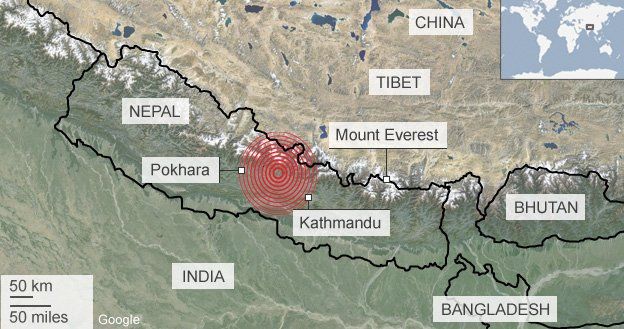
Nepal earthquake map

graphic: BBC

It would seem that this earthquake near Kathmandu was a large one (7.8 magnitude) and may have released around 5 – 8 m of slip but as has been pointed out there may be a total of around 20m of slip waiting to occur. The current quake has so far seen some 16 aftershocks of magnitude 4.5 or greater. Deaths in India are over 40 and the Indian government is mounting a large rescue effort in support of the Nepali government, “Fifty doctors have arrived from India to provide emergency services. India dispatched as many as four aircraft including a C-130 plane carrying three tonnes of relief supplies and a 40-member rescue team to Nepal.” Three more planes are to follow carrying a mobile hospital and medical supplies.

FirstPost: The quake measuring 7.9 on Richter scale, which was followed by 16 aftershocks of magnitude 4.5 or greater, striking heavy casualties in Kathmandu and injuring thousand others. Hundreds were feared missing across the country. “Army estimates death toll as much as 1457 so far,” Nepal’s Finance Minister Ram Sharan Mahat tweeted. …….

The earthquake around 11:56 am with epicentre at Lamjung, around 80 kilometers northwest of Kathmandu, had its impact in several cities in Bihar, West Bengal and Uttar Pradesh and tremors were felt across vast stretches of east and North East India. It was also felt in Southern and Western parts of India, China, Bhutan and as far as Pakistan and Bangladesh.

The US Geological Survey reports:

The April 25, 2015 M 7.8 Nepal earthquake occurred as the result of thrust faulting on or near the main frontal thrust between the subducting India plate and the overriding Eurasia plate to the north. At the location of this earthquake, approximately 80 km to the northwest of the Nepalese capital of Kathmandu, the India plate is converging with Eurasia at a rate of 45 mm/yr towards the north-northeast, driving the uplift of the Himalayan mountain range. The preliminary location, size and focal mechanism of the April 25 earthquake are consistent with its occurrence on the main subduction thrust interface between the India and Eurasia plates.

Although a major plate boundary with a history of large-to-great sized earthquakes, large earthquakes on the Himalayan thrust are rare in the documented historical era. Just four events of M6 or larger have occurred within 250 km of the April 25, 2015 earthquake over the past century. One, a M 6.9 earthquake in August 1988, 240 km to the southeast of the April 25 event, caused close to 1500 fatalities. The largest, an M 8.0 event known as the 1934 Nepal-Bihar earthquake, occurred in a similar location to the 1988 event. It severely damaged Kathmandu, and is thought to have caused around 10,600 fatalities.

Was this the big earthquake that was predicted in the Himalayas?

In an interview to The Hindu in May 2013, Vinod Kumar Gaur, seismologist with the Centre for Mathematical Modelling and Computer Simulation, had said: “Calculations show that there is sufficient accumulated energy [in the MFT], now to produce an 8 magnitude earthquake. I cannot say when. It may not happen tomorrow, but it could possibly happen sometime this century, or wait longer to produce a much larger one.”

In a study published in the journal Nature Geoscience in December 2012, a research team led by Nanyang Technological University (NTU) discovered that massive earthquakes in the range of 8 to 8.5 magnitudes on the Richter scale had left clear ground scars in the central Himalayas

High resolution imagery and dating techniques showed that in 1255 and 1934, two great earthquakes ruptured the surface of the Earth in the Himalayas. The 1934 earthquake broke the surface over a length of more than 150 km.

India (finally) puts Ford Foundation and Greenpeace on watch list

April 25, 2015

The Indian government has put the Ford Foundation and Greenpeace on their “watch” list. It was about time. The Ford Foundation serves as an instrument of the CIA and the US government in prosecuting foreign policy and Greenpeace has degenerated into a home for the far-left and the communists who have been left homeless since the collapse of Marxist (and Maoist) ideologies.

NGOs, “not for profit” organisations and charities often take advantage of the misperception of an implied objectivity or impartiality or of being apolitical. A very few such organisations may come close to being so but the vast majority exist to promote a particular view or support a particular group of people or to carry out particular kinds of projects. In every instance they are deeply – and inevitably – political. Nothing wrong with that of course but it is a common misperception to think that being non-profit they are somehow above politics. They are sometimes funded by governments, sometimes used by governments and sometimes used by opposition to governments. They are sometimes used as a cover for espionage (industrial and by states) and sometimes to “promote democracy” by undermining some other view. They sometimes provide much needed education and health care. And sometimes they use education or health services as a cover for carrying out political or religious indoctrination. Madrasas funded from Saudi Arabia as being educational are purely religious and political. The ostensible reason for the existence of the organisation is often used to cloak a hidden agenda. So-called charity workers and others in the field may not even be aware of the hidden agenda they are promoting.

In most cases these organisations enjoy tax breaks. When they receive government funding it is often to enable governments to covertly act in a manner they can not as a government. They are sometimes used for money laundering and sometimes are just a scam for extracting funds from donors. Even so-called charities may actually donate to others less than 10% of the money they raise. Sometimes they do good and often they don’t.

But the bottom line is that they are all – without exception – political. The political standpoint may be implicit or it may be explicit but it is always there. There is no “human rights” charity or NGO which does not have a political agenda. There is no “centre for democracy” which does not have some political agenda which – perforce – is in conflict with the prevailing “authority” or “government”. ISIS, after all, would qualify as a “not for profit” NGO. There is no “wildlife protection” NGO which does not promote a political agenda which may be as simple as preventing poor farmers from clearing forests to grow more crops, or the development of a highway.

I have no doubt that some NGOs – and usually those without the backing of Big Funds – bring attention to and take action in areas that are desperately necessary but which fall between the cracks of government or public policy. But when an NGO is funded by the Ford Foundation or the Bill & Melinda Gates Foundation, I am automatically suspicious about the hidden agenda in that organisation’s objectives.

Many organisations – Greenpeace, the WWF and the FoE as examples – which once had some worthy aims and even did some good work have -since 1991 – been hijacked by the far-left and communists who had no place else to go. In India it is not surprising that the Maoists and the Naxals and other “dissenting and seditious” groups have become the beneficiaries of such NGOs. During my time in the Indian corporate world (2000 -2007) I met with many NGOs seeking corporate funds – but I was not too impressed. Even less so when I found that at remote sites where we were executing projects, the protection money (sometimes even ransom money for our engineers) being demanded by local mafiosos were to be channeled through some ostensibly do-gooding NGO.

The Ford Foundation has for long been used and is still used by the CIA (and the US government) as a vehicle for promoting US policy.

Global Research: The CIA uses philanthropic foundations as the most effective conduit to channel large sums of money to Agency projects without alerting the recipients to their source. From the early 1950s to the present the CIA’s intrusion into the foundation field was and is huge. A U.S. Congressional investigation in 1976 revealed that nearly 50% of the 700 grants in the field of international activities by the principal foundations were funded by the CIA (Who Paid the Piper? The CIA and the Cultural Cold War, Frances Stonor Saunders, Granta Books, 1999, pp. 134-135). The CIA considers foundations such as Ford “The best and most plausible kind of funding cover” (Ibid, p. 135). The collaboration of respectable and prestigious foundations, according to one former CIA operative, allowed the Agency to fund “a seemingly limitless range of covert action programs affecting youth groups, labor unions, universities, publishing houses and other private institutions” (p. 135). The latter included “human rights” groups beginning in the 1950s to the present. One of the most important “private foundations” collaborating with the CIA over a significant span of time in major projects in the cultural Cold War is the Ford Foundation.

….. History and contemporary experience tells us a different story. At a time when government over-funding of cultural activities by Washington is suspect, the FF fulfills a very important role in projecting U.S. cultural policies as an apparently “private” non-political philanthropic organization. The ties between the top officials of the FF and the U.S. government are explicit and continuing. A review of recently funded projects reveals that the FF has never funded any major project that contravenes U.S. policy.

So I was not too surprised to read that the Ford Foundation and Greenpeace India have been put on the Indian government’s watch list.  My surprise is that the Ford Foundation with its CIA connections has been allowed to fund – albeit indirectly – dissension and sedition within India for so long.

Zee News (PTI): The United States on Friday expressed concern over India’s crackdown on Ford Foundation and Greenpeace, and said it is seeking “clarification” on the action.

“We are aware that the (Indian) Ministry of Home Affairs suspended the registration of Greenpeace India and has placed the Ford Foundation on a prior permission watch list,” State Department Deputy Acting Spokesperson, Marie Harf, told reporters at her daily news conference.

“We remain concerned about the difficulties caused to civil society organisations by the manner in which the Foreign Contributions Regulations Act has been applied,” she said in response to a question.

“We are concerned that this recent ruling limits the necessary and critical debate within Indian society and we are seeking a clarification on this issue with the appropriate Indian authorities,” Harf said.

In a crackdown on foreign funding to NGOs, the Union Home Ministry has put the Ford Foundation of the US on its “watch list” and ordered that all funds coming from the international organisation have to be routed only with its nod due to “national security concerns”.

The Home Ministry said it has decided to keep a watch on all activities funded by Ford Foundation and by exercising the powers conferred under Section 46 of Foreign Contribution Regulation Act 2010, directed Reserve Bank of India to ensure that funds coming from it be brought to the notice of the Home Ministry.

The Ministry said it wanted to ensure that funds coming from Ford Foundation is utilised for “bonafide welfare activities without compromising on concerns of national interest and security”.

The move came after Gujarat government asked the Home Ministry to take action against Ford Foundation as it alleged that the US-based organisation was “interfering in the internal affairs” of the country and also “abetting communal disharmony” through an NGO run by social activist Teesta Setalvad.

Early this month, the Home Ministry had frozen seven bank accounts of Greenpeace India and barred it from receiving foreign funds for allegedly violating FCRA and “prejudicially” affecting the country’s public and economic interests.

Non-profit does not mean non-partisan or apolitical.

For me NGOs is a dirty word.

Time to invest in fossil fuels as China discovers vast new reserves

April 21, 2015

There is a campaign in the western “do-gooding” and deluded “green” community (exemplified by The Guardian) to pressurise investors to disinvest from fossil fuels. Fortunately there is no shortage of investors in Asia who would be only too happy to see the European financial institutions and pension funds selling off their shares in oil, shale and coal producing and using companies. There are few better investments than snapping up artificially depressed energy shares. I am watching closely to pick up any bargains that might appear if this campaign has any impact. So far it has had little effect.

In the 1970s and 1980s the alarmist view was that coal, oil and gas would run out catastrophically. Now that peak-oil and peak-gas have been pushed out into the indeterminate future and further new shale reserves are found, the alarmism has shifted to the use of these resources being catastrophic! The campaign itself is rather idiotic (“leave it in the ground”) and counter-productive, since any success can only shift ownership of energy companies eastwards. Supposedly – but misguidedly – it is about climate but the campaign has no measurable or relevant objectives. (Note that no “climate policy”  ever has a climate parameter as an objective and which can be measured.) It will certainly not reduce the consumption of fossil fuels at all – which will instead continue to grow as developing countries develop. In fact the competitiveness of the fossil fuel using countries will be further emphasised as the “do-gooding” countries entrap themselves into a very high-cost electricity production regime based on intermittent solar and wind energy. (It is worth noting that Germany which has installed more renewable energy than any other European country now has an electricity cost which is the highest in Europe and more than twice that of the US. And yet Germany burned more coal last year than they have ever done! The German Energiwende has been a fiasco for all other than those who have milked the subsidies available)

There is – again fortunately – no prospect of India, China and other developing countries in Asia and Africa reducing their use of all the fossil fuels they have available. If I could I would be investing directly in coal and oil and natural gas and shale gas in India and China and Indonesia. At present I must satisfy myself with some indirect investment.

History will be contemptuous of the irrational demonisation of fossil fuels by the alarmists and the “do-gooders” during the late 20th and early 21st century.

Xinhua reports:

China continued to be increasingly successful at discovering crude oil and natural gas reserves last year, new data from the Ministry of Land and Resources indicated on Thursday.

The country discovered nearly 1.06 billion tonnes of new crude oil deposits in 2014, up from 1.1 billion tonnes the previous year, marking a stable increase and the eighth consecutive year in which the amount discovered surpassed 1 billion tonnes. More than 1.1 trillion cubic meters of new natural gas reserves were also discovered in 2014, a record high.

Of the new discoveries, 187 million tonnes of oil and 474.9 billion cubic meters of natural gas can be exploited with current technology, according to the ministry.

New shale gas reserves discovered amount to 106.75 billion cubic meters, with 26.69 billion exploitable.

This is the first time that proven reserves of shale gas have been publicized since the Chinese government approved the listing of shale gas as an independent mineral resource in 2011.

Discoveries of coal-bed methane, an unconventional gas, amounted to 60.2 billion cubic meters, up 155.3 percent year on year.

shale basins China (The Diplomat)

shale basins China (The Diplomat)

The Indian sub-continent too has large shale reserves waiting to be exploited. The shale basins extend into Pakistan and Bangladesh and offers Pakistan the possibility of actually becoming self-sufficient for energy.

shale gas basins India

shale gas basins India

A prosecutor who admits lying to influence opinion and the outcome of a trial

March 21, 2015

A trial in the media run in parallel to a trial in court is becoming – for both defence and prosecution – a necessary way of influencing the atmosphere in which the legal process is carried out.

Ajmal Kasab was the baby-faced terrorist who participated in the 26/11/2008 Mumbai bombings, was convicted on 80 charges in 2010 and was executed on 21st November 2012.

On 3 May 2010, Kasab was found guilty of 80 offences, including murder, waging war against India, possessing explosives, and other charges. On 6 May 2010, the same trial court sentenced him to death on four counts and to a life sentence on five counts. Kasab’s death sentence was upheld by the Bombay High Court on 21 February 2011. The verdict was upheld by the Supreme Court of India on 29 August 2012. Kasab was hanged on 21 November 2012 at 7:30 a.m. and buried at Yerwada Jail in Pune.

A remarkably rapid legal process by Indian standards. The speed of the process was undoubtedly influenced by public opinion and the outrage that the attack had generated. However sensationalised media reports during 2009, about Kasab’s “tears”, his assumed emotions and his apparent remorse during the trial created some sympathy especially among those opposed to the death penalty. This sympathy wave was then followed by a counter-wave in the media where it was reported that a remorseless Kasab was demanding “mutton biriyani”!  “Why feed terrorists biryani?” became a catch phrase and the trial process was even further speeded up.

But the biriyani story was entirely concocted by the Special Prosecutor who disseminated it in the media. He admitted this himself at a conference this week on counter-terrorism in Jaipur. He had taken it upon himself to mould public opinion such that his own case in court could be favourably influenced:

Economic Times: 26/11 Mumbai terror attack accused Ajmal Kasab’s demand for mutton biryani in jail was just a myth and was “concocted” to stop an “emotional wave” which was being created in favour of the militant, claimed Ujjwal Nikam, public prosecutor in the case.

“Kasab never demanded biryani and was never served by the government. I concocted it just to break an emotional atmosphere which was taking shape in favour of Kasab during the trial of the case,” Nikam told reporters on the sidelines of international conference on counter-terrorism.

Ujjwal Nikam is a high profile lawyer who – even when a trial is ongoing and is presumably sub judice – has few qualms about talking to the media. Already in 2009, he was being criticised by other lawyers about his propensity to prosecute his cases in the media:

Indian ExpressPublished on:July 28, 2009

Special public prosecutor Ujjwal Nikam has come under criticism from his own legal fraternity over what they allege his attempts to conduct trial outside the court for the 26/11 Mumbai attacks.

Around 20 lawyers at a meeting in the city passed a resolution criticising Nikam and advising him not to sit on judgment in the case before the final verdict is out. A copy of the resolution has been sent to the State Government,urging it to put a gag on Nikam in order to maintain the fairness of the trial.

“Some of the comments made by the special public prosecutor during his briefings to the media are objectionable and do not reflect the seriousness of the trial. You get the feeling that he is conducting a trial outside the court when he should actually be taking up those points before the judge and not before the media,” said advocate Sushil Mancharkar,who was present at the meeting.

But I don’t suppose that Ujjwal Nikam is going to change his methods of conducting his prosecutions in the media as an enhancement to his prosecutions in court. Especially, as has been fairly obvious in the recent Delhi rape cases, trials in court are not immune to public opinion.

A certain hypocrisy

March 10, 2015

Leslee Udwin’s documentary about the Delhi rapes was shown in Sweden recently and there was much coverage in the media and the talk shows about the misogynist nature of Indian society. Also in India an alleged rapist was lynched last week by a mob which was led by a gang of schoolgirls. The alleged rapist was an immigrant from Bangladesh. The girls are being hailed as heroes in some quarters even though CCTV pictures show the victim apparently willingly accompanying her rapist into and out of a hotel. The “human rights” and “women’s rights” activists are largely silent here. So was the lynching due to misandry and were the schoolgirls leading the mob misandrists?

Today it is reported in Sweden that the rapist of a 13 year old was set free by two successive courts because the girl was well developed for her age. I note also that a certain Julian Assange is sitting holed up in the Ecuadorian Embassy in London to avoid a Swedish arrest warrant for the investigation of an alleged rape by a woman who was willingly sharing his bed. No doubt the Swedish arrest warrant for Assange is largely political (on two counts; first to appease the US and second to appease the feminist lobby). The definition of rape in Sweden is quite wide and many so-called “rapes” would not be considered so in other countries. On the other hand Sweden must be one of a very few countries where sexual intercourse with a minor – no matter what she looked like – would not lead to a rape conviction. And when convictions are reached they often lead to little more than a slap on the wrist. Acquittals are very common. Which leads to the peculiar situation that the bar to what is considered rape is quite low when it comes to prosecution but there are very few convictions by the courts.

(With penalties for rape so low in Sweden I wonder why Assange is so scared of being questioned. Presumably he is more concerned about “rendition” to the US – where he is wanted for the leaks in the Bradley (Chelsea) Manning case – than of any consequences for the alleged rape in the Swedish courts. Sweden does have a history of assisting the CIA in cases of rendition in the past).

But whether in India or in Sweden the hypocrisy is palpable. In India there are only very few and very reluctant prosecutions, but convictions lead to very severe sentences. Once a rape is alleged, the suspect lives precariously. In Sweden, on the other hand, the definition of rape is very wide and the bar to prosecution is very low. The many prosecutions rarely lead to any consequence of substance from the courts.

AftonbladetThe 27-year old man saw the 13-year-old girl on a bench outside his apartment, invited her in and had sex with her.
He was charged with child rape but was acquitted in two instances.
The decisive factor was the Court’s assessment – that the girl’s body was well developed for her age.
The 27-year-old man was arrested in April last year and charged first with child-rape and secondly, rape. But both Västmanland District Court and the Svea Court of Appeal acquitted the man.
The prosecutor chose not to appeal to the Supreme Court, but the girl’s counsel has taken up the case. The Supreme Court must first grant leave to appeal for the case to be reopened.
“There are very few cases that have so far been taken up”, says the girl’s lawyer Goran Landerdahl.

India’s daughter let down by government stupidity

March 9, 2015

The documentary film about the Delhi rape victim by Leslee Udwin and which was banned by a Delhi Court and the Indian government, was shown on Swedish TV tonight (available here till 7th April with Swedish text). I thought the authorities were being rather stupid in their knee-jerk reaction in imposing the ban. Now after seeing the documentary, it is apparent that I was being too kind. The stupidity was multiplied by idiocy. The ban does no service to India’s daughters.

The ban was for having “objectionable content” and because it might cause a “public outcry”. There should instead be a public outcry against their ridiculous ban. I found nothing derogatory at all about women in the film. In fact the attitudes displayed by the rapist (and his lawyer) were what I found most revealing. Their attitudes are no different to what is displayed by most of the male politicians (of all political hues). The argument made by the government that the film provides a platform for the condemned rapist does not hold and could only be put forward by someone who has not seen the film.

As a documentary, the film itself was a little patchy but very good in parts. But where it worked very well was in exposing the ingrained nature of the attitudes of people – male and female – when they have been brought up to see women as chattel.

It ought to be compulsory viewing for Rajnath Singh, all members of the BJP and the Delhi Court which banned the film. (Of course what ought to come first is that they all be required to exercise their minds before opening their mouths).

I was glad to hear that NDTV which was scheduled to screen the documentary today did not replace the film but just showed a slate with the film title for the scheduled duration of the banned documentary:

Screen grab from NDTV of a slate featuring India's Daughter titles

BBC: 

India’s NDTV has halted programming in protest at the banning of the BBC documentary India’s Daughter.

The network ran a slate referring to the film’s title, during the hour-long slot when it should have aired.

The film, which features an interview with one of the men convicted of the Delhi bus rape, was due to be broadcast by the channel on Sunday night.

But it was outlawed by the Indian authorities on the grounds of “objectionable content”.

Explaining its decision not to broadcast an alternative show from 21:00 to 22:00 local time (15:30-16:30 GMT), editorial director Sonia Singh said in a tweet: “We won’t shout, but we will be heard.”


Pvt Jogendra Nath Sen (1887 – 1916) of the 15th West Yorkshire Regiment

March 7, 2015

A rather poignant story about Jogendra Nath Sen of Bengal and Leeds.

JN Sen by Caroline Jaine

JN Sen by Caroline Jaine

Born in Chandernagore in 1887, Jogendra Nath Sen left from Calcutta in 1910 and travelled to Leeds University to study electrical engineering (54 years before I also travelled from Calcutta to the UK though I was on my way to the Midlands and mechanical engineering). He graduated with a Bachelor of Science degree and took up employment with Leeds Corporation at their Electric Lighting Station when the First World War broke out. He was one of the first to volunteer when the 15th West Yorkshire Regiment (Leeds Pals) was formed a month later in September 1914 (service number 15/795). He served first in Egypt and then on the Western front. He was killed during heavy shelling in the trenches of Bus-les-Artois on the night of 22 May 1916 and is buried in the Sucrerie Military Cemetery at Colincamps.

In spite of his education, the colour bar of the time prevented his ever reaching any rank higher than Private. He was not permitted even to be a non-commissioned officer, and to be a regular officer was completely out of the question. Twenty five years later the situation was somewhat changed when my father enlisted for WW2.

15th (Service) Battalion (1st Leeds)
Formed in Leeds in September 1914 by the Lord Mayor and City.
June 1915 : came under orders of 93rd Brigade, 31st Division.
December 1915 : moved to Egypt. Went on to France in March 1916.
7 December 1917 : amalgamated with 17th Bn to form 15th/17th Bn.

Leeds University has published this account of their  former student:

The unlikeliest of Pals? An Indian soldier alone among Yorkshiremen

A shattered pair of spectacles in an Indian museum has helped shed light on the fascinating story of a lone non-white soldier among Yorkshire volunteers fighting on the Western Front.

Jogendra Sen, a highly-educated Bengali who completed an electrical engineering degree at the University of Leeds in 1913, was among the first to sign up to the 1st Leeds “Pals” Battalion when it was raised in September 1914.

He remained the only known non-white soldier to serve with the 15th West Yorkshire Regiment during the First World War. Despite his education, he was thwarted in his attempt to join up as an officer and unable to progress beyond the rank of private. 

Killed in action near the Somme in May 1916, aged 28, the bachelor is thought to have been the first Bengali to have died in the war. Private Sen’s name is on the University’s war memorial. 

His story caught the attention of Dr Santanu Das, Reader in English at King’s College London and an expert on India’s involvement in the First World War. On a visit in 2005 to Sen’s home town of Chandernagore – a former French colony – Dr Das came across Sen’s bloodstained glasses in a display case in the town’s museum, the Institut de Chandernagore.

He said: “I was absolutely stunned when I saw the pair of glasses. It’s one of the most poignant artefacts I’ve seen – a mute witness to the final moments of Sen’s life. It was astonishing that something so fragile has survived when almost everything else has perished.”

A contemporary photograph shows Private Sen relaxing with his fellow Pals – who knew him as Jon – wearing what is thought to be the same spectacles Dr Das found almost a century later. ……… 

……. Known as Jon to his fellow soldiers, he was among the first to sign up to the Leeds Pals shortly after the outbreak of war, while working as assistant engineer at Leeds Corporation Electric Lighting station.

A comrade, Arthur Dalby, told historian Laurie Milner in 1988: “We had a Hindu in our hut, called Jon Sen. He was the best educated man in the battalion and he spoke about seven languages but he was never allowed to be even a lance corporal because in those days they would never let a coloured fellow be over a white man, not in England, but he was the best educated.” 

The battalion had been formed in September 1914 by mayor Edward Brotherton. Some 20,000 people gathered to wave off the first recruits from Leeds on September 25. 

The title “Leeds Pals” is unofficial, but as it suggests, pals battalions were often made up of friends from the same street, school, factory, church or even university. Heavy losses inflicted on such battalions from towns and cities across the country were therefore felt even more keenly back home.

Private Sen ended up in Number 16 Platoon (D Company) of the 15th (Service) Battalion (1st Leeds) Prince of Wales’s Own (West Yorkshire Regiment) – often abbreviated to the 15th West Yorkshire Regiment or 1st Leeds Pals. ….

…. Sen’s personal effects were sent from York back to his brother in India in 1920. Along with a graduation picture, regimental cap badge, notebooks, snaps and a pocket knife was – somewhat tantalisingly – an undated photograph of a well-dressed young woman taken in a Scarborough portrait studio. It bears the inscription “Yours with love, Cis”. 

Nothing more was known about the mystery woman, who also gave the young soldier a book of quotes about the value of friendship inscribed: “With the very best of good wishes in this world + after, To Jogi, my dear brother, From his loving sister, Cis”.

But then researcher Ruth Allison was able to identify her as Mary Cicely Newton (nee Wicksteed), who may have met Sen through her connection with Mill Hill Chapel. Their relationship appears to have remained a platonic one. 

David Stowe also did much research on Jogendra Nath Sen and his account is here,

PTE. JOGENDRA SEN: A LEEDS PAL AND SON OF LEEDS

I first came across the name Jogendra Nath Sen in 2010 when researching the Leeds University Roll of Honour. More recently my attention was drawn to the work of Dr Santanu Das after he had lectured at a Legacies of War event at the University of Leeds.1 Dr Das is an expert on the Indian soldier and his work in that area is impressive. However, as I began to read his work on Jogendra Nath Sen I realized the archive in Chandernagore, where he had located several artefacts belonging to Sen, had caused confusion by mislabeling the collection and mixing Jogendra Nath Sen with his doctor brother who shared the same initials.2

This article seeks to not only correct that confusion, but also answer the question posed by Dr Das: ‘Now, was Dr Sen, a member of the elite Indian Medical Services, fighting as a British imperial subject, or as a Bengali (a member of the ‘non-martial’ race) or as a resident of Chandernagore, which was a French colony, or all three?’3Using both local and national sources it might be impressed that Jogendra Sen had settled into the local community and even joined a local battalion at the outbreak of war. It might be further impressed that Jogendra Sen was a volunteer who had made Leeds his home. ……… 

Idiotic – but expected – Indian government ban on BBC rape film

March 5, 2015

The banning of a BBC film by the BJP and the Court in Delhi, because it reported on an interview with one of the Delhi rapists, is – at best – idiotic. Leslee Udwin had received all necessary permissions to interview the rapist in jail – from the government and from the jail authorities. The film is banned in India but was broadcast in the UK last night.

Of course the real reason for the knee-jerk banning (with little or no exercise of mind either by the government or the Court) is that what the rapist/murderer said is no different from what the male members of the BJP think. He showed absolutely no remorse and contended that if his victim had not struggled and had accepted being raped she would not have been killed. The BJP – and especially their spiritual leaders – all firmly believe that in every instance of rape it is the behaviour of the woman which has invited the rape. And it is not just the BJP of course. It is the mind-set which still prevails in most of rural India (and especially it seems in northern India where the male-female ratio is heavily skewed towards males). It is exacerbated when droves of macho young men migrate to the urban areas and continue to treat women as prey – just as they do with women of “lower caste” in their villages. And the so-called god-men with their fossilised minds don’t help.

DNA:

Mukesh Singh is a man without remorse, retelling in staccato, precise detail how he and his friends raped and grievously wounded the 23-year-old physiotherapy intern on a moving bus on the night of December 16, 2012, and why they were not in the wrong. She was.

His lawyers are equally blasé, men who have little compunction in echoing the view that a girl who goes out at night has only herself to blame — or words to that effect — with one going on to say that he would burn his daughter alive in public were she to have premarital sex. 

The death row convict is the unrepentant, boastful face, the defence lawyers the brazen reflection of a deeply misogynistic society that views as brutal a crime as rape as a consequence of something wrong that a woman has done. And the twin mirrors have found currency in the documentary India’s Daughter by British filmmaker Leslee Udwin that will be telecast by BBC on International Women’s Day on March 8; the chilling testimonies being played out on television prime time, the likes of Mukesh Singh and lawyers ML Sharma and AP Singh, who are not forwarding legal points in a client’s defence but just articulating their views, entering our homes as channels replay the interviews.

…….. there is a degree of voyeurism in a film which has a rape convict expounding at length before a TV camera on his crime and saying that the girl should have just “submitted herself quietly to the rape”. There is also the uneasy question of whether a filmmaker would be given similar licence in Britain to get a rapist’s views out in the public domain. And that, too, when the appeals of three of the convicts against their death sentence are still pending.

There’s another point to ponder — how Udwin got permission to interview a death row convict in Tihar jail when rights activists are consistently denied access to prisoners while probing a case.

…. The various arms of the Indian establishment have reacted true to type — with home minister Rajnath Singh declaring that the government would take all steps to stop the telecast, Delhi Police registering an FIR and a court stepping in on Wednesday to restrain the broadcast of the film.

And that is really no answer.

The knee-jerk ban culture, as we have seen repeatedly, is short-term, ill-advised and serves little or no purpose. The freedom of expression, however uncomfortable, cannot be selective. India’s Daughter may have touched a raw nerve and putting the how and why in question, but seeking a blackout is not the way out.

The simple reality is that Udwin should never have been given permission to interview a rapist/murderer awaiting execution. The BJP as the party in government is responsible for such permission being given. Just bureaucratic and administrative incompetence I think rather than any sinister conspiracy. The subsequent banning both by the Delhi Court and the government however, is a typical reflex, reactive action of guilty consciences with no exercise of mind.