Archive for the ‘Language’ Category

Cliches to avoid from the CIA’s “Bestiary of intelligence writing”

September 25, 2014

Whatever one may think of the CIA, their reports are usually succinct and precise and an example to be followed by verbose NGO’s, second-rate scientists and  – especially – government departments. (Of course there are many examples, from Iraq for example, where their reports are not accurate or are just plain fiction – but they are well written). The US Department of Energy  – in my experience – have much to learn. They judge those who receive funding by the thickness of the reports they submit. The suspicion was that the US DoE actually employed people to measure and register the thickness of each report submitted to them. They then employed others to plot and correlate funding versus thickness-inches of reports submitted!! As a young researcher we had the benefit of a boss who trained us both to  “reduce 3 pages to 1” for scientific publication and also to “expand 1 page to 5” for the reports we had to submit every quarter for a DoE funded project.

Washington Post: The CIA has been hiding something from us: It once had a sense of humor — not to mention Maurice Sendak-esque artistic skills, all before the unfunny news of the agency’s role in the Iran-Contra scandal broke in 1986.

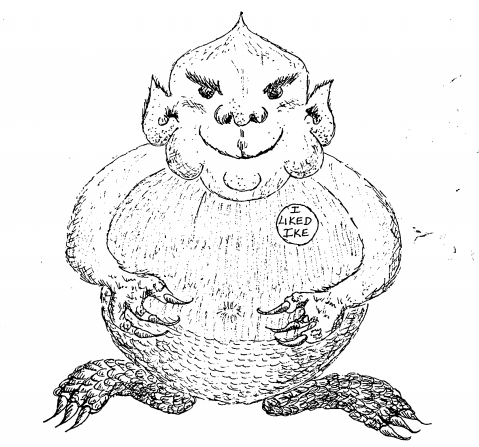
The 1982 fall edition of “Studies in Intelligence,” the CIA internal newsletter, describes a “collection of strange fauna” known as the “Bestiary of Intelligence Writing.” It was an illustrated guide for national security writers on cringeworthy cliches, with apologies to “A Political Bestiary,” a book by James Kilpatrick, former U.S. senator Eugene McCarthy and editorial cartoonist Jeff MacNelly.

 CIA Bestiary of Intelligence writing

(I have posted earlier about the CIA Style Manual: CIA Style Manual)

The author is only identified as (b)(3)(c) and he is also the illustrator

Older employees may recall that when the Headquarters Building was being constructed, guard dogs stalked the corridors by night to sniff out trespassers. Practically no one is aware, however, of the collection of strange fauna in a corner of a sub-basement, the location of which must remain secret. This collection known as the Bestiary of Intelligence Writing, consists of specimen samples of cliches and misused or overused word combinations that CIA editors have encountered frequently over the years.

Now for the first time, the Curator of the Collection has received permission to reveal the existence of the Bestiary and identify some of its principal specimens for the enlightenment, education and general edification of CIA writers. It is hoped that with their new awareness of the Bestiary, analysts and other authors will keep their eyes peeled, noses to the grindstone and ears to the ground, to call the attention of editors to other candidates for possible inclusion in the collection.

The Collection

  1. Multidisciplinary analysis.

  2. Viable alternatives.

  3. Mounting crises.

  4. Parameters

  5. Heightened tensions.

  6. Dire straits.

  7. Far-reaching implication.

  8. Available evidence.

  9. Foreseeable future.

  10. Almost inevitable.

  11. Nonstarter.

  12. Economic constraints.

  13. Broad outlines.

  14. Net effect.

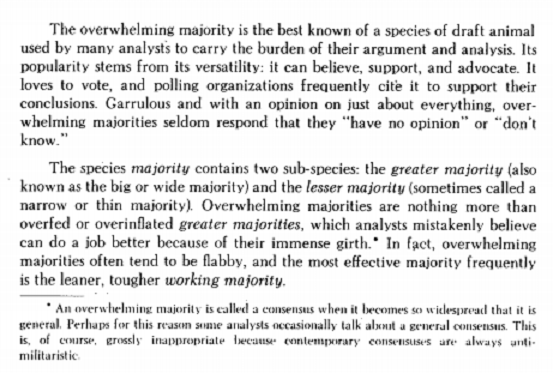
  15. Overwhelming majority

This is the entry for “Overwhelming majority”

CIA Overwhelming majority - from the Bestiary

CIA Overwhelming majority – from the Bestiary

CIA OM text


Not so random animal sounds may show a stepping stone towards language

August 21, 2014

The manner in which humans came to invent gestures and sounds, then developed these into words, then into language and eventually on into writing is a critical and fascinating story from our past that will probably never be fully known or understood. No doubt for humans there is also a connection to the invention of counting, the use of abstract symbols and the evolution of numeracy and the beginnings of the languages of mathematics.The timeline of these evolutions are also in much doubt. Possibly gestures and sounds go back 300,000 years (or even further), but language was established among humans only by about 50,000 years ago. Words and their earlier sounds must have come much, much earlier and writing very much later. Cave paintings around 30,000 years ago may represent the period when abstract symbolism was taking off. It is thought that writing did not come until agriculture expanded – perhaps from about 12,000 years ago.

Now research on animal sounds suggests that for some species the sounds they make are not as random as they were originally thought to be. They exhibit levels of complexity which are suggestive of stepping-stones along the long road to grammar and language. Such steps may have assisted humans from moving from sounds and words to context-free grammars and thence to language.

The sequence in humans – I speculate – could have been:

(300KYA) gestures>> sounds>> (smiles, laughter?)>> words>> ..(unknown steps)>> simple grammar>> context-free grammar>> language>> symbols>> abstract symbols>> writing (12KYA)

Kershenbaum A, Bowles A, Freeburg T, Dezhe J, Lameira A, Bohn K. 2014. Animal vocal sequences: Not the Markov chains we thought they were. Proceedings of the Royal Society B. rspb.royalsocietypublishing.or… .1098/rspb.2014.1370

PhysOrg reports:

The study, published today in the journal Proceedings of the Royal Society B, analyzed the vocal sequences of seven different species of birds and mammals and found that the vocal sequences produced by the animals appear to be generated by complex statistical processes, more akin to human language. ….

Many species of animals produce complex vocalizations – consider the mockingbird, for example, which can mimic over 100 distinct song types of different species, or the rock hyrax, whose long string of wails, chucks and snorts signify male territory. But while the vocalizations suggest language-like characteristics, scientists have found it difficult to define and identify the complexity.

Typically, scientists have assumed that the sequence of animal calls is generated by a simple random process, called a “Markov process.” Using the Markov process to examine animal vocalization means that the sequence of variables—in this case, the vocal elements—is dependent only on a finite number of preceding vocal elements, making the process fairly random and far different from the complexity inherent in human language. ……. 

…… the study found no evidence for a Markovian process. The researchers used mathematical models to analyze the vocal sequences of chickadees, finches, bats, orangutans, killer whales, pilot whales and hyraxes, and found most of the vocal sequences were more consistent with statistical models that are more complex than Markov processes and more language-like. …… 

“Language is the biggest difference that separates humans from animals evolutionarily, but multiple studies are finding more and more stepping stones that seem to bridge this gap. Uncovering the process underlying vocal sequence generation in animals may be critical to our understanding of the origin of language,” said lead author Arik Kershenbaum, a postdoctoral fellow at the National Institute for Mathematical and Biological Synthesis.

Abstract:

Many animals produce vocal sequences that appear complex. Most researchers assume that these sequences are well characterized as Markov chains (i.e. that the probability of a particular vocal element can be calculated from the history of only a finite number of preceding elements). However, this assumption has never been explicitly tested. Furthermore, it is unclear how language could evolve in a single step from a Markovian origin, as is frequently assumed, as no intermediate forms have been found between animal communication and human language. Here, we assess whether animal taxa produce vocal sequences that are better described by Markov chains, or by non-Markovian dynamics such as the ‘renewal process’ (RP), characterized by a strong tendency to repeat elements. We examined vocal sequences of seven taxa: Bengalese finches Lonchura striata domestica, Carolina chickadees Poecile carolinensis, free-tailed bats Tadarida brasiliensis, rock hyraxes Procavia capensis, pilot whales Globicephala macrorhynchus, killer whales Orcinus orca and orangutans Pongo spp. The vocal systems of most of these species are more consistent with a non-Markovian RP than with the Markovian models traditionally assumed. Our data suggest that non-Markovian vocal sequences may be more common than Markov sequences, which must be taken into account when evaluating alternative hypotheses for the evolution of signalling complexity, and perhaps human language origins.

Language and Bombay and Madras and Calcutta

August 17, 2014

During the period when Suresh Prabhu and Anant Geete were Ministers of Power in India I used to have to follow up any discussions with them about power projects with visits to the head of their party, Bal Thackeray, in Bombay. (They were in their posts as representatives of the Shiv Sena Party in the then BJP led coalition but had little freedom to act on their own. The Shiv Sena was embodied in Bal Thackeray and he always had the final word). Bal Thackeray and the Shiv Sena had led the very vocal, sometimes violent and parochially nationalist movement to change the name of “Bombay” to “Mumbai” in 1995. I have found all these “nationalist” movements – whether in Bombay or Madras or Calcutta or Delhi or Bangalore – to be small-minded, rooted in insecurity and representing a deeply-felt  – but real – inferiority.

On my first meeting with Bala-saheb I was given strict protocol instructions by one of his aides before being ushered into the sanctum sanctorum at Mathoshree. I was to make sure that I always referred to “Mumbai” and not to “Bombay”. At the end of the audience I was expected to end my taking leave of him with the words “Jai Maharashtra” (long live Maharashtra). I remember asking the aide then whether, if I said “Bombay”, he would not understand what I meant. As he spluttered and I entered, I remember telling him that while I had no desire to insult anybody, I used language and words and names to best communicate my meaning.

In the event, in about 6 or 7 meetings over a number of years with Bal Thackeray, I never once used the terms “Mumbai” or “Jai Maharashtra“. But I did not go out of my way to use “Bombay” excessively or to provoke. I do not recall that Bala-saheb was ever discomfited or upset at my use of language (or non-use of “Mumbai”), or that we had any difficulty in getting our messages across to each other.

I grew up with “Bombay” and it evokes for me a world of glamour and wealth but also of modernity and substance and rectitude. As a child we lived in Poona (not Pune) and travelled through Bombay regularly. Bombay was avant-garde. “Mumbai” for me conjures up an old dirty village. A picture of slums and unfinished construction and uncollected garbage and rotting mill buildings. All very subjective of course but names and language are about communicating meanings. I note that the international airport designation of Bombay remains “BOM”. Since it takes an Act of Parliament to change it, the “High Court of Bombay” remains the “High Court of Bombay” in Mumbai. The Bombay Electric Supply & Tramways Company Limited (B.E.S. & T Co.Ltd) remains BEST but the “B” now stands for “Brihanmumbai” (meaning Greater Bombay). The name of the main railway station Victoria Terminus (VT) was changed to Chatrapati Shivaji Terminus but it is still referred to by everybody as VT. “Bollywood” remains “Bollywood” and I see no moves to make that “Mullywood”. Bombay Gin would not taste the same as Mumbai Gin. Bombay duck is far superior to Mumbai duck. In the 2000’s I used to stay at a guest house on Malabar Hill. Taxi drivers know exactly what I mean when I refer to Flora Fountain or Cuffe Parade or Kemp’s Corner or Napean Sea Road. The magic of Marine Drive on a misty evening is still untouched. Bombay, Meri Jaan is still the original song with Dev Anand in the movie CID.

The politically correct name is “Mumbai” and foreigners – especially – are very concerned about being politically correct. When I use “Bombay” I have no fear of being misunderstood. And even ardent Marathi nationalists understand exactly what I mean when I say “Bombay”, and the cleverer ones (there are not many of them) may even understand that I don’t think much of their rabid parochialism.

I finished my schooling in Calcutta and my image of the city has to mirror that reality. I am not misunderstood today when I still refer to Calcutta rather than Kolkata. The Calcutta High Court is still going strong. The international airport code is still CCU. Back in 1963 the British Council Library on Theatre Road was one of my favourite haunts. The name of the road was changed to Shakespeare Sarani but when I was there earlier this year – 50 years on –  taxi drivers still referred to Theatre Road (and did not even know that there was any other name). School was on Park Street and Park Circus is just as congested as it always was. Lansdowne Road  and many others have been renamed, but the old names live on. Bangalore remains Bangalore for me and Bengaluru does not trip off my tongue very easily – if at all. In Delhi CP is the supposedly defunct Connaught Place but it is still CP and not Rajiv Gandhi Chowk. Madras airport remains MAA and the Madras High Court is now located in Chennai. Mount Road is still Mount Road and everybody knows where Parry’s corner is.

I am told that Mumbai and Chennai and Kolkata and Bengaluru are the only “correct” forms but that is just a rather empty political statement. There are no rights or wrongs with language. There are only successful communications or misunderstood ones. There is no correctness about grammar – only compliance with a prevailing usage. My point is that as with grammar so with names. Inventing words or rules of grammar – or names – is of little account if the invented terms are not used.

Maybe the old names will be forgotten in a generation or two – or maybe not. The reality of usage always trumps the desires of  “political correctness”.

The injustices of equality

August 3, 2014

We cannot both have individuality and equality.

And it would be a sorry day if humankind consisted just of clones and we had no differences. Without difference, equality is undefined and quality is meaningless and judgement is unnecessary. Discernment would not exist, there would be no “good” and no “bad”, and discrimination would cease to be.  Merely denying difference leads to injustice. Much of the legislation about “Rights” focuses on denying difference – as if that would make difference go away. Our very concepts of what is good or what is just depend upon being able to distinguish differences – in all the various differences that go to making individuals unique. Differences of capability, in behaviour, in performance, of competence, in appearance and – not least – in intelligence.

But it should not be beyond the wit of man to strive for justice – rather than a meaningless equality. Liberté, Égalité, Fraternité  is inherently unjust and should instead have been Liberté, Justice, Fraternité. 

We applaud discernment and judgement but condemn discrimination. We use reverse discrimination to try and correct discrimination. We use “affirmative action” and quotas of various kinds to favour some groups – defined by their difference – to right their “wrongs” by wronging still others. Some gender equality legislation tries to deny that gender difference exists. The Swedish government has just proposed that the term “race” should be removed from all legislation. As if that would make differences disappear.

Given individuality, equality is often incompatible with justice. They are not synonyms and one does not imply the other. It is not for nothing that the phrase “just and equitable” uses both words and having both together assumes that a compromise will be necessary to get a measure of both.

It is a “classic” issue that every society has to take a call on and related to the conflict interface between “what is desired” and “what is deserved”. Should the individuals in a society be granted (as “rights”) what they desire/need or should they only be rewarded for what they deserve/earn? (Desire in this context must be equated  with “need” and anything “deserved” then must have been “earned”.) What an individual “desires” he terms as “needs”, and what he believes that he “deserves” is what he thinks he has “earned”. The surrounding society he operates in may have quite a different view of what he should desire (his needs) or what he has earned (deserves).

Simplistically this is socialism versus capitalism. “Socialism” can be described simply as being the wealth of a society being appropriated and accumulated into a common pool and then distributed “according to the individual’s needs/desires”.  “Capitalism” can be described as a system where each individual generates wealth or is remunerated according to what he has earned/deserved and individuals – rather than their appropriated wealth – are accumulated to make up that society. In these terms, a socialist society assumes ownership of all wealth and then takes a call on how much individualism it will suppress or permit, whereas a capitalist society assumes that ownership of wealth lies with the creators of the wealth who must then determine how much individualism they are prepared to give up for the “common good”.

In practice every society or organisation has a mix – often illogical and irrational – of the balance between “the needs of society” and the “rights of the individual”. Every society or organisation exhibits a mix of rewards for performance (earned) and allowances for needs (desires). This is a classic ideological problem that all trade unions face today. Once upon a time they advocated – for example – that a father of six should be paid more than a father of two because his needs/desires were greater. To even accept payment for “piecework” or any remuneration for “performance” was once seen as being heresy. Most large corporations today are essentially capitalist but generally implement remuneration on a mix of need and performance factors. Housing allowances, child allowances, education allowances are all examples of payments for perceived needs. Performance bonuses or allowances for extra qualifications or “danger money” have to be earned.

Inevitably socialistic societies tend towards an oppression of minorities by the “majority of wealth consumers” while capitalistic societies lean towards an oppression of the majority by the “minority of wealth creators”. This is the fundamental divide between the Right and the Left; to what extent should individuals and societies be subservient to or dominate the other? It is also the fundamental reason why there must usually be a conflict between “equality” and “justice”.

In this context, socialism maps to equality while capitalism maps to justice.

The desired versus deserved schism cannot be separated from how “equality” is viewed and consequently on defining what discrimination consists of. There is no equality of humans at birth. To be all born equal we would have to be clones and genetically identical which we are not. We are born to parents not of our choice, to our random positions on the predominantly bi-nodal gender scale. Our genetic traits (nature) and our subsequent experiences (nurture) determine our different capabilities and our different behaviours. Since it is these differences in our capabilities, our behaviour and our performance which make us individuals, what, then, should be “equalised” by subsequent unequal treatment?

In the name of “Equal Rights” we try to correct existing injustices. We use “Equal Opportunites” to mean removing the handicaps of unequal nurture for some individuals but in so doing we add handicaps for others. We don’t handicap athletes at the start of an Olympic 100 m race to ensure that all participants finish equal. For “gender equality” two women are paid the same amount at Wimbledon for 3 sets of tennis as two men for five but we accept that it would be an unequal match for the men to play against the women. Striving for equality, Wimbledon has achieved equality of pay for unequal performance. All societies tax their members unequally (and what does equal taxation mean anyway?) Creating or having wealth is taxed more heavily – perhaps justly – than wealth consumption. We punish (hopefully) justly – but unequally – for the same bad behaviour by different individuals.  We reserve places in educational institutions for those considered disadvantaged and thereby deny those same places for the deserving. A just health care system must provide unequal care with more care for those less healthy.

Given individuality, equality and justice will often be in conflict. To be just requires a recognition of differences and to then treat unequally to make suitable compensation for the difference. In theory “equality” should be an objective measure but as soon as it becomes the equality of something, it is just as subjective as notions of what is just.

Far better we strive for justice for individuals rather than for some diffuse and meaningless “equality for all”.
Spying in style

July 6, 2014

As a teenager it was James Bond for me. Later it was Quiller. They created more than their fair share of mayhem and destruction as they saved the world from a variety of evil megalomaniacs – but always in great style. But I came late to James Bond. Before that I had already devoured the adventures of Simon Templar and his Saintly and stylish capers. Sherlock Holmes had arrogance but did not have much style. Ethan Hunt didn’t have it either. Nor did Jason Bourne.

Much can be excused if done with class. While style alone is not class it is certainly a necessary ingredient.

Class is not appearance and it is not personality or charisma; it is a style and elegance of behaviour and a consistency of actions. – Essence of a Manager

In any event it is reassuring to note that the CIA gives proper importance to style – though this guide is only for the style of the written word.

CIA Style Manual

This is the eighth edition of the CIA’s “Style Manual and Writers Guide for Intelligence Publications”.

I find it very well done and something that could well be put to use by many journalists.

For example:

meaningful — is a vacuous word that is too often used by analysts to mean Significant.
The results of the meeting were meaningful is meaningless

Masterful, masterly — Careful writers distinguish between these adjectives. A masterful person is overpowering, overbearing, or imperious; he or she is capable of mastering others. A virtuoso performance is masterly, the work of a master artist.

Preface:

The eighth edition of the Style Manual and Writers Guide for Intelligence Publications provides guidance for English usage and writing style in the Central Intelligence Agency. It incorporates most of the improvements that appeared in previous editions but returns to the organization by chapters of the earliest versions. The chapters on capitalization, numbers, abbreviations, italics, punctuation, spelling, and compound words have numerous headings and subheadings to enable users to find specific subjects quickly within the chapters themselves or through the table of contents. Further subject indexing is provided in chapter 9-the Word Watchers List-which incorporates many of the style rules in abbreviated form; it is similar to the Word Watchers Index in the fourth edition and to the overall organization of more recent editions. The manual also includes a comprehensive Spelling and Compound Words List, as have all previous editions, and an index to the entire manual.
The counsel in this guide is derived from many sources, including the works of Barzun, Bernstein, Copperud, Follett, Fowler, the Morrises, Strunk and White, Gregg, and other recognized arbiters of English usage. It also draws on the stylebooks of press services, newspapers, publishing houses, and past and present CIA offices.
A basic reference for spelling, compounding, and other instructions for all eight editions is the US Government Printing Office’s Style Manual, the most recent edition of which was issued in 2008. The GPO’s authority for spelling imd compounding words is Webster’s Third New International Dictionary, published by G. & C. Merriam Company. That dictionary or the more up-to-date abridgments of it (the latest being Webster’s 11th New Collegiate Dictionary) are the authorities for the preferred spellings listed in this guide that were not found in the GPO manual.
This guide is for both the creators and the processors of intelligence analysis-for the writers and for the editors of their analyses. It also serves writers and processors of administrative papers. Moreover, it has been used and will continue to be used by teachers and students of writing and publications processing.

It is not so easy, I suppose, to have a Style Manual for water-boarding. If only the CIA also had a Manual for classy behaviour.


No sentience without sapience

June 26, 2014

There was a great deal of publicity last week but I am not very convinced that the computer program Eugene Goostman actually passed the Turing test. But whether it did or not, I got to wondering how to distinguish sapience from sentience.

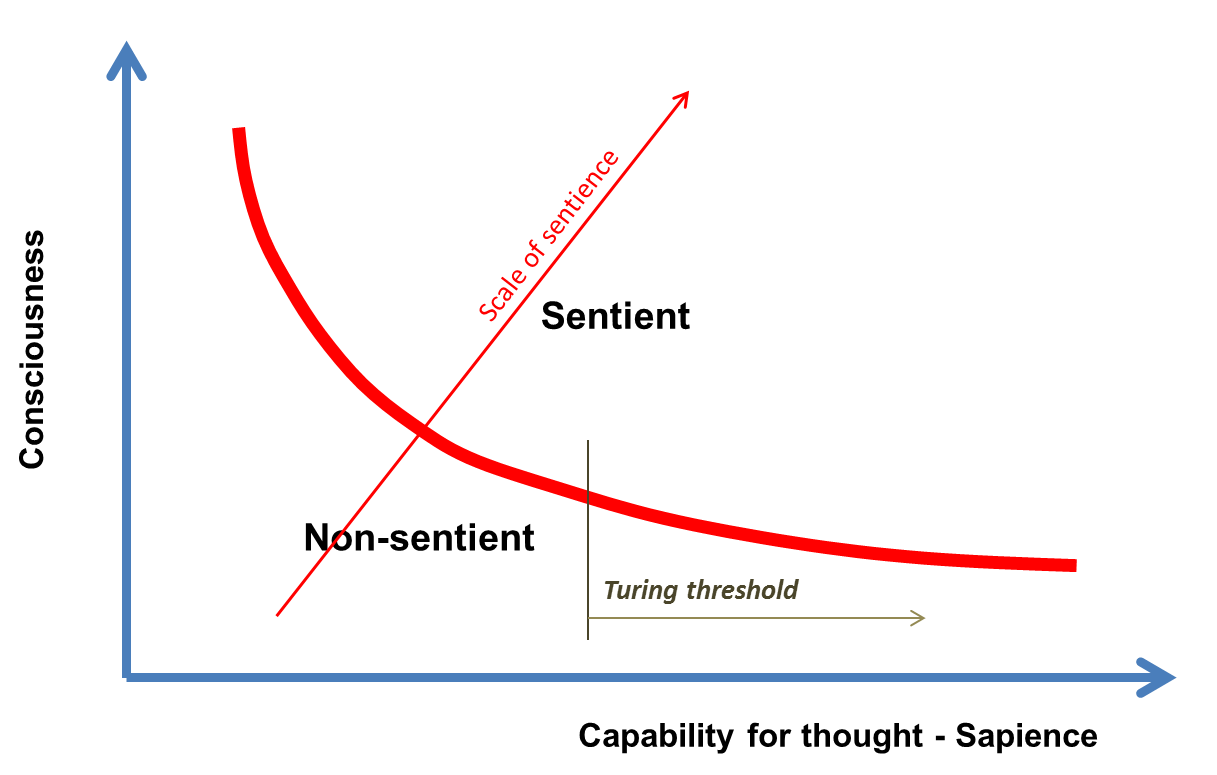
I find that I tend to use “sapience” to imply the capability for thought while I take “sentience” to be a quality of consciousness of self. Which of course leaves rather diffuse and undefined what precisely “thought” involves and what “consciousness of self” consists of. But is sapience linked to sentience? Can one have one without the other? Or does the quality of being conscious only become possible once thought exists?

Rene Descartes’ Cogito ergo sum (I think therefore I am) should perhaps be modified to be Cogito ergo, ego ut sit (I think therefore I may be). “I think therefore I am” requires a pre-conception of individuality, of the “I”. To be aware of the “I”, to be conscious of oneself and to be able to articulate that consciousness would suggest that thought is already present before consciousness of self can come into play. Clearly my computer “thinks” in a fashion, as do many animals – in their fashion. But while some minimum capability for thought may be necessary for consciousness, it is also clearly not sufficient. A certain level of sapience may be necessary for sentience but sapience does not necessarily lead to sentience. Some other attribute or quality is required for a thinking entity to be said to have the level of consciousness necessary for sentience.

The Turing test is, I think, a test of reaching a particular level of sapience but it is not a test of sentience. But I also think that there is a scale of sapience. All  “artifical intelligences” show varying levels of applying “thought” and could be said to be sapient to some degree. Sapience would seem therefore to be on a continuous scale. Many animals and birds also exhibit some level of thought and clearly exhibit different degrees of sapience. But chimpanzees and gorillas and dolphins and even elephants seem to recognise themselves in a mirror while monkeys do not. They would seem to have different levels of self-consciousness and – it would seem – different levels of sentience. I take gorillas and chimpanzees and maybe elephants to be sentient – just – but not dogs or cats. Is there then a scale of sentience which is constrained (or enabled) by, and depends upon, an entity’s position on a scale of sapience?  I suspect that whatever it is I intuitively consider to be sentient depends upon a combination of sapience and the level of consciousness of self of an entity.

Therefore my tentative definitions / conclusions become

  1. Entities may be “alive” or “inert”.
  2. Only some entities are sapient to any significant degree but sapience is independent of being alive.
  3. There is no sentience without sapience.
  4. Only some “living”, sapient entities are sentient.
  5. Sentience is a composite quality and – I propose – depends on the level of sapience and the level of consciousness exhibited by an entity.


sapience and sentience

sapience and sentience

A perception of collective nouns

June 21, 2014

A quest of scientists

A babble of psychologists

A gaggle of poets

A rabble of (……….) – according to personal preference authors/actors/priests/…….

A fusion of physicists

A smell of chemists

A bushel of metallurgists

A parliament of speakers

An invasion of neocons

A cohort of politicians

A harem of coalition partners

A mamillion of mathematicians

A brothel of journalists

A twitter of modistes

A facebook of friends

A hack of spies

A matrix of nerds

A pride of gay people

A tick of lawyers

A bill of consultants

A cancer of bureaucrats

Science needs some scienticians

June 18, 2014

Physic gave rise to physicians long before physics was practiced by a physicist,

Mathematics gives mathematicians, but who would trust a mathematist. 

A practitioner of an “ology” has an honourable profession,

So biologistsoncologists, archaeologists and geologists can be numbered by the million. 

Without the richness of an “ist” modern politics would be barren,

politicist has a murky trade but he is not a politician

We have leftists and rightists and socialists and you can even find some libertarians,

But for all the mayhem in the world, you will not find any extremians.

Environmentalists and conservationists are politically very fashionable,

But their devious methods have now become – rather questionable. 

Philosophy was where it started but we rarely refer to philosophists,

And many of the scientists of today are little more than sophists. 

It was only in 1840 that scientists were one of Whewell’s inventions,

But they are now two-a-penny, and we could do with a few scienticians.

It should be quite clear that I think that there are far too many who claim to be scientists though they do no science. It then becomes useful to distinguish the real scienticians from the rabble. And perhaps the same could apply to the real economians among the multitude of clerks who call themselves economists.

A second language – even if acquired as an adult – can help resist the onset of dementia

June 2, 2014

Being cognitively active has long been suggested as a key element in slowing down the onset of age-related conditions such as dementia and Alzheimers. And being multilingual – it is thought – increases the potential for cognitive activity.

Marian and Shook (2012) – Cognitive benefits of being bilingual

The bilingual brain can have better attention and task-switching capacities than the monolingual brain, thanks to its developed ability to inhibit one language while using another. In addition, bilingualism has positive effects at both ends of the age spectrum: Bilingual children as young as seven months can better adjust to environmental changes, while bilingual seniors can experience less cognitive decline.

And – it would seem from a new study – that having the ability to speak a second language, even if the ability was acquired as an adult, helps in this process.

“Does Bilingualism Influence Cognitive Aging?” Thomas H Bak, Jack J Nissan, Michael M Allerhand and Ian J Deary. Annals of Neurology; Published Online: June 2, 2014 (DOI:10.1002/ana.24158).

Press Release (EurekAlert)New research reveals that bilingualism has a positive effect on cognition later in life. Findings published in Annals of Neurology, a journal of the American Neurological Association and Child Neurology Society, show that individuals who speak two or more languages, even those who acquired the second language in adulthood, may slow down cognitive decline from aging. 

Bilingualism is thought to improve cognition and delay dementia in older adults. While prior research has investigated the impact of learning more than one language, ruling out “reverse causality” has proven difficult. The crucial question is whether people improve their cognitive functions through learning new languages or whether those with better baseline cognitive functions are more likely to become bilingual. 

“Our study is the first to examine whether learning a second language impacts cognitive performance later in life while controlling for childhood intelligence,” says lead author Dr. Thomas Bak from the Centre for Cognitive Aging and Cognitive Epidemiology at the University of Edinburgh. 

For the current study, researchers relied on data from the Lothian Birth Cohort 1936, comprised of 835 native speakers of English who were born and living in the area of Edinburgh, Scotland. The participants were given an intelligence test in 1947 at age 11 years and retested in their early 70s, between 2008 and 2010. Two hundred and sixty two participants reported to be able to communicate in at least one language other than English. Of those, 195 learned the second language before age 18, 65 thereafter. 

Findings indicate that those who spoke two or more languages had significantly better cognitive abilities compared to what would be expected from their baseline. The strongest effects were seen in general intelligence and reading. The effects were present in those who acquired their second language early as well as late. 

The Lothian Birth Cohort 1936 forms the Disconnected Mind project at the University of Edinburgh, funded by Age UK. The work was undertaken by The University of Edinburgh Centre for Cognitive Ageing and Cognitive Epidemiology, part of the cross council Lifelong Health and Wellbeing Initiative (MR/K026992/1) and has been made possible thanks to funding from the Biotechnology and Biological Sciences Research Council (BBSRC) and Medical Research Council (MRC). 

“The Lothian Birth Cohort offers a unique opportunity to study the interaction between bilingualism and cognitive aging, taking into account the cognitive abilities predating the acquisition of a second language” concludes Dr. Bak. “These findings are of considerable practical relevance. Millions of people around the world acquire their second language later in life. Our study shows that bilingualism, even when acquired in adulthood, may benefit the aging brain.” 


Marc Hauser (et al including Chomsky) is back on language evolution

May 1, 2014

The rehabilitation of Marc Hauser continues and he along with many others have just published a review about language evolution in Frontiers in Psychology.  Links to the Abstract and the paper (provisional) are given below but they argue that the “explosion of research in the last 40 years” has made little progress. Essentially, they say (to paraphrase Donald Rumsfeld) :

With regard to the biological evolution of language, we don’t know much and we don’t even know what we don’t know. But now we can at least list some areas that we know that we don’t know. 

Hauser is the lead author and gives his affiliation as Risk Eraser which is engaged in brain training for kids at risk.

Marc D. Hauser, Charles Yang, Robert C. Berwick, Ian Tattersall, Michael Ryan,Jeffrey Watumull, Noam Chomsky and Richard Lewontin, The mystery of language evolution, Front. Psychol., doi: 10.3389/fpsyg.2014.00401

Abstract: Understanding the evolution of language requires evidence regarding origins and processes that led to change. In the last 40 years, there has been an explosion of research on this problem as well as a sense that considerable progress has been made. We argue instead that the richness of ideas is accompanied by a poverty of evidence, with essentially no explanation of how and why our linguistic computations and representations evolved. We show that, to date, 1) studies of nonhuman animals provide virtually no relevant parallels to human linguistic communication, and none to the underlying biological capacity; 2) the fossil and archaeological evidence does not inform our understanding of the computations and representations of our earliest ancestors, leaving details of origins and selective pressure unresolved; 3) our understanding of the genetics of language is so impoverished that there is little hope of connecting genes to linguistic processes any time soon; 4) all modeling attempts have made unfounded assumptions, and have provided no empirical tests, thus leaving any insights into language’s origins unverifiable. Based on the current state of evidence, we submit that the most fundamental questions about the origins and evolution of our linguistic capacity remain as mysterious as ever, with considerable uncertainty about the discovery of either relevant or conclusive evidence that can adjudicate among the many open hypotheses. We conclude by presenting some suggestions about possible paths forward.

Not knowing something we don’t know at least moves it into the realm of things we know we don’t know and as such is quite valuable. 
The very readable paper (provisional) is available hereHauser Provisional Evolution of language