Eoin O’Malley
@AnMailleach
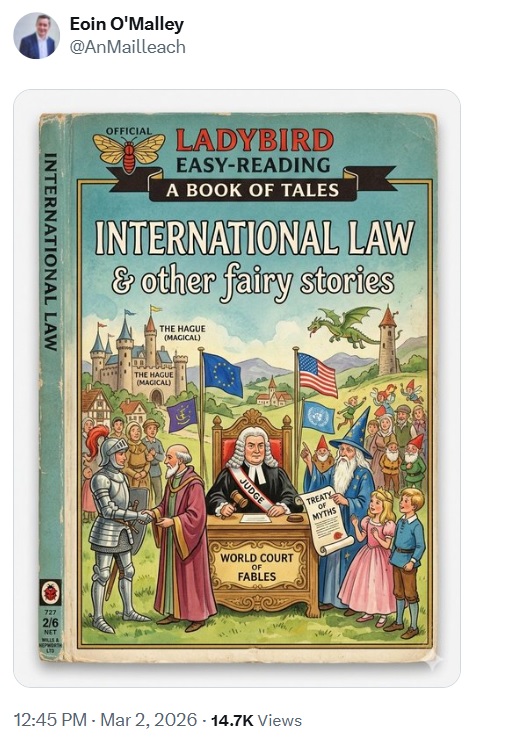
Excellent image.
Captures what I think about the sanctimony and lies around the false concept of international law.
Both transcendental and metaphysical nonsense.
Eoin O’Malley
@AnMailleach
Excellent image.
Captures what I think about the sanctimony and lies around the false concept of international law.
Both transcendental and metaphysical nonsense.
(I dislike the Nobel Peace Prize as being all about politics and being inherently inimical to peace. The Norwegian Nobel Committee are also too woke, self-righteous and sanctimonious for my liking. Too many of the awards are just plain ridiculous and entirely statements of political correctness. But this flurry of stupidity caught my attention this week).
In the wake of María Corina Machado’s decision this week (January 15, 2026) to “present” her 2025 Nobel Peace Prize medal to Donald Trump in the Oval Office, we have witnessed the faintly ridiculous spectacle of a venerable (though somewhat senile) institution getting defensive and huffy about a gift it no longer owns.
The Norwegian Nobel Committee (NC) has responded with a flurry of “cease and desist” style public relations, reminding the world that the prize “cannot be transferred, shared, or revoked.” But in their rush to protect the “Nobel” brand, the Committee is entering the world of nonsense with a legal and logical absurdity.
The Myth of Permanent Authority
The NC’s central argument is that the award and the laureate are “inseparable.” They contend that while Machado can physically hand over the gold, the status of being the 2025 winner remains hers “for all time.”
But this is where the logic fails:
Defensive Branding or Political Insecurity?
The sheer vehemence of the NC’s recent press releases is counterproductive. By issuing multiple statements within a single week, the Committee suggests that their 2025 decision is so fragile that it requires constant shielding from the “wrong” people.
When an institution shouts this loudly about why someone isn’t a winner, it stops sounding like a defense of history and starts sounding like a defensive reaction to current politics. If the award is truly “final and stands for all time,” why does the Committee feel the need to argue with a photo-op?
The “Law is an Ass” Problem
To claim that a recipient cannot “share” the honour of their work is to treat the Nobel Prize like a lease rather than a gift. In any other legal context, once a gift is given, the giver loses the right to dictate its subsequent use or interpretation.
By insisting that Machado cannot “transfer” the sentiment of the prize, the NC is trying to police the thoughts and associations of its laureates. They are essentially saying: “We gave you this, but we still control what it means.”
Conclusion
The Nobel Committee would do well to remember that their prestige should come from the merit of their choices (not very impressive lately) and not from their ability to act as a “history monitor.” María Corina Machado can give her medal to whomever she chooses. Donald Trump can claim he “has” a Nobel. The NC can keep their books in Oslo. But when the Committee tries to assert “authority” over a laureate’s personal property and public statements, they aren’t protecting the brand. They are just confirming that, sometimes, the law (and the institution) can be an ass.
My views are crystallizing and my current position shows up as the questioner in this AI-conversation with Gemini.
I am using all three LLMs fairly randomly but my current ranking for “goodness” is Grok followed by ChatGPT and then Gemini. Gemini is, by far, the most woke and ChatGPT is the most sanctimonious.
(Updated re copyright)
This is getting interesting.
Large language models (such as GPT3 and 4) generate text based on probability of what text should follow. They have no internal conception of truth. The probabilities which determine text generation are reflections of conformity and are based on weights of existing usage patterns contained within its database.
The key questions which arise are:
The product of the use of a hammer or a screwdriver requires skill (or lack of skill) from the user. The user’s “skill” in the case of a large language model is confined to that used in posing the questions to the chatbot. The user’s skill in posing questions has little impact on the text generated.
ChatGPT: US lawyer admits using AI for case research
A New York lawyer is facing a court hearing of his own after his firm used AI tool ChatGPT for legal research. A judge said the court was faced with an “unprecedented circumstance” after a filing was found to reference example legal cases that did not exist. The lawyer who used the tool told the court he was “unaware that its content could be false”. ChatGPT creates original text on request, but comes with warnings it can “produce inaccurate information”.
The original case involved a man suing an airline over an alleged personal injury. His legal team submitted a brief that cited several previous court cases in an attempt to prove, using precedent, why the case should move forward. But the airline’s lawyers later wrote to the judge to say they could not find several of the cases that were referenced in the brief. “Six of the submitted cases appear to be bogus judicial decisions with bogus quotes and bogus internal citations,” Judge Castel wrote in an order demanding the man’s legal team explain itself. Over the course of several filings, it emerged that the research had not been prepared by Peter LoDuca, the lawyer for the plaintiff, but by a colleague of his at the same law firm. Steven A Schwartz, who has been an attorney for more than 30 years, used ChatGPT to look for similar previous cases. In his written statement, Mr Schwartz clarified that Mr LoDuca had not been part of the research and had no knowledge of how it had been carried out. Mr Schwartz added that he “greatly regrets” relying on the chatbot, which he said he had never used for legal research before and was “unaware that its content could be false”. He has vowed to never use AI to “supplement” his legal research in future “without absolute verification of its authenticity”. Screenshots attached to the filing appear to show a conversation between Mr Schwarz and ChatGPT. “Is varghese a real case,” reads one message, referencing Varghese v. China Southern Airlines Co Ltd, one of the cases that no other lawyer could find. ChatGPT responds that yes, it is – prompting “S” to ask: “What is your source”. After “double checking”, ChatGPT responds again that the case is real and can be found on legal reference databases such as LexisNexis and Westlaw. It says that the other cases it has provided to Mr Schwartz are also real.
Both lawyers, who work for the firm Levidow, Levidow & Oberman, have been ordered to explain why they should not be disciplined at an 8 June hearing. Millions of people have used ChatGPT since it launched in November 2022. It can answer questions in natural, human-like language and it can also mimic other writing styles. It uses the internet as it was in 2021 as its database. There have been concerns over the potential risks of artificial intelligence (AI), including the potential spread of misinformation and bias.
The ChatGPT response regarding copyright is a little too weaselly for my liking:
ktwop: Who owns the copyright to text generated by ChatGPT?
ChatGPT: As an AI language model, I don’t have legal ownership or rights. The text generated by ChatGPT is based on a combination of licensed data, data created by human trainers, and publicly available data. The ownership of the copyright for the individual responses or outputs generated by ChatGPT would typically depend on the specific context and how the model is being used.
In most cases, the copyright for the content generated by an AI language model would likely belong to the person or organization that owns the AI system or has the legal rights to its output. For example, if a company develops and operates ChatGPT, they would generally hold the copyright to the content generated by the model.
It’s important to note that while AI models like ChatGPT can assist in generating text, the responsibility for adhering to copyright laws and ensuring proper usage of generated content lies with the user or organization utilizing the model.
My gut feeling is that the creator/owner of the large language model must carry some responsibility (legal liability) similar to a product liability.
Cornell University. Product liability is a doctrine that gives plaintiffs a cause of action if they encounter a defective consumer item. This doctrine can fall under negligence, but it is generally associated with strict liability, meaning that defendants can be held liable regardless of their intent or knowledge.
In Sweden there is a tendency to accord Authority and Institutions unwarranted respect. I was listening to a Member of Parliament trying to explain (defend?) the importance of what he did. His glorified and rather narcissistic view of his own importance in the universe as a “lawmaker” was not unexpected. But I find the idea that current parliamentarians are involved in holy work goes too far. I thought his overly reverential treatment of law as something sacrosanct was especially facile and unsupportable. I find deferential references to the majesty or sanctity or divinity or piety or morality of law artificial and unconvincing.
So, in this note to myself I try to think my way through the nature and purpose of law from “first principles”.
Behaviour (noun): the range, or the manner, in which, things (animate or inanimate) act
This freedom to act as may be physiologically possible is a brute fact of reality and, like the laws of nature, does not need any articulation or declaration or proclamation. In fact, the freedom to act followed by the choice of action, always within the envelope of possible actions, is a distinguishing feature of cognitive, living things. (The conversion of a thought into action lies at the heart of the mind-body problem which is relevant but outside the scope of this note to myself). With increasing cognition, observations create a world view and a view of self in that world. Repetition of actions gives skill and observing consequences of actions gives rise to learning. Not all that is desired leads to actual behaviour but all behaviour has consequences. A living, cognitive creature may choose to restrict itself and moderate its own actions as it learns and according to its skill. The behaviour of the creature may also be constrained, or may be induced, by externally applied forces. The fundamental, behavioural freedom that all cognitive creatures have is to select and implement what they actually do, from all that they could do. Human behaviour is a choice constrained by capability and external forces.
All humans have the freedom to choose what they actually do, or not do, from all that they could do.
The laws of nature, I have no doubt, exist. They both describe and determine how all things (material or energetic) have behaved and how they will behave. They all require/assume time to be passing and become undefined/meaningless otherwise. They apply over the entire universe (as far as we can tell). There is no Authority (known) which formulates and proclaims these laws, but they still command complete, unconditional compliance. They apply even if they are not discerned. The process of science is our attempt to discern what these laws of nature actually are. Even a solitary case of non-compliance is sufficient proof that any purported law of nature is not, in fact, a law. To be a law of nature requires that full compliance is inherent. The question of coercion does not even arise, firstly because non-compliance is just not possible, and secondly because there is no authority available which can either proclaim the law or could levy sanctions for non-compliance. The laws of nature are by definition “natural” and a brute reality of our existence. No sense of morality attaches, or can be attached, to them. “Goodness” or “justice” or “justness” are not attributes that are applicable. The laws of nature are discovered in the world around us. For all practical purposes they exist everywhere and in perpetuity (and what happens within black holes need not be considered here).
The laws of nature are a condition of our existence and there is nothing in known existence which can contravene these laws.
Rule (noun): a description of a principle governing conduct; a sequential specification of events within a particular area of activity; control or dominion over a territory or living things (usually people)
Only the first meaning of rule as a description of a principle governing conduct is relevant here. We generally apply the word conduct to the behaviour of living things (individually or as a collective). To be a rule, it must be general and it must lie within the realm of possible behaviour. It must be either a description of an empirically observed pattern of real behaviour (e.g. as a rule dogs bark, lions roar) or of desired, but not impossible, behaviour (dogs shall fly is meaningless as a rule). A rule of behaviour describes – by inclusion or exclusion – the behaviour desired or not-desired.
I take a society to be any association of interacting humans. It could be a family or a club or a religious order or the members of a social media group or a country. It could even be a temporary association of the people on, say, a trek or present in a restaurant at a particular time. If all the members of a society behaved only as that society collectively desired, then that society would have no need for any rules of behaviour. The need for such rules of behaviour arise in every society because the individual members of that society are capable of behaviour, or non-behaviour, which lies within their capability, but which may not be desired by the “collective mind” for the functioning of that society.
Human laws are not like the laws of nature. They do not flow naturally from the laws of nature. They are all rules of behaviour invented by humans but full compliance is never inherent. They are always made within some societal context and their existence is subordinated to the collective mind of the societies they exist within. Laws are societal rules of behaviour which need to be proclaimed and formally enacted by that society. They are not fleeting but they do not exist in perpetuity either. They can be created, removed or changed as and when a society desires. Even the most important laws in a society (its constitution or other founding laws) are subject to change, albeit with some considerable barriers to change. If a society ceases or breaks down, its laws cease to exist. Laws, in any society, are rules of behaviour for that society and the enacting of laws is the prerogative of the prevailing power in that society. They are formulated and proclaimed within societies by a designated, competent Authority representing the “collective mind”. Competence in this context means not only the legitimacy of the Authority, but also the skill and ability of the Authority to formulate and proclaim rules of behaviour. The establishment and the legitimacy of that “collective mind” in a society can be highly contentious but, generally, the “collective mind” represents the view of the power centre of that society (which is not always, or necessarily, the majority view). Enactment of laws may be accompanied by much ritual and pomp but this is about giving legitimacy to the Authority and does not contribute to the substance of the rule. Without a legitimate Authority, or lacking the competence for proper formulation and proclamation, and unlike the laws of nature, there can be no law. Human laws (rules of desired behaviour), apply over the region or the people (jurisdiction) subject to that Authority, and are always intended either to curtail some freedom of behaviour or to coerce some desired behaviour. Even where penalties or other coercive sanctions are not identified, the intention of any law remains coercive. Rules made by “Authorities” not having control over the jurisdiction or not having the competence to enforce the rule, lack substance and cannot be considered rules or accorded the dignity of the label “law”.
While there is some discussion in jurisprudence and even philosophy about whether “coercion is a conceptually necessary feature of law” there is no doubt that the intention of any human law is always to curtail a behavioural freedom or to coerce some desired behaviour.
The level of compliance or non-compliance with a law speaks to the “goodness” or effectiveness of that law. Human laws are societal constructs, tools for the effective functioning of society. The bottom line is that they are needed because the behaviour of some individuals or sub-groups within the society can come into conflict with the desires of those in power (which may be the many). The detection of non-compliance is a major part of legal systems. The non-compliance actually detected is nearly always only a fraction of all the non-compliance that has occurred. Some of the detections are unsound. Penalties can be imposed only on the fraction convicted. Note that application of laws to only some law-breakers and not to all law-breakers, is inevitably “unfair” to those caught. Penalties and punishment for non-compliance with a law can never undo the non-compliance but may be able to influence the future compliance by others. Legal penalties always involve doing harm. It may be the lesser harm but it nevertheless is about doing harm to those who are non-compliant and are detected. Paradoxically, a law that is never complied with is a useless law and one that is always complied with is an unnecessary law.
All human laws seek to either curtail some existing but unwanted freedom of behaviour, or to coerce some desired behaviour. A law is a tool, a social construct, for the exercise of behavioural control.
Penalties for non-compliance with law are always about doing harm to some for the greater good.
All human laws are thus tools which are used to try and control human behaviour. As with any other tool, the “goodness” of the tool speaks only to its fitness for purpose. The purpose is not inherent within the tool. Purpose then can only lie with those who use the tool; those who seek to control human behaviour. Controlling human behaviour is a necessary part of all successful human societies. That control is exercised is, in itself, neither moral nor immoral. Rules of behaviour are as necessary in a troop of baboons, a bridge club or a cloister as in a nation state. In any functional system composed of many components, each component needs to subordinate its own capabilities and actions to the function and goals of the system. Assuming, of course, that the system (society) has a proper function and a proper purpose. It is the intention of the lawmakers and of those who enforce laws which imbues purpose into the equation. Morality is often implied and attached to laws but the morality of law is not inherent and only derives from the intentions of the makers and the enforcers. It is to be expected that the prevailing power in any society, having the ability to make and enforce laws, ascribes the high moral ground to itself. Immorality is then attached to people according to the level of their non-compliance with the desired behaviour. Whether a law is “good” (effective) is a function of the level of compliance achieved. A badly formulated law may achieve high levels of compliance and be considered “good”. A most beautifully written law may be completely ineffective and would be “bad” law. Whether a law is “just” or promotes “justice” is unconnected to whether a law exists or not. That judgement rests with the observer. Laws, like guns, are merely tools. They may be well made or poorly made and – quite separately – may be skillfully used or incompetently misused. They may be effective or they may not. Purpose, however, lies, not within the law, but with the user.
Laws may be seen as humanitarian or draconian, as fair or unfair, as oppressive or protective, as just or unjust and even as clever or stupid. Law may be an ass. They usually have the successful functioning of the society as a purpose but may also have the preservation of the Authority as an objective. It is almost trivial, but those in power inevitably have a more benign view of the laws they make or enforce than those whose behaviour is being coerced.
A law is a tool for behavioural control. The dignity or majesty or sanctity or divinity sometimes claimed for laws are not inherent in laws or legal systems. They are always imaginary, invented and provide the packaging, the sugar-coating, judged necessary by a society to infuse legitimacy to – or sometimes to just camouflage – the control of human behaviour. The robes and ritual and elaborate ceremony often adopted for the making and application of laws have little to do with the content of laws but have everything to do with legitimising either the makers or the enforcers. A judge’s robes give no weight to the law but attempt to give weight to the judge.
Laws are often categorised according to the societies in which they are used. Divine Laws or the Laws of God are all human-made formulations and proclamations made by religious societies and purporting to be laws. Similarly, Natural Law (not be confused with the Laws of Nature) is claimed by some humanist philosophers to override all other law. It is based on an invented theory of overriding standards of universal morality which apply because they derive from the Nature of the World and the Nature of Human Beings. As with Divine Laws, the claim is that Natural Law should take precedence over any other human-made law. “Nature” is then an invented concept which is accorded divinity. God, the Divine and Nature are all taken to be Supreme Authorities. But they are invented by humans, and the purported laws are all authored by humans who effectively claim to be representatives of the Supreme Authority. They all seek, for good or ill, to control human behaviour. International Law tries to regulate the behaviour of participating nation states who in turn sign on to controlling the behaviour of their citizens. The laws are merely tools for behaviour control. The purpose lies elsewhere.
Human laws can never contravene the laws of nature (though some incompetent Authorities do try, from time to time, to make laws which contravene the laws of nature). They always remain rules of desired behaviour. It is usually the members of a society who grant some societal body (the Authority) the authority to formulate and declare rules of behaviour. However, establishing an Authority is an exercise of power and the members of the society may merely acquiesce. Laws as behavioural rules are organic and dynamic and their purpose is the functioning of the society they are embedded in. They are different from one society to the next. Within a society they can be created, discarded, modified, or replaced from one time to another. The grant of authority to a body to create laws is no guarantee of that body’s competence to create laws. Also the authority and the competence of a body to create laws is no guarantee of the body’s capability to enforce (usually by coercion but sometimes by incentive) such laws. That is a separate competence which may require additional bodies to come into play.
The purpose of law is not inherent. It lies first with the intentions of the Authority enacting the law and then with those tasked by the Authority with enforcing the law.
All humans have the freedom to choose what they actually do, or not do, from all that they could do.
The laws of nature are a condition of our existence and there is nothing in known existence which can contravene these laws.
All human laws seek to either curtail some existing but unwanted freedom of behaviour, or to coerce some desired behaviour. A law is a tool, a social construct, for the exercise of behavioural control.
Penalties for non-compliance with law are always about doing harm to some for the greater good.
The purpose of law is not inherent. It lies first with the intentions of the Authority enacting the law and then with those tasked by the Authority with enforcing the law.
We live in forbidding times.
The 20th century in a sociological sense will be looked back upon as a time when fear – and many undue fears – governed society. It is remarkable that it is so called “liberal” societies who have the greatest overabundance of legislation banning things. Authoritarian societies start with the default position that everything is forbidden unless explicitly allowed. Liberal societies pretend to start with the position that everything is allowed unless explicitly banned. And what is banned is then driven by cowardice in an atmosphere of fear. They then generate a mountain of legislation to ban what cannot be done, said, written, eaten, or worshipped. Legislation bans some from being parents and takes their children away. Dogs are not allowed to run free and people are banned from politically “incorrect” behaviour. Bakers are not allowed to reject unwelcome customers. To give offense is banned. Sellers are forced to sell to unwelcome buyers. Feelings are not allowed to be hurt. Snowflakes melt. Safe spaces are created in which the sanctimony virus is nurtured. Most so-called liberal states have become Nanny states. There is more suppression of individuality today in so-called liberal states than in many dictatorships.
If some behaviour is not banned it is clearly not illegal even if not specifically being identified as being legal. Many companies and organisations ban behaviour and actions which are not banned by legislation. They go well beyond the legislative limits of what is not allowed in law to restrict their own employees or their customers or their users. It is obvious overreach.
But is the overreach illegal? or just immoral or unethical? or just “contrary to the will of the people”.
“Don’t walk on the grass”, “Don’t eat here”, no beer at a football match, keep your dog on a leash, no loudspeakers , and so on, are some of the more innocuous examples. Of course “free speech” does not actually exist – anywhere. It is “cabined, cribbed, confined” by legislation and extra-legal sanctimony. But overreach is overreach and some of it is vicious. The social media groups such as Facebook and Twitter are cases in point. They have taken it upon themselves to become moral police. They ban posts which clearly are not in contravention of any legislation in accordance with their own view of what is acceptable. They go further and, arbitrarily and selectively, ban some people from participating.
It is in that context that Elon Musk’s comments about Twitter should be read.
“The extreme antibody reaction from those who fear free speech says it all. By “free speech”, I simply mean that which matches the law. I am against censorship that goes far beyond the law. If people want less free speech, they will ask government to pass laws to that effect. Therefore, going beyond the law is contrary to the will of the people.”
I stopped using LinkedIn, Facebook and Twitter some time ago. Musk’s take-over of Twitter – if it goes through – is probably the best thing that has happened to social media. But I doubt I will be returning to Facebook or Twitter or LinkedIn anytime soon.
I have suggested in the past that cooking may be the oldest art form and that chefs may have been members of the oldest profession. However it may be that lawyers came first.
Reblogged from A short history of lawyers (upcounsel.com)

Like the symbiotic relationship between trees and fungus, lawyers and humans have an important, interlocking relationship going back to the dawn of man.
The following is excerpted from “Some Lawyers Are People Too!” by Hugh L. Dewey, Esq. (2009).
Legal anthropologists have not yet discovered the proverbial first lawyer. No briefs or pleadings remain from the proto-lawyer that is thought to have been in existence more than 5 million years ago.
Chimpanzees, man’s and lawyer’s closest relative, share 99% of the same genes. New research has definitely proven that chimpanzees do not have the special L1a gene that distinguishes lawyers from everyone else. (See Johnson, Dr. Mark. “Lawyers in the Mist?” Science Digest, May 1990: pp. 43-52.) This disproved the famous outcome of the Scopes Monkey Trial in which Clarence Darrow proved that monkeys were also lawyers.
Charles Darwin, Esquire, theorized in the mid-1800s that tribes of lawyers existed as early as 2.5 million years ago. However, in his travels, he found little evidence to support this theory.
Legal anthropology suffered a setback at the turn of the century in the famous Piltdown Lawyer scandal. In order to prove the existence of the missing legal link, a scientist claimed he had found the skull of an ancient lawyer. The skull later turned out to be homemade, combining the large jaw of a modern lawyer with the skull cap of a gorilla. When the hoax was discovered, the science of legal anthropology was set back 50 years.
The first hard scientific proof of the existence of lawyers was discovered by Dr. Margaret Leakey at the Olduvai Gorge in Tanzania. Her find consisted of several legal fragments, but no full case was found intact at the site. Carbon dating has estimated the find at between 1 million and 1.5 million years ago. However, through legal anthropology methods, it has been theorized that the site contains the remains of a fraud trial in which the defendant sought to disprove liability on the basis of his inability to stand erect. The case outcome is unknown, but it coincides with the decline of the Australopithecus and the rise of Homo Erectus in the world. (See Leakey, Margaret A. “The case of erectus hominid.” Legal Anthropology, March 1947: pp. 153.)
In many sites dating from 250,000 to 1,000,000 years ago, legal tools have been uncovered. Unfortunately, the tools are often in fragments, making it difficult to gain much knowledge.
The first complete site discovered has been dated to 150,000 years ago. Stone pictograph briefs were found concerning a land boundary dispute between a tribe of Neanderthals and a tribe of Cro-Magnons. This decision in favor of the Cro-Magnon tribe led to a successive set of cases, spelling the end for the Neanderthal tribe. (See Widget, Dr. John B. “Did Cro-Magnon have better lawyers?” Natural History, June 1926: p. 135. See also Cook, Benjamin. Very Very Early Land Use Cases. Legal Press, 1953.)
Until 10,000 years ago, lawyers wandered around in small tribes, seeking out clients. Finally, small settlements of lawyers began to spring up in the Ur Valley, the birthplace of modern civilization. With settlement came the invention of writing. Previously, lawyers had relied on oral bills for collection of payment, which made collection difficult and meant that if a client died before payment (with life expectancy between 25 and 30 and the death penalty for all cases, most clients died shortly after their case was resolved), the bill would remain uncollected. With written bills, lawyers could continue collection indefinitely.
In the late 1880s, legal anthropologists cracked the legal hieroglyphic language when they were able to determine the meaning of the now famous Rosetta Stone Contract. (See Harrison, Franklin D. The Rosetta Bill. Doubleday, 1989.) The famous first paragraph can be recited verbatim by almost every lawyer:
“In consideration of 20,000 Assyrians workers, 3,512 live goats, and 400,000 hectares of dates, the undersigned hereby conveys all of the undersigned’s right, title, and interest in and to the property commonly known as the Sphinx, more particularly described on Stone A attached hereto and made a part hereof.”
The attempted sale of the Sphinx resulted in the Pharaoh issuing a country-wide purge of all lawyers. Many were slaughtered, and the rest wandered in the desert for years looking for a place to practice.
Greece and Rome saw the revival of the lawyer in society. Lawyers were again allowed to freely practice, and they took full advantage of this opportunity. Many records exist from this classic period. Legal cases ranged from run-of-the-mill goat contract cases to the well-known product liability case documented in the Estate of Socrates vs. Hemlock Wine Company. (See Wilson, Phillips ed. Famous Roman Cases. Houghton, Mifflin publishers, 1949.)
The most famous lawyer of this period was Hammurabi the Lawyer. His code of law gave lawyers hundreds of new business opportunities. By creating a massive legal system, the demand for lawyers increased ten-fold. In those days, almost any thief or crook could kill a sheep, hang-up a sheepskin, and practice law, unlike the highly regulated system today which limits law degrees to only those thieves and crooks who haven’t been convicted of a major felony.
The explosion in the number of lawyers coincided with the development of algebra, the mathematics of legal billing. Pythagoras, a famous Greek lawyer, is revered for his Pythagorean Theorem, which proved the mathematical quandary of double billing. This new development allowed lawyers to become wealthy members of their community, as well as to enter politics, an area previously off-limits to lawyers. Despite the mathematical soundness of double billing, some lawyers went to extremes. Julius Caesar, a Roman lawyer and politician, was murdered by several clients for his record hours billed in late February and early March of 44 B.C. (His murder was the subject of a play by lawyer William Shakespeare. When Caesar discovered that one of his murderers was his law partner Brutus, he murmured the immortal lines, “Et tu Brute,” which can be loosely translated from Latin as “my estate keeps twice the billings.”)
Before the Roman Era, lawyers did not have specific areas of practice. During the period, legal specialists arose to meet the demands of the burgeoning Roman population. Sports lawyers counseled gladiators, admiralty lawyers drafted contracts for the great battles in the Coliseum, international lawyers traveled with the great Roman armies to force native lawyers to sign treaties of adhesion — many of which lasted hundreds of years until they were broken by the barbarian lawyers who descended on Rome from the North and East — and the ever-popular Pro Bono lawyers (Latin for “can’t get a real job”) who represented Christians and lost all their cases for 300 years.
As time went on, the population of lawyers continued to grow until 1 out of every 2 Romans was a lawyer. Soon lawyers were intermarrying. This produced children who were legally entitled to practice Roman law, but with the many defects that such a match produced, the quality of lawyers degenerated, resulting in an ever-increasing defective legal society and the introduction of accountants. Pressured by the legal barbarians from the North with their sign-or-die negotiating skills, Rome fell, and the world entered the Dark Ages.
During the Dark Ages, many of the legal theories and practice developed during the golden age were forgotten. Lawyers lost the art of double billing, the thirty-hour day, the 15-minute phone call, and the conference stone. Instead, lawyers became virtually manual laborers, sharing space with primitive doctor-barbers. Many people sought out magicians and witches instead of lawyers since they were cheaper and easier to understand.
The Dark Ages for lawyers ended in England in 1078. Norman lawyers discovered a loophole in Welsh law that allowed William the Conqueror to foreclose an old French loan and take most of England, Scotland, and Wales. William rewarded the lawyers for their work, and soon lawyers were again accepted in society.
Lawyers became so popular during this period that they were able to heavily influence the kings of Britain, France, and Germany. After a Turkish corporation stiffed the largest and oldest English law firm, the partners of the firm convinced these kings to start a Bill Crusade, sending collection knights all the way to Jerusalem to seek payment.
A major breakthrough for lawyers occurred in the 17th century. Blackstone the Magician, on a trip through Rome, unearthed several dozen ancient Roman legal texts. This new knowledge spread through the legal community like the black plague. Up until that point, lawyers used the local language of the community for their work. Since many smart non-lawyers could then determine what work, if any, the lawyer had done, lawyers often lost clients, and sometimes their head.
Using Blackstone’s finds, lawyers could use Latin to hide what they did so that only other lawyers understood what was happening in any lawsuit. Blackstone was a hero to all lawyers until, of course, he was sued for copyright infringement by another lawyer. Despite his loss, Blackstone is still fondly remembered by most lawyers as the father of legal Latin. “Res ipsa loquitur” was Blackstone’s favorite saying (“my bill speaks for itself”), and it is still heard today.
Many lawyers made history during the Middle Ages. Genghis Kahn, Esq., from a family of Jewish lawyers, Hun & Kahn, pioneered the practice of merging with law offices around Asia Minor at any cost. At one time, the firm was the largest in Asia and Europe. Their success was their downfall. Originally a large personal injury firm (if you didn’t pay their bill, they personally injured you), they became conservative over time and were eventually overwhelmed by lawyers from the West. Vlad Dracul, Esq., a medical malpractice specialist, was renowned for his knowledge of anatomy, and few jurors would side against him for fear of his special bill (his bill was placed atop 20-foot wooden spears on which the non-paying client was placed).
Leonardo di ser Piero da Vinci, Esq., was multi-talented. Besides having a busy law practice, he was an artist and inventor. His most famous case was in defense of himself. M. Lisa vs. da Vinci (Italian Superior Court 1513) involved a product liability suit over a painting da Vinci delivered to the plaintiff. The court, in ruling that the painting was not defective despite the missing eyebrows, issued the famous line, “This court may not know art, but it knows what it likes, and it likes the painting.” This was not surprising since the plaintiff was known for her huge, caterpillar-like eyebrows. Da Vinci was able to convince the court that he was entitled not only to damages but to attorneys’ fees, costs, and punitive damages as well. The court, taking one last look at the plaintiff, granted the request.
A land dispute case in the late 15th century is still studied today for the clever work of Christopher Columbus, Esq. He successfully convinced an Aztec court, in Columbus vs. 1,000,000 Acres that since the Indians did not believe in possession, they could not claim the land in question. Therefore, his claim had to be given priority. Despite the fact that the entire court was sacrificed to the gods, the case held and Spain took an early legal lead in the New World.
As the New World was colonized, England eventually surpassed Spain as the leading colonizer. England began sending all of its criminals and thieves to the New World. This mass dumping of lawyers to the states would come back to haunt England. Eventually, the grandchildren of these pioneer lawyers would successfully defeat King George III in the now famous King George III v. 100 Bags of Tea. England by this time was now dreadfully short of lawyers. The new American lawyers exploited this shortfall and, after a seven-year legal war, defeated the British and created the United States, under the famous motto, “All lawyers are created equal.”
England never forgot this lesson and immediately stopped its practice of sending lawyers to the colonies. This policy left Australia woefully deficient in lawyers.
With stories of legal success common in the late 1700s, more and more people attempted to become lawyers. This process of stealing a shingle worried the more successful lawyers. To stem this tide as well as to create a new profit center, these lawyers passed laws requiring all future lawyers to be restricted from practice unless they went to an approved law school. The model school from which all legal education rules developed was Harvard Law School.
Harvard, established in 1812, set the standard for legal education when, in 1816, it created the standardized system for legal education. This system was based on the Socratic method. At most universities, the students questioned the teacher/professor to gain knowledge. These students would bill their professors, and if the bill went unfulfilled, the students usually hung up their law professor for failure of payment At Harvard, the tables were turned, with the professors billing the students. This method enriched the professors and remains the standard in use in most law schools in America and England.
As developed by Harvard, law students took a standard set of courses as follows:
- Jurisprudence: The history of legal billing, from early Greek and Roman billing methods to modern collection techniques.
- Torts: French law term for “you get injury, we keep 40%.” Teaches students ambulance-chasing techniques.
- Contracts: Teaches that despite an agreement between two parties (the contract), a lawsuit can still be brought.
- Civil Procedure: Teaches the tricky arcane rules of court, which were modernized only 150 years ago in New York.
- Criminal Law: Speaks for itself.
These courses continue to be used in most law schools throughout the United States.
Despite the restrictions imposed on the practice of law (a four-year college degree, three years of graduate school, and a state-sponsored examination), the quantity of lawyers continues to increase to the point that three out of every five Americans are lawyers. (In fact, there are over 750,000 lawyers in this country.) Every facet of life today is controlled by lawyers. Even Dan Quayle (a lawyer) claims, surprise, that there are too many lawyers. Yet until limits are imposed on legal birth control, the number of lawyers will continue to increase. Is there any hope? We don’t know and frankly don’t care since the author of this book is a successful, wealthy lawyer, the publishers of this book are lawyers, the cashier at the bookstore is a law student, and your mailman is a lawyer. So instead of complaining, join us and remember, there is no such thing as a one-lawyer town.
Lawyers are members of a parasitic life-form which emerges in the cracks of human society.
This is from a before-dinner talk I gave recently.
image – open parachute
Today I return to a little paradox which leads to quite subversive thoughts.
A few weeks ago I had a conversation with a lawyer. Have you noticed that even small talk with a lawyer takes on the character of an inquisition? If only laws were simpler we would not need lawyers, I thought. In any event, it made me think of the nature of the quality of laws. How should we define a good law? And what would be a bad law?
Now, after a long evening you all need to wake up and follow my reasoning.
There are only two types of laws. We have either the natural laws of the universe or we have the myriad laws invented by humans. Even the so-called laws of the various gods have all been invented by humans. Note that the universe does not bother with proclaiming its laws. They just are. The universe does not even care if humans get the formulation wrong. No threat or punishment is required because it is impossible to violate these laws. Without any compulsion, it is guaranteed that everyone will comply with these perfect laws.
So we can say that if everybody complies with a law it is an indication of a law of the highest quality. Perfect laws are those which – without any compulsion – are followed by everyone. As are the natural laws. Worthless laws are those not followed by anybody. Like the speed limits on some motorways in Norrland, for example. But, a law that is followed by everybody, without compulsion, is not needed – is unnecessary, is redundant.
All laws written by humans always fall between these limits of being useless on the one hand or unnecessary on the other. It may seem logical that a society makes a law so that everyone will comply. But that thinking is in error. If everyone does follow the law, it becomes a redundant law. Without laws there are no law breakers. It is not only that law breakers are created by human laws, human laws need law breakers. Laws are established in the first place to prevent some human behaviors which society judges to be undesirable. But if everyone follows a law then that law is unnecessary, and if no one follows that law it is worthless. One could well say that law breakers perform a fundamental and necessary service for society. They keep laws alive. Without law breakers, there would be no need for laws or legislators or lawyers. In a heaven without law breakers, and therefore, without any law makers or lawyers, there is no room for a legal system to exist. Without a system of justice, society collapses.
The paradox for today is that if everyone followed all laws, the legal justice system would vanish and society would implode.
A society and its legal justice system depend – existentially – upon its law breakers.
I am forced to the inevitable but very subversive conclusion that human laws are all made – not to be followed – but to be broken.
Now it’s time for dinner.


 The k2p blog