Archive for the ‘Literature’ Category

Grimm brothers vindicated – Fairy tales go back to ancient beginnings of Indo-European language

January 20, 2016

The Royal Society has a new paper

Sara Graça da Silva, Jamshid J. Tehrani, Comparative phylogenetic analyses uncover the ancient roots of Indo-European folktales

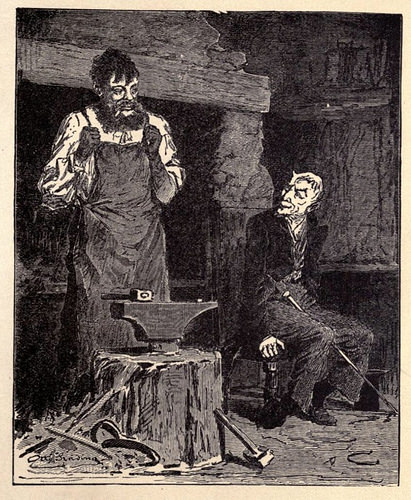
The Smith and the Devil - Russian folk tale or something much older?

The Smith and the Devil – Russian folk tale or something much older?

The BBC reports:

In the 19th Century, authors the Brothers Grimm believed many of the fairy tales they popularised were rooted in a shared cultural history dating back to the birth of the Indo-European language family.

Later thinkers challenged that view, saying some stories were much younger and had been passed into oral tradition having first been written down by writers from the 16th and 17th Centuries.

Durham University anthropologist Dr Jamie Tehrani, who worked with folklorist Sara Graca Da Silva, from the New University of Lisbon, said: “We can come firmly down on the side of Wilhelm Grimm. Some of these stories go back much further than the earliest literary record and indeed further back than Classical mythology – some versions of these stories appear in Latin and Greek texts – but our findings suggest they are much older than that.” ……

….. 

It also used a tree of Indo-European languages to trace the descent of shared tales to see how far they could be demonstrated to go back in time.

Dr Tehrani said Jack And The Beanstalk was rooted in a group of stories classified as The Boy Who Stole Ogre’s Treasure, and could be traced back to when Eastern and Western Indo-European languages split more than 5,000 years ago.

Analysis showed Beauty And The Beast and Rumpelstiltskin to be about 4,000 years old. And a folk tale called The Smith And The Devil, about a blacksmith selling his soul in a pact with the Devil in order to gain supernatural abilities, was estimated to go back 6,000 years to the bronze age. Dr Tehrani said: “We find it pretty remarkable these stories have survived without being written. They have been told since before even English, French and Italian existed. “They were probably told in an extinct Indo-European language.”

Tale telling around a camp-fire must have been one of the major contributors for the evolution of language. But what is a little surprising is that the oral tradition can be so persistent, and for so long. That suggests that orally transmitted tales from ancient cultures should probably be given much more weight. The origin of many concepts, which are often dated to the beginning of written records, are probably much older than thought.

Abstract

Ancient population expansions and dispersals often leave enduring signatures in the cultural traditions of their descendants, as well as in their genes and languages. The international folktale record has long been regarded as a rich context in which to explore these legacies. To date, investigations in this area have been complicated by a lack of historical data and the impact of more recent waves of diffusion. In this study, we introduce new methods for tackling these problems by applying comparative phylogenetic methods and autologistic modelling to analyse the relationships between folktales, population histories and geographical distances in Indo-European-speaking societies. We find strong correlations between the distributions of a number of folktales and phylogenetic, but not spatial, associations among populations that are consistent with vertical processes of cultural inheritance. Moreover, we show that these oral traditions probably originated long before the emergence of the literary record, and find evidence that one tale (‘The Smith and the Devil’) can be traced back to the Bronze Age. On a broader level, the kinds of stories told in ancestral societies can provide important insights into their culture, furnishing new perspectives on linguistic, genetic and archaeological reconstructions of human prehistory.
The science of Poohsticks (and the language of Poohlish)

August 26, 2015

I have known all along that “Poohsticks” is no mere game of chance. The choice of stick, the manner of dropping it, the strength of the current, the strength and direction of the wind, the position of the sun, the amount of honey consumed at breakfast,  and even the phase of the moon on the night before are all critical factors that affect the outcome. Of course, all these factors cannot even be described without knowledge of “Poohlish” which still remains a mystery. Just as physics becomes almost indescribable without the language of mathematics, knowledge of Poohlish is necessary to completely discern the science of Poohsticks. For a practitioner just knowing Poohlish needs to be augmented with practical training in Poohmatics and the art of thinking things through:

“Think it over, think it under.” ― A.A. Milne, Winnie-the-Pooh

Nevertheless some aspects of the game are beginning to be be quantified and some of the more superficial matters – such as the selection of a winning Poohstick – are beginning to be unravelled.

Cambridge News:

The game, in which competitors drop sticks into a river upstream off a bridge and see which comes out downstream first, is first mentioned in The House At Pooh Corner by AA Milne published in 1928.

The research, commissioned to celebrate the release of The Poohsticks Handbook: A Poohstickopedia – a new book featuring Winnie the Pooh and friends, written by comedy writer Mark Evans and illustrated by Mark Burgess – reveals the secrets to finding the perfect Poohstick according to a top scientist, and names the best places in the country to play. ……

….. The formula disproves the views of more than half of Britons (57%) who believe Poohsticks is a game of sheer luck.

Egmont Publishing joined Dr Rhys Morgan, director of engineering and education at the Royal Academy of Engineering, to equip the 39% of people who already take time sourcing the perfect Poohstick with the formula to ensure they pick the speediest stick to sail to victory. …….

…… It turns out that just 11% of Britons naturally pick the right sort of stick, with a third of people (30%) heading straight for a long and thin stick, which according to Dr Morgan is only half right.

The scientist, a father of two and avid Poohsticks player himself, said the main variables that need to be considered when designing the optimum Poohstick include cross sectional area, density/buoyancy, and the drag coefficient.

The perfect Poohstick = tubby and long, fairly heavy (but not so heavy it will sink to the bottom of the river), with quite a lot of bark to catch the flow of the river like paddles – or

PP (Perfect Poohstick) = A x Ï? x Cd.

Cross Sectional Area (= A) is important and the greater the area of an object, the more drag it creates. Normally, a large cross-sectional area decreases speed, but when it comes to Poohsticks, drag is key. If more water is able to influence the trajectory of the stick, it will accelerate more quickly. So when it comes to Poohsticks the tubbier, the better.

The density (= Ï?) of the stick affects its position in the water. The fastest part of the stream is below the surface, so theoretically, a waterlogged stick which sinks into the water a little will go faster than a stick which is floating right on the surface (where it could be slowed down by wind or other external variables).

The drag coefficient (= Cd) describes the shape of stick and roughness of its surface. Generally, a rough stick will create more drag than a smooth stick, so in general, bark is good. However, according to Dr Morgan, a certain roughness can make the stick apparently smoother, similar to the effect created by dimples in golf balls.

Meanwhile, VisitEngland has compiled a list of the best Poohsticks bridges alongside the original Poohsticks Bridge in Ashdown Forest in East Sussex.

The list includes bridges from Cumbria to Cornwall, including Sheepwash Bridge, Ashford in the Water in Derbyshire, Morden Hall Park in London, Heale Gardens in Salisbury, Wiltshire, Packhorse Bridge in Watendlath, Cumbria, and Mottisfont in Romsey, Hampshire.

Merely picking a potentially winning Poohstick is not enough of course. To truly understand the nuances of the game and become a Poohstick Master requires a sound grounding in Poohlish and some practical training in Poohmatics.

Mapping Älvdalen to Middle Earth places Rivendell at Trondheim

May 22, 2015

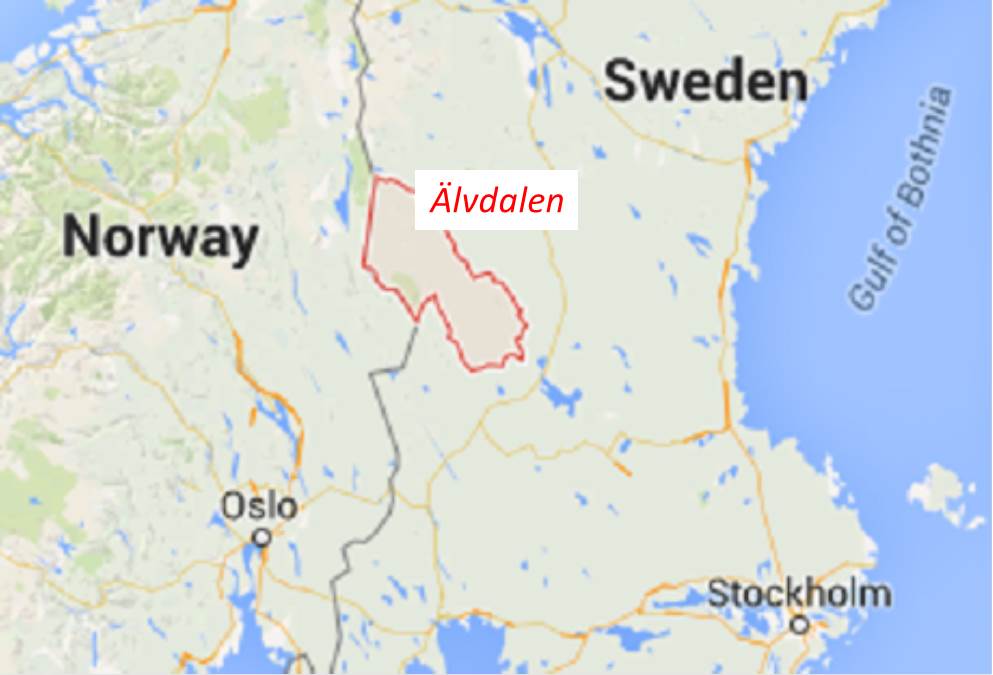
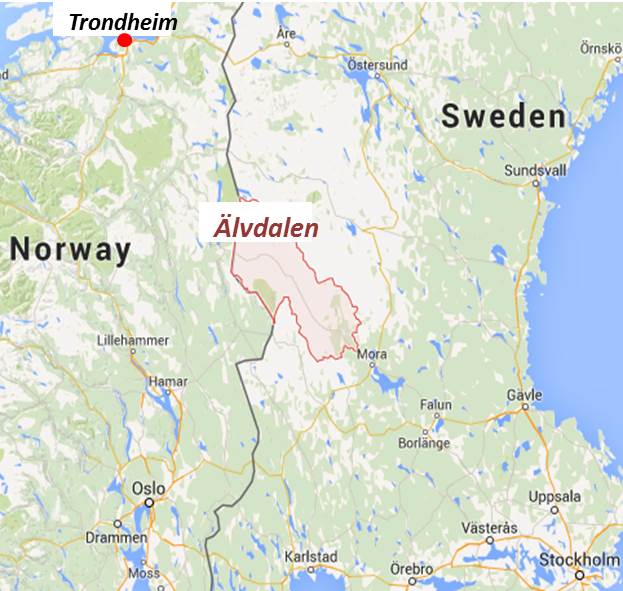
In my previous post I suggested that the municipality of Älvdalen in the county of Dalarna in Sweden was probably as close as one could get to Tolkien’s Lothlorien.

Trondheim to Älvdalen

I have posted earlier about Peter Bird’s wonderful mapping of Middle Earth to a pre-Holocene Europe where sea levels would have been some 120m lower than today.

Middle Earth by Peter Bird

Assuming

  1. that present day Älvdalen corresponds to Lothlorien in Middle Earth, and
  2. then taking Peter Bird’s mapping of Middle Earth to a Europe where sea levels were some 100m lower than today, and
  3. that the Misty Mountains lie between present day Norway and Sweden, and
  4. The Gates of Moria are not to be taken as the present day Mora in Dalarna, and

since the Fellowship of the Ring travelled south and east from Rivendell and through the Gates of Moria across the Misty Mountains to get to Lothlorien, then,

it follows that present day Trondheim maps to Rivendell of Middle Earth.

Frodo's Journey Rivendell to Lothlorien

Frodo’s Journey Rivendell to Lothlorien

Runes and elvish in the Valley of the Älv

May 21, 2015

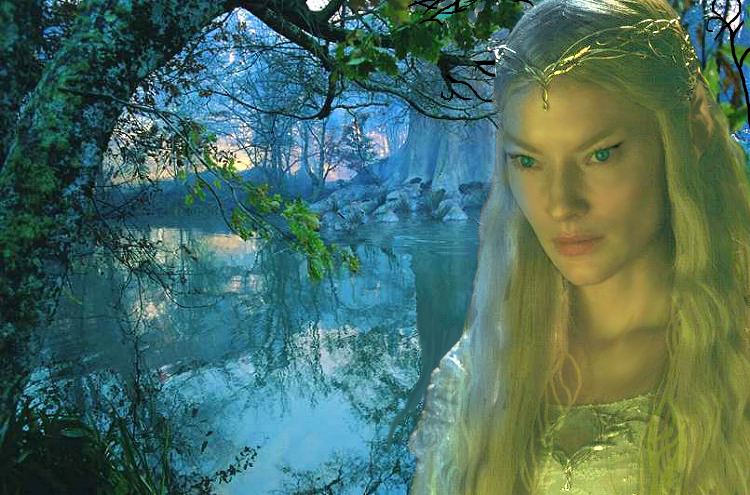
“Älv” in Swedish means “river”. But the origin of “elf” in English is the old English “ælf”. So when it is found that in Älvdalen, runes were used just 100 years ago and they still speak their own ancient Norse language, Elfdalian, it is difficult not to conjure up visions of Legolas and Elrond and of Galadriel in Lothlórien.

ScienceNordic: Elfdalian (älvdalska in Swedish and övdalsk in the language itself) sounds like something you would more likely encounter in Tolkien’s Lord of the Rings rather than in a remote Swedish forest. But the small town of Älvdalen, which gives the language its name, is not an Elven outpost. It is one of the last strongholds of an ancient tongue that preserves much of Old Norse, the language of the Vikings. …. has preserved linguistic features that are to be found nowhere else in Scandinavia, and that had already disappeared from Old Norse by 1200AD. ….

Because of its relative isolation, Elfdalian evolved in an entirely different direction than the modern Scandinavian languages. Its sounds, grammar and vocabulary differ radically from Swedish. So, while speakers of Swedish, Danish and Norwegian can easily understand each other in simple conversations, Elfdalian is completely unintelligible to Swedes who are not from the area.

Only about 2,500 people still speak Elfdalian but it is now being taught again in primary schools in the region.

Älvdalen is a municipality in Sweden and the name actually means River Valley. It is isolated from the rest of Sweden by its mountains, forests and lakes.

Älvdalen

ScienceNordic: “Älvdalen lies extremely deep within the Swedish forests and mountains. You can get there by boat up the river, Dalälven — a journey of more than 100 kilometres — and getting there and back used to be quite an expedition. So people in the area weren’t particularly mobile and were able to preserve this very special culture, considered in Sweden to be extremely traditional and old fashioned,”

The runic script was the dominant written language in Denmark and the rest of Scandinavia until the advent of Christianity in the ninth and tenth century introduced the Latin alphabet.

By the 15th century the Latin alphabet had almost wiped out the use of runes – but not in Älvdalen. Here, the Swedish linguist Henrik Rosenkvist recently saw a letter dated 1906 written partly in runes.

“The runes we see in Älvdalen are probably the most recent use of the script we know of. Runes otherwise died out in the Middle Ages so their use in so recent times is exceptional,” says Rosenkvist who speaks and studies the unique language spoken in Älvdalen.

The runes of Älvdalen — dalrunerne — are reminiscent of those used on runes stones in Denmark but there are a number of differences. Dalrunerne developed over time, influenced partially by the Latin alphabet. Here are the runes as they looked in the period leading up to the 20th century. (Illustration: Tasnu Arakun/Wikimedia Commons)

Nielsen agrees. “The use of runes in Scandinavia gradually ceased during the 15th century. There are the odd areas of Gotland in Sweden and in Iceland where the rune tradition survived until the 17th century, but in Älvdalen their use was widespread until the early 20th century,” he says.

According to Nielsen the runes in Älvdalen were most commonly found on houses and inscribed in furniture. In addition to this, they were also engraved into ’message blades’ which were sticks of wood that were circulated among the farms in the area. “The people who herded the cattle up in the mountains would write messages to each other in runes,” says Nielsen.

Tolkien took much of his inspiration for his elves (and fairies) from a mixture of Norse and Celtic mythologies and medieval writings. But his elves and their love of ships and their writing are straight out of Norse mythology. In that sense the real world Älvdalen is probably as close to  the enchanted – but fictional – forests of Lothlórien as it is possible to get.

Poltergeists on Mars

January 21, 2014

Mysterious forces and poltergeists are at work  on Mars (which in due course will be found not to be so mysterious after all). But stories about moving rocks, and possible aliens are not new. The latest however is just doing the rounds based on the pictures SOL 3528 and 3540.

Rock appears mysteriously in front of Mars Opportunity rover

Rock appears mysteriously in front of Mars Opportunity rover

(Phys.org)The lead scientist for NASA’s Mars rover exploration team (Steve Squyres) has announced that recent images beamed back by the Opportunity rover show a rock sitting in a place nearby where there wasn’t one just twelve days prior. The image, he says, has caused quite a commotion with the rover team as possible explanations for the sudden appearance of the rock are bandied about. The announcement was part of a meeting at California Institute of Technology to celebrate a decade of service by the tiny rover. …… 

….. How it got there has NASA’s best scratching their heads. Thus far, they have two main likely explanations: either the rock was tossed to that spot after a meteorite impact nearby, or far more likely, it came to rest there as a result of clumsy maneuvering by Opportunity itself. The rover is having trouble getting around these days as one of its actuators has failed. This means one wheel winds up scrapping the ground during turns, producing what Squyres described as “chatter” which he said could have caused some debris to be flung to where the rock is now.

But these stories have been appearing since – at least – about 2009 (based for example on pictures SOL 1833 onwards). Moving rocks on Mars have a long history of fanciful – and some not so fanciful – notions. A whole bunch can be found here and here. But it would seem that most of the conspiracy theories and “Life on Mars” stories are connected to the selling of particular books.

As far as stories are concerned, the first ever fictional account of Mars was probably Across the Zodiac (1880) by Percy Greg. But for me, The War of the Worlds (published in 1898) by H. G. Wells  and Edgar Rice Burroughs and his Martian Trilogy – published between 1912 and 1943 and which I first read in 1959 – are not easily surpassed.

Tolkien’s Middle Earth mapped to Europe

January 9, 2014

Some 45 years ago when I first read Tolkien, I recall making (or trying to make) a relief map of Middle Earth on cardboard with crumpled paper and glue and paint and plasticene for the relief features. I never had the patience to get it quite finsished and it was too large to survive my many moves as a student. But maps and cartography have fascinated ever since.

I have just come across this map of Middle Earth which – I think – is about 10 years old. Peter Bird is Professor Emeritus at the Department of Earth, Planetary, and Space Sciences of UCLA and this map of Tolkien’s Middle Earth is from his personal page. Here he superimposes Middle Earth onto a Europe at a time when sea levels (in my estimation) were more than 100m lower than they are today. All very fanciful of course, but interesting and for me very nostalgic.

From Frank Jacobs at strange maps:

But, as Tolkien states in the prologue to ‘The Lord of the Rings’, it would be fruitless to look for geographical correspondences, as “Those days, the Third Age of Middle-earth, are now long past, and the shape of all lands has been changed…” And yet, that’s exactly what Peter Bird attempts with the map here shown. Bird, a professor of Geophysics and Geology at UCLA, has overlapped the map of Middle-earth with one of Europe, which leads to following locations:

  • The Shire is in the South-West of England, which further north is also home to the Old Forest (Yorkshire?), the Barrow Downs (north of England), the city of Bree (at or near Newcastle-upon-Tyne) and Amon Sul (Scottish Highlands).
  • The Grey Havens are situated in Ireland.
  • Eriador corresponds with Brittany.
  • Helm’s Deep is near the Franco-German-Swiss border tripoint, close to the city of Basel.
  • The mountain chain of Ered Nimrais is the Alps.
  • Gondor corresponds with the northern Italian plains, extended towards the unsubmerged Adriatic Sea.
  • Mordor is situated in Transylvania, with Mount Doom in Romania (probably), Minas Morgul in Hungary (approximately) and Minas Tirith in Austria (sort of).
  • Rohan is in southern Germany, with Edoras at the foot of the Bavarian Alps. Also in Germany, but to the north, near present-day Hamburg, is Isengard. Close by is the forest of Fangorn.
  • To the north is Mirkwood, further east are Rhovanion and the wastes of Rhûn, close to the Ural mountains.
  • The Sea of Rhûn corresponds to the Black Sea.
  • Khand is Turkey
  • Haradwaith is the eastern part of North Africa, Umbar corresponds with the Maghreb, the western part of North Africa.
  • The Bay of Belfalas is the western part of the Mediterranean.
Middle Earth by Peter Bird

Middle Earth by Peter Bird
Allowing for polar wander and sea level change, most sites are recognizable. The southern Hithaeglir and northern Ephel Duath have sunk, unless perhaps they were only illusions that have been dispelled.

Men, muscles and noses (and why the Dong has a luminous nose)

November 20, 2013

A new study suggests that men have larger noses than women because they have greater muscle mass to supply with oxygen. That is also possibly why archaic humans with greater muscle mass than modern humans also had larger noses.

Nathan E. Holton, Todd R. Yokley, Andrew W. Froehle, Thomas E. Southard, Ontogenetic scaling of the human nose in a longitudinal sample: Implications for genusHomofacial evolutionAmerican Journal of Physical Anthropology, 2013; DOI: 10.1002/ajpa.22402 

The University of Iowa’s news release:

Human noses come in all shapes and sizes. But one feature seems to hold true: Men’s noses are bigger than women’s.

A new study from the University of Iowa concludes that men’s noses are about 10 percent larger than female noses, on average, in populations of European descent. The size difference, the researchers believe, comes from the sexes’ different builds and energy demands: Males in general have more lean muscle mass, which requires more oxygen for muscle tissue growth and maintenance. Larger noses mean more oxygen can be breathed in and transported in the blood to supply the muscle.

The researchers also note that males and females begin to show differences in nose size at around age 11, generally, when puberty starts. Physiologically speaking, males begin to grow more lean muscle mass from that time, while females grow more fat mass. Prior research has shown that, during puberty, approximately 95 percent of body weight gain in males comes from fat-free mass, compared to 85 percent in females. …. 

…. It also explains why our noses are smaller than those of our ancestors, such as the Neanderthals. The reason, the researchers believe, is because our distant lineages had more muscle mass, and so needed larger noses to maintain that muscle. Modern humans have less lean muscle mass, meaning we can get away with smaller noses.

“So, in humans, the nose can become small, because our bodies have smaller oxygen requirements than we see in archaic humans,” Holton says, noting also that the rib cages and lungs are smaller in modern humans, reinforcing the idea that we don’t need as much oxygen to feed our frames as our ancestors. “This all tells us physiologically how modern humans have changed from their ancestors.” ….

And by whatever strange associations that go on in my brain, Edward Lear’s explanation for how his heartbroken and stalwart Dong made himself a prosthetic, luminous nose (which I must have first read some 50 years ago) keeps going around in my head (extract from Edward Lear’s nonsense poem).

……. And those who watch at that midnight hour
From Hall or Terrace, or lofty Tower,
Cry, as the wild light passes along, —
            “The Dong! — the Dong!
      “The wandering Dong through the forest goes!
            “The Dong! the Dong!
      “The Dong with a luminous Nose!”
…….
Playing a pipe with silvery squeaks,
      Since then his Jumbly Girl he seeks,
      And because by night he could not see,
      He gathered the bark of the Twangum Tree
            On the flowery plain that grows.
            And he wove him a wondrous Nose, —
      A Nose as strange as a Nose could be!
Of vast proportions and painted red,
And tied with cords to the back of his head.
      — In a hollow rounded space it ended
      With a luminous Lamp within suspended,
            All fenced about
            With a bandage stout
            To prevent the wind from blowing it out; —
      And with holes all round to send the light,
      In gleaming rays on the dismal night.
…….
And all who watch at the midnight hour,
From Hall or Terrace, or lofty Tower,
Cry, as they trace the Meteor bright,
Moving along through the dreary night, —
      “This is the hour when forth he goes,
      “The Dong with a luminous Nose!
      “Yonder — over the plain he goes;
            “He goes!
            “He goes;
      “The Dong with a luminous Nose!”

The Dong was first published in 1846 and maybe Rudolph, who first appeared in a 1939 booklet written by Robert L. May, got his glowing red nose, in a similar way to the Dong.

HC Andersen’s lost tale: The Tallow Candle

December 19, 2012

A Christmas present for all lovers of HC Andersen’s fairy tales.

Danish National Archives:

At the Funen Provincial Archives enthusiasm is running high. If you ask Denmark’s leading Hans Christian Andersen expert, Ejnar Stig Askgård, he is in no doubt – it’s a sensational find that has turned up: “It’s my view that this is a transcript of one of Hans Christian Ander­sen’s earliest tales. It’s a work of his youth, from before Andersen’s real debut as a writer and poet. So the manuscript The Tallow Candle must be considered the first tale from the pen of Hans Christian Andersen. It’s a fantastic find.” …. 

Many people will perhaps be asking, “How can we be sure it’s a genuine Hans Christian Andersen tale?” According to the Hans Christian Andersen expert, we can tell from among other things the traces of history, the language and the themes in the manuscript – and they all bear the clear fingerprint of Hans Christian Andersen. “The tale The Tallow Candle has a classic Hans Christian Andersen theme. The themes that run through all his tales also recur here, the idea of ‘inner truth’ as opposed to ‘outer transience’,” says Ejnar Stig Askgård.

The short tale in English is printed by Politiken.dk and is reproduced here.

Copy of an original manuscript that is believed to have been lost, with a later dedication in blue ink reading: To P Plum from his friend Bunkeflod. The Plum and Bunkeflod families were close friends, and Hans Christian Andersen had a close relationship with Mme Bunkeflod.

To Mme Bunkeflod
from her devoted
H.C. Andersen

The Tallow Candle

It sizzled and fizzled as the flames fired the cauldron.. it was the Tallow Candle’s cradle – and out of the warm cradle came a flawless candle; solid, shining white and slim it was formed in a way that made everyone who saw it believe that it was a promise of a bright and radiant future – promises that everyone who looked on believed it would really want to keep and fulfil.

The sheep – a fine little sheep – was the candle’s mother, and the melting pot its father. Its mother had given it a shiny white body and an inkling about life, but from its father it had been given a craving for the flaming fire that would eventually go through its marrow and bone and shine for it in life.

That’s how it was born and had grown; and with the best and brightest anticipation cast itself into existence. There it met so many, many strange creations that it became involved with, wanting to learn about life – and perhaps find the place where it would best fit in. But it had too much faith in the world that only cared about itself, and not at all about the Tallow Candle. A world that failed to understand the value of the candle, and thus tried to use it for its own benefit, holding the candle wrongly; black fingers leaving bigger and bigger blemishes on its pristine white innocence which eventually faded away, completely covered by the dirt of a surrounding world that had come much too close; much closer than the candle could endure, as it had been unable to tell grime from purity – although it remained pristine and unspoiled inside.

False friends found they could not reach its inner self and angrily cast the candle away as useless.

The filthy outer shell kept all the good away – scared as they were to be tainted with grime and blemishes – and they stayed away.

So there was the poor Tallow Candle, solitary and left alone, at a loss at what to do. Rejected by the good, it now realised it had only been a tool to further the wicked. It felt so unbelievably unhappy, because it had spent its life to no good end – in fact it had perhaps sullied the better parts of its surroundings. It just could not determine why it had been created or where it belonged; why it had been put on this earth – perhaps to end up ruining itself and others.

More and more, and deeper and deeper, it contemplated – but the more it considered itself, the more despondent it became, finding nothing good, no real substance for itself, no real goal for the existence it had been given at its birth. As if the grimy cape had also covered its eyes.

But then it met a little flame, a tinder box. It knew the candle better than the Tallow Candle knew itself. The tinder box had such a clear view – straight through the outer shell – and inside it found so much good. It came closer and there was bright expectation in the candle – it lit and its heart melted.

Out burst the flame, like the triumphant torch of a blissful wedding. Light burst out bright and clear all around, bathing the way forward with light for its surroundings – its true friends – who were now able to seek truth in the glow of the candle.

The body too was strong enough to give sustenance to the fiery flame. One drop upon another, like the seeds of a new life, trickled round and chubby down the candle, covering the old grime with their bodies.

They were not just the bodily, but also the spiritual issue of the marriage.

And the Tallow Candle had found its right place in life – and shown that it was a real candle, and went on to shine for many a year, pleasing itself and the other creations around it.

H.C. Andersen.

Arrogant and overbearing political correctness censures Tintin from Stockholm library

September 25, 2012

See update below:

I have little patience with the “do-gooders” who always know best what is good for others. But impatience turns to an active dislike when an arrogant young man (a certain Behrang Meri) presumes that his world-view shall prevail and takes it upon himself to be a censor by removing all copies of Tintin from the shelves of the 10-13 year old library of Stockholm’s Culture Centre. Of course he claims he is doing this “for their own good”. Arrogance and coercion are the stock-in-trade of the “do-gooders” and is wide-spread in Sweden. Banning things for the “good of others” is the order of the day. Some of the coercive tactics employed – even if now coming from the left of the political spectrum – are indistinguishable from those employed by the fascists in Europe almost 100 years ago.

Dagens Nyheter reports (my free translation):

Tintin has been ejected from the Culture Centre in Stockholm. DN can report that the beloved cartoon character has been cleaned out from the library shelves. Now the staff have been instructed to look for any more books which have racist or homophobic values.

The 10-13 year old library of Stockholm’s Culture Centre has  removed Tintin books from the shelves. In consultation with their staff, the artistic director with responsibility for children and activities for the young made ​​the decision.

“That’s right. The picture Tintin books give for example of Africans is afrofobisk. Africans are shown to be a bit silly while Arabs are sitting on flying carpets and Turks smoke water pipes. The image of  the “forest Turk” is still there. It’s about exoticism and Orientalism”, says Behrang Miri, who leads efforts to develop Child and Youth Culture activities in the sections for children, “Tiotretton” and “Lava”. ……. 

Behrang Meri, the self-appointed censor in this case, was appointed to his position in February this year.

He was on the radio this morning and tried to babble his way through by insisting that he was removing the books so that children could actually go deeper into the questions of racism!!  He seemed to be avoiding all questions and merely spouting a practised defence. I would have thought that deepening children’s understanding would only be possible by exposure to the books and not by his over-bearing, over-protectiveness denying exposure to the books. In any case the Tintin serials – which I greatly enjoyed through my childhood – were written in a colonial time and had no racist intentions. It depicted the world-view that existed at the time. Censorship will not change history or cause those times to disappear.

He failed to impress and I cannot help feeling that his ego has got the better of him and his objective is mere self-promotion rather than the cultural enrichment of 10-13 year old children.

UPDATE!

Following a storm of media criticism, officials at the Kulturhuset library in Stockholm have reversed their decision to remove Tintin comic books from its shelves, saying the move happened “too fast”.

I note that it was the head of the Culture Centre who reversed the censorship and Bahrang Meri has accepted being overruled. In spite of his vehement defence of his decision on the radio this morning this was clearly not a resigning issue. Some damage control is ongoing but damage there certainly is:

“I wanted to highlight an opinion piece about issues of discrimination, but realize now that it’s wrong to ban books,” Meri said in a statement. However, Kulturhuset head Sjöström applauded Meri for prompting a discussion about discrimination. 
“The issues of discrimination, equality and norms continue to be debated and discussed,” Sjöström said in a statement.

Saffron Sollitt wins 2011 Poohsticks

March 28, 2011

A.A. Milne

Piglet sidled up to Pooh from behind.  “Pooh!” he whispered.  “Yes, Piglet?”  “Nothing,” said Piglet, taking Pooh’s paw.  “I just wanted to be sure of you.”

BBC reports:

Little Wittenham Bridge with the lock keeper's house beyond: image Wikipedia

A nine-year-old girl from Oxfordshire has won the individual prize in the World Pooh Sticks Championships. Saffron Sollitt, from Wallingford, beat 500 other competitors from around the globe at Days Lock in Little Wittenham, near Abingdon, on the River Thames.

Team Kelly took the top spot in the group competition. Last year’s event was cancelled due to high water levels. The competition attracted entries from New Zealand, Germany and the Netherlands.

The championships started in 1983 when the lock keeper noticed walkers recreating Pooh’s pastime on the River Thames.

He thought it would be an excellent way of raising money for his favourite charity, the Royal National Lifeboat Institution (RNLI). The event went from strength to strength until the lock keeper’s retirement when it was passed to the Rotary Clubs of Oxford Spires and Sinodun.

Money raised this year, expected to be excess of £1,500, will go to the RNLI, Little Wittenham Church and other charities supported by the Rotary club.

All about Poohsticks: image theenchanted100acrewoods


Poohsticks is a game first mentioned in The House at Pooh Corner, a Winnie-the-Pooh book by A. A. Milne. It is a simple game which may be played on any bridge over running water; each player drops a stick on the upstream side of a bridge and the one whose stick first appears on the downstream side is the winner. The annual World Poohsticks Championships have been held at Day’s Lock on the River Thames since 1984.