Archive for the ‘Natural Disasters’ Category

Merapi eruptions slowing down but still deadly

November 13, 2010

Mount Merapi volcano continued spewing hot gas ash but not as violently as before. But the death toll continues to climb as people succumb to their injuries.

Mount Merapi spews volcanic material as seen from Argomulyo, Indonesia, Friday, Nov. 12, 2010.(AP Photo/Achmad Ibrahim)

The Jakarta Globe now puts the toll at 240 lives:

Indonesia’s Mount Merapi volcano has killed 240 people since it began erupting late last month, with more than 390,000 people in makeshift camps, an official said. That figure continues to rise as people with severe burns die from their wounds and officials count those who have died from respiratory problems, heart attacks and other illnesses related to the blasts.

In addition, search operations continue for bodies buried under a thick layer of ash that shrouds whole villages. On Friday, soldiers pulled eight more bodies from around one hard-hit village, said Waluyo Rahardjo, who works for the search and rescue agency.

The Associated Press reports:

Ash has continuously shot out of the crater since it roared to life Oct. 26, occasionally canceling international flights into and out of Jakarta, hundreds of miles (kilometers) to the volcano’s west. After the output slowed overnight, an advisory from the Volcanic Ash Advisory Center in Darwin, Australia, showed the ash patch was well clear of the capital. The airport in Yogyakarta, at the foot of the mountain, however, remained closed.

Officials warned residents that less ash does not mean the volcano is finished.

“The activity of Merapi is still high, but the intensity of eruptions is reducing now. But people still should be careful. Merapi is still on high alert,” said Surano, a state volcanologist who uses only one name.

While officials struggle to persuade hundreds of thousands of people who live on the volcano’s fertile slopes not to return to their homes, a new kind of evacuee has been seen in recent days. Villagers checking on their homes and crops have seen Javan leopards — who live in a national park near the crater — heading down the mountain.

The cats likely feel the continuing tremors, said Tri Prasetyo, who runs the park, and are seeking safer ground. It’s also possible that prey is scarce in areas scorched by searing gases.

Aceng , a Java leopard, released back into the wild. Credit IAR

The Javan leopard — a subspecies of the cat only found on the island of Java — is critically endangered, with no more than 250 left in the wild. Some put the total population as low as 50.

Joko Tirtono, the manager of a zoo in Yogyakarta, said zoo keepers are now searching villages where the leopards have been spotted and laying traps in which they hope to capture the cats alive.

Mount Merapi eruption images from Nasa

November 11, 2010

The steep-sided, cone-shaped Mount Merapi volcano is both boon and curse to the people of Indonesia. Volcanic ash from its frequent eruptions makes the soil fertile enough to support a large population. It is also one of Indonesia’s most active volcanoes, posing a constant threat to tens of thousands of people who live in its shadow. On October 26, 2010, the volcano once again turned destructive, unleashing a series of eruptions that had killed at least 44 people and forced 75,000 people from their homes, said CNN on November 4.

Eruption at Mount Merapi, Indonesia

Eruption at Mount Merapi, Indonesia: Nov 1st: image NASA


The mountain has been shrouded in clouds throughout the eruption, but on October 30 the Advanced Spaceborne Thermal Emission and Reflection Radiometer (ASTER) on NASA’s Terra satellite captured the thermal signature of hot ash and rock and a glowing lava dome. The thermal data is overlaid on a three-dimensional map of the volcano to show the approximate location of the flow. The three-dimensional data is from a global topographic model created using ASTER stereo observations.

The Center of Volcanology and Geological Hazard Mitigation reported that two pyroclastic flows moved down the volcano on October 30. A pyroclastic flow is an avalanche of extremely hot gas, ash, and rock that tears down the side of a volcano at high speeds. ASTER imaged one of those flows.

Merapi shows no signs of slowing. After several days of eruptive episodes, the volcano began an eruption on November 3 that was five times more intense than on October 26 and lasted more than 24 hours. It is the most violent eruption at the volcano since the 1870s, said local geologists.

See more NASA images at:

http://earthobservatory.nasa.gov/NaturalHazards/event.php?id=46815

Eruption at Mount Merapi, Indonesia

SO2 cloud from Mt. Merapi: 4th November: image NASA

Eruption at Mount Merapi, Indonesia

Ash plume from Mt. Merapi 8th Nov: image NASA


New Merapi ash forces Obama to curtail visit, causes more flight cancellations

November 10, 2010

President Obama will cut short his visit to Indonesia by two hours to be able to meet a take-off window created by further ash eruptions from Mount Merapi volcano (431 km from Jakarta) last night and today. Some international flights to Jakarta on Wednesday and Thursday have been cancelled.

The Jakarta Globe.

Mount Merapi erupting again on Wednesday. Four airlines, including Qantas and Malaysia Air, have canceled flights to Jakarta. Some international flights to Bali have also been affected. (EPA Photo)

Mount Merapi erupting again on Wednesday. Four airlines, including Qantas and Malaysia Air, have canceled flights to Jakarta. Some international flights to Bali have also been affected. (EPA Photo)

Indonesia’s Merapi volcano has forced a number of international airlines to cancel flights over concerns about air safety. The volcanic eruptions in central Java also forced United States President Barack Obama to cut short his visit to the country. Obama sliced several hours off his whirlwind 24-hour tour Wednesday.

Mount Merapi, hundreds of kilometers east of Jakarta, has been spewing massive clouds of ash and gas high into the air for more than two weeks, killing at least 153 people and causing travel chaos and forcing two nearby airports to shut down. Syaiful Bahri, who oversees operations at Jakarta’s Soekarno-Hatta International Airport, says that concerns about the ash also forced several international carriers to again cancel flights into and out of the capital. Among them were Cathay Pacific, Value Air, Qantas and Malaysia Air.
An Indonesian government volcanologist said the pace of the eruption had slowed, but Hong Kong’s Cathay Pacific and Australia’s Qantas canceled flights because of the ash. Cathay said it had canceled flights to and from Jakarta on Wednesday and Thursday, while Qantas canceled a Sydney-Jakarta service on Wednesday. “Cathay Pacific will monitor and assess the situation and the possibility of operating flights,” the airline said on its website Wednesday. Jetstar, the low-cost offshoot of Qantas, has also changed its flight schedule for services to the Indonesian island of Bali, canceling flights that arrive at or depart from the popular holiday destination at night.
Officials said safety worries about the ash also meant Yogyakarta airport would stay closed until Monday next week at the earliest.

Mount Merapi rumbles on while Anak Krakatau crater expands and Obama flies in to Jakarta

November 9, 2010
A closer look at Anak Krakatau

Anak Krakatau: Image via Wikipedia

Yogyakarta’s Adi Sutjipto domestic and international airport has been closed until at least next Monday Nov. 15, at which time another decision would be made. Despite the ban on civilian and commercial flights in and out of Yogyakarta, the Indonesian Air Force was still operating Hercules flights to deliver aid to the internally displaced.
More than 300,000 people are believed to be housed in government shelters.

Indonesian rescue workers resumed efforts to retrieve bodies of victims from an eruption of Mount Merapi in central Java on Nov. 5, after surface temperatures forced a halt to the search on Monday. More than 320,000 people are housed at evacuation centers outside the 20-kilometer safety zone in four regencies in Yogyakarta and Central Java provinces, the National Disaster Management Agency said in a statement on its Web site today. Evacuees reached 280,000 people yesterday.

“Volcanic activity is relatively stable this morning compared with yesterday,” said Oka Hamid, a spokesman at Red Cross Indonesia’s Yogyakarta branch. “We recovered two remains in one village but we have to leave another four as the field is hard to reach and they’re all covered with thick ash.”

Meanwhile –

The crater of Anak Krakatau in the Sunda Strait has expanded to a diameter of 25-26 meters, an Indonesian volcanologist says. The news comes as the frequency of eruptions of the volcano, once misidentified as Krakatoa, increases: On Friday there were 615 eruptions, on Saturday 623 eruptions, and on Sunday 668.
Anton S Pambudi, a official from Banten province monitoring the eruptions, said the eruptions over the past two weeks had changed the shape of the crater. Authorities have warned that several other volcanoes in Indonesia are showing increased signs of activity. These include Mount Karangetang on Siau Island in North Sulawesi and Mount Ibu on Halmahera Island in North Maluku.

Banten Governor Ratu Atut Chosiyah said she believed that Anak Krakatau did not pose a threat and that the eruptions, which can be seen from the western tip of Java Island, were interesting to observe.

Philippine Airlines Inc., Emirates, Eva Airways Corp. and Valuair Ltd. resumed flights to Jakarta on Monday after suspending them for two days, PT Angkasa Pura, the Soekarno-Hatta international airport operator said on its Web site. Singapore Airlines Ltd., Cathay Pacific Airways Ltd. and Japan Airlines Corp. restarted services on Sunday.

President Obama arrives in a few hours in Jakarta.

Merapi: Residents flee Yogyakarta but flights resume to Jakarta

November 8, 2010


Mt. Merapi hazard map: image worldlywise.pbworks.com


Yogyakarta lies some 35 km from Mount Merapi but one of the “hazard” tongues from the volcano (see map above) leads directly to the city.

The Jakarta Globe reports:

Frightened residents in a bustling city of 400,000 at the foot of Indonesia’s rumbling volcano headed out of town Monday, cramming onto trains and buses and even rented vehicles to seek refuge with family and friends far away.

Mount Merapi, one of the world’s most active volcanoes, has erupted many times in the last century, killing more than 1,400. But Friday was the mountain’s deadliest day since 1930, with nearly 100 lives lost. The notoriously unpredictable mountain unleashed its most powerful eruption in a century Friday, sending hot clouds of gas, rocks and debris avalanching down its slopes at highway speeds, smothering entire villages and leaving a trail of charred corpses in its path.

All (international flights) were back in the air Monday and White House officials said Obama was still scheduled to touch down on Tuesday.

Merapi, meanwhile, showed few signs of tiring Monday, sending out thunderous claps as it shot clouds of gas and debris high into the air.
The Indonesian government has put Yogyakarta on high alert. Though there have been no orders to evacuate, many residents decided to go on their own.

Iceland volcano watch stands down

November 6, 2010

Jökulhlaup from Grímsvötn subsides

The earlier concern about meltwater flooding from the Grimsvotn glacial lake in Iceland which could have signalled that the volcano underneath was about to erupt has subsided.

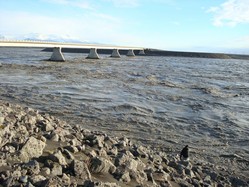
Bridge over Gígjukvísl

Figure 1. The jökulhlaup from Grímsvötn: image vedur.is

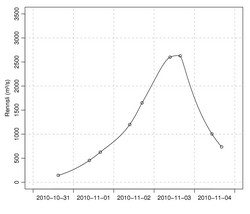
The jökulhlaup (glacial outburst flood) from Grímsvötn that began near the end of October is now coming to an end. The flood reached a maximum level shortly after noon on November 3, and scientists from IMO visited the site on that day to study the effects of the flood on the region adjacent to the ice margin. Two IMO technicians have performed regular discharge measurements on the bridge over the river Gígjukvísl throughout this week (Figure 1) and the results from their measurements are shown in Figure 2.

Figure 2. Discharge (m3/s) measurements at Gígjukvísl bridge: From the curve the total amount of floodwater is estimated 0.45 km3

The discharge curve is typical for jökulhlaups from Grímsvötn that do not result from volcanic activity: Over the course of several days, the amount of water flowing through an ice tunnel at the glacier bed steadily increases. Loss of frictional heat from the floodwater causes melting of the tunnel walls, thereby increasing the flow capacity of the tunnel.

In past centuries, most jökulhlaups from Grímsvötn have entered the course of the river Skeiðará. This time, however, floodwater that emerged from beneath the eastern part of the glacier went westwards along the glacier margin and then entered the river Gígjukvísl. Skeiðará has deposited very large amounts of sediment on the eastern part of Skeiðarársandur plains over the centuries, increasing the elevation of the sandur area there relative to the central part. In addition, the glacier has carved a trench during times of advance. Thus, it was clear that retreat of the glacier over the past 15 years would sooner or later lead to a drastic shift in the direction of meltwater flow from this part of the glacier. In the summer of 2009, this shift occurred and water has ceased to enter the course of Skeiðará.


Mount Merapi ash cloud leads to cancellation of flights to Jakarta

November 6, 2010

Mount Merapi volcano lies 431 km from Jakarta. But the continuing eruptions over the last two weeks have pumped sufficient ash sufficiently high into the atmosphere that flights to Jakarta are beginning to be cancelled. Flights to Yogyakarta, the nearest large airport to Mount Merapi, were suspended a few days ago.

The Guardian reports:

Several airlines have suspended flights into Indonesia’s capital Jakarta after Mount Merapi’s worst eruption in a century spewed volcanic ash up to five miles (8km) into the air.

The move came as number of people killed by Mount Merapi in the last two weeks climbed to 138 after the volcano unleashed a surge of searing gas yesterday that torched houses and trees and incinerated villagers.

Officials at Singapore Airlines, Japan Airlines, Malaysia Airlines, Lufthansa, Cathay Pacific and AirAsia fear the ash is a safety threat and could damage aircraft.

“The volcanic ash presence in the airways surrounding Jakarta could cause severe damage to our aircraft and engines which could impair the safety of our operations including passengers and crew,” said Azharuddin Osman, director of operations for Malaysia Airlines.


mt merapi erupting

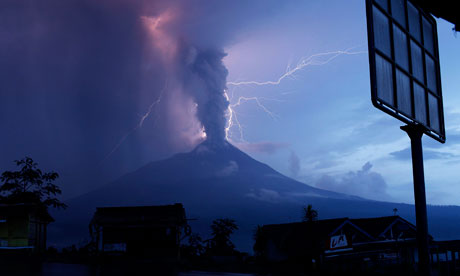
Lightning strikes as Mount Merapi volcano erupted today, spewing out towering clouds of hot gas and debris, as seen from Ketep village in Magelang, Indonesia's Central Java province. Photograph: Beawiharta/Reuters


Mt. Merapi eruptions continue into second week

November 5, 2010

AFP reports:

Merapi eruption

ARGOMULYO, Indonesia: At least 49 people were killed and scores injured Friday when Indonesia’s Mount Merapi volcano erupted again, incinerating villages as far as 18 kilometres (11 miles) away, officials said. The latest deaths bring the total toll to more than 90 since the country’s most active volcano started erupting on October 26. Ash, deadly heat clouds and molten debris gushed from the mouth of the 2,914-metre (9,616-foot) mountain and shot high into the sky for most of the night and into the morning.

The ranks of evacuees swelled past 100,000 people, with 30,000 moved into a sports stadium about 25 kilometres away from the peak. “The emergency shelters are now overcrowded,” emergency response field coordinator Widi Sutikno said.

The international airport at Yogyakarta was closed as ash clouds billowed to the altitude of cruising jetliners and the runway was covered in gray soot, officials said. The exclusion zone was widened from 15 to 20 kilometres around the mountain and everyone living in the area was ordered to evacuate their homes and shelters immediately, he said. Indonesia’s transport ministry has told pilots to stay at least 12 kilometres away from the rumbling volcano and several flights linking central Java to Singapore and Malaysia have been cancelled this week.

Government volcanologist Surono said Friday’s blasts were the largest yet.

Mt. Merapi: map credit hobotraveler.com