
Minamisanriku: photo Kyodo News

Kamaishi: photo Kyodo News

Minamisanriku: photo Kyodo News


Hiromitsu Shinkawa, 60, rescued 15 km from the coast: photo AP
Minamisanriku: photo Kyodo News
Kamaishi: photo Kyodo News
Minamisanriku: photo Kyodo News
Hiromitsu Shinkawa, 60, rescued 15 km from the coast: photo AP
0900 CET: Japanese SDF forces assigned for rescue operations doubled to 100,000. The focal zone for the quake was 500km long and 200km wide and the quake lasted 5 minutes. The highly unusual quake actually consisted of 3 massive quakes. Miyagi Police Dept Chief said the death toll in the prefecture will exceed 10,000. Fukushima Reactors 1 & 3 will probably not start again because of the ingress of sea water. Hydrogen has built up in Reactor no. 3 probably when the core was uncovered and could cause an explosion as in Reactor No.1 but there is no risk of consequent radiation leakage. Cooling water levels have now increased . 210,000 people are being evacuated from the 20km exclusion zone . The hospital where 19 patients were found to have been exposed to some radiation is within the exclusion zone. A 63 old year man was rescued 15km out to sea on Sunday afternoon.
Examples:
0800 CET: The 1999 event at the Tokai Uranium processing plant where 2 people died was also rated as a Level 4 incident. 19 patients at a hospital in Fukushima have been found to have been exposed to radiation and need to be decontaminated but are not in any danger.
Aftershocks of magnitude 7 or more have a probability of 70% and will continue for a week. Magnitudes above 7 could generate tsunamis.
0730 CET: Chief cabinet secretary, Yukio Edano has just held a press conference.
Radiation measurements at Fukushima today rose from around 50 μSieverts to around 1557 μS for 1 hour between 1.44 and 2:42 pm and then came back to 184 μS. The spokesman stated on NHK that a deformation of part of the reactor cores has occurred but that we should be careful with terminology of a meltdown. Some part of some of the sheaths surrounding some of the fuel rods are thought to have melted. The level of 1557 μS should be compared with the 600 μS during a stomach X-Ray. There is no health risk he said. Cooling and safety actions could still give small hydrogen accumulations and consequent explosions but these would not pose any danger or any radiation risks.
4 of the 6 reactors at Fukushima Dai-ichi may never operate again – partly because some of the measures being taken now for safety are irreversible.
Sunday 13th March: 0700 CET
The Quake magnitude has now been set at 9.0 and as more measurements come in it is likely that this probably will end up at 9.1 or 9.2. The number unaccounted for still remains very high.
TEPCO has declared a formal emergency around the Fukushima nuclear plants. Reactors No.1 and 3 at Fukushima Dai-ichi nuclear plant have probably had fuel rods exposed and with loss of cooling and have probably suffered core damage and melting – a partial if not a complete meltdown. However, so far it seems that the melted or partially melted cores have been confined within the containment. Temperatures are too high in 2 further reactors and radiation is still being released even if at low but still unacceptable levels. Some deliberate venting of radioactive gases is still continuing.
The Japan Nuclear agency has (provisionally) rated the Fukushima nuclear plant incident at 4 on the 0 to 10 7 International Nuclear Event Scale developed by the IAEA. Three Mile Island was rated at 5 and Tjernobyl was rated at 7.
A meltdown may have occurred at at least one nuclear power reactor in Japan, the country’s chief cabinet secretary, Yukio Edano, said Sunday. He also said that authorities are concerned over the possibility of another meltdown at a second reactor.
“We do believe that there is a possibility that meltdown has occurred. It is inside the reactor. We can’t see. However, we are assuming that a meltdown has occurred,” he said of the No. 1 reactor at the Fukushima Daiichi nuclear facility. “And with reactor No. 3, we are also assuming that the possibility of a meltdown as we carry out measures.” Edano’s comments confirm an earlier report from an official with Japan’s Nuclear and Industrial Safety Agency, who said, “we see the possibility of a meltdown.”
A meltdown is a catastrophic failure of the reactor core, with a potential for widespread radiation release. However, Toshihiro Bannai, director of the agency’s international affairs office, expressed confidence that efforts to control the crisis would be successful.

Minimisanriku Photo AP
1200 CET: More than 1.2million people are without water and over 4 million households are without electricity. Trains in the Tokyo region are beginning to run again. The earth’s axis has shifted by about 10cm.
Evacuation radius has been increased to 20 km around Fukushima No.1. Clearly a very serious incident has taken place. No further details but it is acknowledged by TEPCO that a meltdown must have occurred. What could have caused the entire building walls to collapse leaving only the framework is also not clear. But whatever explosive force caused the walls to fall down must have originated from within the primary or the secondary reactor containment. Some escape of radiative materials is therefore inevitable. The measured radiation level of 1051μSievert is at least 10,000 times greater than normal and at about the limit of what is considered safe.
1000CET: Further Tsunami warnings with expected 3m waves.
0940 CET: Radiation levels of 1050 μSieverts measured at Fukishima No. 1. No mention of whether it is increasing. This is going to be a lot worse than Three Mile Island but a Tjernobyl type accident is hopefully still unlikely.
0925 CET: LIVE PICTURES FROM NHK SEEM TO SHOW THAT THE ENTIRE OUTER WALL OF REACTOR NO. 1 BUILDING HAS DISAPPEARED WITH ONLY THE SKELETON OF CONSTRUCTION STEEL BEING VISIBLE.

0900 CET: BREAKING: TEPCO REPORTS EXPLOSION AT FUKUSHIMA NO.1 Plant. Some workers injured.
0830 CET: High pressure in Fukushima No.1 plant, Reactor No.1 has been relieved by careful venting. The evacuation zone is a 10km radius around the plant but a BBC correspondent reports that police are stopping people from moving closer than some 60 km from the plant.
Fires are raging at over 650 locations. GPS indicates that some ground stations have shifted by between 1m and 2.4 m 4.o m. Medical teams are on their way to Fukushima No.1 nuclear plant to handle any consequences of any radiation leaks.
0800 CET: 1000 reported dead with 600+ known to be missing
0730 CET: Deathtoll now 900 and rising –
NHK is reporting that Caesium and Iodine has been detected around Fukushima Dai-ichi (No.1) nuclear power plant which may indicate that some fuel rods (or maybe just the metal containment around the rods) have melted. 1.7 m of the rods were exposed. Mobile generators have been brought to the plant and cooling water is being pumped in but levels are still dropping indicating a leak somewhere. All 13 back up diesel generators for the emergency cooling system failed. Evacuation area has been increased to 10km around the plant. Fukushima No.1 has 6 reactors with a total capacity of 10,964 MW.
At Fukushima No. 2 about 10km south of Fukushima No1. pressure is rising in the 4 reactors making up the plant. Some venting of radioactive gases has taken place and more may be required. Residents within a 10km radius have been told to stay indoors. Prevailing winds are currently out to sea. Fukushima Dai-ni has a capacity of 4,400 MW.
Both Fukushima plants are owned and operated by TEPCO (Tokyo Electric Power Co.).
Some of TEPCO’s thermal, hydro and nuclear plants have been shutdown and blackouts may be required in parts of Tokyo.
Diesel generators installed to provide backup power for the cooling systems for units 1–3 were damaged by the tsunami; they started up correctly but then stopped abruptly about 1 hour later. Because cooling is needed to remove residual reactor heat, in Japan a nuclear emergency is declared upon cooling problems and therefore a nuclear emergency was declared—for the first time—when the diesel engines failed. Batteries, which last about eight hours, were being used to power the reactor controls and valves during the electrical outage.Japanese ground forces were said to be trucking generators and batteries to the site.
An evacuation order was issued to people living within 3 kilometres (1.9 mi) of the plant, affecting approximately 5800 residents living near the power plant. People living less than 10 kilometres (6.2 mi) from the power plant were advised to stay indoors. Later the evacuation was expanded to a 10 kilometres (6.2 mi) radius.
Past midnight local time, it was reported that The Tokyo Electric Power Company was considering venting hot gas from the reactor vessel number 1 into the atmosphere, which could result in the release of radiation. The Tokyo Electric Company reported that radiation levels were rising in the turbine building for reactor 1. At 2:00 JST, the pressure inside the reactor was reported to be 600kPa (6 bar or 87 psi), 200 kPa (2 bar or 29 psi) higher than under normal conditions. At 5:30 JST the pressure inside Reactor 1 was reported to be 2.1 times the “design capacity.” At 6:10 JST, the IAEA reported that unit 2 was also experiencing cooling problems.
To reduce mounting pressure potentially radioactive steam has been released from the primary circuit, into the secondary containment. On March 12, 2011 at 6:40 JST, Chief Cabinet Secretary Yukio Edano stated that the amount of potential radiation would be small and that the prevailing winds are blowing out to sea. Measured radiation levels inside the plant control room were reported to be 1000 times greater than normal. Radiation levels measured at a monitoring post near the plant’s main gate were reported to be more than eight times above normal. In a press release at 7 AM (local) March 12, TEPCO stated “Measurement of radioactive material (Iodine, etc.) by monitoring car indicates increasing value compared to normal level. One of the monitoring posts is also indicating higher than normal level.”
The Prime Minister of Japan, Naoto Kan, visited the plant for a briefing 12 March 2011.
After the March 11, 2011, earthquake, Nuclear Engineering International reported that all four units were automatically shut down. Tokyo Electric on March 12 reported that the cooling system for three reactors (nrs 1, 2 and 4) at the plant had topped 100 degrees between 5:30 and 6:10 JST, less than one hour after the start of additional cooling with condensate water,and that the “pressure suppression function was lost”. According to a Reuters report, officials are “prepar[ing] for release of pressure” from the plant. An evacuation order was issued to people living within 3 kilometres (1.9 mi) of the plant, which might be expanded to 10 kilometres (6.2 mi) from the power plant.
I was woken up in Tokyo in 1995 when the Great Hanshin Earthquake hit Kobe (having left Kobe 6 hours earlier on the last Shinkansen to Tokyo the night before) where the epicentre was just off Awaji Island but there was no tsunami then. The destruction was massive and Kobe burned and over 6,000 people perished.
All day today I have been watching the riveting pictures of the tsunami hitting the Sendai coast. The sheer power of the water sweeping irresistibly across the landscape picking up houses, ships, buses and cars like little cardboard models was terrible and awe-inspiring. The memories of 1995 came flooding back and it once again reminded me of the puny impact mankind has in the face of such forces.
And all the energy that is released by these great movements of the continents on Earth have their origin in the energy stored at the time of Earth’s creation and the energy it has received from the Sun since then. And all the energy of all these earthquakes and volcanoes and tsunamis and cyclones are as nothing to the energy released continuously by the Sun. To the Earth this Great Sendai quake of 2011 is just a very small adjustment of stresses and strains and is of little significance. The Great Dance orchestrated and choreographed by the Sun will go on and the continents will keep drifting and moving under each other and volcanoes will keep erupting. And our Science will continue to try and understand and predict when catastrophic events will occur. But we will have to tame the Sun if we are ever to be able to control these events.
The death toll in Sendai is rising and and as morning comes in a few hours to Japan the full extent of the destruction will begin to be revealed. Whole villages could well have been wiped out, entire trains have been carried away by the force of the waters and some ships are missing. Fires are breaking out and the Fukushima nuclear plant was swamped.
Science and technology are our best defence against loss of life and loss of property by “natural” disasters. The preparedness of Japan is a tribute to this when comparing today’s tsunami with that after the Aceh quake of 2004. Science and technology will help us to cope with the consequences of these events and maybe – some day – will help us predict some of them. But they will not prevent such disasters.
The Sun is going through an unusual – but not unprecedented – minimum. There is no proof and there is no evidence of any causal relationship but there are correlations between increased earthquake and volcanic activity with solar minima and solar proton events. We have a further 2 or 3 years of increased earthquake and volcanic activity if this correlation holds true.
It seems not only plausible but also fitting that such great and terrible events can only be a part of the Great Dance of the Sun.
Amid the stories of resilience and indomitable spirit that represent the heights to which human behaviour can ascend come also the stories of the human vultures and the depths to which behaviour can fall.
Police sickened by Christchurch looting

Damaged cathedral after an earthquake in central Christchurch February 22, 2011: Photograph by: HO Credit: REUTERS
New Zealand police said Friday they were “sickened” at a spate of looting, email scams and bogus appeals for charity in the wake of the deadly Christchurch earthquake.
…. They said residents in the stricken city had reported conmen posing as government officials, wearing reflector vests and brandishing fake identification, going door to door trying to gain access to properties.
Looting and burglaries, including one at the home of a woman feared dead in the disaster, have also been reported, while fraudulent emails soliciting charity donations were also doing the rounds.
“I am frankly sickened by people like this, who see this disaster as an opportunity to prey on vulnerable people,” police superintendent Russell Gibson told Radio New Zealand.
District commander Dave Cliff said drunken disorder was also on the rise in the city, where stressed residents have endured two major earthquakes and thousands of aftershocks in the past six months.
Generators being used to restore infrastructure were among the items stolen.
The consumer affairs ministry warned of an email designed to look like it was from the Red Cross which redirected Internet users to a website where they were asked for credit card details.
“The scam website has the same look and feel as the genuine Red Cross website,” it said.
Another fraudulent email claimed to be from Donate4Charity NZ, a legitimate British-based charity, the department said.
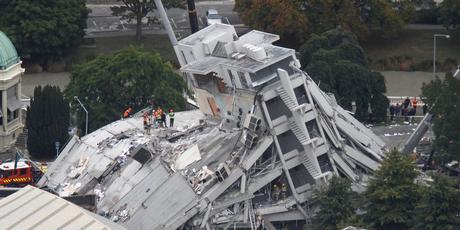
Rescue workers on the collapsed Pyne Gould Guiness Building in central Christchurch. Photo / Mark Mitchell
Prime Minister John Key has told reporters that the death toll from today’s magnitude 6.3 earthquake stands at 65, and Christchurch Mayor Bob Parker said it could quite possibly double. …. TVNZ reports up to 200 people remained trapped in damaged buildings……..
The earthquake shook the city at 12.51pm while streets were crowed with shoppers and office workers. It was not as powerful as the 7.3 that struck in early morning hours of 4 September last year but was much shallower, leading to greater damage.
Scientists put the epicentre at 10km southeast of the city – apparently in the middle of the harbour at Lyttelton, the city’s coastal port – at a depth of only 5km. .. Christchurch has suffered a long series of after shocks following last year’s quake and they continued after the big one today. One tremor of 5.7 occurred five minutes after the main shock and there was another of 5.5 at 2.50pm.
Late in the afternoon after shocks were still occurring in the magnitude 4 range on the Richter Scale. The city’s iconic cathedral in the central square survived September without little damage but its spire fell today and the rest of the building was badly damaged. Christchurch mayor Bob Parker said the damage was much more severe than in the great 7.1 quake almost six months ago.
http://www.nzherald.co.nz/nz/news/article.cfm?c_id=1&objectid=10708043
Cyclone Yasi has come and gone.
Its speed was a blessing in disguise and has ensured that it is already well inland and reducing in strength. It has left behind a trail of destruction but few (if any) serious injuries or fatalities. The township of Cardwell was warned to evacuate, but about 100 residents chose not to leave and they have not been contacted as yet.
Worst hit were the coastal towns of Tully, Mission Beach and Cardwell, with hundreds of houses destroyed. The cities of Cairns and Townsville were relatively unscathed but are being lashed by heavy rains; warnings of further storm surges have been issued. Queensland Premier Anna Bligh said there had been no reports of deaths or serious injuries so far.
The similarities of Yasi to Katrina is apparent but the differences in their respective impacts is quite striking.
This may be partially due to geography and demographics and the speed with which Yasi drove inland, but observing both from across the world leads me to the perception that the primary differences between Queensland and Louisiana were
The thought of Queensland police looting after Yasi as some New Orleans police did after Katrina is inconceivable. It’s just my perception but I believe it shows the difference between institutions having a fundamental belief that they have a duty to the population they serve and others where the concept of duty is much less developed.

credit bbc
Cyclone Yasi still at Category 5 strength is due to hit the North Queensland coast in about 8 hours from now (between midnight and 0100 on 3rd February local time).

Yasi approaching: image news.com.au
The latest BoM warning is warning of a dangerous storm tide as well as destructive winds.

Yasi track: bom.gov.au
SEVERE TROPICAL CYCLONE YASI IS A LARGE AND VERY POWERFUL TROPICAL CYCLONE AND POSES AN EXTREMELY SERIOUS THREAT TO LIFE AND PROPERTY WITHIN THE WARNING AREA, ESPECIALLY BETWEEN CAIRNS AND TOWNSVILLE.
DURING THE EVENING, THE VERY DESTRUCTIVE CORE OF CYCLONE YASI WILL CROSS THE COAST BETWEEN CAIRNS AND INGHAM, ACCOMPANIED BY A DANGEROUS STORM TIDE SOUTH OF THE CYCLONE CENTRE.
Tropical Cyclone Yasi, CATEGORY 5, will continue to move in a west-southwesterly direction. The cyclone is expected to cross the coast between Innisfail and Cardwell close to midnight.
Coastal residents within the warning area, and particularly between Cairns and Proserpine including the Whitsundays, are specifically warned of an EXTREMELY DANGEROUS SEA LEVEL RISE [i.e. storm tide] as the cyclone approaches, crosses the coast and moves inland. The sea is likely to steadily rise up to a level which will be VERY DANGEROUSLY above the normal tide, with EXTREMELY DAMAGING WAVES, STRONG CURRENTS and FLOODING of low-lying areas extending some way inland. People living in areas likely to be affected by this flooding should take measures to protect their property as much as possible, and be prepared to follow instructions regarding evacuation of the area if advised to do so by authorities.
DAMAGING WINDS with gusts to 90 km/hr are currently affecting the coast and islands, and are forecast to spread into the tropical interior overnight and west to Julia Creek during Thursday.
Between Port Douglas and Ayr these winds will become DESTRUCTIVE with gusts in excess of 125 km/hr developing during this afternoon and early evening, spreading into the tropical interior overnight. VERY DESTRUCTIVE winds with gusts up to 290 km/hr are expected to develop between Cairns and Ingham during the evening as the cyclone approaches and crosses the coast. These VERY DESTRUCTIVE winds will also occur on the seaward side of hills to the north of the cyclone and also affect the Atherton Tablelands.
Due to the large size of the cyclone, people in the path of the VERY DESTRUCTIVE WINDS are likely to experience these conditions for about 3 to 4 hours.
The Australian BoM warning for northern Queensland is being couched in stronger language as Cyclone Yasi has intensified to category 5. This is the highest level on the Seffir-Simpson Scale and Category 5 is reserved for storms with winds exceeding 155 mph (69 m/s; 135 kn; 249 km/h).
SEVERE TC YASI IS A LARGE AND VERY POWERFUL TROPICAL CYCLONE AND POSES AN EXTREMELY SERIOUS THREAT TO LIFE AND PROPERTY WITHIN THE WARNING AREA, ESPECIALLY BETWEEN PORT DOUGLAS AND TOWNSVILLE.
THIS IMPACT IS LIKELY TO BE MORE LIFE THREATENING THAN ANY EXPERIENCED DURING RECENT GENERATIONS.
The Cyclone has now reached CATEGORY 5 and will continue to move in a west-southwesterly direction during today.

image: bom.au.gov
| Forecast Location and Intensity Number |  |
|||
|
| Destructive Wind Boundary |  |
| Strong Gale Force Wind Boundary |  |
| Most Likely Future Track |  |
| Range of Likely Tracks of Cyclone Centre |  |
Northern Queensland is bracing itself for Cyclone Yasi which is now expected to cross the coast at about 1am on Thursday morning (3rd February).
The Australian BOM has this warning:
YASI IS A LARGE AND POWERFUL TROPICAL CYCLONE AND POSES A SERIOUS THREAT TO NORTH QUEENSLAND COMMUNITIES

Cyclone Yasi track: image bom.gov.au
- The cyclone is expected to slowly intensify overnight as it moves westwards over the Coral Sea.
- SEVERE TROPICAL CYCLONE YASI, CATEGORY 3 is expected to turn on a more west-southwesterly direction in the next 12 hours.
- DAMAGING winds with gusts to 90 km/hr are expected to develop on the islands during Wednesday morning, then extend onto the coast during the day, and further inland across southern Cape York Peninsula and north of Charters Towers overnight.
- Between Cooktown and Townsville these winds will become DESTRUCTIVE with gusts in excess of 125km/hr late Wednesday afternoon.
- As the centre approaches the coast sea levels will rise above the normal tide with damaging waves and flooding of low lying areas near the shoreline.
- Flooding rains will develop from Cooktown to Sarina during Wednesday afternoon and then extend inland overnight.
- People between Cooktown and Sarina should immediately commence or continue preparations, especially securing boats and property [using available daylight hours/before nightfall].
SMH reports that forced evacuations are are now taking place:
Authorities doorknocking homes in north Queensland are now ordering people to leave their properties, as severe Tropical Cyclone Yasi bears down.
Queensland Premier Anna Bligh said this afternoon councils between Cook and Hinchinbrook shires had given the go-ahead for forced evacuations to be carried out, amid fears a storm surge would cause water levels to rise by two metres.
She said officials who were door-knocking homes in high-risk areas now had the power to issue directives for people to leave.

Cyclone Yasi approaches the Australian coast from the Coral Sea. Photo: Reuters/Japan Meteorological Agency


 The k2p blog