Archive for the ‘Oil’ Category

Are shale oil and low prices the beginning of the end of the OPEC cartel?

November 24, 2014

Currently US crude is at just above $76 per barrel and Brent oil is at about $80. OPEC members are meeting this week in Vienna and it is thought that cuts to oil production of between 0.5 million and 1.5 million barrels per day (bpd) are possible. The drop in oil prices since June (from around $110 per barrel is due to a glut which in turn is due to over production, large quantities of US shale oil becoming available and simultaneously a reduced demand from China and others. Saudi Arabia is conspicuous by not having made any significant production cuts so far. This could be due to one of 3 reasons:

  1. Saudi Arabia is testing the breaking point for some of the shale oil producers since some of the smaller shale wells probably have a break-even level of around $60-70 per barrel, or
  2. Saudi Arabia and the US are targeting Russia and Iran whose economies are vulnerable and very dependent on the oil price (and the Russians alone would lose some $100 billion in oil revenues per year), or
  3. Saudi Arabia is tired of bearing the brunt of the production cuts and is forcing some of the smaller OPEC producers to take their share of the pain of production cuts.

If cuts of less than 0.5 million barrels per day are made it is thought that the prices are headed down to about $60 per barrel. One analyst estimates that a cut of 2 million bpd is needed to get back up to $80 per barrel. Something in between will be – well – something in between.

I just don’t like cartels and especially when they are state sponsored cartels. So far shale oil production is just from the US, and the OPEC strangle-hold on oil price has yet to be broken. But, over time, I expect this cartel to weaken as other countries produce oil and gas from shale. I remain of the opinion that the OPEC cartel has – no doubt – enriched the oil producing countries but has only done so at the expense of the rate of development of non-producers. OPEC has done the global economy a disservice by holding back the developing countries and the strongest correlation in geopolitics is the link between energy consumption and development (not just GDP but also virtually every development parameter).

It may cause some short term turbulence but in the long run it will be a “good thing” even if oil price were to collapse to below $50 per barrel. Some producers will be hard hit but the net result for the global economy will be positive. So I shall be quite happy if OPEC cannot reach agreement on how much oil production to cut or if they make just a small cut. It is time for some of the the developing countries to get a break from the oil price extortion which has been in place since 1973. The sooner the OPEC cartel is rendered obsolete the better.

Reuters:

Some commodity fund managers believe oil prices could slide to $60 per barrel if OPEC does not agree a significant output cut when it meets in Vienna this week. Brent crude futures have fallen by a third since June, touching a four-year low of $76.76 a barrel on Nov. 14. They could tumble further if OPEC does not agree to cut at least one million barrels per day (bpd), according to some commodity fund managers’ forecasts. ….. 

Yet fund managers and brokerage analysts are divided over whether OPEC will reach an agreement on cutting output. Bathe put the likelihood at no more than 50 percent. Oil prices have been falling since the summer due to abundant supply, partly from U.S. shale oil, and because of low demand growth, particularly in Europe and Asia. As a result, some investors believe a small cut of around 500,000 bpd would not be enough to calm the markets. Doug King, chief investment officer of RCMA Capital, sees Brent falling to $70 per barrel even with a cut of one million bpd.

“With this, I would expect lower prices in the first half of 2015,” he said. If OPEC fails to agree a cut, prices will drop “further and quite quickly”, with U.S. crude possibly sliding to $60, he said. U.S. crude closed at $76.51 on Friday, with Brent just above $80. ……..

The market has been awash with conspiracy theories as to why Saudi Arabia has not already intervened. New York Times columnist Thomas Friedman hinted at “a global oil war under way pitting the United States and Saudi Arabia on one side against Russia and Iran on the other”. Hepworth argued that Saudi Arabia appeared pretty happy with current pricing levels and suggested they were waiting to see where the cut-off point for U.S. production was. “Time is on their side, they can afford to wait,” he said, stressing he was talking months, not years, but added if oil fell below $70 that waiting time “shrinks to weeks”.

Tom Nelson, of Investec Global Energy Fund, said he believed Saudi Arabia had allowed the price to fall to incentivise smaller OPEC producers, which often rely on the biggest producer to intervene, to join Riyadh in cutting output. “They (the Saudis) want to cut but they don’t want to cut alone,” Nelson said, adding that a cut of between one million and 1.5 million bpd should be sufficient to balance the market.

“The market really wants to see that OPEC is still functioning … if there is a small cut, with an accompanying statement of coherence from OPEC that presents a united front, and talks about seeing demand recovery, and some moderation of supply growth, then Brent could move up to $80-$90.”
Saudi attack on shale oil could backfire

November 12, 2014

If the recent drop in oil price has been engineered (even in part) by Saudi Arabia as an attempt to put some of the burgeoning shale oil production sites out of business they will need to go much further. A break-even for shale oil production is probably at less than $50 per barrel. In any event the drop so far (25%+ in 6 months) is just the fillip the world economy needs. Saudi Arabia is probably not as vulnerable as other oil producing countries but increasing production to drive down the oil price is a dangerous game which could be self-defeating. Whether the current glut is just due to reduced world (read Chinese) demand and increased shale oil (US) production or has also been exacerbated by increased Saudi production, the oil consumer wins. Consumption will increase – and that will automatically reduce the glut and further increase the production of oil from shale.

If the global economy is to come out of the doldrums it needs the Asian economies – the tigers, the dragon and the elephant – to start prowling in earnest. Increasing consumption in the developing world seems to be one of the most effective ways of stimulating the world economy. It inevitably leads to increased production of consumer goods in the developed countries. And this current step-reduction of oil price could be just the trigger that is needed.

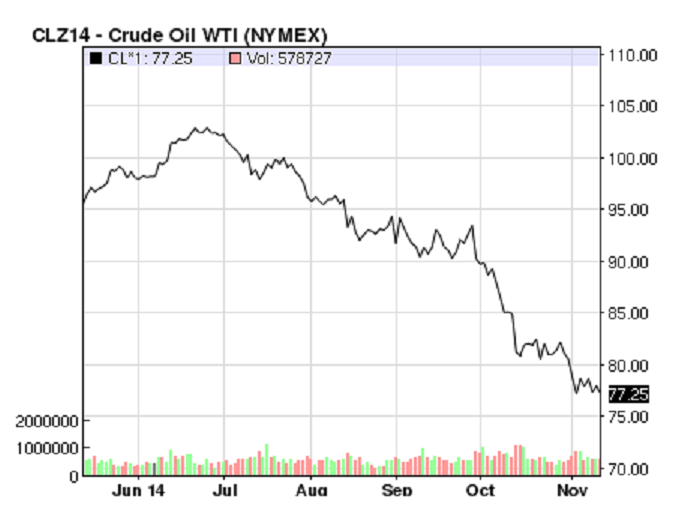
Yesterday the price of crude (WTI) was at about $77 per barrel and that price is sufficient to keep even the small shale oil wells in operation.

crude oil price Nov 2014

crude oil price Nov 2014


Two years of $70 oil could be the boost the global economy needs desperately

October 27, 2014

There are two questions here of course:

  1. How will oil price develop over the next 2 years? And the only certain thing is that forecasts will be wrong, and
  2. Can the net difference between the positive effect on oil consuming countries and the negative effects on oil producing countries be sufficient to lift the global ecoonmy out of its doldrums?

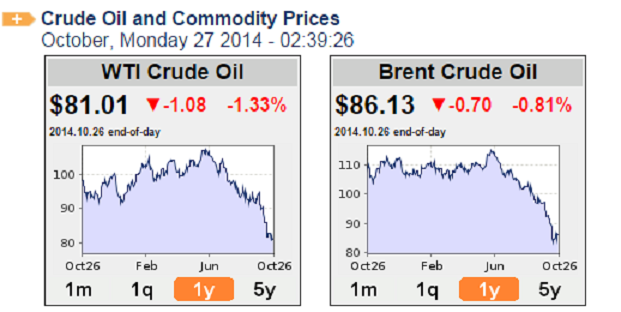
Oil prices have dropped 25% since June and currently WTI crude is at $81 and Brent crude is at $86 – down from around $110 – 115 in June. How far can prices drop and for how long? Of course this depends on supply and demand. But I think there is a new paradigm here and created by the injection of shale oil into the mix. I suspect that shale oil production now establishes a new floor price which means that the prices cannot drop lower than about $60 or possibly even $70. Oil from the traditional, large oil wells can still be produced profitably at much lower prices. But shale oil is more expensive to produce partly due to the costs of fracking but also due to smaller individual wells which last for shorter periods than the large oil wells. This in turn means that there is both a higher investment cost and a higher operating cost for shale oil compared to “traditional” oil. It is thought that as shale oil increases its contribution to the total mix, this production cost will set a floor for all oil at around $60-70 instead of the $30-40 needed for break-even (zero exploration) with traditional oil. The oil companies will maintain profits and dividends by scaling down jobs and their new exploration costs which is the variable they can play with . It is the oil producing countries who will lose tax revenues (offset by increased production – if any).

oil price 2710214 oil-price.net

oil price 27102014 oil-price.net

Goldman Sachs have forecast in a new research report that prices could drop to $70 by the second quarter of 2015.

Reuters 27/10: Brent crude futures fell below $86 a barrel on Monday after Goldman Sachs cut its price forecasts for the contract and for U.S. oil in the first quarter of next year by $15.

The U.S. investment bank said in a research note on Sunday that it had cut its forecast for West Texas Intermediate to $75 a barrel from $90 and that for Brent to $85 from $100, with rising production in non-OPEC countries outside North America expected to outstrip demand.

The bank expects WTI to fall as low as $70 a barrel and Brent to hit $80 in the second quarter of 2015, when it expects oversupply to be most pronounced.

Even Saudi Arabia now seems to have accepted that a regime of low prices will last  1 – 2 years.

Reuters 26/10The recent decline in global oil prices will prove temporary even if it lasts a year or so, since population growth will ultimately bring higher consumption and prices, the chief executive of Saudi Basic Industries Corp said on Sunday.

Mohamed al-Mady was speaking to reporters after the company, one of the world’s largest petrochemicals groups and the Gulf’s largest listed company, reported a 4.5 percent drop in third-quarter net income, missing analysts’ forecasts.

At these price levels for 2 years almost $3 trillion will shift from the “few” producers to the “many” consumers.  But most of this could fuel consumer growth (which it would not do to the same extent when in the hands of the oil producers). The consumer countries will also lose the foreign exchange constraints they must operate under for purchase of oil in US Dollars. It could release monies desperately needed for infrastructure projects. But the consumer countries need the prices to stay low for some time – and I would guess that 2 years is a minimum – for the public funds released to be utilised in “growth” projects.

The EconomistFor governments in consuming countries the price fall offers some budgetary breathing-room. Fuel subsidies hog scandalous amounts of money in many developing countries—20% of public spending in Indonesia and 14% in India (including fertiliser and food). Lower prices give governments the opportunity to spend the money more productively or return it to the taxpayers. This week India led the way by announcing an end to diesel subsidies. Others should follow Narendra Modi’s lead.

Producer countries will be hit. Russia has actually been helped by the fall in the rouble which has cushioned – a little – the rouble values of the dropping oil revenue.

The most vulnerable are Venezuela, Iran and Russia.

The first to crack could be Venezuela, home to the anti-American “Bolivarian revolution”, which the late Hugo Chávez tried to export around his region. Venezuela’s budget is based on oil at $120 a barrel. Even before the price fall it was struggling to pay its debts. Foreign-exchange reserves are dwindling, inflation is rampant and Venezuelans are enduring shortages of everyday goods such as flour and toilet paper.

Iran is also in a tricky position. It needs oil at about $140 a barrel to balance a profligate budget padded with the extravagant spending schemes of its former president, Mahmoud Ahmedinejad. Sanctions designed to curb its nuclear programme make it especially vulnerable. Some claim that Sunni Saudi Arabia is conspiring with America to use the oil price to put pressure on its Shia rival. Whatever the motivation, the falling price is certainly having that effect.

Compared with these two, Russia can bide its time. A falling currency means that the rouble value of oil sales has dropped less than its dollar value, cushioning tax revenues and limiting the budget deficit.

There are a number of other effects of $70 per barrel for oil.

Bio-fuels and bio-diesel, which are fundamentally unsound, have stayed alive on the back of subsidies on the one hand and a high oil price on the other. If the prices stay at $70 for 2 years or longer, land currently being wasted on bio-fuels could revert to food production. With lower fertiliser and transport costs in addition, a great deal of pressure on food prices go away. If the floor price is set by shale oil production costs, it may be too low for oil production from tar sands to take off in any big way. Electricity production costs will be bench-marked against the cost of gas turbine combined cycle plants.

But most importantly, another 2 years or longer with the public spending pressures reduced will allow a number of other countries to get their own shale oil (and gas) production going. And that will make Opec and the oil cartel obsolete. Oil and gas price speculation will no longer be possible.

It could provide the start for a long sustained period – perhaps even a decade or two – with oil prices stable at around $70 per barrel.

US shale oil boom visible from space

October 21, 2014

The drop in oil prices continues though somewhat slowed down by Chinese import demand:

WSJU.S. and global crude benchmarks ended lower Monday amid choppy trading and concerns that member nations of the Organization of the Petroleum Exporting Countries will maintain high production levels in a bid to compete for market share despite growing global crude supplies.

The current drop in oil prices is put down to a glut on the market caused by the boom in shale oil production in the US and the slow-down in the global economy.

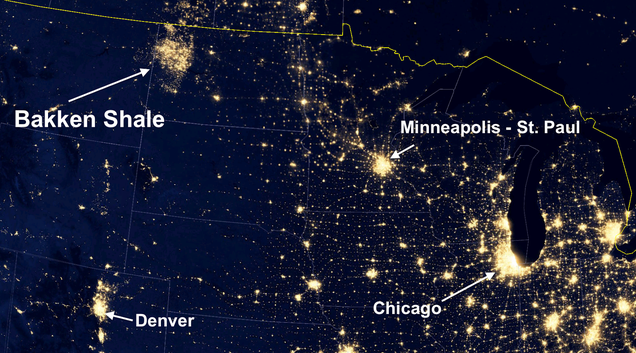
The boom in shale oil production is even visible from space.

Satellite Images Reveal How the U.S. Oil Boom Is Creating New Cities

bakken shale field shows up from space Image NASA/io9

io9This image from NASA reveals a massive cluster of lights in what was — until recently — desolate prairie. This is the Bakken Shale, an oil-rich rock formation stretching across parts of North Dakota, Montana and Canada. The lights are from the illuminated derricks, local boomtowns and gas flares of the oil fields.

Misguided alarmists who have demonised fossil fuels don’t like this. But I find the picture and the visibility of the shale production greatly encouraging. Carbon dioxide has no significant deleterious impact on climate and the availability of fossil energy is what will ensure continued human development.

The Bakken Shale field is a vast resource across Montana, North Dakota, Sasketchewan and Manitoba and a significant contributor to the game changing advent of shale oil and shale gas.

The Bakken Shale ranks as one of the largest oil developments in the U.S. in the past 40 years. The play has single-handedly driven North Dakota’s oil production to levels four times higher than previous peaks in the 1980s. As of 2012, ND is second to Texas in terms of oil production and boasts the lowest unemployment rate in the country at ~3%.

The Bakken Shale Play is located in Eastern Montana and Western North Dakota, as well as parts of Saskatchewan and Manitoba in the Williston Basin. Oil was initially discovered in the Bakken play in 1951, but was not commercial on a large scale until the past ten years.

… The Bakken is estimated to hold as much as 400 billion barrels of oil equivalent in place.

US shale fields map EIA


Can consumer countries fuel global growth with sharply reduced oil prices?

October 20, 2014

Oil prices have “crashed”.

Currently prices are at less than $80 per barrel compared to over $110 in June and the peak of $147 just before the financial bubble burst in 2008. It seems that it is due to the oil glut brought about by the shale oil revolution in the US together with a downturn in global growth. The $147 peak was, I think, more of a trial balloon by the oil producers to test where the resistance lay and the producers concluded that a level of a little over $100 would maximise profits and was sustainable. But I suspect that this $100 level itself has contributed to delaying and prolonging the recovery. Not only because of the increased direct costs to the oil consumer but also due to its knock-on effects which have unnecessarily raised the cost to all electricity consumers. The prolongation of the path to recovery in Europe is certainly – if only partly – due to the very high energy prices that prevail. But right now it is the abundance of shale oil and gas which seems dominant.

BloombergBut the bigger factor appears to be surging global oil production, which outpaced demand last year and is shaping up to do so again in 2014. To try to keep prices high, Saudi Arabia, the world’s biggest petroleum exporter, has reduced its oil production from 10 million barrels a day—a record high—in September 2013 to 9.6 million as of Sept. 30. That hasn’t done much to raise prices, mostly because other OPEC countries are pumping more crude as the Saudis try to slow down. Sharply higher production increases from Libya and Angola, along with surprisingly steady flows out of war-torn Iraq, have pushed OPEC’s total output to almost 31 million barrels a day, its highest level this year and 352,000 barrels a day higher than last September. Combined with the continued increase in U.S. oil production, the world has more than enough oil to satisfy current demand.

crude oil price history 2000-2014

crude oil price history 2000-2014

But this crash in oil prices is probably a “good thing”.

The additional revenues from increasing oil price to the few in the oil producing countries have not been sufficient to counter the hit to the many in the consuming countries. Much of the additional revenue has gone not to fuelling growth but in blowing up new real-estate bubbles.

The additional spending power in consumer countries with reducing oil price is spread among the many (at the lower end of the wealth scale) whereas the reduction in producer oil revenues is generally spread among an affluent few. My contention is that the additional revenues with high oil price in – for example –  the Middle East does not need to be spent on real things which could fuel growth. Revenues in Saudi Arabia and Qatar and other countries have fuelled bubbles and jihad instead of just growth. A great deal went instead into very high margin, weapons systems and to the imaginary values of real estate. In Russia the oil revenue did contribute to some growth but there was still a large proportion spent on imaginary values of various bubbles (which by definition cannot contribute to growth). My simple calculation tells me that 1000 people buying washing machines in China contribute more to global growth than one person spending the same amount on an apartment (his second or third home) in London. A $10 drop in oil price is said to shift 0.5% GDP growth from producer countries to consumer countries. But the pattern of consumption where the “few” fuel the bubbles of imaginary value while the “many” consume mundane goods and services means that the real effect on growth is greater than a net zero. It is shifting an ineffective 0.5% to a more efficient consumption for growth. The net effect is probably a growth in global GDP of 0.2 – 0.3%. Similarly the purchase of large-volume, low-margin goods and services provides more growth and jobs than spending the same amount on low-volume, high margin goods and services. Spending $1000 on an 80% margin Gucci handbag provides less direct growth and fewer direct jobs than buying ten $100, 10% margin travel bags.

Historically – though it is a relatively crude generalisation – low oil price has usually given – or coincided with – consumer-led growth and stability.

crude oil price history 1970-2014

crude oil price history 1970-2014

Some oil producers are more vulnerable than others to the fall in expected revenues. Russia’s budget needs an oil price of over $100 to be balanced. Venezuela spends nearly all of its revenues as it is generated and has nothing put by. The war-torn areas of the Middle East also have nothing put by. Saudi Arabia and the Gulf States have put by vast reserves though some of it is in “bubble” values. A pricking of some of the bubbles they have inflated is probably no bad thing. It is also no bad thing if they have to fall back on reserves and have less excess cash to fund jihadists from Afghanistan to Libya.

Most Asian countries are oil importers and gain from a low oil price.

Clarion Ledger: The picture is reversed in Asia, where most countries are major importers and some subsidize the price of fuels.

China is the second-largest oil consumer and on track to become the largest net importer of oil. Falling prices will provide China’s economy some relief, according to Huang Bingjie, professor from the School of Economics and Management at China University of Petroleum. But lower oil prices won’t fully offset the far wider effects of a slowing economy.

India imports three-quarters of its oil and analysts say falling oil prices will ease the country’s chronic current account deficit. Samiran Chakraborty, head of research in India for Standard Chartered Bank, also says the cost of India’s fuel subsidies would fall by $2.5 billion during its current fiscal year if oil prices stay low.

Japan imports nearly all of the oil it uses. Following the accident at the Fukushima Dai-Ichi nuclear power plant in 2011, Japan has turned more to oil and natural gas, which is priced based on oil, to generate electric power.

The picture is a little more mixed in the Americas and Europe:

Low prices could eventually threaten the boom in oil production in such countries as the U.S., Canada, and Brazil because that oil is expensive to produce. Investors have dumped shares of energy companies in recent weeks, helping to drag global stock markets lower.

For now, lower crude oil and fuel prices are a boon for consumers. In the U.S., still the world’s biggest oil user, consumer spending accounts for two-thirds of the U.S. economy, and lower energy prices give consumers more money to spend on things other than fuel.

The same is true in Europe. Christian Schulz, senior economist at Berenberg Bank, says that a 10 percent fall in oil prices would lead to a 0.1 percent increase in economic output. That’s meaningful because the 18-country currency union didn’t grow at all in the second quarter.

There could be another market crash coming though it is not likely to be as deep as the 2008 crash. But to get back onto a solid, sustainable growth path again it does need the oil consumer countries to grow. And that probably needs a steady oil price at less than $70 per barrel. The oil producer countries will have to revamp their economies to live with the loss of their monopoly as the production of oil from shale spreads.

Oil reserves to rival Saudi Arabia’s found in the Russian Arctic

September 28, 2014
Kara Sea - Arctic  Google maps

Kara Sea – Arctic Google maps

So much for peak oil!

And that’s even without taking shale oil and shale gasand methane hydrates into account.

World BulletinA joint venture between Rosneft and ExxonMobil has discovered a huge amount of oil under the Arctic. The state-run Russian oil company announced on Saturday that the University-1 well struck oil in the Kara Sea.

Igor Sechin, the head of Rosneft, said the “oil trap” has 338 billion cubic meters of gas and more than 100 million tonnes (733 million barrels) of oil. The total resources in the area are estimated at 13 billion tonnes (87 billion barrels) of oil equivalent, according to the Rosneft statement. According to experts, the amount of oil and gas is comparable to the resource base of Saudi Arabia.

Rosneft and ExxonMobil started drilling the University-1 well, the world’s northernmost well, in August. The field will be named Pobeda, which means “victory” in Russian

Sanctions against Russia could deprive ExxonMobil of some of the benefits due to them. Even if sanctions are relatively short-lived the Russians will surely extract their pound of flesh while they can.

ExxonMobil announced last Friday that the U.S. Treasury Department has granted it a licence to “wind down” operations at the well, in response to U.S. and EU sanctions imposed on Russia over the unrest in Ukraine.

However the Russians are still dependent on technology from the large oil companies for drilling and exploitation in these frigid conditions. They also have vast quantities of oil and gas shale in Siberia the value of which needs to be protected. The timing for the development of Arctic reserves then becomes a geopolitical and economic strategy call. It makes most sense for Russia not to flood the market and to keep gas prices to Europe high and growing. But the potential availability of this Arctic reserve – even if production is at least a decade away – adds another arrow in the Russian quiver.

But the doomsday scenarios of “peak oil” or catastrophic depletion of gas and oil reserves have vanished over the horizon – at least for the foreseeable future,


Drinking water contamination caused by weak water wells and not by fracking

September 16, 2014

It is fashionable for environmentalists to blame fracking for all manner of evils as a matter of faith. They have proclaimed that fracking causes earthquakes, water table contamination, emission of dangerous gases, damage to house price levels and even damage to crops. Such claims are usually based on no evidence whatsoever but presented as gospel.

A new paper published in PNAS reports on real experimental measurements (not just a computer model) using noble gases to trace methane leakage into drinking water in 130 water wells in Pennsylvania and Texas. They find that drinking water contamination was caused by weak walls and well construction faults and not by fracking.

TH Darrah et al, Noble gases identify the mechanisms of fugitive gas contamination in drinking-water wells overlying the Marcellus and Barnett Shales, 

Significance

Hydrocarbon production from unconventional sources is growing rapidly, accompanied by concerns about drinking-water contamination and other environmental risks. Using noble gas and hydrocarbon tracers, we distinguish natural sources of methane from anthropogenic contamination and evaluate the mechanisms that cause elevated hydrocarbon concentrations in drinking water near natural-gas wells. We document fugitive gases in eight clusters of domestic water wells overlying the Marcellus and Barnett Shales, including declining water quality through time over the Barnett. Gas geochemistry data implicate leaks through annulus cement (four cases), production casings (three cases), and underground well failure (one case) rather than gas migration induced by hydraulic fracturing deep underground. Determining the mechanisms of contamination will improve the safety and economics of shale-gas extraction.

A key source of groundwater contamination (labeled 5, center right) caused by faulty well casings. Credit: Image courtesy of Thomas Darrah, The Ohio State University

Press Release:

….  neither horizontal drilling nor hydraulic fracturing of shale deposits seems to have caused any of the natural gas contamination.

“There is no question that in many instances elevated levels of natural gas are naturally occurring, but in a subset of cases, there is also clear evidence that there were human causes for the contamination,” said study leader Thomas Darrah, assistant professor of earth sciences at Ohio State. “However our data suggests that where contamination occurs, it was caused by poor casing and cementing in the wells,” Darrah said.

In hydraulic fracturing, water is pumped underground to break up shale at a depth far below the water table, he explained. The long vertical pipes that carry the resulting gas upward are encircled in cement to keep the natural gas from leaking out along the well. The study suggests that natural gas that has leaked into aquifers is the result of failures in the cement used in the well.

Adapting to climate change requires the further development and use of fossil fuels

July 31, 2014

The single thing that differentiates the human species from every other known species on earth has been the control and use of fire.The step change then from primitive to modern humans has been due not least to the control and development of the combustion process and the utilisation of fossil fuels. This in turn has multiplied many times the intensity of energy available to be harnessed by man. I would suggest that the human capability of handling change is largely a function of the power intensity available.

power intensity

power intensity

Fossil fuels have been demonised (by association with carbon dioxide emissions) for the last 30 years. In spite of that most  of the growth in the developing world has been – and continues to be – powered by fossil fuels. Fortunately the lack of evidence of any significant linkage between man-made carbon dioxide and global warming  (which is still the politically correct ideology) is beginning to be realised. The unnecessary, misplaced and ineffective increase of electricity prices in countries which have curtailed their use of fossil fuels has prolonged the recession and has cost many millions of jobs.

We have now had almost 20 years with the highest level ever of fossil fuel utilisation but “global temperature” has remained stubbornly static. In the last decade global temperatures have declined slightly. The hypothesised link between man-made carbon dioxide (which constitutes only about 3% of carbon dioxide emissions) and global temperature is well and truly broken. All the various climate computer models – which build on this link being amplified – have failed miserably.

The indicators of a global cooling cycle having started are piling up.

  1. There is more ice in the antarctic than has ever been measured
  2. There is more ice in the arctic than about a decade ago
  3. Total ice cover is higher now than has ever been measured
  4. Ice cover on the Great Lakes reached levels not seen for over 50 years and has persisted into the spring (even summer) later than has been observed for at least 40 years.
  5. The expected super El Nino forecast for this year has been dampened by a cooling Pacific and only a mild El Nino event – if at all – is now to be expected
  6. Sea level rises are no different to the long term average for sea level recovery since the last glacial minimum and may even have slowed.
  7. The deep oceans are cooling and are no repository of “hidden heat”
  8. The net cooling effect of clouds has been underestimated in nearly all models and cloud cover over the world is increasing (slightly).
  9. Man made water vapour is of greater significance than man made carbon dioxide for climate effects. But man made water vapour is almost insignificant compared to the water vapour flux due to evaporation and respiration.
  10. Solar effects are virtually ignored by all climate models but the sun does not much care for models and is reaching a low level of activity comparable to the Dalton or Maunder Minima.

Crying wolf about global warming has been the politically correct thing to do for 3 decades. Before that it was politically correct to be alarmist about the coming ice age. No doubt all the old fears about an ice age can be dusted off and recycled.

Climate change has been the most powerful force which has shaped human evolution and expansion. Sea level changes and patterns of precipitation and desertification have driven both evolution and migrations. Sea level during an ice age is about 120 m lower than it is today. More land is exposed in equatorial and tropical regions during a glacial period while land is rendered uninhabitable by the ice sheets of the north. But even primitive humanity survived during the glacials.

It is the global cooling cycles and not global warming cycles which will place the greatest demands on farming and energy. The greatest sea level change that humanity has had to – and will have to – adapt to  is the 120 m difference between glacial and interglacial conditions. During an ice age precipitation will drop sharply and river water flows will decline. Hydro power will all but dry up. It is the inevitable coming of the next ice age that will pose the real challenge – not the 1 m sea level rise that may come with another warming cycle. And when the ice age comes again it will be fossil fuels which will keep the home fires burning. It is the further exploitation of nuclear energy and fossil fuels in all its forms – coal, oil, natural gas, shale gas, gas from methane hydrates – that will be needed. It is the availability of power at the intensities provided by nuclear power and fossil fuel combustion which is what will provide humans with the wherewithal to cope with climate change, whether warming or cooling, but especially when the next ice age begins.

Whatever the alarmists would have us do in the short term, reality will eventually bite. The use of fossil fuels will – thankfully – continue as will the exploration for new sources of gas. The next generation of nuclear power plant will be developed – even though nuclear alarmism has led to a dearth of nuclear engineers. No doubt some market niches will be filled by wind and solar power but that will not be very significant in the large picture.


Fossil fuel combustion at an all time high (but global warming is absent)

June 18, 2014

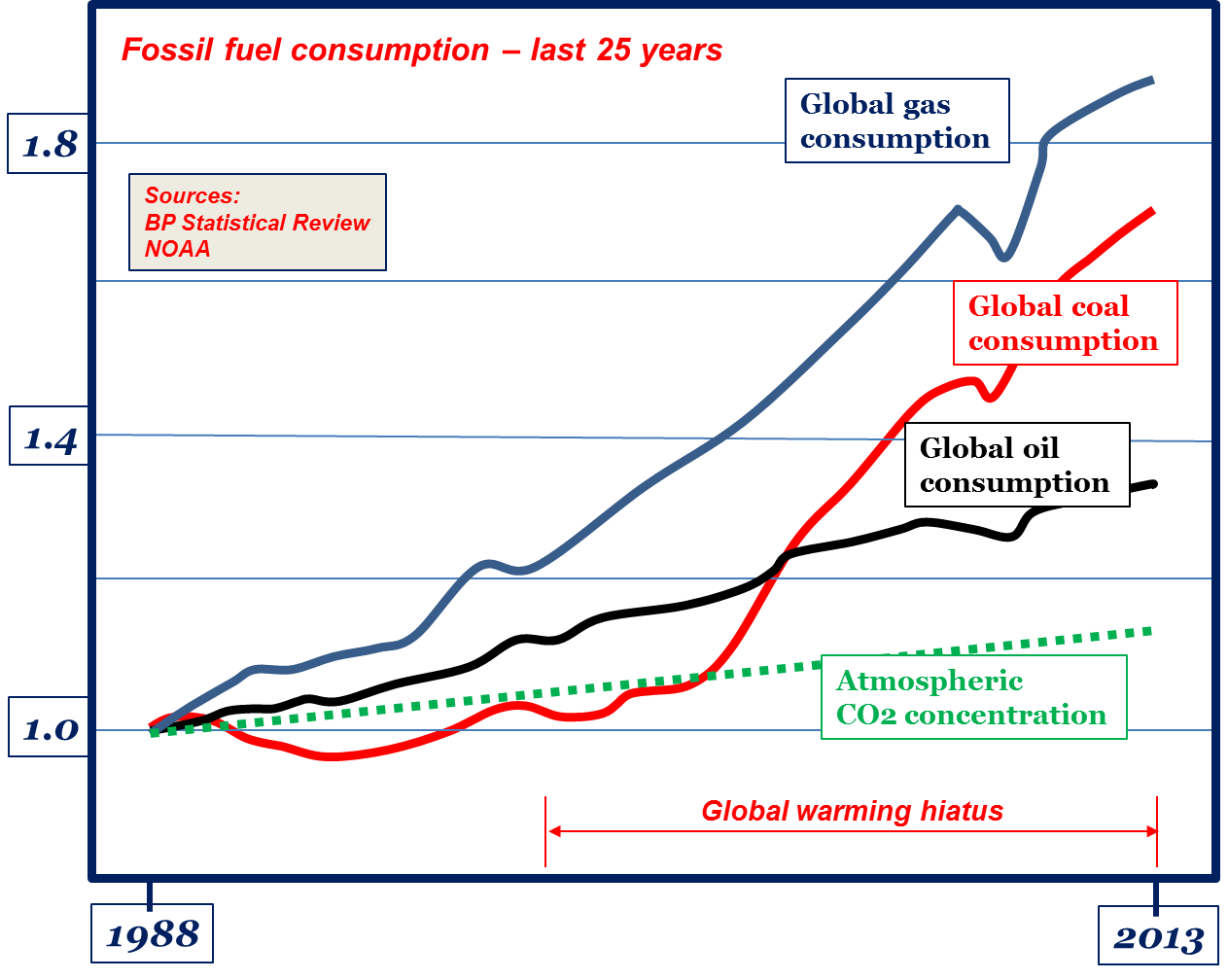
The BP Statistical Review of World Energy 2014 is now out and the consumption of all fossil fuels has never been higher. Coal and gas consumption are particularly strong. And – even though many are in a state of denial about it – global warming has come to a stop over the last 18 years. In the last 10 years global temperatures show a slight downward trend.

There seems to be no purpose to the demonisation of fossil fuels other than for pandering to the religion of global warming. Consider the last 25 years. (I use 1988 as a reference point not only because 25 years should be enough to see some trends but also because the BP data is readily available from that date). During this 25 year period gas consumption has increased by over 80%, coal consumption by 0ver 70% and oil consumption by over 30%. The increased global coal burn since about 1999 is particularly striking. In the same 25 year period the carbon dioxide concentration in the atmosphere has increased from about 355 ppm(v/v) to about 395 ppm(v/v) – a rise of about 11%. And global temperatures have not increased at all for almost 2 decades.

Climate policy is policy without any objectives and without any means of checking any achievements. What exactly could we achieve by not using fossil fuels?

There is not a single climate policy proposed by the IPCC or by any government in the world  which has a definable and measurable climate benefit.

25 years of fossil fuel consumption

25 years of fossil fuel consumption

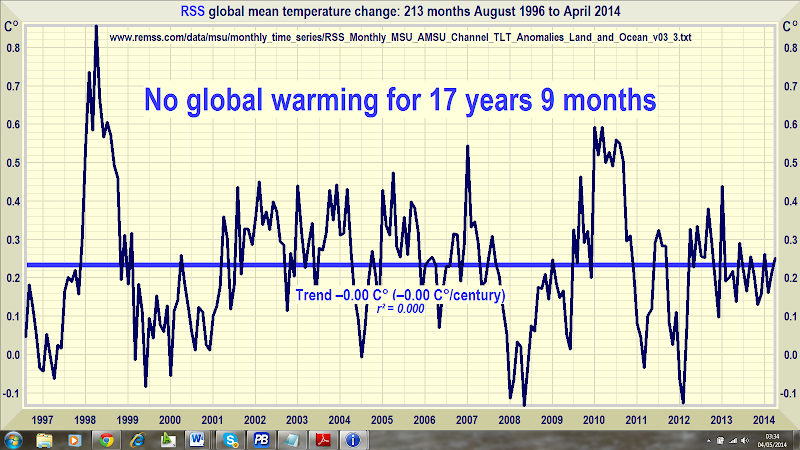
The global warming hiatus now extends to at least 18 years.

Global warming has gone missing

  • The RSS satellite dataset shows no global warming at all for 213 months from August 1996 to April 2014. That is more than half the entire 423-month satellite record.
  • The fastest centennial warming rate was in Central England from 1663-1762, at 0.9 Cº per century – before the industrial revolution began. It cannot have been our fault.
  • The global warming trend since 1900 is equivalent to 0.8 Cº per century. This is well within natural variability and may not have much to do with us.

Huge shale deposits confirmed in the South of England

May 23, 2014
Map of the Weald Basin

Shale deposits in South of England and Wales (BBC)

The British Geological Survey (BGS) has now confirmed the huge deposits of oil bearing shale in the South of England . Ironically this comes just days after the BBC also reported on the idiot report by the self-styled Global Sustainability Institute that the UK would run out of oil, coal and gas in 5 years!!!

BBC (23rd May)The BBC’s John Moylan said that although the BGS study will say that there are several billion barrels of oil in place, is not clear how much would be economically recoverable. ….. By way of comparison, the equivalent of around 45 billion barrels of oil has been extracted from the North Sea over the past 40 years.

Last year, a BGS study of the North of England suggested there could be as much as 1,300 trillion cubic feet of gas contained in shale rocks. ….

Andrew Austin, chief executive of the onshore energy IGAS, said it had long been known that southern England had extensive resources.

He told the BBC: “We’ve known that there’s a big potential for oil and gas explorations across the country but particularly in terms of oil in the Weald Basin which is the area that stretches roughly from Winchester across towards Gatwick, up to the M25 and down to the coast at Chichester.

“There’s been a long history of oil and gas exploration in this area. We as a company produce oil and gas from around 20 sites across that area. Around 40 million barrels have been recovered from that area to date.”

In the US, fracking for oil and gas has created an energy boom and led to speculation that the country could overtake Saudi Arabia as the world’s biggest producer by 2020, or even sooner.

Gas prices in the US have fallen sharply as a result, and other countries are now hoping that shale oil and gas could also lead to lower domestic energy prices.

And just a few days ago the BBC chose to present this nonsense.

BBC (16th May)In just over five years Britain will have run out of oil, coal and gas, researchers have warned. …… There should be a “Europe-wide drive” towards wind, tidal, solar and other sources of renewable power, the institute’s Prof Victor Anderson said. ….

……. Professor Anderson said: “Coal, oil and gas resources in Europe are running down and we need alternatives.

“The UK urgently needs to be part of a Europe-wide drive to expand renewable energy sources such as wave, wind, tidal, and solar power.”

However, Jim Skea, Research Councils fellow in UK Energy Strategy. cast doubt on the findings of the report.

He told BBC News: “This sounds very unlikely. What’s more, it’s irrelevant – the UK has a stable supply of imported energy, even if it is a good idea to increase our own supplies.”

The government recently announced it was cutting subsidies for large-scale solar energy and the Conservatives have said there will be no funding for new onshore wind farms if they win the next election.

Ministers are hoping that enough shale gas – extracted by fracking – will be obtained to make a difference, the BBC’s environment analyst Roger Harrabin says.

Professor Victor Anderson is an alarmist economist who used to work for the World Wildlife Fund. But to develop a catastrophe theory and predict that the UK will run out coal, oil and gas in 5 years is just stupidity.

Prior to taking up his current position Professor Anderson had worked as Senior Policy Officer for One Planet Economy at WWF-UK, a Lecturer at Goldsmith’s College, London University, an Economist at the Sustainable Development Commission, a Senior Parliamentary Researcher at Plaid Cymru Group of MPs, Board Member at London Development Agency and an elected Assembly Member at the Greater London Authority. He is also currently a Member of the Planetary Boundaries Initiative Advisory Group.