Archive for the ‘Oil’ Category

“Peak Oil” vanishes and even OPEC bows to shale fracking technology

November 9, 2012

The various catastrophe scenarios based on the depletion of a limited resource (peak-oil, peak-gas, peak-energy, peak-food……….) have a fundamental weakness – they fail to account for human ingenuity and technological advance. History has shown that such Malthusian scenarios just do not come to pass. New discoveries change the availability of the resource, innovation and technology find alternatives and economics changes pricing and the supply/demand dynamics.

Moving peaks

In February this year I posted:

In recent times the development of fracking technology and the discovery of huge deposits of gas-bearing shales together with the discovery of new deep-sea sources of natural gas have pushed the “peak” for gas production beyond the visible horizon and into the distant future (a few hundred years). When – rather than if – methane hydrates become available for gas production, the “peak” will shift further into the future.

Reuters now reports on Opec’s latest World Oil Outlook 

OPEC acknowledged for the first time on Thursday that technology for extracting oil and gas from shale is changing the global supply picture significantly ……

In its annual World Oil Outlook, OPEC cut its forecast of global oil demand to 2016 due to economic weakness and also increased its forecast of supplies from countries outside the 12-nation exporters’ group.

“Given recent significant increases in North American shale oil and shale gas production, it is now clear that these resources might play an increasingly important role in non-OPEC medium- and long-term supply prospects,” the Organization of the Petroleum Exporting Countries said in the report.

OPEC has been slower than some to acknowledge the impact that new technologies such as hydraulic fracturing – known as “fracking” – may have on supply.
As with peak gas, peak oil and rampant pessimism need to be postponed

July 9, 2012

Recovery of gas and oil from shale is more than just a game changer – it is a mind-changer. The recoverability of oil and gas from shale postpones “peak oil” and “peak gas” indefinitely. For 3 decades we have suffered from the rampant pessimism of the alarmists and the coercive politics of fear. A change of mind-set from pessimistic environmentalism and backward-looking conservationism is called for. A shift of attitude from the joyless “glass half-empty and we are doomed” to the entrepreneurial “glass half-full but can be filled”  is over-due.

Resource depletion with usage is a trivial truth  – though matter at the elemental level is never destroyed by human use. However utilisation of resources does alter the composition and concentration of materials remaining available. But every alarmist and doom-sayer who has ever lived and has forecast impending catastrophe has been proven spectacularly wrong. Human ingenuity has faced every challenge and trumped the doom-sayers – every time.

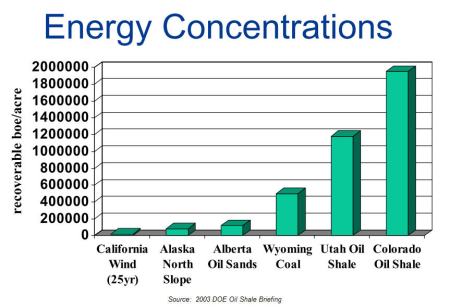
The pictures say it all:

The scope of the US oil shale resource

The scope of the US oil shale resource

Related: “Peak Oil” hypothesis is following “Peak Gas” into oblivion

Moving peaks

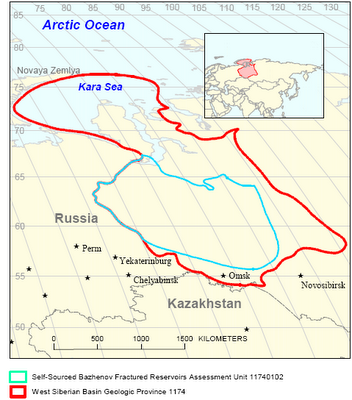
Vast shale oil deposits in Siberia

June 6, 2012

While oil from Siberia is nothing new the vast shale resources in the Bazhenov – containing oil and gas – have yet to be exploited. But fracking technology to extract these is now available. The West Siberian basin is the largest petroleum basin in the world.

Bazhenov basin Western Siberia

The shale in Western Siberia also contains large amounts of gas. Shale gas and oil are already flowing in the US, the shale gas potential in China and India is being explored and developed and now vast reserves of  oil and gas are available from shale deposits in Russia. Europe also has large deposits of shale gas but are dithering under the influence of alarmist environmentalism. They will have little choice but to join the brave new world of shale – or be left far behind.

Forbes reports:

(more…)

“Peak Oil” hypothesis is following “Peak Gas” into oblivion

February 20, 2012

Oil production from oil shales in North Dakota is increasing rapidly and the much-heralded “peak” of oil production may have to be postponed. Alarmists will not be pleased.

“Peak Oil” and “Peak Gas” are the points in time where the production of oil and gas respectively reach a peak and then decline to zero. The concept is based on the normal production cycle of an individual well extrapolated to all the oil and gas existing. The fundamental flaw in these hypotheses when trying to apply them to “finite” and exhaustible resources of any product is of course that:

  • new sources of the product are discovered
  • new extraction technologies enhance what can be recovered from existing sources,
  • new technologies make non-viable sources viable
  • new technologies allow the synthesis or alternative production of the product (price driven)
  • consumption is modified by pricing

Moving peaks

In recent times the development of fracking technology and the discovery of huge deposits of gas-bearing shales together with the discovery of new deep-sea sources of natural gas have pushed the “peak” for gas production beyond the visible horizon and into the distant future (a few hundred years). When – rather than if – methane hydrates become available for gas production, the “peak” will shift further into the future.

In the case of oil there are already many feasible alternatives which are technically feasible but where commercial production by these methods can only be triggered by the sustainable price being higher than the production cost. For example bio-diesel costs are commercial with oil prices above about $70 per barrel but there is a hidden cost in decreased or disrupted food production. Coal liquefaction would need oil prices above $120 per barrel while oil extraction from oil shales and oil sands become commercial at about $90 and $100 respectively. Deep sea wells (new exploration) are increasingly commercial as the price increases.

The alternatives are now coming into play:

(more…)

Oil price drops as Mubarak steps down – will Saudi Arabia follow?

February 12, 2011

We are in for a period with very volatile oil prices as the Middle East enters the age of “people power”. It is quite unlikely that this wave of popular “revolt” will stop with Tunisia and Egypt. Yemen is already showing signs and Libya, Algeria, Morocco, Jordan and the Gulf States are all regimes with a potential for revolution. Saudi Arabia is the big one though for oil price.

But the events in Egypt with no clear political leader and with no retaliatory violence to deliberate provocation are both amazing and encouraging. There is a widespread political maturity that is quite fantastic after 30 years of authoritarian rule.

The Hindu reports:

Besides Egyptian President Hosni Mubarak’s stepping down, the rising dollar index and rally of U.S. stocks triggered oil selling and sent the price to a 10-week low. …

… Light, sweet crude for March delivery dropped 1.15 dollars to 85.58 dollars a barrel on the New York Mercantile Exchange, its lowest settlement since Nov. 30, 2010. The crude oil price went up and down following Egypt’s fears and joys. The commodity had experienced an approximately 6 percent price increase since the crisis began on Jan. 25. Much of that move pertained to the uncertainty surrounding the leadership of Egypt. Although Egypt is not a main oil producer, it controls the Suez Canal, which is an important transportation route for oil from the Middle East.


The short term consequences for oil price when (and it has to be “when” and not “if”) the Saudis finally dismantle the anachronistic regime they have cannot be predicted. But the long-term consequences will probably be a reduction of the base price.

The key is when. It is also amazing in this information and “spying” dominated world that the entire intelligence community had no inkling  of what was coming in Tunisia and Egypt. Information was probably available but clearly no one made the correct analysis or drew the right conclusions.

Methane from BP oil spill has vanished – presumed digested by microbes

January 9, 2011
Molecule of methane.

methane molecule: Image via Wikipedia

A new paper online in Science:

Science DOI: 10.1126/science.1199697 A Persistent Oxygen Anomaly Reveals the Fate of Spilled Methane in the Deep Gulf of Mexico, by John D. Kessler, David L. Valentine, Molly C. Redmond, Mengran Du, Eric W. Chan, Stephanie D. Mendes, Erik W. Quiroz, Christie J. Villanueva, Stephani S. Shusta, Lindsay M. Werra, Shari A. Yvon-Lewis and Thomas C. Weber

It adds to the growing body of evidence that the oceans with the help of microbes are much more resilient than they have been assumed to be.

https://ktwop.wordpress.com/2010/09/12/microbes-ate-the-bp-oil-plume/

https://ktwop.wordpress.com/2010/10/20/microbes-consume-methane-10-to-100-times-faster-than-thought/

As Science News puts it:

Methane, the predominant hydrocarbon produced by the BP blowout last year, has all but vanished from Gulf of Mexico waters, a new study reports — presumably eaten up by marine bacteria. That hadn’t been expected to happen for years.

Two-thirds of the hydrocarbons released by the BP accident were forms of natural gas: largely methane, ethane and propane. While Gulf microbes quickly began devouring the larger gas molecules, they initially left tiny methane — which accounted for an estimated 87.5 percent of the gas initially emitted — largely untouched.

Some of the authors of the new paper had reported in the Oct. 8Science finding almost no microbial breakdown of BP methane in June, about a month and a half into the 83-day gusher.

Rates of biodegradation in subsea plumes, where this gas had been accumulating, “indicated methane would persist for many, many years, if not almost a decade,” observes John Kessler, a chemical oceanographer at Texas A&M University in College Station and an author of that earlier report.

To begin quantifying just how slowly that breakdown was proceeding, he and his colleagues returned to the Gulf for three research cruises between August 18 and October 4. Their sampling at more than 200 sites turned up no BP methane. In fact, concentrations of the gas in seawater throughout the spill zone were lower than typical background concentrations for the Gulf, these researchers report online January 6 in Science.

“We were caught off guard,” Kessler says. “But that highlights the beauty of the scientific process. You put together hypotheses based on the information at hand and test them. And whether we’re right or wrong, at the end of the day we’ll have learned something new about the system.”

The new paper’s conclusions “are quite consistent with what we’ve seen,” says microbial ecologist Terry Hazen of Lawrence Berkeley National Laboratory in California. On August 24, his team was the first to report online in Science that BP oil plumes had disappeared.


Russian oil pipeline to China in operation

January 2, 2011

Xinhua News:

MOHE, Heilongjiang, Jan. 2 (Xinhua) — Some 42,000 tonnes of crude oil had as of 5:48 a.m. Sunday flowed through an oil pipeline linking Russia’s far east and northeast China, 24 hours after the pipeline began operating, a spokesman for the Chinese operator of the pipeline said.

Pipelines and oil storage tanks of China and Russia crude oil pipeline in Mohe, northeast China's Heilongjiang Province, Jan. 1, 2011: (Xinhua/Wang Jianwei)

The pipeline, which originates in the Russian town of Skovorodino in the far-eastern Amur region, enters China at Mohe and terminates at northeast China’s Daqing City. A total of 1.32 million tonnes of oil is scheduled to be transported to China through the pipeline in January, said a spokesman for Pipeline Branch of Petro China Co., Ltd. (PBPC), the operator of the Chinese section of the pipeline.

The 1,000-km-long pipeline will transport 15 million tonnes of crude oil from Russia to China per year from 2011 until 2030, according to an agreement signed between the two countries. Some 72 kilometers of the pipeline is in Russia while 927 km of it is in China.