Archive for the ‘Philosophy’ Category

When the waves of determinism break against the rocks of the unknowable

August 21, 2018

It is physics versus philosophy.

Causal determinism states that every event is necessitated by antecedent events and conditions together with the laws of nature.

Determinism, unlike fatalism, does not require that future events be destined to occur no matter what the past and current events are. It only states that every future event that does occur, is an inevitable consequence of what has gone before and of the natural laws. However inevitability does not mean – and does not need to mean – predictability by the human mind. It should be noted though that the existence of a specific causality does not by itself imply a general determinism extending across all space and all time. A general and absolute determinism is also not a necessary condition for applying the scientific method though it could easily be taken to be so. The scientific method does require determinism but only to the extent that causality applies within the observable range of empirical observations. But it is also therefore unavoidable that the scientific method can only discover causal connections. The scientific method, in itself, rejects the existence of, and is therefore incapable of detecting, non-causal connections.

Most physicists would claim that determinism prevails. (Some of them may concede compatibilism but that is just a subterfuge to allow determinism to coexist with free will). Determinism claims that causality is supreme; that the laws of nature (whether or not they are known to the mind of man) prevail in the universe such that whatever is occurring is caused by, and is a consequence of, what came before. And whatever will happen in the future is caused by what has occurred before and what is occurring now. Absolute determinism allows of no free will. It can not. Clearly determinism allows of no gods or magic either. For determinism to apply it does not require that all knowledge is known or that the natural laws have all been discovered. It does however require that everything is knowable. If the unknowable exists then not everything can be determined. It also requires that all natural laws be self-explanatory in themselves. For the physicist, even the uncertainty at the quantum level does not invalidate determinism because this uncertainty, they say, is not random but is probabilistic. Even the weirdness brought about by quantum loop gravity theories do not, it is thought, invalidate the concept of determinism. Here the laws of nature and time and space themselves are emergent. They emerge from deeper, underlying “laws” and emerge as what we perceive as space and time and the 4 laws of nature. Where those underlying “laws” or rules or random excitations come from, or why, are, however, undefined and – more importantly – undefinable.

The concept that the universe is a zero-sum game, when taking the universe as a whole, does not take us any further. The concept postulates that the universe – taken globally – is a big nothing. Zero energy and zero charge globally but with locally “lumpy” conditions to set off the Big Bang. Some positive energies and some energy consumption such that the total is zero.  I find this unsatisfactory in that the concepts of the universe being homogeneous and isotropic are then a function of scale (space) and of time. Allowing for local lumpiness to exist but which averages to a globally smooth zero, seems far too contrived and convenient.

The problem caused by the acceptance of determinism, and of the consequent denial of the possibility of free will, is that all events are then inevitable and a natural consequence of what happened before. Choice becomes illusory. Behaviour is pre-ordained. In fact all thought and even consciousness itself must be an inevitable consequence of what went before. There can no longer be any moral responsibility attached to any behaviour or any actions (whether by humans or inanimate matter). It is argued that morality is irrelevant for physics. They are different domains. There is no equation for morality because it is not a law of nature. It is merely an emergent thing. Morality, for the physicist, just like consciousness and thought and behaviour, merely emerge from the laws of nature. This is not incorrect in itself, I think, but they are different domains because the laws of nature – as we know them – are incomplete in that they can neither explain themselves or morality.

For the physicist the natural laws apply everywhere and everywhen. Except, they admit, at or before (if there was a before) the Big Bang Singularity. They apply across the universe except that the universe cannot be defined. It is disingenuous to merely claim that the universe expands into nothingness and both creates and defines itself. The natural laws are said to apply across all of time except that time (not to be confused with the passage of time) is not defined. The nature of time is unknown and probably unknowable. What is it that passes? Quantum loop gravity enthusiasts would claim that time is merely a perception and that causality is an illusion. All events throughout space and time, they would say, occur/have occurred simultaneously. We merely connect certain events in our perceptions such that time and causality emerge. But this is no different than invoking magic. It seems to me that the gaping hole in the determinism charter is that there is no reason (known) for the natural laws to exist. Above all, the natural laws cannot explain themselves. I would claim that this lies in the unknowable. Determinism would have us accept that all biological and neural (and therefore cognitive) processes are merely events that are caused by antecedent events and natural law. Except that while natural laws are observed and experienced empirically, they cannot (and probably never will be able to) explain themselves.

And this is where determinism crashes. The four natural laws (gravity, electromagnetism, the strong nuclear force and the weak nuclear force) that we treat as being fundamental are not self-explanatory. They just are. They do not within themselves explain why they must exist. Maybe there is a Theory of Everything capable of explaining itself and everything in the world. Or maybe there isn’t. The natural laws cannot explain why there are 4 fundamental laws and not 5 or 6, or why there are just 12 (or 57) fundamental particles, or why there is a particle/wave duality or why undetectable dark energy or dark matter exist (except as fudge factors).The natural laws, as we know them today, cannot explain why life began (or why life had to begin to satisfy determinism), cannot explain what consciousness is and cannot explain why thoughts and behaviour must be inevitable consequences of antecedent events.  As a practical matter we have no inkling as to which antecedent events cause which cognitive events and following which laws. It is very likely that this is theoretically impossible as well. Some of these explanations may well lie in the realm of the unknowable. I draw the analogy with Gödel’s Incompleteness Theorems:

The first incompleteness theorem states that no consistent system of axioms whose theorems can be listed by an effective procedure (i.e., an algorithm) is capable of proving all truths about the arithmetic of the natural numbers. For any such formal system, there will always be statements about the natural numbers that are true, but that are unprovable within the system.

The second incompleteness theorem, an extension of the first, shows that the system cannot demonstrate its own consistency.

We cannot from within and as part of the universe demonstrate why the axioms used by physics must be. Empiricism gives us what we perceive to be the laws of nature. Empiricism also gives us our perceptions of consciousness and thought and free will. And these contradict one another. The resolution of the contradictions lives in the unknowable.
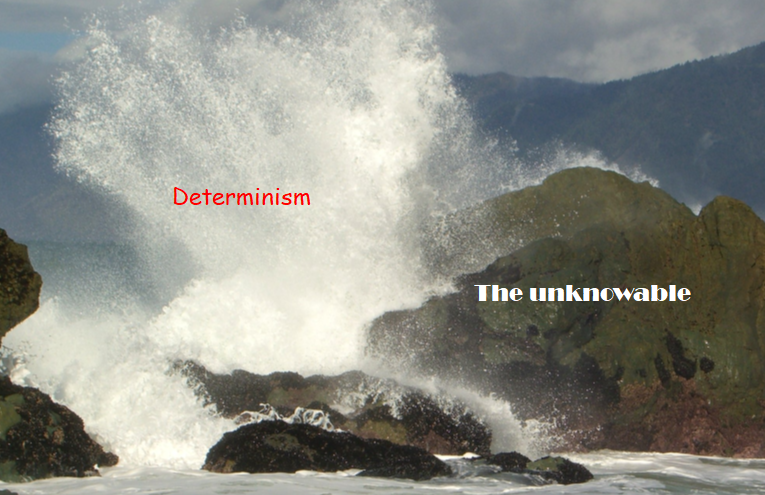
Empiricism can only go so far. It cannot reach the parts that empiricism cannot reach. Determinism cannot extend to places where the natural laws cannot or do not reach. If the unknowable exists then determinism cannot reach there. For the natural laws may not (or can not) apply there. It is not about whether we know all there is to be known about natural law. Determinism requires that some consistent and self-explanatory natural laws apply everywhere and at all times.

Absolute Determinism requires that Natural Laws be complete. That requires that natural laws be able to:

  1. explain their own existence, and
  2. explain all events (material and immaterial), and
  3. apply within and beyond our perception of the universe, and
  4. apply within and beyond our perception of time,

And the existence of such a set of Natural Laws is unknowable.


Related:

https://ktwop.com/2017/07/22/known-unknown-and-unknowable/

https://ktwop.com/2017/09/22/the-unknowable-is-neither-true-nor-false/

https://whyevolutionistrue.wordpress.com/2016/01/11/plain-talk-about-free-will-from-a-physicist-stop-claiming-you-have-it/

https://en.wikipedia.org/wiki/Determinism

http://physicsandthemind.blogspot.com/2013/10/in-defense-of-libertarian-free-will.html

http://backreaction.blogspot.com/2016/01/free-will-is-dead-lets-bury-it.html?spref=tw

http://archive.boston.com/bostonglobe/ideas/brainiac/2011/06/the_big_nothing.html
https://plato.stanford.edu/entries/determinism-causal/


Language transcends its encoded signals

July 19, 2018

My phone “talks” to my desktop computer. It can also “speak” with other devices with which it is “paired” (portable speakers, my lawn mower and my house security system). Coupled devices send and receive short-wavelength UHF radio waves in the ISM band (Bluetooth) to communicate. They follow rules (a vocabulary and a grammar) which specify the “meaning” of the bursts of radio waves they send and detect. I cannot detect any of these signals with my senses. I am neither aware of the communication taking place nor can I enter the conversation except through a compatible device within my control and with which I can communicate using a system which is within the range of my sensory capabilities (touch, vision, sound).

Does the system of signals being used by the bluetooth devices for their communications constitute a language?

There is a vast discourse, starting from ancient times, on the definition and the purpose and the philosophy of language. The Encyclopedia Britannica puts it thus.

Many definitions of language have been proposed. Henry Sweet, an English phonetician and language scholar, stated: “Language is the expression of ideas by means of speech-sounds combined into words. Words are combined into sentences, this combination answering to that of ideas into thoughts.” The American linguists Bernard Bloch and George L. Trager formulated the following definition: “A language is a system of arbitrary vocal symbols by means of which a social group cooperates.” Any succinct definition of language makes a number of presuppositions and begs a number of questions. The first, for example, puts excessive weight on “thought,” and the second uses “arbitrary” in a specialized, though legitimate, way.

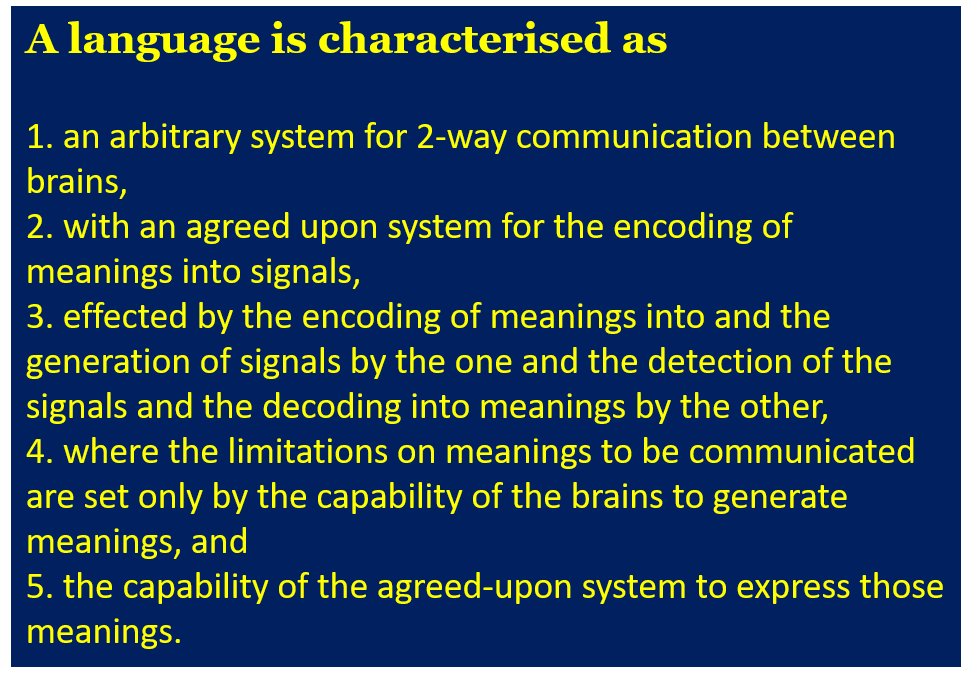
I find that much of the discussion is homocentric and tends to equate language with speech and writing. This I think is incorrect. I have therefore come to my own characterisation of what constitutes a language:

I find it is not necessary to specify that language is confined to human brains. It is claimed that the difference between human and animal communication is that human language is unrestricted.

EB again – “Human beings are unrestricted in what they can communicate; no area of experience is accepted as necessarily incommunicable, though it may be necessary to adapt one’s language in order to cope with new discoveries or new modes of thought. Animal communication systems are by contrast very tightly circumscribed in what may be communicated”. 

But this is unsatisfactory. Human thought is not in fact unlimited. It is limited by the very finite capability of the human brain. What a brain cannot perceive it cannot think about. What it cannot think about, it cannot communicate. Furthermore, the system agreed-upon restricts the meanings that can be transmitted and received. (A communication in French is of limited value to someone who knows little French. It is the lowest common level of shared encoding in the system which sets the constraint).

I also find the debate on language and thought, and language and philosophy, to be very often circular. It may be simplistic but I observe that the logic we perceive to exist in the universe is the same logic we embed in all our languages (including mathematics). We cannot then use language to prove or disprove the logic that is within it.

As in Gödel’s Incompleteness theorems: “The first incompleteness theorem states that in any consistent formal system F within which a certain amount of arithmetic can be carried out, there are statements of the language of F which can neither be proved nor disproved in F. According to the second incompleteness theorem, such a formal system cannot prove that the system itself is consistent (assuming it is indeed consistent).”

Which I paraphrase to be that “in a language embedded with a logic, that language can neither prove or disprove the logic that lies within it”.

I observe that we have more thoughts and emotions and perceptions than we have language for. We perceive more colours than any language we invent can describe. Which convinces me that thought precedes language. Moreover, it is the logic we perceive around us that we then build into the languages we invent. It cannot be, I think, that language circumscribes thought. It is our thoughts generated by our perceptions of what is around us that circumscribes the languages we invent.

Our senses come into play first in determining the meanings we wish to communicate. They then determine the shared system of encoding meanings into signals capable of being generated and detected. Our perception of a tree (vision/brain) is encoded into a particular sound (“tree”) which is generated (vocal chords) and detected and decoded by somebody else (aural/brain) and understood – according to the shared system of encoding – to mean a tree. The choice of encoding system is arbitrary but is primarily a matter of convenience. We use vision, sound and touch as a matter of convenience. We do not use olfactory signals because we cannot – at will – generate as great a range of smells as of sound. Besides, vision and sound can transmit signals across much greater distances than smells can. Sound can be transmitted in the dark. We do not have the capability in our bodies of generating or detecting radio waves or X-rays or infra-red radiation as encoded signals of meaning except through the use of specialised, instruments manufactured for the purpose. But if we had the same organs as bats do, we could use ultrasound signals in our languages. Our senses enable a convenient encoding of meanings into signals. Equally the limitations of our senses restrict the range of signals that we can generate and/or detect.

So my bluetooth devices do communicate with each other but the range of meanings they can transmit or receive are heavily circumscribed. They have not the freedom to express meanings which have not been predefined. They cannot initiate a conversation but can follow an instruction to do so. They do not have language.

But what is clear is that while language is a shared. agreed-upon system for encoding meanings into signals for the purpose of communication, language transcends its signals. While human language is mainly manifested as speech and writing, we also use sign-language and Braille and songs and music and art and dance within our languages. Photography and video are now part of the encoding we use in our languages. If we had organs for radio transmission and reception, we would no doubt have a word for “tree” but it would be expressed as a burst of radio-waves rather than a pressure wave or an image of a tree. Language is the system of conveying meanings where speech and writing and hand-signals are just specific forms of encoding. Language is a system which transcends the encoded signals it uses.


Acquisition of belief

July 18, 2018

Does it matter how a belief is acquired?

Take belief to be a proposition that is acquired or adopted though it cannot be proved. “Not being proven” then means that a truth value cannot be assigned to a belief. A belief proposition needs a mind to reside in. Merely stating a proposition that cannot be proved does not make it a belief. If the mind does not take further actions on the basis of that belief proposition being true, then that proposition cannot be said to have been “adopted” as a belief.

All knowledge is first belief. All knowledge is built on belief. The most fundamental belief adopted by every living thing is, I think, that “Time exists”. From that proposition we move on to “causality exists” and thence to every field of knowledge or endeavor.

In epistemology, knowledge is sometimes defined as being “true beliefs” or “justified true beliefs” though using “truth” to qualify “belief” makes me uncomfortable.

The Analysis of Knowledge.

There are three components to the traditional (“tripartite”) analysis of knowledge. According to this analysis, justified, true belief is necessary and sufficient for knowledge. 

The Tripartite Analysis of Knowledge:
S knows that p if

  1. p is true;
  2. S believes that p;
  3. S is justified in believing that p.

The tripartite analysis of knowledge is often abbreviated as the “JTB” analysis, for “justified true belief”.

Even if a belief-proposition cannot be proven, any proposition can be justified to a greater or lesser extent. Justification takes the form of collateral “evidence” which impacts the perceived probability of the proposition being true. This probability could be said to be the validity of the belief-proposition. (But it should be remembered that the very use of probability is an admission of ignorance. What then is the probability that an improbable proposition turns out to be true?)

Is a “brainwashed belief” less valid than a “freely adopted” belief? Is an imposed belief (whether by indoctrination or by peer pressure or by political correctness) less valid than a belief which has resulted from deep study and much thought? Is a “freely adopted belief” reached without thought and only because “my friend says so”, any less valid than one reached after years of study?

At first glance it might seem so. We could rank beliefs by the level of coercion involved in the acquisition of that belief. Generally the greater the level of coercion, the less critical thinking involved in adopting a belief.

  1. Brainwashing
  2. Indoctrination as an adult
  3. Indoctrination a a child
  4. Peer pressure
  5. Political correctness
  6. Conventional wisdom
  7. Freely adopted but without thought
  8. Freely adopted after much study

The same belief may be held both by a brainwashed person and also by someone after long years of study. The same belief may be held by the indoctrinator and the indoctrinated, by the mad mullah and the gullible youth, by the parent and the unknowing child. It would seem that the method by which a belief comes to be adopted is independent of the belief itself. But this is not entirely so. The less a belief can be justified the greater will be the resistance for another mind to adopt that belief. The greater will be the coercion necessary. There is a likelihood, therefore, that the greater the coercion necessary to inculcate a belief, the less likely it is that the belief in question is justified.

After all that, my fuzzy conclusion is that a belief is not dependent upon the method of its adoption. However, a belief adopted after coercion is likely to be less valid than a belief adopted without coercion – but not always. And validity of a belief is merely a probability.

Or it could be as Calvin believes that having a belief can increase the validity of that belief – or is it just that appearing to adopt some other person’s belief is more likely to extract benefits from the other.


No higher purpose

July 16, 2018

(Of course the ultimate purpose of life, the universe and everything is balance – which is indistinguishable from stasis. The imbalance at the core of time, the universe and everything.

If any change – including the state of change we call life – can be said to have a purpose, it is to eliminate the imbalance which caused the change or life in the first place. It would seem then that the ultimate purpose of all change must be to return to a state of complete equilibrium where even time does not have to flow. A state of stasis.

But let us suppose that there is such a thing as purpose).

Consider the characteristics of purpose.

  1. Purpose is not confined only to conscious minds or only to all living things. Purpose, as an objective or a direction, can be attributed to anything. But the attribution and its articulation seems confined to the existence of a conscious mind.
  2. Having (or being attributed with) purpose implies the flow of time. It implies a current state and actions to reach some other desired state at a later time. A purpose can not and does not address a past state.
  3. A purpose as an objective may describe a future state outside the space of perceived causality (and therefore of an imaginary state). But observe that even an imaginary future state can provide a real direction for current actions.
  4. A consciousness does not need to have a purpose and all its actions may be merely reactive. It also follows that if a conscious mind perceives no desired direction (no purpose), then its actions are reactive and merely respond to the prevailing imbalances it experiences.
  5. When more than one conscious mind is involved, individual purposes and the actions they engender, are additive and combine as vectors giving a “net” purpose.

The purpose of purposes is to give direction to actions. If an individual perceives no “higher” group purpose, that individual’s actions are then directed by that individual’s own purposes (or lack of purpose). Even where a group purpose is discernible, it can only be effected by the actions of individuals who subordinate their own purposes to that of the group. “Higher” purpose is irrelevant unless – and until – it is adopted by the entity carrying out the action. A “higher” purpose is ineffective except as disseminated and adopted by the actors.

Ultimately there is no higher purpose than that set or adopted by an individual for himself or herself.


Imaginary realities (or why all history is imaginary)

July 12, 2018

History is causal.

Actual events in the past resulted in the present. What we think, now, about those events in the past or what stories we tell, now, about the past are of no consequence to the present (no matter how fascinating or revisionist those stories may be).

The consequences of past events reverberate into the future until their influence has reduced so as to be submerged into the background noise. Say it actually was an asteroid impact 65 million years ago which led to the mass extinction of large dinosaurs (even if some survive as birds today). The reverberations of that asteroid impact can no longer be definitively detected. It can still be inferred by other events but all direct consequences are now part of the background noise. We can imagine other alternative histories. It might have been a super-volcano eruption – the detectable impacts of which would now also be lost in the noise – which caused the decline of the dinosaurs. Large dinosaurs may have disappeared catastrophically over a very short period or dwindled gradually over a few million years. We can imagine any story we like as long as its effects are now lost within the background. The super-volcano eruption and the asteroid impact are equally real (or equally imaginary).

Is reality confined to the present?

A real event that occurred yesterday is not real now. If everything not-real is imaginary then everything in history is imaginary now. Events that did occur are imaginary in the now. But events that did not occur are also imaginary. For events from as close as yesterday there may be collateral evidence to support one particular imaginary reality that was. For recent events some imaginary reality may be more real than another. But for events from the more distant past all the supporting evidence may be buried within the background rumble from the past. Then all imaginary realities are equal on the reality scale of imaginary realities. But the “real” reality must be causally connected to the present and so must also be the realities of the future.

Clearly time has an impact on reality. Perhaps it is wrong to thing of reality by itself and we need to think instead of the space within which reality can exist and the reality time-line. The reality space is the space of causality.

Reality space

Perhaps reality has to have a time axis. From the now, past or future realities (which are imaginary in the now) are time-lines which can only exist in the reality space. The reality time-line then must be capable of being causally connected within the reality space and must pass through the now. The imaginary space is then that where events cannot be causally connected to the present.

That dinosaurs have become chickens lies within the reality space that we can discern now and is an imagined reality. That dinosaurs became tigers lies in the imaginary space but cannot be causally linked and, therefore, is not even an imaginary reality.


Atheism cannot cope with the unknowable

July 8, 2018

I take atheism to be a “lack of belief in gods”.

A lack of belief does not lie in the realm of knowledge. Neither does it lie in the realm of the unknown. A lack of belief is silent about the state of knowledge about the subject in question. A lack of belief does not imply a state of knowledge. A lack of a belief is not in itself a logical negation of that belief. Many extend this and take atheism to be a denial of the existence of gods as professed as a belief by others. I suspect that most of my acquaintances who claim to be atheists use the latter definition when they present arguments to support their denial of the existence of gods to try and negate the beliefs of others. But a denial of some belief is then an attempt to shift something unknown into the realm of knowledge. It shifts the conversation from ” I don’t myself believe in X” to “I know that your belief in X is false”.

This shift from the realm of belief to the realm of knowledge, I think, is incorrect, illogical and invalid. We are inevitably drawn into epistemology. The known, the unknown and the unknowable. The known and the unknown are realms that are self-apparent. Science is the process at the interface of these regions which leads to the growth of the region of the known. All beliefs by definition lie in the region of the unknown. Any statement and its negation ( X and not-X) must both either lie in the region of knowledge, or both in the region of the unknown. It is not possible for one to live in the realm of knowledge and its negation to live in the region of the unknown. A belief in gods lies in the unknown. A lack of belief in gods (which is atheism) is not in itself a commentary on that belief. A denial of the belief in gods cannot then be anything other than belief and cannot shift into the realm of knowledge. A denial of a belief – which by definition lies in the unknown – is to claim knowledge of an unknown thing which is self-contradictory.

Known, Unknown and Unknowable

Is some part (and maybe the major part) of the unknown then unknowable? Some scientists – and some atheists – would claim that the unknowable does not exist; that everything – eventually – can be explained. But I think they delude themselves. This trifurcation into the known, the unknown and the unknowable does not address who the observer is or the time element. “To know” requires cognition. Cognition requires a brain. Known to whom? when? for how long? What is “known” depends upon the brains alive to know. Facts which were once part of knowledge may become unknown, though they may well remain facts. I observe that most of past events are now unknowable, though they were once known. What was once known, may have first passed into the region of the unknown (but was still knowable) and then with the further passage of time may have passed into the region of the unknowable. Most of the past events in my own life are already in the region of the unknowable. The most basic questions of science that we can formulate always lead us first into the unknown and then into the unknowable.  When the unknowable is reached we use labels. Gods, The Big Bang, Dark Energy, Dark Matter, …….. . But they are all just labels for Magic.

But more fundamentally, the Great Unknowable – throughout all of space and all of time – is time and its nature. What came before time, when “before” was undefined, is unknowable. At the most basic level, our causal universe and all its laws and all our logic rely upon the existence of an inexorable and inexplicable Time Magic. (I take all events which occur but which are inexplicable to be Magic. It is my label for that which lies in the region of the unknowable). Beliefs in Gods or the Big Bang also lie in the region of the unknowable.

Atheism is about belief and does not address the nature of knowledge or confront the unknowable. An atheist’s lack of belief in gods then lies in the realm of the unknown and perhaps in the realm of the unknowable (Magic). Even an atheist believes in Time Magic (whether he acknowledges it or not).


Behaviour, not form, defines a person

May 18, 2018

Within a decade or two we will need criteria to determine if an artificial intelligence has achieved consciousness. (I take consciousness without consciousness of self to be impossible). The criteria will have to be consistent and applicable both to life forms and to non-living entities. Within a few more decades, and certainly within one hundred years I think, we will need to be able to determine if an autonomous, intelligent, conscious entity meets the requirements for person-hood. At the same time it will become necessary to create criteria for judging what constitutes a person and what is meant by “mankind” (or person-kind).

Our use of the concept of “mankind” or “humanity”  or “humankind” is both concrete and abstract. It is used variously to mean:

  1. the 7+billion people alive today,
  2. the 110 billion modern humans who have ever lived (starting arbitrarily from about 200,000 years ago),
  3. all the people who have ever lived and all their works and all their dreams,
  4. an abstract vision of those who exhibit some ideal behaviour.

My own view is that it is behaviour which determines. To look like a human or to have the physical form of a human is not enough. It is the exhibition of “human behaviour” which determines who qualifies to be a human. “Mankind” or “humanity” or “personkind” then consists of those who exhibit or have exhibited and met some standard of human behaviour.  It also follows that any intelligent, autonomous, conscious creature or entity which exhibits these qualifying standards of behaviour is then a member of “mankind” (or of person-kind if language needs a new word). Genetics would then be involved only insofar as genetics determines behaviour.

“Human rights” as used today is a false concept precisely because it is divorced from behaviour. It is ethically and logically unsupportable. It is focused on the physical form of “being human” and not on the behaviour which makes a human. As used today, “human rights” is about form rather than substance, and about sanctimony rather than reality. When being a person is defined in terms of behaviour it then follows, naturally, logically and inevitably, that privileges for a person are also determined by behaviour.


It would then be perfectly logical to consider the privileges of personhood to be enjoyed by every entity qualifying as a person. And then it would not be necessary to consider privileges for members of IS or MS13 or Anders Behring Breivik or for an Adolf Hitler when he next appears.


The flow of time precedes causality

April 26, 2018

All origins, all beginnings presuppose the existence of a flow of time. Our imagination, our language and our thought are incapable of conceiving the non-existence of a beginning. We cannot conceive of anything in the world where a non-beginning is not also a non-existence. If it exists it must have had a beginning. There is no branch of science or field of study or area of thought which is not based on causality. We perceive the world around us through the eyes of causality. We perceive what is and look for what caused what is. We do not question that what is must have had a cause. We do not question either that what will be, will be caused by and follow what is. But causality pre-supposes the existence of a flow of time.

But there is no philosophy or theology or science which can explain

  1. what time is, and
  2. what causes time to flow

One could say that it is the existence of the flow of time which brings about causality. Causality is itself caused by time.

“Perhaps the simplest and easiest to understand is the argument of the First Cause. (It is maintained that everything we see in this world has a cause, and as you go back in the chain of causes further and further you must come to a First Cause, and to that First Cause you give the name of God). That argument, I suppose, does not carry very much weight nowadays, because, in the first place, cause is not quite what it used to be. The philosophers and the men of science have got going on cause, and it has not anything like the vitality it used to have; but, apart from that, you can see that the argument that there must be a First Cause is one that cannot have any validity. I may say that when I was a young man and was debating these questions very seriously in my mind, I for a long time accepted the argument of the First Cause, until one day, at the age of eighteen, I read John Stuart Mill’s Autobiography, and I there found this sentence: ‘My father taught me that the question, “Who made me?” cannot be answered, since it immediately suggests the further question, “Who made God?” ’ That very simple sentence showed me, as I still think, the fallacy in the argument of the First Cause. If everything must have a cause, then God must have a cause. If there can be anything without a cause, it may just as well be the world as God, so that there cannot be any validity in that argument. It is exactly of the same nature as the Hindu’s view, that the world rested upon an elephant and the elephant rested upon a tortoise; and when they said, ‘How about the tortoise?’ the Indian said, ‘Suppose we change the subject.’ The argument is really no better than that. There is no reason why the world could not have come into being without a cause; nor, on the other hand, is there any reason why it should not have always existed. There is no reason to suppose that the world had a beginning at all. The idea that things must have a beginning is really due to the poverty of our imagination. Therefore, perhaps, I need not waste any more time upon the argument about the First Cause.”  Bertrand Russel – 1927

Time, or space-time nowadays, is sometimes considered as a river. The analogy with fluid flow does not help greatly and only raises further questions. Fluids flow (over time and space) as a causal consequence of forces and energies which are not in balance and which seek balance. Fluids flow from a higher pressure to a lower (in a gas pipeline), from a higher level of potential energy to a lower (in a river) or by being physically forced from one location to another (in a pump or a compressor). In the fluid analogy it is particles of the the fluid which are transported over space and time.

If the flow of time is a river then what exactly is being transported? What then is the imbalance, and in what property or state which causes the transportation of the magical thing called time? Rather than addressing the First Cause, perhaps we should be addressing the First Questions.

What is time? and Why does it flow?

The existence of time precedes beginnings. The flow of time precedes causality. The problem of course is that without time, beginning and precede are undefined.


Justice is just a derived concept

April 20, 2018

Many of our fundamental concepts are not in fact fundamental. They are entirely dependent upon and derive from the negation of other concepts. We are all prisoners of our genes, our bodies, our beginnings and our planet. As a concept “freedom” is meaningless without first defining what captivity means. The concept of freedom is not self-sufficient and derives from some concept of captivity which must come first. Similarly, justice derives from a definition of injustice.  Fighting for justice is a misnomer since it always consists of fighting against some injustice. Equality by itself is almost meaningless. It first requires a definition of inequality. Even in the language of mathematics an equality relies on a prior definition of inequality. Bright opposes dark and each relies on and derives from the other.

Other concepts can live on their own and are not merely negations of some other concepts. Even though they lie on the same scale and may oppose each other they refer to some separate norm as a reference and can live independent lives. Happiness has its own scale (as does unhappiness). The concept of beauty does not require the definition of ugly. Liking and disliking and love and hate can all live on their own. Rich and poor lie on the same scale but each refers to a norm and so they are not dependent upon each other. Rich describes a surplus relative to some norm and poor is a deficiency. Wealth and poverty refer to a norm but not necessarily to the other.


The imbalance at the core of time, the universe and everything

April 11, 2018

Without imbalance there is no change.

When all forces and energies are in equilibrium, nothing happens. Nothing can happen. At equilibrium there can be no motion, no waves no vibrations, no change. If the origin of our universe (or the universe) was in the Big Bang, then that must have been in response to some great, prevailing non-equilibrium, the Great Imbalance which caused the Big Bang. (It always seems to me a little unsatisfactory that a Big Bang can be postulated without also having to postulate why a Big Bang would need to occur). All change is always in the direction of eliminating the imbalance which caused the change. If the universe is expanding then it must be in response to an imbalance and the expansion must work towards eliminating that imbalance. The physical world is driven by imbalances. Fluid flows and heat flows and electricity flows are achieved by creating imbalances which force the flow. Human and animal behaviour is driven by imbalances. In fact all life is driven by imbalance.

All motion and even the vibrations of the most fundamental particles (whatever they are) can only be in response to some imbalance. The earth spins and the planets move because gravitational forces are not in balance. Geology happens in response to imbalances. Imbalance always causes change in the direction of eliminating the causal imbalance. Change can only therefore be a response to an imbalance. One change may cause another imbalance to come into being, leading to further change and so on ad infinitum. Though a change may be in the direction of eliminating the initial imbalance, the chain of change may not necessarily converge to stasis. All change needs time to flow. We do experience that time flows – even if we cannot define or experience what time itself is. But then the flow of time must itself be due to an imbalance which the flow of time seeks to eliminate. We do not – can not – experience any lapse of time without change or observe any change without the lapse of time.

Chemistry (which is just applied physics) causes material to combine and merge and split but always as a consequence of some initiating imbalance. Sometimes this chemistry produces living cells which then maintain not only a cyclical chemistry (now biochemistry) but also a code for maintaining the particular, cyclical biochemistry in a changing environment.  The state we call “life” is a state of change. All life and its evolution must therefore be in response to some causal imbalances. Furthermore the direction of life or evolution must therefore be to eliminate the initiating imbalance. But here too there is no certainty that the chain of life will converge to stasis.

If any change – including the state of change we call life – can be said to have a purpose, it is to eliminate the imbalance which caused the change or life in the first place. It would seem then that the ultimate purpose of all change must be to return to a state of complete equilibrium where even time does not have to flow. A state of stasis.

Our universe and everything within it is then a “state of change”, moving from one equilibrium state of stasis to another.

Time and change and states of stasis

The very concept of Change carries within it the concept of No change – which I call a state of stasis. Without a state of Change there is no framework within which Time can – or needs to – exist. It is this state of No change – changeless and timeless – which defines stasis. The concept of Time and duration would seem to emerge simultaneously with or after the commencement of change. But can there be Change without a concept of Time? Stasis was/ is /will be where Change is not. There may be many different states of stasis. Whether states of stasis can precede or follow periods of change is indeterminate since without change – and therefore without Time – there is no before and there is no after.

In stasis there can be no change of any kind, no material, no energy or even dark energy.

Stasis will be reached again when time runs out.