Archive for the ‘Politics’ Category

In a democracy, oppositions must oppose, governments must govern

October 9, 2013

I was listening yesterday to President Obama’s press conference where he accused the Republicans of “extortion”.

“But I also told him that having such a conversation, talks, negotiations shouldn’t require hanging the threats of a government shutdown or economic chaos over the heads of the American people. …. 

….. members of Congress, and the House Republicans in particular, don’t get to demand ransom in exchange for doing their jobs. And two of their very basic jobs are passing a budget and making sure that America’s paying its bills. They don’t also get to say, you know, unless you give me what the voters rejected in the last election, I’m going to cause a recession.

…. So let me explain this. If Congress refuses to raise what’s called the debt ceiling, America would not be able to meet all of our financial obligations for the first time in 225 years.”

He sounded petulant. It sounded like “Give me back my ball” to me.

But the fundamental foundation of any democracy is that ruling parties govern, to the extent that they have the ability and as they may be constrained by the opposition. It is a fundamental of preventing excesses by a majority against a minority that oppositions oppose to the best of their ability. Oppositions must oppose as best they can. Governments must govern given such opposition. It is the task of government to make the compromises necessary to be able to govern. And the bottom line is that the Republicans in the House are opposing and that Obama and his Democrats are failing to govern.

I certainly don’t know enough about the issues involved to have any decided opinions. But I do think that the US debt is an indicator of many years of profligacy. Obamacare itself may be a wonderful thing but the opposition in the House don’t think so. Passing any budget (and it is actually approving an increase of a debt limit) cannot just be a formality where the ruling party merely gets its way and the opposition knuckles under. One could argue that passing a “balanced budget” is some kind of a fiduciary responsibility of the representatives but this is not such a question. It is for the passing of a grossly “unbalanced budget” and to, thereby, increase the national debt.

So when an opposition does what it is supposed to and succeeds in opposing any measure proposed by a ruling party, it is actually evidence of a failure to govern. There can be no failure of the responsibility of the opposition to oppose.

What Obama seems to be complaining about is that he has not the ability to find the compromises to be able to overcome the opposition!

How the map of the Middle East could develop

October 5, 2013

Once upon a time maps were dawn primarily as symbolic and pictorial descriptions of physical geography. Then came the nation states and “Nations of the Mind” became nations on the ground. With their dark under-belly of nationalism and jingoism, maps have become – nearly always – political, religious or ideological maps superimposed on and tied to physical geography. Some day humans will outgrow the limitations of nation-states and nationalism. “Nations” tied to a geography will eventually become obsolete but it will not be in my lifetime.

The dynamics in the Middle East are particularly volatile and give rise to much speculation about how new nations could form and how the map of the region could develop. But much of the new formations – which are already ongoing – are not by design but by the realities on the ground. Many forces are engaged and much blood is being shed as the various parties try to impose their own designs.

A few years ago Ralph Peters imagined a “better Middle East” in  “Blood Borders: How a Better Middle East Would Look” and was heavily criticised for his provocative work.

The map was prepared by Lieutenant-Colonel Ralph Peters. It was published in the Armed Forces Journal in June 2006, Peters is a retired colonel of the U.S. National War Academy. (Map Copyright Lieutenant-Colonel Ralph Peters 2006). The map is included in Peters’ book Never Quit the Fight.

Ralph-Peters-Remapped-Middle-East

Ralph-Peters-Remapped-Middle-East

As Geo Currents remarked in 2010:

For all of Peters’s miscues, many of his core ideas are sound. His initial assertion – that misplaced boundaries often generate injustice and strife – is spot on. And he is right to point out that the foreign policy establishment refuses to acknowledge the violence engendered by geopolitical misalignment for fear of opening a Pandora’s Box of separatist demands. Because of that fear, any suggestions for alternative arrangements tend to be dismissed out of hand. Such a stance, Peters argues, is intellectually dishonest. New countries sometimes do appear on the map without ruffling the international order. Think of Montenegro, 2006. Such neophyte states must, however, come into being through the channels of global diplomacy if they want international recognition. Should they emerge on their own, their existence will be denied by the powers that be. In this way the system of international diplomacy that Peters mocks can indeed become a masquerade. Grant diplomatic recognition to Somaliland, the only effectively administered territory in the bedlam called Somalia? Impossibly destabilizing: surely anarchy would be loosed across the Horn of Africa!

The New York Times has just carried an article by Robin Wright returning to the same subject

Imagining a Remapped Middle East

Robin-Wrights-Remapped-Middle-East

Robin-Wrights-Remapped-Middle-East – NYT

THE map of the modern Middle East, a political and economic pivot in the international order, is in tatters. Syria’s ruinous war is the turning point. But the centrifugal forces of rival beliefs, tribes and ethnicities — empowered by unintended consequences of the Arab Spring — are also pulling apart a region defined by European colonial powers a century ago and defended by Arab autocrats ever since.

A different map would be a strategic game changer for just about everybody, potentially reconfiguring alliances, security challenges, trade and energy flows for much of the world, too.

Syria’s prime location and muscle make it the strategic center of the Middle East. But it is a complex country, rich in religious and ethnic variety, and therefore fragile. After independence, Syria reeled from more than a half-dozen coups between 1949 and 1970, when the Assad dynasty seized full control. Now, after 30 months of bloodletting, diversity has turned deadly, killing both people and country. Syria has crumbled into three identifiable regions, each with its own flag and security forces. A different future is taking shape: a narrow statelet along a corridor from the south through Damascus, Homs and Hama to the northern Mediterranean coast controlled by the Assads’ minority Alawite sect. In the north, a small Kurdistan, largely autonomous since mid-2012. The biggest chunk is the Sunni-dominated heartland.

…………

Saudi-Arabia-Remapped-by-Robin-Wright

Saudi-Arabia-Remapped-by-Robin-Wright

GeoCurrents reviews the NYT article:

Wright’s article, however, shows that her purpose is different from that of Peters. Whereas Peters sought to depict a more rationally constituted political map, Wright rather speculates about a map that might be developing on its own, regardless of her personal preferences, much less her country’s geo-strategic designs. In this regard, the map has much to recommend it. Libya, Syria, Yemen, and Iraq could well be in the process of disintegration, splitting into de facto states or state-like entities that might bear some resemblance to the territories depicted by Wright’s map. The likelihood of Iraq and Syria regaining stability as effective states within their internationally recognized boundaries seems remote, given the viciousness of the conflicts currently being waged. As things already stand, the non-country of Iraqi Kurdistan is almost as much of a state as Iraq itself, and arguable more of a nation. Whether Libya and Yemen can politically reintegrate is also an open matter. Mapping how the Middle East appears today, rather than how the international political community thinks it should be configured, is thus an essential task. Thinking about where such processes might lead is equally important. Wright’s thoughts on the subject are generally insightful, and her map has many pertinent and intriguing features. I commend the New York Times for publishing such a provocative piece. ……

…….. My serious misgivings concern Wright’s  treatment of Saudi Arabia. She realizes that she goes out on a limb here, noting that “The most fantastical ideas involve the Balkanization of Saudi Arabia…” Unlike the other countries that she remaps, Saudi Arabia is a relatively stable state, with no serious challenges to its territorial integrity. Imagining the division of this country thus does not involve speculating about the possible end-points of processes already in motion, as is the case in the other countries considered. It is not at all clear, moreover, why Wright has divided Saudi Arabia as she has, as her article is largely silent here. Presumably, her division is based on the idea that the non-Wahhabi peripheries of the country could detach themselves from the Wahhabi core, potentially resulting in the emergence of the new states of North Arabia, Eastern Arabia, South Arabia, and Western Arabia.

Fascinating stuff.

Finally! Toilets before temples says Modi

October 3, 2013

Narendra Modi may have announced his candidature a little early but he knows what needs to be done. Paradoxically, in spite of his image as a Hindu Nationalist and the support he has from the RSS, he may actually have the clout to break the stranglehold that religious mores and nonsense has on development in India. Certainly, judging from his track record in Gujarat, the RSS and the VHP may find Modi rather too hot to handle if he becomes Prime Minister.

In my estimation at least half – and maybe 90% – of the roadside shrines and mosques and temples that spring up at the slightest provocation are eyesores, worthless structures and illegal occupation of land. They usually have more to do with real estate politics than any religious intention. Nearly all new “religious” structures have a motive other than religion. But nobody dares to demolish them. Anything smelling of religious intolerance brings all the cowardice possible to the fore.

This appeal to urban India by Narendra Modi is quite clever. The same message has been put forward by others and they have immediately been opposed by the shirt-sleeve religious sentiments of the RSS and the VHP. But they will not dare oppose Modi. The appeal may not go down quite so well in rural India – but it may not carry many negatives.

DNA: Speaking at a function organised here for the youth, Modi said he dared to say so even though his image as a Hindutva leader did not allow him.

Build toilets first and temples later, said Hindutva icon and BJP’s Prime Ministerial candidate Narendra Modi on Wednesday.

Speaking at a function organised here for the youth, Modi said he dared to say so even though his image as a Hindutva leader did not allow him.

“I am known to be a Hindutva leader. My image does not permit to say so, but I dare to say. My real thought is– Pehle shauchalaya, phir devalaya’ (toilets first,  temples later),” he said.

The Gujarat Chief Minister’s comment could well stoke a controversy from within his party and sister organisations, which are keen to rake up the “temple issue” again ahead of next general elections.

A similar comment on toilets from Union Rural Development Minister Jairam Ramesh that the country needs more toilets than temples had stirred a row with a large number of women organisations and NGOs protesting against the remark.

Touting the slogan of development that could take the country on the path of speedy progress, Modi said lakhs of rupees were spent on temples in villages, but there were no toilets there.

Invoking Mahatma Gandhi’s thoughts, he lamented that it was ironic that women in the country had to go in the open for easing themselves in the absence of toilets.

Modi said it was the quality of a real leader to have the strength to handle all problems and lead the way forward.

He said that for good governance and speedy progress, it was necessary for planners to focus on outlay, outcome and social audit.


Miliband caught between a Red and a Marxist place

October 2, 2013

UK politics is always interesting. This I find amusing and great fun. Especially since it is a fight between two parties neither of whom commands my very great respect.

The Daily Mail’s coverage of Ed Miliband’s father and his Marxism as that of a man who hated Britain is getting much coverage in the UK’s press and radio. The BBC radio news coverage – which I generally have on in the background – spent many minutes on the subject. I am just listening to “Red” Ken Livingstone defending both the Milibands but he is a little incoherent. He admitted that Miliband Jr. must have got his values from his father. But Pater Miliband, it seems, must be excused his Marxist views because he was just an academic. Ken doesn’t like the Daily Mail at all – since they once offered his former wife £10,000 for her story – which they would write. But even he was not very scathing about the Mail’s coverage!!

Ed Miliband has already earned the title of “Red” Miliband after his play last week threatening to regulate energy prices. He is also known to be an ardent supporter of regulation of the press. This is not of course full-blown Marxism but such plays are not inconsistent with being a budding Marxist. He cannot repudiate being labelled “Red” since he is courting the left wing of the Trade Unions but he would prefer not to have the word as a title. ( Red Arthur Scargill and Red Ken being examples to avoid). But he is now caught in a tough place. His every defence of his father – which is politically necessary  to demonstrate his family values – takes him closer to being labelled a Marxist.

Red Miliband’s lurch to the Left is a rejection of Blairism and New Labour – and that is probably to his electoral advantage. Not on grounds of ideology but for the contempt that Blair now arouses. But if he is seen to be returning to Harold Wilson’s “bend with the wind” brand of socialism it will not be to his advantage. And if he is seen to be a closet Marxist then he could blow his chances at the next election.

There are some opinions that the whole circus is to Red Miliband’s advantage. I am not so sure. It seems to me that he is now caught between being labelled “Red” or being labelled a Marxist and neither is good for his electoral chances.

Even more amusing is that even the Labour press (the Mirror and to some extent the Guardian and the BBC) are rather full of support for Ed Miliband but rather muted in their criticism of the Daily Mail. They don’t like Miliband’s views on Press Regulation.

An oblique view of the looming US government shutdown points to incompetence in governing

October 1, 2013

It is 6am in Europe and midnight, Monday 30th September in Washington. A US government shutdown is looming because of disagreement between the President and the Senate on the one hand with the House on the other. The Senate has a Democratic majority while the House has a Republican majority. The two sides cannot agree on budget measures to keep paying for government.

There is much – but very predictable – pointing of fingers.

My view is from another aspect. It is not the role of an opposition to lie down in front of the ruling party. It’s job is to oppose. That is the fundamental of the “check and balance” of a two party system. It is the job of the ruling party to do as little as is necessary in compromising with the opposition to be able to govern – not to blame the opposition. A failure to govern is in itself evidence of an inability to govern. It is evidence of incompetence.

It is the job of the Republican opposition to oppose. It is for the President and the Democxratic majority in the Senate to give in as little as is necessary and as much as is sufficient to be able to govern.

I cannot help but conclude that the President and his Democratic majority have lost sight of the fact that it is their responsibility to make the compromises sufficient and necessary. It is not the role of the Republicans to lie down and be rolled-over. In the hierarchy of things it is for the House to “propose” and the Senate and the president to “dispose”. When whatever comes up from the House is unacceptable and has to be rejected by the Senate or the President it indicates that the President and the Senate are not doing what is sufficient and necessary to get proposals from the House that can be approved.

There is a large element of risk aversion and a fear of “screwing his courage to the sticking place” about President Obama. The Senate Democratic majority is guilty of simple incompetence.

FIFA promoting and condoning slave labour

September 27, 2013

FIFA are “going to investigate”.

It would seem a little too little and much too late.

Brazil is resorting to extraordinary means to get ready for the World Cup next year.

BBC: 

Construction workers employed on a project in Brazil ahead of next year’s World Cup face “slave-like” conditions, officials say.An investigation into the expansion of Sao Paulo international airport found that 111 workers were living in poor accommodation near the building site.

They were approached in poorer states and some had to pay more than $220 (£140) to secure a job, the Labour attorney general’s office says. The promised wages were $625 a month.

The workers, among them six ethnic Pankaruru indians, were reportedly lured in the country’s north-east with promises of work in Sao Paulo. However, many were not immediately employed and had to stay in one of 11 makeshift camps near the airport which is being expanded in preparation for next year’s World Cup. The Labour attorney general’s office says it found the workers living in “conditions analogue to slaves” and has 30 days to present legal action against the contractors.

According to Brazilian legislation, companies must contract migrant workers in their hometown before transferring them to other cities. 

Similar investigations were under way in other World Cup-related building sites, attorney Cristiane Nogueira, from the Labour attorney general’s office in Sao Paulo, told Brazilian newspaper Folha de S Paulo.

But it would seem to be even worse in Qatar for their World Cup in 2022 – undeserved and where the voting was clearly bought. FIFA have been falling over themselves to ensure their share of Qatar money and where they – for the first time ever and in conflict with most football seasons – are going to hold the World Cup in winter. Here at least 44 Nepalese construction workers have died in just 3 months and the World Cup is still 9 years away. At the rate they are going thousands could die before the World Cup is held.

The Guardian: 

Dozens of Nepalese migrant labourers have died in Qatar in recent weeks and thousands more are enduring appalling labour abuses, a Guardian investigation has found, raising serious questions about Qatar’s preparations to host the 2022 World Cup.

This summer, Nepalese workers died at a rate of almost one a day in Qatar, many of them young men who had sudden heart attacks. The investigation found evidence to suggest that thousands of Nepalese, who make up the single largest group of labourers in Qatar, face exploitation and abuses that amount to modern-day slavery, as defined by the International Labour Organisation, during a building binge paving the way for 2022.

According to documents obtained from the Nepalese embassy in Doha, at least 44 workers died between 4 June and 8 August. More than half died of heart attacks, heart failure or workplace accidents.

The investigation also reveals:

 Evidence of forced labour on a huge World Cup infrastructure project.

• Some Nepalese men have alleged that they have not been paid for months and have had their salaries retained to stop them running away.

• Some workers on other sites say employers routinely confiscate passports and refuse to issue ID cards, in effect reducing them to the status of illegal aliens.

• Some labourers say they have been denied access to free drinking water in the desert heat.

• About 30 Nepalese sought refuge at their embassy in Doha to escape the brutal conditions of their employment.

The allegations suggest a chain of exploitation leading from poor Nepalese villages to Qatari leaders. The overall picture is of one of the richest nations exploiting one of the poorest to get ready for the world’s most popular sporting tournament.

“We’d like to leave, but the company won’t let us,” said one Nepalese migrant employed at Lusail City development, a $45bn (£28bn) city being built from scratch which will include the 90,000-seater stadium that will host the World Cup final. “I’m angry about how this company is treating us, but we’re helpless. I regret coming here, but what to do? We were compelled to come just to make a living, but we’ve had no luck.” 

Of course FIFA is shocked and distressed and will investigate! Not as distressed as the workers are in Qatar or as distressed as the families of the dead.

The Telegraph: 

Britain’s most senior Fifa member said he was “appalled and distressed” by allegations made in an expose of construction practises in the Gulf State as it readies its infrastructure to stage the 2022 tournament.

Boyce told the Telegraph Sport: “Fifa must fully investigate all the facts contained in the article and hopefully report back to the executive committee.”

The Northern Irishman also insisted the matter would be discussed at next week’s Fifa executive committee meeting.

That meeting had initially been expected to confirm that the tournament would move from the summer but is now in danger of being hijacked by a “slavery” scandal. …


IPCC still cooking it’s books to cover-up the inconvenient truths

September 27, 2013

The 95% probability/certainty of global warming being due to human activity is based on a show of hands and not on any evidence or statistical analysis of data. What it actually says is that 95% of all global warming believers, believe.

Late last night the IPCC delegates in Stockholm were still messing around preparing their 30 page political summary of their AR5 report to be released today.

The political summary of AR5 is primarily a CYA effort to protect the posteriors of the policy makers (mainly political figures, bureaucrats and activists) in the face of a long row of broken models and broken hypotheses. The IPCC has forgotten that natural variability is a euphemism for unknown mechanisms which cannot be calculated or predicted. It is going to be interesting to see just how the summary report will cover-up, deny or ignore the long string of inconvenient facts:

  • Global temperatures have not risen for 17-18 years while CO2 has kept on increasing. 
  • Global temperatures have been declining for the last 11 years. 
  • None of the IPCC’s computer models have predicted the warming hiatus or the cooling over the last decade.
  • Global wildfires are lower than normal. 
  • Rainfall patterns (and the Indian monsoon) continue within the bounds of known natural variability. 
  • Food and grain production is at an all-time high. 
  • Flood frequency and flood levels have not been at unprecedented levels. Just more people live in flood-plains today than before. 
  • CO2 in the atmosphere reached the magic level of 400 ppm (albeit for just a few hours) and nothing happened.
  • How much of the CO2 concentration increase is due to carbon dioxide from fossil fuel. combustion is unclear but fossil fuel emissions are only 5% of global carbon dioxide emissions. 
  • The absorption and release of carbon dioxide by the oceans is unknown and the error margin is greater than the total amount released by fossil fuels.
  • CO2 absorption mechanisms do not care where the CO2 being absorbed came from.
  • The sensitivity of global temperature to CO2 concentration has been grossly exaggerated by the computer models.
  • Carbon dioxide concentration is more likely to follow global temperature (due to subsequent changes in emission and absorption rates) than to lead it.
  • Sea ice levels are increasing at both poles with the Antarctic at record high levels.
  • Polar bear populations are thriving and increasing.
  • Sea levels are continuing to rise at just the historical levels due to the recovery from the last glacial and are not accelerating due to industrialisation or the use of fossil fuels.
  • Oceans are still strongly alkaline and any increase in acidity is within known natural variability.
  • Coral reefs have shown themselves to be self-healing when damaged and are not showing any signs of ocean acidification.
  • Climate models have grossly underestimated solar effects because the mechanisms are unknown.
  • Sunspot activity in SC24 is well down from SC 23 and is not unlike the period of the dalton minimum during SC5 and SC6.
  • Clouds and moisture in the atmosphere have a much bigger impact on global warming and cooling than CO2 in the atmosphere.
  • Cloud formation is linked to sunspot activity and cosmic rays.
  • Global warming and cooling follow solar effects via the oceans in long decadal cycles.
  • The number of hurricanes and tornadoes are at historically low levels.
  • Heat released from the earth’s interior by tectonic and volcanic activity is not known.
  • A Little Ice Age is more likely than further Global Warming and a global cooling cycle lasting 20-30 years may have begun.
  • This interglacial is due (within c. 1000 years) to come to an end.

There is more we don’t know that we don’t know about the climate than the IPCC would like to admit. And for policy makers, activists and bureaucrats who have followed misguided policies for the last 25 years it is no longer possible to admit that they have been making “certain” predictions in an ocean of uncertainty. They have replaced scientific objectivity by “consensus science” where the validity of a hypothesis is based on how many believe and not on evidence. The 95% probability/certainty of global warming being due to human activity being touted by the IPCC is based on a show of hands of believers, and not on any evidence or statistical analysis of data.

Will the UK Lib-Dems go the way of the German FDP?

September 26, 2013

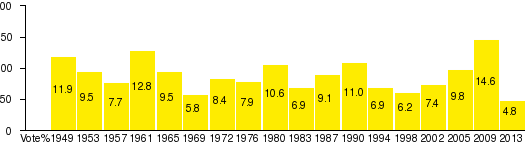
Last Sunday’s election results were an unmitigated disaster for the FDP in Germany. Historically – and going back to 1949 – it was unprecedented. They have no seats in the Bundestag for the first time. Sharing power in government has not helped them.

(All charts from Wikipedia)

FDP seats won

FDP vote percentage

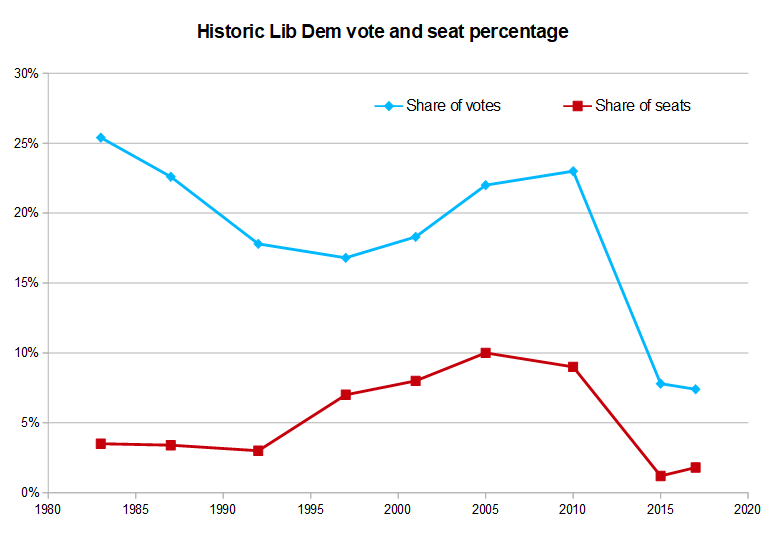
There is a parallel to be drawn with the UK though the German proportional representation system has generally been kinder to the FDP than the UK “first past the post” system has been to the Liberal Democrats. But when times are bad the PR system of Germany is also more ruthless. The FDP dropped from an all- time high of 14.6% of the vote in 2009 to 4.8% last Sunday. The Lib-Dems were at 23% in 2010 and are currently at 10%.

File:LibDem vote-seat percent.PNG

Votes and seats won by the Lib-Dems

Today’s modern Lib-Dem party is not quite the Liberal party of old. In my youth I read about the great days of the Liberal party of Gladstone and Lloyd George (and even the young Winston Churchill). I thought quite highly of Jo Grimond and David Steele. But the merger of the Liberals – proposed by David Steele – with the break-away Social Democrats  from the right of the Labour party in 1988 has created a strange animal which has no true identity of its own. Like the ancient chimera with the head of a lion, the body of a goat and the tail of a snake the Lib-Dems today try to combine mutually repellent ideologies and produce rather confused, fascistic do-gooders. With figures like Nick Clegg, Chris Huhne (now disgraced), Vince Cable and Ed Davey in their ranks they are enjoying their moment in the sun but are suffering from the twin fantasies that the tail wags the dog and that they know best what is good for others.

That their time in government supporting the Tories will be to their electoral detriment in the next general election seems very likely. Whether they will be wiped out like the FDP is unlikely in the British system but a comprehensive collapse is not inconceivable. Like the FDP which participated in a government dominated by Angela Merkel, the Lib-Dems are propping up but are totally dominated by Cameron’s conservatives.

Like the FDP, the Lib-Dems now run the risk of forcing their normally middle-of-the-road base towards the left or the right.  Like in the FDP, their traditional supporters in academia and the education system and the welfare services are going to move leftwards as the Lib-Dems give in to the Tories (with student tuition fees for example and for Helath Service cuts). The Lib-Dems have been the “green” face of this government but Cameron has been quite adept at using them for cover (as Angela Merkel has also done with the FDP). The disastrous cost of the renewable energy policies in Germany and the UK are seen as being more the fault of the Greens/FDP in Germany and of the Lib-Dems in Britain. Their ususal support among the environmental “do-gooders” is likely to shift leftwards for the moderates and greenwards for the more extreme. The traditional support from small shop keepers and small businesses is likely to shift rightwards.  The NSA scandal has hit the civil liberties image of the FDP as being a colluding party within the ruling government and so also for the Lib-Dems.  The support of The Guardian for the Lib-Dems can be compared to that of Die Zeit and Der Tagesspiegel for the FDP.

The general election in the UK is due in May 2015 (Scotland independence referendum intervening in 2014) and this gives the Lib-Dems 18 months to demonstrate that they have an agenda of their own. But this requires them to repudiate much of what they have agreed to while in government and will lead to a level of schizophrenia.

My guess is that the Lib-Dems will be reduced to less than the 10% they are currently polling at (from the 23% they had in the 2010 election). Philipp Rösler has just resigned as the FDP chairman. Nick Clegg will need to do the same in 2015 – though one could argue that the Lib-Dems might do better if they got rid of him before the election. They could do with a leader who is not as light-weight as Clegg or tainted as being Cameron’s poodle (but who?).

They will probably slip behind UKIP who are also at about the same 10% level but seem to be imploding. 2015 then will be a straight Tory-Labour fight. Neither Cameron or Milliband are particularly impressive as leaders. And so it will be a battle to see who is better at losing. And Milliband may be the more prone to losing an election.

Keeping score in the great Syria chess game

September 24, 2013

It is not possible to say who won or who lost. The Great “Game” will take a long time to reach a conclusion. All that can be done is to see who’s winning and who’s losing.

David Cameron is losing and may have lost. He took a slap in the face from the House of Commons. If he had managed the vote in his favour, the US strike on Syria would have taken place almost immediately. Whether the strike would have achieved much will never be known but Obama would have “walked” his “talk”. Milliband seemed to be winning since he had defeated Cameron but it is becoming clear that he had played his trump far too soon and allowed Putin to make his play. And Milliband can be credited for letting down the US and the special relationship. Tony Blair lost. He showed up as a “rabid dog” revelling in going to war (to try and justify his bad judgements during the Iraq war). And nobody took him very seriously.

Barack Obama is losing. He has confirmed his reputation as a ditherer and that he is risk-averse to the point of being  seen as being ruled by his fears. He has effectively shifted the balance of power in going to war from the Presidency towards Congress. This power given up will be difficult to regain. Without the backing of the UK he was forced to look for ways to extricate himself from his “red line” box.

John Kerry was point-man for Obama and was – for a time – the potential scape-goat. But he has repositioned himself and may even take away some credit for the Russian play. His throw-away line about “no strike if Syria gave up their chemical weapons” is now being spun as an intentional statement.

Francois Hollande is losing. His support for Obama was not enough to allow the US to carry out a strike on Syria. The value of French support – compared to the UK support which was not forthcoming – was diminished. And then to make matters worse his Parliamentarians made it quite clear that they did not support his position even though they were not required to vote. Having supported a strike he was not quite adroit enough to claim any credit for the alternate diplomatic path that resulted. Getting Freedom Fries reverting to be French Fries was his only consolation.

Vladimir Putin and Sergei Lavrov are winning. The diplomatic path is now their creation. Suddenly Russia is the peace-maker in the face of US war-mongering! Not only was the US strike on their ally delayed indefinitely, it is now Assad’s Syria – and not the various opposition groups – which is required to engage with the international community. Any opposition forces who seem to be coming in the way of inspecting or securing control of the chemical weapons can now be attacked by Assad with the full support of the international community. Russia can continue supplying Syria with conventional weapons.

The Syrian Opposition groups (including Al Qaida) are losing the civil war. Assad can now get more weapons replacements than they can. Al Qaida need a weakened Assad to create a winning position and they need a prolonged civil war to achieve dominance among the opposition groups. Both objectives would have been assisted by a US strike.

Bashar al-Assad is winning. He does not really need chemical weapons which cannot effectively be used anyway. Any US strike on his forces is postponed indefinitely. With no prospect of any no-fly zone being declared his air-force could be decisive in the civil war. The supply of conventional weapons from Russia is assured. His claim that rebels and terrorists were responsible for the use of Sarin is backed up by Russia and the UN weapons inspectors have no option but to investigate this (and they are on their way back to Syria).

Iran is winning. President Hassan Rohani is on a roll. First Hizbollah – at Iran’s bidding – helped to keep the Syrian opposition groups at bay when they seemed to be gaining ground. Then he supported the Russian diplomatic initiative. That was followed by an interview  on NBC  and an op-ed in the Washington Post to assure the US and the world that Iran had no intention of developing WMD of any kind including nuclear weapons. Iran’s foreign minister, Mohammad Javad Zarif, sent Rosh Hashanah greetings to Jews worldwide via Twitter and caught the Israelis off-guard. Now Rohani is on his way to address the UN General Assembly. Willy-nilly they are now a part of the diplomatic path for Syria and cannot just be ignored. That engagement allows the Iranian charm offensive to proceed as well on other fronts.

Israel is both winning and losing. It was Israeli intelligence intercepts – not US  – which led to Obama’s threatened strike. A strike by the US was definitely preferred by the Israelis though their objective was to maximise turbulence for as long as possible in Syria.  To be able to get the US to threaten a strike as they wished based on selective intelligence was a coup. Not to have the strike consummated was a setback. If the Iran/Russia influence grows and Assad is more secure than before, then these are also setbacks.

Turkey is losing. The Islamic government was perhaps the strongest supporter of a strike on Assad. Their dislike of Assad is so strong that they would even have supported a strike by Israel. But Turkey’s subservience to and support for all groups Islamic ( Muslim Brotherhood in Egypt) is now becoming an embarrassment for Europe. Their application to join the EU is – I think – already lost.

The Great Game has a long way to run. It has been running for a thousand years and there are many more twists and turns to come. Many pieces will be lost and won by all the parties and there may never be a check-mate and a clear winner in this game. Having a clear winner always requires having a clear loser. Having a clear loser in the Middle East is not always a good thing.

And so a stalemate is probably the closest there is to a win-win.

Angela Merkel triumphs – could even govern without the FDP?

September 22, 2013

Angela Merkel’s CDU/CSU have made a very strong showing at over 42% and the exit polls are predicting that both the FDP and AfD (Alternative for Germany) will both miss the 5% threshhold and get no seats. But the FDP and the Greens are the big losers and the AfD are sending a clear anti-European message even if they get no seats.

Angela Merkel is only 2 or 3 seats away from having her own majority without any coalition partners.

The SPD are around 26% and the Greens are down to 8%.

This could give the CDU/CSU around 298 seats in the Bundestag. With the SPD at around 185 seats and the Greens at about 57 seats it is even conceivable that Angela Merkel could govern without any coalition partner dragging her down. It is highly unlikely that the SPD/Greens would call upon the 59 or so seats of the Far Left.

The tactical voting to help the FDP that I was half-expecting does not seem to have taken place.

The Greens will have little leverage.

The way is now clear for a slow reversal of the disastrous nuclear policy pushed by the Greens though Angela Merkel will have to be very dainty on her feet to make this U-turn.