Archive for the ‘Science’ Category

S. Korea acts to recover from Hwang Woo-suk stem-cell debacle

September 19, 2011

Hwang Woo-suk “is a South Korean veterinarian and researcher. He was a professor of theriogenology and biotechnology at Seoul National University (dismissed on March 20, 2006) who became infamous for fabricating a series of experiments, which appeared in high-profile journals, in the field of stem cell research. Until November 2005, he was considered one of the pioneering experts in the field, best known for two articles published in the journal Science in 2004 and 2005 where he reported to have succeeded in creating human embryonic stem cells by cloning”.

Now the S. Korean government has introduced new regulations and is pumping more money into stem-cell research in an effort to rebuild the pre-eminent position that the country once had. The potential  for financial benefits for the technology leaders in  stem-cell based medical treatment is enormous and the government is responding to pressure from the country’s health care industry. The government sees potential for revenues for the country from stem-cell based treatments equalling or surpassing even that from its IT industry.

FCB-Pharmicell is a leading Korean company trying to use stem-cell based techniques for medical treatments and in July their Hearticellgram-AMI treatment was approved by the Korean Food and Drug Administration for the clinical treatment of heart-attack victims.

InvestorStemCell: More than five years after South Korea’s scientific reputation was shattered by a cloning research scandal, the country has approved stem cell medication in the form of a treatment for heart attack victims for the world’s first clinical use. …. Unlike embryonic stem cells, the use of somatic — or adult — stem cells, as in this case, is not controversial as they are derived from adult tissue samples and not destroyed human embryos. ….

Countries such as the United States and Germany are using this radical form of treatment in a ‘research’ capacity. What puts the South Korean team ahead is that it has shown the treatment as being good enough to win regulatory approval and make it available for clinical use.

…. After six years of clinical trials, the KFDA said it had finalized all procedures needed to permit the sale of Hearticellgram-AMI, a stem cell therapy for acute myocardial infarction, commonly known as heart attack.

Now the government is taking regulatory action to strengthen the oversight provisions but also to simplify licencing. The objective is to try and regain the reputation and credibility of the S. Korean researchers and the companies poised to commercialise the new techniques:

Reuters: South Korea’s president vowed on Monday a series of regulatory reforms to help regain its place as a stem cell research powerhouse, trying to reclaim momentum five years after a cloning scandal. President Lee Myung-bak said that by breathing new life into the industry, it could become “core new growth engine” for Asia’s fourth biggest economy along the same lines as its lucrative IT sector.

“Just a decade ago, Korea took the lead in stem cell research in the world along with the United States,” Lee said in a bi-weekly radio address. “Unfortunately, there was a disappointing incident, which caused inevitable damage to the entire stem-cell research community in Korea,” Lee said, referring to the scandal involving the pre-eminent scientist, Hwang Woo-suk. … As a result of the scandal, South Korea all but put stem cell research into the deep freeze. Lee said the lapse had allowed other countries such as the United States, Japan, Britain and China to get the jump on South Korea, depriving the country of valuable revenue. “While we were faltering in our quest for stem cell research, other nations streamlined their regulations and aggressively expanded their investments in research,” he said.

Lee said the government would invest nearly 100 billion won ($90 million) in stem cell research next year and that it would reform related regulations to make clinical and licensing procedures easier. He said the reforms would help the Korea Food and Drug Administration (KFDA) and other agencies “to ensure that they proactively adapt to the changes in the international environment”. 

“The government has decided to foster the stem cell industry as a core new growth engine following the footsteps of the IT industry,” he said.


On biodiversity and conservation and the number of frog species

September 17, 2011

One of the politically correct and alarmist themes that pervades the conservation movement is that biodiversity is vital and is dangerously threatened. Generally biodiversity can be considered to include

  1. gene diversity within a particular species, and
  2. species diversity within some particular region
Sometimes having different ecosystems and environments within a particular region is also included as being a form of ecological biodiversity. Yet it has always been inexplicable to me as to why human intervention for the protection of a species which has been out-competed by other species is not considered unnatural and artificial. Extinction of species happens naturally as a consequence of natural selection and evolution as some species succeed and others fail. If species did not fail and become extinct there would be diminishing space for evolution of other species. More species are thought to have become extinct than are in existence today.
I find that there is a fundamental conflict between allowing evolution to happen naturally with successful species (and that includes humans) eliminating unsuccessful species and the conservationist view of interfering with this normal development in favour of artificially maintaining failed species.
Conservationism at heart is a conservative (with a small “c”) and backward looking philosophy trying to prevent development and evolution because of fear. I suppose that is why I find “conservationsim” unattractive – because it is based on fear subordinating actions and that – by definition – is cowardice. King Canute trying to hold back the tide!
As I have posted earlier: The problem is not only that we have not identified all the eukaryote species in existence (and about 1.3 million have been classified and named) but we have no idea whether the number in existence is to be measured in millions or in hundreds of millions. About 15,000 new species are identified and catalogued each year. If  Bacteria and Archaea are added to eukaryotes, the total number of species could be in the billions.
Vub night frog
And with so many species around why should humans interfere to protect some but not others. In fact some species are considered interlopers in some regions and then conservation is all about exterminating these.
We do not know how many frog species exist and new species are being “discovered” continuously. Species thought to have become extinct are rediscovered. Of course a “discovery” of a species has nothing to say about how long that species has been in existence. And the importance of any particular species to the future of humans and the environment humans survive and thrive in is an unknown unknown.
Wired  – which is a very politically correct on-line journal – reports that 12 New and 3 Lost Night-Frog Species Discovered in India. Researchers in India have found a dozen new frog species belonging to the night frog group, named for their nocturnal habits, and rediscovered three species, one of which had not been seen in nearly a century. The findings appeared in the journal Zootaxa on Sept. 15. …… half of the newly discovered species reproduce without any physical contact between the sexes, with the female depositing her eggs on a leaf and the males later fertilizing them.
All the frogs were spotted in a region known as the Western Ghats, a mountain range than runs along the western coast of India that has been identified as one of the ten hottest biodiversity hotspots in the world. Because of the small area they occupy, at least six of the new species are sensitive to habitat loss and will require immediate steps toward conservation.
I find the conclusion that “the new species are sensitive to habitat loss and will require immediate steps toward conservation”  illogical and inexplicable.
Why interfere?
Just the number of articles about frogs in Wired in recent times further deepens the mystery. It only demonstrates all we don’t know that we don’t know. Even if out of fear of what is to come, humans were to try and intervene and protect every discovered species, the intervention would still fail and would not return us to the time of the dinosaurs.

Conservationism – as an ism – has no clear purpose that I can see.

Diamonds from the deep: Carbon cycle extends down to earth’s lower mantle

September 16, 2011
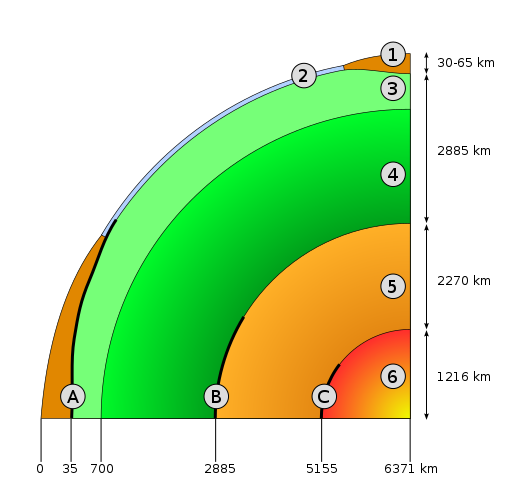
S-waves do not pass through the Earth's core, ...

Image via Wikipedia

What we know about the layers forming the interior of the earth are mostly inferred from mapping the propagation and refraction of earthquake waves. The earth’s lower mantle starts some 700km down and extends to a depth of about 2900km. The upper and lower mantle demonstrate – in fluid dynamic terms – a viscous chaotic flow but the mechanisms by which material is exchanged between the upper and lower mantle are not fully understood.

Science Daily: Michael Walter of the University of Bristol and colleagues in Brazil and the United States analyzed a set of “superdeep” diamonds from the Juina kimberlite field in Brazil. Most diamonds excavated at Earth’s surface originated at depths of less than 200 kilometers. Some parts of the world, however, have produced rare, superdeep diamonds, containing tiny inclusions of other material whose chemistry indicates that the diamonds formed at far greater depths

M. J. Walter, S. C. Kohn, D. Araujo, G. P. Bulanova, C. B. Smith, E. Gaillou, J. Wang, A. Steele, S. B. Shirey. Deep Mantle Cycling of Oceanic Crust: Evidence from Diamonds and their Mineral Inclusions. Science, 2011; DOI: 10.1126/science.1209300

ABSTRACT

A primary consequence of plate tectonics is that basaltic oceanic crust subducts with lithospheric slabs into the mantle. Seismological studies extend this process to the lower mantle, and geochemical observations indicate return of oceanic crust to the upper mantle in plumes. There has been no direct petrologic evidence, however, of the return of subducted oceanic crustal components from the lower mantle. We analyzed superdeep diamonds from Juina-5 kimberlite, Brazil, which host inclusions with compositions comprising the entire phase assemblage expected to crystallize from basalt under lower mantle conditions. The inclusion mineralogies require exhumation from the lower to upper mantle. Because the diamond hosts have carbon isotope signatures consistent with surface-derived carbon, we conclude that the deep carbon cycle extends into the lower mantle.

“This study shows the extent of Earth’s carbon cycle on the scale of the entire planet, connecting the chemical and biological processes that occur on the surface and in the oceans to the far depths of Earth’s interior,” according to Nick Wigginton, associate editor at Science.

The carbon cycle generally refers to the movement of carbon through the atmosphere, oceans, and the crust. Previous observations suggested that the carbon cycle may even extend to the upper mantle, which extends roughly 400 kilometers into Earth. In this region, plates of ocean crust — bearing a carbon-rich sediment layer — sink beneath other tectonic plates and mix with the molten rock of the mantle.

Seismological and geochemical studies have suggested that oceanic crust can sink all the way to the lower mantle, more than 660 kilometers down. But actual rock samples with this history have been hard to come by

File:Slice earth.svg

Schematic view of the interior of Earth. 1. continental crust - 2. oceanic crust - 3. upper mantle - 4. lower mantle - 5. outer core - 6. inner core - A: Mohorovičić discontinuity - B: Gutenberg Discontinuity - C: Lehmann discontinuity: image Wikipedia

PhysOrg: The diamonds were analyzed for carbon at Carnegie. Four of the diamonds contained low amounts of carbon-13, a signature not found in the lower mantle and consistent with an ocean-crust origin at Earth’s surface. “The carbon identified in other super-deep, lower mantle diamonds is chiefly mantle-like in composition,” remarked co-author Steven Shirey  at Carnegie. “We looked at the variations in the isotopes of the carbon atoms in the diamonds. Carbon originating in a rock called basalt, which forms from lava at the surface, is often different from that which originates in the mantle, in containing relatively less carbon-13. These super-deep diamonds contained much less carbon-13, which is most consistent with an origin in the organic component found in altered oceanic crust.

Tilburg University on terms of reference for Diederik Stapel misconduct inquiry

September 15, 2011

Following the suspension (pending dismissal) of Diederik Stapel for faking data, Tilburg University has published the terms of reference of the Levelt investigation committee and which is to report latest by the end of October.

Universiteit van Tilburg

Rector Magnificus of Tilburg University Prof. P. Eijlander has asked the Levelt Committee to investigate the extent and nature of the breach of scientific integrity committed by mr. Stapel. There are two elements to the task:

  1. The committee will examine which publications are based on fictitious data or fictitious scientific studies and during which period the misconduct took place.
  2. The committee should form a view on the methods and the research culture that facilitated this breach of scientific integrity, and make recommendations on how to prevent any recurrence of this.

The committee will publish its (interim) report by the end of October at the latest. The universities of Groningen and Amsterdam have both appointed staff members responsible for communication with the inquiry. 

Members committee
Prof.dr. W.J.M. Levelt, Prof.mr. M.S. Groenhuijsen, Prof.dr. J.A.P. Hagenaars,

Dr.ir. S.A.M. Baert (secretary)

Prof. Levelt is a psycho-linguist and former president of the Royal Netherlands Academy of Arts and Sciences while Prof. Groenhuijsen and Prof. Hagenaars are from Tilburg’s Law School.

Stapel has agreed to cooperate fully with the investigation and to help identify every instance of data fabrication. There are likely to be a number of retractions to come from among his published papers. It would though be a good sign if the Journals involved were to be pro-active in identifying these rather than starting their processes only after the investigation was complete. Some of the journals involved could be ScienceEuropean Journal of Social Psychology, Journal of Personality and Social Psychology and Journal of Experimental Social Psychology.

Misuse of peer review by UK Research Councils leads to mediocrity

September 14, 2011

The 7 UK Research Councils are publicly-funded agencies responsible for the funding of most research in the UK. They have often been criticised for being much too “establishment” driven such that any line of research considered heretical is strangled of any funding. Donald W. Braben is honorary professor in the department of earth sciences, University College London and known for his support for academic freedom and “blue-skies” research. In an article in The Times Higher Education Supplement,  he comes down hard against the research councils and their use of “peer review”. He argues that they inherently discourage  any “pioneering” research and drive towards mediocrity.

Until about 1970, academic researchers were usually given modest funds to use as they pleased. This apparent profligacy led to a prodigious harvest of unpredicted discoveries and huge stimulants to economic growth. ……. 

It is said that peer review is like democracy: it’s not the best but it’s the best we know. But science is not democratic. One doubtful scientist can be right while 100 convinced colleagues can be wrong. Indeed, the physicist Richard Feynman once defined science as “the belief in the ignorance of experts”. Specifically, peer review of grant applications, or peer “preview”, is inimical to radically new ideas. Today, however, the all-powerful peer-preview bureaucracy is the determinant of excellence. It is taboo even to criticise it. So the natural inclination to oppose major challenges to the status quo has become institutionalised. For radical research, one can argue that “the best we know” has become the worst. 

“Independent expert peer review” is contradictory. One submits a proposal and the councils ask experts to assess it. But these experts are likely to include proposers’ closest competitors, even if they are selected internationally, because science is global – and real pioneers have no peers, of course. How then can the councils ensure that reviews are independent? To make matters worse, these experts can pass judgement anonymously: applicants don’t know who put the boot in.

I suggest that the misuse of peer review is at the heart of the research councils’ problems. Before about 1970, they largely restricted its use to the assessment of applications for large grants or expensive equipment. Scientific leaders protected the seed corn, ensuring that young scientists could launch radical challenges if they were sufficiently inspired, dedicated and determined. Today, the experts whose ignorance they would challenge might also influence their chances of funding. ………

….. The research councils are taking UK research down pathways to mediocrity and using peer review as justification. We – the academic community – must stop them, or accept the dire consequences.

Read the whole article

Political goals distort the science done by the US National Parks Service

September 13, 2011

This is not the first time of course that slanted and pre-determined conclusions to suit a political agenda are drawn from supposedly “rigorously peer-reviewed research”. Peer-review carried out correctly is no doubt very effective but it also always discourages the non-establishment view. And if the establishment has a preconceived “belief”, then any views dissenting from that orthodoxy are easy to suppress.

ABC reports:

There are new allegations of scientific misconduct being directed at the National Park Service. A park service study claims an oyster farm in the Point Reyes National Seashore is harming wildlife, but there are disturbing new questions about the science behind that study. 

The Drakes Bay Oyster Company has been at Point Reyes since the 1930s, but the National Park Service says it must close in 2012 in order to return it back to wilderness. The park service released a study in April claiming to have evidence the oyster farm is a threat to harbor seals, driving them out of their home in Drakes Estero. However, an independent analysis by outside experts shows that evidence is slanted to make the oyster farm look bad.

Addendum (21st September 2011)

It seems (not yet confirmed) that the paper in question is Modeling the effects of El Nino, density-dependence,and disturbance on harbor seal (Phoca vitulina) counts in Drakes Estero, California: 1997–2007 by Becker, Press and Allen,
MARINE MAMMAL SCIENCE, 25(1): 1–18 ( January 2009), Society for Marine Mammalogy, DOI: 10.1111/j.1748-7692.2008.00234.x

I think the problematic paragraph could be this one in the Results section
Disturbance rates in the upper estero (subsites OB, UEF, UEN) significantly
increased with oyster harvest (rs = 0.55, P < 0.03) (Fig. 2B). This correlation
is highly robust to sample size. For example, there was still a significant positive
correlation (rs = 0.53, P < 0.04) of disturbance rate with oyster harvest even
when removing the 2006 disturbance, four of the 2007 disturbances (including two
disturbances on 1 day in 2007 that the mariculture company challenged), and four of
the 1996 disturbances (nine total) from the analysis. Similarly, oyster harvest levels
in years with oyster related disturbances were significantly higher (U = 43, n =
13, P1−tail < 0.04). 

The independent study itself seems to have been done by heavyweights in the world of science led by Corey S Goodman:

“This is a published paper, it’s publicly available, it’s been supported by taxpayer dollars, it’s done by government scientists,” said biologist Corey Goodman, Ph.D. Goodman is a member of the National Academy of Sciences and he has published more than 200 scientific papers. He was asked by a Marin County supervisor in 2007 to look into how the park was conducting scientific research and he’s been pouring over data ever since. ……. 

It took the National Park Service three months to hand over their data to Goodman. When he finally got it, he shared it with statisticians at Stanford and U.C. Davis to see if they could replicate the results. “And what I find is that none of the conclusions in the paper are valid,” said Goodman. ……That’s why Goodman is charging the park service with distorting science to fit their ultimate goal of closing the oyster farm. 

Further details of Dr. Goodman’s charges of scientific misconduct are here.

The author of the Parks Service paper seems to have gone into hiding and the Parks Service is in a defensive mode.

ABC7 wanted to hear from the park service scientist who wrote the study, Dr. Ben Becker, director of the Pacific Coast Science and Learning Center at Point Reyes National Seashore. We asked the park service for an interview, left messages for Becker, and sent emails, but never heard back. We even went to his house to get answers, but Becker refused to answer our questions.

Park service spokesman Melanie Gunn told us in an email that Becker’s paper “went through a rigorous peer review process.”

But merely invoking peer-review -which is notoriously patchy in its quality – and which often ends up as being “pal-review” is unlikely to be enough in this case.

Goodman’s concerns were still enough to raise the interest of Sen. Dianne Feinstein, D-California. The senator has asked the Marine Mammal Commission to do an independent review of the park service study and now she wants the park service to delay its environmental impact statement on the oyster farm until after that review. She sent a letter to Interior Secretary Ken Salazar.

In it the letter, Feinstein says: “I fear that if the Department of Interior does not stand behind the independent analysis, it will be another example of a lack of credibility at Point Reyes National Seashore.”

The park service says it is cooperating with the review but still plans to release its report this month, adding that “Dr. Becker continues to work with the Marine Mammal Commission on any remaining questions the Commission may have.”

Related: Peer review and the corruption of science

The Heidelberg affidavit: German Universities take action to prevent PhD fraud

September 12, 2011

I have long felt that the work of researchers and scientists cannot and should not be devoid of liability (whether criminal or civil liability) in cases of scientific misconduct or fraud. Recently two University of Toronto law professors argued that medical ghostwriting where medical or pharmaceutical companies finance the writing of favourable, peer-reviewed,  scientific articles should be considered fraud and liable as such.

Now after the retraction of a splurge of PhD’s awarded to German politicians, the academic community is acting to protect the reputation and the value of their PhD’s. Heidelberg University and Bonn University – among others – are tightening their regulations. The NY Times  reports:

The plagiarism scandals that rocked the political world in Germany this year have led to a period of soul-searching among academics and researchers around the country. They have also prompted calls for stricter controls at German universities. …. After several cases in which doctoral theses were described as using unattributed material from earlier works — the most prominent of which pushed Karl-Theodor zu Guttenberg to resign as defense minister — German universities have questioned the way doctoral candidates are tested. Some academics insist that the system is generally sound, pointing out that in the half-dozen high-profile cases where plagiarism was found, the doctoral degree was ultimately retracted.

… the University of Bonn, which in July retracted the doctoral title of Jorgo Chatzimarkakis, a member of the European Parliament, the university will publish extensive and explicit guidelines so that doctoral students know exactly what is expected.

Heidelberg University, which in June formally retracted the doctorate of Silvana Koch-Mehrin, a member of the European Parliament, announced in August that it would begin demanding that doctoral students sign a legally binding affidavit, attesting original authorship. Signing a false statement on such an affidavit can prompt legal action in the local courts, which can lead to a fine and even to a prison sentence of up to three years under the German penal code.

Professor Thomas Pfeiffer, speaking for the university, said the threat of possible legal action, in addition to the embarrassment of a retracted doctorate, would act as a further deterrent.

Faculties at the University of Bonn, Heidelberg University and the University of Bayreuth have all retracted doctorates after internal commissions determined that students-turned-politicians had plagiarized. They are demanding that all doctoral theses be submitted as an electronic copy, to help spot-checking with plagiarism-detection software, a step considered just as important as a deterrent for would-be plagiarists as it is a detection mechanism.

Read the whole article

The Heidelberg affidavit seems a relatively simple and effective way to go. It is pre-emptive and should act as a deterrent without being oppressive. Of course one would wish scientific research to be carried out in an open atmosphere which is not clouded by suspicion. But since the rewards of scientific misconduct – whether as academic or political advancement or in monetary gain – can be very high, suspicion and rivalry will remain unless a system of liability is introduced. This would not only create accountability but would also encourage the taking of responsibility for one’s own work. In fact, if scientists and researchers automatically bear a certain liability for the integrity (not the quality) of their work, then an open atmosphere could actually be promoted.

I see no reason why an extension of the “Heidelberg affidavit” could not be applied to all research workers regarding the integrity of their work and be an integral part of any employment contract.

Chang’e 2 is now “liberated” from earth and lunar gravity

September 11, 2011

China’s lunar probe Chang’e 2 completed its mission orbiting the moon three months ago and has now reached Lagrange (liberation) Point L2.

It has now reached a point in space where neither the moon nor the earth’s gravity will affect the probe. This point is called L2. It’s the farthest a Chinese spacecraft has ever been.

Chang’e 2’s primary mission was to orbit the moon at only 100 kilometers from the surface, taking high resolution photos. After completing this, scientists decided that there was enough fuel to continue with the second part of the mission. But sending the probe from the moon was unprecedented. Similar missions has previously left directly from Earth, so keeping the satellite on course was a technological challenge.

Zhou Jianliang, Deputy Chief Designer, Measure & Control System of Chang’e 2, said, “The satellite faced various disruptions on its journey, which could have led it off course. We had planned four readjustments to keep it on track. But we only need(ed) to do it once since the first adjustment proved so accurate.”

China’s ambitious three-stage moon mission is steadily advancing. The next phase will be the launch of Chang’e-3 in 2013. The probe’s mission is to land on the moon together with a moon rover. In the third phase, the rover should land on the moon and return to Earth with lunar soil and stones for scientists to study. The Chang’e program was named after the legendary Chinese goddess who flew to the moon. With the progress in technology and experience from the Chang’e mission, sending a Chinese astronaut to the moon is now clearly feasible.

On Lagrange Points:

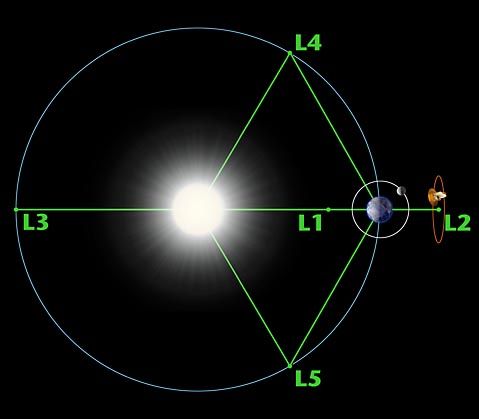
The Italian-French mathematician Joseph-Louis Lagrange discovered five special points in the vicinity of two orbiting masses where a third, smaller mass can orbit at a fixed distance from the larger masses. More precisely, the Lagrange Points mark positions where the gravitational pull of the two large masses precisely equals the centripetal force required to rotate with them. Those with a mathematical flair can follow this link to a derivation of Lagrange’s result (168K PDF file, 8 pages).

Of the five Lagrange points, three are unstable and two are stable. The unstable Lagrange points – labeled L1, L2 and L3 – lie along the line connecting the two large masses. The stable Lagrange points – labeled L4 and L5 – form the apex of two equilateral triangles that have the large masses at their vertices.

Lagrange Points

Lagrange Points of the Earth-Sun system (not drawn to scale!): NASA

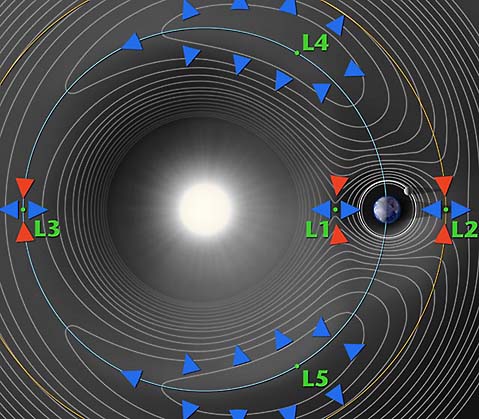
 The easiest way to see how Lagrange made his discovery is to adopt a frame of reference that rotates with the system. The forces exerted on a body at rest in this frame can be derived from an effective potential in much the same way that wind speeds can be inferred from a weather map. The forces are strongest when the contours of the effective potential are closest together and weakest when the contours are far apart. In the contour plot below we see that L4 and L5 correspond to hilltops and L1, L2 and L3 correspond to saddles (i.e. points where the potential is curving up in one direction and down in the other).

Effective Potential

A contour plot of the effective potential (not drawn to scale!): NASA

Significance of differences of significance: Erroneous statistics in neuroscience

September 10, 2011

Experimental work where a difference between tests is observed must also be analysed statistically to show that the difference observed is significant. But when the significance of difference observed in one group of tests is compared to that observed in another group, then the significance of the difference of the differences is often wrongly analysed according to a new paper in Nature Neuroscience.

The authors  analysed 513 behavioral, systems and cognitive neuroscience articles in five top-ranking journals (Science, Nature, Nature Neuroscience, Neuron and The Journal of Neuroscience). Of the 157 papers where this error could have been made 78 used the correct procedure and 79 used the incorrect procedure. Suspecting that the problem could be more widespread they “reviewed an additional 120 cellular and molecular neuroscience articles published in Nature Neuroscience in 2009 and 2010 (the first five Articles in each issue)”. They did not find a single study that used the correct statistical procedure to compare effect sizes. In contrast, they found at least 25 studies that used the erroneous procedure and explicitly or implicitly compared significance levels.

Erroneous analyses of interactions in neuroscience: a problem of significance by Sander Nieuwenhuis, Birte U Forstmann & Eric-Jan Wagenmakers, Nature Neuroscience 14, 1105–1107 (2011) doi:10.1038/nn.2886

(These) statements illustrate a statistical error that is common in the neuroscience literature. The researchers who made these statements wanted to claim that one effect (for example, the training effect on neuronal activity in mutant mice) was larger or smaller than the other effect (the training effect in control mice). To support this claim, they needed to report a statistically significant interaction (between amount of training and type of mice), but instead they reported that one effect was statistically significant, whereas the other effect was not. Although superficially compelling, the latter type of statistical reasoning is erroneous because the difference between significant and not significant need not itself be statistically significant.

Full paper is here: PDF Nieuwenhuis et al 

AbstractIn theory, a comparison of two experimental effects requires a statistical test on their difference. In practice, this comparison is often based on an incorrect procedure involving two separate tests in which researchers conclude that effects differ when one effect is significant (P < 0.05) but the other is not (P > 0.05). We reviewed 513 behavioral, systems and cognitive neuroscience articles in five top-ranking journals (Science, Nature, Nature Neuroscience, Neuron and The Journal of Neuroscience) and found that 78 used the correct procedure and 79 used the incorrect procedure. An additional analysis suggests that incorrect analyses of interactions are even more common in cellular and molecular neuroscience. We discuss scenarios in which the erroneous procedure is particularly beguiling.

The authors conclude

It is interesting that this statistical error occurs so often, even in journals of the highest standard. Space constraints and the need for simplicity may be the reasons why the error occurs in journals such as Nature and Science. Reporting interactions in an analysis of variance design may seem overly complex when one is writing for a general readership. Perhaps, in some cases, researchers choose to report the difference between significance levels because the corresponding interaction effect is not significant. Peer reviewers should help authors avoid such mistakes. … Indeed, people are generally tempted to attribute too much meaning to the difference between significant and not significant. For this reason, the use of confidence intervals may help prevent researchers from making this statistical error. Whatever the reasons for the error, its ubiquity and potential effect suggest that researchers and reviewers should be more aware that the difference between significant and not significant is not itself necessarily significant.


Remote Sensing: A case of editorial cowardice in the face of bullying from the orthodoxy

September 3, 2011

If this had been the middle ages there would have been witch-hunts and burnings at the stake (but of course it would then have been during the Medieval Warm Period).

Spencer and Bracewell had their paper On the Misdiagnosis of Climate Feedbacks from Variations in Earth’s Radiant Energy Balance published in the Journal Remote Sensing. The paper was refereed in the normal way and gained a lot of attention because it went against global warming orthodoxy. The global warming cabal were not amused and their blogs were full of objections to the paper. (This was all before the CERN CLOUD experiments).

The Editor-in-Chief of the Journal – a certain Wolfgang Wagner – obviously faced a lot of heat from the members of the global warming orthodoxy for publishing such heresy. He was clearly threatened by having the flow of scientific articles to his new journal throttled. But he could not retract the paper – not having any basis for doing so. Instead he has resigned in a blaze of publicity saying that the paper should not have been published!! Where peer review failed to find any fault with the paper, the editor has resorted to grandstanding to attack the paper.

It seems a simple case of the high priests of a religion threatening to excommunicate the poor little editor-in-chief of this new journal who has caved in on the basis of blog comments (and no doubt some irate telephone calls). A simple case of editorial cowardice.

The full story is detailed in these posts:

Editor-in-chief of Remote Sensing resigns over Spencer & Braswell paper

Critiques and responses 

Comment On The Resignation of Wolfgang Wagner