Archive for the ‘Science’ Category

New pictures show the return of Jupiter’s lost stripe

November 26, 2010

In May this year one of Jupiter’s characteristic stripes (the South Equatorial Belt) disappeared. Then  two weeks ago a turbulent plume was observed breaking through the giant planet’s cloudtops in the south equatorial zone heralding the possible re-emergence of the stripe.

Now the latest infrared pictures of Jupiter show the turbulent plume developing into a “trail” suggesting that the SEB is re-emerging from under the ammonia clouds. The BBC reports:

Jupiter's returning stripe highlighted (JPL, University of Oxford, UC Berkeley, Gemini Observatory, University of San Carlos)

Jupiter's returning stripe highlighted (JPL, University of Oxford, UC Berkeley, Gemini Observatory, University of San Carlos)

The South Equatorial Belt had blended into surrounding white clouds but an “outbreak” spotted by an amateur astronomer heralds the stripe’s return. The stripe’s disappearing act is due to clouds shifting altitudes, with white ammonia clouds obscuring clouds below. This performance will give astronomers their first chance to study the weather and chemistry behind the phenomenon.

As part of the show, the Great Red Spot has darkened, but astronomers say it will lighten again as the South Equatorial Belt comes back. The stripe has come and gone several times in recent decades but the mechanism by which it returns remains mysterious. The first signs of the return were spotted by Christopher Go of the Philippines and was confirmed by the Infrared Telescope Facility and Gemini and Keck telescopes in Hawaii.

“At infrared wavelengths, images in reflected sunlight show that the spot is a tremendously energetic ‘outburst,’ a vigorous storm that reaches extreme high altitudes,” said Imke de Pater, professor of astronomy at the University of California, Berkeley. “The storms are surrounded by darker areas, bluish-grey in the visible, indicative of ‘clearings’ in the cloud deck.”

Tasting Sour – Add a dash of protons

November 26, 2010
Schematic drawing of a taste bud

Taste bud: image via Wikipedia

Each taste bud on human or animal tongues contain around 50 receptor cells. Each of the receptor cells then reacts to one of the 5 primary tastessour and salty are detected with ion channels while sweet, bitter and umami (savoury) are detected by G protein coupled receptors. There is some debate as to whether there is a sixth primary taste that distinguishes fat content. At one time it was thought that different parts of the tongue responded to different tastes but it is now clear that all tastes are detected by all parts of the tongue.

New research has studied the mechanism by which sour is detected.

Rui B. Chang, Hang Waters, Emily R. Liman: A proton current drives action potentials in genetically identified sour taste cellsProceedings of the National Academy of Sciences, 2010; DOI:10.1073/pnas.1013664107

Science Daily has the story:

Neurobiology researchers at the University of Southern California have made a surprising discovery about how some cells respond to sour tastes.

Sour is the sensation evoked by substances that are acidic, such as lemons and pickles. The more acidic the substance, the more sour the taste. Acids release protons. How protons activate the taste system had not been understood. The USC team expected to find protons from acids binding to the outside of the cell and opening a pore in the membrane that would allow sodium to enter the cell. Sodium’s entry would send an electrical response to the brain, announcing the sensation that we perceive as sour.

Instead, the researchers found that the protons were entering the cell and causing the electrical response directly.

The finding is to be published in the Proceedings of the National Academy of Sciences (PNAS). “In order to understand how sour works, we need to understand how the cells that are responsive to sour detect the protons,” said senior author Emily Liman, associate professor of neurobiology in the USC College of Letters, Arts and Sciences.

“In the past, it’s been difficult to address this question because the taste buds on the tongue are heterogeneous. Among the 50 or so cells in each taste bud there are cells responding to each of the five tastes. But if we want to know how sour works, we need to measure activity specifically in the sour sensitive taste cells and determine what is special about them that allows them to respond to protons.”

Liman and her team bred genetically modified mice and marked their sour cells with a yellow florescent protein. Then they recorded the electrical responses from just those cells to protons. The ability to sense protons with a mechanism that does not rely on sodium has important implications for how different tastes interact, Liman speculates. “This mechanism is very appropriate for the taste system because we can eat something that has a lot of protons and not much sodium or other ions, and the taste system will still be able to detect sour,” she said. “It makes sense that nature would have built a taste cell like this, so as not to confuse salty with sour.”

US scientists more likely to publish fake research

November 16, 2010

A new on-line paper in the Journal of Medical Ethics has studied the PubMed database for all scientific research papers that had been retracted between 2000 and 2010.

Retractions in the scientific literature: do authors deliberately commit research fraud? by R Grant Steen J Med Ethics doi:10.1136/jme.2010.038125

Abstract

Background Papers retracted for fraud (data fabrication or data falsification) may represent a deliberate effort to deceive, a motivation fundamentally different from papers retracted for error. It is hypothesised that fraudulent authors target journals with a high impact factor (IF), have other fraudulent publications, diffuse responsibility across many co-authors, delay retracting fraudulent papers and publish from countries with a weak research infrastructure.

Methods All 788 English language research papers retracted from the PubMed database between 2000 and 2010 were evaluated. Data pertinent to each retracted paper were abstracted from the paper and the reasons for retraction were derived from the retraction notice and dichotomised as fraud or error. Data for each retracted article were entered in an Excel spreadsheet for analysis.

Results Journal IF was higher for fraudulent papers (p<0.001). Roughly 53% of fraudulent papers were written by a first author who had written other retracted papers (‘repeat offender’), whereas only 18% of erroneous papers were written by a repeat offender (χ=88.40; p<0.0001). Fraudulent papers had more authors (p<0.001) and were retracted more slowly than erroneous papers (p<0.005). Surprisingly, there was significantly more fraud than error among retracted papers from the USA (χ2=8.71; p<0.05) compared with the rest of the world.

Conclusions This study reports evidence consistent with the ‘deliberate fraud’ hypothesis. The results suggest that papers retracted because of data fabrication or falsification represent a calculated effort to deceive. It is inferred that such behaviour is neither naïve, feckless nor inadvertent.

PhysOrg summarises the paper:

The study author searched the PubMed database for every scientific research paper that had been withdrawn—and therefore officially expunged from the public record—between 2000 and 2010. A total of 788 papers had been retracted during this period. Around three quarters of these papers had been withdrawn because of a serious error (545); the rest of the retractions were attributed to fraud (data fabrication or falsification).

The highest number of retracted papers were written by US first authors (260), accounting for a third of the total. One in three of these was attributed to fraud.

The UK, India, Japan, and China each had more than 40 papers withdrawn during the decade. Asian nations, including South Korea, accounted for 30% of retractions. Of these, one in four was attributed to fraud.

The fakes were more likely to appear in leading publications with a high “impact factor.” This is a measure of how often research is cited in other peer reviewed journals. More than half (53%) of the faked research papers had been written by a first author who was a “repeat offender.” This was the case in only one in five (18%) of the erroneous papers.

The average number of authors on all retracted papers was three, but some had 10 or more. Faked research papers were significantly more likely to have multiple authors. Each first author who was a repeat fraudster had an average of six co-authors, each of whom had had another three retractions.

“The duplicity of some authors is cause for concern,” comments the author. Retraction is the strongest sanction that can be applied to published research, but currently, “[it] is a very blunt instrument used for offences both gravely serious and trivial.”

Paraguay suspends Natural History Museum’s “genocide” expedition

November 16, 2010
Very approximate location of the Gran Chaco (U...

Gran Chaco area: Image via Wikipedia

I posted a few days ago about the dangers of the Natural History Museum’s planned 60 – 100 strong “expedition” to the forests of Paraguay.

Today comes news that on Monday Paraguay suspended a British scientific expedition into the remote Chaco woodlands after indigenous rights groups raised concerns over the welfare of protected tribes in the region.

Sponsored by Britain’s Natural History Museum, the 45-member British-Paraguayan expedition planned to conduct a month-long survey of animal and plant life in the sprawling savanna 800 kilometers (500 miles) north of Asuncion, the ministry said in a statement.

The decision to suspend it followed “last minute” concerns raised by indigenous rights groups including Iniciativa Amotocodie, and recommendations by the Washington-based Inter-American Human Rights Commission, the environment ministry said.

“The massive presence of about 60 researchers in the land inhabited by the Ayoreo tribal groups in the remote, northern reaches of Chaco… poses significant risks to their lives and territory,” Amotocodie said in a statement.

The rights groups argued that since the tribes have had very little contact with the outside world they are at risk of contracting diseases that in some cases could prove fatal.

It would have been far better if the Natural History Museum had itself suspended the expedition and had taken the initiative to carry out the consultations which it is now forced to conduct.

Seattle pi:

Paraguay denied authorization Monday for a British-led scientific expedition to catalog plants and animals in the country’s remote northern corner, saying there isn’t enough time to consult with relatives of nomadic Indians who try to remain isolated as they pass through the area.

The non-governmental Amotocoide Initiative, an advocacy group for native Ayoreo Indians who live in the dry forests of northern Paraguay, had warned that scientists might carry European diseases to the Indians, leave trash or otherwise suffer violent encounters.

Isabel Basualdo, director of the biodiversity office of Paraguay’s environmental ministry, said in a statement that the decision follows the recommendation of the Interamerican Human Rights Commission that public hearings and all other legal requirements are complied with before such a visit.

Richard Lane, the British Natural History museum’s director of science, said the expedition had been suspended while consultations take place. “We believe that this expedition to scientifically record the richness and diversity of the animals and plants in this remote region is extremely important for the future management of this fragile habitat,” Lane said in a statement.

But some anthropologists who advocate for the Ayoreos say no outsiders should enter these dry forests, where small bands of people are still trying to live in isolation from the modern world. Irene Gauto, who represents the private environmental group Guyra Paraguay, told The Associated Press that the environment ministry “sent a letter to the British museum arguing that, for now, it’s better to delay the visit of the scientists because there hasn’t been time enough to hold public hearings with the relatives of the forest-dwelling Ayoreos,” one of 20 surviving indigenous groups living in Paraguay.

The trip was to begin Saturday to the Chovoreca and Cabrera-Timane hills near Paraguay’s border with Bolivia and Brazil, about 500 miles (800 kilometers) northeast of the capital. The scientists planned to catalog species on a private cattle ranch within a Paraguayan nature reserve. The ranch’s owners approved the trip and said indigenous people didn’t live there, Gauto said.

The government appeared ready to approve the trip. But the situation changed after a leader of the Totobiegosode subgroup of Ayoreos, Chiri Etacori, said about two dozen nomadic Ayoreos wander through the area.

Jupiter’s lost stripe may be returning

November 16, 2010

In May this year, one of Jupiter’s characteristic stripes – the South Equatorial Belt (SEB) disappeared.

http://science.nasa.gov/science-news/science-at-nasa/2010/20may_loststripe/

May 20, 2010: In a development that has transformed the appearance of the solar system’s largest planet, one of Jupiter’s two main cloud belts has completely disappeared. Known as the South Equatorial Belt (SEB), the brown cloudy band is twice as wide as Earth and more than twenty times as long. The loss of such an enormous “stripe” can be seen with ease halfway across the solar system.

These side by side images of Jupiter taken by Australian astrophotographer Anthony Wesley show the SEB in August 2009, but not in May 2010.Individual images: Aug. 4, 2009; May 8, 2010.

Anthony Wesley is a veteran observer of Jupiter, famous for his discovery of a comet hitting the planet in 2009. Like many other astronomers, he noticed the belt fading late last year, “but I certainly didn’t expect to see it completely disappear,” he says. “Jupiter continues to surprise.” Planetary scientist Glenn Orton of NASA’s Jet Propulsion Lab thinks the belt is not actually gone, but may be just hiding underneath some higher clouds.

“It’s possible,” he hypothesizes, “that some ‘ammonia cirrus’ has formed on top of the SEB, hiding the SEB from view.” On Earth, white wispy cirrus clouds are made of ice crystals. On Jupiter, the same sort of clouds can form, but the crystals are made of ammonia (NH3) instead of water (H2O).

But now the SEB may be breaking through again.

http://www.spaceweather.com/

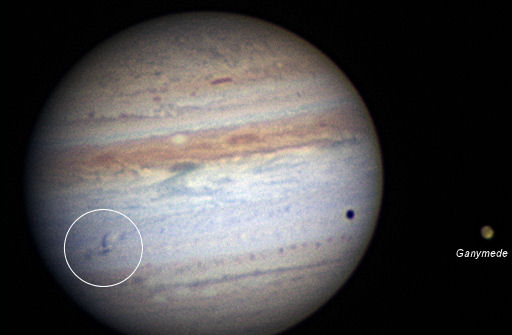
Tuesday, Nov. 16, 2010: A turbulent plume is breaking through the giant planet’s cloudtops in the south equatorial zone, heralding the emergence of … what? This Nov. 14th photo from astrophotographer Paul Haese of Glenalta, South Australia shows the plume.

The SEB revival is now underway. Tonight I captured the revival transiting the face of Jupiter. To boot I was lucky enough to include Ganymede with detail and Europa's shadow after a double transit. What a night. Taken with peltier cooled C14 and Skynyx 2-0: Paul Haese

The plume, circled in Haese’s photo and known to astronomers as the “SEB Revival Spot,” is a sign that Jupiter’s South Equatorial Belt (SEB) is about to return. The great brown belt disappeared earlier this year, leaving Jupiter without one of its signature stripes. No one knows where the SEB went, although some researchers have speculated that it sank beneath high altitude clouds and might now be bobbing back to the top.

Christopher Go of the Philippines first noticed the Revival Spot on Nov. 9th. At first it was small and white and required careful astrophotography to detect. Only five days later, it is expanding rapidly and darkening; soon, it could become visible to novices in the eyepieces of backyard telescopes.

Hayabusa particles are extra-terrestrial

November 16, 2010

The particles found in Hayabusa have now been confirmed to be extra-terrestrial from the asteroid 25143 Itokawa.

Nikkei News reports:

Capsule from the Hayabusa probe contained particles from the Itokawa asteroid (Kyodo)

The Japan Aerospace Exploration Agency said Tuesday it has confirmed that the particles retrieved from the Hayabusa unmanned space probe after its seven-year space trip are from the asteroid Itokawa.

JAXA says the roughly 1,500 particles it analyzed using electron microscopes are totally different from substances found on Earth. The particles measure only about 10 micrometers in diameter.

The Hayabusa probe is the first exploratory spacecraft to land on a celestial body other than the Moon and then return to Earth.

Water levels in the Murray-Darling basin are highest since 2001

November 14, 2010
Second version of a Murray catchment map

Murray Darling Basin: image via Wikipedia

After 10 years of drought, heavy rainfall has left the Murray-Darling Basin now so full of water that controlled spillages are having to be made to prevent levels becoming too high. The Sydney Morning Herald:

AFTER years of drought, there are dams and reservoirs across the Murray-Darling Basin where controlled spilling is taking place to keep levels within specified limits. The amount of water stored in the basin is close to 19,000 gigalitres, the highest level since November 2001. The Bureau of Meteorology water storage website, which monitors more than 25,000 gigalitres of storage, reports that basin storages are now more than 74 per cent full, compared to 29 per cent a year earlier.

Several reservoirs have reached capacity, including the Menindee Lakes, Burrendong Dam and Blowering Reservoir in NSW, and the Hume Dam on the NSW-Victoria border near Albury. A year ago the Hume Dam was at 39 per cent and the Blowering Reservoir at 36 per cent.

A spokeswoman for the Murray-Darling Basin Authority confirmed it had been forced to spill water from the Hume Dam and Lake Menindee to prevent the storages rising above specified levels. More rain is forecast for the Murray-Darling Basin tomorrow and on Monday, but the bureau’s deputy director for water, Robert Vertessy, said it was ”50/50” whether storages would break through the 75 per cent mark because a lot of the rain was expected to fall in areas that have no further capacity.

”What is spectacular is how much it has gone up in the last year,” Dr Vertessey said. In the long term it was very unlikely that basin storages would ever reach 100 per cent because rainfall patterns varied across the basin and some dams, such as the Dartmouth in north-eastern Victoria, had enormous capacity compared to the drainage area they serviced, Dr Vertessey said.

Replenished water storages mean that many farmers are now receiving their full general allocation of water. Trading of temporary water allocations has ground to a halt in many areas and the price of water in one exchange has fallen to $45 per megalitre, down from $200 a year ago and a peak of about $1200 in late 2007.

Meanwhile the Guide prepared by The Murray-Darling Basin Authority came under fire because the computer models used to prepare the Guide did not (or could not) account for some 20% of the water flows in the basin. The Guide has proposed drastic cuts in irrigation flows and this not at all popular with farmers. The Australian reports:

KEY assumptions about water flows in the Murray-Darling Basin guide are under challenge from newly released figures. It emerged that 20 per cent of basin water flows were not included in scientific models. The models were used to recommend cuts of up to 37 per cent in irrigators’ water entitlements.

In technical volumes published with the guide, the Murray-Darling Basin Authority said the complexity of hydrologic modelling made it difficult to consider a large range of scenarios on sustainable diversion limits in a timely way. Hydrologic models have been developed for all major rivers in the basin in conjunction with the states and the CSIRO. “Overall, about 80 per cent of current surface water use under current diversion limits in the basin is explicitly represented in the hydrologic modelling framework,” the guide says.

The National Farmers Federation seized on the concession, saying it would challenge key assumptions in the guide. NFF chief executive Ben Fargher said he would challenge how the plan had identified environmental assets for protection and the modelling for environmental water requirements. “They are saying because of the complexity of all the hydrological models it has been difficult for them to do the modelling, and so they’ve used analytical tools,” he said. “We are not confident in that. In our view it is not robust, not good enough and we are going to challenge it.” NSW Irrigators Council chief executive Andrew Gregson said the guide’s modelling “has holes in it” and the authority needed to be 100 per cent certain, given the enormous ramifications for the communities along the river.

Last night the authority defended the guide and Wentworth Group of Concerned Scientists chief executive Peter Cosier described the science behind it as “some of the best in the world”. The authority said the 20 per cent of water flows not represented in hydrologic models would not affect recommendations about water allocations or environmental flows.

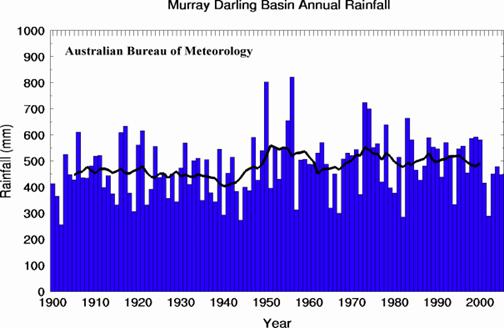
The 10 years of drought have often been attributed to climate change but rainfall records over the last 100 years  suggest that the variation of rainfall and of the subsequent water levels are nothing unusual. Online opinion has this to say:

The Australian Bureau of Meteorology has information on rainfall right back to 1900. The rainfall record for the Murray Darling Basin (see chart below) shows there have been periods of as low rainfall in the past. The 11-year rolling average, the trend line shown in chart, indicates there has been no general increase or decrease in rainfall over the last 100 years. Carbon dioxide levels have increased by about 30 per cent over this same period.

Indeed the rainfall record for the Murray Darling Basin would suggest it is drawing a long bow to blame the current drought on climate change.

Murray Darling Basin Annual Rainfall

Where Science gets done

November 12, 2010

(Reuters) – The United States still leads the world with its scientific clout, armed with highly respected universities and a big war chest of funding, but Europe and Asia are catching up, according to a Thomson Reuters report released on Friday.

But U.S. influence is waning — not because the United States is doing less, but because other countries are doing more, Thomson’s Jonathan Adams and David Pendlebury found. “In 1981, U.S. scientists fielded nearly 40 percent of research papers in the most influential journals,” they wrote.

“By 2009, that figure was down to 29 percent. During the same period, European nations increased their share of research papers from 33 percent to 36 percent, while research contributed by nations in the Asia-Pacific region increased from 13 percent to 31 percent.” China is now the second-largest producer of scientific papers, after the United States, with nearly 11 percent of the world’s total. In 2008, Asian nations as a group passed the United States with $387 billion in research and development spending, compared with $384 billion in the United States and $280 billion in Europe.

Precisely half of U.S. research focuses on the biological sciences “just at the time when Asian nations are focusing on and investing substantial sums in engineering, physical sciences, and technology,” the report notes. In the United States, the Massachusetts Institute of Technology and California Institute of Technology (MIT and Caltech) led in research, the report found. Outside the United States, the Chinese Academy of Sciences and the Russian Academy of Sciences lead.

Earlier this week the United Nations Educational, Scientific and Cultural Organization, or UNESCO, released a report showing similar findings. UNESCO said in 2002, almost 83 percent of research and development was carried out in developed countries but this dropped to 76 percent by 2007. It found China was leading the pack of emerging nations with 1.4 million researchers.

Stem Cells turn injured rodents into Mighty Mice

November 11, 2010

The implications for the possible treatment of wasted muscles – and perhaps even for aged, wasted muscles – is immense.

(Reuters) – Injecting stem cells into injured mice made their muscles grow back twice as big in a matter of days, creating mighty mice with bulky muscles that stayed big and strong for the rest of their lives, U.S. researchers said on Wednesday.

Mighty Mouse

If the same applies to humans, the findings could lead to new treatments for diseases that cause muscles to deteriorate, such as muscular dystrophy.

It may even help people resist the gradual erosion of muscle strength that comes with age, Bradley Olwin, of the University of Colorado at Boulder, and colleagues reported in the journal Science Translational Medicine. “This was a very exciting and unexpected result,” Olwin, who worked on the study, said in a statement.

“We found that the transplanted stem cells are permanently altered and reduce the aging of the transplanted muscle, maintaining strength and mass.” Olwin’s team experimented on young mice with leg injuries, injecting them with muscle stem cells taken from young donor mice. Stem cells are unique in that they can constantly renew themselves, and form the basis of other specialized cells. These cells not only repaired the injury, but they caused the treated muscle to increase in size by 170 percent. Olwin’s team had thought the changes would be temporary, but they lasted through the lifetime of the mice, which was about two years.

“When the muscles were examined two years later, we found the procedure permanently changed the transplanted cells, making them resistant to the aging process in the muscle,” Olwin said in a statement.

Olwin and colleagues said when they injected the cells into a healthy leg, they did not get the same effect, suggesting there is something important about injecting the cells into an injured muscle that triggers growth.

“The environment that the stem cells are injected into is very important, because when it tells the cells there is an injury, they respond in a unique way,” he said.

The team hopes eventually to find drugs or combinations of drugs that mimic the behavior of transplanted cells,” Olwin said. The findings are encouraging for human research, but Olwin cautions that putting stem cells from young mice into other young mice is not the same thing as making old muscles young again.

And the study is in mice, not people.

The paper is

Prevention of Muscle Aging by Myofiber-Associated Satellite Cell Transplantation by John K. Hall, Glen B. Banks, Jeffrey S. Chamberlain and Bradley B. Olwin. Sci Transl Med 10 November 2010: Vol. 2, Issue 57, p. 57ra83
DOI: 10.1126/scitranslmed.3001081

ABSTRACT

Skeletal muscle is dynamic, adapting to environmental needs, continuously maintained, and capable of extensive regeneration. These hallmarks diminish with age, resulting in a loss of muscle mass, reduced regenerative capacity, and decreased functionality. Although the mechanisms responsible for this decline are unclear, complex changes within the local and systemic environment that lead to a reduction in regenerative capacity of skeletal muscle stem cells, termed satellite cells, are believed to be responsible. We demonstrate that engraftment of myofiber-associated satellite cells, coupled with an induced muscle injury, markedly alters the environment of young adult host muscle, eliciting a near-lifelong enhancement in muscle mass, stem cell number, and force generation. The abrogation of age-related atrophy appears to arise from an increased regenerative capacity of the donor stem cells, which expand to occupy both myonuclei in myofibers and the satellite cell niche. Further, these cells have extensive self-renewal capabilities, as demonstrated by serial transplantation. These near-lifelong, physiological changes suggest an approach for the amelioration of muscle atrophy and diminished function that arise with aging through myofiber-associated satellite cell transplantation.

Mount Merapi eruption images from Nasa

November 11, 2010

The steep-sided, cone-shaped Mount Merapi volcano is both boon and curse to the people of Indonesia. Volcanic ash from its frequent eruptions makes the soil fertile enough to support a large population. It is also one of Indonesia’s most active volcanoes, posing a constant threat to tens of thousands of people who live in its shadow. On October 26, 2010, the volcano once again turned destructive, unleashing a series of eruptions that had killed at least 44 people and forced 75,000 people from their homes, said CNN on November 4.

Eruption at Mount Merapi, Indonesia

Eruption at Mount Merapi, Indonesia: Nov 1st: image NASA


The mountain has been shrouded in clouds throughout the eruption, but on October 30 the Advanced Spaceborne Thermal Emission and Reflection Radiometer (ASTER) on NASA’s Terra satellite captured the thermal signature of hot ash and rock and a glowing lava dome. The thermal data is overlaid on a three-dimensional map of the volcano to show the approximate location of the flow. The three-dimensional data is from a global topographic model created using ASTER stereo observations.

The Center of Volcanology and Geological Hazard Mitigation reported that two pyroclastic flows moved down the volcano on October 30. A pyroclastic flow is an avalanche of extremely hot gas, ash, and rock that tears down the side of a volcano at high speeds. ASTER imaged one of those flows.

Merapi shows no signs of slowing. After several days of eruptive episodes, the volcano began an eruption on November 3 that was five times more intense than on October 26 and lasted more than 24 hours. It is the most violent eruption at the volcano since the 1870s, said local geologists.

See more NASA images at:

http://earthobservatory.nasa.gov/NaturalHazards/event.php?id=46815

Eruption at Mount Merapi, Indonesia

SO2 cloud from Mt. Merapi: 4th November: image NASA

Eruption at Mount Merapi, Indonesia

Ash plume from Mt. Merapi 8th Nov: image NASA