Archive for the ‘Science’ Category

Doomsday postponed!

September 17, 2010
Ozone Hole

Ozone hole - Wikipedia

There is hope. Doomsday is being postponed

But no doubt some new catastrophic scenarios will be found (invented).

    Fast wireless charging from Fujitsu

    September 17, 2010
    Faraday's experiment with induction between co...

    Image via Wikipedia: Faradays induction experiment

    This will be a significant step forward but if only I could also charge my laptop wirelessly as well………

    From Asahi News:

    Kawasaki, Japan, September 13, 2010 — Fujitsu Laboratories Limited today announced the development of wireless recharging technology that enables the design of magnetic resonance-based wireless charging systems that can simultaneously recharge various types of portable electronic devices. Details of this technology are being presented at the 2010 conference of the Institute of Electronics, Information and Communication Engineers (IEICE), opening September 14 at Osaka Prefecture University.

    Electromagnetic induction and magnetic resonance are the methods most often used for wireless charging. With electromagnetic induction, a magnetic flux is induced between the power-transmitting and power-receiving coils, and operates based on electromotive force. This method has been used in cordless phones, among other equipment. The drawbacks are that the method only works over short distances, and the power transmitter and power receiver need to be in alignment, so it is effectively no different than using a charging station with a wired connection. By contrast, the magnetic resonance method, which was first proposed in 2006, uses a coil and capacitor as a resonator, transmitting electricity through the magnetic resonance between the power transmitter and power receiver. This method can transmit electricity over a range of up to several meters, and because a single transmitter can power multiple receiving devices, developments are under way for a broad range of potential applications, charging everything from portable electronics to electric cars.

    What Fujitsu Laboratories has done is to develop technology that dramatically shortens the time required to design transmitters and receivers for magnetic resonance charging systems and, in addition, enables accurate tuning of resonant conditions in the design phase, even for compact transmitters and receivers that are prone to influences from nearby metallic and magnetic objects.

    Fujitsu plans to continue using this analysis and design technology in research and development on wireless charging systems for mobile phones and other portable devices, and plans to bring products using it to market in 2012. The company is also looking at applying the results of this work to fields other than portable electronics, including power transmission between circuit boards or computer chips, and providing mobile charging systems for electric cars.

    BP Oil Plume was only 1/3 oil, 2/3 was gas

    September 17, 2010
    Gas from the damaged Deepwater Horizon wellhea...

    Image via Wikipedia

    Perhaps this helps to explain where all the oil went.

    The plumes of oil that spewed into the Gulf of Mexico’s depths this spring and summer in the aftermath of the BP Deepwater Horizon blowout were actually only about one-third oil,  with the remainder consisting of natural gas.

    Research reported online September 16 in Science found that in June, marine microbes were primarily feeding on propane and ethane in the oil plumes. “We estimate that there’s about two times as much gas sitting in those subsurface plumes as there is oil — and there’s about a million barrels of oil in them,” says David Valentine of the University of California, Santa Barbara, speaking by phone from a National Oceanic and Atmospheric Administrationresearch vessel in the Gulf. Chemists had been trying to estimate how much oxygen might disappear as microbes began degrading BP’s spilled oil. It now turns out oil is only a tiny part of the issue. “Probably 66 to 75 percent of the oxygen loss — maybe even a bit more — will ultimately come from bacterial metabolism of the gases,” Valentine projects.

    https://ktwop.wordpress.com/2010/09/12/microbes-ate-the-bp-oil-plume/

    The new research “is quite solid and something people will be taking seriously,” says Benjamin Van Mooy, a chemical oceanographer at the Woods Hole Oceanographic Institution in Massachusetts.

    Terry Hazen of Lawrence Berkeley National Laboratory in California and his colleagues recently reported finding substantial microbial degradation of a particular fraction of the spilled oil called n-alkanes in subsea plumes. He says that the work by the Woods Hole team and the authors of the new Science paper doesn’t contradict his group’s findings. “They’re all quite consistent,” he says. Each group looked at different hydrocarbons at different times, and sometimes in different plumes. The environment is dynamic, he notes, and truly understanding what’s happening will take a lot more work.

    One big concern since the initial discovery of deep-sea hydrocarbon plumes has been what will happen to oxygen concentrations near the seabed. Some scientists have questioned whether fish-suffocating dead zones might develop. But a September 7 federal study looked for evidence of such oxygen deprivation in plume zones and found none.

    Based on four months of sampling data through August 9, “Oxygen levels have dropped by about 20 percent from their long-term average in this area of the Gulf,” said Steve Murawski, chief science advisor to NOAA’s Fisheries Department and head of the largely federal interagency Joint Analysis Group on the BP spill. Oxygen levels in plume zones have stabilized, he said, and “would have to decrease another 70 percent in order to be classified a dead zone.”

    Further proof that glaciers are not well understood

    September 16, 2010

    http://www.sciencedaily.com/releases/2010/09/100915140119.htm

    Glacial armoring

    A new paper in Nature shows that glaciers can both help mountains grow as well as cause erosion. The stubborn certainty displayed by Pachauri and the IPCC about glaciers seems all the more ridiculous.

    Stuart N. Thomson, Mark T. Brandon, Jonathan H. Tomkin, Peter W. Reiners, Cristián Vásquez, Nathaniel J. Wilson.Glaciation as a destructive and constructive control on mountain buildingNature, 2010; 467 (7313): 313 DOI:10.1038/nature09365

    Glaciers can help actively growing mountains become higher by protecting them from erosion, according to a University of Arizona-led research team. The finding is contrary to the conventional view of glaciers as powerful agents of erosion that carve deep fjords and move massive amounts of sediment down mountains. Mountains grow when movements of the Earth’s crust push the rocks up. The research is the first to show that the erosion effect of glaciers — what has been dubbed the “glacial buzzsaw” — reverses on mountains in colder climates.

    Glaciers atop mountains in temperate latitudes flow downhill, scouring away the surface of the mountain. Over millennia, such erosion can reduce the height and width of a mountain range by miles. However in very cold climates such as the Patagonian Andes, rather than scraping away the surface of the mountain, the team found that glaciers protect the mountain top and sides from erosion. The team dubs the action of the cold-climate glaciers “glacial armoring.”

    “Climate, especially through glaciers, has a really big impact on how big mountains get,” said Reiners, a UA professor of geosciences.

    Riding piggy-back can save the polar bears from melting ice!!

    September 16, 2010

    Well now….

    Swedish Radio reports that a previously unknown behaviour of polar bears has been observed. A cub can travel on its mother’s back while she swims in search of food. “It could be a way for polar bears to cope better than we thought” said Tom Arnbom of WWF. “I think it’s positive” he says. “It proves that the polar bears can adapt if climate changes in the Arctic”

    image: Isbjörnar. Foto: Angela Plumb/WWF.

    Polar bear with cub

    Update: Story also on the BBC http://news.bbc.co.uk/earth/hi/earth_news/newsid_8284000/8284906.stm

    Dr Jon Aars from the Norwegian Polar Institute in Tromso describes what happened in the journal Polar Biology. On the 21 July 2006, Mrs Angela Plumb, a tourist from the UK, was aboard a ship in the mouth of a fjord in the Svalbard archipelago.

    “The cub was on the back of the polar bear when it was in the water, then it got out of the water and stayed on its mother’s back a little, then she shook it off,” Mrs Plumb explains.

    For large parts of the year, polar bears (Ursus maritimus) live among the sea ice, feeding mainly on seals. The challenge for the bears is to navigate the many areas of open water between the islands of floating ice. Seeing the bear had a radio collar, Mrs Plumb got in touch with Dr Aars to report her sighting and asked if this was a common behaviour.

    “I hadn’t seen this behaviour before or heard about it so I asked other researchers and found out it is something that has been observed but not frequently at all,” Dr Aars says.

    Dr Aars was especially interested if this behaviour might have some adaptive value for the bears. “This could be potentially important because it means that the cubs get exposed to less water. If they are in the water they would have to swim and very small cubs are very badly insulated in water,” he says.

    Beware the Icarus syndrome

    September 16, 2010

    Like Icarus the global warming believers pay little attention to the sun and its moods. But like the wings of Icarus the demonisation of carbon dioxide is likely to be demolished by the sun. We are now in Solar Cycle  24 and magnetic flux and sunspots continue to be lower than the already low forecasts for this cycle. The Landscheidt minimum approaches and the sun is entirely oblivious of fanciful theories about coming ice ages or the melting of the polar ice caps. The sun will not be denied. The earth will merely adapt to whatever the sun deigns to produce and it might be best if we focused on adapting to whatever the sun does and waste less time on trying to control the climate.

    Say Goodbye to Sunspots?

    Science reports a new paper submitted to the International Astronomical Union Symposium No. 273, an online colloquium showing that the dearth of sunspots is at an unprecedented low level.

    The sun goes through an 11-year cycle, in which the number of sunspots spikes during a period called the solar maximum and drops—sometimes to zero—during a time of inactivity called the solar minimum.The last solar minimum should have ended last year, but something peculiar has been happening. Although solar minimums normally last about 16 months, the current one has stretched over 26 months—the longest in a century. One reason, according to the paper is that the magnetic field strength of sunspots appears to be waning.

    After studying sunspots for the past 2 decades the authors have concluded that the magnetic field that triggers their formation has been steadily declining. If the current trend continues, by 2016 the sun’s face may become spotless and remain that way for decades—a phenomenon that in the 17th century coincided with a prolonged period of cooling on Earth. Sunspots disappeared almost entirely between 1645 and 1715 during a period called the Maunder Minimum, which coincided with decades of lower-than-normal temperatures in Europe nicknamed the Little Ice Age. But Livingston cautions that the zero-sunspot prediction could be premature. “It may not happen,” he says. “Only the passage of time will tell whether the solar cycle will pick up.” Still, he adds, there’s no doubt that sunspots “are not very healthy right now.” Instead of the robust spots surrounded by halolike zones called penumbrae, as seen during the last solar maximum (photo), most of the current crop looks “rather peaked,” with few or no penumbrae.

    Over a year ago Henrik Svensmark, Professor, Technical University of Denmark, Copenhagen warned “In fact global warming has stopped and a cooling is beginning. No climate model has predicted a cooling of the Earth – quite the contrary. And this means that the projections of future climate are unreliable.”

    It’s important to realise that the Little Ice Age was a global event. It ended in the late 19th Century and was followed by increasing solar activity. Over the past 50 years solar activity has been at its highest since the medieval warmth of 1000 years ago. But now it appears that the Sun has changed again, and is returning towards what solar scientists call a “grand minimum” such as we saw in the Little Ice Age.

    The match between solar activity and climate through the ages is sometimes explained away as coincidence. Yet it turns out that, almost no matter when you look and not just in the last 1000 years, there is a link. Solar activity has repeatedly fluctuated between high and low during the past 10,000 years. In fact the Sun spent about 17 per cent of those 10,000 years in a sleeping mode, with a cooling Earth the result.

    image: http://solarcycle24.com/sunspots.htm

    Yvo de Boer: “Emissions targets and timetables are irrelevant”

    September 15, 2010

    I am an optimist and maybe I am over-reacting but I see clear signals that the “establishment” is beginning to back away from the hype and hysteria surrounding Global Warming and carbon dioxide. The reduction of temperatures in the last decade while carbon dioxide concentration has increased but where the increase is less than half of that which should have been caused by man-made emissions is beginning to bring common sense back into play.

    Yesterday it was Caroline Spelman the new UK Environment Secretary. Today Yvo de Boer the former head of the UN climate negotiations, has acknowledged that the long debate over targets and timetables for the reduction of carbon dioxide emissions is irrelevant. Asked by Bloomberg about emissions reductions targets in the context of the upcoming climate negotiations in Cancun, de Boer replied:

    “Discussions about targets have become largely irrelevant in the context of the Copenhagen outcome. I don’t think that we’re going to see a dramatic increase in the level of ambition.”

    image: treehugger.com

    The failure of both the UN climate negotiations and domestic cap-and-trade policies has opened up new opportunities for progress on our long-stalled climate and energy goals. That progress will be driven primarily by direct public investment in energy technology, not by carbon markets, and will focus explicitly on making clean energy cheap through innovation.

    Even though I don’t believe that carbon dioxide has any significant impact on Climate change I can only agree that innovation and technology development – rather than carbon trading scams or futile subsidies for renewables (which can never be more than intermittent) is the way to go.

    A whiff of common sense

    September 14, 2010

    Perhaps a return to some common sense instead of the religious fervour of the global warming terrorists.

    • Climate change is inevitable and warming and cooling will continue till the earth dies a “heat death” in about 4 to 5 billion years

    • The little (relative to the distance from the centre of the earth to the sun) turbulent layer of crust and atmosphere within which we live is a “chaotic” system dominated by the sun’s radiation and with the oceans as the primary vehicle for heat transport in this layer. The next largest “heat transporter” is the volcanic activity around the world and its transient effects. The atmosphere comes next and effects of its composition are dominated first by clouds and only then by the trace gases, sub-micron particulates and aerosols such as carbon dioxide and soot.
    • Climate science (which is a hotchpotch of disciplines and still a long way from being a science) can only  speculate as to the causes of and directions of climate change – from coming ice ages in the 1970’s to global warming and the melting of the ice caps in the 1990’s and to the prospects of a new little ice-age now.
    • Resorting to alarmism and the nonsensical “precautionary principle” in an attempt to control climate while still not understanding the causes of change is more than futile – it is plain stupid.

    The new UK  Environment Secretary, Caroline Spelman seems to have changed tack – ever so slightly but still significantly – to focusing on adaptation rather than on trying to control or brake climate changes.

    Perhaps a whiff of common sense returning. And high time for that.

    The Telegraph reports that she will express this shift in her first speech on climate change. For the past few years Government policy has concentrated on trying to make people turn off lights and grow their own vegetables in an effort to bring down carbon emissions. But as global greenhouse gases continue to increase, with the growth of developing countries like China and India, and the public purse tightens, the focus will increasingly be on adapting to climate change. Temperatures are expected to rise further because of greenhouse gases that are already “locked in” but will take decades to warm the atmosphere.

    http://i.telegraph.co.uk/telegraph/multimedia/archive/01408/carolinespelmanabb_1408348c.jpg

    Climate change is inevitable, says Caroline Spelman

    Termites predict climate change!

    September 13, 2010
    Termietenheuvel

    Image via Wikipedia

    USA Today reports that Termites help predict impact of climate change.

    They rely on instinct rather than mathematical models but they surely couldn’t do worse than Michael Mann & The Hockey Stick Gang

    Termites are careful builders that locate their mounds in areas with the right balance of moisture and drainage. This intuitive understanding of geology and hydrology can help explain how a local ecosystem might evolve, according to the study by the Carnegie Institution’s Department of Global Ecology.

    “By understanding the patterns of the vegetation and termite mounds over different moisture zones, we can project how the landscape might change with climate change,” explains co-author Greg Asner.

    http://i.usatoday.net/communitymanager/_photos/green-house/2010/09/10/termitex-wide-community.jpg

    http://www.nature.com/ncomms/journal/v1/n6/full/ncomms1066.html

    Regional insight into savanna hydrogeomorphology from termite mounds

    by Shaun R. Levick, Gregory P. Asner, Oliver A. Chadwick, Lesego M. Khomo, Kevin H. Rogers, Anthony S. Hartshorn, Ty Kennedy-Bowdoin & David E. Knapp

    Microscopic secrets

    September 12, 2010

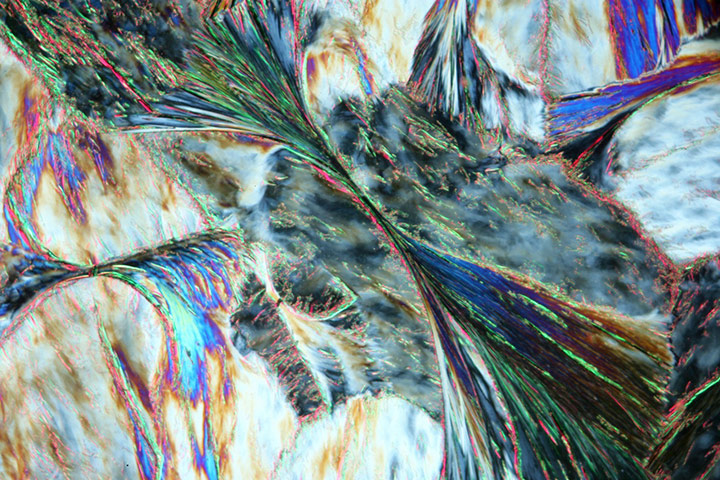
    The Guardian reports that Spike Walker was awarded the Royal Photographic Society‘s combined Royal Colleges medal for his ‘outstanding contribution to photography and its application in the service of medicine’. A retired schoolteacher, Spike produces photomicrographs in his garage, which he has converted into a laboratory

    Dopamine is a key neurotransmitter released in our brains when we do something rewarding. The dopaminergic system is behind most good feelings we have, and it is also the chemical that is targeted by highly addictive drugs such as cocaine.

    http://thebeautifulbrain.com/wp-content/uploads/2010/09/Dophamine.jpg

    The Beautiful Brain: To create this beautiful micrograph of dopamine crystals, Spike Walker, who won Thursday evening’s Royal Photographic Society‘s Combined Royal Colleges Medal, shone polarized light at the minute chemical structures. The crystals reflect light at different wavelengths depending on their orientations within the overall chemical structure. According to Walker, using this technique highlights more detail in the crystal structure than regular observation through a microscope.

    Crystals of stearic acid, a saturated long-chain fatty acid found in animal fat and cocoa butter.

    http://static.guim.co.uk/sys-images/Guardian/Pix/pictures/2010/9/8/1283953758659/Crystals-of-stearic-acid-010.jpg

    Bike blog: Crystals of stearic acid