Archive for the ‘Science’ Category

“Hausergate” and the perversion of peer review

August 14, 2010

It would seem that  Marc Hauser fudged or exaggerated or imagined or just plain made up some of the results in at least 3 papers which were published after peer review.

Predictably, Harvard is being very reticent with information but as reported by The Boston Globe the university has assured the world that all necessary corrections will be made. Harvard University confirmed yesterday that it has examined concerns about scientific work by prominent psychology professor Marc Hauser and said it has “taken steps to ensure that the scientific record is corrected’’ in three journal articles for which he was a coauthor.

Also predictably others at Harvard are rationalising and taking a sympathetic view. Greg Laden says: “I know Marc Hauser, and I trust him.”

http://homelessmanspeaks.files.wordpress.com/2008/11/circling-wagons-nov-27-2008.jpg

Hauser himself is taking a year off as penance and to purge himself of his misconduct.

1. A 2002 paper published in the journal Cognition is being retracted by Hauser and two coauthors. The retraction notes that an internal Harvard examination found that the data do not support the findings.

The journal ( or is it magazine) and Elsevier need to now defend their editorial process. Who were the peers and what did they review?

2. Also called into question by the investigation is a 2007 paper in the journal Science. Ginger Pinholster, a spokeswoman for the journal, said that one of the coauthors — Justin Wood, a former graduate student at Harvard who now is an assistant professor of psychology at the University of Southern California — wrote a letter to the journal in late June. According to Pinholster, the letter stated that an internal investigation at Harvard found there were missing field notes and that the team at Harvard had recreated its research as a result. Science has yet to make a formal change to the article.

Did the missing notes ever exist? Time for Science to open up.

3. A 2007 paper in the Proceedings of the Royal Society B has already been corrected, because of missing video records and field notes. Earlier this week, Victoria Millen, publishing editor of the British journal, confirmed that the authors contacted the journal last month and informed it of the investigation. The correction notes that incomplete video records and field notes were collected by “the researcher who performed the experiments,’’ a scientist named David Glynn, who has not responded to multiple e-mail and voicemail messages.

Hausergate and Climategate and all its associated “gates” show that the peer review process is sufficiently perverted and corrupted that it needs an overhaul. It is time for the assenting and dissenting peers to stand up and be counted and not hide behind the skirts of anonymous independance.

The Harvard statement said that in cases like Hauser’s, Harvard reports its findings to federal funding agencies, which do their own reviews.

But Harvard cannot pass the buck.

Arctic melt season seems to be over for 2010

August 13, 2010

From the DMI mean temperatures above 80 degrees North it would seem that the Arctic melt season is over. Temperatures are now clearly below zero. This year it has been about 8 days shorter than the average melt season (green line below) of about 67 days.

Arctic tempereatures

Antarctic sea ice growing fast

August 10, 2010

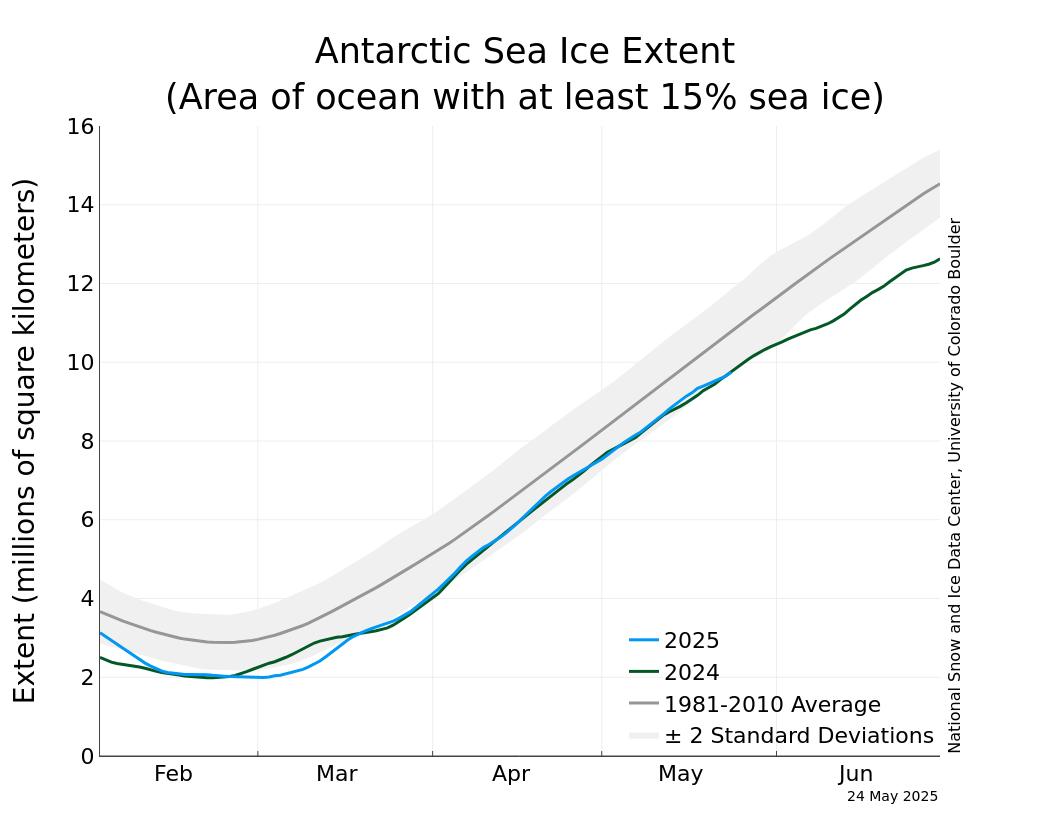
The sea ice extent in the Antarctic continues to be well above the 2009 level and more than 2 SD’s higher than the 1979-2000 average. Sea ice extent peaks at the end of September and, if anything, the growth is accelerating rather than slowing down when we are now in the middle of August.

http://nsidc.org/data/seaice_index/images/daily_images/S_stddev_timeseries.png

In the Northern Hemisphere, temperatures above the 80th parallel have dipped below freezing and are also clearly lower than the 1958 -2002 average.

http://ocean.dmi.dk/arctic/meant80n.uk.php

Looks like we are in for another long and cold winter.

La Niña conditions now established?

August 9, 2010

It would seem that La Niña conditions are no longer just a probability.  La Niña conditions are expected to strengthen towards the end of the year and through the first quarter of 2011.

In the latest bulletin issued by the NOAA (Update prepared by Climate Prediction Center / NCEP 9 August 2010) we see that

  • La Niña conditions are present across the equatorial Pacific. Negative sea surface temperature anomalies continue to strengthen across much of the Pacific Ocean.  La Niña conditions are likely to continue through early 2011
  • Since March 2010, positive SST anomalies have decreased across much of the equatorial Pacific. Since the beginning of May 2010, SST anomalies have become increasingly negative in the eastern half of the Pacific.
  • During the last four weeks, equatorial SST anomalies have been negative in the eastern half of the Pacific. During the last 30 days, negative SST anomalies increased in magnitude in the central equatorial Pacific
  • Since mid-June 2010, negative subsurface temperature anomalies have dominated the central and eastern equatorial Pacific, with only slight variations in the magnitude of the anomalies.

The formal designation of a La Niña is keyed to a 3 month mean of the Oceanic Niño Index (ONI) in Region 3.4 and is likely to happen in the first two weeks of September.


Ethanol more damaging to the Gulf than BP oil spill

August 8, 2010

Supposed environmental solutions often create new problems.

Dead zone in gulf linked to ethanol production

While the BP oil spill has been labeled the worst environmental catastrophe in recent U.S. history, a biofuel is contributing to a Gulf of Mexico “dead zone” the size of New Jersey that scientists say could be every bit as harmful to the gulf.

Each year, nitrogen used to fertilize corn, about a third of which is made into ethanol, leaches from Midwest croplands into the Mississippi River and out into the gulf, where the fertilizer feeds giant algae blooms. As the algae dies, it settles to the ocean floor and decays, consuming oxygen and suffocating marine life.

Known as hypoxia, the oxygen depletion kills shrimp, crabs, worms and anything else that cannot escape. The dead zone has doubled since the 1980s and is expected this year to grow as large as 8,500 square miles and hug the Gulf Coast from Alabama to Texas.

The gulf dead zone is the second-largest in the world, after one in the Baltic Sea. Scientists say the biggest culprit is industrial-scale corn production. Corn growers are heavy users of both nitrogen and pesticides. Vast monocultures of corn and soybeans, both subsidized by the federal government, have displaced diversified farms and grasslands throughout the Mississippi Basin.

“The subsidies are driving farmers toward more corn,” said Gene Turner, a zoologist at Louisiana State University. “More nitrate comes off corn fields than it does off of any other crop by far. And nitrogen is driving the formation of the dead zone.”

Has “peer review” failed??

August 7, 2010

An interesting, provocative and thought provoking post by Nigel Calder here.

It would seem that “peer review” which was intended to improve the quality of scientific papers has actually been a hindrance to new discoveries rather than a help. As Climategate has shown very clearly the “peer review” process is easily perverted by the ruling clique preventing anything opposing their views to be published and the prevailing group-think ensuring that anything “heretical” is suppressed.

“As there is not the slightest sign of any end to science, as a process of discovery, a moment’s reflection tells you that this means that the top experts are usually wrong. One of these days, what each of them now teaches to students and tells the public will be faulted, or be proved grossly inadequate, by a major discovery. If not, the subject must be moribund.”

Back in 1989, James Lovelock had this to say about “peer review”: ‘Before a scientist can be funded to do a research, and before he can publish the results of his work, it must be examined and approved by an anonymous group of so-called peers. This inquisition can’t hang or burn heretics yet, but it can deny them the ability to publish their research, or to receive grants to pay for it. It has the full power to destroy the career of any scientist who rebels.’

Galileo facing the inquisition

Calder continues:This month the life sciences magazine The Scientist has interesting articles on peer review.

One, entitled “Breakthroughs from the Second Tier”, describes five “high-impact” papers that should have been published in more prestigious journals than they were. You can see it here http://www.the-scientist.com/2010/8/1/30/1/.

Also in The Scientist is “I Hate Your Article” by Jef Akst, who quotes David Kaplan, professor of pathology at Case Western Reserve University:

Theoretically, peer review should “help [authors] make their manuscript better,” [Kaplan] says, but in reality, the cut-throat attitude that pervades the system results in ludicrous rejections for personal reasons—if the reviewer feels that the paper threatens his or her own research or contradicts his or her beliefs, for example—or simply for convenience, since top journals get too many submissions and it’s easier to just reject a paper than spend the time to improve it. Regardless of the motivation, the result is the same, and it’s a “problem,” Kaplan says, “that can very quickly become censorship.”

Akst’s full article is here: http://www.the-scientist.com/article/display/57601/ . It goes on to discuss some of the ideas on offer for easing the peer review problem. That’s the basis for this brief update to be added to Magic Universe.

Amid growing recognition of problems with peer review, a few scientific journals tested various remedies. As reported by The Scientist magazine, by 2010 they included ending the anonymity of reviewers, so that they could both be held responsible for their comments and be acknowledged for their work, which was time-consuming. Another policy was to insist that reviewers should concern themselves only with the rigour and proper reporting of the work, not with its impact or scope. And to speed up publication, reviewers’ comments made for one journal might be passed on to others. Some journals went so far as to publish preliminary versions of papers before the peer-review process was complete.

Peer review has to get back to being strictly a review of the quality of the work done and not a commentary on or a review of the conclusions to be drawn.

When “models” and fudge factors are touted as evidence

August 6, 2010

Doomsday scenarios are taken to be evidence!!

Dr. Nepstad is at it again but he has a great deal of money to protect.

The same actors, the same advocacy and the same techniques to forecast DOOM.

Only this time drought, land use, illegal logging and climate change  are taken together to provide the necessary forcings to provide the catastrophe. It is called a “study” and implies some objectivity but the models use a variety of fudge factors to decide on the impact of the various variables. It might be more accurate to call it The Doomsday Scenarios since the “study” is no more than the generation of scenarios to come to a pre-determined conclusion. The conclusion is of course that we must immediately reduce greenhouse gas emissions drastically!

The Daily Telegraph reports today that

Rainforest loss may have been overstated, scientists

Climate change and illegal logging could wipe out rainforest wildlife by 2100

Daniel Nepstad, an ecologist at the Woods Hole Research Center in Massachusetts, said only a cut in greenhouse gases can save the world’s wildlife.

“This study is the strongest evidence yet that the world’s natural ecosystems will undergo profound changes — including severe alterations in their species composition — through the combined influence of climate change and land use,” he said.

Unfortunately Dr. Nepstad is already rather tainted. He works for the Woods Hole Research Centre which is associated in Brazil with the Instituto de Pesquiza Ambiental da Amazonia (IPAM).  IPAM is a Brazilian advocacy group. He appears to have a vested interest in magnifying the value of carbon contained within the Rain Forests.

He is entitled to advocate for his point of view of course and to advocate for getting even more funding but his advocacy is not science.

Booker had this to say about 3 weeks ago:

This curious episode may also point to another reason why WWF and Woods Hole have been so active in recent years to promote concern over the danger of global warming for the Amazon rainforest. As I revealed here on March 20, they have been closely allied in support of a scheme known as REDD (Reduction in Emissions from Deforestation and Degradation of Tropical Forests). Its aim is to turn the CO2 in forest trees into “carbon credits”, saleable on the world market to allow firms to continue emitting CO2. Backed by $80 million from the World Bank, WWF, Woods Hole and IPAM are partners in a consortium, supported by the Brazilian government, to protect and manage a vast area of forest in the Tumucumaque region, in return for which they would have the right to sell its carbon credits. In 2007 Dr Nepstad published a formula which would allow the carbon contained in the entire forest to be valued at $60 billion.

Alarmism: Exaggerations aplenty

August 4, 2010

1. A solar storm yes, but hardly a Tsunami

The headlines were alarmist as usual: NASA scientists braced for ‘solar tsunami’ to hit earth, but reality was a little less alarming. A C3 flare caused a G2 geomagnetic storm  (G1 being the weakest and G5 the strongest) with a Kp value of 6. (Kp of 5 at G1 and 9 at G5).

image:http://solarcycle24.com/

The Northern lights could be particularly spectacular but a moderate G2 storm can be expected to have some relatively minor but significant effects:

  • Power systems: high-latitude power systems may experience voltage alarms, long-duration storms may cause transformer damage.
  • Spacecraft operations: corrective actions to orientation may be required by ground control; possible changes in drag affect orbit predictions.
  • Other systems: HF radio propagation can fade at higher latitudes, and aurora has been seen as low as New York and Idaho (typically 55° geomagnetic lat.).

From http://www.spaceweather.com/ The solar storm of August 1st sent two CMEs toward Earth. The first one arrived yesterday, August 3rd, sparking mild but beautiful Northern Lights over Europe and North America (see below). The second CME is still en route. NOAA forecasters estimate a 35% chance of major geomagnetic storms when the cloud arrives on August 4th or 5th. High-latitude sky watchers should remain alert for auroras.

In Solar Cycle 24  sunspot activity continues to undershoot Solar Cycle 5.

2.The media and the environmental community were up in arms about “the worlds worst environmental disaster” and BP has been demonised by the US press but we now learn that 75% of the oil leakage in the Gulf of Mexico has already dispersed and that the Oil From Spill Poses Little Additional Risk.

The government is expected to announce on Wednesday that three-quarters of the oil from the Deepwater Horizon leak has already evaporated, dispersed, been captured or otherwise eliminated — and that much of the rest is so diluted that it does not seem to pose much additional risk of harm.

Hayabusa returns — Ion engine spacecraft back after 7 years

August 4, 2010

The Japanese asteroid exploration spacecraft Hayabusa returned miraculously on 13th June from a seven-year, trouble-filled journey  powered by ion engines.

Hayabusa’s main engine failed due to fuel leaks, but the probe was able to complete its odyssey by relying on ion engines developed by  NEC. The Japanese firm’s unique method of using microwaves can extend the lifespan of an ion engine to more than twice that of conventional engines. Hayabusa’s successful return “has boosted the credibility of ion engines,” an NEC official said.

image: http://www.jpl.nasa.gov/missions/missiondetails.cfm?mission=Hayabusa

Japan is planning for the launch of the “Hayabusa-2” asteroid probe sometime between July 2014 and 2015.

(more…)

New Carbon Dioxide Emissions Model !!

August 3, 2010

Yet another model which seems to indulge in circular argument – again.

The now discredited methodology  of the 4th IPCC Asessment report will be used to produce model calculations for the 5th IPCC Asessment report and, I suppose the 5th will lead to the 6th and so on ad infinitum!

It seems like a methodology to ensure the keeping of climate modellers in work for ever.

Erich Roeckner, Marco A. Giorgetta, Traute Crueger, Monika Esch, Julia Pongratz. Historical and future anthropogenic emission pathways derived from coupled climate-carbon cycle simulationsClimatic Change, DOI: 10.1007/s10584-010-9886-6

According to Science Daily

The scientists used a new method with which they reconstructed historical emission pathways on the basis of already-calculated carbon dioxide concentrations. To do this, Erich Roeckner and his team adopted the methodology proposed by the International Panel on Climate Change (IPCC) for simulations being carried out for the future Fifth IPCC Assessment Report: earth system models that incorporate the carbon cycle were used to estimate the anthropogenic carbon dioxide emissions that are compatible with a prescribed concentration pathway. In this case, the emissions depend solely on the proportion of the anthropogenic carbon in the model that is absorbed by the land surface and the oceans. Repetition of the experiments using different pre-industrial starting dates enabled the scientists to distinguish between anthropogenic climate change and internal climate variability.

“It will take centuries for the global climate system to stabilise,” says Erich Roeckner.

And perhaps decades for the funding to continue.