Archive for the ‘Space’ Category

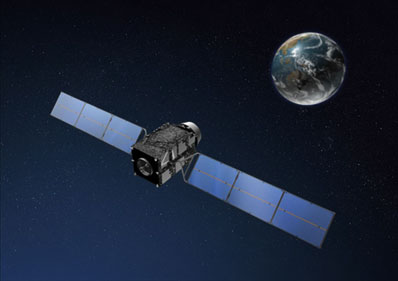
Michibiki navigation satellite in position over Japan

September 30, 2010

Japan’s first navigation satellite has arrived on station more than 20,000 miles over Asia to improve positioning coverage in mountainous terrain and urban centers.

Artist's concept of the Michibiki satellite. Credit: JAXA

MICHIBIKI injected into the quasi-zenith orbit with its center longitude of about 135 degrees.

The First Quasi-Zenith Satellite MICHIBIKI, which was launched by the H-IIA Launch Vehicle No. 18 on Sept. 11 (JST,) has been maneuvered to shift its orbit from the drift orbit to the quasi-zenith orbit starting on the 21st. The satellite is now confirmed to be inserted into the quasi-zenith orbit over Japan with its center longitude of about 135 degrees through the final orbit control performed at 6:28 a.m. on Sept. 27. The MICHIBIKI was launched from the Tanegashima Space Center at 8:17 p.m. on September 11, 2010 (JST.)

Yoshinobu Launch Complex

Yoshinobu Launch Complex at the Tanegashima Space Center: JAXA

JAXA’s press release is here:

http://www.jaxa.jp/press/2010/09/20100927_michibiki_e.html

“Gliese 581g”: Habitable planet found?

September 30, 2010
Habitable zone-he

Image via Wikipedia: Habitable zone

From just a week ago “Two researchers have used the pace of past exoplanet finds to predict that the first habitable Earth-like planet could turn up in May 2011″.

A pessimistic forecast perhaps because astronomers may have found the most Earth-like alien planet to date, and it’s located only a short distance away, cosmically speaking. The team says that the planet’s proximity to its sun, coupled with the ease with which it was detected, suggests that the galaxy could be teeming with habitable worlds.

Science reports that:

Gliese 581g looks like a game-changer. Detected from the minuscule amount of gravitational influence it exerts on its star, the planet lives a mere 20 light-years away in the constellation Libra. Gliese 581g is the sixth world discovered around its sun—and the fourth most distant. Yet its orbit brings it closer to its parent star than Mercury is to our sun. Still, it’s squarely within the habitable zone, because the planet’s star, which is a type known as a red dwarf, contains only about 30% of the sun’s mass and shines with only about 1% of its brightness, the researchers will report in an upcoming issue of the Astrophysical Journal.

Read the article:

http://news.sciencemag.org/sciencenow/2010/09/astronomers-find-most-earth-like.html

UN appoints an “Alien Ambassador” – Alien travel to earth suspended.

September 27, 2010
Logo of UN Office for Outer Space Affairs

UNOOSA

This is probably the kiss of death for any prospective alien visits to earth.

An Alien Ambassador is to be appointed by the United Nations to act as the first point of contact for aliens trying to communicate with Earth.

In the midst of a global financial meltdown and a painful recovery the UN is displaying a remarkably insensitive – but not unsurprising – sense of priorities.

But the required quota of Malaysian UN appointees has probably been filled.

Take me to your leader

But good luck anyway to Mrs Mazlan Othman, a Malaysian astrophysicist, who is going to co-ordinate humanity’s response if and when extraterrestrials make contact. This sounds like a well-paid and tenured appointment which should last at least for life. Mrs Othman is currently head of the UN’s little known Office for Outer Space Affairs (Unoosa).

She is quoted to have said:

“The continued search for extraterrestrial communication, by several entities, sustains the hope that some day human kind will received signals from extraterrestrials. When we do, we should have in place a coordinated response that takes into account all the sensitivities related to the subject. The UN is a ready-made mechanism for such coordination.

Under the Outer Space Treaty of 1967, which Unoosa oversees, UN members agreed to protect Earth against contamination by alien species by “sterilising” them.

Alien travel agents must now be striking Earth off their tours.

Oh Dear !

Dyson spheres and Solar Wind Power by satellite

September 26, 2010

Freeman Dyson is credited with being the first to formalize the concept of the Dyson sphere in his 1959 paper “Search for Artificial Stellar Sources of Infra-Red Radiation”, published in the journal Science.

Dyson Sphere: centauri-dreams.org

However, Dyson was inspired by the mention of the concept in the 1937 science fiction novel Star Maker, by Olaf Stapledon, and possibly by the works of J. D. Bernal and Raymond Z. Gallun who seem to have explored similar concepts in their work. Such a “sphere” would be a system of orbiting solar power satellites meant to completely encompass a star and capture most or all of its energy output. Dyson speculated that such structures would be the logical consequence of the long-term survival and escalating energy needs of a technological civilization.

The New Scientist carries a report on  a speculation about using the solar wind to generate power for use on earth, based on the paper by  Harrop and Schulze-Makuch in the International Journal of Astrobiology, “The Solar Wind Power Satellite as an alternative to a traditional Dyson Sphere and its implications for remote detection”.

The concept for the so-called Dyson-Harrop satellite begins with a long metal wire loop pointed at the sun. This wire is charged to generate a cylindrical magnetic field that snags the electrons that make up half the solar wind. These electrons get funnelled into a metal spherical receiver to produce a current, which generates the wire’s magnetic field – making the system self-sustaining.

Dyson-Harrop Satellite

Any current not needed for the magnetic field powers an infrared laser trained on satellite dishes back on Earth, designed to collect the energy. Air is transparent to infrared so Earth’s atmosphere won’t suck up energy from the beam before it reaches the ground.

Back on the satellite, the current has been drained of its electrical energy by the laser – the electrons fall onto a ring-shaped sail, where incoming sunlight can re-energise them enough to keep the satellite in orbit around the sun.

A relatively small Dyson-Harrop satellite using a 1-centimetre-wide copper wire 300 metres long, a receiver 2 metres wide and a sail 10 metres in diameter, sitting at roughly the same distance from the sun as the Earth, could generate 1.7 megawatts of power – enough for about 1000 family homes in the US.

A satellite with the same-sized receiver at the same distance from the sun but with a 1-kilometre-long wire and a sail 8400 kilometres wide could generate roughly 1 billion billion gigawatts (1027 watts) of power, “which is actually 100 billion times the power humanity currently requires”, says researcher Brooks Harrop, a physicist at Washington State University in Pullman who designed the satellite.

Solar panels cost more per pound than the copper making up the Dyson-Harrop satellites, so according to Harrop, “the cost of a solar wind power satellite project should be lower than a comparative solar panel project”.

A smaller version of this satellite could help power some space missions perhaps in helping generate power for something like the Ulysses spacecraft, which went around the poles of the sun.


Fascinating stuff!

It occurs to me that getting a sharp enough focus for the laser beam may be restricted – everything else becoming feasible –  to “base stations” having no atmosphere and therefore located in space not too far from the satellite.

A point to note about all such schemes where man’s power generation needs on earth are satisfied by using off-earth sources of energy (including solar energy which does not normally get to earth) is that all such power will eventually be dissipated as heat into the first 100m of the earth’s atmosphere. If such power is significant with respect to the solar radiation reaching the earth then cooling will need to be arranged for.

http://en.wikipedia.org/wiki/Dyson_sphere

“Houston, We have a problem”: Astronauts abort return to Earth

September 24, 2010

Update!

25.10.2010 – 0635 CET

Astronauts undocked successfully and are due to touchdown at 09:22 this morning.

(Reuters)

Two Russians and a U.S. astronaut aborted a return to Earth on Friday when their space capsule failed to separate from the International Space Station. “This situation has never occurred before,” a spokeswoman at Russian Mission Control near Moscow said, as space officials scrambled to determine the cause.
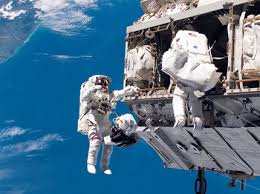
International Space Station

NASA astronaut Tracy Caldwell Dyson and two Russian crew mates climbed into a Soyuz capsule hitched to the station for the descent, but latches holding the craft to a docking port failed to open, the spokeswoman said.

Russia’s space agency chief Anatoly Perminov told reporters at Mission Control that Dyson, Alexander Skvortsov and Mikhail Korniyenko’s return to Earth after nearly six months in space had been rescheduled for Saturday.

The docking mechanism did not function because the station’s computer sent a false signal indicating the hatch between station and capsule was not fully sealed, Perminov said. He said technicians had found no problem with the seals, and suggested they were still puzzling over exactly went wrong.

A second undocking attempt “could have gone ahead today, but we need additional time to make sure we have reliable information about the problem,” Perminov told a terse news conference at Mission Control. “There is no point in rushing,” he said. Perminov refused to take questions, saying he did not want to fuel rumors.

Russian Mission Control and the U.S. space agency NASA’s Mission Control in Houston agreed the three crew members would go back to the space station and await a fresh undocking attempt on Saturday, NASA said. Three other crew members, Russian Fyodor Yurchikhin and NASA astronauts Doug Wheelock and Shannon Walker, would remain aboard the station as planned after Saturday’s departure. “I see no technical problem on the station or anywhere that would threaten the crew,” Perminov said. Another Russian space agency official, Alexei Krasnov, said the landing should now take place on Saturday at about 9:20 a.m.

Skvortsov, Korniyenko and Dyson boarded the space station on April 4 after a flight up together in the Soyuz TMA-18 craft, which will also be used for their return to Earth.

Fingers crossed for the next attempt on Saturday.
“You left spacedock without a tractor beam?”: Mysterious force holds back NASA probes

September 19, 2010

Star Trek Generations

Star Trek Generations:

Kirk: You left spacedock without a tractor beam?
Harriman: It doesn’t arrive until Tuesday.

The Telegraph:

A space probe launched 30 years ago has come under the influence of a mysterious force that has baffled scientists and could rewrite the laws of physics. Researchers say Pioneer 10, which took the first close-up pictures of Jupiter before leaving our solar system in 1983, is being pulled back to the sun by an unknown force. The effect shows no sign of getting weaker as the spacecraft travels deeper into space, and scientists are considering the possibility that the probe has revealed a new force of nature.

Tractorbeam arriving on Tuesday

“If the effect is real, it will have a big impact on cosmology and spacecraft navigation,” said Dr Laing, of the Aerospace Corporation of California. Pioneer 10 was launched by Nasa on March 2 1972, and with Pioneer 11, its twin, revolutionised astronomy with detailed images of Jupiter and Saturn. In June 1983, Pioneer 10 passed Pluto, the most distant planet in our solar system.

pt:Trajectória da sonda Pioneer 10 em Jupiter

Pioneer 10 trajectory

Research to be published shortly in The Physical Review, a leading physics journal, will show that the speed of the two probes is being changed by about 6 mph per century – a barely-perceptible effect about 10 billion times weaker than gravity.

Assertions by some scientists that the force is due to a quirk in the Pioneer probes have also been discounted by the discovery that the effect seems to be affecting Galileo and Ulysses, two other space probes still in the solar system. Data from these two probes suggests the force is of the same strength as that found for the Pioneers.

Dr Duncan Steel, a space scientist at Salford University, says even such a weak force could have huge effects on a cosmic scale. “It might alter the number of comets that come towards us over millions of years, which would have consequences for life on Earth. It also raises the question of whether we know enough about the law of gravity.”

Son of Hubble — getting expensive

September 18, 2010

Successor to Hubble, the James Webb Space Telescope is now slated for launch in 2014. The $5 billion mission is once again plagued by cost overruns.

Science News reports:

How can astronomers advise NASA on how to trim the costs of developing missions if no one will tell them how much the costliest mission of all, the James Webb Space Telescope, is running over budget?

That’s what Alan Boss, chair of the independent NASA Astrophysics Subcommittee, would like to know. When the subcommittee met in Washington, D.C., on September 16 and 17, Boss and his colleagues already knew that the $5 billion infrared space observatory, the Hubble Space Telescope’s successor now set for launch in 2014, was once again in need of a monetary transfusion.

What Boss wanted to know was how much. But no one in room 3H46 at NASA headquarters was willing to talk dollars and sense — when Boss, an astronomer at the Carnegie Institution for Science in Washington, D.C., asked if anyone in the room could cite a dollar figure, his question was met with a silence as deep as any in the vast empty reaches of intergalactic space.

Fear of making a huge and embarrassing error like the one that produced Hubble Space Telescope’s infamously misshapen primary mirror may be causing JWST scientists and engineers to go overboard and do too much testing, Weiler said. The comprehensive report on JWST due next month, led by John Casani of NASA’s Jet Propulsion Laboratory in Pasadena, Calif., will cite instances where engineers on the mission may be overzealous in testing equipment.

JWST gobbles up about 40 percent of NASA’s astrophysics science budget.

Future of flight …

September 17, 2010

Der Spiegel:  What will air travel look like in the year 2050? A special team of engineers from European aircraft manufacturer Airbus have drafted plans for the future of flight. These include a completely transparent fuselage that will allow passengers to the see the stars above and city lights below.

“Passengers in an airplane like this would experience flight in a completely new way,” enthuses Axel Krein, 49, head of research and technology for European aircraft manufacturer Airbus. The unconventional idea came from the special team that Krein himself put together to forge ideas for the airplanes of the future.

“We told our engineers to give their imaginations free rein,” Krein explains. “What emerged were completely realistic visions of flight in the year 2050. Our people are grounded in reality, after all. And most of the necessary technology already exists.”

Finnair solar powered helicopter

Finnair 450 bed space hotel

Finnair's flying saucer. In 2093 with 2400 passengers

Lockheed Martin Corporation supersonic jet

Finnair supersonic jet

'Concept Plane' by Airbus 2050

Hawking, God, creation and gravity

September 2, 2010

There have been headlines today regarding Stephen Hawking’s new book The Grand Design (co-written by US physicist Leonard Mlodinow) to be published on 9th September.


Defense Meteorological Satellite Program

Image via Wikipedia


“God did not create the Universe”

is the BBC headline.

Citing the 1992 discovery of a planet orbiting a star other than our Sun, he said: “That makes the coincidences of our planetary conditions – the single Sun, the lucky combination of Earth-Sun distance and solar mass – far less remarkable, and far less compelling as evidence that the Earth was carefully designed just to please us human beings.” He adds: “Because there is a law such as gravity, the universe can and will create itself from nothing. ….Spontaneous creation is the reason there is something rather than nothing, why the universe exists, why we exist…..It is not necessary to invoke God to light the blue touch paper and set the universe going.”

But if The Big Bang and  all the subsequent creation events flow naturally and inevitably from the law of gravity, what still remains is to explain where the law of gravity came from or from what it flows naturally and inevitably……….

No matter how much more is discovered by science we will still have the space of the “unknown unknowns” (a la Rumsfeld) where we do not even know what questions are feasible – let alone what question to ask.

Solar Flares may dampen radioactive decay on Earth !

August 24, 2010

A detective story from Stanford University News. http://news.stanford.edu/news/2010/august/sun-082310.html

When researchers found an unusual linkage between solar flares and the inner life of radioactive elements on Earth, it touched off a scientific detective investigation that could end up protecting the lives of space-walking astronauts and maybe rewriting some of the assumptions of physics.

BY DAN STOBER

http://www.pcaire.com/images/solar_flares.png

(more…)