Archive for the ‘Space’ Category

Russia’s Mars jinx continues: Phobos-Grunt in big trouble; 3 days in parking orbit to fix computer problem

November 9, 2011

The jinx on Russia’s probes to Mars continues.

Phobos-Grunt launched successfully last night but failed to enter its departure trajectory when two engine burns failed – presumed due to computer problems. It is now in a “parking” orbit and the problem needs to be fixed within 3 days when its batteries will run out. The fuel tanks are still in place for the craft’s own thrusters and there is still thought to be some hope. If the problem cannot be fixed it will be the fourth successive failure of a Russian Mars mission.

(more…)

Russian Phobos-Grunt mission to Mars and Phobos blasts off today

November 8, 2011

Much Russian news just now from the Nord Stream pipeline in the Baltic going live today to an ambitious and critical Mars mission which will launch late today (November 8th).

Russia’s last interplanetary launch of a probe to Mars in 1996  failed at launch. Prior to that in missions to the larger of Mars’ 2 moons, Phobos 1 was launched on July 7, 1988 and Phobos 2 on July 12, 1988. Communication with Phobos 1 was lost in September 1988. Phobos 2 operated normally till it was within 50m of the surface of Phobos and again communication was lost in March 1989.

In the meantime the US Mars Rover has operated on Mars for thousands of hours, Chinese and Indian probes have reached the moon and a Japanese probe has brought back some minute quantities of matter from an asteroid. The Russians have been short of financing and are now trying to regain the pre-eminence they once had. To have the Chinese planting flags on the moon in 3 or 4 years would be unbearable.

Russian missions to Mars have never yet been completely successful and the launch on November 8th as part of the Phobos-Grunt (Фобос-Грунт meaning Phobos -soil) project is carrying a great deal of Russian prestige and – more importantly – the future of the Russian space program.

(more…)

Asteroid 2005 YU 55 will fly-by closer than the moon on Tuesday

November 6, 2011

A very close encounter coming up on Tuesday at 6:28 pm US Eastern time.

(Reuters) – A huge asteroid will pass closer to Earth than the moon Tuesday, giving scientists a rare chance for study without having to go through the time and expense of launching a probe, officials said.

Earth’s close encounter with Asteroid 2005 YU 55 will occur at 6:28 p.m. EST (2328 GMT) Tuesday, as the space rock sails about 201,000 miles from the planet.

(more…)

Iran fails in attempt to launch a monkey into space

October 13, 2011

In February last year Iran sent several small animals into space — a rat, two turtles and worms — aboard a capsule carried by its Kavoshgar-3 rocket.

Iran then developed ambitious plans to launch a monkey into space. Apparently this attempt was made last month but it failed. The Telegraph reports:

Kavoshgar 3 launch in 2010 - image: http://militaryasia.blogspot.com

“The Kavoshgar-5 rocket carrying a capsule with a live animal (a monkey) was launched during Shahrivar,” an Iranian calendar month spanning August 23 to September 22, Deputy Science Minister Mohammad Mehdinejad-Nouri was quoted as saying by the ISNA news agency.

“However, the launch was not publicised as all of its anticipated objectives were not accomplished,” Mehdinejad-Nouri told reporters.

He said the launch of a live animal into space was “strategic, and a priority,” and expressed hope that future launches would attain more of the objectives set.

On October 3, Iran indefinitely postponed plans to send a live monkey into space, without giving any reasons.

“One cannot give a set date for this project and as soon as our nation’s scientists announce the readiness (of the project) it will be announced,” said Hamid Fazeli, head of Iran’s Space Organisation.

“Where no man has gone before” – 50 new exoplanets discovered

September 12, 2011

Fifty New Exoplanets Discovered by HARPS

Astronomers using ESO’s world-leading exoplanet hunter HARPS have today announced a rich haul of more than 50 new exoplanets, including 16 super-Earths, one of which orbits at the edge of the habitable zone of its star. By studying the properties of all the HARPS planets found so far, the team has found that about 40% of stars similar to the Sun have at least one planet lighter than Saturn.

The HARPS spectrograph on the 3.6-metre telescope at ESO’s La Silla Observatory in Chile is the world’s most successful planet finder. The HARPS team, led by Michel Mayor (University of Geneva, Switzerland), today announced the discovery of more than 50 new exoplanets orbiting nearby stars, including sixteen super-Earths. This is the largest number of such planets ever announced at one time. The new findings are being presented at a conference on Extreme Solar Systems where 350 exoplanet experts are meeting in Wyoming, USA.

The harvest of discoveries from HARPS has exceeded all expectations and includes an exceptionally rich population of super-Earths and Neptune-type planets hosted by stars very similar to our Sun. And even better — the new results show that the pace of discovery is accelerating,” says Mayor.

In the eight years since it started surveying stars like the Sun using the radial velocity technique HARPS has been used to discover more than 150 new planets. About two thirds of all the known exoplanets with masses less than that of Neptune were discovered by HARPS. These exceptional results are the fruit of several hundred nights of HARPS observations.

Working with HARPS observations of 376 Sun-like stars, astronomers have now also much improved the estimate of how likely it is that a star like the Sun is host to low-mass planets (as opposed to gaseous giants). They find that about 40% of such stars have at least one planet less massive than Saturn. The majority of exoplanets of Neptune mass or less appear to be in systems with multiple planets.

Read the full European Southern Observatory Press Release

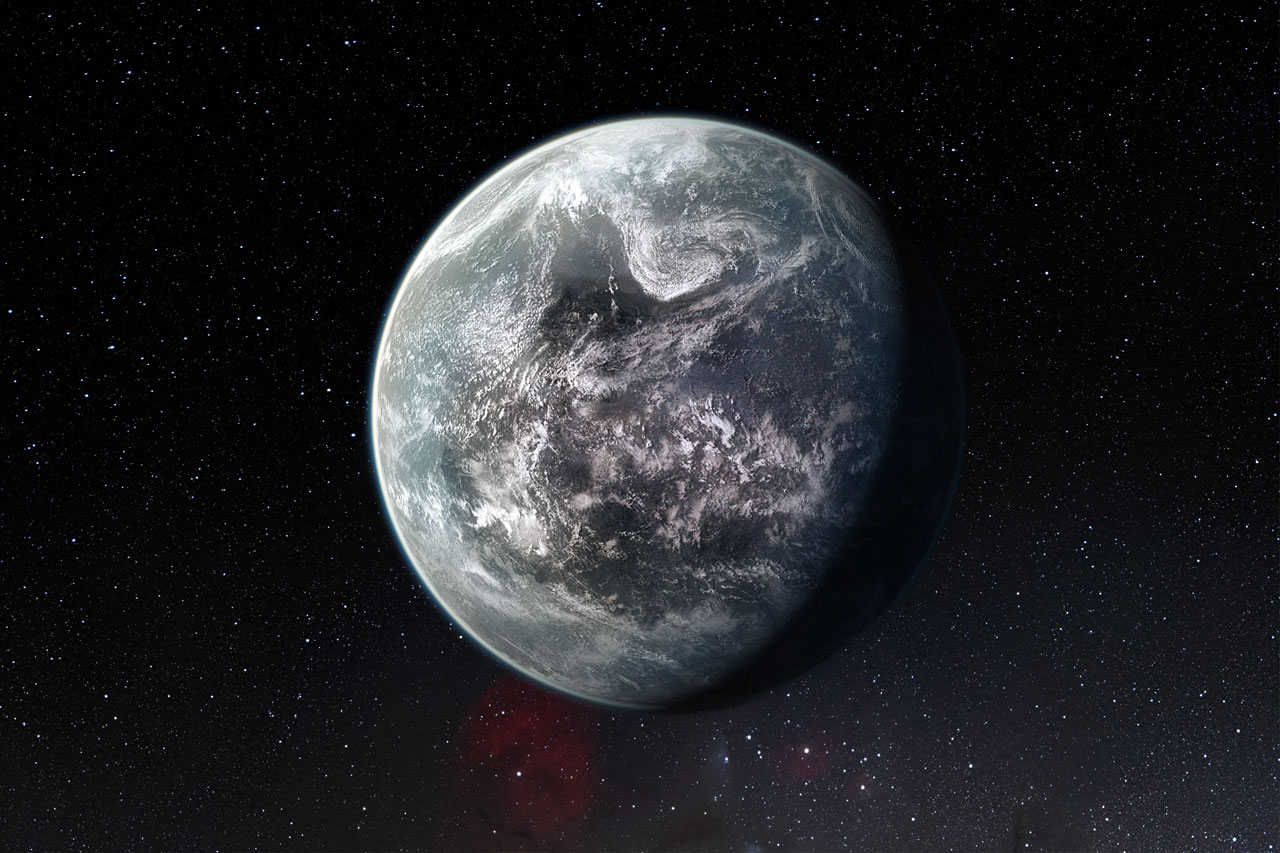
Artists’s impression of one of more than 50 new exoplanets found by HARPS: the rocky super-Earth HD 85512 b: image ESO

Chang’e 2 is now “liberated” from earth and lunar gravity

September 11, 2011

China’s lunar probe Chang’e 2 completed its mission orbiting the moon three months ago and has now reached Lagrange (liberation) Point L2.

It has now reached a point in space where neither the moon nor the earth’s gravity will affect the probe. This point is called L2. It’s the farthest a Chinese spacecraft has ever been.

Chang’e 2’s primary mission was to orbit the moon at only 100 kilometers from the surface, taking high resolution photos. After completing this, scientists decided that there was enough fuel to continue with the second part of the mission. But sending the probe from the moon was unprecedented. Similar missions has previously left directly from Earth, so keeping the satellite on course was a technological challenge.

Zhou Jianliang, Deputy Chief Designer, Measure & Control System of Chang’e 2, said, “The satellite faced various disruptions on its journey, which could have led it off course. We had planned four readjustments to keep it on track. But we only need(ed) to do it once since the first adjustment proved so accurate.”

China’s ambitious three-stage moon mission is steadily advancing. The next phase will be the launch of Chang’e-3 in 2013. The probe’s mission is to land on the moon together with a moon rover. In the third phase, the rover should land on the moon and return to Earth with lunar soil and stones for scientists to study. The Chang’e program was named after the legendary Chinese goddess who flew to the moon. With the progress in technology and experience from the Chang’e mission, sending a Chinese astronaut to the moon is now clearly feasible.

On Lagrange Points:

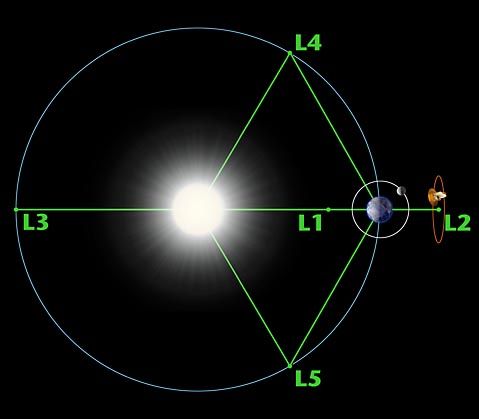
The Italian-French mathematician Joseph-Louis Lagrange discovered five special points in the vicinity of two orbiting masses where a third, smaller mass can orbit at a fixed distance from the larger masses. More precisely, the Lagrange Points mark positions where the gravitational pull of the two large masses precisely equals the centripetal force required to rotate with them. Those with a mathematical flair can follow this link to a derivation of Lagrange’s result (168K PDF file, 8 pages).

Of the five Lagrange points, three are unstable and two are stable. The unstable Lagrange points – labeled L1, L2 and L3 – lie along the line connecting the two large masses. The stable Lagrange points – labeled L4 and L5 – form the apex of two equilateral triangles that have the large masses at their vertices.

Lagrange Points

Lagrange Points of the Earth-Sun system (not drawn to scale!): NASA

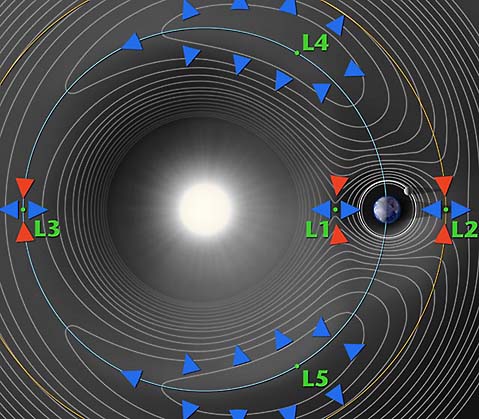
 The easiest way to see how Lagrange made his discovery is to adopt a frame of reference that rotates with the system. The forces exerted on a body at rest in this frame can be derived from an effective potential in much the same way that wind speeds can be inferred from a weather map. The forces are strongest when the contours of the effective potential are closest together and weakest when the contours are far apart. In the contour plot below we see that L4 and L5 correspond to hilltops and L1, L2 and L3 correspond to saddles (i.e. points where the potential is curving up in one direction and down in the other).

Effective Potential

A contour plot of the effective potential (not drawn to scale!): NASA

First private space flight to the ISS in November?

August 16, 2011

California-based rocket maker SpaceX said that it will make a test flight in late November to the International Space Station, now that NASA has retired its space shuttle program.The Dragon space capsule to be launched by a Falcon Heavy rocket has been given a November 30th launch date by NASA.

The Space X news release is here.

Space X Dragon capsule: image spacetourismnow.com

PhysOrg

“SpaceX has been hard at work preparing for our next flight — a mission designed to demonstrate that a privately-developed space transportation system can deliver cargo to and from the International Space Station (ISS),” the company, also called Space Exploration Technologies, said in a statement.

The mission is the second to be carried out by SpaceX, one of a handful of firms competing to make a spaceship to replace the now-defunct US shuttle, which had been used to carry supplies and equipment to the orbiting outpost.

“NASA has given us a November 30, 2011 launch date, which should be followed nine days later by Dragon berthing at the ISS,” the company said.

It said the arrival of the vessel at the space station would herald “the beginning of a new era in space travel.”

“Together, government and the private sector can simultaneously increase the reliability, safety and frequency of space travel, while greatly reducing the costs,” SpaceX said.

The company won $75 million in new seed money earlier this year, after it became the first to successfully send its own space capsule, the gumdrop-shaped Dragon, into orbit and back in December 2010.

Pamela finds anti-matter in the Van Allen belt

August 9, 2011

I had no difficulty as a student and later as an engineer in using  imaginary and complex numbers  involving i, where

i 2 = −1

and I am reasonably confident that I grasp the general concept of imaginary numbers. It took me a while when I was a student to realise that “imaginary” here meant “being capable of being imagined” and not something that ” did not exist and could only be imagined”.

I have much greater difficulty in following the concepts of “anti-matter” and why it is rational and necessary that anti-matter must exist. But I am no high energy physicist. On the other hand, I have no difficulty in “imagining” an alternative universe composed of anti-matter subject to anti-gravity, lit up with anti-light and which presumably began with an anti-Big Bang (an implosion)! But why anti-matter must exist in our universe is something I am content to leave to physicists. But like black holes they make me vaguely uncomfortable and I suppose it’s a good thing that anti-matter does not exist naturally on the earth’s surface. Of course if the physicists could suggest how I could use anti-matter to annihilate about 20kgs of my mass I would sign on immediately!

Anti-matter

The modern theory of antimatter begins in 1928, with a paper by Paul Dirac. Dirac realised that his relativistic version of the Schrödinger wave equation for electrons predicted the possibility of antielectrons. These were discovered by Carl D. Anderson in 1932 and named positrons (a contraction of “positive electrons”). Although Dirac did not himself use the term antimatter, its use follows on naturally enough from antielectrons, antiprotons, etc.A complete periodic table of antimatter was envisaged by Charles Janet in 1929.

Antimatter cannot be stored in a container made of ordinary matter because antimatter reacts with any matter it touches, annihilating itself and an equal amount of the container. Antimatter that is composed of charged particles can be contained by a combination of an electric field and a magnetic field in a device known as a Penning trap.

In any case, when cosmic rays smash into molecules in the Earth’s upper atmosphere, a shower of smaller particles is created. Physicists have assumed that a small number of those resulting particles will be anti-protons. Most of those will be instantly annihilated when they collide with particles of ordinary matter. But those which don’t collide should get trapped in the Earth’s torus-shaped Van Allen radiation belt, and form a layer of antimatter in the Earth’s atmosphere.

Van Allen radiation belts : image stars.astro.illinois.edu

Wired reports on the paper in The Astrophysical Journal Letters –  The discovery of geomagnetically trapped cosmic ray antiprotons bu O. Adriani et al. 2011 ApJ 737 L29 doi: 10.1088/2041-8205/737/2/L29

Data from the cosmic ray satellite PAMELA has added substantial weight to the theory that the Earth is encircled by a thin band of antimatter. The satellite, named Payload for Antimatter Matter Exploration and Light-nuclei Astrophysics, was launched in 2006 to study the nature of cosmic rays — high-energy particles from the Sun and beyond the solar system which barrel into Earth.  ……

It was one of PAMELA’s goals to hunt out those tiny numbers of antimatter particles among the ludicrously more abundant normal matter particles, like protons and the nuclei of helium atoms. To find them, the satellite regularly moved through a particularly dense section of the Van Allen belt called the South Atlantic Anomaly. Over a period of 850 days — from July 2006 to December 2008 — sensors aboard PAMELA detected 28 anti-protons. That might not sound like much, but it’s three times more than would be found from a random sample of the solar wind, and is the most abundant source of anti-protons ever seen near the Earth.

But what does this discovery mean, other than proving that a bunch of theorizing physicists were correct? The discovery opens the doors to harnessing those anti-protons for a variety of medical, sensing and, most importantly, rocket-propelling applications.

In a 2006 NASA-founded study by Draper Laboratory, researchers wrote, “it has been suggested that tens of nanograms to micrograms of anti-protons can be used to catalyze nuclear reactions and propel spacecraft to velocities up to 100 km/sec.”

Perhaps there is no life on other planets

August 1, 2011

The fundamental weakness of the Drake Equation is that it starts with the assumption that life on Earth is not unique. After that it merely applies a string of probabilities to derive the number of civilizations in our galaxy with which communication might be possible. Fermi’s paradox is the apparent contradiction between high estimates of the probability of the existence of extraterrestrial civilizations (such as given by the Drake Equation) and the lack of evidence for, or contact with, such civilizations.

The paradox of course is resolved if there are no other such civilisations except on Earth which would be the case if life (as we know it) was unique to Earth.

It might not be what I would want to or like to believe but it is the simplest resolution of the apparent paradox. And if that is so then Drake’s equation starts with a false premise and is irrelevant and invalid. The existence of extraterrestrial life is still in the realms of belief and hope and is not (yet) science.

Now Bob Yirka of PhysOrg reports that

Astrophysicists apply new logic to downplay the probability of extraterrestrial life

David Spiegel and Edwin Turner of Princeton University have submitted a paper to arXiv that turns the Drake equation on its head. Instead of assuming that life would naturally evolve if conditions were similar to that found here on Earth, the two use Bayesian reasoning to show that just because we evolved in such conditions, doesn’t mean that the same occurrence would necessarily happen elsewhere; using evidence of our own existence doesn’t show anything they argue, other than that we are here.

…….. Spiegel and Turner point out, basing our expectations of life existing on other planets, for no better reason that it exists here, is really only proof that we are more than capable of deceiving ourselves into thinking that things are much more likely than they really are. ……

When taken at face value, some might conclude that such arguments hold no more logic than arguments for the existence of God, i.e. it’s more about faith, than science. At any rate, most would agree that the only concrete way to prove whether there is life out there or not is to prove it, by finding it.

Nasa Glory mission fails again after launch

March 4, 2011
Top down view of Taurus XL carrying OCO

Top down view of Taurus XL carrying OCO: Image via Wikipedia

The US space agency’s (Nasa) attempt to launch its latest Earth observation mission has ended in failure. This is the second straight failure for the Taurus XL rocket, which appears to be connected to the rocket failing to release its payload. The Glory satellite lifted off from California at 0209 local time (1009 GMT), but officials became aware of a problem five minutes into the mission.

The Glory spacecraft was scheduled for launch today  Friday, March 4 after technical issues with ground support equipment for the Taurus XL launch vehicle led to the scrub of the original Feb. 23 launch attempt. Those issues were thought to have been resolved. Data from the Glory mission is expected to allow scientists to better understand how the sun and tiny atmospheric particles called aerosols affect Earth’s climate. The Taurus XL also carries the first of NASA’s Educational Launch of Nanosatellite missions. This auxiliary payload contains three small satellites called CubeSats, which were designed and created by university and college students.

From Nasa’s blog:

After Liftoff of Taurus XL Rocket, Fairing Fails to Separate

The Glory spacecraft and Taurus XL rocket lifted off this morning on time at 2:09:43 a.m. PST/5:09:43 a.m. EST.

About six minutes into the launch, a spacecraft contingency was declared by Launch Director Omar Baez. Data indicates the rocket fairing did not separate. More information will be provided at a news briefing later on NASA TV.

Project management for Glory is the responsibility of NASA’s Goddard Space Flight Center in Greenbelt, Md. The launch management for the mission is the responsibility of NASA’s Launch Services Program at the Kennedy Space Center in Florida. Orbital Sciences Corp. of Dulles, Va., is the launch service provider to Kennedy of the four-stage Taurus XL rocket and is also builder of the Glory satellite for Goddard.