Archive for the ‘Space’ Category

Vostok 3KA-2 Soviet space capsule from 1961 to be auctioned at Sotheby’s

February 28, 2011

Before blasting the first human into space in 1961, the Soviet Union fired off one last test flight of the tiny capsule that would carry Cosmonaut Yuri Gagarin on his historic mission.

The test capsule, Vostok 3KA-2, still scorched from re-entry, will be sold at Sotheby’s in New York on April 12, the 50th anniversary of Gagarin’s flight. Sotheby’s, which is displaying the capsule at its New York headquarters ahead of the sale, estimates it will fetch between $2 million to $10 million.
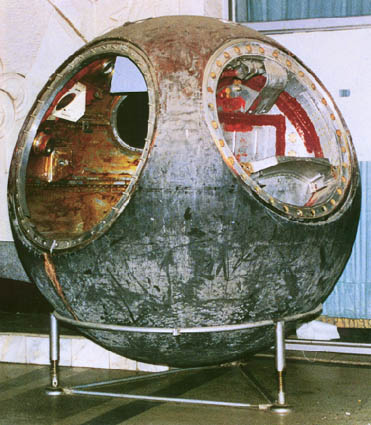
Vostok 3KA-2, one of three Vostok space capsules produced for Yuri Gagarin's historic space flight. On March 23, 1961, it took a test flight for 115 minutes with a dummy and a dog onboard: image csp.co.jp

The Vostok space program, conceived by the architect of the Soviet space program Sergei Korolev, first made history by blasting two dogs, Belka and Strelka, into space — the first animals to survive the voyage in 1960.

The capsule’s spherical cabin, no more than 2.5 meters (8 feet) in diameter and made of aluminum alloy, was then adapted to carry humans.

Just weeks before Gagarin’s mission, in a final test flight the capsule carried a life-size cosmonaut mannequin and a dog named Zvezdochka.

The capsule completed one orbit, re-entered the earth’s atmosphere and landed in a snow-filled gully near the Soviet town of Izhvesk, paving the way for Gagarin historic mission in an exact copy of the capsule.


Kepler telescope finds two planets sharing the same orbit

February 25, 2011

Architecture and Dynamics of Kepler’s Candidate Multiple Transiting Planet Systems

by Jack J. Lissauer, Darin Ragozzine, Daniel C. Fabrycky, Jason H. Steffen, Eric B. Ford, Jon M. Jenkins, Avi Shporer, Matthew J. Holman, Jason F. Rowe, Elisa V. Quintana, Natalie M. Batalha, William J. Borucki, Stephen T. Bryson, Douglas A. Caldwell, David Ciardi, Edward W. Dunham, Jonathan J. Fortney, Thomas N. Gautier III, Steve Howell, David G. Koch, David W. Latham, Geoffrey W. Marcy, Robert C. Morehead, Dimitar Sasselov

Astrophysical Journal (arxiv.org/abs/1102.0543).

From the New Scientist:

Room for two (Image: NASA/Ames/JPL-Caltech)

Room for two (Image: NASA/Ames/JPL-Caltech)

Buried in the flood of data from the Kepler telescope is a planetary system unlike any seen before. Two of its apparent planets share the same orbit around their star. If the discovery is confirmed, it would bolster a theory that Earth once shared its orbit with a Mars-sized body that later crashed into it, resulting in the moon’s formation.

The two planets are part of a four-planet system dubbed KOI-730. They circle their sun-like parent star every 9.8 days at exactly the same orbital distance, one permanently about 60 degrees ahead of the other. In the night sky of one planet, the other world must appear as a constant, blazing light, never fading or brightening.

Gravitational “sweet spots” make this possible. When one body (such as a planet) orbits a much more massive body (a star), there are two Lagrange points along the planet’s orbit where a third body can orbit stably. These lie 60 degrees ahead of and 60 degrees behind the smaller object. For example, groups of asteroids called Trojans lie at these points along Jupiter’s orbit.

In theory, matter in a disc of material around a newborn star could coalesce into so-called “co-orbiting” planets, but no one had spotted evidence of this before. “Systems like this are not common, as this is the only one we have seen,” says Jack Lissauer of NASA’s Ames Research Center in Mountain View, California. Lissauer and colleagues describe the KOI-730 system in a paper submitted to the Astrophysical Journal (arxiv.org/abs/1102.0543).

File:Lagrange points2.svg

Lagrange Points: image Wikipedia

Space shuttle Discovery sets of on her last mission

February 25, 2011

Shuttle Discovery sets out on last voyage

Space shuttle Discovery

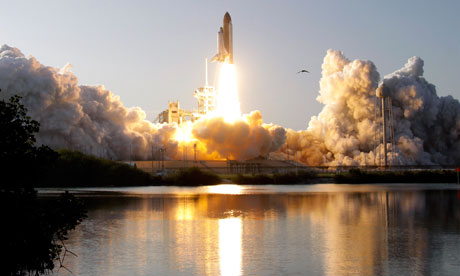
Space shuttle Discovery lifts off from the Cape Canaveral. Photograph: Chris O'Meara/AP

The US shuttle Discovery has launched from the Kennedy Space Center for the last time. The orbiter roared into a bright blue Florida sky, leaving the pad at 1653 local time (2153 GMT).

Its 11-day mission will see it deliver a new store room and a sophisticated humanoid robot to the International Space Station (ISS). Only two further flights remain by Endeavour and Atlantis, which Nasa is trying to see concluded this year.

The orbiter fleet is then expected to retire to museums.

….. First launched in 1984, this is its 39th outing. When it lands back on Earth in nearly two weeks’ time it will have covered a cumulative career distance of 230 million km (143 million miles). That’s further than the distance from the Earth to the Sun (149 million km).

Once the shuttles are retired, the plan is for US astronauts to fly to the space station on Russian Soyuz rockets until perhaps the middle of the decade.

Related:

Space shuttle Discovery prepares for final mission

JAXA to go fishing for space debris

February 13, 2011

Space junk: image discovery.com

http://www.jaxa.jp/projects/engineering/research/index_e.html

From the Telegraph

The Japan Aerospace Exploration Agency (JAXA) and Nitto Seimo Co aim to tackle the increasingly hazardous problem of rubbish in orbit around the Earth damaging space shuttles and satellites once and for all.

Last year, a US report concluded that space was so littered with debris that a collision between satellites could set off an “uncontrolled chain reaction” capable of destroying the communications network on Earth. It is estimated there are 370,000 pieces of space junk.

The Japanese plan will see a satellite attached to a thin metal net spanning several kilometres launched into space. The net is then detached, and begins to orbit earth, sweeping up space waste in its path.

During its rubbish collecting journey, the net will become charged with electricity and eventually be drawn back towards earth by magnetic fields – before both the net and its contents burn upon entering the atmosphere.

It is likely the nets will target the orbital paths of space shuttles which are constantly monitored for debris.

It is thought that the net will remain in orbit for several weeks, collecting enough rubbish to make the trip financially worthwhile, before sending another net into space.

Inspired by a basic fishing net concept, the super-strong space nets have been the subject of extensive research by Nitto Seimo for the past six years and consist of three layered metal threads, each measuring 1mm diameter and intertwined with fibres as thin as human hair.

The company, which became famous for inventing the world’s first machine to make strong knotless fishing nets in 1925, is aiming for the fuel-free system to be completed within two years.


Space shuttle Discovery prepares for final mission

February 1, 2011

Only 3 more flights – money permitting – for an iconic series of space craft before they are retired.

BBC:

The US shuttle Discovery has rolled out for what should be its final mission. The orbiter completed its slow journey to the Kennedy Space Center’s Launch Pad 39A overnight, Monday into Tuesday.

Discovery’s flight to the space station is scheduled to begin on 24 February. With its crew of six astronauts, the ship will deliver a storeroom to be attached to the 350km-high platform, along with further supplies and spares.

NASA last tried to launch the vehicle in November but technical hitches, including cracks on its giant external fuel tank, kept the ship on the ground. The agency said engineers had now fixed those defects and carried out further work to strengthen the tank.

President Barack Obama and the US Congress have determined that the shuttle fleet should be retired this year. Discovery is the oldest of the three surviving orbiters. First launched in 1984, it has since completed 38 missions, travelling some 230 million km in the process. Endeavour is expected to fly to the station in April. Atlantis will go no earlier than June, if Nasa has sufficient money left in its shuttle programme budget.

Following the fleet’s retirement, the plan is for US astronauts to fly to the space station on Russian Soyuz rockets until perhaps the middle of the decade.

Discovery

Space shuttle Discovery : image NASA


25 years since Challenger exploded; almost 8 years since Columbia was destroyed

January 28, 2011

The Space Shuttle Challenger’s maiden flight was on 4th April, 1983, and it completed nine missions before breaking apart 73 seconds after the launch of its tenth mission, STS-51-L on 28th January, 1986.

A sombre anniversary today.

A special ceremony is taking place at the Kennedy Space Center’s visitor complex this morning. Members of the NASA family and the public will gather to honor those who died aboard space shuttle Challenger.

Twenty-five years ago the STS-51L crew boarded Challenger for a six-day flight. It was just after liftoff when things went wrong. Challenger was in the air for 73 seconds before the orbiter exploded. …. According to investigators’ findings, the cause of the explosion was an O-ring that failed in one of the solid rocket boosters. Cold weather was cited as a contributing factor.

File:Challenger explosion.jpg

The breakup of the space shuttle Challenger: 28th January 1986: Wikipedia

Challenger crew; El Onizuka,Christa McAuliffe, Greg Jarvis, Judy Resnik, Mike Smith, Dick Scobee, Ron McNair: image christa.org

Today is also 4 days short of 8 years since the space shuttle Columbia was destroyed during rentry.

Space Shuttle Columbia (NASA Orbiter Vehicle Designation: OV-102) was the first spaceworthy Space Shuttle inNASA’s orbital fleet. First launched on the STS-1 mission, the first of the Space Shuttle program, it completed 27 missions before being destroyed during re-entry on February 1, 2003 near the end of its 28th, STS-107. All seven crew members were killed.

The investigation found that 82 seconds after launch a large piece of foam insulating material from the external tank broke free and struck the leading edge of the shuttle’s left wing, damaging the protective carbon heat shielding panels. This damage allowed super-heated gases to enter the wing structure during re-entry into the Earth’s atmosphere and caused the destruction of the Columbia.

Columbia was commanded by Rick Husband and piloted by William McCool. The mission specialists were Michael Anderson, Kalpana Chawla, David Brown, Laurel Clark; and the payload specialist was Israeli astronaut Ilan Ramon: image NASA

Currently the 3 operational orbiters are the

Space Shuttles Discovery, Atlantis anEndeavour.


Another form of life based on Arsenic?

December 2, 2010
The Arecibo message as sent 1974 from the Arec...

The Arecibo message as sent 1974: image via Wikipedia

The Telegraph  has an eye-catching headline (naturally):

‘Life as we don’t know it’ discovery could prove existence of aliens

But even without the exaggerations and the splash headlines, the possible existence of a form of life intimately connected with Arsenic would have enormous consequences on the definition and abundance of life in the universe and on how to go about searching for extra-terrestrial life.

NASA has sent the internet into a frenzy after it announced an “astrobiology finding” that could suggest alien life exists – even on earth.

The discovery could prove the theory of “shadow” creatures which exist in tandem with our own and in hostile environments previously thought uninhabitable. The “life as we don’t know it” could even survive on hostile planets and develop into intelligent creatures such as humans if and when conditions improve. In a press conference scheduled for tomorrow evening, researchers will unveil the discovery of a microbe that can live in an environment previously thought too poisonous for any life-form to survive.

The bacteria has been found at the bottom of Mono Lake in California’s Yosemite National Park which is rich in arsenic – usually poisonous to life.

Somehow the creature uses the arsenic as a way of surviving and this ability raises the prospect that similar life could exist on other planets, which do not have our benevolent atmosphere. Dr Lewis Dartnell, an astrobiologist at the Centre for Planetary Sciences in London, said: “If these organisms use arsenic in their metabolism, it demonstrates that there are other forms of life to those we knew of. “They’re aliens, but aliens that share the same home as us.”

The Brisbane Times reports:

The US space agency has created a buzz with its announcement of a press conference early tomorrow morning (Australian time) to discuss a scientific finding that relates to the hunt for life beyond the planet Earth.

“NASA will hold a news conference at 2pm EST (6am AEDT) to discuss an astrobiology finding that will impact the search for evidence of extraterrestrial life,” it said on its website.

But Nasa has declined to elaborate further on the topic, other than to say astrobiology is the ”study of life in the universe, including its origin and evolution, where it is located and how it might survive in the future”. The vague announcement has sent the blogosphere in a flurry of speculation about its potential meaning.

Blogger Jason Kottke tipped NASA would announce the discovery of arsenic on Titan, or possibly chemical evidence of bacteria utilising it for photosynthesis.

That speculation was quickly picked up and repeated by a number of other bloggers and internet sites. However Kottke theory has been rebuffed by Alexis Madrigal, senior science writer for The Atlantic, who tweeted that he had read the Science article relating to the Nasa announcement. ”I’m sad to quell some of the @kottke-induced excitement about possible extraterrestrial life. I’ve seen the Science paper. It’s not that,” he tweeted.

The American Association for the Advancement of Science, which publishes the journal in which the research will appear, told ABC News in the US that it had received numerous inquiries about the “mostly erroneous online and/or tabloid speculation about the forthcoming research”.

For NASA TV streaming video and downlink information, visit: http://www.nasa.gov/ntv at 2pm EST today (2nd December).

Oxygen – carbon dioxide atmosphere found on Saturn’s moon Rhea

November 27, 2010

From The New Scientist:

On its journey around Saturn and its moons, the Cassini mission – jointly run by NASA and the European Space Agency – has made another breathtaking discovery. The findings, published in Science (DOI: 10.1126/science.1198366), show that Rhea, the second biggest moon of the giant planet, has an atmosphere that is 70 per cent oxygen and 30 per cent carbon dioxide. This adds to the picture of Rhea that Cassini has already provided by imaging its craters anddiscovering its rings.

“This really is the first time that we’ve seen oxygen directly in the atmosphere of another world”, Andrew Coates, from University College London’s Mullard Space Science Laboratory, told The Guardian. Layers containing oxygen had already been detected around the Jovian moons Europa and Ganymede in the 1990s, but only from a distance using NASA’s Hubble Space Telescope.

This time, Cassini’s instrument had the chance to “smell” that oxygen, as it flew through it over Rhea’s north pole, just 97 kilometres above the surface, according to the details given on Space.com. This layer – with an oxygen density probably about 5 trillion times less than on Earth – was “too thin to be remotely detected”, said Ben Teolis of the Southwest Research Institute in San Antonio.

These three views of Saturn's moon Rhea from NASA's Cassini spacecraft are enhanced to show colorful splotches and bands on the icy moon's surface. New observations have shown Rhea has an oxygen-rich atmosphere. Credit: NASA/JPL/SSI/LPI

Cassini Finds an Oxygen–Carbon Dioxide Atmosphere at Saturn’s Icy Moon Rhea B. D. Teolis, G. H. Jones, P. F. Miles, R. L. Tokar, B. A. Magee, J. H. Waite, E. Roussos, D. T. Young, F. J. Crary, A. J. Coates, R. E. Johnson, W.-L. Tseng and R. A. Baragiola

Science DOI: 10.1126/science.1198366, Published Online 25 November 2010

Abstract: The flyby measurements of the Cassini spacecraft at Saturn’s moon Rhea reveal a tenuous oxygen–carbon dioxide atmosphere. The atmosphere appears to be sustained by chemical decomposition of the surface water ice under irradiation from Saturn’s magnetospheric plasma. This in situ detection of an oxidizing atmosphere is consistent with remote observations of other icy bodies such as Jupiter’s moons Europa and Ganymede, and suggestive of a reservoir of radiolytic O2 locked within Rhea’s ice. The presence of CO2suggests radiolysis reactions between surface oxidants and organics, or sputtering and/or outgassing of CO2endogenic to Rhea’s ice. Observations of outflowing positive and negative ions give evidence for pickup ionization as a major atmospheric loss mechanism.

New pictures show the return of Jupiter’s lost stripe

November 26, 2010

In May this year one of Jupiter’s characteristic stripes (the South Equatorial Belt) disappeared. Then  two weeks ago a turbulent plume was observed breaking through the giant planet’s cloudtops in the south equatorial zone heralding the possible re-emergence of the stripe.

Now the latest infrared pictures of Jupiter show the turbulent plume developing into a “trail” suggesting that the SEB is re-emerging from under the ammonia clouds. The BBC reports:

Jupiter's returning stripe highlighted (JPL, University of Oxford, UC Berkeley, Gemini Observatory, University of San Carlos)

Jupiter's returning stripe highlighted (JPL, University of Oxford, UC Berkeley, Gemini Observatory, University of San Carlos)

The South Equatorial Belt had blended into surrounding white clouds but an “outbreak” spotted by an amateur astronomer heralds the stripe’s return. The stripe’s disappearing act is due to clouds shifting altitudes, with white ammonia clouds obscuring clouds below. This performance will give astronomers their first chance to study the weather and chemistry behind the phenomenon.

As part of the show, the Great Red Spot has darkened, but astronomers say it will lighten again as the South Equatorial Belt comes back. The stripe has come and gone several times in recent decades but the mechanism by which it returns remains mysterious. The first signs of the return were spotted by Christopher Go of the Philippines and was confirmed by the Infrared Telescope Facility and Gemini and Keck telescopes in Hawaii.

“At infrared wavelengths, images in reflected sunlight show that the spot is a tremendously energetic ‘outburst,’ a vigorous storm that reaches extreme high altitudes,” said Imke de Pater, professor of astronomy at the University of California, Berkeley. “The storms are surrounded by darker areas, bluish-grey in the visible, indicative of ‘clearings’ in the cloud deck.”

Spaceport America gets ready for first commercial passengers to space

November 18, 2010
Simplistic map of Sierra County, New Mexico, i...

Location of Spaceport America: image via Wikipedia

Reuters reports:

The New Mexico Spaceport Authority, which plans to start launching citizen astronauts on suborbital flights within 18 months, has begun soliciting contract bids from local businesses for day-to-day operations of the facility.

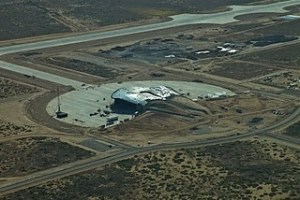
Construction of the world’s first commercial passenger space terminal, dubbed Spaceport America, is slated to be finished next year near the town of Truth or Consequences in southern New Mexico. The 2-mile-long main runway was completed in October.

Spaceport America Wednesday, 10 November 2010 04:09 :image spaceportamerica.com

Two other major structures nearing completion at the nearly $200 million facility are the air-fire rescue facility and a 110,000-square-foot hangar, authority spokesman David Wilson said.

To date, 380 wannabe space cowboys have each plunked down $200,000 each to reserve a seat aboard a Virgin Galactic six-passenger spacecraft for a 2-1/2-hour suborbital flight some 70 miles above the Earth, Wilson said.

Under a 20-year lease with the state, Richard Branson’s firm is Spaceport America’s anchor tenant and principal spaceliner, paying lease charges of up to $200 million, plus user fees to operate their own aircraft and to contract with other aerospace companies.

The site has been providing commercial launch services for the aerospace industry since 2006 and is expected to be fully operational by mid-2011. But Virgin Galactic expects to take another year to begin its private passenger service, once its test-flight program is complete.

The authority’s executive director, Rick Homans, this week issued a call for businesses to submit proposals for three major areas of operation of the spaceport.

They include general services, such as maintenance; protective services for site security, safety and environment health management; and technical services, including airfield and launch support, airspace management and flight safety engineering.

Artists impression of Virgin Galactic: image forums.finalgear.com

Virgin Galactic’s VSS Enterprise made its solo flight in October.