Archive for the ‘Space’ Category
November 16, 2010
In May this year, one of Jupiter’s characteristic stripes – the South Equatorial Belt (SEB) disappeared.
http://science.nasa.gov/science-news/science-at-nasa/2010/20may_loststripe/
May 20, 2010: In a development that has transformed the appearance of the solar system’s largest planet, one of Jupiter’s two main cloud belts has completely disappeared. Known as the South Equatorial Belt (SEB), the brown cloudy band is twice as wide as Earth and more than twenty times as long. The loss of such an enormous “stripe” can be seen with ease halfway across the solar system.

These side by side images of Jupiter taken by Australian astrophotographer Anthony Wesley show the SEB in August 2009, but not in May 2010.Individual images: Aug. 4, 2009; May 8, 2010.
Anthony Wesley is a veteran observer of Jupiter, famous for his discovery of a comet hitting the planet in 2009. Like many other astronomers, he noticed the belt fading late last year, “but I certainly didn’t expect to see it completely disappear,” he says. “Jupiter continues to surprise.” Planetary scientist Glenn Orton of NASA’s Jet Propulsion Lab thinks the belt is not actually gone, but may be just hiding underneath some higher clouds.
“It’s possible,” he hypothesizes, “that some ‘ammonia cirrus’ has formed on top of the SEB, hiding the SEB from view.” On Earth, white wispy cirrus clouds are made of ice crystals. On Jupiter, the same sort of clouds can form, but the crystals are made of ammonia (NH3) instead of water (H2O).
But now the SEB may be breaking through again.
http://www.spaceweather.com/
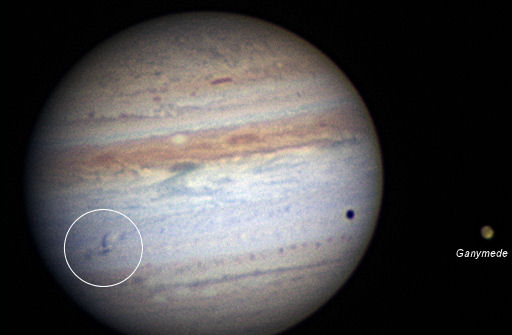
Tuesday, Nov. 16, 2010: A turbulent plume is breaking through the giant planet’s cloudtops in the south equatorial zone, heralding the emergence of … what? This Nov. 14th photo from astrophotographer Paul Haese of Glenalta, South Australia shows the plume.

The SEB revival is now underway. Tonight I captured the revival transiting the face of Jupiter. To boot I was lucky enough to include Ganymede with detail and Europa's shadow after a double transit. What a night. Taken with peltier cooled C14 and Skynyx 2-0: Paul Haese
The plume, circled in Haese’s photo and known to astronomers as the “SEB Revival Spot,” is a sign that Jupiter’s South Equatorial Belt (SEB) is about to return. The great brown belt disappeared earlier this year, leaving Jupiter without one of its signature stripes. No one knows where the SEB went, although some researchers have speculated that it sank beneath high altitude clouds and might now be bobbing back to the top.
Christopher Go of the Philippines first noticed the Revival Spot on Nov. 9th. At first it was small and white and required careful astrophotography to detect. Only five days later, it is expanding rapidly and darkening; soon, it could become visible to novices in the eyepieces of backyard telescopes.
Tags:Jupiter, Jupiter's stripes, SEB, Solar System, South Equatorial Belt
Posted in Astronomy, Geosciences, Science, Space | 2 Comments »
November 16, 2010
The particles found in Hayabusa have now been confirmed to be extra-terrestrial from the asteroid 25143 Itokawa.
Nikkei News reports:

Capsule from the Hayabusa probe contained particles from the Itokawa asteroid (Kyodo)
The Japan Aerospace Exploration Agency said Tuesday it has confirmed that the particles retrieved from the Hayabusa unmanned space probe after its seven-year space trip are from the asteroid Itokawa.
JAXA says the roughly 1,500 particles it analyzed using electron microscopes are totally different from substances found on Earth. The particles measure only about 10 micrometers in diameter.
The Hayabusa probe is the first exploratory spacecraft to land on a celestial body other than the Moon and then return to Earth.
Tags:25143 Itokawa, extra-terrestrial particles, Hayabusa, Japan Aerospace Exploration Agency, Space probe
Posted in Astronomy, Japan, Science, Space | Comments Off on Hayabusa particles are extra-terrestrial
November 11, 2010
Earlier this year it became clear the the son of Hubble the James Webb Space Telescope, was late and over budget. Costs had ballooned to 5 billion dollars (from the earlier 3.5 billion dollars) and launch was expected in 2014. It has now been acknowledged that costs will be not less than 6.5 billion dollars and launch even in 2015 is optimistic. The management is now being changed and reorganised.
The BBC has the story:
The scale of the delay and cost overrun blighting Nasa’s James Webb Space Telescope has been laid bare by a panel called in to review the project. The successor to Hubble will probably cost at least $6.5bn to launch and operate, and may get into orbit by September 2015.
But even that assessment is optimistic, say the panel members. The head of the US space agency has accepted that “cost performance and coordination have been lacking”. Charles Bolden has ordered a reorganising of the project and has changed the management at its top. Estimates for JWST’s total cost to build, launch and operate have steadily increased over the years from $3.5bn to $5bn. Along with the cost growth, the schedule has also eroded.
The most recent projected launch of 2014 has looked under pressure for some time. The independent panel chaired by John Casani of Nasa’s Jet Propulsion Laboratory (JPL) in Pasadena, California, believes it to be unrealistic. The group was convened to examine the root causes of JWST’s problems. It found the original budget for the project to be insufficient and poorly phased, and blamed the management for failing to pick up and deal with the issue.
“This is a very large complex project and to estimate something with any real degree of precision that’s never been done before is a tough job,” John Casani told reporters. “But the bottom line is that there was never enough money in the budget to execute the work that was required. The panel did however commend the technical success of the project. Mr Casani said the technology on JWST was in “very good shape”. The telescope was always regarded as major undertaking. Its primary mirror is 6.5m (21ft) across – close to three times wider than Hubble’s. The huge reflector will sit behind an even more expansive sun shield, the area of a tennis court. This structure will protect the observatory from radiation from the Sun and the Earth. Whereas Hubble sees the Universe mostly in visible light, JWST will observe the cosmos at longer wavelengths, in the infrared. It will see deeper into space and further back in time, to the very first population of stars.
When it is finally built, it will be launched on Europe’s Ariane 5 rocket and sent to an observing position 1.5 million km from Earth. It is expected to have a 10-year lifespan. Its distance from Earth means the telescope cannot be serviced by astronauts, as was the case with Hubble.
Tags:Hubble Space Telescope, James Webb Space Telescope, NASA, Project delays and cost over-runs
Posted in Astronomy, Engineering, Science, Space, Technology | Comments Off on Son of Hubble may not launch till after 2015
November 8, 2010
Xinhua reports the success of the Chang’e-2 mission.
Chinese Premier Wen Jiabao Monday unveiled the first pictures of the moon’s Sinus Iridum, or Bay of Rainbows, marking the success of China’s Chang’e-2 lunar probe mission.

Chinese Premier Wen Jiabao attends an unveiling ceremony for pictures of the moon's Sinus Iridum, or Bay of Rainbows, taken and sent back by the Chang'e-2, China's second lunar probe, in Beijing, capital of China, Nov. 8, 2010. (Xinhua/Huang Jingwen)
The pictures were taken and sent back by the Chang’e-2, China’s second lunar probe, which was launched on October 1.
Chang’e-2 entered into its final 118 min orbit and formally started its mission of mapping the moon and preparing the way for Chang’e-3 on October 9th.
Tags:Chang'e 2, China, Exploration of the Moon, First pictures from Chang'e-2, Sinus Iridium, Wen Jiabao
Posted in China, Lunar science, Science, Space | Comments Off on Chinese Premier Wen Jiabao unveils Chang’e-2 pictures
November 6, 2010

Discovery approaching ISS:Image by TopTechWriter.US via Flickr
BBC News:
The final mission of the space shuttle Discovery has been postponed again because of a fuel leak. After 26 years of service, the vehicle is due to make one last flight to the International Space Station (ISS) before being retired to a museum. Escaping hydrogen detected midway through fuelling left Nasa no choice but to stand Discovery down once more.
The agency is now planning a launch date on 30 November, to give plenty of time to fix the leak. Nasa has simply run out of time in the current launch window, which ends on Monday. There then follows a three-and-a-half-week period of unfavourable sun angles at the orbiting platform that make a docking very difficult because of the heating experienced by an approaching shuttle. The leak occured at the ground umbilical carrier plate, an attachment point between the external tank and a 18cm pipe that carries vented hydrogen safely away from Discovery to a flare stack, where it is burned off. Discovery’s six astronauts had yet to board the spaceplane when the leak was detected. When the ship does get up, she will deliver a storeroom to be attached to the ISS, along with much needed supplies and spares.
Discovery is the oldest of the surviving ships. First launched in 1984, it has since completed 38 missions, travelling some 230 million kilometres in the process. Its commander on the final mission, Steve Lindsey, says Discovery is probably the most important of three remaining shuttles. “It is obviously a very historical vehicle, having flown the ‘return to flight’ test missions after both the Challenger and Columbia accidents,” he said. “It deployed Hubble (and) it’s the fleet leader in terms of number of flights – it’ll have flown about a year on orbit by the time we’re done with it, which is pretty remarkable for a space shuttle.”
After Discovery returns, only the Endeavour shuttle has a firm date to launch, in February next year. Atlantis could fly in June if the budget allows. Beyond that, American astronauts will use Russian Soyuz rockets to get into space until a range of commercial US launch systems are introduced in the middle of the decade.
Robonaut 2, a dexterous, humanoid astronaut helper, will fly to the International Space Station aboard space shuttle Discovery on the STS-133 mission.
Tags:International Space Station, NASA, Robonaut 2, Space Shuttle Discovery
Posted in Engineering, Science, Space | Comments Off on Discovery’s final mission delayed till end November
November 2, 2010
Update!
The U.S. National Aeronautics and Space Administration (NASA) Wednesday greenlighted a launch of space shuttle Discovery on Thursday 4th November, to begin its 11-day mission to the International Space Station. The Prelaunch Mission Management Team (MMT) now is confident since a main engine controller problem on Discovery has been solved, said Mike Moses, chairman of the MMT. Therefore, the team gave a unanimous “go” for Discovery’s launch due to start at 3:29 p.m. EDT (1929 GMT) on Thursday.
Robonaut 2, a dexterous, humanoid astronaut helper, will fly to the International Space Station aboard space shuttle Discovery on the STS-133 mission. Although it will initially only participate in operational tests, upgrades could eventually allow the robot to realize its true purpose — helping spacewalking astronauts with tasks outside the space station.

Face-off with Robonaut 2: Image Credit: NASA/JSC Robert Markowitz
Associated Press:
CAPE CANAVERAL, Fla. (AP) — NASA celebrated 10 years of continuous human presence at the International Space Station on Tuesday while readying shuttle Discovery for one last trip into orbit. Lift off is set for Wednesday afternoon.
Discovery is bound for the space station, currently home to six U.S. astronauts and Russian cosmonauts who fielded calls of congratulations on this special anniversary.
Breaking !
On Tuesday an electrical problem cropped up again aboard space shuttle Discovery and could jeopardize Wednesday’s launch. The trouble appears to be with a backup controller for one of the shuttle’s three main engines. NASA ordered last-minute reviews and hurriedly scheduled a mid-afternoon meeting of top managers.
A NASA spokeswoman said it’s too soon to know whether Wednesday afternoon’s planned launch will remain on track. Discovery’s final launch originally was scheduled for Monday, but was delayed by shuttle gas leaks.
The controller was sluggish early Tuesday morning. But after turning a circuit breaker and switch on and off several times, everything seemed to be fine. Later, voltage irregularities were noted.
Tags:International Space Station, NASA, Robonaut 2, robotics, Space Shuttle Discovery, STS-133
Posted in Engineering, Science, Space | 1 Comment »
October 29, 2010
Xinhua reports
Scientists successfully activated four attitude control engines on Chang’e-2 and sent the satellite into the orbit with a perilune of just 15 kilometer above the moon, according to a flight control official in Beijing. It will photograph the Bay of Rainbows region with its CCD cameras from Wednesday, according to the center.
NASA has revived 2 satellites that were dying and sent them to the moon creating the ARTEMIS mission:
A pair of NASA spacecraft that were supposed to be dead a year ago are instead flying to the Moon for a breakthrough mission in lunar orbit. “Their real names are THEMIS P1 and P2, but I call them ‘dead spacecraft walking,'” says Vassilis Angelopoulos of UCLA, principal investigator of the THEMIS mission. “Not so long ago, we thought they were goners. Now they are beginning a whole new adventure.”
The story begins in 2007 when NASA launched a fleet of five spacecraft into Earth’s magnetosphere to study the physics of geomagnetic storms. Collectively, they were called THEMIS, short for “Time History of Events and Macroscale Interactions during Substorms.” P1 and P2 were the outermost members of the quintet. Working together, the probes quickly discovered a cornucopia of previously unknown phenomena such as colliding auroras, magnetic spacequakes, and plasma bullets shooting up and down Earth’s magnetic tail. These findings allowed researchers to solve several longstanding mysteries of the Northern Lights.
The mission was going splendidly, except for one thing: Occasionally, P1 and P2 would pass through the shadow of Earth. The solar powered spacecraft were designed to go without sunlight for as much as three hours at a time, so a small amount of shadowing was no problem. But as the mission wore on, their orbits evolved and by 2009 the pair was spending as much as 8 hours a day in the dark. “The two spacecraft were running out of power and freezing to death,” says Angelopoulos. “We had to do something to save them.”
Because the mission had gone so well, the spacecraft still had an ample supply of fuel–enough to go to the Moon. “We could do some great science from lunar orbit,” he says. NASA approved the trip and in late 2009, P1 and P2 headed away from the shadows of Earth.
With a new destination, the mission needed a new name. The team selected ARTEMIS, the Greek goddess of the Moon. It also stands for “Acceleration, Reconnection, Turbulence and Electrodynamics of the Moon’s Interaction with the Sun.”
The first big events of the ARTEMIS mission are underway now. On August 25, 2010, ARTEMIS-P1 reached the L2 Lagrange point on the far side of the Moon. Following close behind, ARTEMIS-P2 entered the opposite L1 Lagrange point on Oct. 22nd. Lagrange points are places where the gravity of Earth and Moon balance, creating a sort of gravitational parking spot for spacecraft.

The ARTEMIS spacecraft are currently located at the L1 and L2 Earth-Moon Lagrange points: NASA
http://science.nasa.gov/science-news/science-at-nasa/2010/27oct_artemis/
Tags:ARTEMIS, Chang'e 2, Lunar orbit, Moon, NASA
Posted in Astronomy, Lunar science, Science, Space | Comments Off on Lunar activity: Chang’e-2 starts mission and Nasa revives 2 satellites
October 22, 2010
The New York Times reports on the latest results from the $79 million Lcross mission. Last October, as it neared impact, the Lcross spacecraft released the empty second stage and slowed down slightly so that it could watch the stage’s 5,600-mile-per-hour crash into a 60-mile-wide, 2-mile-deep crater named Cabeus.

Debris ejected from the Cabeus lunar crater about 20 seconds after the Lcross impact: image Science / AAAS
A series of articles reporting the Lcross results appear in Friday’s issue of the journal Science.
Last November, the team reported that the impact had kicked up at least 26 gallons of water, confirming suspicions of ice in the craters. The new results increase the water estimate to about 40 gallons, and by estimating by amount of dirt excavated by the impact, calculated the concentration of water for the first time. The Sahara sands are 2 to 5 percent water, and the water is tightly bound to the minerals. In the lunar crater, which lies in perpetual darkness, the water is in the form of almost pure ice grains mixed in with the rest of the soil, and is easy to extract. The ice is about 5.6 percent of the mixture, and possibly as high as 8.5 percent of it, Dr. Colaprete principal investigator of NASA’s Lunar Crater Observation and Sensing Satellite — Lcross – said.
In lunar terms, that is an oasis, surprisingly wet for a place that had long been thought by many planetary scientists to be utterly dry. If astronauts were to visit this crater, they might be able to use eight wheelbarrows of soil to melt 10 to 13 gallons of water. The water, if purified, could be used for drinking, or broken apart into hydrogen and oxygen for rocket fuel — to get home or travel to Mars.
Also surprising was the cornucopia of other elements and molecules that Lcross scooped out of the Cabeus crater, near the Moon’s south pole. Lying in perpetual darkness, the bottom of Cabeus, at minus 370 degrees Fahrenheit, is among the coldest places in the solar system and acts as a “cold trap,” collecting a history of impacts and debris over perhaps a couple of billion years.
“This is quite a reservoir of our cosmic climate,” said Peter H. Schultz, a professor of geological sciences at Brown University and lead author of one of the Science papers. “It reflects things that hit the Moon.”
By analyzing the spectrum of infrared light reflected off the debris plume, Dr. Schultz and his colleagues identified elements like sodium and silver.
Tags:Cabeus crater, LCROSS, Lunar water, Moon, NASA
Posted in Lunar science, Science, Space | Comments Off on Lunar crater “Cabeus” contains more water than the Sahara
October 15, 2010
The German aerospace centre announced today that
On 14 October 2010, the radar satellite TanDEM-X moved into close formation with its ‘twin’, TerraSAR-X. Before this, the two satellites were orbiting 20 kilometres apart – a flight time of almost three seconds. Now, there are only 350 metres separating the pair, which means their antennas are able to acquire radar images of the same area simultaneously.

Premiere – TerraSAR-X and TanDEM-X now flying in close formation
The objective of the mission is to create a high-precision, three-dimensional digital elevation model of Earth’s land surface. The project needs the satellites to operate in parallel for a period of three years. The transition to close formation flight marks the beginning of the final preparatory stage of the TanDEM-X mission. The routine operations phase is due to start in early January next year.
The TerraSAR-X and TanDEM-X orbit trajectories, patented by DLR researchers, are like the strands of a double helix – they circle around one another without crossing. The team of scientists based in DLR Oberpfaffenhofen took just three days to carry out the approach in preparation for the final formation flight. “First, we had to manoeuvre TanDEM-X to reduce its orbital period, so that the satellite could ‘catch up’, reducing the 20 kilometre gap between it and TerraSAR-X. After two further manoeuvres we brought the distance between the pair down to 350 metres,” explains DLR flight dynamics expert Ralph Kahle.
The reduced distance between the satellites means that the two radar systems can be synchronised for the first time. TerraSAR-X and TanDEM-X can also monitor each other’s ‘health’ via an inter-satellite link. “This is completely uncharted territory. Never before have two satellites worked in such close formation over a period of several years,” says Manfred Zink, Project Manager for the TanDEM-X Ground Segment. Eckard Settelmeyer, Director of Earth Observation and Science at Astrium, adds: “This dual mission will give another boost to satellite-supported applications and science.”
Read the whole article:
http://www.dlr.de/en/desktopdefault.aspx/tabid-1/117_read-27086/
Tags:Digital elevation model, Satellite, satellite mapping, TanDEM-X, TerraSAR-X
Posted in Cartography, Geosciences, Germany, Space | Comments Off on German twin satellites now orbiting in close formation
October 14, 2010

Chang'e flies to the moon: Image via Wikipedia
After requiring only one course correction en route to the moon the fuel left on board Chang’e-2 keeps open all its future options after it completes its 6 month mission. Since Chang’e-1 was already crashed intentionally onto the moon, a return to earth or a flight into outer space are more likely than another descent to the moon’s surface. If the instruments remain in working order a continued flight past other targets in space could be more rewarding than a tame return to Earth.
Xinhua reports:
Chang’e-2 was carried into lunar orbit by a rocket, and only corrected once during the transfer from earth orbit to lunar orbit, so a large amount of fuel will be left after its mission, Zhou Jianliang, the vice chief-designer of BACC, said.
It is s expected to have enough fuel to fly back to earth, the vice chief-designer of the Beijing Aerospace Control Center (BACC) said Tuesday.
Zhou said there are three possible “fates” for Chang’e-2 after it finishes its six-month mission: landing on the moon; flying to outer space; or returning to earth. The fate of Chang’e-2 will be decided according to its condition when the mission is complete.
The Long March-3C carrier rocket took Chang’e-2 into space from southwest China on Oct. 1. The probe completed its final braking on Oct. 9 and is now orbiting the moon at a 100 km-high orbit.
Tags:Chang'e 2, Lunar exploration, Moon, Outer space
Posted in Climate, Space | Comments Off on Flight accuracy gives Chang’e-2 new options



 The k2p blog