Archive for the ‘Technology’ Category

Will I be able to buy a “car which drives me” when I am 80?

March 20, 2026

When I bought my current car (hybrid Mercedes E) a few years ago I predicted that “it would be the last car I bought which I would drive. My next car would need to drive me”. Around 2028 would probably be the right time to get a new car. In two years I will be 80. I can already observe my reactions slowing, attention span shortening, hearing slowly deteriorating and muscle memory slackening. By then a “car which drives me” may well be a necessity.


The SAE International (Society of Automotive Engineers) standard J3016 defines six levels of driving automation, ranging from Level 0 (no automation) to Level 5 (full automation).

Level 0: No Automation 

  • The human driver is fully responsible for all aspects of driving, including steering, braking, and accelerating.
  • Systems: May include warnings (lane departure, blind spot) or momentary interventions like Automatic Emergency Braking (AEB).
  • Driver Role: Full-time performance of all driving tasks.

Level 1: Driver Assistance 

  • The vehicle features a single automated system that assists with either steering or speed (acceleration/braking), but not both at once.
  • Examples: Adaptive Cruise Control (ACC) or Lane Keeping Assist.
  • Driver Role: Must monitor the road at all times and perform all other driving tasks.

Level 2: Partial Driving Automation 

  • The system can control both steering and speed simultaneously under certain conditions.
  • Examples: Tesla Autopilot, GM Super Cruise, and Ford BlueCruise.
  • Driver Role: Must remain fully engaged, monitor the environment, and be ready to take over instantly.

Level 3: Conditional Driving Automation 

  • The vehicle handles all driving tasks under specific, limited conditions (e.g., traffic jams), allowing the driver to disengage from monitoring.
  • Example: Mercedes-Benz DRIVE PILOT.
  • Driver Role: Must be available to resume control when requested. [5, 10, 11, 12]

Level 4: Full Automation

  • The vehicle operates autonomously within defined, geofenced zones, not requiring human intervention for driving tasks, as defined in SAE standards.
  • Examples: Robotaxis from companies like Waymo.
  • Driver Role: None required within the designated area.

Level 5: High Driving Automation

  • Level 5 vehicles require no human attentionand the driver is eliminated.
  • No steering wheels or acceleration/braking pedals, free from geofencing, able to go anywhere and do anything that an experienced human driver can do.
  • Fully autonomous cars are undergoing testing in several pockets of the world.

Currently, no truly “fully autonomous” cars (FSD or Level 5) that can drive anywhere without any human intervention are available for general sale. However, several come close and offer advanced semi-autonomous systems that could be called Supervised Fully Self Driving.
Tesla is the only manufacturer currently selling a system marketed as “Full Self-Driving” (FSD) across its entire consumer lineup. The videos I have seen demonstrate remarkable autonomy but it is formally (legally) still classified as Level 2 and must have constant driver supervision.

  • Tesla self-classifies its systems (including FSD Supervised) as SAE Level 2 in communications with regulators.
  • NHTSA investigations and documents treat Tesla’s systems as Level 2 partial automation, requiring a fully attentive driver.
  • Level 2 systems face fewer strict regulations than higher levels (e.g., no special exemptions needed for deployment, unlike Level 3+), which is why they are the strategic choice to get the necessary approvals while gaining customer acceptance.
File:Tesla logo.png - Wikimedia Commons
Tesla “Full Self-Driving” (FSD) (Supervised)
  • Available Models: All current Tesla production models, including:
    • Model 3
    • Model Y
    • Model S
    • Model X
    • Cybertruck
  • Key Capabilities: Navigation from point-to-point on city streets and highways, responding to traffic lights and stop signs, and automated lane changes.
  • Global Availability: Currently available in the U.S., Canada, China, Mexico, Puerto Rico, Australia, New Zealand, and South Korea.
Other Manufacturers with Advanced Autonomy
While only Tesla uses the “FSD” name, several other brands offer systems with similar or even more advanced (eyes-off) capabilities in specific regions:
File:Mercedes-Logo.svg - Wikimedia Commons
  • Mercedes-Benz (Level 3 – DRIVE PILOT): The first manufacturer to offer a certified Level 3 “eyes-off” system. 
    • Models: S-Class and EQS Sedan.
    • Availability: Limited to specific highways in California and Nevada (USA) and Germany.
  • BMW (Level 3 – Personal Pilot L3): Offers eyes-off driving at low speeds.
    • Model: 7-Series. 
    • Availability: Currently available only in Germany.
  • General Motors (Super Cruise): A robust hands-free highway system.
    • Models: Includes the Chevrolet Tahoe, GMC Hummer EV, and Cadillac Escalade.
    • Availability: North America (U.S. and Canada) on hundreds of thousands of miles of mapped highways.
  • Ford (BlueCruise): Hands-free highway driving.
    • Models: Mustang Mach-E, F-150, Expedition, and Explorer.
    • Availability: North America (U.S. and Canada).
Scheduled 2026 Models with High-Level Autonomy
Several specialized Level 4 vehicles (designed to drive without human intervention in defined zones) are slated for release or expanded private ownership in 2026:
  • Tesla Cybercab: A dedicated robotaxi without steering wheels or pedals, targeting volume production in 2026.
  • Tensor Robocar: Marketed as the world’s first personal Level 4 autonomous vehicle, built in partnership with VinFast and targeting the U.S., Europe, and UAE.
  • Lucid Gravity: Expected to offer Level 4 capabilities for private purchase through a partnership with Nuro.

If I were buying a car today I think the only available choice would be a Tesla (probably 80/20 in favour of a Model Y over a Cybertruck).

In 2 years though it could be a choice between a Mercedes and a Tesla (20/80 ?).


The last car I buy to drive myself

May 19, 2019

My current car is 10 years old. So, I have ordered my new car for delivery in September.

A hybrid with a petrol engine. Range on batteries alone – 60 km. Range with full batteries and full fuel tank is over 2,000 km. Self-parking (but which must be activated by the driver). “Driving assistance” to keep me awake and stop me from drifting on the highway, but has to be manually engaged. Automatic maintenance of distance from other cars when engaged. 360º vision cameras. Live satellite navigation assistance.

I am 71 now. I can feel my reaction times are slowing. My eyesight is still fine but glare at night on wet roads is increasingly bothersome. My neck hurts sometimes when reversing. I feel my concentration dipping on long journeys. My attention strays. With the various “assistances” now available, I reckon that I should be able to keep and drive this car for another 5 – 6 years. At that time -if I am still around – my faculties would, no doubt, have deteriorated further. But advances in technology are surging ahead and will compensate for my deficiencies. By then I expect very smart, virtually self-driving cars to have come a long long way.

This may not be the last car I buy for myself. But it probably is the last car I buy to drive myself.


My next car – if there is a next – will drive me. 


Boeing and the “manslaughter” of the 157 killed in the Ethiopian Air crash

March 14, 2019

A few days ago, I commented that:

If the Ethiopian Air crash is a repeat of the Lion Air crash then Boeing has blood on its hands

Well it now seems that Ethiopian crash was indeed a repeat.

And if that is so then there is clearly a case of “manslaughter” possible against Boeing for the 157 lives lost in the Ethiopian crash (though the deaths in the Lion Air crash would be due to “misadventure” rather than “manslaughter”).

BBC:

Dan Elwell, acting administrator at the FAA, said on Wednesday: “It became clear to all parties that the track of the Ethiopian Airlines [flight] was very close and behaved very similarly to the Lion Air flight.”

Up until Wednesday, the FAA position was that a review had showed “no systemic performance issues” and that there was no basis for grounding the aircraft.

Earlier in the day, Canada grounded the planes after its transport minister Marc Garneau said he had received new evidence about the crash.

He said that satellite data showed possible similarities between flight patterns of Boeing 737 Max planes operating in Canada and the Ethiopian Airlines plane that crashed.

The flight data is remarkably unstable.

Within the last 12 months I have replaced a phone, a pair of speakers and a router since replacement was cheaper than the diagnosis and repair of a fault. The sophistication of technology in a large number of human appliances (white goods, cars, phones and airplanes) is now such that faults can no longer be rectified by the user. The frequency of faults is declining but when the consequence is the loss of life, that provides no comfort. Specialists – and usually more than one – are needed. In many cases the fault cannot be diagnosed and the faulty appliance is just replaced — with another probably containing the same fault.


Stealth technology causes blindness?

August 28, 2017

In 2004, the aircraft carrier U.S.S. John F Kennedy ran over a dhow in the Persian Gulf.

Nothing untoward then till 2017:

  • In January, the guided-missile cruiser U.S.S. Antietam ran aground in Tokyo Bay. There were no casualties, but eleven hundred gallons of oil were dumped into the water.
  • May 9th the cruiser U.S.S. Lake Champlain collided with a fishing boat off the east coast of South Korea. Again, no casualties.
  • June 17th the destroyer U.S.S. Fitzgerald collided with a Filipino container ship in the waters off Japan. Seven sailors were killed, three more injured.
  • On 27th August, the U.S.S. John S McCain collided with a civilian oil tanker near Singapore. Ten sailors are missing, presumed dead. Five more sailors were injured.

A natural consequence of stealth technology?

If you think nobody else can see you, then you stop seeing others.


Fresh water scarcity will be a thing of the past

April 4, 2017

There is no shortage of water on earth. There is not even a shortage of fresh water resources. However there is a fundamental mismatch between the availability of fresh water and the centres of population. If sea water (or brackish water) can be converted into fresh water at an acceptable energy and economic cost, the problem vanishes.

Excluding the vast amounts of water bound up within rocks in the earth’s core, the fresh water on earth is less than 1% of all the “free” water. (Note also that when humans consume water, the water is not destroyed. Most of it is discharged somewhat contaminated and a small amount is bound up as hydrocarbons. Water “manufactured” by combustion – whether induced by humans or by natural combustion processes – creates water vapour from bound-up hydrogen but the quantities are not very significant).

The UN estimates that by 2025 up to 15% of the world’s population may be subject to fresh water scarcity. Techniques for conversion of sea water into drinking water have been known for at least 3,000  years (and perhaps even 5,000 years). But desalination as an industrial process for providing fresh water to large populations only started in any significant way in the 1960s and started showing high growth rates from the 1990s on.  There are two basic paths to obtaining fresh water from sea water. Through evaporation followed by condensation (multi-stage flash – MSF) or by filtration (reverse osmosis -RO). Whether as heat for evaporation or pumping energy through semi-permeable membranes, the energy requirements (and cost) have been relatively high. Costs have reduced sharply over the last 30 years and currently the lowest cost of production is at less than $0.5/m3. Note, however, that costs of distribution are in addition to the production cost. The world’s population using desalinated water today is fast approaching 1% (perhaps about 500 million people today). But the growth rate here is currently above 5%/year.

For water scarcity to disappear as a potential problem, the cost to access the water (prior to distribution) needs to be less than about 50% of the cost of distribution. For that situation to arise, current desalination costs have to reduce by a factor of about 20 (production cost < $0.02/m3). It seems unlikely that such a cost reduction can be achieved along the evaporation/condensation path. The filtration path remains the best bet but would require

  1. a sharp reduction of the pressure drop across the filtration membrane, and
  2. a reduction in the cost of the membrane, and
  3. developments in the economic handling or treating of large amounts of the salts and minerals filtered out

The rate of development suggests that it is quite probable that such an advance in filtration technology can be achieved over the next 10 – 20 years. The advent of graphene and the use of graphene oxides to create nano-filters is one path which shows great promise.

 Tunable sieving of ions using graphene oxide membranes, Jijo Abraham et al, Nature Nanotechnology (2017), doi:10.1038/nnano.2017.21

BBC: A UK-based team of researchers has created a graphene-based sieve capable of removing salt from seawater. The sought-after development could aid the millions of people without ready access to clean drinking water. The promising graphene oxide sieve could be highly efficient at filtering salts, and will now be tested against existing desalination membranes.

It has previously been difficult to manufacture graphene-based barriers on an industrial scale. Reporting their results in the journal Nature Nanotechnology, scientists from the University of Manchester, led by Dr Rahul Nair, shows how they solved some of the challenges by using a chemical derivative called graphene oxide.

Isolated and characterised by a University of Manchester-led team in 2004, graphene comprises a single layer of carbon atoms arranged in a hexagonal lattice. Its unusual properties, such as extraordinary tensile strength and electrical conductivity, have earmarked it as one of the most promising materials for future applications. But it has been difficult to produce large quantities of single-layer graphene using existing methods, such as chemical vapour deposition (CVD). Current production routes are also quite costly.

On the other hand, said Dr Nair, “graphene oxide can be produced by simple oxidation in the lab”. He told BBC News: “As an ink or solution, we can compose it on a substrate or porous material. Then we can use it as a membrane. “In terms of scalability and the cost of the material, graphene oxide has a potential advantage over single-layered graphene.”

By 2100 global population will be declining almost everywhere. The water scarcity problem will be solved long before the population pressure reduces the demand for fresh water.


Update: ESA’s Schiaparelli destroyed by 300km/h impact

October 21, 2016

ESA has now confirmed that pictures from NASA’s Mars Reconnaissance Orbiter now show that Schiaparelli was destroyed on impact.

ESA:

Schiaparelli entered the martian atmosphere at 14:42 GMT on 19 October for its 6-minute descent to the surface, but contact was lost shortly before expected touchdown. …..  

……. Estimates are that Schiaparelli dropped from a height of between 2 and 4 kilometres, therefore impacting at a considerable speed, greater than 300 km/h. The relatively large size of the feature would then arise from disturbed surface material. It is also possible that the lander exploded on impact, as its thruster propellant tanks were likely still full. These preliminary interpretations will be refined following further analysis.

Reuters:

Images taken by a NASA Mars orbiter indicate that a missing European space probe was destroyed on impact after plummeting to the surface of the Red Planet from a height of 2-4 km (1.2 to 2.5 miles), the European Space Agency said on Friday.

The disc-shaped, 577-kg (1,272 lb) Schiaparelli probe, part of the Russian-European ExoMars program to search for evidence of life on Mars, descended on Wednesday to test technologies for a rover that scientists hope to send to the surface of the planet in 2020.

But contact with the vehicle was lost around 50 seconds before the expected landing time, leaving its fate uncertain until the NASA images were received.

“Schiaparelli reached the ground with a velocity that was much higher than it should have been, several hundred kilometers per hour, and was then unfortunately destroyed by the impact,” ExoMars Flight Director Michel Denis told Reuters TV.

It was only the second European attempt to land a craft on Mars, after a failed mission by the British landing craft Beagle 2 in 2003.

The U.S. space agency’s Mars Reconnaissance Orbiter, which has been circling the planet for about 10 years, took low-resolution pictures that show a bright spot that ESA believes is the 12-metre parachute that Schiaparelli used to slow down. They also show a fuzzy dark patch, around 15 by 40 meters in size, about 1 km north of the parachute, which scientists interpret as having been created by the impact of the lander following a longer-than-planned free fall.

The ESA/NASA  plan to put a rover on Mars by 2021 (ExoMars Rover) is likely to be delayed considerably. NASA is also looking at another project to launch in 2020 and land a rover on Mars perhaps in 2022.

The Indian/Russian plan with Chandrayan 2 to put a lunar rover onto the moon is still on the cards for 2019.


Second European Mars lander (Schiaparelli) also lost (after Beagle 2 in 2003)

October 20, 2016

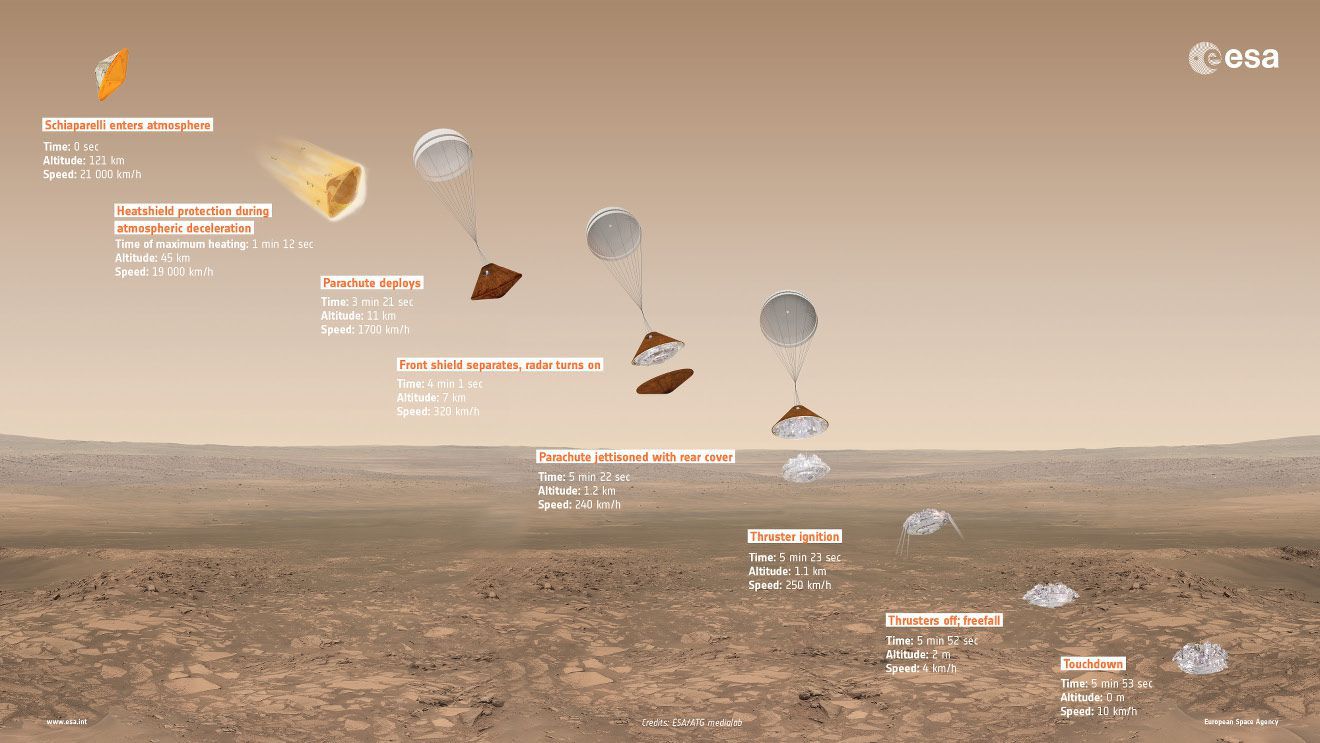
While the ExoMars Trace Gas Orbiter by the European/Russian space agencies (ESA/Roscosmos) seems to have successfully entered the correct orbit around Mars, ESA’s Mars lander, Schiaparelli seems to have been lost on its way down to the surface.

schiaparelli-descent image-esa

schiaparelli-descent image-esa

BBC: 

There are growing fears a European probe that attempted to land on Mars on Wednesday has been lost. Tracking of the Schiaparelli robot’s radio signals was dropped less than a minute before it was expected to touch down on the Red Planet’s surface.

Satellites at Mars have attempted to shed light on the probe’s status, so far without success. One American satellite even called out to Schiaparelli to try to get it to respond. The fear will be that the robot has crashed and been destroyed. The European Space Agency, however, is a long way from formally calling that outcome. Its engineers will be running through “fault trees” seeking to figure out why communication was lost and what they can do next to retrieve the situation.

This approach could well last several days. 

One key insight will come from Schiaparelli’s “mothership” – the Trace Gas Orbiter (TGO). As Schiaparelli was heading down to the surface, the TGO was putting itself in a parking ellipse around Mars. But it was also receiving telemetry from the descending robot.

If the lander is indeed lost, it will be the second failure of a European Mars lander after the failure of Beagle 2 in 2003.

Beagle 2 was a British landing spacecraft that formed part of the European Space Agency’s 2003 Mars Express mission. The craft lost contact with Earth during its final descent and its fate was unknown for over twelve years. Beagle 2 is named after HMS Beagle, the ship used by Charles Darwin.

The spacecraft was successfully deployed from the Mars Express on 19 December 2003 and was scheduled to land on the surface of Mars on 25 December; however, no contact was received at the expected time of landing on Mars, with the ESA declaring the mission lost in February 2004, after numerous attempts to contact the spacecraft were made.

Beagle 2‘s fate remained a mystery until January 2015, when it was located intact on the surface of Mars in a series of images from NASA’s Mars Reconnaissance Orbiter HiRISE camera. The images suggest that two of the spacecraft’s four solar panels failed to deploy, blocking the spacecraft’s communications antenna.

The ESA’s plans and budget for landing a six-wheeled roving vehicle on Mars in 2021 will face further critical scrutiny. The rover is expected “to use some of the same technology as Schiaparelli, including its doppler radar to sense the distance to the surface on descent, and its guidance, navigation and control algorithms”.

ESA has an annual budget of about €5.25 billion.

Of course the EU sees the ESA as a matter of prestige first (and science, only second) which does help to protect the budget.

Perhaps some “frugal engineering” (a la ISRO) is called for.


Thermal efficiency and “emissions elsewhere” from electric cars

August 30, 2016

All electric cars shift emissions from the exhaust pipe of the vehicle to the place where the electricity is generated. The actual mix of fuel sources used to feed the grid then represent the emissions profile of electric cars. The efficiency of electric cars from generation of electricity to wheel-power is not much different from gasoline based automobiles and clearly inferior to diesel engines.

Fossil fuels used directly in vehicle internal combustion engines have a thermal efficiency ranging from 37% for gasoline to over 55% for very large marine diesels.

source JSME

source JSME

For electricity generation the thermal efficiency varies from less than 30% to over 60% for coal, oil, gas, solar thermal or nuclear power plants. Thermal efficiency is meaningless (and undefined) for hydropower, wind power or photovoltaic solar.

thermal efficiency of power generation

An electric car being charged from the grid does so after a further 10% of transmission and distribution losses but only accrues a further 2 – 5% losses through the motor(s) to shaft rotation. (There are further mechanical losses in getting to the rotation of the wheels but these are common to all kinds of motive power).

The emissions due to the use of an electric car are entirely dependant upon the emissions involved in the generation of the charging electricity. If the grid is largely dependant upon coal (India), or coal and gas (US) then the gaseous emissions are higher than for diesel engines but slightly better than for gasoline automobiles. If, the grid is primarily hydropower as in Norway, or primarily hydro and nuclear (as in Sweden) then there are virtually no emissions from electric vehicles.

The fundamental reality is that electric cars are not yet commercially viable (range, weight, charging time and cost). Two decades of subsidies also confirms for me my contention, that subsidies are usually counter-productive, always delay commercialisation and nearly always lead to a focus on milking subsidies rather than commercialising a technology.

A recent Forbes article addresses the fantasies surrounding emissions, and Tesla cars. I wouldn’t mind owning a Tesla car where my acquisition price is heavily subsidised. But now that the initial investors have milked the subsidies, and operations – in spite of the subsidies – have yet to show a profit, I would not invest in Tesla shares.

Earlier this summer, SolarCity, Elon Musk’s rooftop solar company, appeared to be headed toward bankruptcy. So it shocked investors everywhere when Musk’s other brainchild, Tesla Motors TSLA -2.21%, itself struggling, announced plans to acquire the struggling panel maker and installer.

“Tesla Talks Big, Falls Short,” read a headline last week on the front page of the Wall Street Journal. The subtitle: “Car maker has failed to meet more than 20 of CEO Elon Musk’s projections in the past five years.”

Surely combining two wrong businesses won’t make a right one. True, they’re both politically correct. But they’re economically incorrect.

Tesla’s operating losses, along with its fishy accounting practices and unrealistic investor promises, have led Devonshire Research Group to liken the car company’s business model to Enron’s.

Bad entrepreneurship is normally punished by market losses and contraction. But Musk’s market is rigged. A mountain of taxpayer subsidies is allowing Tesla’s bad show to go on — and even expand.

Musk’s various ventures have received almost $5 billion worth of government assistance. Nevada recently chimed in with $1.3 billion to incentivize Tesla to build its “gigafactory” — a new battery producing facility — near Reno. Each car sold by Tesla receives a federal income tax credit of $7,500. And California allows an additional $2,500 rebate to its citizens.

Even the White House is throwing cash Musk’s way. President Obama just announced $4.5 billion in loan guarantees for electric vehicle entrepreneurs. According to the president, the money will help fill garages with EVs and make charging stations ubiquitous.

Tesla is redefining “too big to fail” as “politically correct, so bail.”

….. 

So-called zero-emission vehicles reflect the fuel-profile of electricity generation. 2015 U.S. electricity generation consisted of 33% coal; 33% natural gas; 20% nuclear; 13% renewables; and 1% oil.

Fossil fuels, in other words, have a two-thirds market share for EVs, wind and solar just 5%. Nuclear power, hydropower, and biomass, account for the remainder. …..

…..

http://www.forbes.com/sites/robertbradley/2016/08/24/investors-confront-teslas-energy-fantasy/2/#78d77bfa2bbe


A flying boat or a swimming aircraft? China rolls out the AG600

July 25, 2016

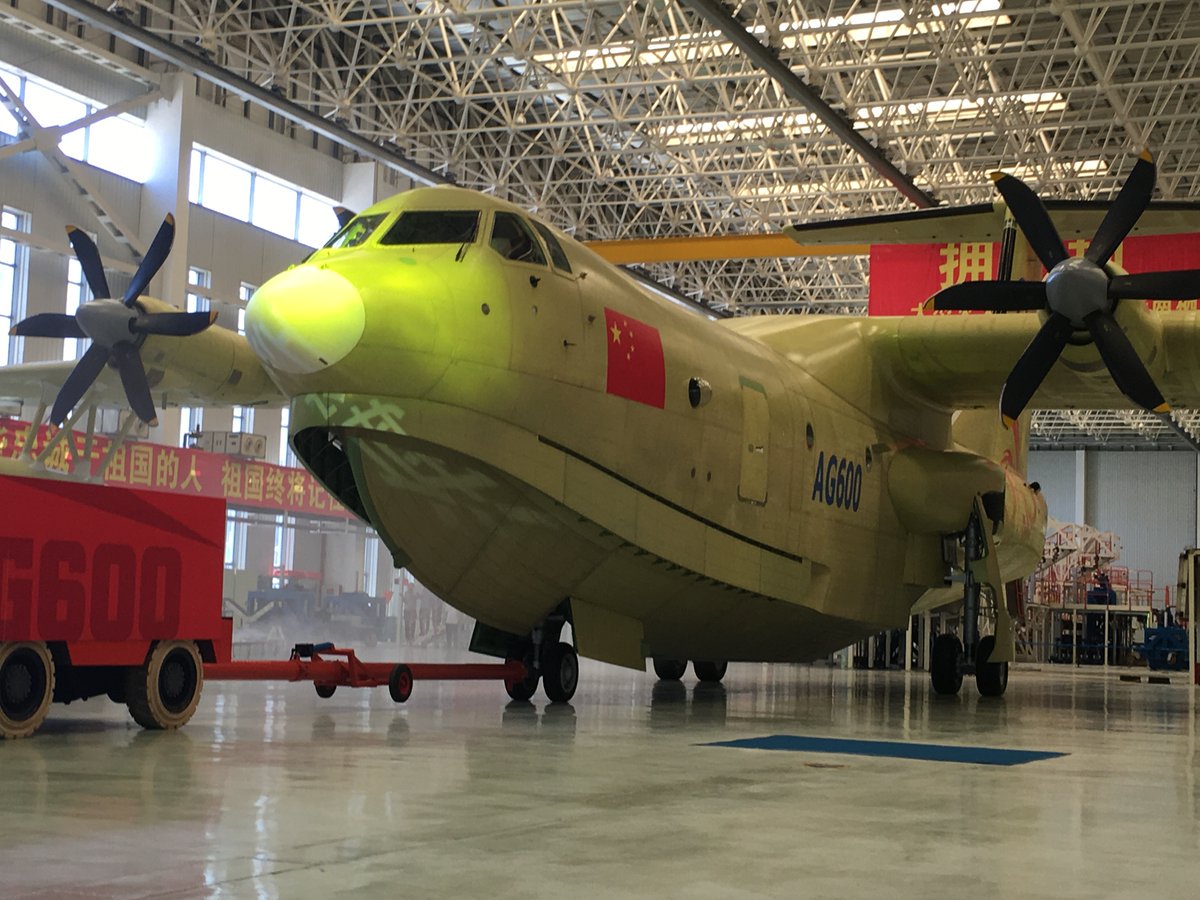
China unveils AG600 – Peoples Daily

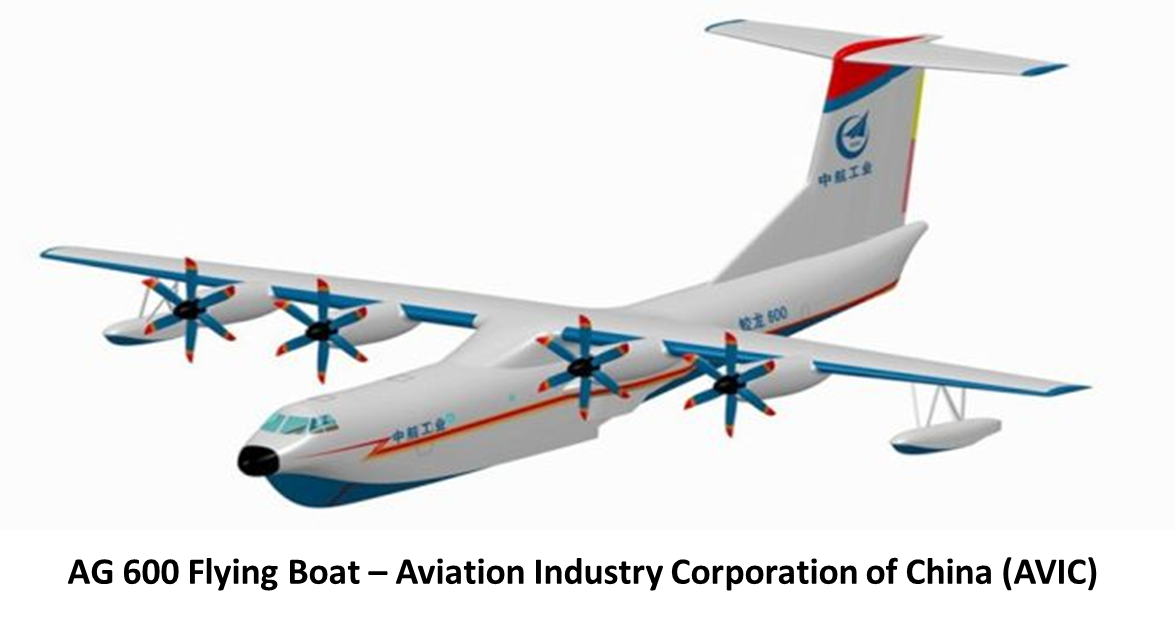
AVIC TA-600, Flying boat
The AVIC TA-600, also known as AG-600, is a large amphibious flying boat that is being designed and built in China by the Aviation Industry Corporation of China.  
Top speed: 570 km/h, Wingspan: 40 m, Length: 40 m Maximum take-off weight 51.5 t.
Manufacturer: Aviation Industry Corporation of China Wikipedia
AG600 - AVIC
China has just rolled out the world’s largest amphibious plane, AVIC’s TA600 designated the AG600.  The AG600 is intended
to fight forest fires and be used for maritime search and rescue (SAR) operations. Being able to land on water means that they can quickly pump in tons of water to fight forest fires. For SAR purposes, the ability of large seaplanes like the TA-600 to land directly near survivors means more rapid rescue responses compared to slower helicopters, which will be attractive to Chinese maritime enforcement agencies. Perhaps most important to current regional tensions, the TA-600 may also offer a new scale and means to rapidly deploy or resupply any current or new remote island garrisons in the South China Sea. A number of islets and reefs are too small to have runways to accommodate conventional transport planes like the Y-8, but sited so as to have strategic value.
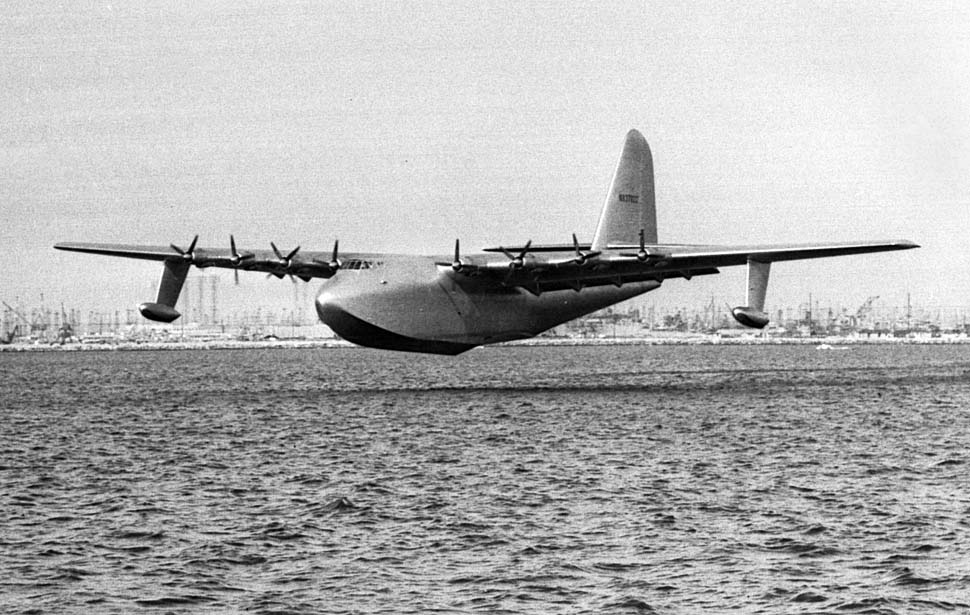
It is not as large as the eight-engined Howard Hughes H-4 “Spruce Goose”, the largest seaplane ever built, which weighed 180 tons in full and had a wingspan of 97 meters. But the Spruce Goose only flew a short distance on its maiden flight in 1947 and never lifted again.
But more to the point, the AG 600 can carry 50 passengers whether people being rescued, or troops on the move to a South China Sea island. Certainly the AG600 adds significant strategic capability to the Chinese claims in the South China Sea.
Nov. 2, 1947: The Hughes Aircraft H-4 Hercules "Spruce Goose" during short flight in the Long Beach-Los Angeles Harbor. This photo was published in the Nov. 3, 1947 LA Times.

Nov. 2, 1947: The Hughes Aircraft H-4 Hercules “Spruce Goose” during short flight in the Long Beach-Los Angeles Harbor. This photo was published in the Nov. 3, 1947 LA Times.


Hot air balloon does in 11 days and 6 hours what Solar Impulse 2 may do in 17 months

July 23, 2016

Solar Impulse 2 set off on its journey around the world on 9th March 2015. Tomorrow it sets off on its last leg from Cairo to Abu Dhabi and it should complete its journey in just under 17 months.

In the meantime, it is reported that Steve Fossett’s record of 13 days and 8 hours to circumnavigate the world in a hot air balloon, set in 2002 has been broken. A Russian balloonist has completed the journey in 11 days and 6 hours. Fedor Konyukhov has been using a Cameron balloon and set off on 12th July.

Flyer: Russian adventurer Fedor Konyukhov has set off on a solo round-the-world flight in a balloon, aiming to beat Steve Fossett’s 14-year-old record for the 33,000 kilometre trip.

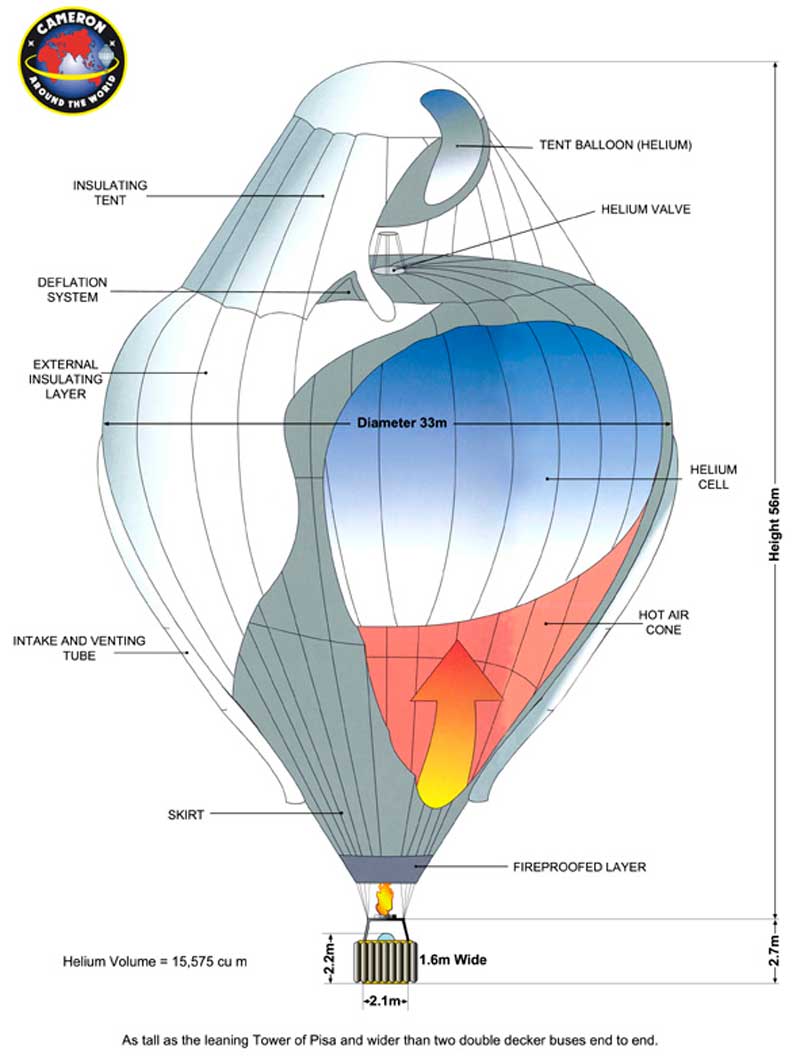
Konyukhov set off from Northam, Western Australia yesterday – the same place Steve Fossett set off from in July 2002. The record stands at 13 days 8 hours 33 minutes. Konyukhov is hoping to beat the record by a substantial amount using up-to-date technologies. He is, however, using a very similar balloon – a Roziere 550 built by British company Cameron Balloons.

“Nobody in the world makes better balloons that the Brits,” said Konyukhov, “so our balloon is being made by Cameron Balloons and it will fly on Russian helium.”

balloon australia

Fox News:

An official says a Russian balloonist has claimed a new 11-day round the world record. Support crew member Steve Griffin says Fedor Konyukhov’s balloon on Saturday passed directly over the airfield at the Australian town of Northam where he began his journey on July 12.

American Steve Fossett also started from Northam to set a record of 13 days and eight hours for his 33,000-kilometer (21,000-mile) journey in 2002.

Konyukhov has taken roughly 11 days and six hours. …… Konyukhov is expected to land later Saturday.

Cameron balloon

Structure of the Cameron balloon image via Flyer.co.uk