Archive for the ‘Technology’ Category

Rolls Royce and EADS shares take a beating

November 4, 2010

London South East reports on the aftermath of Qantas grounding its A 380 fleet and Singapore Airlines delaying all A 380 flights for extra checks of the their Trent 900 engines:

Shares in Rolls-Royce fall 3.2 percent after Qantas Airways suspends flights of its Airbus A380 fleet after the failure of a Rolls Trent 900 engines triggers an emergency landing in Singapore.

Shares in Airbus parent EADS were 3.7 percent down after what is one of the most serious incidents for the world’s largest passenger plane in three years of commercial flight.

‘If it is a design fault on the engines it would be embarrassing because Rolls is the number two engine manufacturer in the world and has a fantastic reputation,’ says BGC Partners senior strategist Howard Wheeldon.

‘These type of things take a fairly lengthy time to investigate,’ he said, adding that ‘it will be costly to address those issues’ if it is a serious fault with the engine.

The intense competition between the two engines for the A 380, the Trent 900 and its rival the GP7200 manufactured by the General Electric/Pratt & Whitney Engine Alliance is centred around fuel efficiency. The GP7200 is generally thought to have a 1% advantage. It also seems to be the strategy for the U.S. engine makers to constantly maintain this performance gap over their competitor as each tries to improve performance.

From Aviation Week:

Of course Rolls-Royce disputes the existence of that fuel-burn performance lead and says its improvement plan for the Trent 900EP (enhanced performance) will lead to more substantial efficiency modifications by around 2013. Still in the early stages, these plans will incorporate advanced technology from the most recent iterations of the Boeing 787’s Trent 1000 and the Trent XWB for the A350.

The core of the package will be the introduction of elliptical leading-edge modifications throughout the entire compression system, including improved high- and intermediate-pressure (HP/IP) compressor blades and vanes. The modification, which also applies to the fan and outlet guide vanes, improves flow interactions by altering boundary layer thickness and increasing laminar flow. The changes are similar to elliptical leading-edge modifications made to the HP compressor introduced recently to International Aero Engines’ V2500 in the SelectOne program, as well as the Trent 700EP. The elliptical feature also is part of the baseline fan design for the Trent 1000 and XWB.

“The package includes tweaks to the air management system, and that also affects fuel burn,” says Crawford. “We’re very confident in being able to achieve the 1% post-2011. The program is already defined, the detailed design is being done and bits are in manufacture. Testing is next year and will cover maturity modifications to upgrade areas we’ve seen on early engines.” These include “potential ‘wear out’ areas we want to address, such as seal segments and optimized tip clearance.”

As with the Trent 700EP, the 900EP enhancement will be offered as an upgrade kit for existing engines. “The modifications are all optional and are completely interchangeable. You will get the full 1% if you install all the parts,” says Richard Keen, Airbus programs marketing director. “From 2011 this will be the production standard for all new Trent 900 orders,” he adds.

With the problems being experienced by the Trent 900 and also with the Trent 1000 for Boeing’s Dreamliner, one obvious question is whether the cut-throat competition for fuel efficiency is leading to a trade-off between efficiency on the one hand and reductions in clearances and compromises on wear considerations on the other.

Update! Singapore Airlines delays all A 380 flights for extra engine checks

November 4, 2010
Rolls-Royce Trent 900 on the prototype Airbus ...

Trent 900: Image via Wikipedia

Update!

After earlier saying they would continue all flights normally, Singapore Airlines Ltd. has delayed flights on Airbus A380 planes after engine trouble forced a Qantas superjumbo to make an emergency landing at Changi Airport. “Our engine manufacturer Rolls Royce and aircraft manufacturer Airbus have advised us to conduct precautionary technical checks on our A380 aircraft, following today’s incident involving another operator’s A380,” Singapore Airlines said in a statement late Thursday evening. “Resulting from this development, Singapore Airlines will be delaying all flights operating our A380 aircraft.”


Lufthansa and Singapore Airlines keep their Trent 900s flying

November 4, 2010


Singapore Airlines (SIA/SQ) Airbus A380 (9V-SK...

ISingapore Airlines A 380: Image via Wikipedia


While Qantas has grounded its A380 fleet, Lufthansa and Singapore Airlines – who also use the Rolls Royce Trent 900 engines of the type which failed on the Qantas jet – are watching the situation but are keeping their A380’s flying.

Bloomberg reports:

Deutsche Lufthansa AG and Singapore Airlines Ltd. said they’ll keep their Airbus SAS A380s flying after Qantas Airways Ltd. grounded its six-strong superjumbo fleet following an engine explosion in mid-flight.

Lufthansa is operating its four A380s as normal, spokesman Boris Ogursky said by telephone, as is Singapore Airlines, which has 11 of the planes, according to a statement. The pair are the only other carriers with superjumbos powered by the same Rolls- Royce Group Plc Trent 900 engines used on the Qantas jet.

Australia’s Qantas will keep its fleet out of service “as long as it takes” after one of the four engines on an A380 failed en route from Singapore to Sydney, Chief Executive Officer Alan Joycesaid today. The pilots performed an emergency landing at Singapore at 11:46 a.m. local time.

Singapore Airlines was the first carrier to operate the A380 and has nine more on order, plus six options, according to its website. All will be powered by Trent 900 turbines.

Lufthansa, based in Cologne, Germany, has ordered 15 A380s, with those already delivered used for services to Tokyo, Beijing and Johannesburg. The Rolls engine passed compulsory tests “with flying colors” before delivery, the airline said in May.

Nicholas Ionides, head of corporate communications for Singapore Airlines, told Reuters the airline was liaising closely with its engineering team and manufacturers.

Meanwhile

Dubai’s flag carrier Emirates Airline, the biggest single customer of the Airbus A380 aircraft, said Thursday all of its superjumbos are operational and on schedule, after an A380 owned by Qantas Airways (QAN.AU) was forced to make an emergency landing due to an engine failure.

“All of our Emirates A380s are operating as scheduled. Emirates has 13 A380s in operation, powered by Engine Alliance GP7200 engines,” the company said in an emailed statement.

Related posts:

https://ktwop.wordpress.com/2010/11/04/rolls-royce-trent-900-engine-was-subject-of-airworthiness-directive-on-17th-september/

https://ktwop.wordpress.com/2010/11/04/qantas-grounds-all-a-380-flights-following-in-flight-failure-of-rr-trent-900/

https://ktwop.wordpress.com/2010/11/04/qantas-a-380-suffers-in-flight-rr-trent-900-engine-failure/

Rolls Royce Trent 900 engine was subject of Airworthiness Directive on 17th September

November 4, 2010

http://rgl.faa.gov/Regulatory_and_Guidance_Library/rgAD.nsf/list/2010-16-07?OpenDocument

The Federal Aviation Administration issued an AD concerning the RR Trent 900 engine recently:

ACTION: Final rule; request for comments.

SUMMARY: We are adopting a new airworthiness directive (AD) for the products listed above. This AD results from mandatory continuing airworthiness information (MCAI) issued by an aviation authority of another country to identify and correct an unsafe condition on an aviation product. The MCAI describes the unsafe condition as:

Wear, beyond Engine Manual limits, has been identified on the abutment faces of the splines on the Trent 900 Intermediate Pressure (IP) shaft rigid coupling on several engines during strip. The shaft to coupling spline interface provides the means of controlling the turbine axial setting and wear through of the splines would permit the IP turbine to move rearwards.

Rearward movement of the IP turbine would enable contact with static turbine components and would result in loss of engine performance with potential for in-flight shut down, oil migration and oil fire below the LP turbine discs prior to sufficient indication resulting in loss of LP turbine disc integrity.
We are issuing this AD to detect rearward movement of the IP turbine, which could result in loss of disc integrity, an uncontained failure of the engine, and damage to the airplane.

DATES: This AD becomes effective September 17, 2010.

Of course it is far too early to say if this has anything to do with the Trent 900 engine failures experienced by Singapore Airlines and Qantas on their A 380’s but the AD does talk about the possibility of an “uncontained failure of the engine”.

Qantas grounds all A 380 flights following in flight failure of RR Trent 900

November 4, 2010

Reuters:

Qantas Airways suspended flights of its Airbus A380s on Thursday after one of the aircraft was forced to land in Singapore with engine trouble, one of the most serious incidents for the world’s largest passenger plane in its three years of commercial flight.

Qantas, which operates six A380s, said it was grounding the aircraft pending a full investigation. “We will suspend all A380 takeoffs until we are fully confident we have sufficient information about (flight) QF32,” Qantas Chief Executive Alan Joyce told reporters in Sydney.


Main Image

Indonesian police examine fallen debris from a Qantas jet collected from several areas on Batam island, an Indonesian territory near Singapore November 4, 2010. :Credit Reuters/Stringer


Singapore Airlines also uses Rolls Royce Trent 900 engines in its A 380s.

Related posts on Rolls Royce engine failures:

https://ktwop.wordpress.com/2010/11/04/qantas-a-380-suffers-in-flight-rr-trent-900-engine-failure/

https://ktwop.wordpress.com/2010/10/25/in-flight-failure-of-rb-211-524-engine/

https://ktwop.wordpress.com/2010/09/28/rolls-royce-trent-1000-fix-is-defined/

Qantas A 380 suffers in-flight RR Trent 900 engine failure

November 4, 2010

Updatedhttps://ktwop.wordpress.com/2010/11/04/qantas-grounds-all-a-380-flights-following-in-flight-failure-of-rr-trent-900/

Sydney Morning Herald

A Qantas A380 has been forced to return to Singapore’s Changi Airport after pilots were forced to shut down one of its four engines. QF32 was bound for Sydney with 443 passengers and 26 crew on board when the engine failed. “Qantas flight QF32 was en route from Singapore to Sydney, the number two engine has shut down, so as a precautionary measure we are taking it back to Singapore,” a Qantas spokeswoman said.


The wrecked engine after the plane landed in Singapore.

The wrecked engine after the plane landed in Singapore.Photo: AFP


Indonesian authorities said there had been some sort of explosion over the island of Batam, just south of Singapore. Elfhinta radio quoted a police officer in Batam, Eryana, saying parts of the plane had been found. “We are still collecting debris,” he said.

In a recent similar incident, an engine exploded on a Qantas flight to San Francisco on August 30, with debris tearing holes in the engine cover.

The Qantas A 380’s have 4 Rolls Royce Trent 900 engines.

The RR Trent 1000 destined for Boeing’s Dreamliner has had some problems during testing.

A month ago on 28th September, a Singapore Airlines A380 also suffered a failure of one of it’s 4 Trent 900 engines.

An engine problem on a Singapore Airlines A380 superjumbo airliner was a “non-event” in technical terms, the chief executive of the company that built it said yesterday. Singapore Airlines said the plane carrying 444 passengers from Paris to Singapore was forced to return to the French capital on Sunday when the as-yet unspecified problem was detected two and a half hours into the flight.

The A380 is the world’s largest passenger airliner and Singapore Airlines (SIA) is the first to take delivery of it, having ordered 19 with an option for six more. Speaking in Paris, Louis Gallois, chief executive of Airbus manufacturer EADS, called the incident “a complete non-event”.

“Engine failure on a four-engine aircraft does happen and nobody should think of it as a drama,” Gallois told journalists. “In technical terms, it is not an event.”

Background: (Wikipedia)

The A380 can be fitted with two types of engines: A380-841, A380-842 and A380-843F with Rolls-Royce Trent 900, and the A380-861 and A380-863F with Engine Alliance GP7000 turbofans. The Trent 900 is a derivative of the Trent 800, and the GP7000 has roots from the GE90 and PW4000. The Trent 900 core is a scaled version of the Trent 500, but incorporates the swept fan technology of the stillborn Trent 8104. The GP7200 has a GE90-derived core and PW4090-derived fan and low-pressure turbo-machinery. Only two of the four engines are fitted with thrust reversers.

Underwater robot will dive down to 6,000m

November 2, 2010

The Fraunhofer Institute issued a press release today regarding their new underwater robot POSEIDON which will be able to dive down to 6,000m.

Robots do not have to breathe. For this reason they can dive longer than any human. Equipped with the necessary sensor technology they inspect docks or venture down to the ocean fl oor to search for raw materials. At present, researchers are developing a model which will carry out routine tasks independently, without help from humans.


The torpedo-shaped underwater robot will be able to dive down to 6,000 meters. (© Fraunhofer AST)


Even when equipped with compressed-air bottles and diving regulators, humans reach their limits very quickly under water. In contrast, unmanned submarine vehicles that are connected by cable to the control center permit long and deep dives. Today remote-controlled diving robots are used for research, inspection and maintenance work. The possible applications of this technology are limited, however, by the length of the cable and the instinct of the navigator. No wonder that researchers are working on autonomous underwater robots which orient themselves under water and carry out jobs without any help from humans.

In the meantime, there are AUVs (autonomous underwater vehicles) which collect data independently or take samples before they return to the starting points. “For the time being, the technology is too expensive to carry out routine work, such as inspections of bulkheads, dams or ships’ bellies,” explains Dr. Thomas Rauschenbach, Director of the Application Center System Technology AST Ilmenau, Germany at the Fraunhofer Institute for Optronics, System Technologies and Image Exploitation IOSB. This may change soon. Together with the researchers at four Fraunhofer Institutes, Rauschenbach’s team is presently working on a generation of autonomous underwater robots which will be smaller, more robust and cheaper than the previous models. The AUVs shall be able to find their bearings in clear mountain reservoirs equally well as in turbid harbor water. They will be suitable for work on the floor of the deep sea as well as for inspections of shallow concrete bases that offshore wind power station have been mounted on.

The engineers from Fraunhofer Institute for Optronics, System Technologies and Image Exploitation in Karlsruhe, Germany are working on the “eyes” for underwater robots. Optical perception is based on a special exposure and analysis technology which even permits orientation in turbid water as well. First of all, it determines the distance to the object, and then the camera emits a laser impulse which is reflected by the object, such as a wall. Microseconds before the reflected light flash arrives, the camera opens the aperture and the sensors capture the incident light pulses. At the Ilmenau branch of the Fraunhofer Institute for Optronics, System Technologies and Image Exploitation, Rauschenbach‘s team is developing the “brain“ of the robot: a control program that keeps the AUV on course in currents such as at a certain distance to the wall that is to be examined. The Fraunhofer Institute for Biomedical Engineering IBMT in St. Ingbert provides the silicone encapsulation for the pressure-tolerant construction of electronic circuits as well as the “ears” of the new robot: ultrasound sensors permit the inspection of objects. Contrary to the previously conventional sonar technology, researchers are now using high-frequency sound waves which are reflected by the obstacles and registered by the sensor. The powerful but lightweight lithium batteries of the Fraunhofer ISIT in Itzehoe that supply the AUV with energy are encapsulated by silicone. A special energy management system that researchers at the Fraunhofer Institute for Environmental, Safety and Energy Technology UMSICHT in Oberhausen, Germany have developed saves power and ensures that the data are saved in emergencies before the robot runs out of energy and has to surface.

A torpedo-shaped prototype two meters long that is equipped with eyes, ears, a brain, a motor and batteries will go on its maiden voyage this year in a new tank in Ilmenau. The tank is only three meters deep, but “that’s enough to test the decisive functions,“ affirms Dr. Rauschenbach. In autumn 2011, the autonomous diving robot will put to sea for the first time from the research vessel POSEIDON: Several dives up to a depth of 6,000 meters have been planned.

Solar power subsidies are not sustainable

October 28, 2010


The power plant.

Planta termosolar Andasol: Image via Wikipedia


In Spain the huge subsidies (with feed in tariffs as much as ten times the average cost of electricity production) had led to a rush of developers getting into projects which is now proving unsustainable. Bloomberg reports that

Solar investors  were lured by a 2007 law passed by the government of Prime Minister Jose Luis Rodriguez Zapatero that guaranteed producers a so-called solar tariff of as much as 44 cents per kilowatt-hour for their electricity for 25 years — more than 10 times the 2007 average wholesale price of about 4 cents per kilowatt-hour paid to mainstream energy suppliers. Now more than 50,000 other Spanish solar entrepreneurs face financial disaster as the policy makers contemplate cutting the price guarantees that attracted their investment in the first place.

Spain stands as a lesson to other aspiring green-energy nations, including China and the U.S., by showing how difficult it is to build an alternative energy industry even with billions of euros in subsidies, says Ramon de la Sota, a private investor in Spanish photovoltaic panels and a former General Electric Co. executive. “The government totally overshot with the tariff,” de la Sota says. “Now they have a huge bill to pay — but where’s the technology, where’s the know-how, where’s the value?”

The situation in Germany is equally disturbing. The New Scientist reports

Solar power is intermittent and can arrive in huge surges when the sun comes out. These most often happen near midday rather than when demand for power is high, such as in the evenings. A small surge can be accommodated by switching off conventional power station generators, to keep the overall supply to the grid the same. But if the solar power input is too large it will exceed demand even with all the generators switched off. Stephan Köhler, head of Germany’s energy agency, DENA, warned in an interview with the Berliner Zeitung on 17 October that at current rates of installation, solar capacity will soon reach those levels, and could trigger blackouts.

Subsidies have encouraged German citizens and businesses to install solar panels and sell surplus electricity to the grid at a premium. Uptake has been so rapid that solar capacity could reach 30 gigawatts, equal to the country’s weekend power consumption, by the end of next year. “We need to cap installation of new panels,” a spokesperson for DENA told New Scientist.

The experience with highly subsidised feed-in tariffs is proving to be less than successful. In country after country the use of such subsidies is proving to be a major distortion, unhealthy and unsustainable. Countries such as India which are contemplating the use of similar subsidies for promoting intermittent, wind or solar power are beginning to have second thoughts and are now having to consider caps. It is beginning to sink in that such intermittent capacity cannot be counted into the generating base and does not reduce the need for alternative, backup generating capacity. Moreover the use of intermittent power from solar and wind only ensures that the operating conditions for the alternative capacity and for the grid are fundamentally more inefficient. This in turn leads to a hidden cost as a consequence of using the solar or wind power.

It is likely that these subsidies will have to be scaled down drastically.

In flight failure of RB 211-524 engine

October 25, 2010

WA Today reports:

Air safety investigators have found extensive turbine damage in the jet engine that exploded on a Qantas jumbo at 25,000 feet near San Francisco in August this year. Engine parts that were flung outwards tore not only a gaping hole on the far side of the engine cover but also peppered the near-side with holes, air safety investigators have revealed. As the engine vibrated, debris ejected through the engine hole hit the underside of the wing, puncturing the wing flaps, investigators have found.


A Qantas jet was forced to turn back to San Francisco after a hole was blown in the shell of the engine.

Flight QF74 failure of RB211-524 engine:Photo: Channel Ten


The findings are contained in a preliminary report by the Australian Transport Safety Bureau (ATSB) into the explosion on flight QF74, carrying 213 passengers and 18 crew, on August 30. The incident occurred 15 minutes after take-off.

The pilots shut down the engine, sought landing clearance, dumped fuel and landed safely at San Francisco, where the plane was met by fire crew, inspected and allowed to taxi to the terminal. This was an exceptionally rare event and the first time Qantas has experienced this type of engine failure,” a Qantas spokesman said.

All of the engine’s turbine blades had either fractured or broken away, investigators said. There was also damage of other engine internals including vanes, bearings, speed probes and a turbine shaft. Further testing of engine components will be undertaken by Rolls-Royce, overseen by UK air safety investigators. The Rolls-Royce RB211-524 engine was removed from the aircraft and taken to Hong Kong for examination. The investigation is continuing.


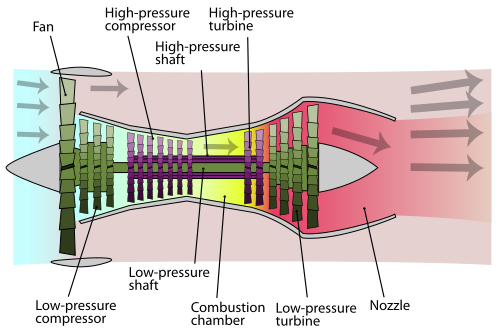
Turbofan engine operation: Wikimedia


RB 211-524: aircraftenginedesign.com


The RB 211 family is a high bypass turbofan engine originally designed for the Lockheed Tristar. The 211-524 engine was developed with increased thrust and efficiency for the Boeing 747-200 and further improvements led to the 211-524 G and 211-524H for the Boeing 747-400 and for the 767. The 211 family has led to the Trent engines and some features of the Trent could be retrofitted to create the 211-524G-T and the 211-524H-T. A newer version of the same family the 211-535 series is used in Boeing 727’s and 757’s.

An industrial version of the RB211 is used for power generation and another inter-cooled version is used in marine applications.

The Rolls Royce Trent 1000 engine designed for Boeing’s Dreamliner has had some initial testing setbacks which seem to be fixed but which has caused some of the delays to the Dreamliner.


Trade war! Cerium oxide price has risen 665% since April

October 22, 2010
Phase diagram of cerium in english

Phase diagram cerium: Image via Wikipedia

Freely translated from Dagens Industri

Cerium oxide, which is used to finish semiconductors and obtained from the rare earth element cerium, has risen in price from $ 4.70 per kg on April 20 to 36 U.S. dollars a kilo on Tuesday, October 19. An increase of 665 percent.

The price rise is primarily due to China scaling down its export quotas. In recent years there has been a gradual reduction of 5-10 percent per year, but in July alone it was reduced by 40 percent.  The country accounts for almost 95 percent of world supply of rare earths and in some cases almost 100 percent.

The official explanation from China is that the  country’s own industrial needs must be met first. These account  for 60 percent of global demand. Producing earth metals is a dirty business and China also gives environmental reasons as an explanation for the lower export quotas.

But many, especially in the U.S., suspect that it is a low-key trade war.