Archive for the ‘Technology’ Category

Rolls Royce leads Finnish project to develop autonomous (drone) ships

August 8, 2015

After flying drones and the coming of driverless cars it is the turn of autonomous ships. The Finnish Funding Agency for Technology and Innovation (Tekes) is funding an €6.6 million project called the Advanced Autonomous Waterborne Applications Initiative, which Rolls-Royce has been appointed to lead. The project aims to produce the specification and preliminary designs for the next generation of advanced ship solutions – the unmanned, “drone” cargo ship.
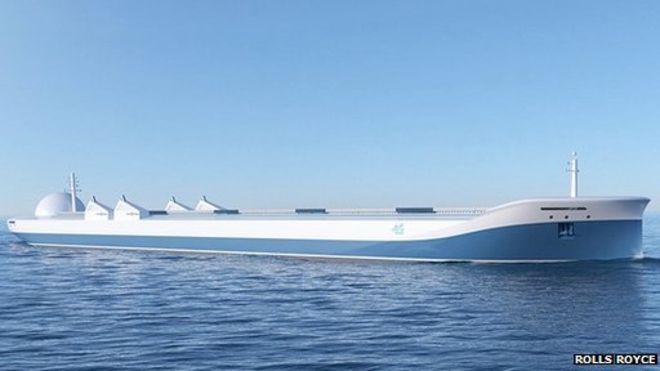
drone ship 1 Rolls Royce

drone ship 1 Rolls Royce

RR Press Release:

…… The project will run until the end of 2017 and will pave the way for solutions – designed to validate the project’s research. The project will combine the expertise of some of Finland’s top academic researchers from Tampere University of Technology; VTT Technical Research Centre of Finland Ltd; Åbo Akademi University; Aalto University; the University of Turku; and leading members of the maritime cluster including Rolls-Royce, NAPA, Deltamarin, DNV GL and Inmarsat.

Rauli Hulkkonen, Tekes, Chief Advisor, said: “This project is a fantastic opportunity to establish the Finnish maritime cluster as the world leader in maritime remote control technology.

Esa Jokioinen, Rolls-Royce, Head of Blue Ocean Team, said: “Rolls-Royce has extensive experience of successfully coordinating multi-disciplinary teams developing complex technologies. We bring a world leading range of capabilities in the marine market to the project including vessel design, the integration of complex systems and the supply and support of power and propulsion equipment. We are excited to be taking the first concrete steps towards making remote controlled and autonomous ship applications a reality. 

The wide ranging project will look at research carried out to date before exploring the business case for autonomous applications, the safety and security implications of designing and operating remotely operated ships, the legal and regulatory implications and the existence and readiness of a supplier network able to deliver commercially applicable products in the short to medium term. The technological work stream, which will be led by Rolls-Royce, will encompass the implications of  remote control and autonomy of ships for propulsion, deck machinery and automation and control, using, where possible, established technology for rapid commercialisation.

The Rolls-Royce Blue Ocean team is responsible for research and development of future maritime technologies and focuses on disruptive game-changing innovations. By combining new technologies with new approaches to ship design and system integration, the team aims to reduce operational costs, minimise emissions and enhance the earning capability of vessels. The team has developed a range of autonomous ship concepts as well as innovative designs for various ship types.

An autonomous tanker -- image rolls royce

An autonomous tanker — image rolls royce

Robot ships are currently illegal and the whole maritime regulatory environment would need to be changed to suit. If driverless cars become a reality by 2020, then there is no reason why robot fleets of cargo ships could not be in use by 2030. Bureaucracy will probably be a bigger barrier than technology.

robot fleet image rolls royce

robot fleet image rolls royce

A gas turbine as a higher level of art

August 4, 2015

It all started with the wheel of course. Mechanical engineering became art – or was it the other way around?

13th century stone chariot wheel - Konark

13th century stone chariot wheel – Konark

The “art” of mechanical engineering is not just about beauty of form, it is about a beauty of both form and substance. It is a higher level of art because it must not only be aesthetically pleasing to the eye – look good – it must also function as it was meant to.  Da Vinci’s helicopter sketches are interesting and even look good but they don’t represent anything which ever worked or can work. Lovely things which do nothing or do things badly may be some kind of art, but they are not examples of the “art” of engineering. Even sketches of humble pulleys or levers or gears which actually work are – for me – a higher level of art in that they have both the form and the substance.

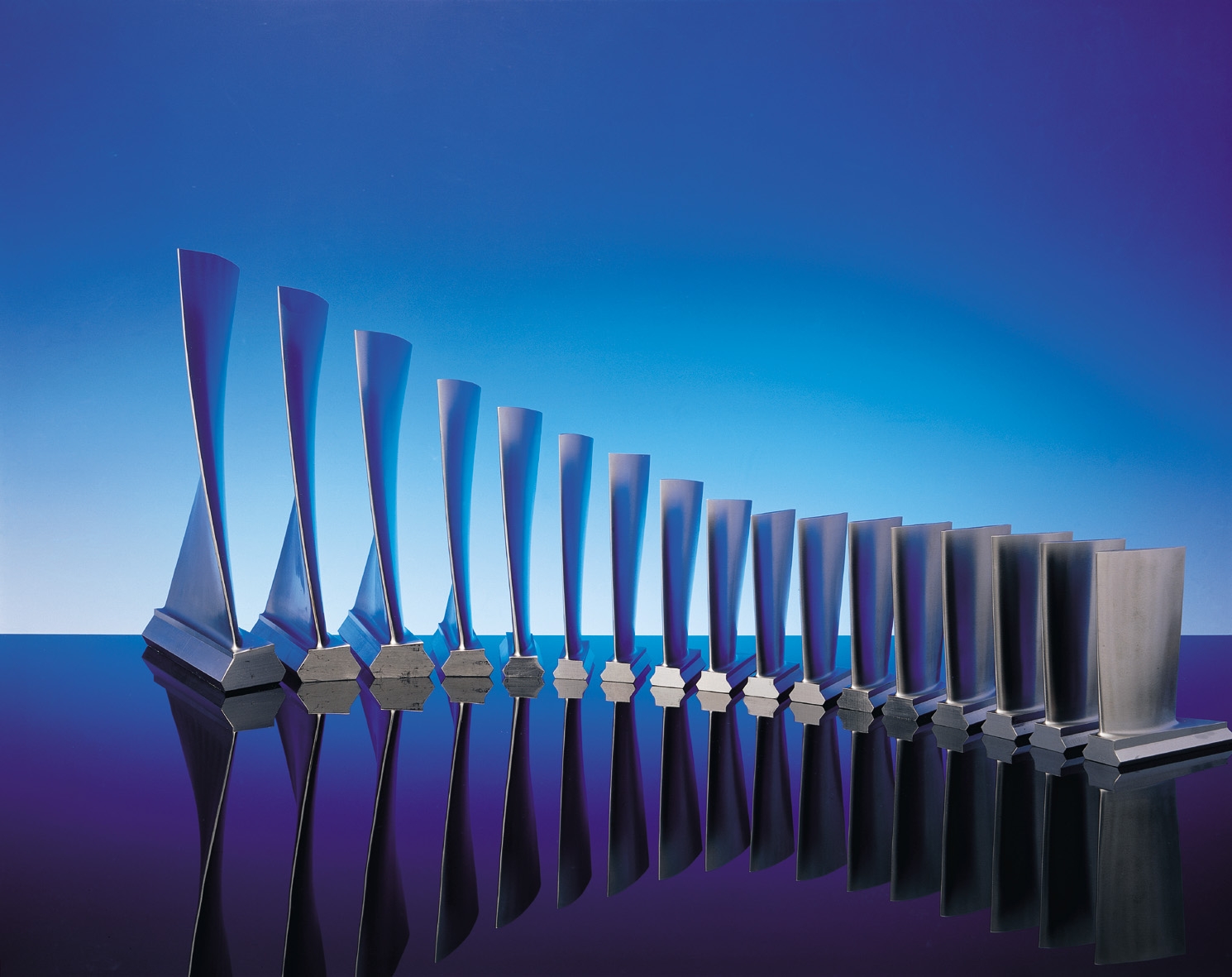
gt blades

GT Blades (image Siemens)

The requirement of substance – that some artefact functions as it should – constrains the degrees of freedom available for aesthetic expression or satisfaction. It is easier to design pleasing shapes which don’t also have to work. When things that work have a form which is also aesthetically pleasing, or inspiring or challenging we have the art in engineering. And in the world of mechanical engineering, it is turbines in general (wind , water, steam and gas), and modern heavy duty gas turbines in particular, which represent, for me, an awe-inspiring and almost frightening beauty in the sublime combination of form and function. From windmills to jet engines there is art in the engineering. State-of-the-art gas turbines are art epitomised.

GT Compressor blading

GT Compressor blading (image Stork)

Artefacts of engineering don’t have to be beautiful. Not all engineering is art. Gas turbines don’t have to be pleasing to the eye – but they are. Mathematics and physics and chemistry are combined to satisfy the substance and the resulting form – perhaps not entirely intentionally – becomes beautiful. The beauty lies not only in the shape and profile of the compressor and turbine blades (which are in themselves almost mesmerising in their irregular regularity), but in the sheer cleverness of the whole engine. The concept of how a gas turbine functions is itself beautifully ingenious. It is far more “intelligent design” than the ineffective (99% failure rate), hit and miss of evolution (just a trial of random mutational errors), which requires billions of years and innumerable failures. A compressor is an unnatural animal. The “natural” order of fluid flow from higher to lower pressure is subverted. To conceive of the use of an unnatural machine, the compressor, to create a high pressure stream of air, to burn a suitable fuel and raise the temperature of the gas such that it can be expanded in a turbine which not only provides the power to drive the compressor but produces surplus power, is genius. And then to do all that and drive an electrical generator as well , while the blades are rotating at 3000 or 3600 revolutions per minute, when they are at temperatures where even the best steels have the strength of soft butter, is more than awesome. Fine, powerful stuff.

GE 9HA

The GE 9HA “Harriet” gas turbine

An infinite number of monkeys pounding away at keyboards for an infinite amount of time would surely reproduce the works of Shakespeare.

But they couldn’t produce a gas turbine.

Windows 10 buys your soul (with your consent)

August 2, 2015

I suppose I have little option but to upgrade.

And I am resigned to being “targeted” by advertisers selected specifically for me. I take some comfort in the fact that I cannot recall actually buying anything because of a web advertisement. I suppose I am just too old for them.

Image result for windows 10

The soul – however you want to define it – is manifested (not defined) in your behaviour. The advent of the internet and its apparent anonymity actually makes visible some parts of your hidden self.  People visit sites and make comments that they would never otherwise do if they were in public view. Of course much of that anonymity is only a perception. Your internet “self” (ID, email, passwords, sites visited, on-line community memberships,…. ) comes closer to painting a picture of your soul than just your visible behaviour.

And Windows 10 acquires more of your soul than ever before – and all with your consent.  It is with your consent because few will ever read and understand the 45 pages of terms and conditions that must be agreed to. Not that Apple and Google are not also involved in photographing and capturing your soul. But even an on-line presence is only a manifestation of your soul and each of Microsoft or Google or Apple have have their own painting of your essence. And these perceptions of who you are, these paintings of your soul, are theirs to sell – to advertisers or to governments or to other interested parties.

The Guardian:

Hundreds of commenters on sites such as Hacker News and Reddit have criticised default settings that send personal information to Microsoft, use bandwidth to upload data to other computers running the operating system, share Wi-Fi passwords with online friends and remove the ability to opt out of security updates.

Many of the complaints relate to the new personalised adverts embedded in Windows 10. When the OS is installed, Microsoft assigns the user a unique advertising ID, which it ties to the email address registered with the company. That email address is also associated with a raft of other services, such as the company’s productivity and communication programs, as well as app downloads and cloud-storage uploads.

Using that information, Microsoft is able to personalise ads to the user, during both web surfing and, for newer apps downloaded from the Windows Store, app usage. Microsoft itself is leading the way on that front, even turning the in-built version of Solitaire (the card game that has been a staple of Windows installations since 1990’s Windows 3.0) into a freemium game, complete with unskippable video adverts.

Elsewhere, Windows 10 also harvests user information in order to teach the built-in personal digital assistant Cortana, Microsoft’s answer to Siri. To enable Cortana, the company says, it “collects and uses various types of data, such as your device location, data from your calendar, the apps you use, data from your emails and text messages, who you call, your contacts and how often you interact with them on your device”.

“There is no world in which 45 pages of policy documents and opt-out settings split across 13 different Settings screens and an external website constitutes ‘real transparency’.”

……. The European digital rights organisation (EDRi) sums up the company’s 45 pages of terms and conditions by saying: “Microsoft basically grants itself very broad rights to collect everything you do, say and write with and on your devices in order to sell more targeted advertising or to sell your data to third parties.”

In many ways, however, Windows 10 is merely moving closer towards what has become the new normal thanks to mobile operating systems. Both Siri and Google Now require access to the user’s personal information to personalise responses, while both Apple and Google offer developers the ability to deliver personalised ads to users based on information such as app installs.

Could Ansaldo/ Shanghai Electric be the inheritors of Alstom’s sequential combustion gas turbine technology

July 30, 2015

There are reports that GE may have offered to sell off some of Alstom’s sequential combustion gas turbine technology to Ansaldo /Shanghai Electric:

PowerTechnology:

US-based General Electric (GE) has confirmed it is prepared to sell parts of Alstom’s gas turbine assets to Italian Ansaldo Energia in order to gain European Union approval for the proposed $17bn acquisition of Alstom’s power business.

Sources have been quoted by Bloomberg as saying that GE informed the EU that it is willing to divest some of Alstom’s sale and servicing activities to the Italian firm, along with certain intellectual property.

Alstom has also agreed to lower the prices of its energy assets to support GE’s efforts to win anti-trust clearance from the European authorities.

Even with Shanghai Electric’s deep pockets I don’t see that Ansaldo could come out with a sequential combustion engine in less than 5 years and perhaps not for a decade. Ansaldo does not have a tradition of breakthrough innovation and neither does Shanghai Electric. The current Ansaldo engines could not be easily modified to cater for sequential combustion. They would have to come out with a completely new machine. More importantly they would need new compressors for the higher pressure ratio that sequential combustion demands. And I don’t see either Ansaldo or Shanghai Electric developing – or even having the capability to develop –  a brand new compressor anytime soon.

However if the EC’s requirements are seen as helping the Chinese (via Ansaldo) gaining a clear foothold in Europe, the EC will not be very popular in France or even with Siemens. In fact this is the argument being used by the French government to urge the EC to approve the deal quickly.

In any event GE’s “remedies” must contain two elements I think

  1. a “sale” of some IP or of that IP being made open source – and this might well involve the sale of some IP to Ansaldo /Shanghai Electric,
  2. a divestment of some of Alstom’s service business and this could be either by a divestment of a small part (not more than 10 installed engines in my estimation) of the service business for Alstom’s GT26 (probably not GT24) fleet, or by a complete or partial divestment of Alstom’s service business for non-Alstom machines.

It is conceivable that Alstom (not GE) has agreed to exclude their subsidiary PSM from the GE deal and then to sell this unit to a 3rd party. But a buyer other than Ansaldo could probably pay much more for this unit which offers an entry into the US marketplace. I am not sure that GE would be party to allowing the Chinese into the US market place to service “GE Frame 6B, 7E/EA, 9E and 7FA machines, the Siemens/Westinghouse 501F (SGT6-5000F) engine and the Mitsubishi 501F engine.”

Whatever actually transpires, the heavy duty gas turbine playing field is seeing upheavals of a kind not seen since ABB divested to Alstom in 2000. With a GT market cycle of 7-8 years, that was two market cycles ago. The next 2 decades (3 market cycles) will probably be dominated by an era of relatively low gas prices. A gas glut and a gas turbine boom could well see the market grow such that entry barriers are reduced and we may see some new players being able to break in.

Previous posts on Alstom/GE deal

Alstom and GE trim the scope of their deal by €300 million to ensure EC approval

July 29, 2015

The “remedies ” that GE has proposed to the European Commission to meet the EC’s concerns about their acquisition of Alstom’s power and grid businesses have not been disclosed. Now it has been announced that the Alstom Board has approved a reduction of €300 million in the sale price to GE. Since I suspect that GE’s proposed “remedies” are in two main areas (technology and service business), it would seem that the €300 million is made up of Alstom retaining some “balance sheet items” and some profitable business that will not, now, be transferred to GE.

Alstom shareholders will be looking at the numbers. Alstom has 309,419,350 shares with a nominal value of €7 each, giving a paid up share-capital of €2.165 billion. The current market cap is €8.22 billion with a share price of €26.6. The original deal with GE was for a sale price of €12.35 billion (€39.9 per share). This has now been reduced by just under €1 per share. Since the deal was originally announced Alstom agreed to pay a fine of €695.4 million ($772 million) to the US to settle past bribery charges. GE had also agreed to pay Alstom an additional €400 million for further, unspecified, commercial arrangements. Since the announcement of the deal therefore the Alstom shareholders have taken a net hit of €595 million (-695+400-300) or €1.9 per share. Estimates of what could finally be received by the shareholders varies between €3.2 and € 3.7 billion ( c. €10-12 per share).

Just as a number crunching exercise I assume that the €300 million reduction is made up of – say – €150 million of balance sheet items (assets to be retained by Alstom) and €150 million is for ongoing business (with a profit potential of about €15 million per year) which will remain in Alstom’s hands. If some of the assets to be retained are IP then their “value” will probably have to be written off by Alstom (as “goodwill”?). Whether Alstom can sell such IP to any other buyer (Shanghai/Ansaldo?, Doosan?) is doubtful but could be a little bonus for shareholders if it does transpire. If some real assets are retained, then presumably they could still generate some profit for Alstom. It occurs to me that a “smart” way out for GE could be with Alstom retaining PSM (Power Systems Mfg., LLC.) a wholly owned subsidiary. This unit is Alstom’s “pirate” company for performing service on non-Alstom machines. This might kill 2 birds with one stone. In 2000 Alstom lost its GE licence and acquired ABB’s gas turbine business. PSM was formed in 2000(?) and acquired by Alstom in 2007. As a “pirate” it is involved with the service of  GE Frame 6B, 7E/EA, 9E and 7FA machines, the Siemens/Westinghouse 501F (SGT6-5000F) engine and the Mitsubishi 501F engine. The loss of competition in the service business is one of the particular areas of concern for the EC. Moreover, GE does not really need PSM. It could well be that Alstom retaining PSM may provide the necessary concession regarding competition in the service business and the entire business may well have a value as an ongoing business of €150-200 million.

Such a solution would mean a much smaller hit for the Alstom shareholders since Alstom could probably continue with the this very self-contained business especially since it is not concerned with the Alstom range of Heavy Duty Gas Turbines. The profitability of this continuing business should not be much impaired by remaining in Alstom ownership. PSM should be “saleable” and could be quite attractive to an aspiring player.

Of course this is speculation, but perhaps Alstom shareholders need not be too despondent over the latest Alstom concession of €300 million. If most of that is due to the retention of PSM then the value of that ongoing and profitable business will not be lost.

Previous posts on the GE/ Alstom deal.

Solar Impulse voyage abandoned after irreversible battery damage

July 16, 2015

The Solar Impulse 2 “adventure” is over. The lithium-ion batteries have overheated and have been irreversibly damaged. It may fly again in April 2016. Even if it does, that cannot – by any stretch of creative hype – be considered a part of this journey which has effectively been abandoned. By April 2016 a new plane could be built. The planned duration of the whole flight was to have been 5 months. But 4 months after starting in Abu Dhabi the plane has been grounded in Hawaii after completing 17,800 km of its planned 35,000 km journey.

The much hyped journey of Solar Impulse 2 as a solo flight circumnavigating the world was never really about technology or science. It was all about perceptions and PR. The project has been made into a symbol for solar energy  with claims that

Solar Impulse is the only airplane of perpetual endurance, able to fly day and night on solar power, without a drop of fuel. 

This revolutionary single-seater aircraft made of carbon fiber has a 72 meter wingspan (larger than that of the Boeing 747-8I) for a weight of just 2,300 Kg, equivalent to that of a car. The 17,000 solar cells built into the wing supply four electric motors (17.5 CV each) with renewable energy.

During the day, the solar cells recharge lithium batteries weighing 633 Kg (2077 lbs.) which allow the aircraft to fly at night and therefore to have virtually unlimited autonomy.

This flight has done little to demonstrate “perpetual endurance” or “unlimited autonomy”. Every flight starts with fully charged batteries (presumably charged from the grid and that would be fossil energy) and the solar cells need to top up the charge lost during night flying during the day. What has actually been demonstrated with the maximum flight length of five days is that – at best – the stored charge declined by 20% each day. Moreover the batteries suffered irreversible damage after a 5 day flight. That suggests fatal-flaws in the design of the plane, both in the sizing of the solar panels and in the design of the batteries. Firstly, either the power absorbed during flight has been under-estimated or the recharging capacity has. Secondly the immaturity of the battery technology and the inherent risk of over-heating during recharging has popped up again (as with Tesla, Volt and the Dreamliner).

Certainly it has demonstrated the endurance of the pilot flying solo and all credit to him for that. But it has not provided much in the way of new science or demonstration of engineering or technology. That solar cells work and solar energy can be converted into electricity is not new. That battery technology is still struggling to provide efficient, reliable and sustainable charging and recharging has been demonstrated but it did not need a plane to do that. That the cost and weight of extra cells needed to compensate for the lack of solar energy at night is still a major challenge, remains the state of the art.

Following the longest and most difficult leg of the round-the-world journey which lasted 5 days and 5 nights (117 hours and 52 minutes), Solar Impulse will undergo maintenance repairs on the batteriesdue to damages brought about by overheating.

During the first ascent on day one of the flight from Nagoya to Hawaii, the battery temperature increased due to a high climb rate and an over insulation of the gondolas. And while the Mission Team was monitoring this very closely during the flight, there was no way to decrease the temperature for the remaining duration as each daily cycle requires an ascent to 28’000 feet and descent for optimal energy management.

solar impulse route . based on BBC graphic

solar impulse route . based on BBC graphic

Log (BBC):

LEG 1: 9 March. Abu Dhabi (UAE) to Muscat (Oman) – 772km; in 13 hours and 1 minute

LEG 2: 10 March. Muscat (Oman) to Ahmedabad (India) – 1,593km; in 15 hours and 20 minutes

LEG 3: 18 March. Ahmedabad (India) to Varanasi (India) – 1,170km; in 13 hours and 15 minutes

LEG 4: 18 March. Varanasi (India) to Mandalay (Myanmar) – 1,536km; in 13 hours and 29 minutes

LEG 5: 29 March. Mandalay (Myanmar) to Chongqing (China) – 1,450km; in 20 hours and 29 minutes

LEG 6: 21 April. Chongqing (China) to Nanjing (China) – 1,241km; in 17 hours and 22 minutes

LEG 7: 30 May. Nanjing (China) to Nagoya (Japan) – 2,852km; in 44 hours and 9 minutes

Leg 8: 28 June. Nagoya (Japan) to Kalaeloa, Hawaii (USA) – 7,212km; 117 hours and 52 minutes.

The story is now being spun madly to get some PR benefit, but if the objective was to demonstrate unlimited autonomy then it has been a fiasco. Five days and nights is a long way from being unlimited.

European Commission’s objections to GE/Alstom deal may come today

June 12, 2015

My previous posts about the GE/Alstom deal are here:


UPDATE2! The EC has apparently sent its statement of objections to GE:

WSJ: The European Commission, the EU’s top antitrust regulator, said it had sent a so-called statement of objections to the U.S. industrial company on Friday.

UPDATE! Reuters reports that Alstom has reacted to the press articles today and said that they will continue to provide evidence to the EC about the positive aspects of the deal for Europe. About the “statement of objections” they said “There have been press comments that a ‘statement of objections’ would be issued by the European Commission associated with the investigation of the sale of Alstom’s Energy businesses to General Electric. This is a usual step in a phase II merger case and it does not prejudge the outcome of the investigation. It will allow both General Electric and Alstom to address specific matters pointed out by the investigating team.”


The EC are playing hardball and seem to be looking for substantial concessions from GE before approving GE’s acquisition of Alstom’s power and grid businesses. According to Reuters a statement of their objections could come today (12th June).

ReutersGeneral Electric Co may need to offer bigger concessions to win European Union approval for its purchase of Alstom SA’s power unit as regulators plan to warn the U.S. company that the deal would harm competition, two people familiar with the matter said on Thursday.

….. “A statement of objections could come on Friday,” one source said.

Such a document shows why the EU regulator views the deal as anti-competitive and is a prelude to a veto unless companies come up with strong arguments or significant concessions.

Alstom shares fell 3.2 percent following the Reuters story, while GE was down 0.3 percent. An EC spokesman declined to comment. Alstom had no immediate comment. GE said it was working constructively with the regulator.  “We are focused on a positive outcome that preserves the deal economics,” GE said, adding it was confident of closing the transaction in the second half of 2015.

As I have written before, I expect that the EC objections are centred around what will happen with Alstom’s Heavy Duty Gas Turbine (HDGT) technology and service business. GE has no immediate need for Alstom’s sequential combustion technology, though, in the long run, GE may be the best placed to utilise that technology to take gas turbines to new heights. Regarding the service business for gas turbines it is very rarely, and only for older machines, that a party other than the OEM can provide the most critical spares. So such spares for the Alstom machines would come in the future from GE instead of Alstom but it would be no real change to the competitive position. (For the critical, “noble” parts of any not-too-old gas turbine, the OEM has a virtual monopoly).

However what the EC may be struggling with is that

  1. insisting on Alstom selling the HDGT business to someone other than GE will not find any competent buyers and certainly not any price close to what GE would pay, or
  2. asking GE (or Alstom) to sell sequential combustion technology to a 3rd party could only find buyers a long way down the learning curve who would need deep pockets and maybe 5 years to bring themselves up to any kind  of competitive position, or
  3. asking GE to either commit to use the sequential combustion technology themselves but where GE would probably want to discontinue the Alstom machines quickly, or
  4. to make the technology  “generally available” (as some kind of open source technology) for other potential competitors which would also require that GE give up the service business for some of Alstom’s biggest engines (say the machines operating in Europe) so that they could be available as a “training ground” for any technology user trying to make a go of it (for example; Ansaldo/Shanghai, MHPS, Harbin, Bhel, Kawasaki Heavy ……)

None of these options would be easy to implement. Option 1, I think, will not fly. Option 4 is probably beyond GE’s walk-away point since the heart of their business plan – the service revenues – would be impaired. Some variation of Options 2 and or 3 and parts of 4 maybe will not chase GE away.

The EC is due to announce its decision by early August, and since the EC is in regular discussions with GE, it does look like there is a negotiation ongoing (even if it cannot ever be acknowledged to be a negotiation by either party). I suspect Alstom has no great part to play in this negotiation. The French government probably can not be seen to be involved, but they are certainly not happy with the EC and its objections. (Of course, it is inconceivable for the French government that the EC could possibly go against “French interests”).

The statement of the EC’s objections – if it comes out today – should give a good indication whether this deal is going to go through or will eventually die. But killing the deal is not really in Europe’s interests, so the EC will have to tread very carefully.

French Minister warns EC not to hold up GE acquisition of Alstom

May 30, 2015

Previous posts on the GE acquisition of Alstom are here.


The GE 9HA gas turbine (nicknamed Harriet after a Galapagos giant tortoise) is being built at their Belfort factory and is surely a giant. At 400 MW it will be the largest gas turbine ever built and will give a combined cycle of, nominally, 600 MW output from a single GT/ST block. This will be the first “H” class Frame 9 machine (Frame 9 is for 50Hz and Frame 7 is for 60 Hz) and it is reported that just scaling up the 7HA engine to the 9HA has cost GE about $1 billion in R & D.  Two such 9HA GT’s with a single steam turbine in a 2+1 configuration would give a 1000 MW power block. The 9HA weighs in at about 400 tonnes. Strong, powerful stuff.

GE 9HA

The GE 9HA turbine, aka Harriet. (GE)

This is the same facility which was part of Alstom while Alstom was a GE licencee and before it was separated from the rest of the site when Alstom acquired ABB’s power generation business. This particular engine is for a gas turbine combined cycle plant for EdeF’s Bouchain North plant. Alstom still has a large part of the Belfort site but Alstom’s power part of the site will go to GE if the acquisition of Alstom’s power and grid businesses now gets approval for the EC. The portion of the site dedicated to transport will remain with Alstom. The steam turbine business at Belfort for nuclear turbines will be in a GE/Alstom JV (project name Arabelle) but I expect that Alstom will (must) exit in due course, though the French government will not allow the nuclear power part to be entirely out of their control. If the deal goes through the French government will have 20% of what is left of Alstom (mainly transport plus their share of the 2 JV’s with GE) and Bouygues will have their (albeit partial) exit.

Most other countries have already approved the acquisition including India, South Africa and Brazil. It has not been much of an issue in the US where Alstom’s business is small compared to GE’s. The long draw-out EC process sticks out.

Yesterday the French Economy Minister, Emmanuel Macron, visited Belfort and his highly publicised visit to both the GE and the Alstom parts of the site was a very visible “blessing” from the French government for the deal. He took the opportunity to warn the EC and Margrethe Vestager, the European commissioner for competition, not to hinder the deal since this would only help the Chinese competitors. I note that Patrick Kron, Alstom’s CEO, was conspicuous by his absence. His €4 million termination deal with Alstom (once the GE deal goes through) has been heavily criticised by the French socialist government. Mind you these same leftists had also talked about “treachery” when the deal was first announced. The French press has also criticised Vestager for being too finicky. Needless to say the EC is not amused.

PoliticoEmmanuel Macron warned that blocking the deal would only bolster Chinese rivals and cost jobs in Belfort, where GE and Alstom are the largest private employers. He has met with Margrethe Vestager, the European commissioner for competition, on two occasions in recent months.

The Commission put the brakes on the deal in late February, announcing an in-depth investigation into the combined market power of the two companies. The Commission said it was concerned about preserving competition in Europe for heavy-duty gas turbines. As the clocked ticked down in May to the Commission’s deadline for GE to submit more information and data, GE’s Chief Executive Jeff Immelt signaled he was ready to bargain, potentially selling some of the intellectual property.

The Commission reset the clock and must now decide by August 21.

Macron assured factory workers and told local newspaper L’Est Républicain, “We think that competition policy is important and we support the Commission’s role in this domain. But we ask it to really look at the right market: that market is global, and the competitors are Chinese. And it is above all them that would benefit from the Commission blocking the rapprochement between GE and Alstom!”

Macron’s intervention is unlikely to please European Commission officials. Seldom do national governments take a public stance on mergers being reviewed by the EU competition authority, which does not take into account a deal’s effect on employment. …… Immelt has drawn a red line around Alstom’s business that services gas turbines. That lucrative segment underpins the economic rationale.

As I have posted earlier, GE will walk away from the deal if the EC demands conditions which impairs the service revenue from Alstom’s existing gas turbine fleet. From my experience it is this revenue which probably enables the deal and impairment here could be fatal.

The EC will need to be very precise in demanding concessions from GE while ensuring that the deal does go through. Divesting parts of the HDGT business to unknown (and probably non-existent) buyers is probably a lose-lose solution. I expect that GE’s walk-away point will be reached if earnings from the service of Alstom’s fleet of gas turbines is removed from the mix. In fact any conditions set by the EC which dilute future revenues could prove fatal for the deal going through. Assurances about keeping R & D located in Europe and assurances about jobs and even about R & D budgets could be absorbed by a robust business plan. But no business plan can survive if something as fundamental as the revenue stream is adversely affected. And it is the volume of that revenue stream – and not just the margin from those revenues – which is crucial.

Macron does have a point though. If EC conditions are so onerous that GE walks away from the deal, Alstom will most likely have to find another (or several) buyers who will not pay anything like as much as GE have offered. If the EC insists that GE must sell Alstom’s sequential combustion business or the technology, any buyer would need to have a high enough technological base and very deep pockets – and that may be an impossible ask. Alstom clearly has no heart left to continue the business by itself. And then Shanghai Electric (leveraging its 40% ownership of Ansaldo) has some interesting possibilities of becoming one of the Big 4 in the gas turbine world (the others being GE, Siemens and Mitsubishi).

Turbines in the orangery

May 26, 2015

Today, in the orangery in the grounds of Finspång Manor, a little gem of a museum was opened. A website is in its infancy. It records the quite remarkable, more than 100 year old, history of the manufacture of steam and gas turbines in this little town. Finspång town has a population of a little over 15,000 today but has an industrial tradition dating back to 1641 and was for 200 years at the forefront of cannon manufacturing (before the advent of the rifled barrel). They had a reputation for usually supplying cannons to both sides of many European wars of the 18th and 19th centuries.

Stal Laval logo

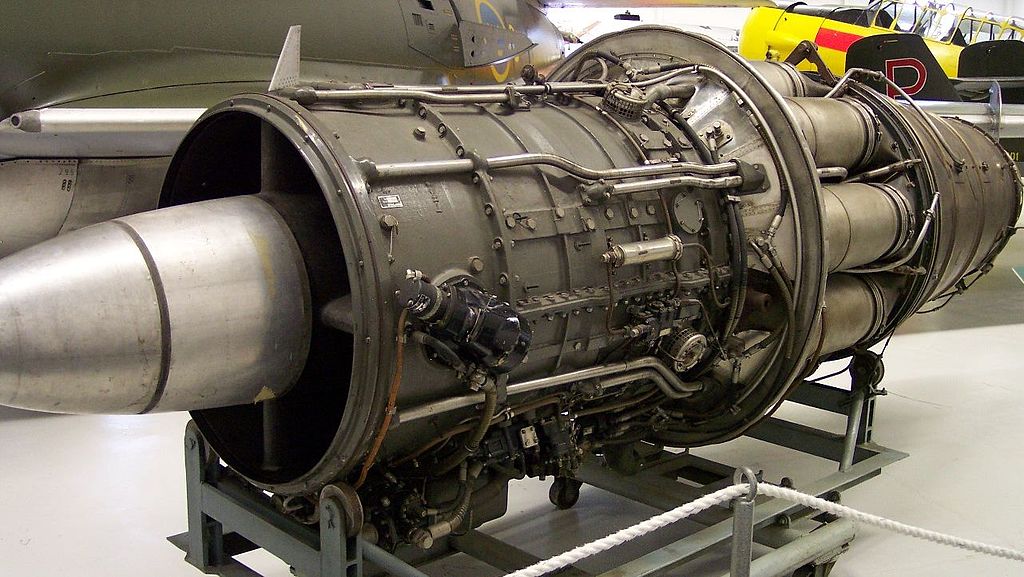
Turbines have been manufactured in Finspång since 1913 but the technology also has a thread going back to Gustaf de Laval who invented his steam  turbine in 1883 and put it into production in 1893 in Stockholm. (In the UK, CA Parsons invented his steam turbine in 1899). The Finspång manufacture of turbines by the STAL company built on the ingenious inventions of the brothers Ljungström, Birger and Fredrik. The two strands of the de Laval and Ljungström technologies came together later in 1959 and STAL became STAL-Laval. Ownership of the factory in due course shifted to ASEA and then to ABB and for a short while was with Alstom and then eventually moved to Siemens who are the current owners. Gas turbines came into the picture in 1945 with the development of a jet engine (the Dovern) for the Swedish Air Force. That engine flew only once (under another aircraft for a test) and never “in anger”. The Swedish Air Force chose Rolls Royce for their engines and STAL converted the development for industrial use. The engine morphed into an industrial gas turbine, the GT35, which first went into operation in 1957 and this engine – with a further development or two – is still around in the Siemens stable. In 1959, STAL delivered a 40MW gas turbine, the GT120, which at the time, was the world’s largest.

STAL Dovern.jpg

“STAL Dovern”. Licensed under CC BY-SA 3.0 via Wikimedia Commons

The Finspång Orangery (built in 1832) in the grounds of Finspång Manor is, at first sight, a most unlikely place for a Museum of Turbine History. But even with its wall frescoes and painted ceilings which evoke a long-gone age of gracious living, the turbines do not seem at all out of place. An older Orangery burnt down in 1830 and the current building was designed by Lars Jakob von Röök.  On two of the back, north-facing walls are frescoes said to be by the Italian painter Guido Reni. (But since Reni was born in 1575 and died in 1642, that is either wrong or the walls are much older and survived the fire of 1830. Since the manor was only built between 1668 and 1685, it is more likely that the artist was someone other than Guido Reni).

Finspångs Orangery juli_2005 (wikipedia)

Finspångs Orangery juli 2005 (wikipedia)

Orangery frescoes (image khaladsphotoblog)

Siemens has provided the Orangery as a home for the Museum, which has been put together by volunteers. They are still working to organise the wealth of material and drawings and pictures and films and models that are gathering dust in the catacombs under Finspong Manor.

Through the summer it is hoped to be able to have the museum open on Wednesdays and Thursdays. In any event the Finspong Manor grounds are well worth a visit and for anyone interested in rotating machinery, the museum should prove fascinating. (The manor itself is used as offices and is closed to the public. However the chapel – now run by the Swedish Church – is a little jewel of a chapel).

Finspång Manor from the SE. (image http://www.skyscrapercity.com)

Chapel in Finspång Manor (photo credit Per Svensson http://www.sfoto.se)

Currently the Finspång facility is the main centre for Siemens’ range of industrial gas turbines and ceased manufacturing steam turbines earlier this year. But the turbine tradition is now into a 6th generation.

EC looking for GE concessions to approve Alstom acquisition

May 12, 2015

UPDATE!

The New York Times also reports on the potential anti-trust issues and GE’s readiness to make some accommodations for EC concerns. However my take away from the NYT article is that GE is warning the EC that Alstom and the European Union have more to lose than GE has if the deal does not go through:

In now dealing with the European Commission’s antitrust office, Mr. Immelt has not forgotten the harsh experience of his predecessor, Jack Welch. In 2001, Mr. Welch failed to win approval for a proposed $42 billion takeover of Honeywell International after objections were raised by Mario Monti, the European antitrust commissioner at the time.

Mr. Immelt was worried enough last week that he met with Ms. Vestager in Brussels, where he also gave an address at the American Chamber of Commerce highlighting Europe’s economic potential. In that address, Mr. Immelt said young Europeans were “awesome” and “amazing,” but he emphasized that Europe needed investment to gain competitiveness and beat unemployment.

Speaking to reporters later, Mr. Immelt said his meeting with Ms. Vestager was “very constructive” and he described her as “a good leader.” G.E., he said, was engaged in “a process” with Brussels, and would “take the process where it goes.”

If G.E. is unable to convince Ms. Vestager of the merits of its case, the next step could be a so-called statement of objections, as soon as next month — formal charges that would outline the commission’s specific antitrust concerns. G.E. and Alstom could avoid that step by offering remedies sooner, perhaps proposing to sell parts of the gas turbine business in Europe.


My expectation was that the European Commision would look for some concessions from GE and would only grant a conditional approval for the acquisition of Alstom’s power and grid businesses.

The EC concerns seemed to be focused on Heavy Duty Gas Turbines (HDGT), and I wrote:

Will the EC approve GE’s acquisition of Alstom’s power business?

…. In any event,  I expect that the deal will go through, but I will not be surprised to see an approval conditional on some assurances from GE regarding R & D centres, R & D jobs and/or R & D budgets in Europe. I think it highly unlikely – and a little meaningless – if the EC were to ask for divestment of Alstom’s HDGT business to a third party (if any such exists). The bottom line is, I think, that Alstom’s HDGT technology has come to a dead-end and can not be developed any further in their own hands. While the business can continue in a diminishing way for some years, Alstom technology has no long-term value except to another party which has access to high temperature cooling technology. To have Alstom continue with the HDGT business as an unwilling and reluctant player does no one any service at all.

This Reuters report today suggests that my expectation may be close to the mark. However it also seems that if the EC demands too much in the way of concessions, GE might walk away. Clearly GE are already getting a little irritated at the protracted nature of the EC approval process. The failure of the deal is not something that Alstom or the EU would look forward to.

The EC decision may also be delayed somewhat beyond August 6th.

Reuters:

General Electric Co said on Monday for the first time it would be willing to consider concessions in order to win European approval to acquire the power equipment unit of France’s Alstom. “We are willing to explore remedies to get this deal done even though again we believe in the merits of the deal,” Steve Bolze, president and CEO of GE Power & Water, the conglomerate’s biggest industrial unit, told Reuters in an interview. Any concessions would have to “preserve the deal economics and our strategic value,” he said. …

… EU regulators typically prefer merging companies to sell overlapping assets or make it easy for rivals to enter the market. GE’s gas turbine competitors include Siemens AG and Mitsubishi Heavy Industries Ltd.

…GE already altered the deal to win the French government’s backing during last year’s two-month battle, in which it fended off Siemens and Mitsubishi. In the interview, Bolze acknowledged the “protracted process” for Alstom, and said GE was focused on “how to move … forward as it makes sense.”

In GE’s first-quarter conference call last month, Chief Executive Jeff Immelt backed the deal’s fit for GE, but said if it “ever would become unattractive, we wouldn’t do it.”

…. GE, which is undergoing an overhaul involving the exit of most of its finance assets, has said it expected synergies from the Alstom deal to add between 6 to 9 cents in earnings per share in 2016. But some analysts have told Reuters they doubt GE’s stock would take a big hit should the deal collapse, with the idea that GE could make up those earnings with stock buybacks or other deals. ……. 

…… EC spokesman Ricardo Cardoso said regulators are waiting for data from the companies before a setting a new deadline to act. The previous deadline was Aug. 6.

The EC will need to be very precise in demanding concessions from GE while ensuring that the deal does go through. Divesting parts of the HDGT business to unknown (and probably non-existent) buyers is probably a lose-lose solution. I expect that GE’s walk-away point will be reached if earnings from the service of Alstom’s fleet of gas turbines is removed from the mix. In fact any conditions set by the EC which dilute future revenues could prove fatal for the deal going through. Assurances about keeping R & D located in Europe and assurances about jobs and even about R & D budgets could be absorbed by a robust business plan. But no business plan can survive if something as fundamental as the revenue stream is adversely affected. And it is the volume of that revenue stream – and not just the margin from those revenues – which is crucial.