Archive for the ‘Trivia’ Category

Only one sentient species at a time

July 23, 2015

Roger Pielke Jr. has an interesting article in the Guardian where he addresses the search for extra-terrestrial life. His primary point is that we do not give sufficient consideration to the consequences of success. We see the search as satisfying curiosity but have no real hopes for success. And we have not really given much thought to the consequences of actually finding extra-terrestrial life.

Politicians tend to stay away from talking about aliens (unless they are “illegal aliens”) for obvious reasons. The United Nations briefly took up the issue of extraterrestrial life in 1977, but has let the issue lapse since then.

Following the 2010 Royal Society meeting, the UN’s Director of the Office for Outer Space Affairs, Mazlan Othman, categorically denied that she was the “the “take-me-to-your-leader person” if the Earth were to be contacted by alien life forms.” It does sound a bit silly. But when pressed Othman “stressed that she did not know what role she would play.”

In fact, it seems unlikely that any policy makers in national or international settings have a clearly thought–through plan for responding to the discovery of extraterrestrial life, whether that be microbes on another body in our solar system or beady-eyed aliens looking to invade. The conversation is only silly if we assume that efforts to detect alien life will never succeed.

But that got me to wondering what would happen not only if we found life but if we found sentient life out there. And I am led to the inescapable conclusion that in the same habitat or space, it is not possible for more than one sentient species to hold sway.

If any of the primate species on Earth displayed sentience, we would wipe them out. Not because humans are so evil as a species but because any sentient species dominating a habitat could not tolerate another less sentient species from challenging that dominance. Unless different sentient species, in the same habitat, displayed exactly the same level of intelligence and mastery over the physical world, then the dominant species would have little option but to ensure that its dominance was not, and could not, be threatened. In most scenarios that would mean wiping out the subordinate sentient species. Live and let live would only be feasible if the two species inhabited completely different habitats. To survive, a sentient species needs to be far below the level of sentience of another more dominant species so as to be “allowed to survive”. As a pet species. Or else it must be the dominant species where all other species sufficiently far below in level of sentience may be allowed to survive.

If any earth species, gorillas or chimps for example, showed signs of becoming sentient and becoming a self-aware, socially coherent group, they would be a more serious existential threat to the human species than any asteroid impact or super-volcanic eruption. Perhaps we might cede the ocean habitat to sentient dolphins, but even that is unlikely. Sentient birds with dexterous appendages with land and the air as their habitat would not long suffer the human race to survive. The Planet of the Apes type of scenario where genetic modifications by humans inadvertently creates a rival, sentient species is, I suppose, not totally implausible. But as soon as two species in a common habitat are close in intelligence and physical capability, the die is cast and there is space only for one to survive. If our pet dogs started challenging our authority and – say – demanding to set the menu for their meals, they are doomed. If we created neo-chimps which started demanding their “rights”, they could not survive. If cows or horses demanded the right to choose their own partners, they would be doomed to extinction or genetic modification to make them more docile.

This also applies to the search for extra-terrestrial intelligence. Suppose we found another sentient species on another planet. It is highly unlikely that it would display a similar level of sentience. Suppose anyway that the species can discern each other and perhaps even communicate. That itself is pretty far-fetched, but not impossible. It is more likely that the “finding” species is higher up in the sentience scale than the “found” species. So if we found a sentient species of inferior ability we might be magnanimous enough to allow it to continue in its own habitat, especially if the habitat was hostile to us. But we would see to it that its habitat was contained and could not expand to ever be a threat to humans. The obvious analogy is with the wiping out or subjugation of the local populations in the Americas or Australia. And that was with populations of the same species.

If we find a species that is superior to us (though it is more likely that they would find us), then it would be best if they were so far superior that the human race was perceived to be a “pet species”. Otherwise we are in for Star Wars and may the best species win. And the worst case scenario is that they find us. That we are found on Earth by a superior – but not too superior – species who find our habitat to be of interest. And the worst of worst cases would be if they found that we did not have the temperament to function as their pets and, moreover, if they found that human flesh, lightly spiced, was a particular delicacy.
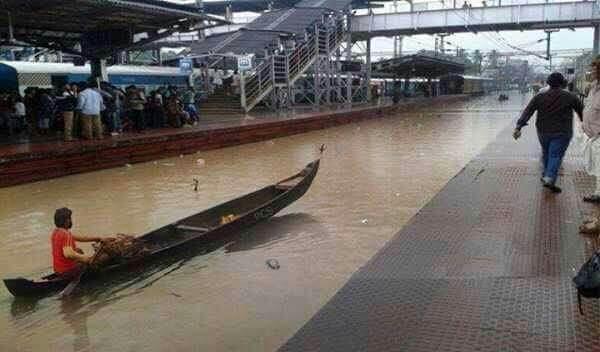
Who needs a train?

July 21, 2015

From Twitter

At a Railway station in Bombay July 20th 2015 (unknown photographer)

Monsoon railways in Bombay

Bewildered kangaroo

July 18, 2015
17 July 2015 A kangaroo on the Colmar Estate vineyard in Orange, New South Wales, Australia during the winter storm image AP

17 July 2015
A kangaroo on the Colmar Estate vineyard in Orange, New South Wales, Australia during the winter storm – image AP


Elephant Party

June 28, 2015

Found on Facebook from Tintu-Mon

Elephant Party


Just a little bit funny, this Saturday morning …

June 13, 2015
  1. A white woman, Rachel Dolezal, believed all the claptrap about how race was just a social construct and decided to identify herself as an African-American. She has altered her appearance and hair style to convince her surroundings and has leveraged the duplicity to get a full scholarship at a black University and then to become President of the local chapter of the NAACP in Spokane, Washington. She has managed to keep this up for some 7 or 8 years. But she didn’t manage to change her ancestry and her genetics and was eventually betrayed by her (white) parents.
  2. King Felipe VI of Spain has removed the title “Duchess of Palma” from his sister, Princess Cristina, who is to go on trial charged with tax evasion. She was granted the title in 1997 when she married Inaki Urdangarin, a former Olympic handball player who is also accused of tax evasion. Presumably she remains a Princess of the Ignoble kind.
  3. Barack Obama demonstrated again that he is a leader incapable of even carrying his own supporters with him. A leader who follows. He is trying to negotiate a trade agreement among 12 countries around the Pacific. He asked Congress to give him “fast track” powers to negotiate the deal. The Senate agreed but his own Democrats killed the enabling bill in the House of Representatives. But Obama will try again.
  4. The AAP (Arvind’s Agitation Populace) are now the ruling party in the Delhi government. True to their ineptitude they appointed a Law Minister, Jitender Singh Tomar, who turned out to have faked all his degrees.
  5. Moldova’s Prime Minister, Chiril Gaburici, also resigned because he was found to have faked his school diploma.
  6. Prince Carl-Philip was the Crown Prince of Sweden when he was born in 1979.  But a year later he had to give up that position to his elder sister Victoria when legislation removed the hereditary preference for male progeny. (This was actually a compromise since legislation to abolish the monarchy failed to pass). Today, he marries a commoner, Sofia Hellqvist, 30, who will become Princess Sofia of Sweden. Hellqvist was something of a hell-raiser when she was younger and more foolish, with a period as a topless model and beauty queen and even as a reality TV participant hobnobbing with porn stars. Just a touch of ignobility here.
  7. In Japan a Supreme court ruling in 1979 established that in a case of a husband or wife cheating with a 3rd party (where the 3rd party was not a prostitute paid for his or her services) the cheated spouse could sue the 3rd party for compensation for disturbing the tranquility of the marriage. But this week a Japanese judge ruled that a Ginza bar hostess who had sex with her business-men clients, not for money but for their continued patronage, could not be sued by an “injured” wife. He argued that this “business adultery” was routine and did not disturb the tranquility of the marriage.
  8. Tony Blair is.

Kill rates from police action and air-strikes

May 31, 2015

The juxtaposition of domestic police shootings in the US and the effectiveness of air strikes in Syria is only because I read one article soon after the other. But numbers always tell a tale – even if it is obscure.

  • Domestic US deaths by police shooting: 385 in 5 months (kill rate 77/month)
  • ISIS fighters killed in Syria by US air strikes: 2217 in 8 months (kill rate 277/month)

I don’t know if any conclusions are justified because, to me, the one seems much higher than it ought to be and the other seems too low. But one observation I have is that kill rate – as a Key Performance Indicator (KPI) – should be maximised in a war but minimised in policing.

Washington Post: 30th May.

Fatal police shootings in 2015 approaching 400 nationwide

……. The three are among at least 385 people shot and killed by police nationwide during the first five months of this year, more than two a day, according to a Washington Post analysis. That is more than twice the rate of fatal police shootings tallied by the federal government over the past decade, a count that officials concede is incomplete.

IB Times: 25th May:

US-Led Airstrikes in Syria Kill 2,217 Isis Fighters

 ….. At least 2,217 Islamic State fighters, mostly European nationals, have been killed in the last eight months by the US-led airstrikes on Isis targets in Syria, a monitoring agency reported.

According to the Syrian Observatory for Human Rights, a high number of Isis casualities were reported from Homs, Hama, al Hasakah, Raqqa, Der Ezzor, and Aleppo.

In total, 2,440 people have been killed since the beginning (September 2014) of the US-led coalition airstrikes on Syria.

According to the estimates provided by the International Center for the Study of Radicalisation, a think tank at King’s College London, at least 3,300 Western Europeans and 100 US citizens are believed to have joined the Islamic State.

In one estimate around 700,000 people are killed worldwide by violent, non-war related, events every year. Currently my guesstimate is that around 300,000 may be the death toll due to war. Since the crude mortality rate is about 56 million (8/1000 of population) every year, it follows that about 2% of all deaths are due to the violence of man upon man.

But it also means that among our 7 billion we have about 50 million people who have, by violence, caused the death of another human.

Beyond infinity must come nothing – not even nothingness

May 26, 2015

An exercise in triviality.

I have been exercised of late by the use of “infinite” as an adjective and came to the conclusion that “infinite” should only be used to describe the unboundedness of things capable of being counted or measured (quantifiable or countable things). So, I reason, the number of terms in a numerical series, or physical things, or length or mass or time could be described as being “infinite”, because they could also be “finite”.  The use of “infinite” to describe something qualitative which could never be finite was therefore illogical. (Not “wrong” but illogical because I take the position that no usage is ever “wrong” if it communicates what is intended to be communicated). But my “rule” is that “infinite” is usable only for things which must first be “finite”. Therefore “boundless” or “endless” should be more appropriate for non-quantifiable things. So “infinite sky” or “infinite space” would be better described as “endless sky” or “boundless space”. “Endless lines” not “infinite lines”, but “lines of infinite length”.

Georg Cantor even imparted qualities to “infinite”. Cantor described “cardinalities” of the infinite for different sizes of infinite sets. Of course, there are then an infinite number of cardinalities. He considered integers as being countably infinite, but he took the infinite set of real numbers – as being capable of being counted – but uncountable. But Cantor’s uncountable, various cardinalities of the infinite still apply only to quantitative things.

Early Indian mathematics distinguished between endless and innumerable and tried to classify infinites by considering loose bounds and rigid bounds:

…… two basic types of infinite numbers are distinguished. ……. a distinction was made between asaṃkhyāta (“countless, innumerable”) and ananta (“endless, unlimited”), between rigidly bounded and loosely bounded infinities.

In the hierarchy of words therefore I take “boundless” to be applicable to all things whereas I take “infinite” to apply only to quantifiable things.

But what happens now to “infinity” as a noun?

As a noun we give “infinity” many meanings. First as the quality or state of endlessness (limitlessness, boundlessness) and second as the number which is larger than any other and always larger than anything conceivable (). We therefore refer to the infinity of space or the infinity of meaning or the infinity of the stars. And in mathematics, is treated as a number (albeit with rather special properties) and can be used in mathematical operations as a number. But there is a third meaning or usage. We also use “at infinity” or “to infinity” as if it were a place. “Parallel lines meet at infinity”, we say in plane geometry. In calculus we speak of “limits at infinity”. We speak of points, planes and lines “at infinity” in projective geometry. The universe ends “at infinity”.

OED:

infinity (n.) late 14c., from Old French infinité. “infinity; large number or quantity” (13c.), from Latin infinitatem (nominative infinitas) “boundlessness, endlessness,” from infinitus boundless, unlimited” (see infinite). Infinitas was used as a loan-translation of Greek apeiria “infinity,” from apeiros “endless.”

infinite (adj.)late 14c., “eternal, limitless,” also “extremely great in number,” from Old French infinit “endless, boundless,” and directly from Latin infinitus “unbounded, unlimited,” from in “not, opposite of” (see in- (1)) + finitus “defining, definite,” from finis “end” (see finish (v.)). The noun meaning “that which is infinite” is from 1580s.

To be finite is the opposite of being infinite. Infinity as a number, ∞, has mathematical zero as an inverse but when considered to be one end (?) of an endless series has -∞ at the other end. But what happens “at infinity”, where parallel lines meet and the universe comes to end. Most of the universe consists of apparently empty space, interspersed with sub-universes, galaxies, stars and star systems. But this space is not nothing. The space between electrons orbiting around the nucleus of an atom is not nothing either. These spaces may not contain matter but they still have attributes and properties. Gravity waves and magnetic waves can traverse them. Light – whether a wave or not – crosses them. Time exists within them. And with light traversing and a time interval, distance must follow. Space, therefore, has dimensions. And since we infer that some magic mass we call dark matter, and some magic energy called dark energy, abound, space also permits/allows/has dark energy and dark matter.

An infinite universe extends “to infinity”. Obviously it has to be nothing which lies beyond. And it is the properties or attributes of this “nothingness” which boggle the mind.

Clearly “empty” space does not serve as an illustration of the nothingness beyond. (It is not space I am told but space-time, where we can observe space as time passes but cannot observe time as space passes). A vacuum, anywhere, is void of matter but otherwise has the attributes of space and does not serve either. Even the Buddhist concept of emptiness, shunyata (Sanskrit where shunya = zero), is not entirely devoid of thought. We cannot say that light does not traverse nothingness because opacity to light would be an attribute. So would the non-passage of gravity waves through nothing also be an attribute. Time does not pass within nothingness. Time, in fact, cannot exist. Dimensions are undefined. No energy, no mass and not even any magic dark energy. No Laws of Nature. Nothingness cannot be imparted with any attributes or properties since then it would no longer be nothing. In fact, nothingness – by its very nature – must be incapable of being demonstrated, illustrated or even conceptualised.

Tom Mason commented on my previous post:

The universe is as it is, there is no boundary no edge. Also the so called expansion (or maybe it’s contraction) of our universe is not real — it is just a readily seen quirk due to the passage of time varying across the universe. The variation that is evident with the universe’s apparent smallness of its beginning and the apparent largeness of now.

And so I end with a circular and trivial argument and I have no better perception of nothingness:

“Nothing” is no thing – neither physical nor abstract. It cannot be conceptualised without becoming some thing. It has no properties and no attributes. No thing is nothing. Therefore nothing is no thing.

Except that nothing can exist beyond infinity and this nothing cannot even contain nothingness.

“Infinite” is of a lower order than “boundless”

May 23, 2015

In common usage, “boundless” is often used as a synonym for “infinite”. But of course the two words represent two quite different properties and, I think, are unnecessarily conflated: to the detriment of both language and understanding. I generally assume “infinite” to apply to quantifiable or countable (i.e capable of being counted) things, whereas I take  “boundless” to apply to both qualitative concepts and “countable” things.

“Infinite” is thus of a lower order than “boundless” since it can be applied only to the subset of “countable” things in the set of all things.

The infinite” is patently impossible since the application of the definite article can only apply to the finite. Of course, “the Infinite” is often used to describe “the divine” which only serves to illustrate the paradox inherent in divinity.

So I sometimes find the use of “infinite” as an adjective a little grating. A specific number is not “countable”, it is itself the “count”. So I find the use of “infinite numbers” or “infinite sets” somewhat misleading. Each and every number or set of numbers is – and has to be – finite. It is only the number of terms in the set which may be infinite. Each set once specified is fixed and distinct from any other set. It may contain an infinite number of terms but the set is finite. You could also say that such a set “extends to infinity” or that the set is “boundless”. The number of such sets can also be said to be infinite or boundless.

The distinction between boundless (or endless) and infinite is of no great significance except when the two properties need to be distinguished. For example, the Koch snowflake is an example of a set of lines of increasing length being drawn within a bounded space. It is only the length of the line – being quantifiable – which tends to the infinite with an infinite number of iterations. Note that every iteration only produces a line of finite length but the number of terms in the set is infinite.

Koch's snowflake

Koch’s snowflake – 4 iterations

The Koch curve has an tends to an infinite length because the total length of the curve increases by one third with each iteration. Each iteration creates four times as many line segments as in the previous iteration, with the length of each one being one-third the length of the segments in the previous stage. Hence the length of the curve after n iterations will be (4/3)n times the original triangle perimeter, which is unbounded as n tends to infinity.

I am told that the universe is expanding and may be infinite but bounded. Or it may be infinite and boundless. Or it may be finite and bounded. Whether the universe is infinite is a different question to whether it is bounded. In fact the term “infinite” can only be applied to some quantifiable property of the Universe (its mass, its diameter, its density, the number of stars or galaxies it contains …), whereas its boundedness can be applied to any qualitative or quantitative property. In one sense the universe where we assume that the fundamental laws of nature apply everywhere must be bounded – if nothing else – at least by the laws of nature that we discern.

Currently the thinking regarding the shape of the universe is:

NASA:

  • If space has negative curvature, there is insufficient mass to cause the expansion of the universe to stop. In such a case, the universe has no bounds, and will expand forever. This is called an open universe.
  • If space has no curvature (i.e, it is flat), there is exactly enough mass to cause the expansion to stop, but only after an infinite amount of time. Thus, the universe has no bounds and will also expand forever, but with the rate of expansion gradually approaching zero after an infinite amount of time. This is termed a flat universe or a Euclidian universe (because the usual geometry of non-curved surfaces that we learn in high school is called Euclidian geometry).
  • If space has positive curvature, there is more than enough mass to stop the present expansion of the universe. The universe in this case is not infinite, but it has no end (just as the area on the surface of a sphere is not infinite but there is no point on the sphere that could be called the “end”). The expansion will eventually stop and turn into a contraction. Thus, at some point in the future the galaxies will stop receding from each other and begin approaching each other as the universe collapses on itself. This is called a closed universe.

A universe with some infinite property in a bounded space only begs the question as to what lies in the space beyond the bounds. It also occurs to me that an endlessly expanding universe has to first assume that empty space – which should contain nothing – must actually contain the property of distance. That too is a bound, for if space did not even contain the property of distance, any expansion would be undefined. (And what does distance mean between two points in truly empty space?).

Imagination can be boundless – rather than infinite – and can even extend beyond the bounds of what we can perceive. In reality even our imaginations are often bounded by the limitations of our modes of expression of language and music and painting. Our emotions can be said to be boundless though they too are bounded by physiological limits.

A bounded universe of boundless infinities it would seem, rather than one of infinite infinities, and certainly not one of infinite boundlessnesses.

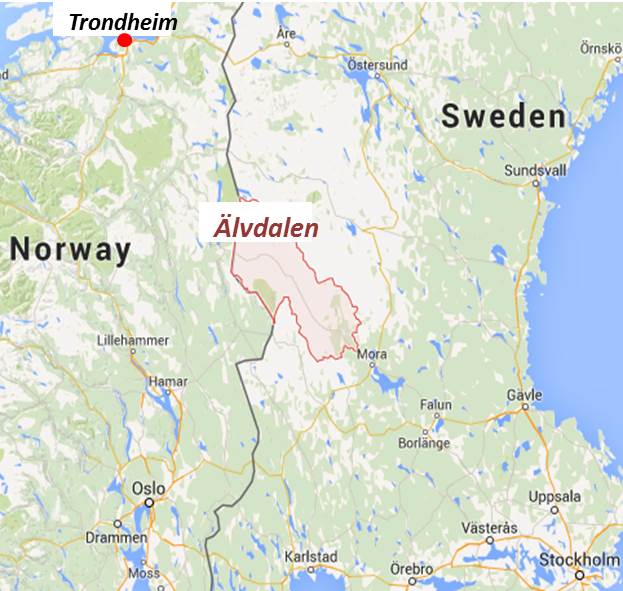
Mapping Älvdalen to Middle Earth places Rivendell at Trondheim

May 22, 2015

In my previous post I suggested that the municipality of Älvdalen in the county of Dalarna in Sweden was probably as close as one could get to Tolkien’s Lothlorien.

Trondheim to Älvdalen

I have posted earlier about Peter Bird’s wonderful mapping of Middle Earth to a pre-Holocene Europe where sea levels would have been some 120m lower than today.

Middle Earth by Peter Bird

Assuming

  1. that present day Älvdalen corresponds to Lothlorien in Middle Earth, and
  2. then taking Peter Bird’s mapping of Middle Earth to a Europe where sea levels were some 100m lower than today, and
  3. that the Misty Mountains lie between present day Norway and Sweden, and
  4. The Gates of Moria are not to be taken as the present day Mora in Dalarna, and

since the Fellowship of the Ring travelled south and east from Rivendell and through the Gates of Moria across the Misty Mountains to get to Lothlorien, then,

it follows that present day Trondheim maps to Rivendell of Middle Earth.

Frodo's Journey Rivendell to Lothlorien

Frodo’s Journey Rivendell to Lothlorien

Dangerous, brown cow shot dead after 3 hour chase in its bid for freedom

May 18, 2015

It’s true.

A dangerous, brown cow has been shot dead by police after it escaped from a field near Newcastle during a three-hour operation involving armed units and a helicopter.

Perhaps this will be a deterrent for other cows which try to escape from lawful slavery.

The Chronicle:

The cow which was later shot by police in Wallsend

The brown cow which was later shot by police in Wallsend – The Chronicle

Police shot dead an escaped cow following a massive operation involving armed officers and a helicopter. The beast was one of three to escape from a farm in Wallsend yesterday afternoon. Northumbria Police deployed marksmen, aerial support and, eyewitnesses said, 15 to 20 cars, closing roads in a bid to keep the animals off the busy A1058 Coast Road.

Witnesses said they believed three cows escaped from the Rising Sun Farm in Wallsend, though two were later recaptured. However the manager of the farm later told the Chronicle that the farm did not have any cows. 

Up to 20 police cars were reported at a field behind O’Hanlon Crescent where armed police were tracking one brown cow. Residents approached the animal, which one bystander claimed to be “distressed”, although others said it was not moving. Resident Barry Aitchison, 56, said people were watching police deal with the cow.

He claimed armed officers then asked to enter his house to shoot the beast from an upstairs window but that there was not enough room for them to do so. Instead, Mr Aitchison claims, they went to his neighbour’s property from where the cow was shot and killed at around 5.15pm.