Archive for the ‘Weather’ Category

Carbon dioxide rip-off has cost Australia $5.5 billion – so far

February 14, 2011

With easy money like this floating around and waiting to be siphoned off it is not difficult to see why the global warming fraud continues! And of course these $5.5 billion are small change compared to the amounts that have been scammed in Europe.

And to make it worse, carbon dioxide emissions are a little less than insignificant for global temperatures.

The Sydney Morning Herald:

Billions blown on carbon schemes

SUCCESSIVE federal governments have spent more than $5.5 billion over the past decade on climate change programs that are delivering only small reductions in greenhouse gas emissions at unusually high costs for taxpayers and the economy.

An analysis by the Herald of government schemes designed to cut emissions by direct spending or regulatory intervention reveals they have cost an average of $168 for each tonne of carbon dioxide abated. ……

The analysis of 17 programs with a total cost of $5.62 billion shows many of the schemes are at odds with the goal of tackling climate change at the lowest cost to the economy. ………

The weighted average cost of the 17 programs was $168 a tonne. They will deliver about 25 million tonnes of carbon abatement in 2020 – less than 10 per cent of that needed to meet the government’s target of reducing emissions in 2020 by 5 per cent on 2000 levels.

The worst offenders have included Labor’s rebates for rooftop solar panels, which cost $300 or more for every tonne of carbon abated, and the Howard government’s remote renewable power generation scheme, which paid up to $340 for each tonne.

Read the article.

Heaviest snowfall in a century in South Korea

February 14, 2011

An excavator removes snow from a road in Gangneung, Gangwon Province, Sunday. The heaviest snowfall in a century hit Gangneung and other cities in the eastern part of the province between Friday and Saturday, with hundreds of people stranded on roads and causing property damage. / Korea Times photo by Kim Joo-young

While all the snow and ice covering a large part of the Northern hemisphere does not prove anything about climate, in the style of the global warmists we could say that it is entirely consistent with the coming of a new Dalton-like solar minimum and a coming ice-age!!

From the BBC:

The heaviest snowfall in more than a century on South Korea’s east coast is causing widespread chaos. Hundreds of houses have collapsed under the weight of the snow. One newspaper described it as a snow bomb. The South Korean government has deployed 12,000 soldiers to rescue stranded residents.

The worst weather has been in Gangwon province. Weather experts say there will be more snowfall in the area in the coming hours. “I am 83 years old. It’s the heaviest snow in my life. I am really grateful for the soldiers’ help,” said Park Chae-ran. …..

….. January was the coldest since the 1960s. In Gangwon on the eastern coast, one city recorded 80cm (2.6 feet) of snow in a single day – the heaviest fall in 24 hours since records began there back in 1911.

The Han River in the capital, Seoul, iced over for the first time in years – but the latest snowfalls have left the capital unaffected so far.

More snow is forecast.

Rivers in the sky

February 12, 2011

Weather (and climate) which are contained within the thin chaotic layer around the earth’s surface are very far away from being “settled science” in spite of what Al Gore and those of his ilk like to pretend.

Unmanned aircraft are now being used in a new programme to study the “atmospheric rivers” which transport vast quantities of rain around the globe.

They’re called atmospheric rivers – narrow regions in Earth’s atmosphere that transport enormous amounts of water vapor across the Pacific or other regions. Aptly nicknamed “rivers in the sky,” they can transport enough water vapor in one day, on average, to flood an area the size of Maryland 0.3 meters (1 foot) deep, or about seven times the average daily flow of water from the Mississippi River into the Gulf of Mexico. The phenomenon was the subject of a recent major emergency preparedness scenario led by the U.S. Geological Survey, “ARkStorm,” which focused on the possibility of a series of strong atmospheric rivers striking California – a scenario of flooding, wind and mudslides the USGS said could cause damages exceeding those of Hurricane Katrina in 2005.

JPL airborne sensor to study 'Rivers in the Sky'

NASA's Global Hawk soars aloft from Edwards Air Force Base, Calif., on a functional check flight of the WISPAR aircraft payload system and science instruments. Credit: NASA Dryden Flight Research Center

While atmospheric rivers are responsible for great quantities of rain that can produce flooding, they also contribute to beneficial increases in snowpack. A series of atmospheric rivers fueled the strong winter storms that battered the U.S. West Coast from western Washington to Southern California from Dec. 10 to 22, 2010, producing 28 to 64 centimeters (11 to 25 inches) of rain in certain areas. The atmospheric rivers also contributed to the snowpack in the Sierras, which received 75 percent of its annual snow by Dec. 22, the first full day of winter.

To improve our understanding of how atmospheric rivers form and behave and evaluate the operational use of unmanned aircraft for investigating these phenomena, NASA scientists, aircraft and sensors will participate in a National Oceanic and Atmospheric Administration-led airborne field campaign slated to begin Feb. 11.

Called Winter Storms and Pacific Atmospheric Rivers, or WISPAR, the field campaign, which continues through the end of February, is designed to demonstrate new technology, contribute to our understanding of atmospheric rivers and assist NOAA in potentially conducting offshore monitoring of atmospheric rivers to aid in future weather predictions.

Read original article.

La Niña and NAO driving current stormy weather

February 8, 2011
During cold La Niña episodes the normal patter...

La Nina Regional impacts: Image via Wikipedia

It may seem obvious (or it should be) that it is ocean currents that dominate weather and man-made effects pale into insignificance in relation to these. But it has been more politically correct to find that every kind of weather event is due to man-made global warming.

But as this article in PhysOrg shows, perhaps the oceans (and the sun) are beginning to get their due (but of course they don’t really care whether anybody believes in them or not – they just carry on).

The term La Niña refers to a period of cooler-than-average sea-surface temperatures in the Equatorial Pacific Ocean that occurs as part of natural climate variability. This situation is roughly the opposite of what happens during El Niño (“the boy”) events, when surface waters in this region are warmer than normal. Because the Pacific is the largest ocean on the planet, any significant changes in average conditions there can have consequences for temperature, rainfall and vegetation in distant places. Scientists at the International Research Institute for Climate and Society (IRI), part of Columbia’s Earth Institute, expect moderate-to-strong La Niña conditions to continue in the tropical Pacific, potentially causing additional shifts in rainfall patterns across many parts of the world in months to come.

These shifts, combined with socioeconomic conditions and other factors, are making some countries more vulnerable. However, La Niña and El Niño conditions actually allow for more accurate seasonal forecasts and help better predict extreme drought or rainfall in some areas. ………..

“Based on current observations and on predictions from models, we see at least a 90 percent chance that La Niña conditions will continue through March,” said IRI’s chief forecaster, Tony Barnston.

Climate scientists have found La Niña’s fingerprints on a number of extreme weather events such as the devastating flood that occurred in Pakistan in 2010, as well as flooding in West Africa, South Africa and most recently in Queensland, Australia, where an area equal to the combined size of France and Germany was underwater. La Niña is also to blame for Cyclone Yasi, one of the strongest to hit Australia, which came ashore on Feb. 2. Cyclone Yasi is the second most damaging Australian cyclone on record after Cyclone Tracy, which struck in 1974.

But La Niña isn’t to blame for the recent severe weather affecting the Northeast. Winter weather for these regions is often driven not by La Niña but by large-scale weather patterns over the U.S., the northern Atlantic Ocean and the Arctic. These are often short-term, and are generally predictable only a week or so in advance. They are the culprits responsible for the dip in temperatures and spike in snow storms in the Midwest and Northeast.

…………

Since 1950, the world has experienced six major La Niña events, wreaking havoc in countries around the world. In 2000, for example, floods associated with La Niña affected 400,000 people in southern Africa, caused at least 96 deaths and left 32,000 homeless.

La Niña conditions typically persist for 9 to 12 months, peaking sometime during the end of the year. But 2010 was a lively year for climate scientists: For the first four months of this year, El Niño conditions prevailed in the tropical Pacific, but that quickly changed, and by June, a La Niña pattern had emerged.

“Last year’s transition from El Niño to La Niña was about the most sudden we’ve ever had,” Barnston said. “When we had rapid flips like this in the past, we sometimes ended up having a two-year La Niña, such as right after the El Niño episodes of 1972 to 1973 and 1997 to 1998.”

Barnston cautions that the likelihood of this happening with the current La Niña is unknown. “Even if we do have a second year of La Niña developing in northern summer 2011, we expect at least a brief return to neutral conditions from May to July of 2011.”

Related:

https://ktwop.wordpress.com/2011/02/03/la-nina-begins-to-show-up-in-global-temperature/

https://ktwop.wordpress.com/2011/02/05/la-nina-will-last-well-into-2011-and-could-extend-into-2012/

https://ktwop.wordpress.com/tag/la-nina/

Do super storms indicate that earth’s magnetic polarity is about to switch?

February 8, 2011


geomagnetic reversal is a change in the orientation of Earth’s magnetic field such that the positions of magnetic north and magnetic south become interchanged. These events often involve an extended decline in field strength followed by a rapid recovery after the new orientation has been established. These events occur on a scale of tens of thousands of years or longer, with the latest one (the Brunhes–Matuyama reversal) occurring 780,000 years ago.

On average geomagnetic reversals occur about every 500,000 years so it would seem that a reversal is overdue. How long a reversal takes and whether a reversal can happen very rapidly is not known. That the earth’s geomagnetic field is due to the flow of liquid metals in the earth’s interior – the dynamo theory – is also very likely. The sun’s magnetic reversals seem to happen at every sunspot maximum with an average period of 11 years between reversals giving a 22 year magnetic cycle.

The movement of Earth's north magnetic pole across the Canadian arctic, 1831-2001. Credit: Geological Survey of Canada.

The movement of Earth's north magnetic pole across the Canadian arctic, 1831--2001. Credit: Geological Survey of Canada.

The position of the magnetic poles is also continuously changing with a current drift (increasing) of the magnetic North Pole from N. Canada towards Siberia at about 40km /year. But this movement may be in some cyclic fashion and is unlikely to be directly connected to the half-million year reversals. For the last 200 years the strength of the earth’s magnetic field has been decreasing and could be the precursor of the overdue reversal.

How the earth will behave during a magnetic reversal is a known unknown and provides the basis of much speculation and cataclysmic theories which cannot be tested. The cataclysmic pole shift hypothesis is one such theory which predicts that the earth’s rotation will reverse, the magnetic field will reverse and mankind will be obliterated – probably in 2012!!

But it is thought that reversals take a few thousand years to complete, and during that time–contrary to popular belief–the magnetic field does not vanish.  Magnetic lines of force near Earth’s surface become twisted and tangled, and magnetic poles pop up in unaccustomed places. A south magnetic pole might emerge over Africa, for instance, or a north pole over Tahiti. Weird. But it’s still a planetary magnetic field, and it still protects us from space radiation and solar storms.

Terrence Aym suggests that we may be seeing the beginning of a reversal (and of course since this is overdue it may well occur at any time):

Forget about global warming—man-made or natural—what drives planetary weather patterns is the climate and what drives the climate is the sun’s magnetosphere and its electromagnetic interaction with a planet’s own magnetic field.

File:Magnetosphere rendition.jpg

Artist's rendition of Earth's magnetosphere: NASA via Wikipedia

Magnetic polar shifts have occurred many times in Earth’s history. It’s happening again now to every planet in the solar system including Earth. The magnetic field drives weather to a significant degree and when that field starts migrating super storms start erupting.

The superstorms have arrived.

The Earth’s northern magnetic pole was moving towards Russia at a rate of about five miles annually. That progression to the East had been happening for decades.

Suddenly, in the past decade the rate sped up. Now the magnetic pole is shifting East at a rate of 40 miles annually, an increase of 800 percent. And it continues to accelerate.

Recently, as the magnetic field fluctuates, NASA has discovered “cracks” in it. This is worrisome as it significantly affects the ionosphere, troposphere wind patterns, and atmospheric moisture. All three things have an effect on the weather.

Worse, what shields the planet from cancer-causing radiation is the magnetic field. It acts as a shield deflecting harmful ultra-violet, X-rays and other life-threatening radiation from bathing the surface of the Earth. With the field weakening and cracks emerging, the death rate from cancer could skyrocket and mutations of DNA can become rampant.

Another federal agency, NOAA, issued a report caused a flurry of panic when they predicted that mammoth superstorms in the future could wipe out most of California. The NOAA scientists said it’s a plausible scenario and would be driven by an “atmospheric river” moving water at the same rate as 50 Mississippi rivers flowing into the Gulf of Mexico……

According to some geologists and scientists, we have left the last interglacial period behind us. Those periods are lengths of time—about 11,500 years—between major Ice Ages. One of the most stunning signs of the approaching Ice Age is what’s happened to the world’s precessional wobble. The Earth’s wobble has stopped. ..

….So, the start of a new Ice Age is marked by a magnetic pole reversal, increased volcanic activity, larger and more frequent earthquakes, tsunamis, colder winters, superstorms and the halting of the Chandler wobble.

Unfortunately, all of those conditions are being met.

Read original article


La Niña will last well into 2011 and could extend into 2012

February 5, 2011

A new article has been posted on the National Oceanic & Atmospheric Administration website and comes to the conclusion that there is an even chance that La Niña conditions could extend into 2012:

Multivariate ENSO Index (MEI) by Klaus Wolter 4th February 2011

El Niño/Southern Oscillation (ENSO) is the most important coupled ocean-atmosphere phenomenon to cause global climate variability on interannual time scales. Here we attempt to monitor ENSO by basing the Multivariate ENSO Index (MEI) on the six main observed variables over the tropical Pacific. These six variables are: sea-level pressure (P), zonal (U) and meridional (V) components of the surface wind, sea surface temperature (S), surface air temperature (A), and total cloudiness fraction of the sky (C). …… Negative values of the MEI represent the cold ENSO phase, a.k.a.La Niña, while positive MEI values represent the warm ENSO phase (El Niño)………

Discussion and comparison of recent conditions with historic La Niña events

In the context of the rapid transition of the MEI into strong La Niña conditions, this section features a comparison figure with strong La Niña events that all reached at least minus one standard deviations by June-July, and a peak of at least -1.4 sigma over the course of an event. The most recent moderate La Niña events of 1998-2001 and 2007-09 did not qualify, since they either did not reach the required peak anomaly (the first one) or became strong too late in the calendar year (both).

The updated (December-January) MEI value has strengthened slightly to -1.62 standard deviations after almost dropping below -2 standard deviations in August-September. Nevertheless, the most recent value ranks 2nd for this time of year, clearly below the 10%-tile threshold for strong La Niña MEI rankings , but slightly weaker than the value recorded in 1974. If one were to take the average of all MEI rankings since July-August (a six-month period), the strongest La Niña half-year periods of mid-55, ’73-74, and late ’75 averaged slightly stronger than the current event, for now (this is means Rank 4 for the current event, up one from last month).
Negative SST anomalies are covering much of the eastern (sub-)tropical Pacific in the latest weekly SST map. Many of these anomalies are in excess of -1C.
For an alternate interpretation of the current situation, I highly recommend reading the latest NOAA ENSO Advisory which represents the official and most recent Climate Prediction Center opinion on this subject. In its latest update (6 January 2011), La Niña conditions are expected to last “well” into the Northern Hemisphere spring of 2011. …….. While La Niña conditions are guaranteed well into 2011, it remains to be seen whether it can rally once more to cross the -2 sigma barrier, and/or whether it will indeed last into 2012, as discussed six months ago on this page. I believe the odds for a two-year event remain well above 50%, made even more likely by the continued unabated strength in various ENSO indices.

It seems self-evident ( even if not fashionable or politically correct) that the sun controls our climate and that the oceans do the sun’s bidding as they drive the atmosphere which then determines our weather.

The consequences of an extended La Niña into 2011 / 2012 could be

  • another good monsoon year in India,
  • a cold winter again for 2011/2012 in the Northern hemishere


La Niña begins to show up in global temperature

February 3, 2011

From Dr. Roy Spencer:

credit:drroyspencer.com

…although this, too, shall pass, when La Nina goes away.

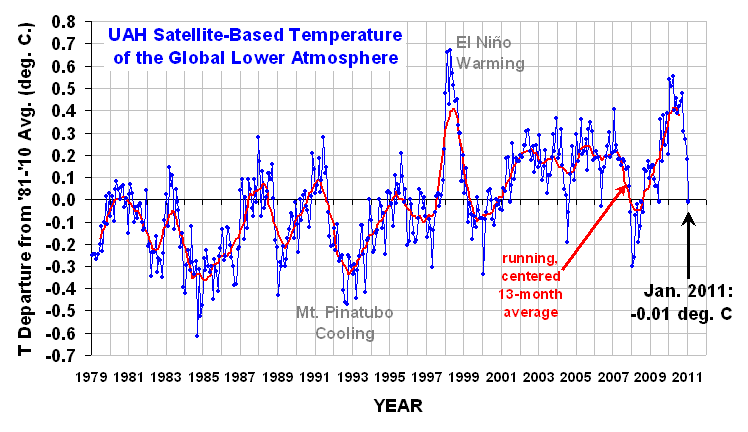
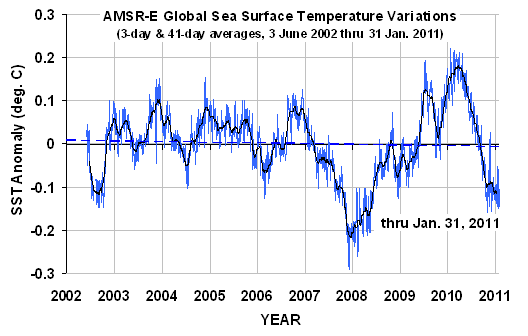
January 2011 experienced a precipitous drop in lower tropospheric temperatures over the tropics, Northern Hemisphere, and Southern Hemisphere. This was not unexpected, since global average sea surface temperatures have been falling for many months, with a head start as is usually the case with La Nina.

This is shown in the following plot (note the shorter period of record, and different zero-baseline):

credit:drroyspencer.com

Read original report: http://www.drroyspencer.com/2011/02/uah-update-for-january-2011-global-temperatures-in-freefall/

Queensland sees off Yasi: Preparedness ensures it was no Katrina

February 3, 2011

Cyclone Yasi has come and gone.

Its speed was a blessing in disguise and has ensured that it is already well inland and reducing in strength. It has left behind a trail of destruction but few (if any) serious injuries or fatalities. The township of Cardwell was warned to evacuate, but about 100 residents chose not to leave and they have not been contacted as yet.

BBC:

Worst hit were the coastal towns of Tully, Mission Beach and Cardwell, with hundreds of houses destroyed. The cities of Cairns and Townsville were relatively unscathed but are being lashed by heavy rains; warnings of further storm surges have been issued. Queensland Premier Anna Bligh said there had been no reports of deaths or serious injuries so far.

The similarities of Yasi to Katrina is apparent but the differences in their respective impacts is quite striking.

This may be partially due to geography and demographics and the speed with which Yasi drove inland, but observing both from across the world leads me to the perception that the primary differences between Queensland and Louisiana were

  • the preparedness of the government and the population,and
  • the sense of civic duty in Queensland, and
  • the level of trust in the state government institutions, and
  • the level of perceived duty within the institutions

The thought of Queensland police looting after Yasi as some New Orleans police did after Katrina is  inconceivable. It’s just my perception but I believe it shows the difference between institutions having a fundamental belief that they have a duty to the population they serve and others where the concept of duty is much less developed.

Cyclone Yasi compared to Hurricane Katrina

credit bbc


Ice in Dallas as super-storm ranges from Texas to Maine

February 2, 2011

Dallas Morning News:

Rain, sleet and snow pushing ahead of the coldest weather in more than 20 years left broad swaths of North Texas virtually impassable Tuesday. And with below-freezing temperatures locked in until at least Friday, conditions won’t improve soon.

Low temperatures Wednesday morning will be in the single digits across much of the Dallas area, and the afternoon will warm only to the low 20s, forecasters said, meaning the snow and ice that paralyzed the region Tuesday will linger, especially along neighborhood streets.

Crews work to clear a wreck involving an 18-wheeler on northbound I-35E at Pleasant Run Road. Photo: Jim Mahoney/Staff Photographer

New York Times:

A paralyzing 2,000-mile swath of winter at its snowy, icy, messy worst pushed eastward across the United States on Tuesday, disrupting the rhythms of everyday life and punctuating this season’s recurring lesson that humankind has no dominion over nature.

Airlines canceled thousands of flights. Governors called out the National Guard. Schools closed early, if they opened at all. Interstate highways became treacherous ribbons of black ice. Top officials from the Department of Homeland Security and the Federal Emergency Management Agencyapprised President Obama of their battle plans for foul weather threatening more than 30 states.

By Tuesday evening, the storm had brought Tulsa to a virtual halt with more than a foot of snow, layered the roadways of St. Louis with an icy sheen, and draped Chicago with a swirling snowfall so thick that the white-gray sky and the gray-white ground blurred into one enveloping test pattern. All the while, the storm was moving inexorably to the Northeast, where many people watched the televised weather reports — of blinding snow and stranded cars — and imagined their Wednesday. …..

The National Weather Service was issuing warnings for certain areas that read like snippets from a disaster-movie screenplay:

“DANGEROUS MULTIFACETED AND LIFE-THREATENING WINTER STORM … BEFORE MAKING DECISION TO TRAVEL … CONSIDER IF GETTING TO YOUR DESTINATION IS WORTH PUTTING YOUR LIFE AT RISK … DO NOT TRAVEL! IF YOU ABSOLUTELY MUST TRAVEL … HAVE A WINTER SURVIVAL KIT WITH YOU.”

Rex Benz of Moline, Ill., did not let conditions stop him from his job search recently. Todd Mizener/The Dispatch, via Associated Press


Queensland prepares as Yasi is due to hit in 8 hours

February 2, 2011

Cyclone Yasi still at Category 5 strength is due to hit the North Queensland coast in about 8 hours from now (between midnight and 0100 on 3rd February local time).

Map no text

Yasi approaching: image news.com.au

The latest BoM warning is warning of a dangerous storm tide as well as destructive winds.

Yasi track: bom.gov.au

SEVERE TROPICAL CYCLONE YASI IS A LARGE AND VERY POWERFUL TROPICAL CYCLONE AND POSES AN EXTREMELY SERIOUS THREAT TO LIFE AND PROPERTY WITHIN THE WARNING AREA, ESPECIALLY BETWEEN CAIRNS AND TOWNSVILLE.

DURING THE EVENING, THE VERY DESTRUCTIVE CORE OF CYCLONE YASI WILL CROSS THE COAST BETWEEN CAIRNS AND INGHAM, ACCOMPANIED BY A DANGEROUS STORM TIDE SOUTH OF THE CYCLONE CENTRE.

Tropical Cyclone Yasi, CATEGORY 5, will continue to move in a west-southwesterly direction. The cyclone is expected to cross the coast between Innisfail and Cardwell close to midnight.

Coastal residents within the warning area, and particularly between Cairns and Proserpine including the Whitsundays, are specifically warned of an EXTREMELY DANGEROUS SEA LEVEL RISE [i.e. storm tide] as the cyclone approaches, crosses the coast and moves inland. The sea is likely to steadily rise up to a level which will be VERY DANGEROUSLY above the normal tide, with EXTREMELY DAMAGING WAVES, STRONG CURRENTS and FLOODING of low-lying areas extending some way inland. People living in areas likely to be affected by this flooding should take measures to protect their property as much as possible, and be prepared to follow instructions regarding evacuation of the area if advised to do so by authorities.

DAMAGING WINDS with gusts to 90 km/hr are currently affecting the coast and islands, and are forecast to spread into the tropical interior overnight and west to Julia Creek during Thursday.

Between Port Douglas and Ayr these winds will become DESTRUCTIVE with gusts in excess of 125 km/hr developing during this afternoon and early evening, spreading into the tropical interior overnight. VERY DESTRUCTIVE winds with gusts up to 290 km/hr are expected to develop between Cairns and Ingham during the evening as the cyclone approaches and crosses the coast. These VERY DESTRUCTIVE winds will also occur on the seaward side of hills to the north of the cyclone and also affect the Atherton Tablelands.

Due to the large size of the cyclone, people in the path of the VERY DESTRUCTIVE WINDS are likely to experience these conditions for about 3 to 4 hours.