Archive for the ‘Weather’ Category

Global warming missing in South America

September 1, 2013

It’s only weather of course but the current winter in South America affords no evidence of global warming. The heat – if it is there – is extremely well hidden.

  1. It is cold that is far more deadly than warmth;
  2. it is only the availability of affordable energy which can help us ward off the cold;
  3. And it is only conventional energy sources (fossil, nuclear and hydro) whic are both available and affordable

Snow grips South American countries
Chile cold snap deaths total 16
Cold snap kills nine in Argentina

Peru snow state of emergency extended to more regions

The Peruvian government has extended to nine more regions a state of emergency called to cope with unusually cold weather and heavy snowfall. At least two people have died and 33,000 others have been affected by the cold spell, local officials say.

Tens of thousands of animals have frozen to death over the past week. President Ollanta Humala has travelled to Apurimac, one of the worst-hit areas, to oversee the distribution of emergency aid.

The state of emergency would be in place for 20 days, an official statement said. 

The heaviest snow fall to hit Peru in a decade has killed tens of thousands of llamas, alpacas, cattle and sheep, and left farmers destitute. A man died when the roof of his hut caved in under the weight of the snow in southern Carabaya province but the circumstances of the second death were unclear. Three people were rescued on Saturday from the same region after their home was cut off by snow. Rescue workers said the three, two girls and an elderly woman, were suffering from frostbite and snow blindness.

The cold front has also hit Peru’s south-eastern neighbour, Bolivia, and Paraguay, where a combined total of five people have died.

A woman walks along a snowy road on the outskirts of La Paz, Bolivia on 25 August 2013

A woman walks along a snowy road on the outskirts of La Paz, Bolivia on 25 August 2013 (BBC)

Farmers’ Almanac caldron “toils and troubles” and predicts a bitterly cold winter

August 26, 2013

How exactly the Farmers’ Almanac makes its predictions is a closely guarded secret. But they tend to be right around 80% of the time.

Based on planetary positions, sunspots and lunar cycles, the almanac’s secret formula is largely unchanged since founder David Young published the first almanac in 1818.

For all we know the Farmers’ Almanac caldron may also contain some or all of the ingredients used by Macbeth’s favourite soothsayers. Certainly the climate caldrons (models) being used by the soothsayers of the IPCC could do with some new ingredients since what they use (eye of Mann and toe of Hansen) don’t seem to work.

IPCC Caldron

Poison’d entrails, venomous toad, Fillet of a fenny snake,

Eye of newt, and toe of frog, 
    Wool of bat, and tongue of dog, 
    Adder’s fork, and blind-worm’s sting, 
    Lizard’s leg, and owlet’s wing,….. 

Scale of dragon; tooth of wolf; 
    Witches’ mummy; maw and gulf 
    Of the ravin’d salt-sea shark; 
    Root of hemlock digg’d i the dark; 
    Liver of blaspheming Jew; 
    Gall of goat, and slips of yew ……

…. Nose of Turk, and Tartar’s lips; 
    Finger of birth-strangled babe ….

and not forgetting a tiger’s chaudron and the whole thing cooled with baboon’s blood!

The FA forecast for the coming winter for the US has just been published under the name of Caleb Weatherbee:

Caleb Weatherbee is the official forecaster for the Farmers’ Almanac. His name is actually a pseudonym that has been passed down through generations of Almanac prognosticators and has been used to conceal the true identity of the men and women behind our predictions.

FA Forecast 2013 winter

So, what’s in store for this winter? The “Days of Shivery” are back! 
For 2013–2014, we are forecasting a winter that will experience below average temperatures for about two-thirds of the nation. A large area of below-normal temperatures will predominate from roughly east of the Continental Divide to the Appalachians, north and east through New England. Coldest temperatures will be over the Northern Plains on east into the Great Lakes. Only for the Far West and the Southeast will there be a semblance of winter temperatures averaging close to normal, but only a few areas will enjoy many days where temperatures will average above normal.

Precipitation-wise, the Southern Plains, Midwest, and Southeast will see above-normal conditions, while the rest of the country will average near normal. With a combination of below-normal temperatures and above-normal precipitation the stage will be set for the Midwest, Great Lakes, and Central and Northern New England to receive lots of snow. Farther south, where the thermometer will be vacillating above or below the freezing mark, Southern New England, Southeast New York, New Jersey, and down through the Mid-Atlantic region will be seeing either copious rains and/or snows.

And yet, the Pacific Northwest (or is it “northwet?”) where indeed wet weather is almost a given during the winter months, the overall winter season could average out drier than normal.

Significant snowfalls are forecast for parts of every zone. Over the Northeast and Mid-Atlantic states, we are “red-flagging” the first ten days of February for possible heavy winter weather. More importantly, on February 2, Super Bowl XLVIII will be played at MetLife Stadium in New Jersey’s Meadowlands—the very first time a Super Bowl will be played outdoors in a typically cold weather environment. We are forecasting stormy weather for this, the biggest of sporting venues. But even if we are off by a day or two with the timing of copious wind, rain, and snow, we wish to stress that this particular part of the winter season will be particularly volatile and especially turbulent.

And mid-March could bring a wave of storminess stretching almost from coast to coast, bringing a wide variety of precipitation types as well as strong and gusty winds.

Late spring, early autumn this year?

August 26, 2013

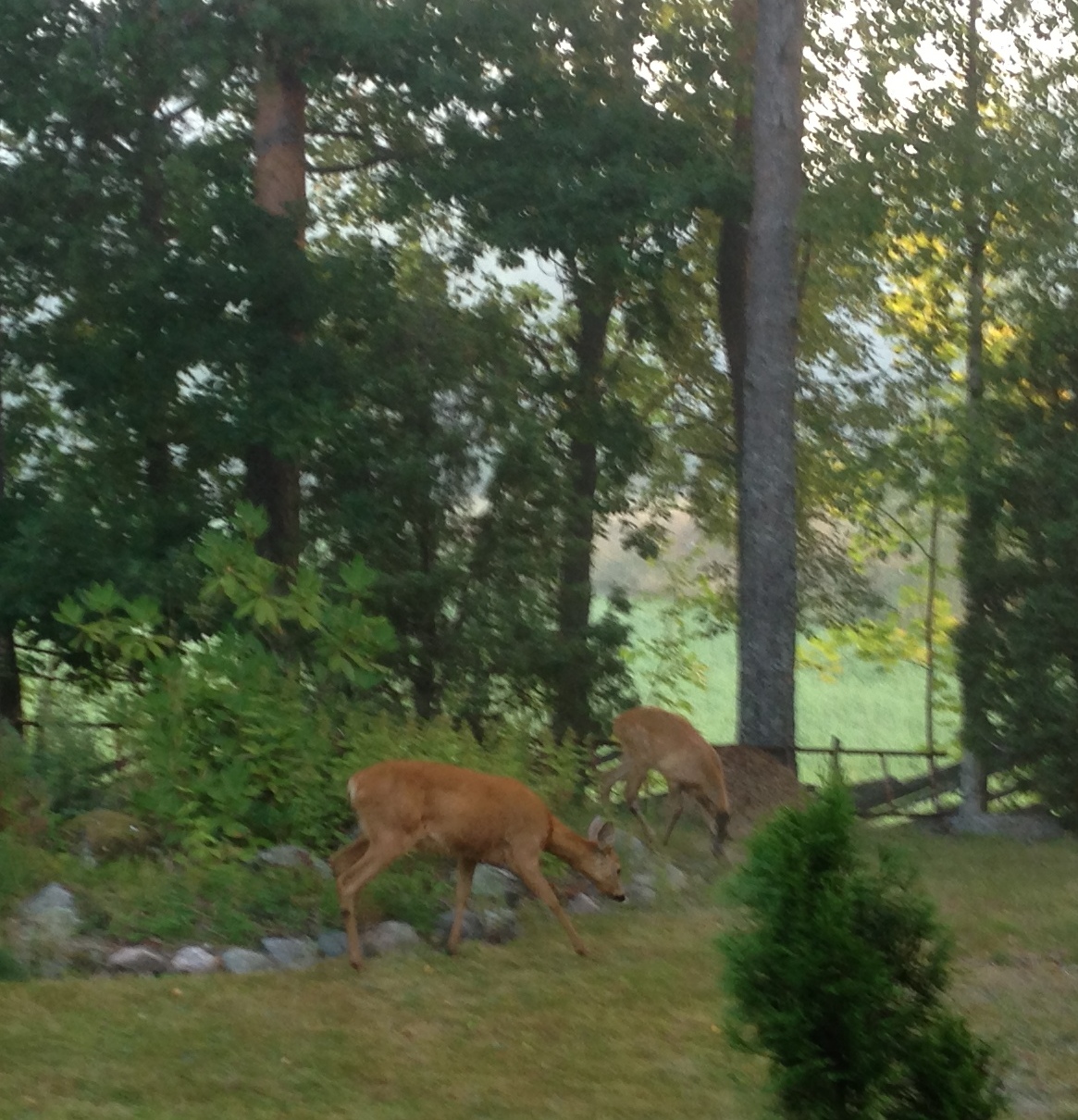
This morning it feels like Autumn is here. Frost has not quite reached us but it is not very far away. The mist is rising thickly as the sun rises. And the deer are in the garden cleaning up all the fallen apples:

From my window 26th August 2013

From my kitchen window 26th August 2013

This year spring came about 3 weeks late.

SMHI defines spring in Sweden as the first day – after 15th February – of 7 continuous days with temperatures between 0 and 10 °C. The “normal” onset of Spring is as below:

  • Malmö: 22nd February
  • Stockholm: 16th March
  • Östersund: 11th April
  • Kiruna: 1st May

Admittedly I am at a latitude of 58.7057° N.  Spring should have come around 12th March and we are going to be around 3 weeks late (at least).

In calendar terms, spring should last from March till May  and summer from June till August. But the onset of Autumn is defined by SMHI – in meteorological terms – as the first day of the first occurrence of 5 consecutive days with an average temperature of less than 10°C.  Normally this should be around 25th September. But it looks like that it might also be around 3 weeks early.

So while it has not been a bad summer it seems summer may be about 5-6 weeks shorter than “normal” this year.

Many consecutive years of long winters and short summers will probably be the precursors of the coming of the next ice age. And these days I find it more relevant to look for signs that the next ice age (either a little ice age or even the end of the inter-glacial) is coming. It is no longer relevant or worthwhile to be looking for signs of man-made global warming!

Climate model results depend upon which computer they run on!

June 26, 2013

Robust models indeed.

Washington Post:

New Weather Service supercomputer faces chaos

The National Weather Service is currently in the process of transitioning its primary computer model, the Global Forecast System (GFS), from an old supercomputer to a brand new one.  However, before the switch can be approved, the GFS model on the new computer must generate forecasts indistinguishable from the forecasts on the old one.

One expects that ought not to be a problem, and to the best of my 30+ years of personal experience at the NWS, it has not been.  But now, chaos has unexpectedly become a factor and differences have emerged in forecasts produced by the identical computer model but run on different computers.

This experience closely parallels Ed Lorenz’s experiments in the 1960s, which led serendipitously to development of chaos theory (aka “butterfly effect). What Lorenz found – to his complete surprise – was that forecasts run with identically the same (simplistic) weather forecast model diverged from one another as forecast length increased solely due to even minute differences inadvertently introduced into the starting analyses (“initial conditions”). ..

……

Indian monsoon starts early and vigorously

June 17, 2013

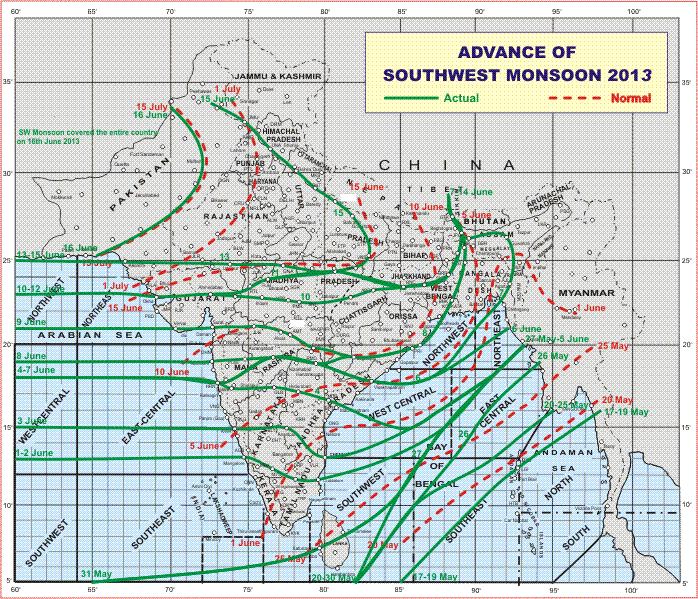
An almost spectacular start to the Indian monsoon and Delhi has received heavy rains almost two weeks earlier than expected. Two weeks of the official 4 month monsoon period (about 15%) are over and the welcome rains have covered the entire country around one month ahead of schedule. Over 30% of the total expected rainfall for a “normal” monsoon has already been received. So much so that the new airport in Delhi was flooded yesterday, not so much because of problems at the airport but because the drainage in the surrounding areas could not cope with the flow draining out of the airport and caused a back-flow!

Temperatures have dropped to a “pleasant” 31°C and it augurs well for my trip to Delhi in a couple of weeks.

Expectations for a “good” monsoon and a subsequently high level of agricultural growth are high.

ToI:The monsoon hit Delhi and its neighbourhood on Sunday, two weeks before time — and in a record sweep, swiftly covered all of northwest India. 

Besides reaching the capital well before the initially predicted date of June 29, a record occurrence unfolded in a span of 24 hours with the rain bearing system reaching the ends ofnorthwest India a full month before the usual July 15 date. The progress of rains to cover all of India as rapidly as happened over Saturday and Sunday last occurred in 1961. 

Delhi recorded 6.1 mm rain till 8.30 am and 45 mm in the next 12 hours. Palam recorded a day’s highest rainfall in the city in two years with 117.8 mm between 8.30 am and 5.30 pm. The showers have been so plentiful that Delhi will see the Yamuna cross the warning level and maybe even touch the danger mark by June 18. 

The city’s maximum temperature sharply fell to 31.5 degrees Celsius, eight degrees below normal while the minimum was 23.7 degrees.

From IMD:

monsoon 16 June 2013

monsoon 16 June 2013

Better to build a roof than to try and stop the rain (or the sun)

June 16, 2013

Climate change is happening.

Of course it is. When was it ever not so?

It will be cooling at times and warming at others but for around 85% of all the time humans have been around we have lived in glacial conditions. Interglacials are the exceptions and not the rule. Yet humans have thrived. Not just by surviving the glacial times but by continuing to develop even during the glacials, Wasting time and energy and vast sums of money on trying to curb the emissions of carbon dioxide has been a blight on development for the last 3 decades. Just in Europe it has come at the expense of around 15 million jobs.

It essentially panders to the political and religious idea that “human development is inherently bad”. In that sense the “Green Movement” and the subsequent growth of enviro-fascism have taken the place of Marxist ideology. They have filled the vacuum left behind as the fall of Communism has spread. They didn’t begin that way. As local movements to clean up air and water and our immediate environments they performed a timely, neccessary and very useful function. But then they became ambitious. Local movements were hijacked by the marxists without a home. Former marxists in non-Communist countries needed a cause. They remained disaffected and had to find a new home. They now had to go Global. Local causes which were the strength of environmentalism were replaced by Global causes.  Global causes were manufactured by inventing impending global catastrophes. All the disaster scenarios had to have growth and development (and by inference – capitalism) as the culprit. Not in Russia or China or other former Communist countries where they were too busy becoming entrepreneurs. And so the carbon dioxide myth took hold and and fossil fuels became the whipping boy.

This interglacial will end.

Fossil fuels and their continued and increased use (and there is enough gas for at least 1000 years) will be critical for human development as and when the next glacial comes along. It is only by adapting to whatever climate change occurs  – not by trying to stop climate change – that the human condition will continue to improve.

It is better to build a roof than to try and stop the rain or the sunshine. But the global warming hierarchy will continue their posturing and their futile dances to try and control the climate.

Montreal Gazette:

Adapting to – not just fighting – climate change is taking the heat out of global warming talk

Efforts to curb global warming have quietly shifted as greenhouse gases inexorably rise.

The conversation is no longer solely about how to save the planet by cutting carbon emissions. It’s becoming more about how to save ourselves from the warming planet’s wild weather.

It was Mayor Michael Bloomberg’s announcement last week of an ambitious plan to stave off New York City’s rising seas with flood gates, levees and more that brought this transition into full focus.

After years of losing the fight against rising global emissions of heat-trapping gases, governments around the world are emphasizing what a U.N. Foundation scientific report calls “managing the unavoidable.”

It’s called adaptation and it’s about as sexy but as necessary as insurance, experts say.

It’s also a message that once was taboo among climate activists such as former Vice-President Al Gore. …… 

…. Now officials are merging efforts by emergency managers to prepare for natural disasters with those of officials focused on climate change. That greatly lessens the political debate about human-caused global warming, said University of Colorado science and disaster policy professor Roger Pielke Jr.

It also makes the issue more local than national or international.

“If you keep the discussion focused on impacts … I think it’s pretty easy to get people from all political persuasions,” said Pielke, who often has clashed with environmentalists over global warming. “It’s insurance. The good news is that we know insurance is going to pay off again.” ….. 

And even from New Zealand comes a commentary that when “even the Green Party of Aotearoa New Zealand is no longer beating the drum. That’s when you know the cause is dead”.

National Business Review:

Global warming ends with a whimper

It’s a good news column today: the Green Party of Aotearoa New Zealand has seriously down-rated the worry about global warming. That’s one less thing that need make us miserable.

The down rating is huge. Green co-leader Russel Norman in his speech to this month’s annual conference never once mentioned global warming. He busied himself instead taking potshots at John Key and the late Sir Robert Muldoon.

The Green Party did have a climate change conference the following week but Mr Norman’s keynote speech lacked any of the usual end-of-world prophecy and knee-jerk call to de-industrialise. His concern was the pedestrian one that New Zealand is failing to meet its international obligations.

There was no hellfire and no brimstone.

When Jeanette Fitzsimons was co-leader global warming was the greatest-ever threat to the planet. It dwarfed all other environmental worries. It was the granddaddy of them all. Global warming threatened to destroy the biosphere and Ms Fitzsimons was forever calling an urgent and radical reduction in the burning of fossil fuels. …… 

….. But the shift on global warming with the Greens is significant. We are safe in concluding that they no longer regard global warming as the greatest threat to the planet. It would, I think, merit a mention in a leader’s annual speech to the Greens if it were. A fast-approaching environmental armageddon would be top of mind, not the constitutionality of parliamentary legislation, and not Peter Dunne’s emails.

So, hallelujah. The polar bears can continue to float about on their ice floes, millions of environmental refugees won’t wash up on our shores, malaria won’t be making an unwanted appearance in New Zealand any time soon, our beachfront properties are safe and there is no need to feel guilty driving past that bus stop.

It was always going to end with a whimper, not a bang. The scare was so big, so dominating, so accepted, that it could not be sustained. Unless, of course, it was true. It’s now not possible to maintain the huff and puff that the media and politics need to keep the headlines running. …..

……. They have been the first to shut up about it. The argument is no longer that global warming has “paused” for 17 years but rather that even the Green Party of Aotearoa New Zealand is no longer beating the drum. That’s when you know the cause is dead.

After all, Mr Norman was still backing Marxism-Leninism long after Mikhail Gorbachev had given up on it. 


UK Met Office to hold summit to redefine all weather events as climate (change)!

June 14, 2013

From the ever reliable Guardian (Leo Hickman) comes this story. All weather events will now be taken as evidence of global climate change!

Met Office brainstorms UK bad weather

Washout summers. Flash floods. Freezing winters. Snow in May. Droughts. There is a growing sense that something is happening to our weather. But is it simply down to natural variability, or is climate change to blame?

To try to answer the question the Met Office is hosting an unprecedented meeting of climate scientists and meteorologists next week to debate the possible causes of the UK’s “disappointing” weather over recent years, the Guardian has learned.

Tuesday’s meeting at the forecaster’s HQ in Exeter is being convened in response to this year’s cool spring, which, according to official records, was the coldest in 50 years.

The one-day gathering will be led by Stephen Belcher, head of the Met Office Hadley Centre and professor of meteorology at the University of Reading, and will include up to 20 experts from the UK’s leading climate research institutions.

The “roundtable workshop” will attempt to outline the “dynamical drivers of the cold spring of 2013”, but attendees are expected also to debate the “disappointing summers of the last seven years”. 

Official records show that above-average temperatures in summer last occurred in 2006, a season that had above-average sunshine hours, and below-average rainfall. The only summer since then to give us average conditions nationally was in 2010.

The meeting will also discuss the washout summer of 2012 and the freezing winter of 2010-11.

The Met Office said it had never held a formal meeting in this way to discuss possible causes behind the UK’s unusual weather of recent years. … 

But rather than admit that climate models have become a fiasco, it would seem that the “establishment” is now “circling the wagons” and rationalising to be able to connect all weather events to “man-made climate change” – defined as being anything over and above “natural variability”. Why would the “natural variability” of just the last 150 years be the benchmark. Why would the Little Ice Age or the Roman Warm Period or the Medieval Warm Period not be part of the “natural variability” to be used as the reference? If the flood levels in Germany this spring reached the same level in Passau 500 years ago, why wouldn’t the weather/climate of 500 years ago also be part of “natural variability”?

If the UK spring this year was the coldest since the 1890’s then it surely proves that weather events today are much the same as 130 years ago.  Even the great 2011 Tohoku quake and  tsunami were events that were a repeat of something that happens every 1000 years or so. It  was not “unnatural” just because it had not happened for 1000 years. Anytime a weather event today is merely a repeat of an event which has taken place in the past, then the preponderance of probability is that it is a part of natural variability.

Everything not within a discernible “natural” pattern is not due to anthropogenic effects. It may well be in the realm of what we don’t know that we don’t know.

The Guardian goes on:

…. One attendee at the meeting, Doug Parker, professor of meteorology at the University of Leeds, said: “We are universally finding that the links between the weather and climate communities are increasing and overlapping. Most climate issues reduce down to questions about what weather events are like, and the representation of short-term weather events is a key challenge in climate modelling. People are increasingly conscious that there is a change [to our weather]. There have been informal discussions in our communities about this for a while now. The key question is whether this is down to natural variability alone, or whether climate change is now projecting on to, and adding to, natural variability. I am going to the meeting with my eyes and ears open.”

But – it seems to me – with a closed mind!

A Met Office spokesman said: “We have seen a run of unusual seasons in the UK and northern Europe, such as the cold winter of 2010, last year’s wet weather and the cold spring this year. This may be nothing more than a run of natural variability, but there may be other factors impacting our weather there is emerging research which suggests there is a link between declining Arctic sea ice and European climate – but exactly how this process might work and how important it may be among a host of other factors remains unclear.”

Indian monsoon on schedule

June 10, 2013

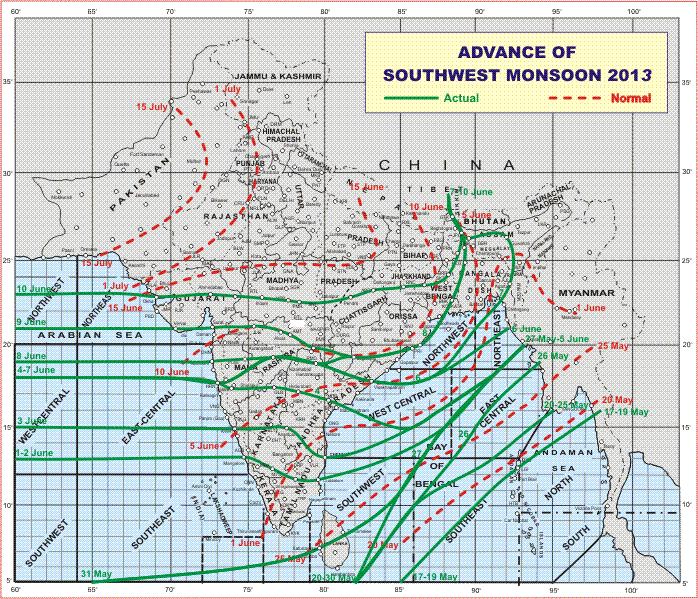
The Indian monsoon season has just started and officially runs from June to September. It seems to be on schedule and perhaps a little early in the west and a few days late in the east. Mumbai is seeing heavy rains a few days early.  Last year the monsoon was somewhat delayed and not too regular though it was “average” taken over the entire 4 months. With industrial growth still somewhat in the doldrums a boost to agricultural output will be very welcome.

( from IMD).

Monsoon progress 10th June 2013

Monsoon progress 10th June 2013

There are no signs of the catastrophe scenarios that climate models take delight in forecasting about the effects of global warming on the Indian monsoon.

Back from UK’s coldest spring for 50 years

May 31, 2013

It was a grand holiday for 15 days in the UK.

The warmth of meeting old friends more than compensated for the lack of warmth in the weather. Every day we were in England, the weather we had left behind in Sweden was warmer by a couple of degrees. We had two  reasonably warm and – relatively – dry weekends but it was wet and chilly for the rest of the time.

And now I find that it was the coldest Spring (March – May) in the UK for 50 years.

The average temperature over the period came in at 6.0C, which is 1.8C, or nearly 25 per cent, lower than is typical for the time of year, according to the Met Office.

This makes it the fifth coldest spring since records began in 1910 and the chilliest for 51 years.

A Met Office spokesman said: “The colder than average conditions have been caused by difference patterns at certain times, but generally this season has seen frequent easterly and northerly winds which have brought cold air to the UK from polar and northern European regions.”

Rainfall was lower than normal in March and April but May has been wetter than usual, the Met Office added. As a result, spring has been slightly drier than average, but not as dry as the springs of 2010 and 2011.

So much for global warming! And so much for the utterly negligible impact of  carbon dioxide increase over the last 50 years!!

We stayed with friends during our vacation and everywhere we went we found a current of discontent about energy prices and the manner in which utility bills had increased. Utility bills are never popular at whatever level they may be pitched but the cost of energy is fundamental to our economies. To have a cost of electricity which is some 50 – 70% higher than it needs to be is irresponsible. I reckon that in W Europe the subsidies provided for non-commercial energy production has provided windfalls for about 500,000 owners/developers of wind farms and solar plants but has cost the jobs of about 15 million.

There is little doubt in my mind that it has been the idiot pursuit of “low carbon dioxide emissions” which is now contributing to the lack of growth and lack of jobs in Europe. The common-sense goal of pursuing the most economic sources of energy has given way to the pursuit of the wrong thing for the wrong reasons. To be politically correct but impoverished seems a poor – and rather immature – bargain to settle for.

So much for the idiots who have wasted three generations chasing the mirage of green political correctness but have allowed common sense to wither.

It is time to go back to basics.

Climate “science” reduced to “Retrospective Predictions”

May 13, 2013

Hindsight science

Wow!

Nature and Climate Science are now reduced to publishing “Retrospective Predictions”.  And Predicting the Past is apparently good enough to get published! At least you can never make a prediction which is wrong!

It used to be called  hindsight!


Retrospective prediction of the global warming slowdown in the past decade

by Virginie Guemas, Francisco J. Doblas-Reyes, Isabel Andreu-Burillo & Muhammad Asif

Nature Climate Change (2013) doi:10.1038/nclimate1863

Despite a sustained production of anthropogenic greenhouse gases, the Earth’s mean near-surface temperature paused its rise during the 2000–2010 period. To explain such a pause, an increase in ocean heat uptake below the superficial ocean layer has been proposed to overcompensate for the Earth’s heat storage. Contributions have also been suggested from the deep prolonged solar minimum, the stratospheric water vapour, the stratospheric and tropospheric aerosols. However, a robust attribution of this warming slowdown has not been achievable up to now. Here we show successful retrospective predictions of this warming slowdown up to 5 years ahead, the analysis of which allows us to attribute the onset of this slowdown to an increase in ocean heat uptake. Sensitivity experiments accounting only for the external radiative forcings do not reproduce the slowdown. The top-of-atmosphere net energy input remained in the [0.5–1] W m−2 interval during the past decade, which is successfully captured by our predictions. Most of this excess energy was absorbed in the top 700 m of the ocean at the onset of the warming pause, 65% of it in the tropical Pacific and Atlantic oceans. Our results hence point at the key role of the ocean heat uptake in the recent warming slowdown. The ability to predict retrospectively this slowdown not only strengthens our confidence in the robustness of our climate models, but also enhances the socio-economic relevance of operational decadal climate predictions.

And how many reviewers saw nothing wrong with “Retrospective Predictions”?