Young Mohamed with his fake bomb/clock …..

September 22, 2015

There has been a lot of righteous indignation about the arrest of 14 year old Ahmed Mohamed  for bringing a home-made clock to school but which was taken as a threat by an English teacher. The indignation has been about this “brilliant inventor” being handcuffed and led away by “stupid police”. The school, its teachers and the police have come in for heavy criticism. Mark Zuckerberg and even President Obama have come out in support of this “clever and creative” young boy.

When I first came across the story I also thought that the authorities had been rather heavy handed. But now I am not so sure.

This photo provided by the Irving Police Department shows the homemade clock that Ahmed Mohamed brought to school, Wednesday, Sept.16, 2015, in Irving. Police detained the 14-year-old Muslim boy after a teacher at MacArthur High School decided that the homemade clock he brought to class looked like a bomb, according to school and police officials. The family of Ahmed Mohamed said the boy was suspended for three days from the school in the Dallas suburb.

Irving Police /AP

It looks more and more as if either the boy was pretty stupid or that the whole episode was engineered with the help of his father and some others. A 14 year old must be pretty stupid to not realise that his clock – which looked nothing like a clock – would not be taken at face value for what it looked like. Moreover to bring it to school on 9/11 is either malicious or just idiotic. And the police never took it for a “bomb”. They took it for the “fake bomb” it looked like. The picture of the boy in handcuffs was apparently staged by his father and taken by his sister after the cuffs had been removed.

This from Jerry Pournelle who, I have found, tends to check his facts quite carefully

He was charged, not with making a bomb, but with making a fake bomb.  He repeatedly was uncooperative with the authorities before he was arrested; in particular he would never say why he brought a bomb-looking object – it looks like NCIS or any other TV show bomb – to school on 9/11. He just insisted it was a clock. …..

It is clear they did not think that pencil box with its ugly contents was a bomb, and they did not treat the incident as a bomb. They thought, as I would have thought, that looked like a fake bomb, and they acted accordingly. They gave him ample opportunity to explain why he would bring an object that eerily resembled most of the bombs you see on TV action adventures to school on 9/11. He did not cooperate, but insisted that it was a clock. He would have had to be very naïve and somewhat retarded not to recognize that nearly everyone would get the first impression that it was in fact a bomb, but he kept insisting that it was a clock. ….. Under Texas law, is a crime to scare people with a fake bomb. That was explained to him. He grinned and said it was a clock. ……

At the police station the handcuffs were removed. So far he had not been photographed in handcuffs, but at the police station young Mohammed’s father insisted that they be put back on him so that his sister could photograph him in handcuffs. The police naively complied.

The story was pushed by the Council on American Islamic Relations which seems to have an enviable ease of access to the President.

Maybe not so much a story of a bright young Muslim boy being discriminated against. More perhaps of a stupid boy craving attention.

Would you like your fellow air passenger to be carrying such a clock?

The Trump effect: Even the Pope switches to English for his greetings to the US

September 21, 2015

Pope Francis is going out of his way to be a populist Pope. It makes him seem – in my perception – to have few convictions which cannot be overturned to suit perceived public opinion. The Pope will soon move on from Cuba to the US for a 3 day visit. He has sent a video greeting to the US and it seems he has been listening to Trump. He has recorded the video in English though most of his speeches in the US are expected to be in Spanish.

Now if only some of his audience would use English a little more.

“I look forward to greeting the pilgrims and the people of Philadelphia when I come for the World Meeting of Families,” Francis said in a video shared Sunday by Archbishop James Chaput of the Philadelphia Archdiocese. “I will be there because you will be there! See you in Philadelphia!”

Catholics unlike socialists, atheists and Muslims are acceptable as Presidential candidates across all sections of US society.

POTUS: Socialists, atheists and Muslims need not apply

September 21, 2015

Ben Carson is getting a lot of flack – but what he said was that those whose values are not consistent with the US constitution should not be President, and that he believed that Muslim values were not consistent with the constitution. (I just heard an idiot BBC radio correspondent parse this to say that Carson had said that the Constitution disallowed Muslims and that was patently wrong). Carson could have chosen his words better and said instead that the “values of radical Muslims would not be consistent with the Constitution” and nobody would have been able to quarrel with that. Donald Trump is being criticised for not defending Barack Obama against someone who charged him with being a Muslim. (He countered – but later – that it was not his job to defend Obama).

But the real point here is that even all the mainstream media and all the “conventional” politicians see the characterisation of being a Muslim as negative and as an attack. Now why would that be? Why object to Obama being called a Muslim if that was not perceived as being derogatory?

In June this year, Gallup conducted a poll about the acceptability of different categories of people as President of the US (a question which apparently was first asked in 1937). The results are quite clear. For the country as a whole, socialists, atheists and Muslims need not apply.

Between now and the 2016 political conventions, there will be discussion about the qualifications of presidential candidates -- their education, age, religion, race and so on. If your party nominated a generally well-qualified person for president who happened to be _____, would you vote for that person? June 2015 results

The 3 least acceptable categories and their relative positions are the same across Democrats, Independents and Republicans.

Willingness to Vote for President of Various Backgrounds, by Political Party, June 2015

When looking at the differences by age, opinions are very soft for those between 18 and 29 ( which is to be expected since those under 25 have brains where the critical cognitive faculties are not fully developed). Opinions harden with age. But even here the 3 categories least acceptable across all age groups are always socialists, atheists and Muslims.

Willingness to Vote for President of Various Backgrounds, by Age, June 2015

Across all political parties and across all age groups, socialists, atheists and Muslims – in that order – need not apply. Of course what Gallup does not show is who the socialists, atheists and Muslims find least acceptable.

The natural world is overturned as the Japanese ” Cherry Blossoms” devour the S African “Springboks”

September 20, 2015

The Rugby Union World Cup is on and the natural order of the universe has been overturned. The carnivorous cherry blossoms from Japan won their first ever World Cup match since 1991 (when they beat Zimbabwe), by bringing down the mighty S African Springboks. Or maybe that should be the once-mighty Springboks.

Holland beating England in a T20 cricket world cup match last year was shocking enough but still does not come close to yesterday’s astonishing result.

The S African team are now probably suffering from PTSD.

sbnation: Japan has stunned the world with a wholly unbelievable 34-32 win over South Africa in the Rugby World Cup. Before Saturday, the Cherry Blossoms hadn’t won a World Cup game in 24 years when Japan defeated Zimbabwe in 1991. They knocked off one of the favorites to win the whole thing.

Carnivorous cherry blossoms

springbok (Antidorcas marsupialis)


India still ranks abysmally low in the ease of doing business

September 18, 2015

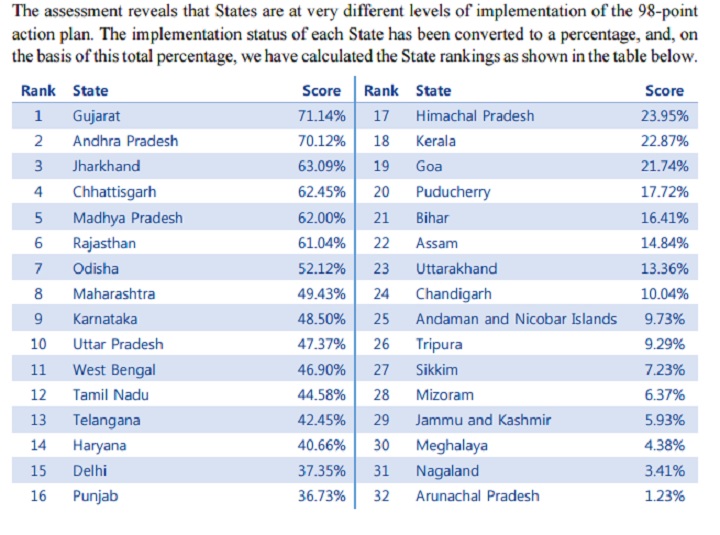
Two reports have just been issued. The first is the World Bank’s assessment of doing business in India where India’s ranking among countries is depressingly low (considering the size of India’s economy). At 142nd of 189 countries India is in the bottom quartile of all countries. The second report assesses the relative success of the various Indian states in implementing business reforms and is issued by the World Bank and the Indian Government.

  1. Doing Business India 2015 World Bank
  2. State Assessment Report 14 September 2015

The WB assessment is broken down into 10 main areas and they have ranked 189 countries. In most categories the Indian ranking is embarrassingly low. (Even where the ranking is not too embarrassing, I note that there is a downside. Getting credit is apparently not too difficult but the other side of the coin is that the banks are sitting with a great deal of bad debt. Similarly minority interests are well protected but there are many cases of tyranny by the minority). I show the Indian rankings alongside those for Russia, China, Bangladesh and Mexico for reference.

In the overall ranking for Setting up a business India comes in at a lowly 142 of 189 countries. (Mexico 39, Russia 62, China 90, India 142, Bangladesh 173)

The rankings in the 10 main sub-categories are

  1. Starting a business –  Russia 34Mexico 67, Bangladesh 115, China 128, India 158
  2. Dealing with construction permits – Mexico 108, Bangladesh 144, Russia 156, China 179, India 184
  3. Getting electricity – Mexico 116, China 124, India 137, Russia 143, Bangladesh 188
  4. Registering property – Russia 12, China 37, Mexico 110, India 121, Bangladesh 184
  5. Getting credit – Mexico 12, India 36, Russia 61, China 70, Bangladesh 131
  6. Protecting minority investors – India 7, Bangladesh 43, Mexico 62, Russia 100, China 132
  7. Ease of paying taxes – Russia 49, Bangladesh 83, Mexico 105, China 120, India 156
  8. Trading across borders – Mexico 44, China 98, India 126, Bangladesh 150, Russia 155
  9. Enforcing contracts – Russia 14, China 35, Mexico 57, India 186, Bangladesh 188
  10. Resolving insolvency – Mexico 27, China 53, Russia 65, India 137, Bangladesh 147

The second report deals with the performance of the different states in implementing reforms. Of course the states ranked high are now crowing over those ranked lower down. The hope of the Indian government is that this league table will enhance competition between states and will add an impetus to development.

State rankings September 2015

The ranking of the NCR of Delhi is almost pathetic and lies even behind an Uttar Pradesh (boosted by Noida) and a Haryana (boosted by Gurgaon). And while Gujarat is crowing over Bihar and Tamil Nadu peevishly questions the data, they all seem to forget that these are just state rankings for a country ranking which is abysmally low. States lying below 50% are at levels comparable to the lowest 10% of the 189 countries that have been ranked.

Europe’s refugees just follow the ancient routes for the peopling of Europe in the Neolithic

September 17, 2015

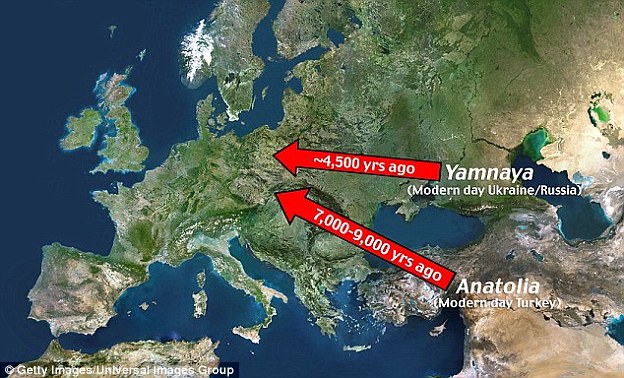
Compared to the population of Europe of 740 million (500 million in the EU), the total refugee numbers of some 400,000 are not large enough to talk about “invasions” or being “over-run”. (In the short-term numbers may, of course, be locally overwhelming). But the routes being travelled now are the same routes that were used for the peopling of Europe in the neolithic. Neanderthals probably retreated westwards as the hunter gatherers from central Asia arrived. They had been absorbed and were long gone as a separate “race” by the time the 2 main agricultural waves arrived.

And now the refugee numbers are beginning to be large enough to be a not insignificant impact on the populations of Europe. It could well be a new “peopling of Europe”. Or it could turn out to be not so large or important. But history will probably show that the migrations of peoples into Europe in the early 22nd century was of similar importance to the neolithic migrations. History will probably show that this  migration is what stemmed the downward population spiral that was troubling Europe.

In ancient times –

First came the movement of peoples westwards into Europe. This was during the paleolithic some 40,000 – 20,000 years ago with hunter-gatherers coming from the east. The “admixture” events between the Neanderthals and modern humans could have been along the westward moving front.

Then came the advent of agriculture, starting earlier but in earnest perhaps about 10,000 years ago. Genetic evidence indicates 2 waves of farmers from the east who then mixed with the hunter-gatherers already there.

So it would seem that hunter-gatherers mixed with farmers from the east who spread across Europe about 9,000 years ago. They formed the first agricultural settlements. Then came the invasion of the nomadic Yamnaya culture around 5,000 years ago. The Yamnayans were much more individualistic than the peoples they replaced and gave rise to the prominence of the nuclear family and the development of large family holdings of cleared lands, rather than the clusters of people in village settlements. They came on horses and brought livestock. But by about 4,000 years ago they too were overrun by the warlike Sintashta.

peopling of europe in the neolithic - via daily mail

peopling of europe in the neolithic – via daily mail

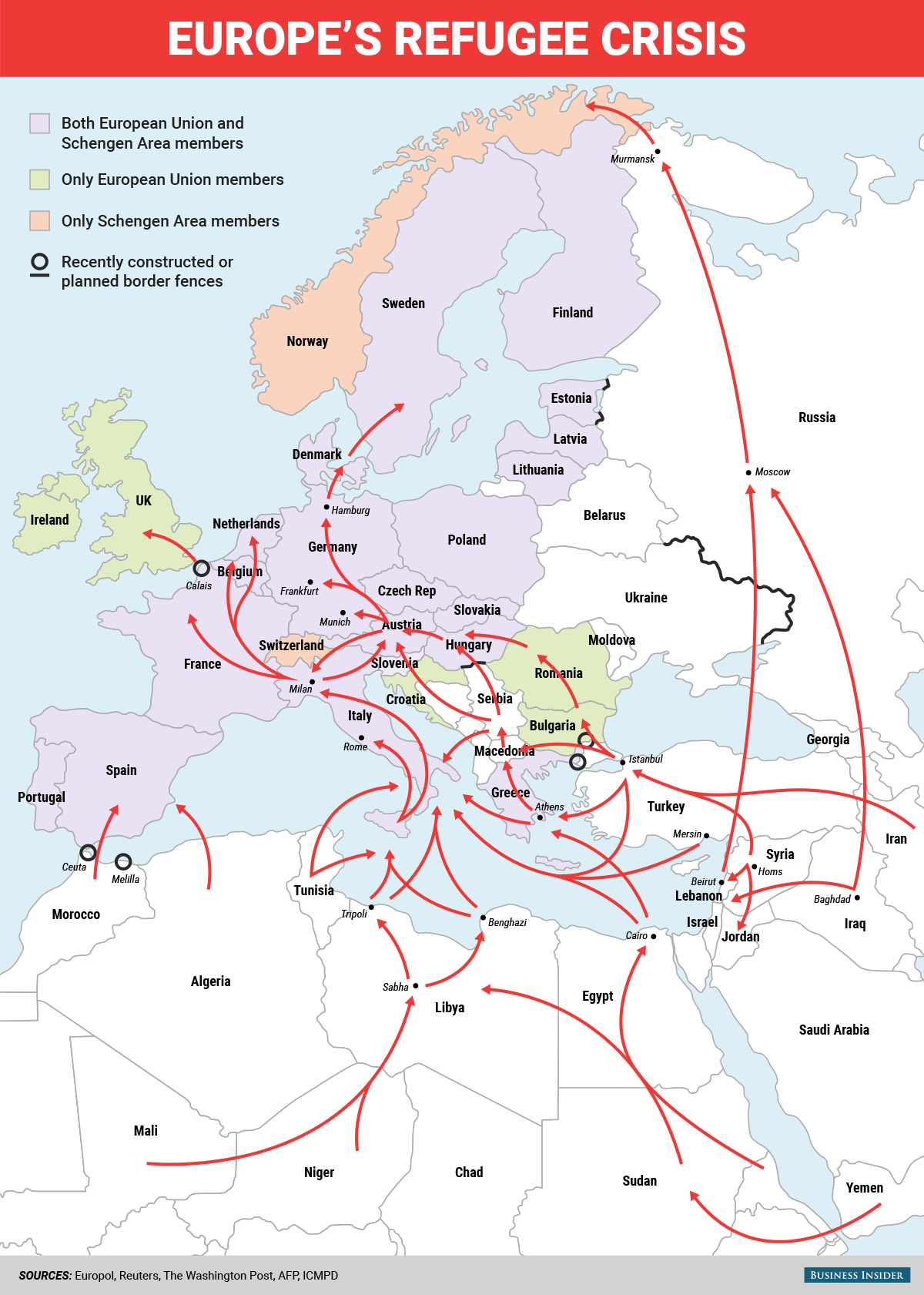
and now the current refugee crisis has about 400,000 people moving north westwards –

Business InsiderAccording to the United Nations Human Rights Council (UNHRC), EU countries received 437,384 asylum applications from January to July. The UNHRC also reports that during that time, Germany was by far the country that received the most asylum applications, with 188,486. Hungary came second in place with 65,415 applications, and Sweden took third with 33,234 applications. Italy was fourth with 30,223, and France was fifth with 29,832 demands. Many refugees fleeing the Syrian civil war and ISIS have been entering the European Union through Greece — 258,365 refugees entered Greece by boat so far this year — after going through Turkey.

europe's refugee crisis - business insider graphics

europe’s refugee crisis – business insider graphics

Nothing new under the sun.

Obama still has no strategy for ISIS

September 17, 2015

Last year Barack Obama admitted he had no strategy, “yet”, for ISIS. By the latest admissions, he still doesn’t. He is pouring money into “fighting ISIS” but it would seem that there are many expensive but ineffective actions ongoing – but there are few signs of any coherent, comprehensive strategy with any real goals.

The latest example of money down the drain, with nothing to show for it, is revealed by the testimony of Gen. Lloyd Austin to the Senate Armed Services Committee. The $500 million program to train 5,400 Syrian fighters against ISIS started off by training and sending 54 well-armed fighters. Only 4 or 5 remain. The others have been captured or killed by Al Qaida or ISIS or have abandoned the fight.

CBS NewsOnly four or five U.S-trained Syrian fighters remain on the battlefield against militants with the Islamic State of Iraq and Syria, the top U.S. commander in the Middle East acknowledged Wednesday in the face of withering criticism from senators who dismissed the training program as a “total failure” and demanded a change of strategy. Gen. Lloyd Austin told the Senate Armed Services Committee that the U.S. is looking at better ways to deploy the Syrian forces, but he agreed that the U.S. will not reach its goal of training 5,000 in the near term. ….. 

The first group of 54 U.S.-trained Syrian fighters was sent into Syria in late July. But a Syrian affiliate of al Qaeda attacked the group, killing several of the fighters and taking others hostage. A number of the remaining fighters fled. Officially called the New Syrian Force, the contingent was trained by the U.S. military at a base in Turkey and sent across the border into Northern Syria, ……..

The committee’s chairman, Republican Sen. John McCain, called the U.S. strategy against ISIS a debacle. He said assessments by Austin and the Pentagon that the U.S. strategy is working is “divorced from reality.” And other senators focused directly on the stumbling training effort that takes months to identify and screen Syrian rebels for the program and has lagged far behind original goals. “We have to acknowledge this is a total failure,” said Sen. Jeff Sessions, R-Ala., said about the training. “I wish it weren’t so, but that’s the fact.”

Congress has approved $500 million to train Syrian fighters. Officials have said fewer than 200 are going through training now.

Last week we heard how Obama and Kerry missed the opportunity in 2012 to work with Russia to arrange for Assad to step aside in an orderly transfer of power. Was it just ego that stopped that? Was it the wishful thinking that the support being given to the splintered Syrian rebels by the US and the Europeans, would lead to a complete defeat of Assad.

I certainly have the perception that the US (and their European partners) have been more than a little incompetent in their efforts at regime change – whether in Iraq or Libya or Syria or even the Ukraine. Like it or not, it is the lack of a coherent strategy and the incompetence of  implementation of ad hoc actions, which has provided the space for ISIS to flourish. While Saddam and Gaddafi and Assad were in place, many were throttled, but so was ISIS.

Another case of promoting a drug with “incorrect reporting and distorted data”

September 17, 2015

There is a Catch 22 situation here.

Clinical trials for new drugs are all funded – of necessity – by the pharmaceutical companies. It is only to be expected that negative results are downplayed and positive results are highlighted. Positive results get published. Negative results for drugs not yet approved are rarely published. Those conducting clinical trials are looking to enhance their lists of publications. Furthermore there is an incentive to invent “medical conditions” which can be “treated” by otherwise useless – or even damaging – compounds. My perception is that the pharmaceutical companies sometimes discover compounds unintentionally or by accident or as a compound which fails its originally intended purpose. Then – by defining (or inventing) new medical disabilities – they try and find a use for these compounds.

So how many of the new, psychiatric drugs are really of no benefit? And how many of the supposed “illnesses” – which can only be diagnosed by subjective methods – and which these new drugs are supposed to to treat – are really medical conditions?

A University of Adelaide led study has found that a psychiatric drug – paroxetine – which was claimed to be a safe and effective treatment for depression in adolescents is actually ineffective and associated with serious side effects is published today in the BMJ.

Joanna Le Noury, John M Nardo, David Healy, Jon Jureidini, Melissa Raven, Catalin Tufanaru, Elia Abi-Jaoude. Restoring Study 329: efficacy and harms of paroxetine and imipramine in treatment of major depression in adolescence. BMJ, 2015 DOI: 10.1136/bmj.h4320

there is also an editorial in the BMJ:

No correction, no retraction, no apology, no comment: paroxetine trial reanalysis raises questions about institutional responsibility

UofAdelaide press releaseProfessor Jon Jureidini, from the University of Adelaide’s newly created Critical and Ethical Mental Health Research Group (CEMH) at the Robinson Research Institute, led a team of international researchers who re-examined Study 329, a randomised controlled trial which evaluated the efficacy and safety of paroxetine (Aropax, Paxil, Seroxat) compared with a placebo for adolescents diagnosed with major depression.

Study 329, which was funded by SmithKline Beecham (now GlaxoSmithKline), was reported in 2001 as having found that paroxetine was effective and safe for depression in adolescents. However, Professor Jureidini’s reanalysis showed no advantages associated with taking paroxetine and demonstrated worrying adverse effects.

“Although concerns had already been raised about Study 329, and the way it was reported, the data was not previously made available so researchers and clinicians weren’t able to identify all of the errors in the published report,” says Professor Jureidini. “It wasn’t until the data was made available for re-examination that it became apparent that paroxetine was linked to serious adverse reactions, with 11 of the patients taking paroxetine engaging in suicidal or self-harming behaviours compared to only one person in the group of patients who took the placebo,” he says. “Our study also revealed that paroxetine was no more effective at relieving the symptoms of depression than a placebo.”  ……

……. “Study 329 was one of the trials identified as in need of restoration, and because the original funder was not interested in revisiting the trial, our research group took on the task. 
“Our reanalysis of Study 329 came to very different conclusions to those in the original paper,” he says. “We also learnt a lot about incorrect reporting and the considerable fall out that can be associated with distorted data.”

If all doctors treating patients were truly independent the system would be self-correcting. Overhyped and unnecessary drugs would wither away. But many doctors have a vested interest in the continued use of the drugs they prescribe. (And note that even some members of the WHO panels who recommend mass vaccination programs have been found to have vested interests).

As the editorial in the BMJ writes:

But in the case of Study 329 no epistemological acrobatics would seem able to reconcile the differences between the 2001 JAACAP paper and the RIAT republication. They cannot both be right. …

Such stark differences between the original paper and the rewrite are bound to put particular pressure on Andrés Martin, Yale University professor and current editor in chief of JAACAP. Martin has been under pressure to retract the paper for years, including from within his own society. Last October, Martin was compelled to address the academy’s assembly about Study 329. According to the minutes, members heard how Martin had investigated the matter thoroughly by consultation with the authors, the Committee on Publication Ethics (COPE), clinical experts, “a whole range of attorneys, and more.” Martin’s assessment, completed in July 2010, concluded that no further action was necessary. A follow-up inquiry, again by Martin, in 2012, after GSK was fined $3bn, similarly concluded “no basis found for editorial action against the article.” ……

It has proved no easier to get the professional society to talk. Several of the authors of the JAACAP paper are members of the American Academy of Child and Adolescent Psychiatry (AACAP). The BMJ sent four requests for comment to the academy’s president, Paramjit Joshi, and past president Martin Drell, but received no response.

Scientists behaving badly and psychiatrists behaving very badly. A can of worms no doubt.

The economy is to a car as interest rates are to the suspension

September 16, 2015

Cutting interest rates is the traditional method of fighting deflation and stimulating an economy. Just as increasing interest rates was the way to go with overheated economies with high inflation. But as Japan found out, and now much of the industrialised world is finding out, when interest rates are already very low, they are no longer a tool to fight deflation with. In fact going to even negative interest rates dampens all economic activity.

The physical analogy I like is of the economy being a vehicle on tensioned springs. I prefer the suspension analogy to that of interest rates acting as either accelerator or brake. As long as the springs are in tension the suspension can be tightened (hard springs) or loosened (soft springs) to suit the bumps and type of bumps on the road. Take this simple description from a suspension tuning blog:

The purpose of the springs are to control wheel movement and keep the tyre in contact with the road over bumps and undulations. Stiffening the springs front and rear will reduce body roll and make handling more responsive, but cause a loss of traction over bumpy surfaces. Likewise, softening all of the springs will give more grip on bumpy tracks, but increase roll and reduce responsiveness.

Paraphrasing in terms of the economy I get:

The purpose of the interest rate is to control movement in the economy and keep the entire economy steady despite the bumps and undulations in different sectors. Increasing interest rates will restrict overspeeding in economies growing fast, but will cause a loss of control when growth is low or sectors are growing at uneven rates. Likewise, reducing interest rates will give more traction in low speed economies to sectors with low growth, but can give rise to uncontrolled expansion (bubbles) in other sectors.

Of course, it is only an analogy, but taking it just a little further, the low-interest rate regimes that are prevailing are akin to having no tension at all in the suspension. Trying to tune a floppy, tension-less suspension on a very bumpy road is futile. Taking interest rates negative is equally futile. My take-away is that the floppy springs have to be changed-out or you have to go off-road or get onto another road. Right now the springs are broken – not just floppy. We are in interest-rate territory where they no longer function. If this analogy holds, then it is not messing about with very low interest rates which can help. It needs a fundamental change in the way taxes are raised to change the economic road being travelled.

So my recipe for stimulating economies now stuck in the doldrums, would leave interest rates alone for the time being, but provide tax-cuts or tax-credits to real activity that increased turnover or jobs – but only after the increased turnover or jobs had been delivered. The benefits should be for growth delivered. Increasing profit while turnover is reducing should be a sin. So should be increasing spending when there is no growth. Changes to public expenditure should then be made contingent upon – but lagging – actual growth. Wages and salaries ought then to be in line with growth achieved and not with inflation. The same job in a successful business should pay more than in a failing business. How not?

Nothing is as simple as it seems but the idea that public expenditure can lead growth is totally flawed. Equally, just cutting public expenditure (austerity), without also providing for economic stimulation – in the form of judicious tax benefits (after the event), is a cul-de-sac. Going back to a horse-and-cart might sound idyllic but resolves nothing and only increases misery.

Don’t mess with negative interest rates. Instead, stimulate jobs. Cut the cost and long-term liabilities of employing people and more people will inevitably be employed. A too high entry wage and long-term employment commitments when the future is uncertain, are the biggest barriers to creating new jobs. Profits are for the shareholders but the turnover is for the economy. Focus then on turnover as the deliverable from any business to the economy at large and provide real tax benefits for generating such turnover.  Cut the crippling costs for establishing or expanding turnover and both growth and employment will benefit.


There was no biodiversity to begin with

September 15, 2015

I was listening to some conservationists on the radio discussing the rate of loss of species and how this was a catastrophe in the making for biodiversity. It was an unsatisfactory talk mainly because they all made what I thought were quite unjustified assumptions. It was more about political advocacy rather than any attempt to argue based on evidence.

The “politically correct” view is that biodiversity (measured as the number of species in existence) is a “good thing” and that more species is “good” and fewer species is “bad”. Saving endangered species is also a “good” thing. That species are becoming extinct at an alarming rate means catastrophically that a 6th mass extinction is nigh. But I find this viewpoint lacking in substance. We have more species existing today than ever before. Probably too many. Mass extinctions have helped “clean out” the rubbish that evolution throws up. Extinction rates may be high but that is hardly surprising when the number of species is so high. A 6th mass extinction may, in fact, be necessary. More species and more biodiversity is not always a good thing.

The fossil record shows that biodiversity in the world has been increasing dramatically for 200 million years and is likely to continue. The two mass extinctions in that period (at 201 million and 66 million years ago) slowed the trend only temporarily. Genera are the next taxonomic level up from species and are easier to detect in fossils. The Phanerozoic is the 540-million-year period in which animal life has proliferated. Chart created by and courtesy of University of Chicago paleontologists J. John Sepkoski, Jr. and David M. Raup.

The fossil record shows that biodiversity in the world has been increasing dramatically for 200 million years and is likely to continue. The two mass extinctions in that period (at 201 million and 66 million years ago) slowed the trend only temporarily. Genera are the next taxonomic level up from species and are easier to detect in fossils. The Phanerozoic is the 540-million-year period in which animal life has proliferated. Chart created by and courtesy of University of Chicago paleontologists J. John Sepkoski, Jr. and David M. Raup.

An endangered species is one whose population is low and dangerously in decline. If numbers of individuals of a species are that low, then that species has already become irrelevant in its contribution to the functioning of the biosphere. It may well be a matter of regret, just as there is always regret when a language becomes extinct from disuse. But apart from providing entertainment value for humans, the saving of a few members of a doomed species provides no real benefit for the functioning of the biosphere. I would be very sorry to see tigers becoming extinct, but the reality is that their numbers are so low that they play no significant part in the sustenance of the biosphere. The role of a predator species is primarily to control the population of its prey. From a biodiversity point of view they are already irrelevant. Saving the tiger has nothing to do with maintaining a healthy biodiversity and everything to do with human entertainment (including that of the conservationists) and “feeling good”.

(I am of the opinion that helping an endangered species to survive can be desirable but then “conservation” should be based on helping that species to adapt genetically rather than to freeze it into an artificial habitat – zoos and reserves – to which it is not suited).

At one time there was just a single species that all life derives from – perhaps even just one living cell. (And even for creationists, all the diversity of humankind has derived from a single mating pair – and the raging incest that that implies). There was no biodiversity to begin with. Genetic variation with each generation and genetic mutations then caused new species to come into being, first to fill up the spaces that the prevailing environment allowed and then to adapt to changing environments. If each generation of the first species had bred true there would, of course, be no biodiversity. Genetic variation and empty space in the environment led to growth of species. Overcrowding of a given space or drastic environment change cause the decline and extinction of species. The prevailing level of “biodiversity” at any time is not then some target to be achieved, but just the current balance between the birth and death of species.

It seems almost self-evident to me that, for any given environment there must be an optimum number of species, with particular combinations of characteristics, which allow the ecosystem or biosphere to be in a self-sustaining equilibrium (not growing or declining but self-sustaining). This optimum will vary depending upon the characteristics and interactions between the particular species existing and the available space in the prevailing environment. Then, having fewer than the optimum number of species in that environment would mean that all the complex interdependent, interactions between species that seem to be necessary for sustaining each of the participating species would not be fully developed. I say “seem” because it is not certain that all interdependencies are necessarily of benefit to individual species. “It is the entire ecosystem which benefits” I hear some say, but even that is more an assumption than a conclusion.

But what would happen in such a situation?  If the interactions are truly necessary, then some of these sub-optimal number of species should logically be on the way to stagnation or to extinction. But it is not certain that some new equilibrium will not be reached. One species too few for a given environmental space will only lead to the space being occupied by an existing or a new species. One species too many for a given space will lead to the extinction of a redundant species or of a number of species existing under genetic stress, until genetic variation reduced the stress. The interactions between species in any environment are not planned in advance. They are just those that happen to prevail and survive because they succeed in the environmental space available. Too few species will give an increase of species until overcrowding reduces the number of species. A rapid change of environment and a reduction of the space available must give a decrease in the number of species making up the optimum for a self-sustaining biosphere.

Generally species of plant life have increased in the wake of human habitations.

For example, more than 4,000 plant species introduced into North America during the past 400 years grow naturally here and now constitute nearly 20 percent of the continent’s vascular plant biodiversity.

But then we try to eradicate “invasive” species even though that represents a decrease in biodiversity. Clearly some biodiversity “is not good”. We hunt down successful species as pests when they reach and thrive in new or empty environmental spaces. We protect and support unsuccessful (failed) species in the name of conservation and biodiversity. We have no qualms in trying to eradicate insects, microbes and bacteria which cause human disease even if biodiversity is consequently reduced. From the perspective of the biodiversity of the genetic pool, losing a species of some unknown bacteria may be just as significant as the extinction of the elephant.

The rate of growth of the human species has meant that other species have not been able to adapt fast enough – genetically – to their loss of habitat or the increase of competition. The environmental space available to them has drastically reduced. But that is reality. Creating artificially unsustainable habitats will not change that. The optimum level of biodiversity for the environmental space today is different to that of 100 years ago. Biodiversity cannot be considered independently of the environmental space available. Conservationism which seeks to maintain the wrong level of biodiversity for the available space seems to me to be both futile and stupid. Especially when conservationism has no idea what the “optimum” level of biodiversity is and whether the current level lies above or below the optimum level.