
Oracular Google
Oracular Google
If the space of ignorance is infinite then increasing knowledge cannot reduce the real extent of the space of ignorance. However, whether the space of ignorance is infinite or not, increasing our quantum of knowledge always increases the perimeter of what we know that we don’t know.

The space of ignorance
Belief and faith can only exist in the space of ignorance. Whether the human psyche needs to have beliefs – which by definition are in the realm of ignorance – is an open question. I strongly suspect that humans do need to make some assumptions – call them beliefs – about areas of behaviour and motivation and appreciation, the reasons for which lie in the space of ignorance. However, it is not clear to me that these assumptions are necessary to live our lives. I “believe” that they do help in achieving a better “quality” of life – but even that is just a belief – an assumption in my space of ignorance. The level of “beliefs” that any individual needs, I think, must vary with the individual.
Religions exist as an organised set of beliefs in the space of ignorance. Organised religions take it upon themselves to impose those set of beliefs on their followers and even to expand the numbers of their followers. Followers can argue interminably about the superiority of their particular ignorances over the ignorance of others. This applies to their gods as well. “My unknown god is better than your unknown god” maps to “My ignorance is better than your ignorance”.
In a post-religion world I expect that we would have moved beyond “organised religions” where sets of beliefs are imposed on others. “Freedom of choice of religion” would come to its logical conclusion to become “freedom of belief”. I can see that individuals would be free to select which beliefs or sets of beliefs they preferred to use as assumptions. They would be free to mix and match components from different belief sets – as it suited them or they judged to be beneficial for their own lives. They would be free to change their beliefs at will. After all they would merely be swapping one item of ignorance for another.
But my point is that the human psyche needs to make assumptions about the unknown (whether unknowable or not). The choice of these beliefs influence our values and then our behaviour our aesthetics and our motivations. The need for such assumptions/beliefs will not reduce in a post-religion world. But our selection of these beliefs will be less constrained. Sets of belief will not be as rigidly enforced by “organised religions”. We will choose those that suit as. Individuals may choose to believe in reincarnation if they wish to; or in the Daughter of God if they prefer or in no god at all. They can believe in a God of Dark Energy or his Son, the God of Dark Matter in an infinite Universe with a Paradise – or a Hades – lying beyond. There will be more beliefs than ever before – all in the space of ignorance. Maybe the Law is that the entropy of belief can only increase.
But there will still be psychopaths and sociopaths who will try to impose their particular ignorant assumptions on others
From the Spectator regarding an article about Pope John Paul II :
‘Correction of the day’ goes to the Times for an apology which brings new meaning to the age-old question ‘is the Pope Catholic?’
Buried on the paper’s letters page is a gem of an apology concerning an article they ran about Karol Wojtyla, the first non-Italian Pope since the Dutch Pope Adrian VI, who served from 1522 to 1523.
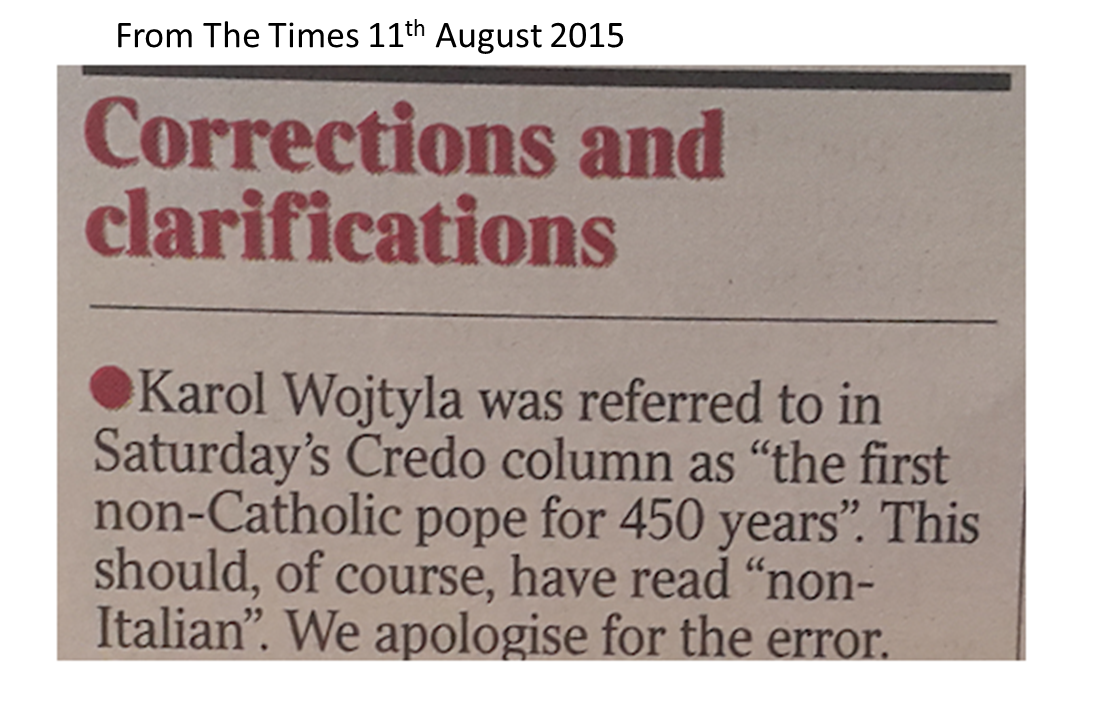
The current Pope is also a non-Italian and may have moved beyond Catholicism. His brand of populist religion might make him the first example of a post-Catholic – or should it be a post-modern Catholic?
CBS News: The Environmental Protection Agency is taking the blame for a huge leak of contaminated water into a Colorado river. Government officials said Sunday three million gallons spilled into the Animas River. That is three times larger than the original estimate. The once-clean waterway that was a popular place for kayakers is now filled with yellow, contaminated water.
Three million gallons of toxic waste are now pushing down two rivers that cross Colorado, New Mexico and Utah.
Last Wednesday a crew working for the Environmental Protection Agency accidentally breached a dam holding back heavy metals used in gold mining. Colorado’s governor declared a disaster.
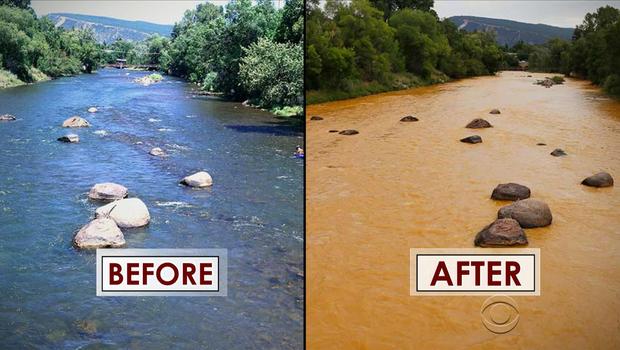
EPA caused pollution colorado August 2015 – cbs news
The EPA had no alternative to taking the blame. After all they did do it. A scapegoat will no doubt be found but no EPA heads will roll.
That most of the US media want the Trump campaign to die is fairly clear. That the Republican party establishment are in a little panic about Trump becoming the Republican nominee or – even worse – being an independent third candidate is also fairly clear. In fact, for the Republican party an independent Trump could be worse than a Trump nomination. There has been more than a whiff of wishful thinking in the headlines over the last 3 days. But the latest NBC post-debate poll shows that the anti-Trump spinning and even the Megyn Kelly hullabaloo have done nothing to dent his commanding lead in the polls.
Despite a debate in which Fox moderators repeatedly attacked him and three days of hostile press coverage which came after it, Donald Trump remains in a commanding lead in the race for the Republican nomination, according to a poll released Sunday evening by NBC News. The results confound weekend press coverage suggesting Trump’s campaign was foundering.
The online poll was conducted by the Analytics Unit of NBC News and the University of Pennsylvania’s Program on Opinion Research and Election Studies over a 24 hour period from Friday evening into Saturday, thus coming entirely after the debate on Thursday evening.
According to poll, Trump has the support of 23% of Republican voters, followed by Ted Cruz with 13%, Ben Carson with 11%, Marco Rubio and Carly Fiorina tied at 8% and Jeb Bush and Scott Walker at 7%. The poll showed Trump essentially unchanged from a poll taken one week ago in which he garnered 22% support.
Numerous commentators speculated over the weekend that Trump’s public spat with Fox News host Megyn Kelly might finally spell the end of his surge in the polls. Top Republicans openly cheered his apparent downfall. But NBC’s weekend poll suggests that assumption was misplaced.
The media headlines were quite clear in their hopes. For some reason the UK Guardian is very perturbed about Trump and is quite openly anti-Trump in its wishful thinking (though it is schizophrenic in its views about the UK’s very own left-wing clown in Jeremy Corbyn):
But a formally “recognised clown” – as Trump clearly is – has an “authorisation” to be as politically incorrect as he wishes. He is now capturing the attention of a large section of the disaffected Republican electorate and attacking him for being politically incorrect can only be counter-productive. Any candidates who wish now to displace him need to create their own independent story-lines which can live their own lives.
As in any show, a clown is not necessarily just a B-act. An accepted clown is not susceptible to ridicule. I suspect that Trump cannot be shot down by the conventional bullets of political correctness. He now can only be over-taken by a “faster” candidate with a better story.
It is almost the first lesson I was taught when I started doing “research”. Research 101. If the data does not fit the model, you change the model – not the data. The fundamental problem with climate models is that they are not falsifiable. And as long as “climate science” can not, or will not, put forward falsifiable hypotheses, it is not Science. The models all start with assumptions which are approved by the high-priests of the religion. The results are then “forced” to fit with past data and are then used to assert that the initial assumptions are correct. When they are then used for making forecasts they invariably fail. They then try to “adjust” the data (cooling the past) rather than change their religiously-held assumptions.
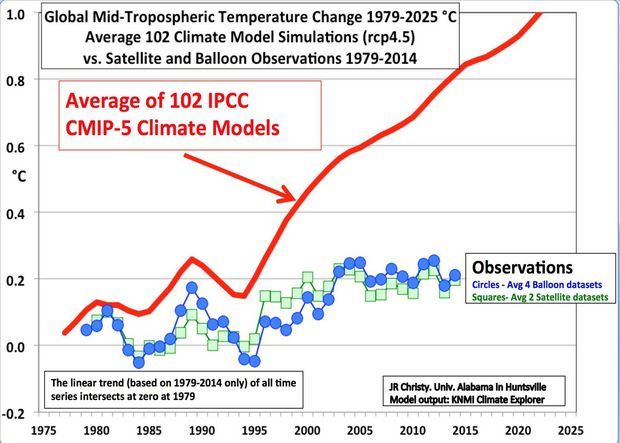
Five year running mean temperatures predicted by UN IPCC models and observations by weather balloons and satellites. University of Alabama’s John Christy presentation to the House Committee on Natural Resources on May 15, 2015.
Just the effect of carbon dioxide concentration on incoming and outgoing radiation is small, easy to include and not really an issue. The problem arises because of the assumptions made of the feedback loops and the subsequent “forcing” attributed to carbon dioxide concentration. It is politically incorrect and therefore no climate model is ever allowed to ignore carbon dioxide “forcings”. Even though the “forcings” are largely conjecture. The feedback loops due to changes in carbon dioxide concentration acting through consequent changes in water vapour concentration and cloud cover are not only not known – it is not even known if they are net positive or net negative on temperature. The unknown “forcings” are called “climate sensitivity”, just to make it sound better, but these “climate sensitivities” are little better than fudge factors used by each model. (Even more fudge factors are applied to assert how man-made carbon dioxide emissions affect the carbon dioxide concentration even though the long-term data show that carbon dioxide concentration lags temperature). What I note is that the error between the models and real data is of the same magnitude as ascribed to the effects – with “forcing” – of carbon dioxide concentration in the atmosphere. There is no evidence that the assumed “forcings” are valid. The obvious correction to be made in the model assumptions is that the “climate sensitivity” assumed for carbon dioxide concentration is too high and that any “forcing” effects must be scaled down. But that, of course, is politically incorrect. You cannot get funding for developing a model which does not pay homage to the orthodoxy.
A simple sanity check shows that every single climate model used by the UN’s IPCC would fit real data better if it used a much lower sensitivity to carbon dioxide concentration by using a lower level of assumed forcing.
It is cool summers – not cold winters – which will be the harbingers of the coming of a little ice age. In the north of Iceland it has been the coldest summer in over 30 years (since 1983) and in the south it has been the coolest since 1992.
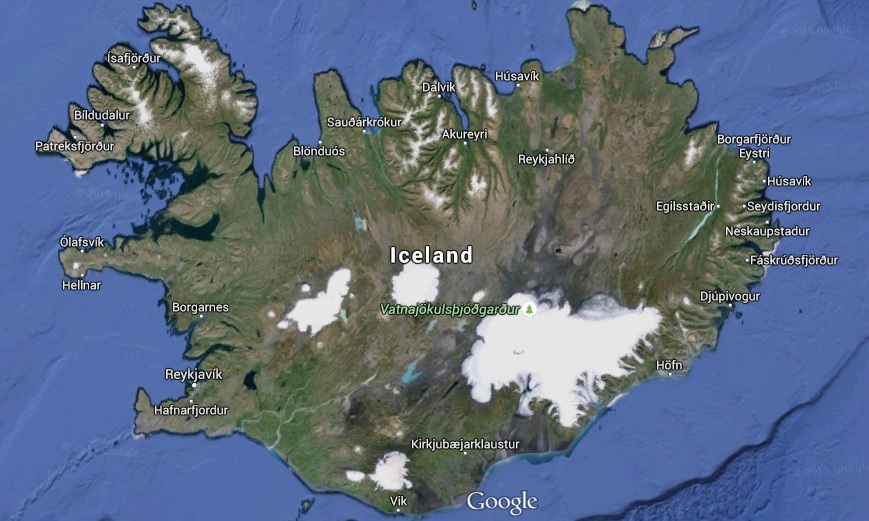
The first thirteen weeks of summer this year have been the coldest in Reykjavik in over twenty years, reveals Icelandic meteorologist Trausti Jónsson.
The northern city of Akureyri fares even worse – one has to go back around thirty years to find a colder summer. Last year was Akureyri’s warmest summer in 67 years.
Summer in Reykjavik has not been this cold since 1992, although the summer of 1979 was by far the coldest. The warmest summer in Reykjavik in the past 67 years was in 2010.
Summer in Akureyri has not been this cold since 1983.
And meanwhile the UK summer has been pretty miserable as well:
Paul Homewood: As I indicated a couple of weeks ago, July has been another miserably cold affair, despite a couple of hot days at the start of the month.
The UK as a whole has been 0.7C below the 1981-2010 average, with the west and north particularly cool. In Scotland, it was the coldest July since 1998. This is the third cool month on the trot, making the May to July start to the holiday season the coldest since 1996.
Despite a mild winter and early spring, UK temperatures year to date are now running 0.2C below the 1981-2010 average.
The media, every Democrat, his Republican challengers and even the Republican establishment are trying to represent, in one way or another, that the clown Donald Trump did not win the debate. They are in denial, and just cannot admit that he won the event by ignoring debate. He changed the game to be to be about the occasion and not about winning debating points. Twenty four million tuned in to the event.
HuffPo: In terms of total viewers, the debate was the highest-rated non-sports cable telecast of all time, according to Nielsen data — with the staggering viewership shattering expectations of what was already a highly-anticipated event. The telecast also made history for Fox: it was the most highly-rated broadcast of the network’s 20-year history, according to CNN Money.
That level of interest is entirely to Trump’s credit. He was chasing exposure – not some brownie debating points – and he won. Resoundingly. Neither the moderators nor his challengers had any idea of how to handle him. The moderator Megyn Kelly attacked him with a barrage of political correctness. How stupid was that? She came off as being sanctimonious and he could demonstrate – again – “that he speaks his mind”.
For the first time in many years I observe in the US that “speaking your mind” is beginning to trump being politically correct. (Sorry). And not just in the US. I suspect the pendulum is beginning to swing and there is a realisation – globally – that sanctimonious, self-righteous, “political correctness” is not an acceptable excuse to avoid asking the questions you don’t want to hear the answer to.
Donald Trump has formally taken on the role of being “clown”. And in a circus the role of “clown” is not so unimportant. In fact the “clown” is very often the star of the show. Trying to make a “clown” look ridiculous is doomed to help the clown perform his act. Trying to get a clown to be serious only demonstrates stupidity and can only backfire. A clown does not need to be politically correct. In fact to be politically incorrect is not just expected of him, it his calling-card. He feeds on the indignation of others. The others and the media are just becoming his “straight men”, and “straight men” are never the star event.
I observe that nearly all the media – and even the Republican media – are playing down what Trump achieved. But they are playing into his hands. Erick Erickson of RedState has “disinvited” him from the Red State gathering. He is by his own admission being politically correct in his own way. But he is trying to make Red State part of the establishment and the disinvitation too only plays into Trump’s hands.
The post debate polls will be available next week and I will not be at all surprised to see Trump well ahead of the others again. The one post-debate poll I have seen shows him not just the clear winner but so far ahead of the others as to be embarrassing – for the others.
Newsmax: Here is a breakdown of the poll results:
- Donald Trump: 38 percent
- Ted Cruz: 15.5 percent
- Neurosurgeon Dr. Ben Carson: 10.2 percent
- Florida Sen. Marco Rubio: 9.7 percent
- Kentucky Sen. Rand Paul: 9.3 percent
- Ohio Gov. John Kasich: 4.9 percent
- Wisconsin Gov. Scott Walker: 4.5 percent
- Former Arkansas Gov. Mike Huckabee: 3.5 percent
- Former Florida Gov. Jeb Bush: 2.5 percent
- New Jersey Gov. Chris Christie: 1.4 percent
So far, the clown has it.
After flying drones and the coming of driverless cars it is the turn of autonomous ships. The Finnish Funding Agency for Technology and Innovation (Tekes) is funding an €6.6 million project called the Advanced Autonomous Waterborne Applications Initiative, which Rolls-Royce has been appointed to lead. The project aims to produce the specification and preliminary designs for the next generation of advanced ship solutions – the unmanned, “drone” cargo ship.
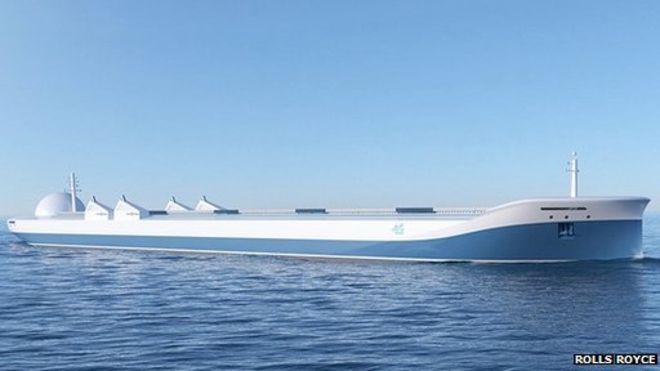
drone ship 1 Rolls Royce
…… The project will run until the end of 2017 and will pave the way for solutions – designed to validate the project’s research. The project will combine the expertise of some of Finland’s top academic researchers from Tampere University of Technology; VTT Technical Research Centre of Finland Ltd; Åbo Akademi University; Aalto University; the University of Turku; and leading members of the maritime cluster including Rolls-Royce, NAPA, Deltamarin, DNV GL and Inmarsat.
Rauli Hulkkonen, Tekes, Chief Advisor, said: “This project is a fantastic opportunity to establish the Finnish maritime cluster as the world leader in maritime remote control technology.
Esa Jokioinen, Rolls-Royce, Head of Blue Ocean Team, said: “Rolls-Royce has extensive experience of successfully coordinating multi-disciplinary teams developing complex technologies. We bring a world leading range of capabilities in the marine market to the project including vessel design, the integration of complex systems and the supply and support of power and propulsion equipment. We are excited to be taking the first concrete steps towards making remote controlled and autonomous ship applications a reality.
The wide ranging project will look at research carried out to date before exploring the business case for autonomous applications, the safety and security implications of designing and operating remotely operated ships, the legal and regulatory implications and the existence and readiness of a supplier network able to deliver commercially applicable products in the short to medium term. The technological work stream, which will be led by Rolls-Royce, will encompass the implications of remote control and autonomy of ships for propulsion, deck machinery and automation and control, using, where possible, established technology for rapid commercialisation.
The Rolls-Royce Blue Ocean team is responsible for research and development of future maritime technologies and focuses on disruptive game-changing innovations. By combining new technologies with new approaches to ship design and system integration, the team aims to reduce operational costs, minimise emissions and enhance the earning capability of vessels. The team has developed a range of autonomous ship concepts as well as innovative designs for various ship types.

An autonomous tanker — image rolls royce
Robot ships are currently illegal and the whole maritime regulatory environment would need to be changed to suit. If driverless cars become a reality by 2020, then there is no reason why robot fleets of cargo ships could not be in use by 2030. Bureaucracy will probably be a bigger barrier than technology.

robot fleet image rolls royce
Here’s an article from the Journal of Epidemiology & Community Health about the implied stresses and strains of being a young father. It seems that men who become fathers under the age of 25 have a higher risk of dying in middle-age than those who become fathers when older. It seems fairly obvious that those between 30 and 44 are far more likely to have stable economics in the home and the wherewithal to support a family, than young men of 25. Considering also that the development of the cognitive faculties – especially those of judgement – are not fully developed till the age of 25, it is perhaps not entirely surprising that the stresses of fatherhood are more debilitating on the young than on the older. But I had not thought that these stresses were sufficient to be visible as an increase in the mid-life mortality rate.
The conclusions that I draw are that young men under 25 are first to be discouraged from setting up families. Secondly young fathers probably need more societal support for some 4 or 5 years if they do take on the burdens of a family. Possibly young fathers received far more support from their parents and relatives in the pre-industrial world.
“the association between young fatherhood and mid life mortality is likely to be causal”
Elina Einiö, Jessica Nisén, Pekka Martikainen. Is young fatherhood causally related to midlife mortality? A sibling fixed-effect study in Finland. Journal of Epidemiology and Community Health, 2015; jech-2015-205627 DOI: 10.1136/jech-2015-205627
Becoming a dad before the age of 25 is linked to a heightened risk of dying early in middle age, indicates a sibling study published online in the Journal of Epidemiology & Community Health. The published evidence suggests that men who father a child in early life have poorer health and die earlier than men who delay fatherhood, but family environment, early socioeconomic circumstances and genes are thought to explain this association.
In a bid to tease out the underlying factors, the researchers used a 10 per cent nationally representative sample of households drawn from the 1950 Finnish Census. This involved more than 30,500 men born between 1940 and 1950, who became fathers by the age of 45. The dads were tracked from the age of 45 until death or age 54, using mortality data for 1985-2005. Some 15% of this sample had fathered their first child by the age of 22; 29% at ages 22-24; 18% when they were 25-26;19% between the ages of 27and 29; and 19% between the ages of 30 and 44. The average age at which a man became a dad was 25-26, and men in this age bracket were used as a reference.
During the 10 year monitoring period around 1 in 20 of the dads died. The primary causes of death were ischaemic heart disease (21%) and diseases related to excess alcohol (16%). Men who were dads by the time they were 22 had a 26% higher risk of death in mid-life than those who had fathered their first child when they were 25 or 26. Similarly, men who had their first child between the ages of 22 and 24 had a 14% higher risk of dying in middle age.
These findings were independent of factors in adulthood or year of birth.
At the other end of the scale, those who became dads between the ages of 30 and 44 had a 25% lower risk of death in middle age than those who fathered their first child at 25 or 26. The risk of death for men fathering their first child between the ages of 27 and 29 was the same as that of men in the reference group. In a subsidiary sample of 1124 siblings, brothers who had become dads by the age of 22 were 73% more likely to die early than their siblings who had fathered their first child at the age of 25 or 26. Similarly, those who entered parenthood at 22-24 were 63% more likely to die in mid life. …… Once again, men who became dads between the ages of 30 and 44 had a 22% lower risk of a mid-life death, although this was statistically the same as those who fathered their first child at 25/26.
“The findings of our study suggest that the association between young fatherhood and mid life mortality is likely to be causal,” write the researchers. “The association was not explained by unobserved early life characteristics shared by brothers or by certain adult characteristics known to be associated both with fertility timing and mortality,” they explain.
They go on to say that although having a child as a young adult is thought to be less disruptive for a man than it is for a woman, taking on the combined role of father, partner and breadwinner may cause considerable psychological and economic stress for a young man and deprive him of the ability to invest in his own wellbeing. The researchers point out that while these factors may not be so important for today’s generation of dads, they may nevertheless experience other types of stressors.

 The k2p blog