“Let there be cesium” and there was a leap second

June 28, 2015

On 30th June 2015 at 23:59:60, a leap second will be added before 1st July 2015, 00:00:00 because the difference between Coordinated Universal Time (UTC) and Universal Time (UT1) would have reached 0.9 seconds. Universal Time also known as Astronomical Time is based on the Earth’s rotation around its own axis, which determines the length of a day. Since 1972, 25 leap seconds have been inserted to synchronise these two clocks and this leap second will be the 26th. The differences are so irregular that the need for a leap second cannot be predicted more than about 6 months in advance.

The leap second is for synchronising the two clocks and not – directly – for compensating for the slowing down of the earth and the lengthening of the day. That adds about 1 second every 58,800 years (1.7ms per century). Since modern humans arrived on the scene some 200,000+ years ago the length of the day has increased by about 4 seconds.

International Atomic Time (TAI) is the “standard” used to synchronise the other two clocks and is built up by combining the output of some 200 highly precise atomic clocks worldwide and where the second is defined by the resonant oscillation frequency of cesium 133.

Atomic clocks use the second as the base unit and hours, days and years are taken to be multiples.

“The second is the duration of 9 192 631 770 periods of the radiation corresponding to the transition between the two hyperfine levels of the ground state of the cesium 133 atom.”

The wise men of our age believe (they cannot know) that this resonant frequency of the cesium 133 atom will remain “stable” for millions of years and is far more stable than the period of rotation of the irregular orbit of the earth around the sun or the even more irregular (and slowing) rotation period of the earth on its own axis.

All we measure, or try to measure, are periods of time – provided of course that time exists. Cesium would not have come into existence until about 3 minutes after the Big Bang, but time, presumably, began with the Big Bang. Initially there was only hydrogen and then came Big Bang Nucleosynthesis (BBN), which after about 10 seconds (cesium 133 seconds, though cesium still didn’t exist) started producing helium. The heavy elements came about 3 minutes after the BB and after about 20 minutes BBN ceased. Light would have been created as soon as the fusion of hydrogen started with the BB itself.

Rephrasing Genesis

The Big Bang was the Beginning and then came Fusion. The expanse was without form and void, and dark energy was over the face of the deep. And the Spirit of Gravity hovered over the face of the aether. And Gravity said, “Let there be Coalescence” and the stars of the heavens came to be. “Let there coalesce a Sun” said Gravity, and so there was light. “Let coalescence proceed” and under Gravity came the earth bathed in the light of the Sun. And the light was good. 

And the rest is history.


Twerking is pretty old-fashioned and Bostonians could be “massholes”

June 25, 2015

The Oxford English Dictionary has added 500 new words

Press Release: Today the Oxford English Dictionary (OED) announces its latest update, ushering in nearly 500 new words and over 900 newly revised and updated words. There are also over 2400 new senses of existing words added. This confirms the OED’s place as one of the largest and longest-running language research projects in the world. 

The new words include masshole, hot mess, twerk, fo’shizzle, sext, stanky, twitterati, meh.

I particularly like

masshole: A term of contempt for a native or inhabitant of the state of Massachusetts

Miley Cyrus may have thought she was being original and innovative with her “twerks” but it turns out that she was being pretty old-fashioned with a move which dates back to 1820 and came into dance in the 1990s.

The use of twerk to describe a type of dancing which emphasizes the performer’s posterior has its roots in the early 1990s in the New Orleans ‘bounce’ music scene, but the word itself seems to originate from more than 170 years before that.

It was in use in English as a noun by 1820 (originally spelled ‘twirk’) referring to ‘a twisting or jerking movement; a twitch’. Its use as a verb emerged a couple of decades later, in 1848, and the ‘twerk’ spelling had come about by 1901. The precise origin of the word is uncertain, but it may be a blend of twist or twitch and jerk, with influence from the noun quirk and from work (v.) in reference to the dance.

Keepers of language such as the OED always do – and must – lag usage. But it is wrong to think of the OED as any kind of arbiter of what is “right” or “wrong”. Usage always overrides any judgement of “correctness”. The keepers of language only record what was considered acceptable usage at a certain point in time. In fact I am inclined to the view that there is no such thing as bad spelling or bad grammar. There is only bad or good usage. The only real criterion is whether the meaning intended to be conveyed was conveyed.

Viking Voyages

June 25, 2015

From thinglink

Click image for a larger map.

Viking voyages – 700 – 1050 CE

Nordic Science:

“Viking Age people knew about sails, at least since the birth of Christ, because they had contact with the Romans who had sails on their ships. But it is not until around the seventh and eighth century that we see the sail introduced in Scandinavia,” says Dr Morten Ravn, an archaeologist and curator from the Viking Ship Museum in Roskilde, Denmark.

“We don’t know why they didn’t have sails earlier, perhaps they just chose not to use it” says Ravn, who believes that the Norsemen must have known about the use of sails in the seventh century.

With the sail began a historical period when the Norse reached all the way down to the Caspian Sea, Gibraltar, Iceland, Greenland, and America.

….. 

“We do not know what was happening in between the time of the Nydam society’s boats and ships of the third and fourth century AD which were exclusively propelled by oars, and the seventh century where we begin to find pictorial depictions of ships. We cannot rule out that at some point we will find a ship from the year AD 500, but right now it is one of archaeology’s great questions,” he says.

The Nydam boat is 23 meters long and 3.5 meters wide. It is clinker built, a technique where the edges of hull planks overlap and planks are joined end to end into a strake. This was developed in northern Europe and successfully used by the Norsemen, and it represents a step in evolution in shipbuilding between the sewn plank boats and the new Viking ships.

During the Viking Age, they developed different types of ships for different purposes — either for crew, food, or merchandise.

Some ships were built for navigating along coasts and rivers, whereas the ships that went to England, Iceland, Greenland, and America were likely to have been large oceangoing vessels that could carry up to 80 people or a large amount of cargo. ……

Written sources indicate that Vikings travelled, traded, and raided, throughout most of Europe.

The annals from the Franciscan monastery of St. Bertin in 841 AD describe how the Danish Vikings sailed down from the North Sea and entered the English Channel to attack Rouen, a town in Normandy, Northern France. The scribes tell how the Vikings raged and plundered, used swords and fire, destroyed the town, killed and enslaved monks and other townspeople, ravaged all monasteries and settlements along the Seine or left them terrified after taking their money as bribes.

The Icelandic sagas written in the Middle Ages are another example, and perhaps the most famous written accounts of the Viking travels. One tells the story of the Norwegian King Harald Hardrada and his travels to Miklagård (modern day Istanbul). He entered into service as the Emperor’s bodyguard and returned home to Norway a wealthy man.

Post-intellectual West Bengal

June 23, 2015

The new post-intellectual intelligentsia ruling West Bengal are demonstrating the heights to which they aspire:

NDTV: West Bengal Chief Minister Mamata Banerjee’s nephew Abhishek has publicly threatened to “gouge out the eyes and chop off the hands” of anyone who dares to hurt Bengal’s interests. … “Those who dare to glare at us, we can gouge their eyes out and throw them on the road. Show us your hands and we can cut them off,” Abhishek said, adding, “But remember, it is the common man who will have the last word.” …

… Last year, Mamata Banerjee and the Trinamool Congress had to face many embarrassing questions after a prominent parliamentarian, actor Tapas Pal, said at a public meeting: “If the CPM people touch a hair on the head of my workers, I will set my boys upon their women to rape them.”

The West Bengal of today is not the intellectual or cultural powerhouse it once was. I finished my schooling in Calcutta long before it had been ravaged to be called Kolkata. I have been a regular visitor since then and was last there in 2014 for the 50th anniversary of graduating from school.

I grew up knowing – and living – with the intellectual legacy of Swami Vivekananda (Narendra Nath Datta), Rabindranath Tagore and Jagadish Chandra Bose. Satyajit Ray and Ravi Shankar were living legends. But they were all of the old school of Bengali intellectualism. Since then West Bengal was first plagued by 5 decades of a very peculiar Marxist communism. Just two layers of society were recognised. First came the agricultural masses who were all organised into almost-martial cadres and then there were the politburo and its hangers-on who amassed their corrupt wealth. The middle class and those who actually contributed to growth and culture and thought were reviled and oppressed. Marxist communism collapsed in on itself after years of decay. The communists were then replaced by an even more peculiar bunch, the Trinamool Congress. They are led by the narcissistic Mamata Banerjee with the slogan “Ma Mati Manush”  which is supposed to mean “Mother, Motherland and People” but where the sub-text says “Me, Me and Me”.

As an aside, I note that in spite of the efforts of post- nationalists, Theatre Road is still Theatre Road to all taxi drivers. It was renamed as  Shakespeare Sarani during my time there in the 1960s but that is only for maps and road signs. More than 50 years after the name was changed, the Post Office will still deliver your mail addressed to Theatre Road. Lansdowne Road is still Lansdowne Road and many don’t even know it is now called Sarat Bose Road. Lower Circular Road  is still referred to as such, though it is officially Acharya Jagadish Chandra Bose Road. Who does not know Park Street (officially Mother Teresa Sarani and earlier Burial Ground Road) and Park Circus? Camac Street and Free School Street were part of my schooldays beat and are still there – though the building we lived in no longer exists. Officialdom can be schizophrenic and is often irrational. High Courts are set up by Acts of Parliament and their names cannot be changed so easily. So it is the High Court of Calcutta in Kolkata. The Netaji Subhas Chandra Bose International Airport is the mouthful rarely uttered for what was Dum Dum airport and is still designated CCU.

In the 1970s post-intellectual Bengal produced a vicious and violent movement – the Naxals – who considered themselves intellectuals but who in reality were anything but. They considered themselves Maoist communists, engaged in a permanent revolution (a la the cultural revolution) and naturally opposed to everybody else, including the Marxist communists in power in the state. Mayhem was the name of the game. Culturally they were the Bengali Taliban. Many of the starry-eyed, self-styled and self-proclaimed “intellectual” leaders were killed by vicious police and army actions in the early 1970s. Some of my class mates were among them. This revolutionary communist movement still exists in pockets and has spread to other states. But the movement lacks any intellectual content or realism.

In recent times intellectuals from West Bengal have been few and those few have been relatively lightweight. Amartya Sen may have received a Nobel prize but it was only for economics which does not really count. His theories suffer from the confusion of his wanting to be a capitalistic socialist and he ends up being nothing of anything. Pranab Mukherjee was a disaster as a Finance Minister and is nondescript as President. Intellectually, just a bantam-weight.

It is a post-intellectual, post-nationalist West Bengal struggling to find a new role for itself.

Monsoon slow to reach North West but rainfall running 11% above average

June 22, 2015

In spite of a forecast of a deficient monsoon, a late start and a possible El Nino year, so far, so good.

The advance of the monsoon front is a little slow across central India and into the North West. Pakistan is experiencing a heat wave.

monsoon advance June 21st 2015 - IMD

monsoon advance June 21st 2015 – IMD

Rainfall has been holding up quite well. Accumulated rainfall across the entire country (weighted average) in the 3 weeks of the 16 week long monsoon season is running about 11% higher than the long-term average. Rainfall is deficient (from a low expected value) only in the North West region and is above average elsewhere. Even rainfall in the Southern region which often starts deficient is running some 20% above average. In this period the heaviest rainfall is usually in the North East and even here it is running 5% above normal.

rainfall till 20th june 2015 - IMD

rainfall till 20th june 2015 – IMD

The start, at least, is better than was feared and the government will be relieved that the emergency plans for “drought” conditions will not, yet, need to be activated.

Greek deal will be done: Bread rather than Guernica

June 22, 2015

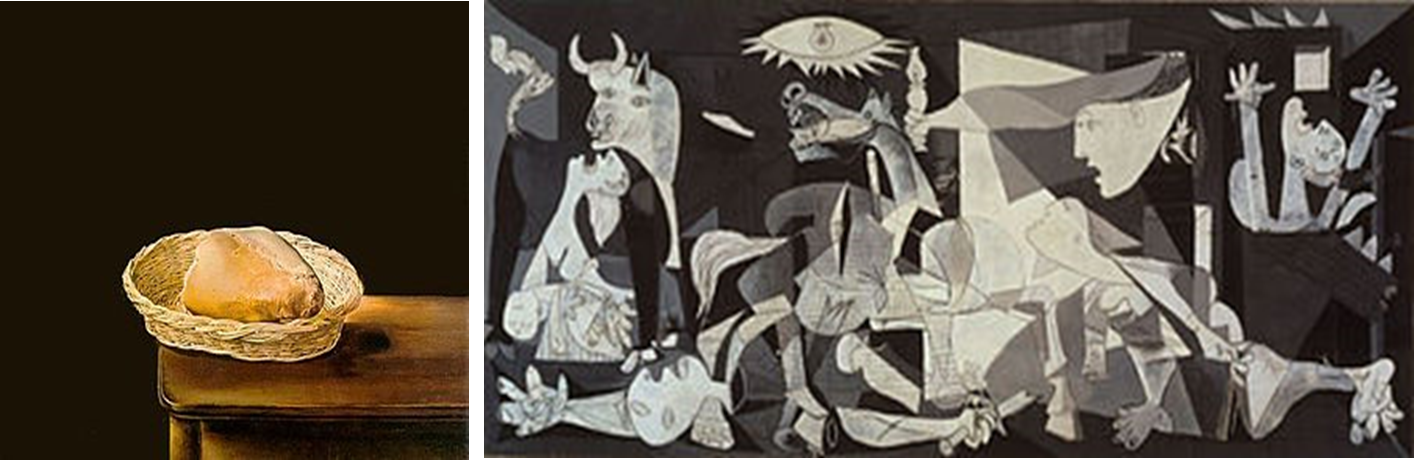
I was listening to Swedish, UK and German radio this morning and one could be forgiven for being utterly depressed. But surprisingly, the blackness went over the top. It was too much. The picture being painted by all the pundits and commentators seemed a little surreal. The picture left in my mind is of  Salvador Dali’s “Basket of Bread” rather than Picasso’s “Guernica”.

bread rather than destruction

bread rather than destruction

So instead, I am feeling remarkably upbeat. Maybe I am just an optimist and would rather see bread than destruction. But I am sufficiently “moved” that I shall make a forecast for the next few weeks.

Tsipras will make statements which seem like that he will do something about curtailing pensions. These will be worded sufficiently loosely such that the Eurozone Finance Ministers can accept the assurances and still have their posteriors covered. Tsipras will have sufficient face-saving text so that he can argue domestically that pensions will not actually be cut when the turnaround occurs and that the turnaround is just around the next corner (or maybe the one after that).

The ECB will make further emergency arrangements so that the current run on Greek banks will not be unmanageable. (By some accounts Greek banks have seen some €20 billion withdrawn).

The payment due to the IMF will be paid.

A short-term (6 month?) deal will be done and the whole problem of a non-homogeneous and splintered Eurozone will be patched up for the short term

Which is good for the short term but which, in the long term and if the Eurozone does not become homogeneous, will give a very big bang when it implodes.

There is a little more brinkmanship to go through until the Greek payment actually falls due at then end of the month.  But I expect a real jump in European markets – and followed by the Asian markets – when Greece makes the payment due and a “deal” is announced. Probably by the end of June.

Maybe it is time to pick up some equity bargains.

Human dissonances

June 21, 2015

It could be that the primary distinguishing feature of humans from other species is not the control of fire or the use of tools or the level of cognition, but is our propensity for cognitive dissonance.

  • The development of the human brain (especially the prefrontal cortex and the ability to make judgements) continues well past teenage years and is not complete till about 25 years of age. Yet the age for permitting voting and other decision making, where critical judgement is crucial, is being reduced and sometimes to as low as 16 years.
  • We consider children not to be the property of their parents but only their dependants and having their own rights. Yet we permit IVF, surrogacy, adoption and abortion primarily for the “benefit” of the parents. We “grant” single parents and gay couples the “right” to have children as if they were just property.
  • Many types of unacceptable, criminal behaviour are “treated” rather than punished (or punished leniently) on the grounds that the fault with the perpetrator is genetic, yet we permit such perpetrators to reproduce these same genetic faults.
  • Capital punishment is not considered justified except for the perpetrators of the most horrific and violent crimes (and sometimes not even for them). Yet the unrestricted, on-demand, abortion of human foetuses up to about 15 weeks before birth is considered a “human right” – of the mother. (see Note 1). Assisted suicide, however, is generally not allowed (with some exceptions),
  • Race and gender are realities of genetic ancestry and and yet we treat them as “social constructs” and try to introduce laws to deny or outlaw genetic differences.
  • “To each as he deserves” is opposed “to each as he needs” and is the classical confrontation between the “right” and the “left”. “To me as I need” and “to you as I judge you deserve” is the creed of the dictator.
  • To be able to discriminate is good but to discriminate is bad, except when we discriminate to correct discrimination, for that is good.
  • We are each considered uniquely individual and different, but the differences are denied when we are also all considered “equal”. “Male” and “female” and “transgender” are taken to express the span of genetic gender differences among humans, but the differences are denied when they are all then taken to be “equal”.
  • We take what is equal to be just, but then exercise inequality to dispense justice. (i.e to dispense justice we treat the plaintiff or the guilty or the victim differently to their opponents).
  • We support and protect failed species which cannot cope with their changing environments in the name of “conservation”and then consign them to a life of imprisonment in the same conditions in which they have failed. On the other hand, we hunt down and destroy species which have successfully adapted to the changes caused by humans as being pests.

Note 1: Births per year, globally, are about 130 million after about 40 million abortions (conception is thus around 170 million per year). Deaths per year globally are about 60 million and about two-thirds of these are due to age. Thus about 40 million die purely of age related causes, 4 million die as infants under 12 months old, 1.3 million in traffic accidents and 0.6 million by violence (including wars and terrorism).


“Mad Professor” Ehrlich cries wolf again

June 20, 2015

Paul Ehrlich will probably be remembered as being the professor who has been more wrong, more often than any other.

To be proved spectacularly wrong , time after time, is apparently a prime qualification for “mad professors” to remain employed. Paul Ehrlich is the perfect example of what is wrong with the tenure system. Of course it helps if your predictions are about catastrophes to come which inevitably garner headlines – no matter how stupid the predictions are. He is at it again making doomsday predictions. This time the doom approaching is because humans have already started the 6th mass extinction which may include the disappearance of the human species. (Actually the earth has too many species and a drastic cull of species is needed).

It is worth recalling all the sensational, headline grabbing but wonderfully wrong predictions that Ehrlich has made:

  • 1968, “The battle to feed all of humanity is over. In the 1970s hundreds of millions of people will starve to death in spite of any crash programs embarked upon now. At this late date nothing can prevent a substantial increase in the world death rate …”
  • 1968, “India couldn’t possibly feed two hundred million more people by 1980.”
  • 1969, “By 1985 enough millions will have died to reduce the earth’s population to some acceptable level, like 1.5 billion people.”
  • 1969, He predicted that by the end of the century the population of the US would be under 20 million, and our life expectancy would be around 40 years – due not to starvation, but to pesticides.
  • 1970, “In ten years all important animal life in the sea will be extinct. Large areas of coastline will have to be evacuated because of the stench of dead fish.”
  • 1970, “When you reach a point where you realize further efforts will be futile, you may as well look after yourself and your friends and enjoy what little time you have left. That point for me is 1972.”
  • 1970s, “The train of events leading to the dissolution of India as a viable nation is already in motion.”  He proposed a number of radical solutions to the overpopulation crisis; dumping sterilizing agents into water supplies, allowing only selected people the privilege of reproduction, and performing mass “triage” of nations, between those who don’t need help (North America, Australia, parts of Europe), those who can be saved, and those who are beyond help – India, Sub-Saharan Africa, and much of Asia, which he predicted would be hell on earth by the 1980’s
  • 1971, “By the year 2000 the United Kingdom will be simply a small group of impoverished islands, inhabited by some 70 million hungry people. …… I would take even money that England will not exist in the year 2000.”

For 4 decades he has made predictions about catastrophes due to famine, depletion of resources, disease, poisoning by pesticides, global warming and climate disruption. Every one of his predictions about the future has been, or is being, proved wrong. Sometimes he gets his history right, but his ability to look forward, even over short times, is hopelessly flawed.

Now he is at it again about the 6th mass extinction that has “already started”. But we actually have more species today than we have probably ever had. The detritus of failed and failing species needs to be cleaned out.

Gerardo Ceballos, Paul R. Ehrlich, Anthony D. Barnosky, Andrés García, Robert M. Pringle and Todd M. Palmer. Accelerated modern human–induced species losses: Entering the sixth mass extinction. Science Advances, 2015 DOI: 10.1126/sciadv.1400253

Abstract: ...  We assess, using extremely conservative assumptions, whether human activities are causing a mass extinction. First, we use a recent estimate of a background rate of 2 mammal extinctions per 10,000 species per 100 years (that is, 2 E/MSY), which is twice as high as widely used previous estimates. We then compare this rate with the current rate of mammal and vertebrate extinctions. The latter is conservatively low because listing a species as extinct requires meeting stringent criteria. Even under our assumptions, which would tend to minimize evidence of an incipient mass extinction, the average rate of vertebrate species loss over the last century is up to 114 times higher than the background rate. Under the 2 E/MSY background rate, the number of species that have gone extinct in the last century would have taken, depending on the vertebrate taxon, between 800 and 10,000 years to disappear. These estimates reveal an exceptionally rapid loss of biodiversity over the last few centuries, indicating that a sixth mass extinction is already under way.

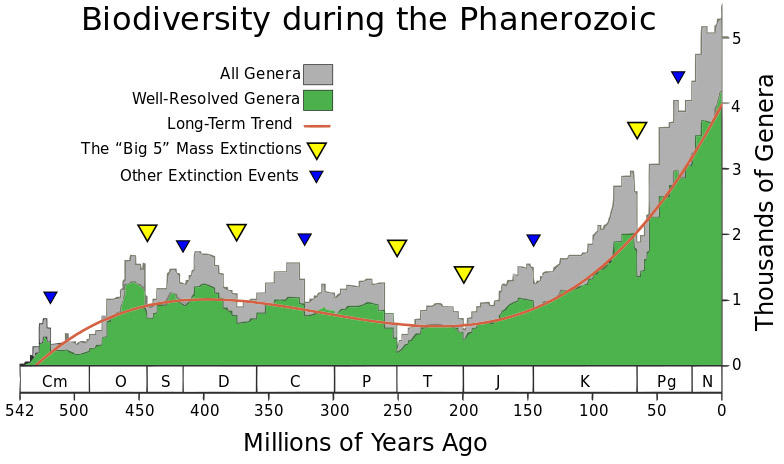
But there are still more species around than ever before. And a lot of them need to go extinct to make way for others that are more suited. No previous mass extinction has been any threat to life on earth though it has each time cleared the decks of species not fit or worthy to continue.

The fossil record shows that biodiversity in the world has been increasing dramatically for 200 million years and is likely to continue. The two mass extinctions in that period (at 201 million and 66 million years ago) slowed the trend only temporarily. Genera are the next taxonomic level up from species and are easier to detect in fossils. The Phanerozoic is the 540-million-year period in which animal life has proliferated. Chart created by and courtesy of University of Chicago paleontologists J. John Sepkoski, Jr. and David M. Raup.

But the one good thing about Paul Ehrlich’s predictions is that it provides a clear identification of an area not to worry too much about.

In Sweden, “white flight” is triggered with just 4% “non-whites” in a neighbourhood

June 19, 2015

The “white flight“ phenomenon has been known and studied in the US since the 1950s and also more recently in the UK. It is observed also in Australia, New Zealand, The Netherlands and in the Scandinavian countries. It is the term applied to

the large-scale migration of whites of various European ancestries from racially mixed urban regions to more racially homogeneous suburban or exurban regions.

In Sweden the term “native-born” usually designates whites and the term “non-European birth” is the euphemism usually applied to non-whites. (It is politically incorrect to refer to “whites” and “non-whites” or “coloured” or “black”). A new study from Linnaeus University (Emma Neuman – “Essays on Segregation, Gender Economics, and Self-employment”) looks at the ethnic segregation in where people live and in the work place and the differences between the 1990s and the 2000s.

Press Release: The results show that the native-born tend to move away from or avoid moving into residential areas when those of non-European birth reach a certain trigger level in an area. Thus the behaviour of the native-born is a major factor behind the rise of ethnic segregation in Sweden. Furthermore Neuman argues that ethnic segregation during childhood can have an impact on economic outcomes in adulthood.

Segregation and “ghettoism” is often blamed on immigrant populations but this study suggests that it may, to a great extent, be due to whites moving away. And then of course, the immigrant population is powerless to avoid this segregation by exclusion. Integration of immigrants is a two-way street. There may be many who don’t wish to integrate. But it would seem that the native-born also do not wish to be integrated into and actively avoid integration.

Hem&Hyra:

Economist Emma Neuman at Linnaeus University in Växjö has studied migration patterns in residential areas during the 1990 and 2000s to see how ethnic segregation has changed. Statistics show that the native-born begin to move away from or avoid moving to a residential area when it has reached a certain proportion of residents born outside Europe.

The breakpoints vary a little between different cities, but on average it stands at around four percent. “The process can take a long time, but it is around there somewhere we see that it starts – the native-born begin to move out or avoid moving in”, says Emma Neuman.

The trigger point may seem low, but still has increased from the 90s to the 00s. “One can see clearly that the breakpoint is higher in the second period than in the first. It can be interpreted that the native-born have become more tolerant”.

If the trigger for the Swedish white population to begin moving out of an area is just 4 non-whites in 100, I would have described the behaviour as being highly intolerant. Four percent seems incredibly low as the trigger point for resentments against non-whites to be expressed. If toleration of 3 non-whites in the 90s has now increased to 4 in a 100 a decade later, it is still a picture of overwhelming intolerance. In fact, the intolerance level is so high that I would suggest that it is an indicator of an irrational fear of non-whites. Perhaps the low level of integration of non-white immigrants in Sweden is not just because they don’t want to, but because they are not allowed to.

It’s not about the guns, it’s all about the parenting

June 19, 2015

Another day, another mass shooting in the US. Add Charleston to the list. Another public lamentation from Barack Obama. Blame the NRA. Blame “gun culture”. Blame the politicians. Blame the political system. Blame the guns.

I am not a social psychologist busy faking data for my next paper and my next television appearance. But I do consider myself a student of human behaviour. One thing that is certain and common about these mass killers, whether in the US or in the Middle East or in Mexico, is that all the killers have been behaviourally “primed”. The priming can be called corruption or radicalisation or perversion or brain-washing or imprinting, but it is always the creation of a state of mind which leads to a particular behaviour.

It is not (primarily) about the killers’ genetic make-ups. It is not about the guns. It is about behaviour. And the behaviour is (primarily) a consequence of nurture not nature. It is about the bringing-up of children and young people who do not reach mental maturity till they are 25. It is about the behaviour of young humans whose critical abilities and ability to make judgements continues to develop long after their teenage years. It is about parenting in the main. It is about societies which allow parents to abandon their responsibilities (and their liabilities) before the pre-frontal cortex of their children and their consequent ability to exercise judgement has been fully developed.

So when I hear about radicalised teenagers running off to ISIS or a 21 year-old massacring people in a church in Charleston, I don’t blame the guns. I blame the parents who leave vacuums to be filled by radical preachers. I blame parents who have inculcated in their children the view that killing some particular group of people is not just acceptable, but desirable.

I blame the killers first. But then I blame their parents who brought them up, and third, the societies which encourage these parents to cease parenting early. I blame “children’s rights” movements which argue for allowing greater autonomy and giving more “power” to children whose judgement and critical abilities are very far from fully developed. Where inculcating discipline in children is considered oppressive, where parents are given the right to brainwash their children into any religion they choose but have no duty to develop any sense of morals or ethics. Where parents abrogate their responsibilities to teachers or the State and where teachers are hamstrung by regulations.

It’s not about the guns. It’s all about behaviour. It’s all about the parenting. Even if there is a small genetic component, it is still about the parents.