Turbines in the orangery

May 26, 2015

Today, in the orangery in the grounds of Finspång Manor, a little gem of a museum was opened. A website is in its infancy. It records the quite remarkable, more than 100 year old, history of the manufacture of steam and gas turbines in this little town. Finspång town has a population of a little over 15,000 today but has an industrial tradition dating back to 1641 and was for 200 years at the forefront of cannon manufacturing (before the advent of the rifled barrel). They had a reputation for usually supplying cannons to both sides of many European wars of the 18th and 19th centuries.

Stal Laval logo

Turbines have been manufactured in Finspång since 1913 but the technology also has a thread going back to Gustaf de Laval who invented his steam  turbine in 1883 and put it into production in 1893 in Stockholm. (In the UK, CA Parsons invented his steam turbine in 1899). The Finspång manufacture of turbines by the STAL company built on the ingenious inventions of the brothers Ljungström, Birger and Fredrik. The two strands of the de Laval and Ljungström technologies came together later in 1959 and STAL became STAL-Laval. Ownership of the factory in due course shifted to ASEA and then to ABB and for a short while was with Alstom and then eventually moved to Siemens who are the current owners. Gas turbines came into the picture in 1945 with the development of a jet engine (the Dovern) for the Swedish Air Force. That engine flew only once (under another aircraft for a test) and never “in anger”. The Swedish Air Force chose Rolls Royce for their engines and STAL converted the development for industrial use. The engine morphed into an industrial gas turbine, the GT35, which first went into operation in 1957 and this engine – with a further development or two – is still around in the Siemens stable. In 1959, STAL delivered a 40MW gas turbine, the GT120, which at the time, was the world’s largest.
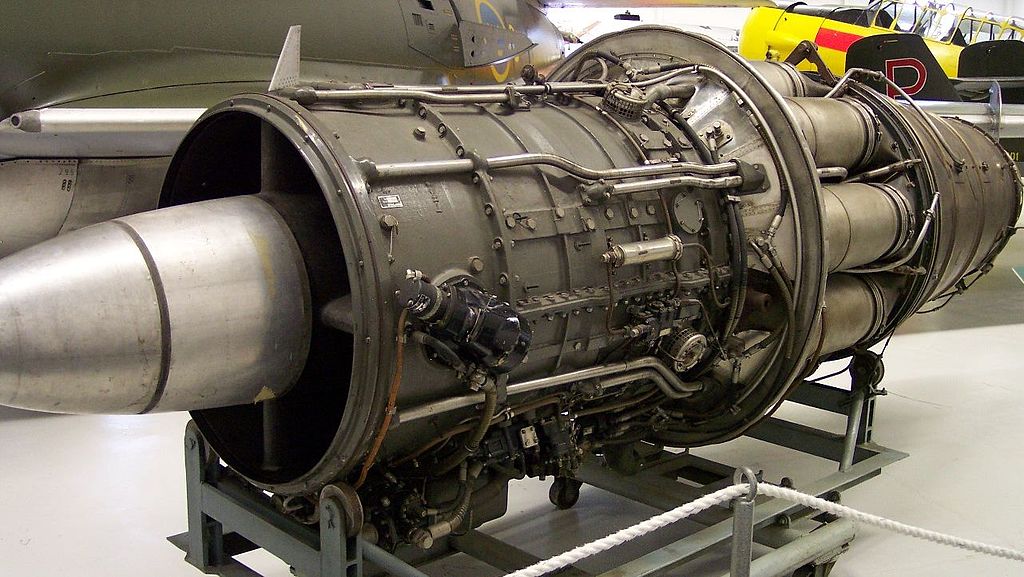
STAL Dovern.jpg

“STAL Dovern”. Licensed under CC BY-SA 3.0 via Wikimedia Commons

The Finspång Orangery (built in 1832) in the grounds of Finspång Manor is, at first sight, a most unlikely place for a Museum of Turbine History. But even with its wall frescoes and painted ceilings which evoke a long-gone age of gracious living, the turbines do not seem at all out of place. An older Orangery burnt down in 1830 and the current building was designed by Lars Jakob von Röök.  On two of the back, north-facing walls are frescoes said to be by the Italian painter Guido Reni. (But since Reni was born in 1575 and died in 1642, that is either wrong or the walls are much older and survived the fire of 1830. Since the manor was only built between 1668 and 1685, it is more likely that the artist was someone other than Guido Reni).

Finspångs Orangery juli_2005 (wikipedia)

Finspångs Orangery juli 2005 (wikipedia)

Orangery frescoes (image khaladsphotoblog)

Siemens has provided the Orangery as a home for the Museum, which has been put together by volunteers. They are still working to organise the wealth of material and drawings and pictures and films and models that are gathering dust in the catacombs under Finspong Manor.

Through the summer it is hoped to be able to have the museum open on Wednesdays and Thursdays. In any event the Finspong Manor grounds are well worth a visit and for anyone interested in rotating machinery, the museum should prove fascinating. (The manor itself is used as offices and is closed to the public. However the chapel – now run by the Swedish Church – is a little jewel of a chapel).

Finspång Manor from the SE. (image http://www.skyscrapercity.com)

Chapel in Finspång Manor (photo credit Per Svensson http://www.sfoto.se)

Currently the Finspång facility is the main centre for Siemens’ range of industrial gas turbines and ceased manufacturing steam turbines earlier this year. But the turbine tradition is now into a 6th generation.

Beyond infinity must come nothing – not even nothingness

May 26, 2015

An exercise in triviality.

I have been exercised of late by the use of “infinite” as an adjective and came to the conclusion that “infinite” should only be used to describe the unboundedness of things capable of being counted or measured (quantifiable or countable things). So, I reason, the number of terms in a numerical series, or physical things, or length or mass or time could be described as being “infinite”, because they could also be “finite”.  The use of “infinite” to describe something qualitative which could never be finite was therefore illogical. (Not “wrong” but illogical because I take the position that no usage is ever “wrong” if it communicates what is intended to be communicated). But my “rule” is that “infinite” is usable only for things which must first be “finite”. Therefore “boundless” or “endless” should be more appropriate for non-quantifiable things. So “infinite sky” or “infinite space” would be better described as “endless sky” or “boundless space”. “Endless lines” not “infinite lines”, but “lines of infinite length”.

Georg Cantor even imparted qualities to “infinite”. Cantor described “cardinalities” of the infinite for different sizes of infinite sets. Of course, there are then an infinite number of cardinalities. He considered integers as being countably infinite, but he took the infinite set of real numbers – as being capable of being counted – but uncountable. But Cantor’s uncountable, various cardinalities of the infinite still apply only to quantitative things.

Early Indian mathematics distinguished between endless and innumerable and tried to classify infinites by considering loose bounds and rigid bounds:

…… two basic types of infinite numbers are distinguished. ……. a distinction was made between asaṃkhyāta (“countless, innumerable”) and ananta (“endless, unlimited”), between rigidly bounded and loosely bounded infinities.

In the hierarchy of words therefore I take “boundless” to be applicable to all things whereas I take “infinite” to apply only to quantifiable things.

But what happens now to “infinity” as a noun?

As a noun we give “infinity” many meanings. First as the quality or state of endlessness (limitlessness, boundlessness) and second as the number which is larger than any other and always larger than anything conceivable (). We therefore refer to the infinity of space or the infinity of meaning or the infinity of the stars. And in mathematics, is treated as a number (albeit with rather special properties) and can be used in mathematical operations as a number. But there is a third meaning or usage. We also use “at infinity” or “to infinity” as if it were a place. “Parallel lines meet at infinity”, we say in plane geometry. In calculus we speak of “limits at infinity”. We speak of points, planes and lines “at infinity” in projective geometry. The universe ends “at infinity”.

OED:

infinity (n.) late 14c., from Old French infinité. “infinity; large number or quantity” (13c.), from Latin infinitatem (nominative infinitas) “boundlessness, endlessness,” from infinitus boundless, unlimited” (see infinite). Infinitas was used as a loan-translation of Greek apeiria “infinity,” from apeiros “endless.”

infinite (adj.)late 14c., “eternal, limitless,” also “extremely great in number,” from Old French infinit “endless, boundless,” and directly from Latin infinitus “unbounded, unlimited,” from in “not, opposite of” (see in- (1)) + finitus “defining, definite,” from finis “end” (see finish (v.)). The noun meaning “that which is infinite” is from 1580s.

To be finite is the opposite of being infinite. Infinity as a number, ∞, has mathematical zero as an inverse but when considered to be one end (?) of an endless series has -∞ at the other end. But what happens “at infinity”, where parallel lines meet and the universe comes to end. Most of the universe consists of apparently empty space, interspersed with sub-universes, galaxies, stars and star systems. But this space is not nothing. The space between electrons orbiting around the nucleus of an atom is not nothing either. These spaces may not contain matter but they still have attributes and properties. Gravity waves and magnetic waves can traverse them. Light – whether a wave or not – crosses them. Time exists within them. And with light traversing and a time interval, distance must follow. Space, therefore, has dimensions. And since we infer that some magic mass we call dark matter, and some magic energy called dark energy, abound, space also permits/allows/has dark energy and dark matter.

An infinite universe extends “to infinity”. Obviously it has to be nothing which lies beyond. And it is the properties or attributes of this “nothingness” which boggle the mind.

Clearly “empty” space does not serve as an illustration of the nothingness beyond. (It is not space I am told but space-time, where we can observe space as time passes but cannot observe time as space passes). A vacuum, anywhere, is void of matter but otherwise has the attributes of space and does not serve either. Even the Buddhist concept of emptiness, shunyata (Sanskrit where shunya = zero), is not entirely devoid of thought. We cannot say that light does not traverse nothingness because opacity to light would be an attribute. So would the non-passage of gravity waves through nothing also be an attribute. Time does not pass within nothingness. Time, in fact, cannot exist. Dimensions are undefined. No energy, no mass and not even any magic dark energy. No Laws of Nature. Nothingness cannot be imparted with any attributes or properties since then it would no longer be nothing. In fact, nothingness – by its very nature – must be incapable of being demonstrated, illustrated or even conceptualised.

Tom Mason commented on my previous post:

The universe is as it is, there is no boundary no edge. Also the so called expansion (or maybe it’s contraction) of our universe is not real — it is just a readily seen quirk due to the passage of time varying across the universe. The variation that is evident with the universe’s apparent smallness of its beginning and the apparent largeness of now.

And so I end with a circular and trivial argument and I have no better perception of nothingness:

“Nothing” is no thing – neither physical nor abstract. It cannot be conceptualised without becoming some thing. It has no properties and no attributes. No thing is nothing. Therefore nothing is no thing.

Except that nothing can exist beyond infinity and this nothing cannot even contain nothingness.

Five millennia of the Middle East

May 25, 2015

From Maps of War

5,000 years of the Middle East in 90 seconds

http://www.mapsofwar.com/images/EMPIRE17.swf

Obama deals with imaginary threats while “in denial” about ISIS

May 25, 2015

I would have said that Barack Obama is not just “in denial” but living in a bubble of his own making. If one needed an example to illustrate a “clear and present” danger, there couldn’t be one better than the advance of ISIS and the lack of resistance from the Iraqi Army. It is the danger of advancing barbarism and the lack of resistance from the “civilised” world represented by the US and its allies. The risk now is greater than that imagined to be posed by Saddam Hussain’s imaginary WMD. It is greater than the risk posed by Gaddafi in Libya.

And instead Obama is blathering on about the imaginary immediacy of the imaginary risk of imaginary global warming. “An immediate risk to our national security ….and we need to act now” he proclaims. He stopped just short of ordering air strikes against global warming.

The Guardian:

Senator John McCain on Sunday attacked the president for citing climate change as a threat to national security, suggesting that the Obama administration’s focus on environmental issues was detracting from the fight against Islamic State militants in Iraq and Syria.

The comments by the Senate armed services committee chairman were part of a rotating blame game over the Memorial Day weekend about who is responsible for recent gains by Isis fighters, who last week took control of the ancient Syrian city of Palmyra and the Iraqi city of Ramadi.

“There is no strategy, and anybody who says there is, I’d like to hear what it is,” McCain said, appearing on CBS News. “Because it certainly isn’t apparent. Right now we are seeing these horrible reports, in Palmyra, they’re executing people and leaving their bodies in the streets.

“Meanwhile the president of the United States is saying that the biggest problem we have is climate change.”

In a commencement address at the US Coast Guard Academy last week, President Barack Obama said climate change posed an “immediate risk”.

“I’m here today to say that climate change constitutes a serious threat to global security,” Obama said. “An immediate risk to our national security. And make no mistake, it will impact how our military defends our country. And so we need to act, and we need to act now.”

Bolton was just as blunt, accusing the White House of being in denial.

Washington Examiner:

White House officials are “in denial” about the threat posed by Islamic State fighters in the Middle East, former U.S. Ambassador to the United Nations John Bolton said Sunday.

“They just simply will not acknowledge that ISIS is a threat,” Bolton told Fox News Sunday’s Chris Wallace. “I think they’re blinded by their own ideology.”

Bolton said countries in the region, such as Turkey and Saudi Arabia, “need American leadership” to fight the rising extremist movement that has swallowed up cities in Iraq in recent weeks.

“Are we really saying we are going to put American security in the hands of the Saudi defense ministry?” Bolton said.

And the spin doctors are out again to divert attention from the lack of US strategy and instead to blame the Iraqis. The Iraqis are now nothing more than what has been created by the US. If they lack the will to fight it is because the US “divide and rule” policy has sapped their will to fight. And the artificially created Iraq, without the Shia element will always be incomplete. But to bring the Shia into a position of strength – and thereby favour Iran – is ideologically impossible for Obama. He is stuck with his religious commitment to Saudi Arabia. Maybe that will change when the nuclear deal with Iran has to be struck.

On Sunday the US defense secretary, Ash Carter, blamed the fall of Ramadi, in Anbar province west of Baghdad, not on a lack of American commitment but on Iraqi forces, who he said lack the “will to fight”.

“What apparently happened is the Iraqi forces just showed no will to fight,” Carter told CNN. “They were not outnumbered. In fact, they vastly outnumbered the opposing force. That says to me, and I think to most of us, that we have an issue with the will of the Iraqis to fight [Isis] and defend themselves.”

The simple conclusion I come to is that merely stating that he has a strategy does not mean that Obama actually has any strategy. His actions (or lack of action) actually demonstrate that he does not.

Cold – not heat – is the real killer

May 24, 2015

Climate will change as it always has. While there is a religious belief among the radicalised of the true faith that man-made global warming is real, the reality is that there is no signature of man-made global warming that can be distinguished from the natural variations of climate. I have no doubt that whatever change occurs, humans will cope as well as they are able to, and history shows that even glacial conditions have not held back human development. When (not if) the current inter-glacial ends, humans will have access to energy levels and energy intensities magnitudes greater than what was available during the last glacial maximum (20 – 25,000 years ago). And we will have fossil fuels and nuclear energy to thank for that. Hydro Power will virtually vanish during glacial conditions. The more time we have to prepare, and the preparations we make, will determine how well we cope and how many deaths may occur while we do adjust.

It is cold which is by far the more dangerous and which requires the greater preparation. It is far, far better we prepare for the ice age that will undoubtedly come than for any imaginary man-made global warming.

A new paper in the Lancet reports on an analysis of over 74 million (74,225,200) deaths between 1985 and 2012 in 13 countries with a wide range of climates, from cold to subtropical. The results show that moderate cold or heat cause more deaths than extreme weather and that cold kills 20 times more people than heat.

Antonio Gasparrini et alMortality risk attributable to high and low ambient temperature: a multicountry observational study. The Lancet, May 2015 DOI: 10.1016/S0140-6736(14)62114-0

The Lancet (press release):

Cold weather kills 20 times as many people as hot weather, according to an international study analysing over 74 million deaths in 384 locations across 13 countries. The findings, published in The Lancet, also reveal that deaths due to moderately hot or cold weather substantially exceed those resulting from extreme heat waves or cold spells.

“It’s often assumed that extreme weather causes the majority of deaths, with most previous research focusing on the effects of extreme heat waves,” says lead author Dr Antonio Gasparrini from the London School of Hygiene & Tropical Medicine in the UK. “Our findings, from an analysis of the largest dataset of temperature-related deaths ever collected, show that the majority of these deaths actually happen on moderately hot and cold days, with most deaths caused by moderately cold temperatures.” 

…… Around 7.71% of all deaths were caused by non-optimal temperatures, with substantial differences between countries, ranging from around 3% in Thailand, Brazil, and Sweden to about 11% in China, Italy, and Japan. Cold was responsible for the majority of these deaths (7.29% of all deaths), while just 0.42% of all deaths were attributable to heat. The study also found that extreme temperatures were responsible for less than 1% of all deaths, while mildly sub-optimal temperatures accounted for around 7% of all deaths—with most (6.66% of all deaths) related to moderate cold. …

The study also shows that cold has greater impact in Japan and Italy than in Sweden but that is only to be expected. Warm countries will be more unprepared for cold and vice versa.

President of India has difficulty distinguishing between Swiss and Swedish

May 24, 2015

Pranab Mukherjee, the President of India is visiting Sweden next week, the first ever State visit by an Indian Head of State. There have been two Prime Ministerial visits; Nehru in 1957 and Rajiv Gandhi in 1988. In preparation he was interviewed “in depth” by the Editor-in-Chief of Dagens Nyheter, Peter Wolodarski. The English version of the interview is here.

But there was very little depth to the interview – either in the questions or in Mukerjee’s parrotting of the “official line”. The interviewer was not incompetent precisely, but none of his questions were particularly insightful and some of his questions were considerably less than intelligent.

Imagine asking a serving Head of State what he thinks about another serving Head of State, “You’ve met President Putin several times. How would you describe him?” Would he have thought to ask the Swedish King what he though of Prince Charles, I wonder. Or the profundity on display in his question “Is the Chinese one-party system more effective (than Indian democracy)?” On Bofors, the interviewer tries to get Mukherjee to claim that it was all a “media scandal” but does not quite succeed. The interviewer is of course keen to display his own political correctness for his readers with What is the most important thing that can be done to strengthen the position of women in India?” The interviewer’s questions regarding why there is a higher rate of female foetuses being aborted in India (and I have written before about the 2,000 abortions of female foetuses every day), seem to suggest that he is asking how the rate of abortion of male foetuses can be increased, as if a higher total rate of abortion is probably a good thing. (Of course Sweden today has abortion on demand and abortion rates today are at the same level as infant mortality rates of 300 years ago). The interviewer dwells on the Nirbhaya, Delhi rape case and tries to get the President to admit to some institutional or ingrained social failing rather than that it was just an isolated and aberrant case. Mukerjee asserts that extreme poverty can be eliminated with 10 years of growth at 8-9%, which the interviewer takes leave to doubt.

Photograph: Lars Lindqvist via Dagens Nyheter

The interviewer’s questions actually reflect “political correctness” (the Swedish version) and his own preconceptions much more than eliciting anything insightful. Of course the readers of Dagens Nyheter will probably be very pleased to get the incredible revelation that Sweden has a population of 9 million to India’s 1.2 billion. I think he only insults the intelligence of his readers while displaying his own shortcomings in this dreadful interview.

Mukerjee’s answers reveal nothing new. He is old Congress. He was nondescript as a Defense Minister. He was a disastrous Finance Minister. He is President because of the Peter Principle and because the possibilities of his doing anything disastrous in that post are low. The only real substance comes in his final statement. “One thing I must correct”, he says. “Two, three times during the interview, I have used the word Swiss. I, of course, meant Swedish”.

Oh Well! And was it Switzerland or Sweden which won the Eurovision song contest last night?

US, UK and Canada protect Israel’s nuclear weapons

May 23, 2015

An Egyptian proposal for a nuclear weapons free Middle East as part of the UN nuclear non-proliferation treaty (NPT) was blocked by the US, UK and Canada. The blockage was not unexpected since Israel which is not a signatory to the NPT had already indicated its opposition and on such matters Washington generally obliges Israel. The NPT 2015 conference ended without agreement and the US representative blamed the Egyptians – of course – for making a proposal that had no chance of success. The status quo continues and Israel can maintain all its nuclear warheads. The NPT conference will next be held in 2020.

It is not so surprising that all the western countries which created Israel and now protect its not-so-secret stock of nuclear warheads are the same powers who don’t want any possibility of Iran developing its own nuclear weapons. I can quite accept that Israel will want to protect its own interests. The position of the US and its allies is entirely expected but is also just plain hypocritical. But the myth of Israel not having any nuclear warheads can be put to rest for ever. If they didn’t have any there would be no point in blocking the Egyptian proposal.

Jerusalem PostAfter four weeks of negotiations on ways to improve compliance with the pact, there was no consensus among its 191 signatories. US Under Secretary of State Rose Gottemoeller announced there was “no agreement” and accused some countries of undermining the negotiations.  Gottemoeller did not name any countries but diplomats said she was referring to Egypt. ……. 

Last month, Egypt, backed by other Arab and non-aligned states, proposed that UN Secretary-General Ban Ki-moon convene a regional conference on banning weapons of mass destruction (WMD) as called for at the 2010 NPT review with or without Israel’s participation, without agreement on an agenda and with no discussion of regional security issues.

Those conditions are unacceptable to Israel and Washington.

Decisions at NPT review conferences, which are held every five years, are made by consensus. ……. 

Egypt’s proposals, Western diplomats say, were intended to focus attention on Israel. Washington and Israel say Iran’s nuclear program is the real regional threat. Iran says its program is peaceful. It is negotiating with world powers to curb it in exchange for lifting sanctions. Israel has said it would consider joining the NPT only once at peace with its Arab neighbors and Iran.

There were disagreements on other aspects of the NPT but delegates said the Middle East issue was the most divisive.

And in the meantime ISIS has announced that it is trying to get hold of one of the Pakistani warheads to be able to do something spectacular.

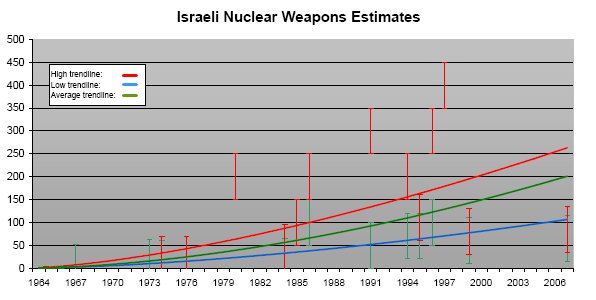
The Israeli nuclear stockpile of nuclear warheads probably lies between 100 and 400.

Estimates for Israel's nuclear weapons stockpile range from 70 to 400 warheads. The actual number is probably closer to the lower estimate. Additional weapons could probably be built from inventories of fissile materials.   http://fas.org/nuke/guide/israel/nuke/

Estimates for Israel’s nuclear weapons stockpile range from 70 to 400 warheads. The actual number is probably closer to the lower estimate. Additional weapons could probably be built from inventories of fissile materials.
http://fas.org/nuke/guide/israel/nuke/

“Infinite” is of a lower order than “boundless”

May 23, 2015

In common usage, “boundless” is often used as a synonym for “infinite”. But of course the two words represent two quite different properties and, I think, are unnecessarily conflated: to the detriment of both language and understanding. I generally assume “infinite” to apply to quantifiable or countable (i.e capable of being counted) things, whereas I take  “boundless” to apply to both qualitative concepts and “countable” things.

“Infinite” is thus of a lower order than “boundless” since it can be applied only to the subset of “countable” things in the set of all things.

The infinite” is patently impossible since the application of the definite article can only apply to the finite. Of course, “the Infinite” is often used to describe “the divine” which only serves to illustrate the paradox inherent in divinity.

So I sometimes find the use of “infinite” as an adjective a little grating. A specific number is not “countable”, it is itself the “count”. So I find the use of “infinite numbers” or “infinite sets” somewhat misleading. Each and every number or set of numbers is – and has to be – finite. It is only the number of terms in the set which may be infinite. Each set once specified is fixed and distinct from any other set. It may contain an infinite number of terms but the set is finite. You could also say that such a set “extends to infinity” or that the set is “boundless”. The number of such sets can also be said to be infinite or boundless.

The distinction between boundless (or endless) and infinite is of no great significance except when the two properties need to be distinguished. For example, the Koch snowflake is an example of a set of lines of increasing length being drawn within a bounded space. It is only the length of the line – being quantifiable – which tends to the infinite with an infinite number of iterations. Note that every iteration only produces a line of finite length but the number of terms in the set is infinite.

Koch's snowflake

Koch’s snowflake – 4 iterations

The Koch curve has an tends to an infinite length because the total length of the curve increases by one third with each iteration. Each iteration creates four times as many line segments as in the previous iteration, with the length of each one being one-third the length of the segments in the previous stage. Hence the length of the curve after n iterations will be (4/3)n times the original triangle perimeter, which is unbounded as n tends to infinity.

I am told that the universe is expanding and may be infinite but bounded. Or it may be infinite and boundless. Or it may be finite and bounded. Whether the universe is infinite is a different question to whether it is bounded. In fact the term “infinite” can only be applied to some quantifiable property of the Universe (its mass, its diameter, its density, the number of stars or galaxies it contains …), whereas its boundedness can be applied to any qualitative or quantitative property. In one sense the universe where we assume that the fundamental laws of nature apply everywhere must be bounded – if nothing else – at least by the laws of nature that we discern.

Currently the thinking regarding the shape of the universe is:

NASA:

  • If space has negative curvature, there is insufficient mass to cause the expansion of the universe to stop. In such a case, the universe has no bounds, and will expand forever. This is called an open universe.
  • If space has no curvature (i.e, it is flat), there is exactly enough mass to cause the expansion to stop, but only after an infinite amount of time. Thus, the universe has no bounds and will also expand forever, but with the rate of expansion gradually approaching zero after an infinite amount of time. This is termed a flat universe or a Euclidian universe (because the usual geometry of non-curved surfaces that we learn in high school is called Euclidian geometry).
  • If space has positive curvature, there is more than enough mass to stop the present expansion of the universe. The universe in this case is not infinite, but it has no end (just as the area on the surface of a sphere is not infinite but there is no point on the sphere that could be called the “end”). The expansion will eventually stop and turn into a contraction. Thus, at some point in the future the galaxies will stop receding from each other and begin approaching each other as the universe collapses on itself. This is called a closed universe.

A universe with some infinite property in a bounded space only begs the question as to what lies in the space beyond the bounds. It also occurs to me that an endlessly expanding universe has to first assume that empty space – which should contain nothing – must actually contain the property of distance. That too is a bound, for if space did not even contain the property of distance, any expansion would be undefined. (And what does distance mean between two points in truly empty space?).

Imagination can be boundless – rather than infinite – and can even extend beyond the bounds of what we can perceive. In reality even our imaginations are often bounded by the limitations of our modes of expression of language and music and painting. Our emotions can be said to be boundless though they too are bounded by physiological limits.

A bounded universe of boundless infinities it would seem, rather than one of infinite infinities, and certainly not one of infinite boundlessnesses.

Stockholm city to provide priority for social services for returning ISIS murderers

May 22, 2015

Even if one didn’t want to accept the case for capital punishment the least that could be contemplated for ISIS murderers would be a chemical castration and incarceration for ever, with an exit only via an assisted suicide. Neither the world nor the human race have any benefit from any ISIS murderers continuing to exist or to have any off-spring. I do have some qualms with capital punishment but these all vanish when confronted by barbarous murderers such as these. Not for “revenge” but because they have nothing positive to contribute and neither do their genetic offspring. They are a contaminating virus which kills the sapience in homo sapiens.

But the Red/Green/Pink (Social Democrats + Environmental party + Feminist party) majority in the Social Services Committee of Stockholm city have now approved and adopted a sanctimonious and monstrous strategy for rewarding any ISIS terrorists of Swedish nationality (and there are many) who return. They and their families are to get adequate support by getting a priority for handouts, housing and jobs.

The same committee, in its wisdom, also provides financial support to Swedish Muslim organisations such as the Islamic Association of Sweden which just happens to be the Swedish “branch” of the Muslim Brotherhood.

It is sanctimonious do-gooding gone mad.

The world may someday be destroyed by an asteroid impact or a super-volcano, but the greater risk is that the human race will degenerate into something barbarous because of the behaviour of naive, sanctimonious, well-meaning, self-righteous, politically-correct do-gooders.

Metro:

When the red-green-pink majority of Stockholm’s social services committee on Tuesday adopted a new strategy to counter violent extremism the criticism was not long in coming. The strategy, which proposes that people who want to leave extremist groups or return from fighting abroad should be helped with sustenance, employment and housing, is being attacked for providing the “cream” for criminals, and because it does not give any concrete proposals on how people should de-radicalised-

“I think that is extremely naive and completely lacking any realization that that under Swedish law these people are serious criminals. They have committed genocide, and it is one of the worst crimes one can commit. They should be prosecuted and put in prison” says Lotta Edholm (FP), opposition member of the City Council of Stockholm to Metro.

The City of Stockholm has a system for social preference, where people with strong medical or social needs can be given priority in the housing queue. According to Lotta Edholm, the new strategy will lead to, for example, the returning ISIS murderers getting priority in Stockholm’s housing queue.

“The strategy contains a lot of fuzz and the majority probably mean well. But if this strategy means anything it must mean that these IS-murderers should get a social priority. It’s so stupid”, says Lotta Edholm.

Stupid is an understatement.

Per Gudmundson on his blog has this picture uploaded by a barbarian, “Abu Ikrema”,  from Stockholm who writes ” It is impossible to describe the joy one feels….”

The new social strategy will apply to people like him.

The fall of Ramadi: Is it “very serious” or just a “tactical setback”?

May 22, 2015

What is clear is that 2,500 soldiers of the Iraqi “army” entrenched in Ramadi ran away when faced by 200 ISIS fighters. They left their heavy weapons behind. They did not even make any sustained effort to evacuate the city.They left the civilian population to flee as best they could. Today there are reports that virtually all those left behind have been slaughtered by ISIS.

But the spin doctors are in full flow. The Iraqi forces were not driven out. They drove away – of their own free will.

They were just tired of being in Ramadi.

BloombergObama Dismisses Fall of Ramadi in Iraq as ‘Tactical Setback’

The fall of the Iraqi city of Ramadi to Islamic State was only a “tactical setback” and not a sign the U.S. and its allies are failing in the fight against extremists, President Barack Obama said in an interview published Thursday in the Atlantic magazine.

“I don’t think we’re losing,” Obama said in the interview conducted by Jeffrey Goldberg Tuesday at the White House. “There’s no doubt there was a tactical setback, although Ramadi had been vulnerable for a very long time, primarily because these are not Iraqi security forces that we have trained or reinforced.”

Nothing to worry about then. Obama the brave has all under control.

CNNU.S. calls fall of Ramadi ‘very serious’

A senior State Department official acknowledged Wednesday that ISIS’s seizure of Ramadi, Iraq, over the weekend was major blow in the fight against the terror organization.

His comments came, however, on the very same day that the Chairman of the Joint Chief Staffs Gen. Martin Dempsey insisted Iraqi forces chose on their own to leave.

“The ISF (Iraqi Security Forces) was not driven out of Ramadi. They drove out of Ramadi,” he told reporters while on a trip to Brussels.

Just as with Tikrit, Obama will do little beyond making token gestures about retaking Ramadi. He is waiting for the Iran -backed Shiite cavalry to come riding in to redress the situation