Earth has too many failed species and 30% need to go extinct

May 1, 2015

There is a biodiversity myth that “more species” is better than “fewer species”. Even when the species are failed or useless species. The myth counts the 5 mass extinctions of the past as “bad events”, even though many current species (including humans) could not have evolved without the mass extinctions creating the space for new species. Every mass extinction has provided a cleansing (though not always effective) process for removing the failures of evolution.

The alarmist brigade are publicising a paper which claims that 1 in 6 species will go extinct due to global warming. (I note that the paper refers to global warming but all the publicity quotes “climate change”. What if the climate change was a global cooling?) The paper published in Science is a nonsense speculation and the abstract begins “Current predictions of extinction risks from climate change vary widely depending on the specific assumptions and geographic and taxonomic focus of each study.” He then goes on to selectively review the literature and chooses just those papers which support his conclusion. The author, Mark Urban, really has no value to add to anything about the climate and has just used the most “politically correct” opinion which ensures his funding and his publication. He uses “politically correct” assumptions to come to – surprise, surprise! – “politically correct” conclusions. He is a biologist but his “suggestions” about species and species extinction are equally valueless. He concludes that if global temperatures rises by 4ºC then up to 1 in 6 existing species will go extinct.

There are two things wrong with this example of bad science:

  1. Both the magnitude of global warming and the effect of warming are assumed (by the author and the papers he chooses to cite). The argument is circular.
  2. He assumes that the extinction of 1 in 6 species is a “bad thing”, even though there are more species now than ever before.

The sheer number of species in existence today is an indicator of how inefficient the process of evolution is. There are more failed species struggling along today and which need to go extinct, than ever before. It is my thesis that there is an optimum number of interconnected species to suit any given conditions. Evolution does not go for the optimum and because of the ineffectiveness of the process produces a great deal of “rubbish”. It is my contention that the Earth desperately needs another mass extinction to clean out the accumulated and accumulating muck of the “rubbish” of failed species.

Evolution fails in over 99% of its attempts to create species that can survive. The 1%  of species that do and have survived may seem to be perfectly tailored for the prevailing conditions but that is putting the cart before the horse. Evolution has no direction and does not seek excellence. It only throws up a plethora of species where just 1% of those species happen to suit the prevailing conditions.

The “conservation” movement and its blind worship of “biodiversity” borders on the stupid. Failed and useless species are given as much weight (sometimes more weight) than successful and useful species. Failing species are protected and successful species are persecuted. Useful species are hunted and useless species are coddled.
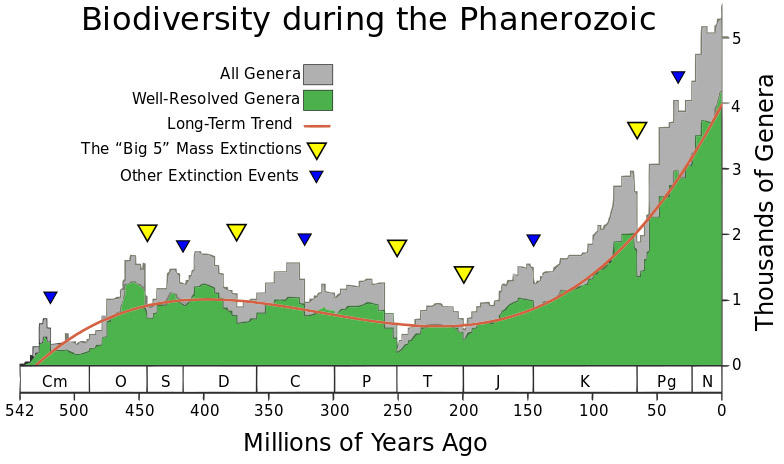
The fossil record shows that biodiversity in the world has been increasing dramatically for 200 million years and is likely to continue. The two mass extinctions in that period (at 201 million and 66 million years ago) slowed the trend only temporarily. Genera are the next taxonomic level up from species and are easier to detect in fossils. The Phanerozoic is the 540-million-year period in which animal life has proliferated. Chart created by and courtesy of University of Chicago paleontologists J. John Sepkoski, Jr. and David M. Raup.

The 3rd and 5th mass extinctions probably reduced the then existing number of species by about 50%. More than 30% of the species alive today (plant and animal) could be considered failed species – where a “failed species” is one which cannot cope with current change, or provides no benefit to any other species, or is in an evolutionary cul-de-sac. These species need to be allowed to go extinct or – when they are harmful to human or other life – to be terminated.

Plastic in the oceans grossly exaggerated: How the UN spreads bad science

April 30, 2015

It is widely assumed that about 10% of annual plastic production ends up in the oceans. That would mean that about 30 million tonnes end up in our seas every year. But this is just a myth and has been spread by a UN mistake as reported by Nordic Science. The actual number is 2 – 4%. The UN knows it is a mistake but it serves their “political” goals to go slow with any correction. I would go so far as to say that the UN mistake (by a consultant – of course) was quite deliberate. Which advocacy group did that consultant come from – I wonder?

It is tempting to beat our largest drums when fighting pollution. … One of science’s cardinal virtues is accuracy. Despite that, scientists are contributing to the dissemination of numbers with rather nebulous sources.

When ScienceNordic’s Norwegian partner forskning.no recently wrote about new calculations quantifying the plastic debris in the sea, we wondered why the new figures were so much lower than previous findings.

A number of researchers stated that the new calculation methods were the best they had seen to date. So we tried to find out how other scientists had ended up with a much higher figure –ten percent of the world’s plastic output. This was no easy task. The one-tenth figure cropped up ubiquitously, but no one could say what research it was based on. Apparently it didn’t come from research at all.

Some still claim that ten percent of the plastic produced annually ends up in marine environments. In 2013 alone that would equate to 30 million tonnes. This is a staggering amount of plastic for the oceans of the world and the marine life in these seas to cope with.

The latest calculations decrease this share of plastic debris to two to four percent of annual output.

We started searching for the source of the ten-percent figure.

Each reference pointed to another, which in turn referred to another article or paper in an apparent endless chain. Where was the original source?

A UN document for a workshop of international experts on marine debris also referred to a scientific paper. But when we checked that paper there we found no trace of this ten percent estimate.

We contacted the Secretariat of the UN Convention on Biological Diversity, which had commissioned the document from the UN Environment Programme (UNEP). They would not put us in touch with the author of the document, but Jihyun Lee in the Secretariat sent us an e-mail:

“Our consultant quoted the reference in good faith as it was cited in a peer-reviewed paper as being the source of the information. A robust review of this paper by the consultant when he quoted this information could have avoided this mistake. Unfortunately he did not go back to the source reference in this case to double-check the original source.”

The UN document was a draft. The mistake had already been pointed out by a scientist at the workshop and checked out. Jihyun Lee explains that the number will now be deleted from the final report.

But the number had already spread internationally, including to Norway, where the expert on plastics Geir Wing Gabrielsen of the Norwegian Polar Institute quoted it in the media.

“When I read a scientific article or a UN report, I expect the references made to be correct and they should be possible to confirm. It is unfortunate when, as in this case, numbers are impossible to track down,” he writes in an e-mail.

Read the whole article

Forskning.no finally traced the 10% number through many a false citation to a non-peer-reviewed conference presentation by a Professor Richard Thompson of Plymouth University who now admits he had no basis for the number but says it was based on “grey” literature. Which advocacy group did his “respected source” come from?

“ It was from a respected source, it seemed credible and I believed it as did others,” he writes in an e-mail to forskning.no. But he doesn’t answer the question of why he neglected to investigate the reference which the number comes from.

Thompson writes that he relied on grey literature, in other words, information from the authorities, organisations or academics who have not been peer reviewed through formal scientific publications. Typically, this could be a report, a work note or a presentation. 

“On further digging there is no substance to them – they were guesses and I should not have used them. I have not used the quote again,” he writes.

No doubt the consultant and the grey literature were from some advocacy group, such as Greenpeace, who have no qualms about making up information when it suits their purpose. Lies are justified as necessary because their “ends are good”. I note that the UN bureaucracy believe that the end justifies the means and their means include disseminating “grey information” as if it was gospel. It is not so surprising then that the UN IPCC reports on climate are full of highly dubious grey literature.

The UN’s scientific panels are little better than advocacy groups. Accuracy and truth have just become collateral damage in the furthering of their political goals. And the IPCC leads all the rest.

Swedish names in English for pronunciation by an American

April 30, 2015

An American friend was complaining that pronouncing Swedish names correctly was a pain – and he used Göteborg, Göran, Håkan and Norrköping as his “evidence”.

I bet him that I could write all Swedish names phonetically in English such that he would have no choice – even in his deep South drawl – but to pronounce them correctly. We enlisted another friend to be judge. He was – unlike me – a native Swedish speaker whose own name caused some problems for Americans – Jönsson.

I think I won more than a whiskey or two that night.

A few examples below. It seems to be possible also with Hindi words rendered phonetically in English for pronunciation by an American (even one from Boston). And getting someone with a Boston twang to even pronounce English correctly is an achievement in itself.

Swedish Name Rendered phonetically in English
Göteborg Yette-bor-ye
Göran Yo-rahn
Håkan Ho-kahn
Jönsson Yuhn-sson
Norrköping Nor-scher-ping
Östergötland Oester-yert-land
Kjell Schell
Agneta Ahg-nyet-a


UK longevity increasing faster than national statistics forecasts

April 30, 2015

The rule-of-thumb is that average longevity in a developed country increases by about 1 year every 25 (4 years every century). So in the year 2500 an average longevity should be well over 100 years. It has been postulated that that this rate of longevity increase will decrease as we approach some kind of asymptotic “maximum possible” age – variously proposed to be 100, 150 or even 200 years. But it seems that the understanding of how telomeres affect cell aging and cancer is also fast increasing. If medical science develops to the extent that key cells can be encouraged to renew themselves in a controlled manner (by not reducing the telomere tail in a cell’s DNA with every replication) and yet not succumbing to the risk of uncontrolled growth (cancer), then a human longevity of even 500 years  does not seem impossible.

After 2100 the world will be faced with a fertility rate below replenishment levels and one way of mitigating the effects of a declining population will be an increasing longevity and a corresponding increase in the span of the “child-bearing” years (which in turn will correct the fertility decline). The challenge is going to be in arresting the decline of human faculties. If that is achieved it will automatically increase the “productive life span” and balance the critical and currently declining ratio of productive population to supported population.

A new paper in The Lancet suggests that official statistics in the UK are underestimating the rate at which longevity is increasing. 

J.E. Bennett et al. ‘The future of life expectancy and life expectancy inequalities in England and Wales: Bayesian spatial forecasting of population health.’ Lancet, 2015. http://dx.doi.org/10.1016/

Imperial College has put out a press release:

A new study forecasting how life expectancy will change in England and Wales has predicted people will live longer than current estimates.

The researchers say official forecasts underestimate how long people will live in the future, and therefore don’t adequately anticipate the need for additional investments in health and social services and pensions for the elderly.

The new study, published in the Lancet, also predicts that regional inequality in life expectancy will increase, highlighting a need to help deprived districts catch up with affluent areas.

Researchers at Imperial College London developed statistical models using death records, including data on age, sex, and postcode, from 1981 to 2012 to forecast life expectancy at birth for 375 districts in England and Wales.

They predict that life expectancy nationally will increase for men from 79.5 years in 2012 to 85.7 in 2030, and for women from 83.3 in 2012 to 87.6 in 2030. The longevity gap between men and women has been closing for nearly half a century and will continue to get narrower.

The forecasts for 2030 are higher than those by the Office of National Statistics, by 2.4 years for men and 1.0 year for women. …

During my life-time, “middle age” has shifted from 40 years to be now around 50. For my children “middle age” will probably be at around 60.

The MiliBrand & Sturgeon Show

April 29, 2015

The rise of the new M & S.

Could these be the new rulers of the United Kingdom?

Mili-Brand

Ed Miliband savaged for Russell Brand video stunt

Mili-Brand


and Sturgeon

Ed Miliband shakes hands with Nicola Sturgeon at the end of the BBC debate on 16 April 2015

Mili-Sturgeon


Australian “bullying” gave Indonesia no chance to exercise clemency

April 29, 2015

I sometimes felt that Australia’s attitude and rhetoric about the execution of the Bali 9 was going to be counter-productive but generally assumed that governments must have exercised their collective minds and knew what they were doing. I did wonder sometimes why Indonesia was always being painted into a corner with no exit route. I assumed that some quiet diplomacy was ongoing but apparently it was not.

The drug-runners were initially arrested following an Australian police tip-off to their Indonesian counterparts. And when the Australian police sent the tip-off they were very well aware of

  1. Indonesia’s hard-line and death sentences for convicted drug dealers, and
  2. that Australian citizens were the subject of their tip-off.

In fact the chain of event which led to the death penalty and the executions were started by Australia.

But now this from the New Zealand Minister of Internal Affairs suggests that the Australian strategy – if there ever was a strategy – and their rhetoric may not have been very well thought through. They made it almost impossible by their public noise for Indonesia to exercise clemency without also being humiliated.

Stuff: Peter Dunne, the Minister of Internal Affairs, is accusing Australia of “playing international bully” in its handling of Indonesia’s execution of two of the Bali nine.

In his regular newsletter, Dunne Speaks, the MP for Ohariu said Australia seemed more interested in pushing Indonesia around than saving the lives of two of its citizens.

Andrew Chan and Myuran Sukumaran were executed by firing squad early Wednesday morning (NZ time) on drug smuggling charges.

Australia has led international condemnation of the executions, two of a number of foreign nationals killed in Indonesia today, but Dunne turned attention on Australia’s diplomatic efforts.

“While nothing excuses the barbarism of Indonesia’s actions, the various interventions by Australia… all served to make it virtually impossible for Indonesia to get off its high horse with any semblance of dignity,” he wrote.

“From the crass linking of Australian aid after the Boxing Day tsunami to favourable consideration of this case, through to independent commentary in Australia on the eve of the executions that the actions of President Widodo actually showed his political impotence, Australia appeared hell-bent on humiliating Indonesia into submission, rather than saving the lives of its two citizens.”

Dunne said the episode could provide a lesson for New Zealand, with Antony de Malmanche currently on trial on drugs charges in Indonesia.

“We need to be talking quietly to the Indonesians now, letting them know our views, and working with them to see if a reasonable solution can be effected. The process needs to be ongoing, not just left until the last few months.”

Foreign Minister Murray McCully’s office pointed to comments he had made on Wednesday about the executions.

“While we respect Indonesia’s right to set and apply its own laws, and understand the immense harm the country suffers from drug trafficking, we are dismayed that these executions have proceeded in the face of continued appeals from some of Indonesia’s closest friends.”

What did the government of the Philippines do that Australia did not?

The freedom of hypocrisy

April 29, 2015

There is a fundamental human right which needs to be included in the UN Human Rights Convention.

And that is the inalienable human right to be freely hypocritical.

Charlie Hebdo’s cartoons – many in very poor taste – were an “expression of freedom of speech”. In fact very few of Hebdo’s cartoons are actually clever or funny though nearly all are smutty. (And it is their lack of any real intellectual content which makes me think that the PEN award to Charlie Hebdo may be a tribute to the 12 who were killed but it is certainly not for any journalistic excellence).

I must admit that I see no great insult to women generally in exhorting women who are potential customers for weight loss products to be “Beach Body Ready”. Or any insult to mis-shapen men like me in exhortations to get “magnificent abs” so that we can wear – and show off – our Calvin Klein underwear!

But how is it that the very same people who so strenuously defended Charlie Hebdo’s “rights” to publish material seen as insulting by others, now want this – to me rather inoffensive – advertisement to be banned? And banned on the grounds that it is insulting to women and sexist. I don’t much care for the colour of her bikini, and I think that anybody who believes weight loss advertisements is more than a little gullible, but I think the right of Protein World to earn their bread by advertising their products is absolute.

An insult may be meant or not, but it is only perceived in the mind of the receiver. And even when an insult is meant, but it is not perceived to be an insult, then it is no insult.

A Protein World advert displayed in an underground station in London. More than 44,000 people have signed a petition to have the adverts removed.

A Protein World advert displayed at a London Underground station. More than 44,000 people have signed a petition to have the posters removed. Photograph: Catherine Wylie/PA

It is no different in principle to this

or this one

sharpmagazine.com

I suspect that just as with the lunatics who attacked Charlie Hebdo, the fault lies in the minds of those who are irrationally insulted.

Help is often restricted by the ability to receive – be it Nepal or Baltimore

April 28, 2015

The news today about the riots and looting currently ongoing in Baltimore got me to wonder why in 2015 such behaviour is still possible in the US? Even with a black (or more accurately, half-black) President and a black Attorney General (Holder followed by Lynch). One hundred and fifty years after the Civil War, and after over 5 decades of “affirmative action”, why are “African Americans” still at the bottom of all social and economic league tables in the US? Why are they – as a group – being overtaken even by the “new immigrants” from Asia?

Could it be that the efforts to lift the African American community have been misguided, or that the particular measures on offer have not been capable of being received?

Take the situation in Nepal.

There is much international help on offer but much is not getting through because of the limitations on the ability (infrastructure and personnel) to receive it. The current death toll of over 4,000 may turn out eventually to be closer to 10,000 .

Planes arriving in Kathmandu have been slow in being unloaded and then the relief supplies have been stuck on the ground because many of the airport workers have left for their own damaged homes and injured relatives. The airport was never designed to handle this level of traffic. The aftershocks are continuing and everything comes to a halt when one occurs.

Relief and medical teams from India and China remained undeployed for many hours because there was nobody available to direct them where to go. And when the “authority” of who would decide was settled, they had no information as to where the teams could be best deployed. Infrastructure was poor in any case but is now damaged. Highways into the remote areas are blocked. Power and water distribution has been hit hard. Foreign teams arriving in Kathmandu have not had the local support necessary readily available. In fact, just finding the necessary support for the foreign teams (guides, interpreters, vehicles, maps, intelligence) itself has overloaded the few organised resources available. The Nepalese Army is overwhelmed. Many Gurkha villages have been hard hit and the primary concern of some of these Gurkha soldiers is to get to their villages and their relatives.

Even in Kathmandu itself – let alone relief and rescue in remote areas – heavy lifting equipment is limited. Even when available they cannot reach “at least 19” areas of the city because of the narrow lanes which have to be negotiated or because of rubble blocking their access.

It is often underestimated or forgotten that the provision of anything (help or education or technology) – once the will to provide is established – is still restricted by the ability to receive.

I am reminded of the struggles we had with “technology transfer” where the will and readiness to transfer technology was often restricted by the ability to receive and absorb technology. I recall that our efforts to open new factories in rural areas were severely limited by the ability of local villagers to absorb the change from working in a field to working in a factory.

The ability to receive trumps the will to give.


And so it begins! UK writes off its over 75s

April 27, 2015

National health services all over Europe are facing an increase of costs as longevity increases. It is only a matter of time before state health services encourage those considered “too old” to expedite their exit from life and save them from the costly obligations of providing care. The first stage is when some medical services are denied for those considered too old and these initial indicators are already visible. Expensive treatments will be the first to go. I have already posted about prostate cancer treatment being denied to those considered too old (over 70) in some parts of Sweden. Physicians already discourage elderly patients – perhaps unconsciously – from expensive or long treatment as a matter of routine.

And now I read that patients over 75 are going to be encouraged by the UK NHS to start planning their exits. Private health insurance premiums for the elderly are already on the rise. Perhaps the over 75s will be uninsurable soon. Ostensibly it is just to get them to sign a “non-resuscitation” declaration – but it is the start. Next they will be asked to choose their preferred method of assisted dying. The sad part is that this is no longer about providing care or about dying with some semblance of dignity. It is all about saving cost.

And if you ever read about an over 75 who was not resuscitated after suffering complications from an ingrowing toe-nail, you can at least be sure that a great deal of money was saved.

Daily Mail:

Doctors are being told to ask all patients over 75 if they will agree to a ‘do not resuscitate’ order. New NHS guidelines urge GPs to draw up end-of-life plans for over-75s, as well as younger patients suffering from cancer, dementia, heart disease or serious lung conditions.

They are also being told to ask whether the patient wants doctors to try to resuscitate them if their health suddenly deteriorates.

The NHS says the guidance will improve patients’ end-of-life care, but medical professionals say it is ‘blatantly wrong’ and will frighten the elderly into thinking they are being ‘written off’.

In some surgeries, nurses are cold-calling patients over 75 or with long-term conditions and asking them over the phone if they have ‘thought about resuscitation’. 

Non-resuscitation is the new euphemism for assisted death. And it is also only a little further along this road before the assisted death is not even a voluntary choice but is mandated for all who are past a certain age and have the misfortune to be hospitalised. A mandatory death age to follow a mandatory retirement age. Maybe those past the mandatory age of death will not be actively terminated in their own homes but woe betide them if they are ever hospitalised.

Great Himalayan earthquake is still waiting to happen

April 27, 2015

This earthquake in Nepal – devastating as it was – has not released enough of the pent-up strain under the Himalayas. The death toll now exceeds 3,500 and most are due to collapsing buildings.

It would need about 50 such quakes with magnitude 7.9  or one super quake of magnitude 9 to release all the slip built up over centuries. The Indian tectonic plate is being subducted under the Eurasian tectonic plate with the Indian Plate moving North East at about 6 -7 cm per year while the Eurasian Plate is moving Northwards at about 2 cm per year. There is a net 2 – 3 cm of slip to be accumulated – or to be relieved by some form of energy release – every year.

The Great Himalayan Earthquake has still to come. The scale of loss of life and devastation will be magnified greatly if the Great quake is located in the central Himalayas such that the tremors extend into the densely populated Gangetic Plain. The central Himalayas have not seen any large quakes for about 700 years and the pent-up energy is ominous. It is highly unlikely that either in Nepal or in the vulnerable regions of India, that buildings will be sufficiently “earthquake-proofed” to minimise the loss of life (and over 90% of the loss of life is due to the collapse of buildings).

Down to Earth: … It has been hypothesised for long that a large earthquake, called the “great Himalayan earthquake”, can strike anytime, but its time and place cannot be predicted. In many locations in the Himalayan belt there is enough energy stored currently to lead to one.

At a magnitude of 7.9 on the Richter scale, the April 25 earthquake has caused devastation but it is not the anticipated “great Himalayan earthquake”.  This does not qualify as a great earthquake which needs to be of magnitude 8, says Roger Bilham, geologist with the University of Colorado Boulder who studies the seismicity of the Himalayan area. “The earthquake is in a region that is being compressed by18 mm each year,” he says. The amount today’s earthquake slip would have been exactly right to release all this accumulated stress, he adds. His team has identified some areas where the great Himalayan earthquake is anticipated (see image). The question mark shows the area where an earthquake is potentially possible but the magnitude is not known.

himakayan

Anticipated Himalayan Earthquakes

 “This (Nepal earthquake) has unfortunately not come as a surprise. We expected an earthquake of high magnitude in the region between Kathmandu and Pokhara,” says Paul Tapponnier from Nanyang Technological University’s Earth Observatory of Singapore who also studies earthquakes in the area. Tapponnier’s earlier work showed that the quakes in 1255 and 1934 were ground-breaking quakes or when ruptures develop in the earth’s crust and the pent up energy in the earth is released. As the areas west or east of the 1934 Nepal ground rupture do not have records of earthquakes, they are at a greater risk of a major earthquake.

In a paper published just two months ago scientists from the Jawaharlal Nehru Centre for Advanced Scientific Research conclude that “the frontal thrust in central Himalaya may have remained seismically inactive during the last ~700 years. Considering this long elapsed time, a great earthquake may be due in the region”.

The Himalaya has experienced three great earthquakes during the last century—1934 Nepal-Bihar, 1950 Upper Assam, and arguably the 1905 Kangra. Focus here is on the central Himalayan segment between the 1905 and the 1934 ruptures, where previous studies have identified a great earthquake between thirteenth and sixteenth centuries. Historical data suggest damaging earthquakes in A.D. 1255, 1344, 1505, 1803, and 1833, although their sources and magnitudes remain debated. ….. Age data suggest that the last great earthquake in the central Himalaya most likely occurred between A.D. 1259 and 1433. While evidence for this rupture is unmistakable, the stratigraphic clues imply an earlier event, which can most tentatively be placed between A.D. 1050 and 1250. …. Rupture(s) identified in the trench closely correlate with two damaging earthquakes of 1255 and 1344 reported from Nepal. The present study suggests that the frontal thrust in central Himalaya may have remained seismically inactive during the last ~700 years. Considering this long elapsed time, a great earthquake may be due in the region.

Other scientists also estimate that this current quake has dissipated only a very small part of the energy stored under the Himalayas and waiting to be released:

Indian Express:

“We know there is a huge amount of accumulated strain in this area. It is due for a major earthquake, perhaps a series of earthquakes, bigger than 8 on the Richter scale. That is the kind of energy that is estimated to be accumulated there. This was certainly not one of those earthquakes that is probably imminent. In terms of energy release, I would say this would not have released even four or five per cent of the energy that is estimated to be stored there,” said Harsh K Gupta, former director of the Hyderabad-based National Geophysical Research Institute and a former member of the National Disaster Management Authority.

Prof Sankar Kumar Nath of IIT Kharagpur, who has studied seismic activity in the Himalayan region, said the energy released from Saturday’s earthquake “was equivalent to the explosion of about 100mn tonnes of TNT, comparable to the energy in detonation of small nuclear bombs”.

“This earthquake would only be classified as medium in terms of energy released. That area, the 2500-km stretch from the Hindukush region to the end of Arunachal Pradesh, is capable of generating much bigger earthquakes, even nine on Richter scale,” he said.

“If you look at it differently, we are actually lucky that only a 7.9-magnitude earthquake has come. I would be very happy to have a few 7.9-magnitude earthquakes than a 9-magnitude earthquake which would be absolute disaster. The trouble is that in terms of energy release, which is what causes the damage, it would take 40 to 50 earthquakes of magnitude 7.9 to avoid an earthquake of magnitude 9,” he said.