Age discrimination to be tested in Swedish court

March 16, 2015

Age discrimination is endemic in Sweden – that is discrimination on the basis of just age and not because of some attribute or lack of competence. Though it is illegal it is an everyday occurrence. To be labelled a “pensioner” in Sweden is often as an excuse for exclusion and a not so subtle form of insult.

The elderly are noticeably absent in parliament where they are grossly underrepresented. This is, in part, due to the fact that all the political parties are inherently prejudiced against age and have an obsession about youth. It shows up with the party leaders and their entourages as well, where youth – and being seen to be young – is of primary importance. Incompetence and inexperience are tolerated (even encouraged) to satisfy the youth fetish. Competence and experience do not balance the perceived disadvantages of age. The theory being, I suppose, that this attracts young, first time voters. I perceive the incidences of incompetence in government and in political life as increasing. I would go so far as to say that there has been a “dumbing-down” of politics. The proportion of the elderly among the electorate is growing sharply. But so far their electoral strength has not manifested itself in politics or in parliament.

A public transport company, Keolis, has introduced a blanket rule forbidding those over 70 years old from being bus or taxi drivers. This is a ban based entirely on age and not on competence. The Discrimination Ombudsman is taking this to court to see if such a blanket age-based ban is legal.

Swedish radio: The Discrimination Ombudsman has taken the position that the public transport company Keolis is discriminating illegally against the elderly with their ban on people aged 70 or over from driving buses and taxis. For the first time, such a general upper age limit will now be tested in the Labour Court.

Marie Nordström who is handling the case within the office of the Discrimination Ombudsman hopes that this will send a clear signal to employers. “We must become aware of that age itself actually constitutes grounds for discrimination, and that we should not discriminate against older people in employment. We must make effective use of older people’s knowledge and experience to a greater extent than we do today”.

…… Cecilia Jerneheim, Human Resources Manager at Keolis, says that the age limit is not about discrimination, but about road safety. “It is known that with increasing age, hearing, vision and response time are impaired and therefore we have chosen the age of 70. We need to put a limit somewhere and we have chosen 70” says Cecilia Jerneheim.

But whatever the labour court says the attitude of general condescension towards, and the political exclusion of, the elderly will continue in Swedish society for some time yet.

Saudi Arabia, Netanyahu and GOP make unusual bedfellows

March 16, 2015

The nuclear non-proliferation treaty is fundamentally flawed. Establishing a monopoly for some selected countries is unsustainable in the long run. But the opposition of the GOP, Benjamin Netanyahu and now Saudi Arabia to any nuclear deal with Iran makes an unholy alliance against a deal but which is counter-productive. It provides an unusual indication that Barack Obama – by accident rather than by design – is on the right track with his negotiations with Iran. The general expectation of course is that a deal is inevitable. It will be reached (at some time if not now) where Iran will – with certain safeguards – continue the enrichment of uranium for the production of nuclear fuels and the UN sanctions will be lifted. As far as nuclear weapons are concerned, no international treaty can succeed unless all member countries sign up to the same obligations. It cannot be a few reserving special positions for themselves and imposing different obligations on all others. Four of the nine nuclear countries are not signatories to the nuclear non-proliferation treaty.

SIPRI: At the start of 2014 nine states—the United States, Russia, the United Kingdom, France, China, India, Pakistan, Israel and North Korea—possessed approximately 4000 operational nuclear weapons. If all nuclear warheads are counted, these states together possessed a total of approximately 16 300 nuclear weapons (see table 1) compared to 17 270 in early 2013.  

…. all five legally recognized nuclear weapon states—China, France, Russia, the UK and the USA—are either deploying new nuclear weapon delivery systems or have announced programmes to do so. India and Pakistan continue to develop new systems capable of delivering nuclear weapons and are expanding their capacities to produce fissile material for military purposes.

There is an emerging consensus in the expert community that North Korea has produced a small number of nuclear weapons, as distinct from rudimentary nuclear explosive devices.

world nuclear forces 2014

* ‘Deployed’ means warheads placed on missiles or located on bases with operational forces.

Source: SIPRI Yearbook 2014 

The GOP letter to Iran makes for an interesting precedent. It emphasises – again – that the US is now highly polarised  and that the government does not represent a very large section of the country. But the GOP actions (their Iran letter and their invitation to Netanyahu to make a speech) are primarily about opposing Obama and secondly about supporting Netanyahu. The support is for Bibi himself and not for any “socialist Israel” which they – and Netanyahu – fear. (In fact most of the Republican business world would quite welcome the lifting of UN sanctions).

Netanyahu’s opposition to any deal with Iran is not unexpected. Israel is the sole nuclear force in the region and this underpins its existence. Even its massive superiority in conventional forces could not prevail against another country in the region prepared to use nuclear weapons. The deterrence strategy – based on overwhelming superiority – which has served Israel very well would fail against a more “equal” opponent who was more ready to use nuclear force than Israel. “A mad mullah would be more ready to destroy himself while destroying the enemy than a mad rabbi”.

The Saudi Arabia opposition to anything which benefits Iran is the front-line of the Shia – Sunni war. Moreover Saudi has plans to build 16 nuclear plants over the next 20 years. The idea that Iran could produce nuclear fuel while they had to import all theirs is unthinkable. Anything Iran gets is something that Saudi Arabia also must have.

BBC: A senior member of the Saudi royal family has warned that a deal on Iran’s nuclear programme could prompt other regional states to develop atomic fuel. Prince Turki al-Faisal told the BBC that Saudi Arabia would then seek the same right, as would other nations.

Six world powers are negotiating an agreement aimed at limiting Iran’s nuclear activity but not ending it. Critics have argued this would trigger a nuclear arms race in the region spurred on by Saudi-Iran rivalry.

“I’ve always said whatever comes out of these talks, we will want the same,” said the prince, Saudi Arabia’s former intelligence chief. “So if Iran has the ability to enrich uranium to whatever level, it’s not just Saudi Arabia that’s going to ask for that. The whole world will be an open door to go that route without any inhibition, and that’s my main objection to this P5+1 [the six world powers] process.”

…… Riyadh has also signed nuclear co-operation agreements with China, France and Argentina, and intends to construct 16 nuclear power reactors over the next 20 years. ….. 

Government policies shifting to encourage increase of fertility

March 15, 2015

Increasingly countries must now resort to long term and official policies to try and increase their fertility rates. In Japan government policy is all about providing incentives for couples to have more children. In Iran government policy is moving from exhortation to “go forth and multiply” to now the banning of vasectomies and discouraging contraception and abortion. Of course the Iranian measures are drawing much criticism from groups which believe that this is making women into baby-factories! European countries have been addressing this by their immigration policies even if they rarely admit that declining fertility is a problem. I note that addressing the ageing problem is politically acceptable but that admitting a fertility problem is not. Equally, promoting immigration as the combined solution for both fertility and ageing is not electorally attractive. But the reality is that fertility and ageing as potential problems are lowest in those European countries which have permitted significant immigration (UK, Germany, France, Sweden ….).  Over the next 20 years an increasing number of countries globally will have to include policies explicitly to address ageing and the decline in fertility. In European countries where the reaction to immigration is strong, there will inevitably be a move towards more restrictive abortion regulations since attempts to be restrictive on contraception would be futile. It will not have escaped the notice of demographers and policy planners that in Europe there are about 25 abortions for every 100 live births. I can envisage the situation where having a child (and especially a second child) is of such value to a society that it is prioritised over being free to work. A steady increase of incentives in the form of child benefits and tax breaks can be expected.

In Japan, of course the population implosion problem is real and is already under way. The fertility rate is currently at 1.29 (replenishment 2.1) and not only is population declining but the ageing problem is gathering pace. By 2050 population will drop by about 30 million from 127 million today to about 97 million. At the same time the proportion of the population over 65 will increase from about 25% today to about 40%. The impact on the critical ratio of “working population” to “supported population” is even more severe. And so the Japanese government is introducing further policy measures.

japan fertility berlin institut

japan fertility berlin institut

Japan’s fertility rate for decades has continued to decline. The sharp fall in 1966 is attributed to a superstition according to which women born in the year of the Fire Horse will bring grief upon their future husbands (Source: NIPSSR 2006; Schoppa 2008).

BBC: … Local authorities will get government support if they organise speed-dating or other forms of matchmaking, according to a draft policy outlining measures to increase the number of people having children…… 

The government wants to do more than just encourage those early days of romance, though. The draft includes plans to improve access to free nursery care, and for counselling centres to be set up across the country for people undergoing fertility treatment. There’s also a target to boost the number of fathers taking paternity leave immediately after their baby is born to 80% by the year 2020. …

Iran has been aware of their coming fertility problem since the late 1980s but has relied so far on exhortation to try and increase fertility. Last year the Ayatollah Khamenei issued a 14 point plan to improve fertility rate.

Iran has seen its fertility rate reduce from close to 7 children per woman in 1960 to around an implosion level of 1.8 per woman  at the current time. For a stable population the replenishment rate required is 2.1 children per woman. Through the 1980’s Iran ran a free contraception program and the birth rate plummeted. So much so that Iran is facing a coming crisis of population implosion.

The Ayatollah Khamenei has taken notice and issued a 14 point plan to increase the fertility rate.

Iran – Israel total fertility rate Google public data

But now legislation is being introduced and two new bills will ban voluntary vasectomies and be much more restrictive on contraception and abortion. Human rights and lobby groups such as Amnesty are opposing the legislation on the grounds that they would  “entrench discriminatory practices and expose women to health risks”.

I am not so sure that the Iranian legislation is coercive in itself. I think it  is attempting to make having a baby the default rather than not having a baby. Both Japan and Iran have very little immigration which can help their numbers though there are signs that Japanese politicians are  trying to pave the way for some future immigration.

But over the next few decades, an increasing number of countries will have to come to grips with population implosions and ageing.


Putin has not been seen in public for 10 days

March 15, 2015

He has not been seen in public since March 5th and speculation is rife. Being missing for a week-end would be rare but not unknown. Going AWOL for a week would be almost unheard of except for a well-planned holiday announced well in advance. But for a world leader to be “missing” for 10 days would suggest something quite unusual – and rather disturbing. An illness would either have to carry some kind of stigma or leave him unsightly not to have been announced.

  1. He is in Switzerland with his girl friend, gymnast Alina Kabayeva, for the birth of his “love-child”.
  2. He is under arrest after a secret coup by hard-liners who think he is being soft on Ukraine.
  3. He has the flu.
  4. He has bird flu or swine flu.
  5. He is undergoing a face-lift.
  6. He is being held for ransom and negotiations or ongoing over a price for the kidnappers to keep him.
  7. He is dead.

I am not quite sure how much more dangerous or destabilising a Russia without Putin might be. A public meeting with the leader of Kyrgystan is expected on Monday. If that does not happen ……….

The Anthropocene began 400,000 years ago when fire was “controlled”

March 13, 2015

A new paper tries to address when the “age of man” – the Anthropocene – bagan. The authors argue for 1610 when “an unusual drop in atmospheric carbon dioxide and the irreversible exchange of species between the New and Old Worlds” began.

I find this a rather arrogant Eurocentric fantasy which is less than convincing. Animal species – and humans – reached the Americas and Australia and Europe long before that.  The Norsemen took rats over to the Americas 500 years before that. Dog species from India crossed to Australia somehow 10,000 years ago. Darwin did not take wild-life to the Galapagos – they were already there. That the ancient civilizations of Egypt and China and the Mohenjo-Daro Valley were not part of the “Age of Man” seems to me to be just arrogance. That the Greeks or the Romans came before the “Age of Man” borders on stupidity. The Age of Man must begin when the dominance of the species Homo becomes established and sustainable.  While there is no other species which uses tools  as widely as Humans some other species do use tools. But there is no other species at all which can start a fire let alone control it.

Simon L. Lewis, Mark A. Maslin. Defining the Anthropocene. Nature, 2015; 519 (7542): 171 DOI: 10.1038/nature14258

Summary: Time is divided by geologists according to marked shifts in Earth’s state. Recent global environmental changes suggest that Earth may have entered a new human-dominated geological epoch, the Anthropocene. Here we review the historical genesis of the idea and assess anthropogenic signatures in the geological record against the formal requirements for the recognition of a new epoch. The evidence suggests that of the various proposed dates two do appear to conform to the criteria to mark the beginning of the Anthropocene: 1610 and 1964. The formal establishment of an Anthropocene Epoch would mark a fundamental change in the relationship between humans and the Earth system.

The advent and control of fire led – eventually but inevitably –  to the Stone Age transforming into the Bronze Age and the Iron Age. And in due course it has given the Machine Age, the Electrical Age, the Plastics Age and the current Semiconductors Age. All these “Ages” are surely part of the Anthropocene. There is a case to be made for the advent of stone tools defining Man but I think there is a much stronger case to be made for the advent and control of fire being what defines and distinguishes “Man” from all other animals.

Once fire was harnessed, the dominance of Homo Sapiens not just over other species but also over the environment became inevitable. Fire saw humans through the Ice Ages. The Stone Age plus fire gave the Bronze Age. The Bronze Age + fire led to the Iron Age. It was fire in its various avatars (hearths to ovens to smelters, or energy to steam to electricity) which helped transform one Age to the next.

The one single capability which initiated the divergence of humans from all other animals and which has resulted in the inevitable development and domination of modern humans is the control of fire. And that was around 400,000 years ago. The Age of Man began when Homo Erectus learned to produce fire at will and to contain fire in a hearth. I would even speculate that without fire Homo Erectus would not have survived to evolve into Homo Sapiens. Without fire Homo Sapiens would not have thrived through the ice ages or left the tropics to colonise more northern climes.

The Age of Man started long before 1610. Perhaps 1610 is a date of great significance – but that was not the start of the Age of Man. The Anthropocene started with fire 400,000 years ago.


Japan plans over 13GW of new coal fired capacity till 2025

March 12, 2015

The Wall Street Journal reports on Japan’s return to coal fired power generation following the alarmist – and inaccurate – demonisation of nuclear power after the 2011 Tōhoku earthquake and tsunami which caused the Fukushima nuclear plant meltdowns. And it is still worth remembering that while the earthquake and tsunami claimed more than 18,000 lives, the Fukushima plant incident has caused no direct fatalities.

The reality is that the cost of electricity production in a 2011 government estimate put the “cost of coal power in Japan at ¥7.5, or about 6 cents, per kilowatt-hour including construction and operation. The same report put the cost of nuclear power at ¥9 per kwh, gas power at ¥10 per kwh and oil power at ¥19 per kwh”. Seven new large coal plants with a total capacity of 7,260 MW have already been announced and are planned to be commissioned until 2025. And a further 6,000 MW are being currently tendered for.

The same cost structure prevails in India or China or Indonesia or South Africa. Even in Europe without artificial (and pointless) skewing of the market place, meaningless carbon taxes and subsidies for renewable power which are not commercially viable, coal offers the lowest cost of electricity production. The same cost structure would apply also in Australia. In the US coal is only second to gas.

WSJ: Japan is continuing to re-embrace coal to make up for its lack of nuclear energy, with plans for another power station released Thursday bringing the number of new coal-fired plants announced this year to seven.

……….  Kansai Electric Power Co. and Marubeni Corp. informed Akita prefecture on Thursday of their plans to build a new, 1.3-gigawatt coal-fired power station in the northern prefecture of Japan, the two companies said.

If all seven projects including the plant in Akita materialize, they will increase the nation’s coal-power generation by up to 7.26 gigawatts by around 2025. That is equivalent to seven medium-size nuclear reactors.

……. Kansai Electric, based in Osaka, plans to use the Akita project to supply electricity to customers in Tokyo, the only place in Japan where major growth in power demand is expected, a company spokesman said.

The other projects include Chubu Electric Power Co.’s plan to replace an old oil-power station near Nagoya with a 1 gigawatt coal-power station, and a 1.2 gigawatt coal-power station planned byElectric Power Development Co., Osaka Gas Co. and Ube IndustriesLtd. in Yamaguchi prefecture in western Japan.

More projects are likely to be announced as the year goes on. Tokyo Electric Power Co. is holding a tender to build new power stations to replace 6 gigawatts of old oil-power capacity in Tokyo.  ……

The relative cheapness of coal was indicated in a 2011 government report that estimated the cost of coal power in Japan at ¥7.5, or about 6 cents, per kilowatt-hour including construction and operation. The same report put the cost of nuclear power at ¥9 per kwh, gas power at ¥10 per kwh and oil power at ¥19 per kwh.

……… All of Japan’s 48 reactors are offline over safety concerns following the Fukushima nuclear accident, though four of them are expected to come back online later this year.


A total eclipse of the Sun – 20th March, 2015

March 12, 2015

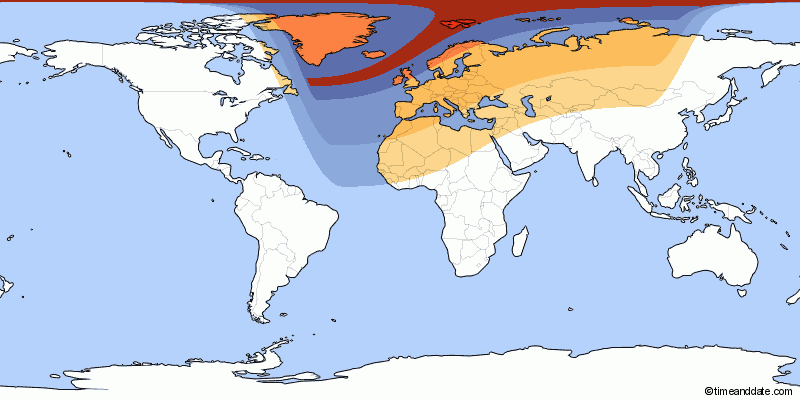
Though it’s a total eclipse only over Svalbard and the Faeroe Islands, it should be a partial but almost complete solar eclipse visible from Scandinavia on Friday March 20th. It should be visible in Europe, northern and eastern Asia and northern and western Africa. The eclipse starts at 07:41 UTC and ends at 11:50 UTC (0841 – 1250 CET).

The red zones will see a complete eclipse and the orange area will see more than 90% of Sun eclipsed by the moon.

total solar eclipse 20th march 2015 time and date.com

total solar eclipse 20th march 2015 timeanddate.com

Now Mars moves into India’s orbit

March 11, 2015

I couldn’t resist the headline. At one time a Mars bar and a pint of beer used to be lunch.

Mars Bar

Business Standard: Chocolate manufacturer Mars International India is all set to invest Rs 1,005 crore (over $160 million) to set up its manufacturing plant in Pune. The company, a wholly owned subsidiary of US-based Mars Inc., today signed an MoU with the Government of Maharashtra to set up a Greenfield project in Khed at Pune.

The manufacturing plant will be the first from in the country, which was so far importing its products Snicker and Galaxy. Mars has been selling its product in India for last four years.

The company said that the investment will generate 200 direct employment opportunity and indirect employment of over 1000 people.


Not much difference between Hillary Clinton and Richard Nixon

March 11, 2015

They didn’t have email in Richard Nixon’s day. And we don’t have much in the way of magnetic tape recordings these days. But otherwise Richard Nixon’s deletion of 18.5 minutes of incriminating recordings is no different to Hillary Clinton’s deletion of some 32,000 emails – self defined as being “private”.

To claim that over 50% of her email during this period when she was secretary of state was private is an insult to intelligence. “Of the 62,320 emails in her account, her office said 30,490 were deemed public business, while the remaining 31,830 were deemed private”. Really!

WashPo (16th June, 2014):

This week in 1972, a conversation took place which would lead to the most famous incident of evidence destruction by a presidential administration. ……. 

On November 17, 1973, the White House informed Federal District Judge John Sirica that the 18 1/2 minute Nixon-Haldeman conversation of June 20, 1972, had been erased. White House Counsel Fred Buzhardt told the Court that he no explanation for the erasure.

Nixon’s Secretary Rose Mary Woods took the blame for the first five minutes of the erasure. She said that she had been transcribing the tape, and when she reached to take a phone call, her foot hit a pedal on the recording machine, inadvertently causing the tape player to “record” over the original tape’s contents. Reporters were called to the White House to watch her perform a re-enactment, and the photos of her performing a tremendous stretch, which she supposedly held for five minutes, were rejected as implausible. Moreover, the particular tape recording machine does not operate the way she had claimed; simply pressing the foot pedal to “record” would not initiate a recording unless the play button was being manually depressed at the very same time.

Chief of Staff Alexander Haig blamed the 18 1/2 minute gap on a “sinister force.” In January 1974, experts who examined the tape reported that were four or five separate erasures. ……..

WashingtonTimes (10th March, 2015):

Former Secretary of State Hillary Rodham Clinton deleted nearly 32,000 emails she deemed private from her time in the Obama administration and refused Tuesday to turn over her personal email server, insisting she “fully complied” with the law and that voters will have to trust her judgment.

Answering questions for the first time about her emails, Mrs. Clinton said she’s turned over to the State Department 55,000 pages of emails she deemed work-related, but said she got rid of the rest last year. She defended her decision to keep control of her emails by using a private account, saying previous secretaries did the same thing, and saying it was more “convenient” for her this way.

“I wanted to use just one device for both personal and work emails instead of two,” she said in a hastily called press conference after she spoke at the U.N. Conference on Women.

Hillary Clinton’s motives and morals in destroying incriminating evidence are not so different to Richard Nixon’s. There is only one reason for a public official (or even any employee in any company) to use private email rather than the organisation or company provided email. And that is to keep something secret from that organisation or company. Deletion of material is even more an explicit admission that the deleted material was incriminating. The “convenience” argument is childish – but I am surprised at how many in the US can be so “gullible” and take such an excuse seriously. I suppose the acolytes will believe whatever they want to believe no matter what the evidence says.

A certain hypocrisy

March 10, 2015

Leslee Udwin’s documentary about the Delhi rapes was shown in Sweden recently and there was much coverage in the media and the talk shows about the misogynist nature of Indian society. Also in India an alleged rapist was lynched last week by a mob which was led by a gang of schoolgirls. The alleged rapist was an immigrant from Bangladesh. The girls are being hailed as heroes in some quarters even though CCTV pictures show the victim apparently willingly accompanying her rapist into and out of a hotel. The “human rights” and “women’s rights” activists are largely silent here. So was the lynching due to misandry and were the schoolgirls leading the mob misandrists?

Today it is reported in Sweden that the rapist of a 13 year old was set free by two successive courts because the girl was well developed for her age. I note also that a certain Julian Assange is sitting holed up in the Ecuadorian Embassy in London to avoid a Swedish arrest warrant for the investigation of an alleged rape by a woman who was willingly sharing his bed. No doubt the Swedish arrest warrant for Assange is largely political (on two counts; first to appease the US and second to appease the feminist lobby). The definition of rape in Sweden is quite wide and many so-called “rapes” would not be considered so in other countries. On the other hand Sweden must be one of a very few countries where sexual intercourse with a minor – no matter what she looked like – would not lead to a rape conviction. And when convictions are reached they often lead to little more than a slap on the wrist. Acquittals are very common. Which leads to the peculiar situation that the bar to what is considered rape is quite low when it comes to prosecution but there are very few convictions by the courts.

(With penalties for rape so low in Sweden I wonder why Assange is so scared of being questioned. Presumably he is more concerned about “rendition” to the US – where he is wanted for the leaks in the Bradley (Chelsea) Manning case – than of any consequences for the alleged rape in the Swedish courts. Sweden does have a history of assisting the CIA in cases of rendition in the past).

But whether in India or in Sweden the hypocrisy is palpable. In India there are only very few and very reluctant prosecutions, but convictions lead to very severe sentences. Once a rape is alleged, the suspect lives precariously. In Sweden, on the other hand, the definition of rape is very wide and the bar to prosecution is very low. The many prosecutions rarely lead to any consequence of substance from the courts.

Aftonbladet: The 27-year old man saw the 13-year-old girl on a bench outside his apartment, invited her in and had sex with her.
He was charged with child rape but was acquitted in two instances.
The decisive factor was the Court’s assessment – that the girl’s body was well developed for her age.
The 27-year-old man was arrested in April last year and charged first with child-rape and secondly, rape. But both Västmanland District Court and the Svea Court of Appeal acquitted the man.
The prosecutor chose not to appeal to the Supreme Court, but the girl’s counsel has taken up the case. The Supreme Court must first grant leave to appeal for the case to be reopened.
“There are very few cases that have so far been taken up”, says the girl’s lawyer Goran Landerdahl.