The freedom not to breed is the coming demographic challenge

December 26, 2014

Alarmism has its downsides. It is always cowardly since it requires actions (and inactions) to be subservient to fear. The actions proposed by Alarmists are very often coercive in the name of the “common good”. But the Alarmists are nearly always wrong.

For over 40 years we have been brain-washed by the Malthusian alarmism of catastrophic population growth, catastrophic resource consumption (peak oil, peak gas, peak food), catastrophic loss of biodiversity and catastrophic environmental change. The population alarmism was expounded in 1968 in Hardin’s “Tragedy of the Commons”. Garrett Hardin was one of the leading lights of the population doom-sayers. His paper became a classic but is a classic example of the arrogance of the Alarmist, overwhelmed by the fear of doom and looking down at the “Commons” from on high. It was the conclusion of the Hardins of this world that “coercion” was both necessary and acceptable to control breeding which led to the coercive sterilisation programmes and the one-child policy.

Freedom To Breed Is Intolerable. To couple the concept of freedom to breed with the belief that everyone born has an equal right to the commons is to lock the world into a tragic course of action.

Unfortunately this is just the course of action that is being pursued by the United Nations. In late 1967, some 30 nations agreed to the following :

The Universal Declaration of Human Rights describes the family as the natural and fundamental unit of society. It follows that any choice and decision with regard to the size of the family must irrevocably rest with the family itself, and cannot be made by anyone else.

It is painful to have to deny categorically the validity of this right; denying it, one feels as uncomfortable as a resident of Salem, Massachusetts, who denied the reality of witches in the 17th century. ……. If we love the truth we must openly deny the validity of the Universal Declaration of Human Rights, even though it is promoted by the United Nations. …….. 

The only way we can preserve and nurture other and more precious freedoms is by relinquishing the freedom to breed, and that very soon. “Freedom is the recognition of necessity”–and it is the role of education to reveal to all the necessity of abandoning the freedom to breed. Only so, can we put an end to this aspect of the tragedy of the commons.

As van Dalen and Henkens put it

…… the Malthusian assertion that the earth’s capacity to support mankind is outpaced by population growth. The main proponent of this view was Hardin (1968), who explained this idea more fully in his classic article,
“Tragedy of the Commons.” ……. it is the central thesis behind Al Gore’s documentary An Inconvenient Truth. Hardin related the tragedy directly to the problem of overpopulation, and his conclusion was therefore quite unequivocal: “Freedom to breed will bring ruin to us all” 

There are numerous political pressure groups in the international arena trying to establish zero or negative population growth in order to prevent a “tragedy of the commons.”

Al Gore like Hardin before him is another example of an arrogant Alarmist.

We are now less than one hundred years away from a general population decline across all countries of the world. It is already a reality in many countries. Development and economic growth and the emancipation of women has achieved far more than forced sterilisation programmes. The Chinese one-child policy has only anticipated by a few years what development would have achieved anyway.

Japan’s population will be down to less than 90 million in 2060 compared to the 128 million today. The replacement fertility rate is 2.1 births/woman in industrialised countries and about 2.3 -2.4 in countries with higher mortality rates. Already (2014) more than half the world’s population has fertility rates below the replacement level. Europe as a whole has a fertility rate of less than 1.6. So has China. Japan is at 1.4 and Singapore is down at 0.8. More than half the states of India are at below the replacement rates and half are just above but declining fast. Countries which have significant immigration from developing countries initially see a boost to their fertility rates but that tends to be short-lived as immigrants are assimilated and also exhibit the rates applying to the country’s level of development. In parts of Asia, Africa and Latin America where fertility rates are higher than the replacement rate, they are declining fast.

Hardin got it quite wrong. As with all Alarmist memes, he was more than just a little condescending of the “Commons” but his worst mistake was allowing his fear to exclude common sense. The freedom to breed is no guarantee that any breeding – let alone uncontrolled breeding – will occur. In fact, it is the freedom not to breed which could make humanity extinct.

Many countries are now seeing population declines in rural areas which are significant enough to affect local tax revenues and cause the deterioration of infrastructure and social services. All over Europe, rural areas see growing needs for health and social services for the elderly and declining demands for children’s services. Skilled craftsmen leave because the client-base is declining. The public sector in rural areas is tending towards being both underfunded due to the loss of tax revenues and over-staffed (and mis-matched) for the declining and ageing population. It is not that planners are not aware of the challenges.

The reality is that fertility is reducing (and subsequently population is peaking), not for lack of resources but because of new technologies and the shift of attitudes that they have brought about. The factors well correlated with a decline of fertility are fairly well established, even if the mechanisms by which these factors affect attitude are not certain. Some of the clearest factors – where many are interlinked – are:

  1. the availability of contraception,
  2. the emancipation of women,
  3. women being an integral part of the labour market,
  4. economic development (GDP)
  5. the decline of infant mortality,
  6. the decline of mortality rates and the increase of longevity
  7. the availability of TV
  8. the availability of safe abortion procedures

Some of the changes of attitude which can also be observed are of couples marrying later (or not marrying), of women having children later and a social acceptance of being childless. It is the spread of the ability and of the freedom not to breed which dominates fertility rate decline.

While we can observe the decline of fertility rates all across the world, we have no clear notion of how fertility rates can be increased. Many countries have tried but few – if any – have succeeded in increasing fertility rates. Russia has tried many times and failed.

In 1944, as Russians were being ground up in the war against Germany, Josef Stalin created the “Motherhood Medal” for women who bore six children. …….. In 1955, Nikita Khrushchev surveyed the nascent Western overpopulation mania and declared it a “cannibalistic theory” invented by “bourgeois ideology.” ……….

None of it worked, then or now. The Soviet Union’s fertility rate—that’s the average number of children a woman bears during her lifetime—declined throughout the ’50s, ’60s, and ’70s. The only brief period of increase came during the late 1980s. And then it resumed decline.

Putin’s initiatives haven’t fared any better. The Russian government declared demographic victory in 2012 because there was an increase in the crude number of births. “The demographic programs enacted in the past decade are, thank God, working,” Putin said. But most demographers believe this is a statistical ghost—the slight spike in fertility rates during the late ’80s created a relatively fat cohort of women now in their prime childbearing years. So while the number of births has increased thanks to the size of this cohort, Russia’s total fertility rate has remained very low. The CIA World FactBook puts it at 1.61.

Singapore, Spain, Japan and South Korea have all instituted programmes to increase fertility rates but – at best – they have had limited and only temporary success.

Where fertility is increasing, it is often a result of delayed childbearing caused by a long-term shift in childbearing patterns or by marriages delayed by an unfavorable economy. In Sweden, the peak age group of childbearing for women is now 30 to 34, up from 25 to 29 in 2001. In Russia, childbearing below age 25 dropped sharply after 1990 so that women ages 25 to 29 are just as likely to have a birth as those ages 20 to 24. A similar pattern has emerged in Ukraine. …… 

Many governments have moved to address the problem of low fertility and extreme societal aging. In Russia, couples can receive about $9,000, a huge sum, for a second or subsequent child. Child payments are lower in Ukraine, but are still significant. Singapore has introduced beneficial tax packages and lengthened government-subsidized maternity leave from 12 to 16 weeks. Spain introduced a 2,500 Euro payment for each birth. Other countries debate ways to encourage childbearing, without reaching a consensus. In Japan, there has been much discussion in government and the media on steps that might be taken but little has actually been done. The very slight rise in births from 2007 to 2008, heralded in the press, was almost entirely due to births to non-Japanese resident in the country.

Iran has shifted from promoting birth control to promoting more children. Ayatollah Khamenei has implemented a 14 point plan to avoid a population implosion but the fertility rate is still stubbornly declining.

Iran has seen its fertility rate reduce from close to 7 children per woman in 1960 to around an implosion level of 1.8 per woman  at the current time. …. Through the 1980’s Iran ran a free contraception program and the birth rate plummeted. So much so that Iran is facing a coming crisis of population implosion. The Ayatollah Khamenei has taken notice and issued a 14 point plan to increase the fertility rate.

The fertility increase programmes around the world generally offer various forms of financial incentives – by way of grants or tax breaks or subsidies – for additional children, but the declining trends have not been arrested.

By 2100 the world population will be between 10 and 11 billion and a fertility rate of -perhaps – about 1.9. To remain at such a level is unsustainable of course, but the real question is what are the behavioural forces which could increase fertility rate. Certainly financial incentives will help but their effect seems weak. An Alarmist of the 22nd century would no doubt suggest coercive and compulsory artificial insemination and ban abortions for convenience. But parents resentful of children they are forced to have seems counter-productive. Better no child than an unwanted child. The social engineering needed to ensure that sufficient breeding takes place – but not too much – will be the challenge of the 21st century.

Maybe it will happen naturally. No doubt children will be given higher value when they are in short supply. But I suspect that behavioural change, leading to the desire to have more children, will only come when there is both an elevation of status and of the financial condition of the mother. I can imagine a time where the social accolades and real benefits for having children are more than sufficient to outweigh the perceived disadvantages. But a woman’s career is also linked to fertility rate and there is an obvious trade-off between caring for a number of children and a woman’s working career. An increase of fertility may be necessarily connected to a reduction of time spent on the labour market. Abortions for convenience may come to be impacted more by social acceptance and social pressures than by any religious or moral considerations. Having children may afford social prestige.

The countries of the former Soviet Union maintain the highest rate of abortions in the world. In 2001, 1.31 million children were born in Russia, while 2.11 million abortions were performed – 62% of all conceptions. Currently about 25% of all conceptions worldwide are aborted. In Japan, the overall abortion rate dropped from 26% to 22% of all conceptions between 1975 and 1995 but these rates are thought to be under-reported. These numbers are not insignificant since a  dangerously low fertility rate of 1.6 – for example – would increase to 2.1 without the 25% abortion of all conceptions. It is conceivable that abortions will come to be permitted only for serious health issues for the mother or for the foetus.

But the bottom line is that every freedom has a corresponding duty. And so does the freedom to breed. There has to be a perceived duty to breed but not to breed indiscriminately.

US increases outsourcing of its war in Iraq to private mercenaries

December 25, 2014

Mercenaries have been called the second oldest profession in the world. Some claim that they are just a special sub-set of the oldest profession since they sell their bodies and their skills. But the idea that mercenaries are only those fighting under a foreign flag has never really made sense to me. Any volunteer army is essentially a mercenary army using my definition of a mercenary being any one who sells military services.

Mercenaries were in common use by the time of the Romans 2,000 years ago. They were used by Hannibal and even by Alexander. They were in use in the Egypt of 5,000 years ago. We know little of the times earlier than the first civilizations some 6,000 years ago. But it is likely that some form of paid military specialists derived from those individuals who had specialised as hunters. They were probably in use from the time that human societies created the first settlements and where individuals had started specialising. That probably takes us back to times before the first cities and perhaps even to the time of semi-permanent, seasonal settlements (earlier than 12,000 years ago). Hunters became guards and then in due course became specialised soldiers.

From the Auxiliaries of the Romans or the Seljuks a thousand years later, mercenaries have always been around. Gallowglasses and the Irish Wild Geese operated – for pay – all over Europe. The Viking traditions lived on with the Varangians who operated around the Black Sea. The business of soldiering was very lucrative – especially for the survivors. Criminal piracy was converted to the legal and profitable trade of privateering. Europe was filled with military entrepreneurs with mercenary regiments available to the highest bidder. Even the national armies and navies of various countries were available for hire. The Swedish Foreign Legion consisted mainly of Poles, The Turks employed Swedish elite troops and the Swiss Guard took care of the Popes. The Dutch had their Foreign Legion, the British had the Gurkhas and the French had their Foreign Legion in Africa. American pilots flew in the  Lafayette Escadrille and American volunteers joined the Abraham Lincoln Brigade. Chennault’s Flying Tigers were American pilots flying in the Chinese Air Force. The Spanish had their Foreign Legion and the International Brigade fought in Spain.

In the last 50-60 years, the business of soldiering has become an industry in its own right. Mercenaries – of any nationality – are now known as “private contractors” or “defence contractors”. Governments are increasingly outsourcing the business of war. As with all outsourcing, the temporary hiring of military resources minimises the liability and cost that comes with the maintaining of permanent resources. Moreover it adds a layer of deniability when things go wrong and does not deprive the employer of any credit if things go well.

The US has been using private contractors in a big way for some 4 decades now. After all, private contractor presence does not count as “boots on the ground”. The war in Iraq is now being conducted for the US to a large extent by private contractors.

Reuters:

The U.S. government is preparing to boost the number of private contractors in Iraq as part of President Barack Obama’s growing effort to beat back Islamic State militants threatening the Baghdad government, a senior U.S. official said.

How many contractors will deploy to Iraq – beyond the roughly 1,800 now working there for the U.S. State Department – will depend in part, the official said, on how widely dispersed U.S. troops advising Iraqi security forces are, and how far they are from U.S. diplomatic facilities.

Still, the preparations to increase the number of contractors – who can be responsible for everything from security to vehicle repair and food service – underscores Obama’s growing commitment in Iraq. When U.S. troops and diplomats venture into war zones, contractors tend to follow, doing jobs once handled by the military itself. 

“It is certain that there will have to be some number of contractors brought in for additional support,” said the senior U.S. official, speaking on condition of anonymity.

After Islamic State seized large swaths ofIraqi territory and the major city of Mosul in June, Obama ordered U.S. troops back to Iraq. Last month, he authorized roughly doubling the number of troops, who will be in non-combat roles, to 3,100, but is keen not to let the troop commitment grow too much.

There are now about 1,750 U.S. troops in Iraq, and U.S. Defense Secretary Chuck Hagel last week ordered deployment of an additional 1,300.

The U.S. military’s reliance on civilians was on display during Hagel’s trip to Baghdad this month, when he and his delegation were flown over the Iraqi capital in helicopters operated by State Department contractors.

……… the State Department boosted from 39 to 57 the number of personnel protecting the U.S. consulate in Erbil that came under threat from Islamic State forces during its June offensive.

That team is provided by Triple Canopy, part of the Constellis Group conglomerate, which is the State Department’s largest security contractor. Constellis did not respond to a phone call seeking comment.

The presence of contractors in Iraq, particularly private security firms, has been controversial since a series of violent incidents during the U.S. occupation, culminating in the September 2007 killing of 14 unarmed Iraqis by guards from Blackwater security firm.

Three former guards were convicted in October of voluntary manslaughter charges and a fourth of murder in the case, which prompted reforms in U.S. government oversight of contractors. …….. 

MH17: Shot down by Ukrainian, Sukhoi-25, military jet

December 25, 2014

It is looking increasingly likely that MH17 was shot down by a Ukrainian, military, attack plane (a Su-25) using R-60 air-to-air missiles and followed by cannon fire. The Sukhoi 25 may well have been flown by a Captain Voloshin.

Ukrainian Air Force Su-25UB Wikimedia

Ukrainian Air Force Su-25UB Wikimedia

MH17 crashed in eastern Ukraine on July 17. All 298 passengers and crewmembers on board the Boeing 777 were killed. The victims were from 10 nations, while most of the passengers – 193 in total – were from the Netherlands. The second-largest number of casualties, 43, was from Malaysia.

There are two theories about the shooting down of Malaysian Airlines MH17:

  1. that the aircraft was shot down by a BUK ground-to-air missile fired by Russian separatists in Ukraine and perhaps in the mistaken belief that they were shooting at a Ukrainian military transport plane. This is the theory that is favoured by the Ukrainian government, most western countries and by NATO, or
  2. that the aircraft was shot down mistakenly by a Ukrainian miltary jet using an air-to-air missile. This was followed by cannon fire perhaps because the mistake was realised and no survivors could be permitted. This theory is supported by the Russians and the Russian separatists.

The Russian theory was initially ridiculed by the Ukrainians, NATO countries and the western media. But a few weeks ago the Dutch investigators let slip the information that at least one oxygen mask had been deployed and this was much more consistent with a weaker air-to-air missile followed by cannon fire rather than the much more powerful BUK ground-to-air missile. A BUK ground-to-air missile would not have given any time for the oxygen mask to deploy. Moreover a multitude of regular holes were found in the remains of the fuselage. They were too regular to just be shrapnel and their size and regularity were consistent with high velocity cannon fire.

Now the Russian investigation claims that it has evidence from a Ukrainian citizen who witnessed a Ukrainian military Sukhoi 25 take off, before MH17 was shot down, from an airfield in the Ukrainian city of Dnipropetrovsk, fully armed and return without its missiles. The flight was flown by a Captain Voloshin and was armed with R-60 air-to-air missiles. The Ukrainians admit that a Captain Voloshin does exist but claim he did not fly that day.

This is not a truth that the US or NATO countries would like to be revealed. The Dutch investigation is probably under intense pressure to “manage” whatever is published. The Malaysians reeling from the loss of MH370 are also probably being pressured not to make waves. (Incidentally the latest theory about MH370, is now that it was remotely hijacked, was on its way to Diego Garcia and was shot down by US assets.) I note that the information about the oxygen mask deployed on MH17 was kept concealed for a long time and was only revealed by mistake.

I don’t expect that Dutch investigation will exchange information with the Russian investigation.

The Russian Defense Ministry made public radar data indicating that a Ukrainian military jet capable of taking down the airliner with an air-to-air missile was in the vicinity of MH17 at the time of the incident.

MH17 - Su-25 graphic RT news

MH17 – Su-25 graphic RT news

RT reports:

Russia’s Investigative Committee has confirmed the claims by a Ukrainian, who said he witnessed the deployment of a Ukrainian warplane armed with air-to-air missiles on the day the Malaysian Airlines flight MH17 was shot down.

The interview was conducted on Tuesday, spokesman for the committee Vladimir Markin told the media on Wednesday. This followed a report in a Russian newspaper, in which the Ukrainian citizen, who preferred to remain anonymous, voiced his allegations.

The investigators used a polygraph during the interview, which showed no evidence of the witness lying, he added. “The facts were reported by the witness clearly and with no inconsistencies. The investigators lean towards considering them truthful. A polygraph examination confirmed them too,” the official said.

“According to his account, he personally saw the plane piloted by Captain Voloshin armed with R-60 air-to-air missiles,” Markin said. “He added there was no need for such weapons during regular air missions of the Ukrainian Air Forces because the rebel forces had no military aircraft.”

Markin said that the Investigative Committee will continue gathering and analyzing evidence perpetrating to the downing of MH17 and will share the information with the Netherlands-led international probe into the incident, “if they really interested in establishing the truth and send an inquiry.”

The witness is likely to be taken into protective custody in Russia because his life may be threatened, Markin said.

The Ukrainian Security Service confirmed on Wednesday that a Captain Voloshin does serve as a military pilot in the country’s armed services. But it said he didn’t fly any missions on the day the Malaysian Airlines flight was shot down.

Aliud orbita et hoc anno

December 23, 2014

Another orbit, another year.

Since the Earth – recognisable as a condensed planet – started rotating around the Sun, there have been an estimated 4.54 ± 0.05 billion rotations (4.54 × 10⁹ ± 1% revolutions). From the time humans – recognisable as modern humans – walked the earth, there have been over 200,000 revolutions. The number 2015 is measured from an arbitrary and a rather meaningless point in time and – for the SUN or the Earth – has no significance whatever. It is just a label for the coming year.

In any event the lucky number for “2015”  is 8.

Sol et manet invictus. (And the Sun remains invincible).

sol invictus 2014


Have a wonderful year!

Decline of Indian fertility rates is accelerating but some worrying demographics

December 23, 2014

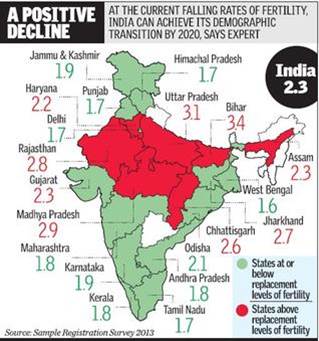
Just over a year ago the average fertility rate in India was 2.5 (where the replenishment level is 2.1) and over half the country was at levels below 2.1. With corresponding declines in infant mortality the projections were for population to reach a peak between 2040 and 2050 and to decline slowly thereafter. But new data for 2013 from the Registrar General shows that fertility is declining faster than expected. The average is already down to 2.3. By 2020 the country as a whole will have an average fertility rate below the 2.1 needed for maintaining a constant population (the replenishment rate). However, infant mortality rate has declined slower than expected. India’s population will therefore likely peak closer to 2040 than 2050.

The HinduThe 2013 data for the Sample Registration Survey (SRS), conducted by the Registrar General of India, the country’s official source of birth and death data, was released on Monday.

India Fertility 2013 - graphic The Hindu

India Fertility 2013 – graphic The Hindu

The SRS shows that the Total Fertility Rate – the average number of children that will be born to a woman during her lifetime – in eight States has fallen below two children per woman, new official data shows.

Just nine States – all of them in the north and east, except for Gujarat – haven’t yet reached replacements levels of 2.1, below which populations begin to decline. West Bengal now has India’s lowest fertility, with the southern States, Jammu & Kashmir, Punjab and Himachal Pradesh. Among backward States, Odisha too has reduced its fertility to 2.1.

“At 2.3, India is now just 0.2 points away from reaching replacement levels. Fertility is declining rapidly, including among the poor and illiterate. At these rates, India will achieve its demographic transition and reach replacement levels as early as 2020 or 2022,” Dr. P. Arokiasamy, a demographer and Professor at the International Institute for Population Sciences (IIPS), Mumbai, explained to The Hindu.

Some of the demographics are worrying.

  1. The ratio of women to men is low (average 909 women per 1000 men). Haryana, Rajasthan, Punjab and Uttar Pradesh have women /men ratios of less than 900 per 1000. I suspect that it is these states which have the lowest levels of emancipation of women and tend to have the highest fertility rates as well. It is clearly the level of development in the state – and not least the emancipation of women – which impacts the fertility rate.
  2. The shortage of women in urban areas (Delhi – 887/ 1000), is probably also due to the general shift of young males seeking employment from rural to urban areas. I wonder if this is also one of the contributing causes for the higher incidence of rape and sexual harassment in places like Delhi.
  3. Countrywide, the mortality rates for infants and children upto 5 years old is higher for girls than for boys.
  4. Abortion rates for female foetuses are also higher than for male foetuses.

Farage can’t take schoolboy humour

December 23, 2014

Nigel Farage of UKIP is quite amusing at times. As with the Sweden Democrats in Sweden, the little parties have to accept support from many questionable individuals. Junkies, hooligans and general riff-raff keep popping up among their candidates. Both parties have an under-current of racism (more white-supremacy than simple racism). Nigel Farage like Jimmy Åkesson is eloquent, personable and each has some “style”. Both have had difficulty in keeping control of their hooligan element.

Farage has been particularly good at mocking other politicians – especially those who tend to be sanctimonious or self-righteous or take themselves too seriously. One of his apparent strengths has been his “silicon skin” which has been impermeable to the taunts and abuse of his many opponents. But now it seems some schoolboys have managed to penetrate this skin and he seems very riled by what is rather simple, schoolboy humour. He can dish it out but he can’t take much of it.

The lesson that Farage’s opponents have to learn is that the way to penetrate his defences is by sinking low enough to get under his skin. They need to make their taunts against him particularly childish and crude. Being too sophisticated or clever does not work. But he can’t take banana skins and red noses and schoolboy humour. Probably toilet humour or vulgarity would also work.

The Guardian:

Nigel Farage attacks pupils’ Ukip parody app featuring Nicholas Fromage

App developed by sixth-formers at Canterbury Academy allows players to kick immigrants off white cliffs of Dover
Ukik app

Phone App with Fromage kicking immigrants off a cliff Photograph: FonGames

A phone app made by school students and featuring a character called Nicholas Fromage kicking immigrants off the white cliffs of Dover has been criticised by the Ukip leader, Nigel Farage.

Farage claimed the game, developed by a group of sixth-formers from Canterbury Academy, was “risible and pathetic” and that it had “crossed the line”, despite saying he welcomed the opinions of young people.

But the school’s principal, Phil Karnavas, has defended the app, which he says is a bit of fun to celebrate “brilliant, traditional British satire”.

He said: “Never has a British political party offered themselves so easily to satire.

“It’s a bit rich, bearing in mind some of the things the members of Ukip have said, for their leader to say they have crossed the line.

“Mr Farage can’t have it both ways. He cannot expect young people to engage in politics and then criticise what they say when they do.”

The Android app, called Ukik, has been developed by 18-year-olds John Brown, James Dupreez, Fraser Richardson, John Hutchinson and Joe Brown, who work under the name FonGames.

I am looking forward to schoolboy taunts from Ed Miliband and David Cameron.  But Ed is so full of his own worthiness he may have difficulty in getting his humour to be low enough. David Cameron may have a better chance of being able to use slapstick.

Turn and turn again and behold we have time

December 22, 2014

The winter solstice has passed. The longest night is almost over and the days will start getting longer again.

Turn and turn again and behold we have time.

We are surrounded and dominated by cycles. Without periodicity and cycles we would have no concept of time.

Daily cycles, monthly cycles, annual cycles, solar cycles every 11 years, the earth’s precession cycle with a period of 26,000 years, the earth’s axial tilt cycle of about 41,000 years and the Milankovitch cycles of about 100,000 years, are just some of the cycles that surround us.

Whether everything derives from the vibrations within the most fundamental particles and then are manifested by the periodic motion of bodies in our cosmos or whether the motion in the cosmos is the origin of everything else, periodicity and cyclic behaviour is ingrained within us and our world.


Tax free prostitution in Norway – no VAT, no income tax

December 21, 2014

I am not sure if this is a blow for women’s rights or just the consequences of laws only half-thought through or a case of “the law being an ass”. In any event this case does not quite uphold the majesty of the law.

If prostitution income is not subject to income tax because buying sex is a crime, then the proceeds from the sale of stolen property cannot either be subject to income tax. Moreover the selling of stolen goods does not need to attract VAT!!

The LocalA prostitute won a landmark victory against police in an Oslo court on Wednesday, when it ruled that police were wrong to claim taxes for the money she had made selling sex in the Norwegian capital.

Police in August raided an Oslo flat where a woman known as Patricia (34) lived with two other sex workers. They seized 74,000 kroner, much of it in foreign currency. 

They refused to return the money to Patricia, who is from Nigeria, claiming that the money was earned in Norway and should be subject to income tax and VAT (sales tax), according to newspaper VG.

But the court queried whether the state should tax income from prostitution, given that related activity such as pimping and human trafficking are crimes.

I note also that

It also said that it was not proven that Patricia was a tax resident in Norway at the time.

which might make the rest of the case moot.

Is Saudi Arabia prepared to let oil price drop to $20?

December 20, 2014

Saudi Arabia seems to fighting two battles; one against oil shale and one against the Iran-Russia combination. In the long term both are doomed to failure. At best all that Saudi Arabia can hope for is that

  1. the smaller shale oil producers find it uneconomic to continue production, and
  2. Iran and Russia’s oil production is severely curtailed.

But any such result is bound to be temporary. It may force the reduction of investment in shale oil but Russia and Iran will need to produce more to keep their revenues up. It is unlikely to lead to the permanent impairment of oil production from shale or in Iran and Russia. It may allow Saudi Arabia to take control of pricing for a while but the OPEC monopoly has already gone. And the limited monopoly they can win, can only continue as long as oil price stays too low to make it economic for the shale and tar sands alternatives. The reestablished monopoly will only apply as long as oil stays cheap.

It becomes intriguing now as to whether Saudi Arabia has the nerve to allow prices to drop to as low as $20 per barrel and for how long? The long term benefits to Saudi Arabia are not quite so clear for me. Having a monopoly which does not allow prices to rise seems somewhat useless. Certainly their cost of extraction is so low (less than $5 per barrel) that they could continue making profits, but they would need to keep the price low for many years to see off the competition – and the competition would come back if prices rose again.

Anatole Kaletsky considers this question at his Reuters blog:

…… Low oil prices will last long enough for one of two events to happen. The first possibility, the one most traders and analysts seem to expect, is that Saudi Arabia will re-establish OPEC’s monopoly power once it achieves the true geopolitical or economic objectives that spurred it to trigger the slump. The second possibility, one I wrote about two weeks ago, is that the global oil market will move toward normal competitive conditions in which prices are set by the marginal production costs, rather than Saudi or OPEC monopoly power. This may seem like a far-fetched scenario, but it is more or less how the oil market worked for two decades from 1986 to 2004. ….

….. The key question is whether the present price of around $55 will prove closer to the floor or the ceiling of this new range. The history of inflation-adjusted oil prices, deflated by the U.S. Consumer Price Index, offers some intriguing hints. The 40 years since OPEC first flexed its muscles in 1974 can be divided into three distinct periods. From 1974 to 1985, West Texas Intermediate, the U.S. benchmark, fluctuated between $48 and $120 in today’s money. From 1986 to 2004, the price ranged from $21 to $48 (apart from two brief aberrations during the 1998 Russian crisis and the 1991 war in Iraq). And from 2005 until this year, oil has again traded in its 1974 to 1985 range of roughly $50 to $120, apart from two very brief spikes in the 2008-09 financial crisis.

What makes these three periods significant is that the trading range of the past 10 years was very similar to the 1974-85 first decade of OPEC domination, but the 19 years from 1986 to 2004 represented a totally different regime. It seems plausible that the difference between these two regimes can be explained by the breakdown of OPEC power in 1985 and the shift from monopolistic to competitive pricing for the next 20 years, followed by the restoration of monopoly pricing in 2005 as OPEC took advantage of surging Chinese demand. ….

……. There are several reasons to expect a new trading range as low as $20 to $50, as in the period from 1986 to 2004. Technological and environmental pressures are reducing long-term oil demand and threatening to turn much of the high-cost oil outside the Middle East into a “stranded asset” similar to the earth’s vast unwanted coal reserves. Additional pressures for low oil prices in the long term include the possible lifting of sanctions on Iran and Russia and the ending of civil wars in Iraq and Libya, which between them would release additional oil reserves bigger than Saudi Arabia’s on to the world markets.

The U.S. shale revolution is perhaps the strongest argument for a return to competitive pricing instead of the OPEC-dominated monopoly regimes of 1974-85 and 2005-14. Although shale oil is relatively costly, production can be turned on and off much more easily – and cheaply – than from conventional oilfields. This means that shale prospectors should now be the “swing producers” in global oil markets instead of the Saudis. In a truly competitive market, the Saudis and other low-cost producers would always be pumping at maximum output, while shale shuts off when demand is weak and ramps up when demand is strong. This competitive logic suggests that marginal costs of U.S. shale oil, generally estimated at $40 to $50, should in the future be a ceiling for global oil prices, not a floor. …

…… So which of these arguments will prove right: The bearish case for a $20 to $50 trading-range based on competitive market pricing? Or the bullish one for $50 to $120 based on resumed OPEC dominance?

Whether market pressures dominate or whether the cartel reestablishes control, we seem to be in for a long period of prices around $40 – 50 per barrel. At this price bio-diesel would need hefty subsidies to survive. Assuming that gas prices continue their link to oil prices, gas becomes the dominating choice as fuel for power generation. Renewable energy will need even greater subsidies which are already being cut back. Not all of this price reduction will be passed on to the transport industry. The pass through of the price cut will be greater in the US than in Europe or Asia. But any pass through is itself a stimulus for consumer spending.

For the stagnating world economy low oil prices can only be a good thing.

European Court’s ruling on obesity is not as idiotic as it may appear

December 20, 2014

Last week the headlines all reported that the European Court of Justice had made a ruling that obesity could be a disability and they all implied that here was another ruling by learned judges which contradicted common sense.

  1. Obesity IS a DISABILITY, rules highest EU court | Daily Mail
  2. European Court Rules That Obesity Could Be a Disability …
  3. Obesity can be a disability, EU court rules – The Guardian
  4. BBC News – Obesity ‘could be a disability’ – EU courts rule
  5. EU court rules that fatness ‘can constitute a disability’ – The …

That was my first reaction too.

But reading the ruling itself (ECJ press release) shows the logic followed by the Court. I have other objections to the whole concept of “equal rights” granted by a society (where equality is not subordinated to justice and where there are no corresponding duties), but there is no fault in the logic followed here:

  1. The EU directive on discrimination prohibits discrimination “based on religion, belief, disability, age or sexual orientation”.
  2. “The concept of ‘disability’ within the meaning of the directive must be understood as referring to a limitation which results in particular from long-term physical, mental or psychological impairments which in interaction with various barriers may hinder the full and effective participation of the person concerned in professional life on an equal basis with other workers”.
  3. Disability does not specifically refer to obesity.
  4. “…. if, under given circumstances, the obesity of the worker entails a limitation which results in particular from physical, mental or psychological impairments
    which in interaction with various barriers may hinder the full and effective participation of that person in professional life on an equal basis with other workers, and the limitation is a long-term one, such obesity can fall within the concept of ‘disability’ within the meaning of the directive”.
  5. “It is for the national court to determine whether Mr Kaltoft’s obesity falls within the definition of  ‘disability’.”

If obesity causes impairment which is due to a long-term physical, mental or psychological impairment then – by the very definition of disability – it is a disability in the meaning of the discrimination directive. As it must be. In fact, the Court has just stated the obvious since any condition, whether labelled obesity or anything else, if due to long term physical, mental or psychological impairment is a disability.

The onus will be on an obese person – who wishes to be classified as being disabled – to show that the obesity is due to a long-term physical, mental or psychological impairment.

Perfectly rational and unobjectionable – given the definition of disability.