“Undiscovery” is the discovery that something “discovered” was not

October 18, 2014

Some Saturday trivia.

A “discovery” is an observation of something new, something (animal, mineral or abstract) which had not been observed before.

But what is an “undiscovery”?

Something “undiscovered” is “undetected”. It may or may not exist. If it does not exist it is something which is “undiscoverable” and always will be until it exists – if ever. But something which exists may also be “undiscoverable” with available techniques of observation but that is not to say that it will always be “undiscovered”.

With a “discovery” it is always implied that the “discovery” is subject to the limits of observation available at the time of the “discovery”. “Scientific discovery” is very rarely just observations and in these days requires much interpretation of the observations. The interpretation – in turn – is subject to the limits of knowledge and language and philosophy available (where I take mathematics to be another language and concepts of the cosmos or the micro-cosmos as philosophies). A “discovery” is not necessarily for ever. A “discovery” may be of something transient as of a state which exists for a period of time and then does not. A “discovery” could be a false claim or in error, in which case the supposed “discovery” was no discovery after all.

The “discovery” of an error is just another “discovery”.  Does that make the “supposed discovery” an “undiscovery”? When, in 2012,  it was discovered that Sandy Island in the Coral Sea and shown on many maps, did not exist and had not existed, it was described as the “undiscovery of Sandy Island”.

Which begs the question whether the discovery of something thought to exist, but which does not exist, could be an “undiscovery”?

As in the past with the undiscovery of the Sun’s motion around the Earth, or the undiscovery of phlogiston, or the undiscovery of the aether.

And as we are currently discovering, the undiscovery of man-made global warming, the undiscoveries of the catastrophic dinosaur or Neanderthal extinctions and the undiscovery of the ozone hole.

And yet to come is the possible discoveries of the  undiscoveries of the Big Bang, dark matter, dark energy and the graviton.
Poor Panda

October 16, 2014

Found at Kuriositas.

Why the Panda is black and white


Five Mars orbiters observe from cover as Comet Siding Spring approaches Mars

October 16, 2014

Mars is a crowded place these days and is soon to get another, high-speed, transient visitor.

Comet Siding Spring (C/2013 A1) is approaching Mars and will pass within about 87,000 miles (139,500 kilometers) on Sunday 19th October.

Siding Spring’s nucleus will come closest to Mars around 11:27 a.m. PDT (2:27 p.m. EDT), hurtling at about 126,000 mph (56 kilometers per second). This proximity will provide an unprecedented opportunity for researchers to gather data on both the comet and its effect on the Martian atmosphere. 

Siding Spring came from the Oort Cloud, a spherical region of space surrounding our sun and occupying space at a distance between 5,000 and 100,000 astronomical units. It is a giant swarm of icy objects believed to be material left over from the formation of the solar system.

Siding Spring will be the first comet from the Oort Cloud to be studied up close by spacecraft, giving scientists an invaluable opportunity to learn more about the materials, including water and carbon compounds, that existed during the formation of the solar system 4.6 billion years ago.

Currently NASA has three craft in orbit around Mars (Odyssey, MRO and MAVEN), the European Space Agency has MEX and the Indian Space Research Organisation has MOM. In addition there are two active rovers on the surface of Mars; Opportunity and Curiosity. All the orbiters face a small risk of damage – not so much from Comet Siding Spring itself but from its long dust tail.  The rovers are not considered to be at significant risk since they will be protected by the Martian – albeit very thin – atmosphere. They have been moved to positions to observe.

SkyandTelescope: Such a close encounter means the dust tail left in C/2013 A1’s wake might graze Mars’s upper atmosphere. The smallest particles are only about a half millimeter across, but even these could severely damage a spacecraft when striking at 35 miles per second. Scientists predict that the time of greatest danger for the orbiters will occur about 90 minutes after Comet Siding Spring’s closest approach and last about 20 minutes. 

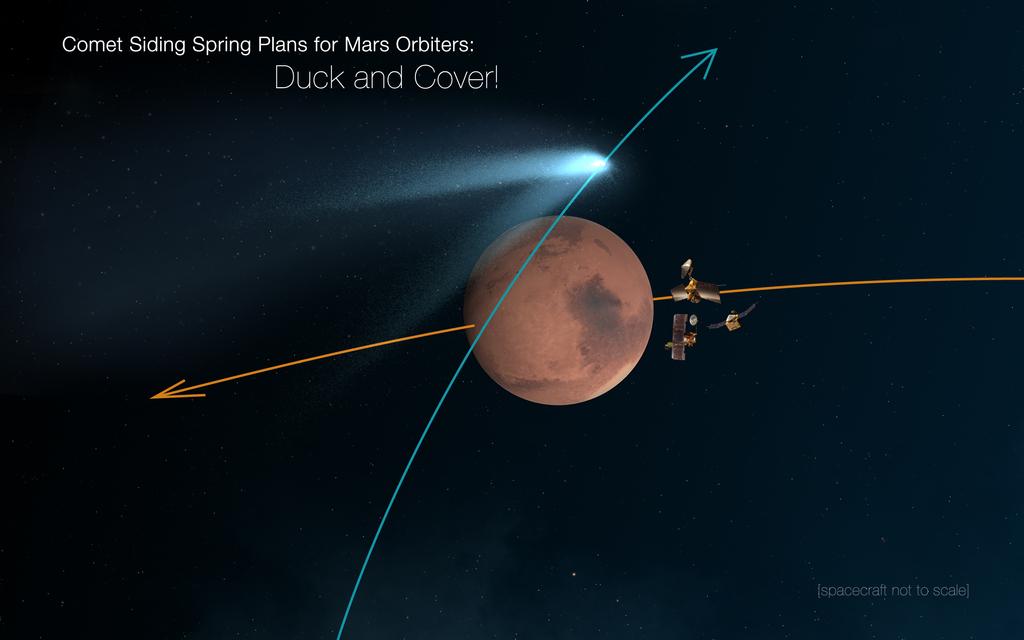
The three NASA Orbiters and ESA’s MEX have re-positioned themselves and will take shelter on the far side of Mars as the comet flies past. The Indian MOM has very little fuel to expend for any major changes to its orbital path and will just try to get as far away from the dust tail as possible and keep its antennae crossed.

To avoid the threat of Siding Spring’s debris, NASA engineers will manipulate the orbiters’ trajectories so that all three will end up on the opposite side of the planet during the flyby. The MRO team executed one maneuver at the beginning of July, with another planned for the end of August. The Mars Odyssey team took similar steps on August 5th, and the MAVEN team will perform a precautionary maneuver shortly after the spacecraft enters orbit around Mars.

Mars Orbiters 'Duck and Cover' for Comet Siding Spring Encounter

Mars Orbiters ‘Duck and Cover’ for Comet Siding Spring Encounter – NASA

MEX is following the same strategy

The European Space Agency is taking similar precautions to protect its Mars Express (MEX) orbiter. MEX has a highly elliptical orbit that would leave it exposed to Siding Spring’s debris longer than MRO or Odyssey. On June 22nd the MEX team altered the orbiter’s track around the planet so that it will be hidden behind Mars for 27 minutes during the comet’s closest approach.

ISRO’s MOM will not be behind Mars when the comet makes its closest approach to the planet. They do not have the fuel to expend and so will just try and be as far away as possible.

Hindustan Times: We have repositioned the Mars Orbiter, as the comet Siding Spring is expected to be close to the Mars on October 19. We have taken the Orbiter to a position farthest from the tail of the comet so that it doesn’t affect the satellite,” AS Kiran Kumar, director, Space Application Centre, Ahmedabad, said.

Fortunately the latest estimates have reduced the risk of collision somewhat:

ESA: Initial estimates gave the possibility that Mars Express might have to contend with a large particle flux – and that several (2? 3?) very high-speed (~56 km/sec!) particles might bash into the spacecraft. Happily, additional observations by ground and space telescopes (including the ESA/NASA Hubble Space Telescope) have allowed initial estimates to be refined and the risk is now understood to be much lower – and perhaps even as low as zero.

ISRO successfully launches 3rd of the 7-satellite IRNSS

October 16, 2014

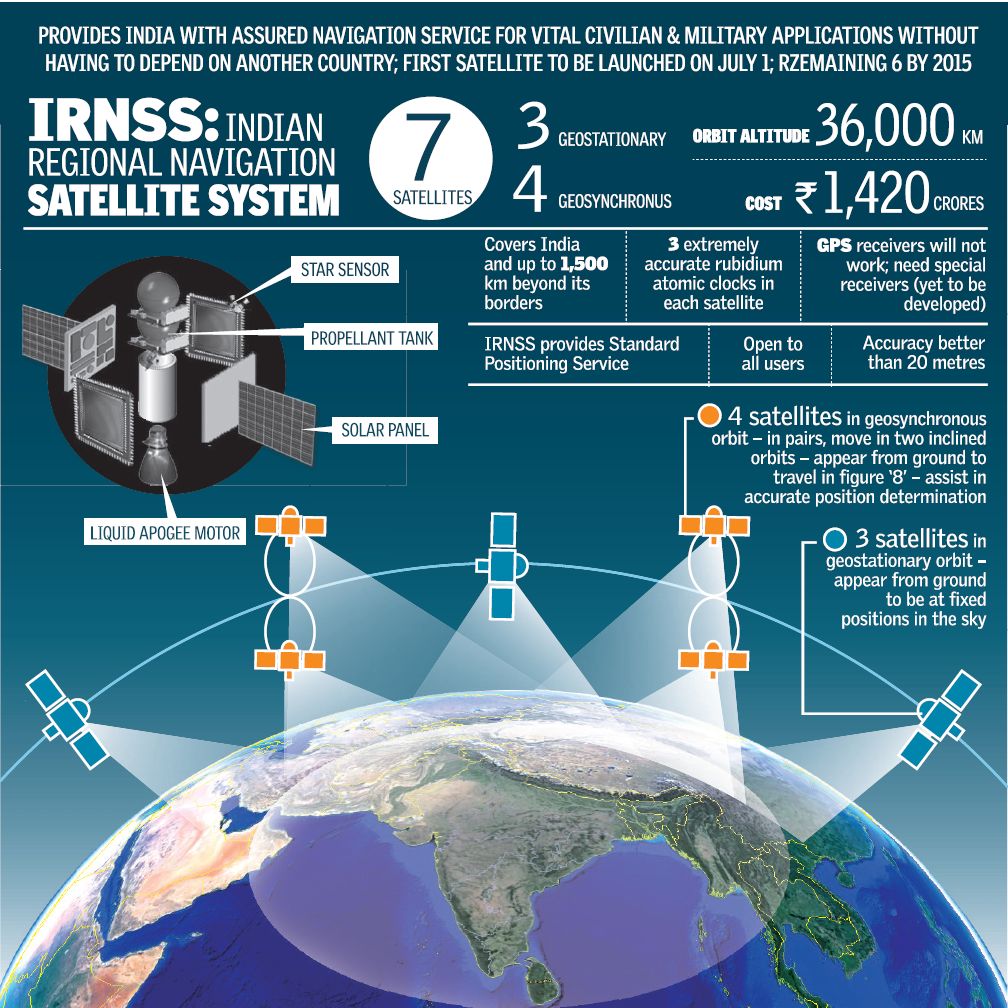
After the successful arrival of the MOM in Mars Orbit, ISRO has taken the more mundane step of putting the 3rd of 7 satellites for India’s satellite navigation system into place.

ISRO’s Polar Satellite Launch Vehicle, PSLV-C26, successfully launched IRNSS-1C, the third satellite in the Indian Regional Navigation Satellite System (IRNSS), in the early morning hours of today (October 16, 2014) at 0132 hours IST from Satish Dhawan Space Centre, Sriharikota. This is the twenty seventh consecutively successful mission of PSLV. The ‘XL’ configuration of PSLV was used for this mission. Previously, the same configuration of the vehicle was successfully used six times.

The Indian Regional Navigation Satellite System (IRNSS) is India’s 7-satellite global positioning system. It is similar to the GPS of the US, Russia’s Glonass , Europe’s Galileo  China’s Beidou and the Japanese Quasi Zenith Satellite System. The IRNSS is autonomous and under the control of the Indian Government. In addition to providing civilian navigation services (Standard Positioning Service – SPS) in a region extending 1500 km beyond the country’s borders, the IRNSS will also provide encrypted military and strategic services (Restricted Services – RS) independent of foreign governments. The positioning accuracy is designed to be 20 m in the primary service area. Each satellite is designed for a life of 10 years.

The IRNSS program received government approval in 2006 and is planned to be fully deployed by the end of 2015. The budgeted cost is 14.2 billion INR (about $240 million) and must count as another example of ISRO’s “frugal engineering”. The cost includes for two stand-by satellites on the ground making nine included in the budget. As a comparison Europe’s Galileo navigational system comprises 27 satellites and is expected to cost about 50 times more at about €10 billion ($13 billion).

IRNSS - ISRO

IRNSS – ISRO

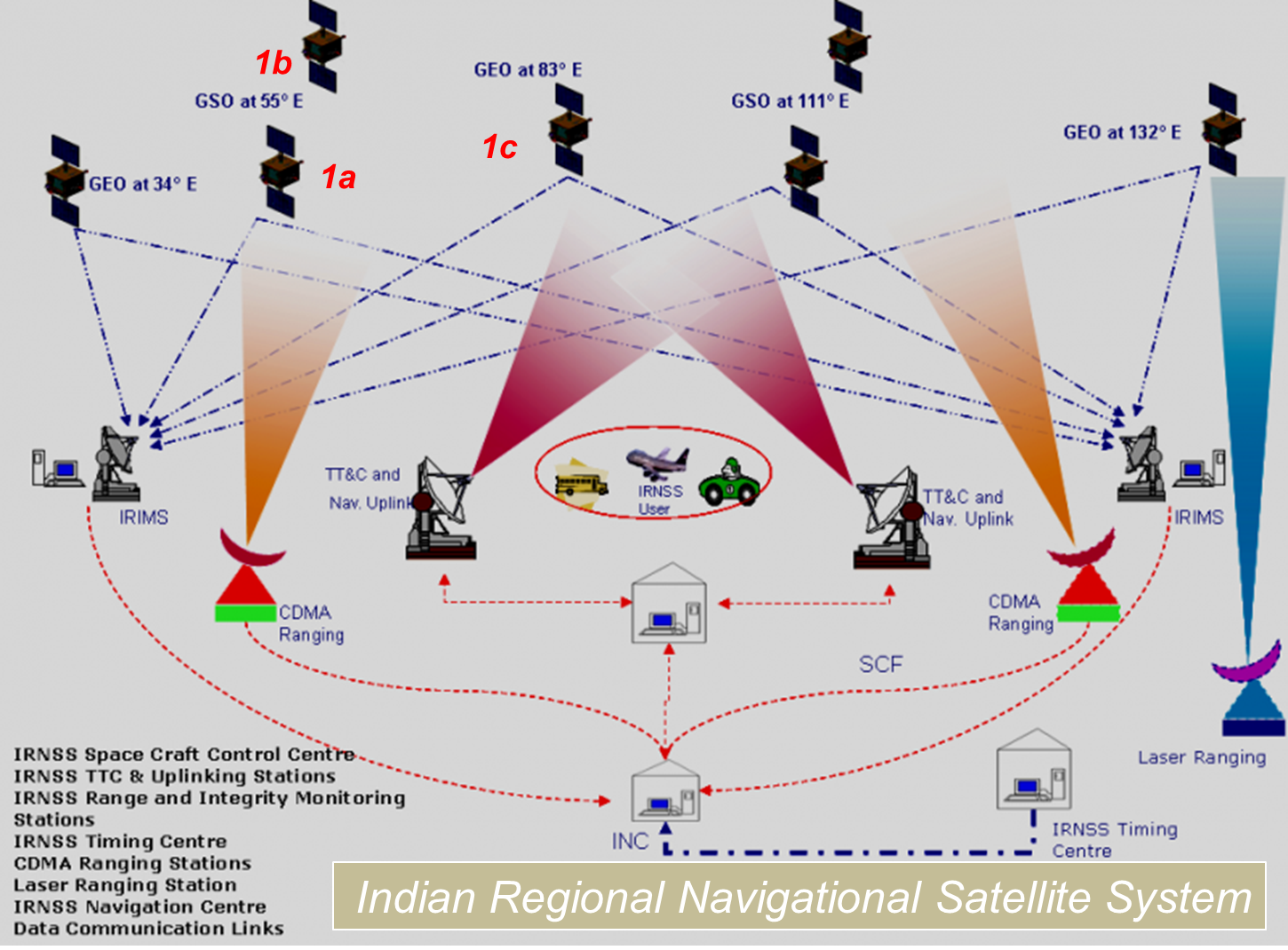
The 7 satellite system consists of 4 satellites as two pairs of geosynchronous satellites and 3 in geostationary orbit. The first two satellites in the series, IRNSS 1a and IRNSS 1b formed the first geosynchronous pair and were launched from Sriharikota on July 1st, 2013 and April 4th this year. respectively. The IRNSS-1c launched this morning is the first geostationary satellite and carries two payloads, one for transmitting navigation service signals to users and another consisting of a C-band transponder to facilitate Cube Retro Reflectors for laser ranging. It is the central satellite of the seven satellite configuration. The satellites launched so far are individually operational but the system will become operational only with the next launch of a geostationary satellite. (The system needs one geosynchronous pair, the central satellite and one more geostationary satellite to reach the threshold conditions to become operational). All seven satellites are planned to be in place and operational by the end of 2015.

IRNSS Architecture - ISRO

IRNSS Architecture – ISRO

NasaSpaceflight:

Based on ISRO’s I-1K satellite bus, each IRNSS satellite has a mass at launch of 1,425 kilograms (3,142 lb). Unfuelled, the spacecraft has a mass of only 600 kilograms (1,323 lb), with the remaining 825 kilograms (1,819 lb) being taken up by propellant for their apogee motors and manoeuvring engines.

The spacecraft are designed for ten years’ operational service. Generating 1.6 kilowatts of power through twin solar arrays, the satellites broadcast L5 and S band navigation signals. C-band transponders and retroreflectors are used for range calibration.

Each satellite is fitted with a single liquid apogee motor producing 440 newtons (99 pounds-force) of thrust. Three-axis control is provided by reaction wheels, magnetorquers and twelve reaction control thrusters.

The apogee motor is tasked with propelling the satellite from its initial deployment orbit into the final geostationary orbit, while the remaining thrusters will be used to manoeuvre and orient the spacecraft once it is in orbit.

IRNSS-1C is the first geostationary satellite in the IRNSS system. Planned for operation at a longitude of 83 degrees East, it will operate at the middle station of the constellation.

Two more geostationary satellites will be added; at longitudes of 34 and 132 degrees, while the remaining four spacecraft will operate in inclined geosynchronous orbits to increase the angle of separation between signals. Two of the inclined satellites are already in orbit; IRNSS-1A and 1B operate at a longitude of 55 degrees East. A second pair will be located at 111 degrees East next year.

The two satellites already in orbit were deployed in July 2013 and April 2014, both riding PSLV rockets to orbit from the Satish Dhawan Space Centre

The PSLV launch vehicle was introduced in 1993 and this is its 28th successful use (27th consecutive successful use). Today’s launch used the PSLV-XL configuration – the most powerful version of the PSLV currently flying – which makes use of six PS0M-XL boosters containing S-12 solid rocket motors. Four of these motors are lit when the rocket leaves its launch pad, with the remaining two lit during the early stages of its ascent.


Sea surface temperature and the 18.6 year lunar nodal cycle

October 15, 2014

There is a growing body of scientific papers (some reported in my post here) which show long period connections between the 18.6 year lunar nodal cycles and sea level, tidal sedimentation, tidal mixing, sea surface temperature, Arctic climate and even drought. The mechanisms by which these influences are transmitted are hypothesised but are not known.

Compared to solar cycles the lunar cycles are not well known:

The lunar nodal cycle is not something that is very well known but it is another celestial cycle which is clearly not to be ignored. Naturally the IPCC takes no notice of solar cycles, planetary cycles or lunar cycles and all these are lumped into what could be considered “natural variability”.

(Sourced from Wikipedia)

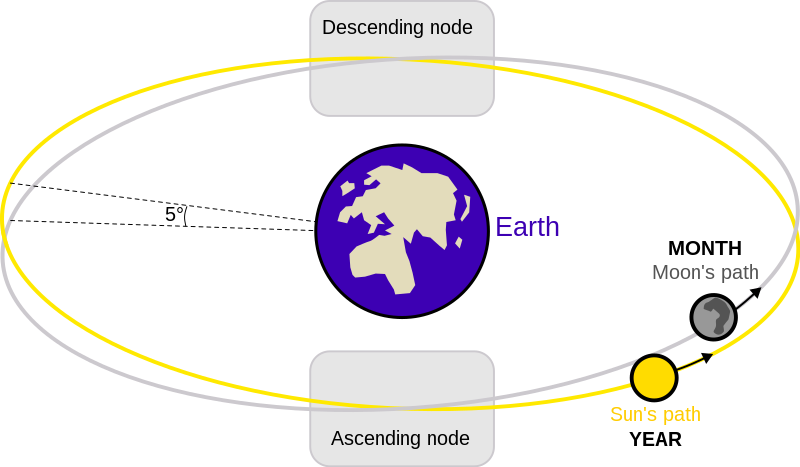
The lunar orbit is inclined by about 5 degrees on the ecliptic. The moon  therefore can lie up to about 5 degrees north or south of the ecliptic. The ecliptic is the plane of the apparent path of the Sun on the celestial sphere, and is coplanar with both the orbit of the Earth around the Sun and the apparent orbit of the Sun around the Earth.

File:Lunar eclipse diagram-en.svg

Lunar eclipse orbital diagram: wikipedia

The lunar nodes precess around the ecliptic, completing a revolution (called a draconitic or nodical period, the period of nutation) in 6793.5 days or 18.5996 years.

The effects of the 18.6 year lunar nodal cycle on climate on tides and geological sediments and on weather and climate have long been of interest (though not apparently for the IPCC).

The lunar nodes and the nodal cycles were known even to ancient astronomy (Greek, Hindu, Tibetan…) and has found a place in both Eastern and Western astrology. Since astrology is not considered “scientific”, suggestions that the lunar nodal cycle has any impact on the earth’s geology and climate are very often treated with ridicule. Yet the undoubted lunar effects on tides and tidal sedimentation and (therefore) geologic events are not disputed. The nodal period also controls when eclipses can occur.

Eclipses occur only near the lunar nodes: Solar eclipses occur when the passage of the Moon through a node coincides with the new moon; lunar eclipses occur when passage coincides with the full moon. A lunar eclipse may occur if there is a full moon within 11° 38′ (Celestial Longitude), of a node, and a solar eclipse may occur if there is a new moon within 17° 25′ of a node.

It is not surprising that the ancient astrologers/astronomers attributed many effects to the lunar nodes and the nodal cycles:

In Hindu astronomy, the ascending node is called Rahu and the descending node is called Ketu. Rahu and Ketu are thus the north and the south lunar nodes. Rahu represents the severed head of an asura, that swallows the sun causing eclipses. Times of day considered to be under the influence of Rahu are considered inauspicious even today in many parts of India (for weddings, starting journeys …..)

A new paper considers the effects of the 18.6 year lunar nodal cycle on Sea Surface Temperature (SST) and the Pacific Decadal Oscillation (PDO).

S. Osafune, S. Masuda and N. Sugiura, Role of the oceanic bridge in linking the 18.6-year modulation of tidal mixing and long-term SST change in the North Pacific, Geophysical Research Letters, DOI: 10.1002/2014GL061737

HockeyShtick reports:

A paper published today in Geophysical Research Letters finds a “significant contribution” of the 18.6 year lunar-tidal cycle to “wintertime sea surface temperatures near the center of action of the Pacific Decadal Oscillation [PDO] in the eastern Pacific,” and that

“This result supports the hypothesis that the 18.6-year tidal cycle influences long-term variability in climate; thus, knowledge of this cycle could contribute towards improving decadal predictions of climate.” [which IPCC climate models do not incorporate]

The approximately 60-year long Pacific Decadal Oscillation [PDO] in-turn profoundly affects global climate and interacts with other ocean and atmospheric oscillations. A very simple climate model based solely upon the sum of the sunspot integral, Pacific Decadal Oscillation [PDO], and Atlantic Multidecadal Oscillation [AMO] explains 96% of climate change over the 20th century: …..


Paper Abstract:The impact of the 18.6-year modulation of tidal mixing on sea surface temperature (SST) in the North Pacific is investigated in a comparative study using an ocean data synthesis system. We show that remote impact through a slow ocean response can make a significant contribution to the observed bidecadal variation in wintertime SST near the center of action of the Pacific Decadal Oscillation in the eastern Pacific. A comparative data synthesis experiment showed that the modified SST variation is amplified by bidecadal variation in the westerly wind. This relationship between SST and wind variations is consistent with an observed air–sea coupled mode in the extratropics, which suggests that a midlatitude air–sea interaction plays an important role in enhancing the climate signal of the 18.6-year modulation. This result supports the hypothesis that the 18.6-year tidal cycle influences long-term variability in climate; thus, knowledge of this cycle could contribute towards improving decadal predictions of climate.

I am of the opinion that climate is predominated by solar effects which are mediated primarily by the oceans over multidecadal periods and only over shorter periods by the atmosphere. And if lunar nodal cycles influence the tidal flows and tidal mixing then they will also influence the climate – also on the decadal scale.

We dance to a celestial music and the moon provides the variations on the climate themes set by the sun.


Turkey is “against” Kurdish separatism much more than it is “against” ISIS

October 14, 2014

I remain of the opinion that Turkish government policy is dominated by being against any Kurdish unity or separatism even if it means that their actions may assist ISIS. A Greater Kurdistan with access to oil wealth is a much greater fear than any new Caliphate. Two reports today only serve to strengthen my perception of Turkey walking the tightrope between NATO membership and an application to join the EU on the one hand, and their reluctance to intervene against ISIS if it helps the Kurds to consolidate their territory and attacks on PKK on Turkish territory on the other.

BBC: Turkish jets bomb Kurdish PKK rebels near Iraq

Turkish F-16 and F-4 warplanes have bombed Kurdish PKK rebel targets near the Iraqi border, as their ceasefire comes under increasing strain. The air strikes on Daglica were in response to PKK shelling of a military outpost, the armed forces said.

Both sides have been observing a truce and it is the first major air raid on the PKK since March 2013.

Kurds are furious at Turkey’s inaction as Islamic State (IS) militants attack the Syrian border town of Kobane. Fighters from the PKK (Kurdistan Workers’ Party) have been aiding Kurdish YPG militia in Kobane and Turkey has refused to help supply its long-standing enemy with weapons or allow Kurdish fighters to enter Syria.

NYT: Turkey Denies Reports of Deal for Use of Its Bases in Fight Against Islamic State

A day after American officials said Turkey had agreed to allow its air bases to be used for operations against the Islamic State, which they described as a deal that represented a breakthrough in tense negotiations, Turkish officials said on Monday that there was no deal yet, and that talks were still underway.

Evidence for man-made global warming has vanished

October 14, 2014

Where is the real evidence of man-made global warming? Where are the signs? Where are the measurements?

The simple fact is that in spite of what computer models might say, without global warming, there is no man-made global warming.

I am more persuaded by evidence than by climate models which have only demonstrated that they do not work. The man-made global warming hypothesis has a number of crucial assumptions which are all proving to be unproven, lacking evidence or just plain wrong.

  1. Global temperature is increasing, and
  2. Increasing carbon dioxide concentration in the atmosphere is due to man-made effects, and
  3. Increasing CO2 concentration does give measurably increasing global temperature, and
  4. Increasing man-made carbon dioxide emissions does give significant and measurable increases in global temperature.

Every one of these assumptions is suspect and- at best – uncertain.

“Global Warming” has warped to be “Climate Change” so that any slightly unusual weather event can be claimed to be man-made. The hypotheses are never falsifiable. But the bottom line remains that all the change can be put down to man-made emissions which increase the heat trapped on earth, which then cause global temperatures to rise and fuel the “climate changes” observed. But all man-made climate change vanishes without man-made global warming to power it.

The signs of global warming were touted as being ice melting, sea level rising, loss of polar wildlife and sundry other secondary catastrophes. The poster-children of the global warming religion were the loss of polar ice, the corresponding rise of sea levels, disappearing islands, and the extinction of polar bears.

Just consider the real evidence.

Antarctic sea ice cover has reached the highest levels ever measured and has reached record levels for each of the last 3 years

NSIDC: This year’s Antarctic sea ice maximum was 1.54 million square kilometers (595,000 square miles) above the 1981 to 2010 average maximum extent, which is nearly four standard deviations above this average. The 2014 ice extent record is 560,000 square kilometers (216,000 square miles) above the previous record ice extent set on October 1, 2013. Each of the last three years (2012, 2013, and 2014) has set new record highs for extent in the Antarctic.

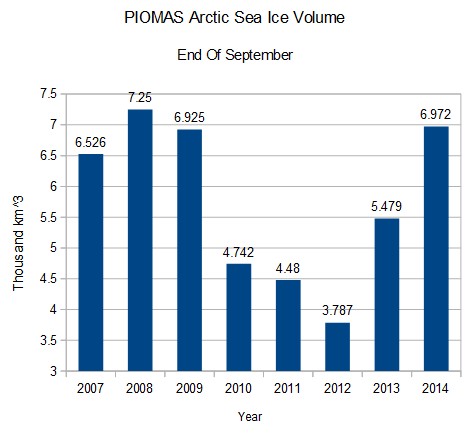
Arctic sea ice cover has recovered from the low of 2012 and is now within the 2SD band of the 1981-2010 average. It is up 84% from 2012 and the trend is upwards.

ScreenHunter_3480 Oct. 09 15.16

The trend for Arctic ice is upwards

Global sea ice cover is unchanged and shows no discernible trend since 1979.

Global temperatures have not risen for 18 years. In recent years there may even be a cooling trend.

Forbes:Remote Sensing Systems(RSS) also compiles data from the satellite instruments, though RSS measures a slightly different range of the lower atmosphere. RSS reports a similar temperature history,available here. In the RSS compilation, we see not just a recent temperature plateau, but actual cooling. Again, the pace of warming throughout the entirety of the record is approximately 1 degree Celsius per century.

In the last 18 years man made carbon emissions have increased by about 70%. Over the same period carbon dioxide concentration in the atmosphere has risen by about 10% and global temperatures have not risen at all. On this data there is no correlation between global temperature and carbon dioxide concentration let alone carbon dioxide emissions.

Polar bear numbers are higher than for 50 years and walrus numbers are very high as well.

Sea level increases are no higher than the long term rise due to coming out of a glacial age. A rise of 2 inches by 2050 is on the cards.

Where is the evidence of man-made global warming?


Juxtaposition: Call for health care strikes in Liberia and in the UK

October 13, 2014

There was a time when societies accepted that certain professions and essential activities and vocations were considered to transcend the right to strike. But even today there are strikes and there are strikes.

There are many heroes in West Africa who in spite of low pay, delayed salaries and a shortage of protective equipment continue to treat the many Ebola patients around them. Ninety-five health workers have so far died from the virus in Liberia.

I am sure that the calls to strike in both Liberia and the UK have their own justifications. It is just that they both come today and it is the juxtaposition of the two strike calls which I find interesting.

Liberia

BBCNurses and medical assistants fighting the Ebola outbreak in Liberia have largely ignored a call to strike over danger money and conditions. Most health workers were working as normal on Monday, the BBC’s Jonathan Paye-Layleh in Monrovia said. A union official said the government had coerced workers to ignore the strike – but the government said it had simply asked them to be reasonable.

Liberia is the country hit hardest by the deadliest ever Ebola outbreak. Health workers are among those most at risk of catching the disease. Ninety-five have died from the virus in Liberia.

The latest outbreak has killed more than 4,000 people in Liberia, Sierra Leone, Guinea and Nigeria since it was identified in March. …….. Liberia’s National Health Workers Association, a union, had called the strike to demand an increase in the monthly risk fee paid to those treating Ebola cases.

It wants workers to be paid a risk fee of $700 (£434) a month. The fee is currently less than $500 a month, on top of basic salaries of between $200 and $300. The association also wants more protective equipment and insurance for workers, and has accused the government of not providing enough protection from the virus.

UK

The GuardianNHS staff are to take further industrial action next month unless ministers agree to give them a 1% pay rise.

Unions whose members are taking part in the first walkout by NHS staff over pay since 1982 will undertake further action in November if the health secretary, Jeremy Hunt, does not meet them for talks and offer more money.

“We are already planning, and will definitely be taking, further industrial action if the government doesn’t put more money on the table and doesn’t talk to us,” said Rachael Maskell, head of health at the Unite union. “There will definitely be more industrial action by NHS staff if Jeremy Hunt doesn’t sit down and talk and make more money available. It’s clear that the government are going to have to find money [to settle] this [dispute].”

The seven unions taking part in Monday’s action were discussing three options for the next stage of their attempts to force the coalition to pay all NHS staff the 1% rise recommended last year by the NHS Pay Review Body but rejected by Hunt.

Union sources said one option could be a repeat of the four-hour walkout by midwives, paramedics, porters and other non-medical staff. Another option would be to escalate that into a full-day stoppage. Or they may opt for different groups of workers taking action at different times over the course of a day.

Diederik Stapel markets himself (anonymously) on Retraction Watch

October 13, 2014

Diedrick Stapel

In June last year it disturbed me that the New York Times was complicit in helping Diedrik Stapel market his “diary” about his transgressions. There is something very unsatisfactory and distasteful when we allow wrong-doers to cash in on their wrong-doing or their notoriety. I had a similar sense of distaste when I read that the Fontys Academy for Creative Industries offered him a job to teach social psychology – almost as a reward for being a failed, but notorius, social psychologist.

Retraction Watch carried a post about the new job. And Diedrik Stapel was shameless enough to show up in the comments (first anonymously) but finally under his own name when he was exposed by Retraction Watch. The comments were all gratuitously self-serving. Perhaps he was carrying out a social experiment?

But this was noticed also by Professor Janet Stemwedel writing in the Scientific American:

You’re not rehabilitated if you keep deceiving

…… But I think a non-negotiable prerequisite for rehabilitation is demonstrating that you really understand how what you did was wrong. This understanding needs to be more than simply recognizing that what you did was technically against the rules. Rather, you need to grasp the harms that your actions did, the harms that may continue as a result of those actions, the harms that may not be quickly or easily repaired. You need to acknowledge those harms, not minimize them or make excuses for your actions that caused the harms. ….

….. Now, there’s no prima facie reason Diederik Stapel might not be able to make a productive contribution to a discussion about Diederik Stapel. However, Diederik Stapel was posting his comments not as Diederik Stapel but as “Paul”.

I hope it is obvious why posting comments that are supportive of yourself while making it appear that this support is coming from someone else is deceptive. Moreover, the comments seem to suggest that Stapel is not really fully responsible for the frauds he committed.

“Paul” writes:

Help! Let’s not change anything. Science is a flawless institution. Yes. And only the past two days I read about medical scientists who tampered with data to please the firm that sponsored their work and about the start of a new investigation into the work of a psychologist who produced data “too good to be true.” Mistakes abound. On a daily basis. Sure, there is nothing to reform here. Science works just fine. I think it is time for the “Men in Black” to move in to start an outside-invesigation of science and academia. The Stapel case and other, similar cases teach us that scientists themselves are able to clean-up their act.

Later, he writes (sic throughout):

Stapel was punished, he did his community service (as he writes in his latest book), he is not on welfare, he is trying to make money with being a writer, a cab driver, a motivational speaker, but not very successfully, and .. it is totally unclear whether he gets paid for his teaching (no research) an extra-curricular hobby course (2 hours a week, not more, not less) and if he gets paid, how much.

Moreover and more importantly, we do not know WHAT he teaches exactly, we have not seen his syllabus. How can people write things like “this will only inspire kids to not get caught”, without knowing what the guy is teaching his students? Will he reach his students how to become fraudsters? Really? When you have read the two books he wrote after his demise, you cannot be conclude that this is very unlikely? Will he teach his students about all the other fakes and frauds and terrible things that happen in science? Perhaps. Is that bad? Perhaps. I think it is better to postpone our judgment about the CONTENT of all this as long as we do not know WHAT he is actually teaching. That would be a Popper-like, open-minded, rationalistic, democratic, scientific attitude. Suppose a terrible criminal comes up with a great insight, an interesting analysis, a new perspective, an amazing discovery, suppose (think Genet, think Gramsci, think Feyerabend).

Is it smart to look away from potentially interesting information, because the messenger of that information stinks?

Perhaps, God forbid, Stapel is able to teach his students valuable lessons and insights no one else is willing to teach them for a 2-hour-a-week temporary, adjunct position that probably doesn’t pay much and perhaps doesn’t pay at all. The man is a failure, yes, but he is one of the few people out there who admitted to his fraud, who helped the investigation into his fraud (no computer crashes…., no questionnaires that suddenly disappeared, no data files that were “lost while moving office”, see Sanna, Smeesters, and …. Foerster). Nowhere it is written that failures cannot be great teachers. Perhaps he points his students to other frauds, failures, and ridiculous mistakes in psychological science we do not know of yet. That would be cool (and not unlikely).

Is it possible? Is it possible that Stapel has something interesting to say, to teach, to comment on?

To my eye, these comments read as saying that Stapel has paid his debt to society and thus ought not to be subject to heightened scrutiny. They seem to assert that Stapel is reformable. …. …… behind the scenes, the Retraction Watch editors accumulated clues that “Paul” was not an uninvolved party but rather Diederik Stapel portraying himself as an uninvolved party. After they contacted him to let him know that such behavior did not comport with their comment policy, Diederik Stapel posted under his real name:

Hello, my name is Diederik Stapel. I thought that in an internet environment where many people are writing about me (a real person) using nicknames it is okay to also write about me (a real person) using a nickname. ! have learned that apparently that was —in this particular case— a misjudgment. I think did not dare to use my real name (and I still wonder why). I feel that when it concerns person-to-person communication, the “in vivo” format is to be preferred over and above a blog where some people use their real name and some do not. In the future, I will use my real name. I have learned that and I understand that I –for one– am not somebody who can use a nickname where others can. Sincerely, Diederik Stapel.

He portrays this as a misunderstanding about how online communication works — other people are posting without using their real names, so I thought it was OK for me to do the same. However, to my eye it conveys that he also misunderstands how rebuilding trust works. Posting to support the person at the center of the discussion without first acknowledging that you are that person is deceptive. Arguing that that person ought to be granted more trust while dishonestly portraying yourself as someone other than that person is a really bad strategy. When you’re caught doing it, those arguments for more trust are undermined by the fact that they are themselves further instances of the deceptive behavior that broke trust in the first place.

Stapel will surely become a case study for future social psychologists. If he truly wishes rehabilitation he needs to move into a different field. Self-serving, anonymous comments in his own favour will not provide the new trust with his peers and his surroundings that he needs to build up. Just as his diary is “tainted goods”, anything he now does in the field of social psychology starts by being tainted with the onus of proof on him to show that it is not.

In defence of the Quagga mussel

October 13, 2014

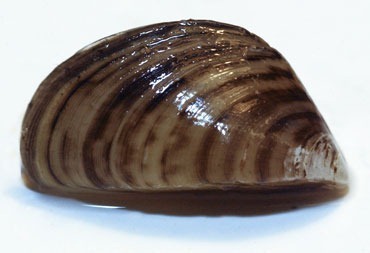
Quagga Mussel from Lake Michigan – image lakescientist.com

Here we go again! Yet another successful species is being demonised and attacked and oppressed just because it is successful.

A species of freshwater mussel – the Quagga Mussel – is being targeted by so-called conservationists in Europe and the US as an “invasive” or “alien” species. Just because it is successful. Just because it has made the hazardous journey from its origins across hostile environments inhabited by unfriendly humans to establish itself in fresh-water bodies in the Great Lakes and now across Europe and the UK.

It originates in the drainage of the River Dnieper in Ukraine into the Black Sea. It lives only in freshwater and can tolerate brackish water but is killed by the salt in the sea water. It is edible for humans but overeating can lead to the concentration of some toxins. But somehow it has managed to get across the Atlantic to the Great Lakes and to many canals and rivers in Europe. Now it has been found in the UK. Fresh water species from the ponto-Caspian region (from the Black, Caspian, and Azov seas) have been observed to be spreading westwards for many years.

R Dnieper – map KidsBrittanica

A new paper has chosen a suitably alarmist title to get massive coverage today from the UK newspapers and radio.

Gallardo and Aldridge, Is Great Britain heading for a Ponto–Caspian invasional meltdown?, Journal of Applied Ecology  10/2014; DOI: 10.1111/1365-2664.12348

The choice of alarmist vocabulary is itself off-putting. It suggests that the research is so unsound that it needs to be propped up by the language of the scandal-sheets!

“Alien”, “invasive”, “meltdown”, “catastrophic” are some of the words chosen. And not just mussels. They are accompanied by predatory, omnivorous, “killer shrimps”.

The GuardianAlien Quagga mussel may already have been joined by other invasive species

Scientists warn that the destructive mussel recently spotted in the UK, has probably been joined by additional undetected invaders, such as shrimp, that pose a threat to native wildlife.

A foreign mussel recently found for the first time in the UK is likely to have already been joined undetected by at least four other alien species that threaten native shrimp and fish, scientists warn on Monday.

The Quagga mussel (Dreissena rostriformis bugensis), which was found in the river Wraysbury on 1 October and can cover boat hulls and smother native mussels to death, is just one of a group of freshwater species that has been spreading westward from the Ponto-Caspian region in south-east Europe in recent years and which risk causing a “meltdown” as they invade Britain.

The south-east of England is most at risk from these invaders which can prey on native British freshwater species, substantially alter the ecology of waterways and wreak economic damage by blocking water pipes, according to a new study by a University of Cambridge team. …..

.. The study warns that the first wave of invaders, including the Quagga, are likely to act as a beachhead for further invaders from the Ponto-Caspian region, aiding their establishment. “Because there are so many of these organisms that have had a long evolutionary time to develop a cosy relationship with each other, what we’re finding is when they get over here they tend to facilitate each other,” said Aldridge.

Quagga mussels reached the Great Lakes some time ago

LakeScientist:

An increase in water clarity in Lake Michigan is actually cause for concern. The heightened clarity is due to quagga mussels, an invasive species. Gary Fahnsteil, a senior ecologist at the National Oceanic and Atmospheric Administration Great Lakes field station in Muskegon, Mich., was a part of a group of scientists who measured Lake Michigan’s water quality.

Clear water is usually a welcome phenomenon; however, the 950 trillion quagga mussels are making Lake Michigan too clear to support aquatic life, especially for salmon and the other fish they consume. Fahnsteil and others consider quagga mussels to be the most detrimental of the 186 invasive species that occupy the Great Lakes. The mussels’ eating behavior wreaks havoc on the aquatic food chain at every level. In 2000, Great Lakes researchers discovered a phenomenon they called the doughnut in the desert,” a massive, ring-shaped bloom of aquatic plants that helps sustain aquatic animals that stay in the lakes during the winter. The bloom appears in March and April.

However, they also discovered that quagga mussels have taken a big bite out of the “doughnut.” As a result, the animals that rely on it face starvation in the winter. Furthermore, the fish that feed off of those species could starve as well.

Well with the entire scientific and alarmist bastions against them it doesn’t look good for the Quagga mussel. They are now one of the oppressed species. But I am rooting for them. Having traveled from Ukraine across oceans of hostile salt water, they deserve to enjoy all their successes.