Oil reserves to rival Saudi Arabia’s found in the Russian Arctic

September 28, 2014
Kara Sea - Arctic  Google maps

Kara Sea – Arctic Google maps

So much for peak oil!

And that’s even without taking shale oil and shale gasand methane hydrates into account.

World BulletinA joint venture between Rosneft and ExxonMobil has discovered a huge amount of oil under the Arctic. The state-run Russian oil company announced on Saturday that the University-1 well struck oil in the Kara Sea.

Igor Sechin, the head of Rosneft, said the “oil trap” has 338 billion cubic meters of gas and more than 100 million tonnes (733 million barrels) of oil. The total resources in the area are estimated at 13 billion tonnes (87 billion barrels) of oil equivalent, according to the Rosneft statement. According to experts, the amount of oil and gas is comparable to the resource base of Saudi Arabia.

Rosneft and ExxonMobil started drilling the University-1 well, the world’s northernmost well, in August. The field will be named Pobeda, which means “victory” in Russian

Sanctions against Russia could deprive ExxonMobil of some of the benefits due to them. Even if sanctions are relatively short-lived the Russians will surely extract their pound of flesh while they can.

ExxonMobil announced last Friday that the U.S. Treasury Department has granted it a licence to “wind down” operations at the well, in response to U.S. and EU sanctions imposed on Russia over the unrest in Ukraine.

However the Russians are still dependent on technology from the large oil companies for drilling and exploitation in these frigid conditions. They also have vast quantities of oil and gas shale in Siberia the value of which needs to be protected. The timing for the development of Arctic reserves then becomes a geopolitical and economic strategy call. It makes most sense for Russia not to flood the market and to keep gas prices to Europe high and growing. But the potential availability of this Arctic reserve – even if production is at least a decade away – adds another arrow in the Russian quiver.

But the doomsday scenarios of “peak oil” or catastrophic depletion of gas and oil reserves have vanished over the horizon – at least for the foreseeable future,


Spider Art

September 28, 2014

Spiders were thought to decorate their webs to stabilise them but this is not accepted any more, even though there is no consensus on the reason for the spiders’ art.

Perhaps it is just the spiders’ aesthetic sense.

spider decoration

image from arkinspace.com

A whole gallery of spider art is at Ark in Space.

The structures are known as web decorations but the more scientific name for one is stabilimentum.  In the plural they are known as stabilimenta and the name came about because of a mistake.  When first studied the decorations were believed to be used in stabilizing the web of a spider – and there you have the term stabilimentum – get it?  However, this theory is generally dismissed these days – although it is obvious to one and all why early scientists may have thought this. …..

…. The truth be told, it is quite likely that the purpose and function of stabilimenta are manifold.  It has been discovered that they evolved independently perhaps as many as ten times.  Some spiders make their decorations purely out of their silk.  Other spiders will make them from this and the remains of their egg sacs, not to mention any detritus that just happens to be close to their webs.  The fact that they evolved independently does seem to point towards different functionality. …… 

Some think that the web decorations afford the spider and extra edge in terms of self protection.  It may make spiders appear larger, as already seen, or make them more camouflaged.  It may be the reverse of camouflage – by making the spider more visible then the web itself will be seen by animals like birds that are then less likely to inadvertently damage the web, partially wrecking or even destroying the painstakingly built structure.  So it could well be a kind of ‘stop sign’ to other animals. …… One more modern idea posited is that the stabilimenta are used in order to attract more prey to the web.  You have all seen insects at night flying towards lights?  Ultraviolet light is often used to attract insects and then there is a sharp noise of insect flesh impacting and exploding under the influence of an electric current.  It is now thought that the web decorations reflect ultraviolet light and this makes them attractive to a large number of insect species.  Unwittingly they fly to their deaths.

Federer photoshopped for his trip to India

September 27, 2014

Roger Federer will be visiting India for the International Premier Tennis League in December this year. To help select places to visit in India he tweeted  “I need some help from my supporters in India. I’m only in Delhi for a few days, so can’t visit all amazing places that I’d like.” “Maybe you guys could help #PhotoshopRF? Show me where I should visit and I’ll retweet the best pics!”

Here are a few that I think are the best of the collection.

Embedded image permalink

Kanha National Park

Embedded image permalink

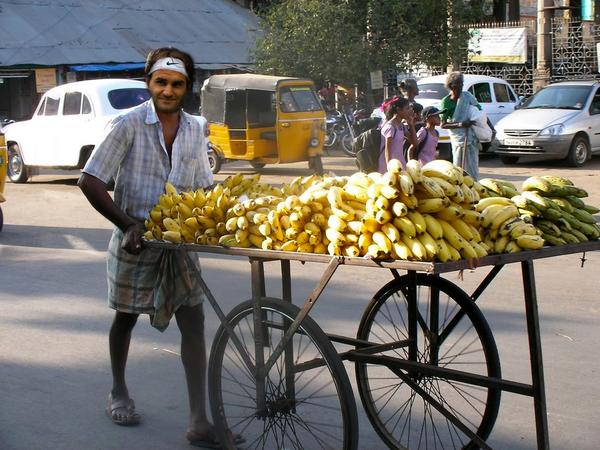
Selling bananas

Embedded image permalink

Goonda Federer at Bollywood


Science by Press Release: Overhyped “gravity waves” were just dust

September 27, 2014

In March this year there was a great deal of publicity about the detection of gravity waves after the Big Bang. There were Press Releases and promotional videos and blanket coverage in the media. There was talk about Nobel prizes. Not unlike the massive publicity mounted by CERN about the discovery of (or more accurately the potential discovery of a possible indication of a particle not inconsistent with) the Higgs boson particle. After that non-discovery also there was talk about the CERN team being awarded a Nobel Prize! Even a member of the Nobel Committee was taken in by the publicity and fought for CERN the organisation, to be awarded  the physics prize. Most of the campaign in favour of CERN was initiated and orchestrated by the PR department at CERN and the CERN fan-club.

Now it turns out that the gravity waves may well have been cosmic dust.

BBCOne of the biggest scientific claims of the year has received another set-back.

In March, the US BICEP team said it had found a pattern on the sky left by the rapid expansion of space just fractions of a second after the Big Bang. The astonishing assertion was countered quickly by others who thought the group may have underestimated the confounding effects of dust in our own galaxy.

That explanation has now been boosted by a new analysis from the European Space Agency’s (Esa) Planck satelliteIn a paper published on the arXiv pre-print server, Planck’s researchers find that the part of the sky being observed by the BICEP team contained significantly more dust than it had assumed.

BIG Science of this kind needs BIG FUNDS. BIG FUNDS need BIG CLAIMS. A BIG CLAIM followed by a retraction is seen to be better – from a publicity perspective – than an uninteresting claim or no claim at all. The people who control the BIG FUND purse strings are generally governments in the form of bureaucrats and administrators and politicians. They don’t usually read the scientific papers themselves. But they do read the Press Releases and take note of the number of column-inches of newspaper articles that are generated. Promotional videos with many hits on You-Tube are also taken note of.

This is science by Press Release. Scientific quality is now judged by the amount of publicity generated.

I am not competent to judge the technical content of these “discoveries” and therefore have to rely on others who are. And so I take note of what Sean Carroll, a CalTech physicist writes on his blog:

Ever since we all heard the exciting news that the BICEP2 experiment had detected “B-mode” polarization in the cosmic microwave background — just the kind we would expect to be produced by cosmic inflation at a high energy scale — the scientific community has been waiting on pins and needles for some kind of independent confirmation, so that we could stop adding “if it holds up” every time we waxed enthusiastic about the result. And we all knew that there was just such an independent check looming, from the Planck satellite. The need for some kind of check became especially pressing when some cosmologists made a good case that the BICEP2 signal may very well have been dust in our galaxy, rather than gravitational waves from inflation (Mortonson and Seljak; Flauger, Hill, and Spergel).

Now some initial results from Planck are in … and it doesn’t look good for gravitational waves.

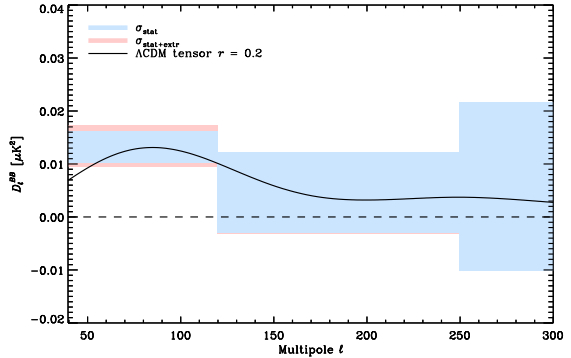
Planck intermediate results. XXX. The angular power spectrum of polarized dust emission at intermediate and high Galactic latitudes
Planck Collaboration: R. Adam, et al.

planck-bmode-spectrum

The light-blue rectangles are what Planck actually sees and attributes to dust. The black line is the theoretical prediction for what you would see from gravitational waves with the amplitude claimed by BICEP2. As you see, they match very well. That is: the BICEP2 signal is apparently well-explained by dust.

….. Planck has observed the whole sky, including the BICEP2 region, although not in precisely the same wavelengths. With a bit of extrapolation, however, they can use their data to estimate how big a signal should be generated by dust in our galaxy. The result fits very well with what BICEP2 actually measured. It’s not completely definitive — the Planck paper stresses over and over the need to do more analysis, especially in collaboration with the BICEP2 team — but the simplest interpretation is that BICEP2’s B-modes were caused by local contamination, not by early-universe inflation. ….. 

“Science by consensus” and “science by press release” and even “science by press release about the consensus” have infected much of what passes for science today.

Di Caprio puts on an act for climate change

September 26, 2014

I am always more than a little suspicious when a “celebrity” starts supporting some “benevolent” cause. My suspicions are directed primarily at the cause – not so so much at the celebrity. The celebrities are celebrities because they want to be. Their narcissistic urges are usually very well developed. But any “cause” which has to enlist the use of celebrities – with no particular qualifications other than being well known – to prop up its justification for existing is demeaned and damaged by the exercise. The celebrities of course get the extra exposure they so yearn for.

Whether it is Victoria Beckham on Millenium goals or George Clooney on Poverty or Arundhati Roy on dams or now Leonard Di Caprio on Climate, I find the causes are damaged while the celebrities satisfy their narcissistic urges. Arnold Alois Schwarzenegger must be the kiss of death for the causes he supportsIn fact studies have shown that the good causes of the famous ‘benefit themselves more than the charities

The chief beneficiaries of star-studded attempts to raise the profile of a good cause are the celebrity themselves, according to sociologists, who say the appearance of altruism makes them more popular with the public.

Two pieces of research by UK academics argue that “the ability of celebrity and advocacy to reach people is limited” and that celebrities are “generally ineffective” at encouraging people to care about foreign causes.

But the publicity surrounding Di Caprio this week has been particularly gratuitous and unconvincing. He attended President Obama’s speech about Climate at the UN on Tuesday:

RCP: ……… But it was President Obama who provided the most visible sign that the talks were heading in the wrong direction. Arriving late, the president looked as if he’d rather be anywhere else. The president’s tone in speaking to his fellow leaders and delegates was as if he were talking to a meeting of congressional Republicans. Five years had passed since the failure of the previous round of talks at Copenhagen, he said. Since then, the scientific understanding had advanced. What was once a distant threat had, the president claimed, moved firmly into the present, although the president did not mention that global temperatures have been flat for a decade and a half and that there had been little scientific advance to explain it.

Those words were prologue to the president’s blunt warning. The U.S. is stepping up to the plate, the president declared. The U.S. must be joined by other nations. Nobody gets a pass, especially the big emerging economies, climate change code for India and China, whose leaders were giving the summit a pass. Solving climate change was a matter of taking a lead, the president said, making the improbable claim that giving a lead is what the United Nations General Assembly is for.

There were quite a number of empty seats in the chamber as the president spoke. Secretary of State John Kerry played with his BlackBerry. Many looked bored. At the end of the president’s remarks, the most enthusiastic applause came from DiCaprio. Perhaps that’s because he’s good actor. The climate change talks might be attracting dwindling audiences. But there’s one thing you can bet on: the climate change show will run and run. 

Ah Well.

Maybe there is a silver lining in the celebrity cloud.

More women than men – throughout history

September 26, 2014

The Max Planck Institute for Evolutionary Anthropology is pioneering many new techniques of investigative genetics and is causing minor revolutions in many areas of anthropology. Perhaps the best known of these is Svante Pääbo and his group’s work on extracting and analysing ancient DNA.  Their work on the Neanderthal genome is changing the previously accepted history of Modern Humans and their relationships with Neanderthals, Denisovans and other ancient branches of homo erectus.

A new paper reports on a DNA study of 623 males from 51 different populations and comes to the conclusion that throughout history women have outnumbered men. The study compared the paternally-inherited Y chromosome (NRY) with maternally inherited mitochondrial DNA (mtDNA). The researchers developed a high-resolution Y chromosome sequencing assay that allowed them to get paternal and maternal histories of similar quality and resolution. Female populations were larger before the out-of-Africa migration(s) and remained so throughout almost all subsequent migrations. Women migrated more (presumably as they were married out) and men stayed put more. For most of our history a greater proportion of women in the population reproduced than men leading to females making a larger genetic contribution to the current global population than males did. Men tended to fertilise multiple females (perhaps an indicator of polygyny).

CBS News: …. people in East Asia and Europe have larger genetic differences for paternal than for maternal DNA, suggesting high levels of female migration. In contrast, populations in Africa, Oceania and the Americas have bigger differences for maternal DNA than for paternal DNA.

Human paternal and maternal demographic histories: insights from high-resolution Y chromosome and mtDNA sequences, Sebastian Lippold, Hongyang Xu, Albert Ko, Mingkun Li, Gabriel Renaud, Anne Butthof, Roland Schroeder and Mark Stoneking, Investigative Genetics 2014, 5: 13

Eurekalert:

Female populations have been larger than male populations throughout human history, according to research published today in the open access journal Investigative Genetics. The research used a new technique to obtain higher quality paternal genetic information to analyse the demographic history of males and females in worldwide populations.

The study compared the paternally-inherited Y chromosome (NRY) with maternally inherited mitochondrial DNA (mtDNA) of 623 males from 51 populations. The analysis showed that female populations were larger before the out-of-Africa migration and remained so throughout almost all subsequent migrations. The main drivers of this trend are likely to be processes such as polygyny, where one male mates with many females, and the fact that in most societies, women tend to move to live with their husbands. This has resulted in females making a greater genetic contribution to the global population than males.

Previous research on genetic history has used different techniques to analyse NRY and mtDNA, which has led to an ascertainment bias in the results. In this study, researchers from the Max Planck Institute for Evolutionary Anthropology developed a high-resolution Y chromosome sequencing assay that allowed them to get paternal and maternal histories of similar quality and resolution, so they could make a direct comparison. The results confirmed previous findings that when comparing human populations on a global scale, there are greater genetic differences in paternal NRY than in mtDNA. However, these differences are not as large as previously thought and the authors were surprised to see substantial variation in relative amounts of NRY vs. mtDNA differentiation at the regional level.

The authors argue that using this new technique, greater analysis can be undertaken at a regional level to create a clearer picture of the paternal and maternal influences on specific populations. In the African populations they studied, they saw lower paternal genetic diversity, which may be a direct result of the Bantu expansion into eastern and southern Africa beginning about three thousand years ago. In samples taken from the Americas, initial results suggest higher maternal genetic diversity, indicating that there were fewer males than females among the original colonisers.

Dr. Mark Stoneking, Department of Evolutionary Genetics, Max Planck Institute, an author on the paper, said: “Our new sequencing technique removes previous biases, giving us a richer source of information about our genetic history. It allows us to take a closer look at the regional differences in populations, providing insights into the impact of sex-biased processes on human genetic variation.”

BJP dumps Shiv Sena. As expected?

September 25, 2014

The 25 year old alliance between the BJP and Shiv Sena is finally over. Of course it was actually an alliance between Bal Thackeray and the BJP and without him the Shiv Sena is just a shadow of what it once was (and some might say that it was always a blight on Indian politics with Bal Thackeray – and being a shadow of a blight without him was a welcome shift to the light!). But the simple reality is that the BJP – at national level – does not need the Shiv Sena. In fact they are a liability.

ToIThe 25-year-old BJP-Shiv Sena alliance split on Thursday amid continued deadlock over seat-sharing for the October 15 Maharashtra assembly polls.

After several rounds of talks over the last few days, senior state BJP leaders announced on Thursday evening severing of the ties between the two parties, blaming Shiv Sena’s “inflexibility” for it.

“We have conveyed our decision to snap ties to Shiv Sena. The decision was taken with a heavy heart,” Maharashtra BJP chief Devendra Fadnavis told reporters after a meeting of the state party’s core committee.

While this split is just for the Maharashtra elections, it is effectively a national split since the Shiv Sena is a zero without or outside of Maharashtra.

After the Modi wave at the general elections it was only a matter of time. Back in July I speculated

The biggest credibility challenge that Narendra Modi faces is to convince Indians – and the outside world – that he represents something much larger, secular and inclusive than the narrow, religiously-bigoted  and exclusive position espoused by the RSS and some even more extreme Hindu nationalist groups. But he has to do this equitably but without giving the perception of appeasing the Muslim fanatics.

And he has to clean his own house first. His ally in Maharashtra, the Shiv Sena, is now an embarrassment and a liability. Within his own party also there is no dearth of intellectually retarded loud-mouths. They are all now a burden and unless he cuts them down to size they have the potential to negate all his efforts to be  inclusive.

The Shiv Sena is a special case and I think Modi can afford to dump them. They have just made utter fools of themselves  ……..

……. The Shiv Sena remains a force – if only in Maharashtra – but they are in a declining spiral and my reading is that it would be least damaging for Modi to dump them now – early on in his term – and cap his losses.


MOM’s first image from Mars

September 25, 2014

ISRO has released the first image taken by MOM on Mars.

Taken from a height of 7300 km; with 376 m spatial resolution.

Shades of pink and brown, but I am not sure why the lighter shades around each crater reminds me of gas bubbling through sand. The “streaks” in the bottom right quadrant are suggestive of “wind effects” in a sea of sand.


Cliches to avoid from the CIA’s “Bestiary of intelligence writing”

September 25, 2014

Whatever one may think of the CIA, their reports are usually succinct and precise and an example to be followed by verbose NGO’s, second-rate scientists and  – especially – government departments. (Of course there are many examples, from Iraq for example, where their reports are not accurate or are just plain fiction – but they are well written). The US Department of Energy  – in my experience – have much to learn. They judge those who receive funding by the thickness of the reports they submit. The suspicion was that the US DoE actually employed people to measure and register the thickness of each report submitted to them. They then employed others to plot and correlate funding versus thickness-inches of reports submitted!! As a young researcher we had the benefit of a boss who trained us both to  “reduce 3 pages to 1” for scientific publication and also to “expand 1 page to 5” for the reports we had to submit every quarter for a DoE funded project.

Washington Post: The CIA has been hiding something from us: It once had a sense of humor — not to mention Maurice Sendak-esque artistic skills, all before the unfunny news of the agency’s role in the Iran-Contra scandal broke in 1986.

The 1982 fall edition of “Studies in Intelligence,” the CIA internal newsletter, describes a “collection of strange fauna” known as the “Bestiary of Intelligence Writing.” It was an illustrated guide for national security writers on cringeworthy cliches, with apologies to “A Political Bestiary,” a book by James Kilpatrick, former U.S. senator Eugene McCarthy and editorial cartoonist Jeff MacNelly.

 CIA Bestiary of Intelligence writing

(I have posted earlier about the CIA Style Manual: CIA Style Manual)

The author is only identified as (b)(3)(c) and he is also the illustrator

Older employees may recall that when the Headquarters Building was being constructed, guard dogs stalked the corridors by night to sniff out trespassers. Practically no one is aware, however, of the collection of strange fauna in a corner of a sub-basement, the location of which must remain secret. This collection known as the Bestiary of Intelligence Writing, consists of specimen samples of cliches and misused or overused word combinations that CIA editors have encountered frequently over the years.

Now for the first time, the Curator of the Collection has received permission to reveal the existence of the Bestiary and identify some of its principal specimens for the enlightenment, education and general edification of CIA writers. It is hoped that with their new awareness of the Bestiary, analysts and other authors will keep their eyes peeled, noses to the grindstone and ears to the ground, to call the attention of editors to other candidates for possible inclusion in the collection.

The Collection

  1. Multidisciplinary analysis.

  2. Viable alternatives.

  3. Mounting crises.

  4. Parameters

  5. Heightened tensions.

  6. Dire straits.

  7. Far-reaching implication.

  8. Available evidence.

  9. Foreseeable future.

  10. Almost inevitable.

  11. Nonstarter.

  12. Economic constraints.

  13. Broad outlines.

  14. Net effect.

  15. Overwhelming majority

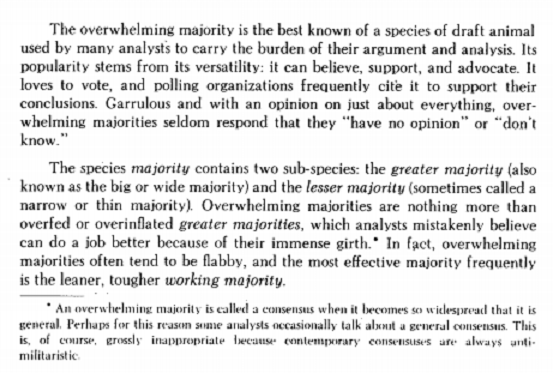
This is the entry for “Overwhelming majority”

CIA Overwhelming majority - from the Bestiary

CIA Overwhelming majority – from the Bestiary

CIA OM text


MOM orbit exactly as planned with a flawless MOI

September 24, 2014

ISRO can feel very satisfied. The MOI was flawless. The tracking indicates that the MOM has achieved an orbit of 421.7 km / 76993.6 km compared to the planned 423 km / 80,000 km. Not bad after a 10 month journey of some 680 million km. The inclination of orbit with respect to the equatorial plane of Mars is 150º and exactly as planned. 

The first colour pictures of Mars from MOM are expected within a day or two.

Now for a manned, fast, free-return, fly-by of Mars in 2018?

ISRO: India’s Mars Orbiter Spacecraft successfully entered into an orbit around planet Mars today morning (September 24, 2014) by firing its 440 Newton Liquid Apogee Motor (LAM) along with eight smaller liquid engines. This Liquid Engines firing operation which began at 07:17:32 Hrs IST lasted for 1388.67 seconds which changed the velocity of the spacecraft by 1099 metre/sec. With this operation, the spacecraft entered into an elliptical orbit around Mars. 

The events related to Mars Orbit Insertion progressed satisfactorily and the spacecraft performance was normal. The Spacecraft is now circling Mars in an orbit whose nearest point to Mars (periapsis) is at 421.7 km and farthest point (apoapsis) at 76,993.6 km. The inclination of orbit with respect to the equatorial plane of Mars is 150 degree, as intended. In this orbit, the spacecraft takes 72 hours 51 minutes 51 seconds to go round the Mars once.

Spaceflight101Launched back on November 5, 2013 atop a Polar Satellite Launch Vehicle, the Mars Orbiter was constrained by the performance of India’s workhorse launcher that required the spacecraft to take the scenic route – first entering an elliptical Earth orbit that the spacecraft raised by making six engine burns before firing its main engine, the Liquid Apogee Motor, a seventh time to depart Earth and enter a path to Mars on November 30. ….. 

The Mars Orbit Insertion Burn had a planned change in velocity of 1,098.7 meters per second with an anticipated burn time of 24 minutes and 14 seconds. However, engine shutdown was triggered by the navigation system when accelerometers sensed that the proper delta-v was achieved, dynamically adjusting for actual engine performance by extending of shortening the burn slightly. 

For MOM, the sun came up 19.5 minutes into its burn, but Earth was not coming into view until three minutes after the scheduled end of the Mars Orbit Insertion burn. The spacecraft was programmed to start the re-orientation back to its comm attitude one minute after shutdown, followed five minutes later by the re-activation of the communications system when MOM was visible from Earth again.
The Mars Orbit Insertion Burn had a planned change in velocity of 1,098.7 meters per second with an anticipated burn time of 24 minutes and 14 seconds. However, engine shutdown was triggered by the navigation system when accelerometers sensed that the proper delta-v was achieved, dynamically adjusting for actual engine performance by extending of shortening the burn slightly. 
For MOM, the sun came up 19.5 minutes into its burn, but Earth was not coming into view until three minutes after the scheduled end of the Mars Orbit Insertion burn. The spacecraft was programmed to start the re-orientation back to its comm attitude one minute after shutdown, followed five minutes later by the re-activation of the communications system when MOM was visible from Earth again.