Baka people suffer abuse by WWF in the name of conservation

October 6, 2014

The WWF is not my favourite organisation. They have become eco-fascists and have lost sight of what conservation is all about (as have many environmentalists who blindly follow a vision of an authoritarian society where they know what is best for everybody else).

Now comes this accusation from Survival International

Survival International, the global movement for tribal peoples’ rights, has uncovered serious abuses of Baka “Pygmies” in southeast Cameroon, at the hands of anti-poaching squads supported and funded by the World Wide Fund for Nature (WWF).

The Baka are being illegally forced from their ancestral homelands in the name of “conservation” because much of their land has been turned into “protected areas” – including safari-hunting zones.

Rather than target the powerful individuals behind organized poaching, wildlife officers and soldiers pursue Baka who hunt only to feed their families.

The Baka and their neighbors accused of “poaching” face arrest, beatings and torture. Many Baka claim that friends and relatives have died as a result of the beatings.

Cameroon’s Ministry of Forests and Fauna, which employs the wildlife officers, is funded by WWF. WWF also provides officers with technical, logistical and material assistance. Without this support the anti-poaching squads could not function.

UN standards require WWF to prevent or mitigate “adverse human rights impacts directly linked to its operations” even if it has not contributed to them, but the giant of the conservation industry appears reluctant to acknowledge this. Despite the evidence that the anti-poaching squads have grossly abused the rights of the Baka, WWF continues to provide its crucial support.

I am not surprised.


Google marks Thor Heyerdahl’s 100th birth anniversary

October 6, 2014

Last year I posted about his 1947 Kon-Tiki expedition.

Today is the 100th anniversary of Thor Heyerdahl‘s birth.

Google marks the day:

Heyerdahl 100th birth anniversary


And the Medicine Nobel goes to …..O’Keefe, Moser and Moser

October 6, 2014

The Nobel Assembly at Karolinska Institutet has today decided to award The 2014 Nobel Prize in Physiology or Medicine with one half to John O´Keefe and the other half jointly to May‐Britt Moser and Edvard I. Moser for their discoveries of cells that constitute a positioning system in the brain

The winners were not among the Thomson-Reuters predictions.

Chillies will have to wait.

===============================================

I like chillies.

After all chillies are what distinguish humans from animals. As Paul Bloom, a Yale psychologist, puts it,

“Philosophers have often looked for the defining feature of humans — language, rationality, culture and so on. I’d stick with this: Man is the only animal that likes Tabasco sauce.”


And few chutneys are better than a Vengayaa chutney with onions and red chillies.

Which is as good a reason as any for suggesting that David Julius will be awarded the prize for his discovery of the genes that determine how we feel pain, heat and cold. He has studied chilies and how pain and heat are experienced.

I am not sure if he is the favourite but his name is tipped by the Svenska Dagbaldet this morning

Height is 80% nature (genetics) and 20% nurture

October 5, 2014

A DNA study of more than 250,000 people has doubled the number of identified genetic factors which determine height to around 700 variants in over 400 genome regions. But the factors identified so far may be only 20% of the genetic factors which apply.

EurekAlert:

A study which examined data on DNA from more than 250,000 people, published on October 6 in Nature Genetics, roughly doubles the number of known genome regions involved in height to more than 400. It also revealed that more than half of the factors involved in determining height are explained by simple common genetic variation – the sort of genetic variation that exists in more than 1 in 10 people.

The collaboration, co led by the University of Exeter Medical School and part-funded by the Wellcome Trust, involved more than 450 experts from well over 300 institutions in Australia, the USA and several European countries. Together, they form the aptly named GIANT consortium. The study is the largest of its kind to date. They checked more than 2 million common genetic factors – those shared by at least five per cent of participants. From this they found 697 genetic variants in 424 regions of the genome that are related to height. The findings represent a massive stride forward in an area of research in which virtually nothing was known as recently as 2007.

Professor Tim Frayling, of the University of Exeter Medical School, oversaw the study. He said: “It’s common knowledge that people born to tall parents are more likely to be tall themselves. Most of this is down to the variations in our DNA sequence that we inherit from our parents – the different versions of all our genes. In 2007 we published the first paper that identified the first common height gene, and since then the research has come on leaps and bounds. We have now identified nearly 700 genetic variants that are involved in determining height. This goes a long way towards fulfilling a scientific curiosity that could have real impact in the treatment of diseases that can be influenced by height, such as osteoporosis, cancer or heart disease. It also a step forward towards a test that may reassure parents worried that their child is not growing as well as they’d hoped – most of these children have probably simply inherited a big batch of “short genes.”

Height is determined by a very large, but finite, number of contributing factors. Genetic causes are located throughout the genome, and environmental factors such as diet also play a role. The GIANT consortium is working towards identifying the thousands of hidden factors which have varying effects in height, ranging from minute to gigantic. The results arise from analysis of DNA data on 253,288 individuals of European ancestry. The research team says increasing sample sizes of this magnitude make it far easier to find commonalities that determine traits such as size.

Lead author Dr Andrew Wood, of the University of Exeter Medical School, said: “Our findings have helped to identify a large proportion of the genetic architecture that contributes to determining our height. We know that as a population we have become taller over the last few generations, because of factors including improved nutrition. But more than 80 per cent of the factors in height variation are known to be down to genetics, with the rest caused by environmental factors. Thanks to advances in technology, we now have access to far greater quantities of DNA data. These data sets are proving to be a genetic treasure trove which has enabled us to shed light on height, and we expect to continue to make significant advances, both in this field and in other human traits. Our results suggest that massive human genetic studies, possibly into the millions, will continue to uncover all the subtle effects of our genetic variation that influence our health, behaviour, body shape and all aspects of what makes us who we are.”

Dr Joel Hirschhorn, of Boston Children’s Hospital and the Broad Institute of MIT and Harvard, is leader of the GIANT Consortium and co-senior investigator on the study. Dr Hirschhorn said: “When you double the sample size and increase your statistical power, you can make new discoveries. Our results prioritise many genes and pathways as important in skeletal growth during childhood. Without a highly collaborative model, there’s no way we could get this work done. We can now explain about 20 percent of the heritability of height, up from about 12 percent where we were before.”

Professor Peter Visscher, of the University of Queensland, Australia, said: “The study narrows down the genomic regions that contain a substantial proportion of remaining variation—to be discovered with even larger sample sizes.”

Professor Frayling said: “The genes and pathways involved in height should help facilitate future studies, and we have made them publicly available to this end. We believe that large genetic studies could yield similarly rich lists in a variety of other traits, and could generate new biological hypotheses and motivate future research into the basis of human biology and disease.”


Noted in passing 5th October 2014

October 5, 2014
undefined

Walking on Water Photo and caption by Dave Kan from NG 2014 photo contest

A French court has given a man leave to marry his former stepmother. His father attended the wedding. It is not clear whether the French law prohibiting such marriages is an ass or whether the court is an ass or whether this is a triumph for common sense. He is 45, she is 48. The father’s age is not reported.

Desperate environmental “scientists” at Oxford are developing a “fast-track model” to prove that global warming is responsible for any extreme weather event within 3 days of that event. It seems that the scientific method has been abandoned and faith is put in yet another model where the premise is false and with a built in confirmation bias in the result.

The minority Red/Green coalition government in Sweden has announced its new ministers. The Greens have 6 of 24 ministers (2 junior ministers) including the portfolios for Climate and Environment, Housing, Foreign Aid and Education. Many of the names are sops to youth and a little dubious. I can hope that the Greens will not do much damage. Prime Minister Lofven started by announcing hat Sweden would recognise Palestine and upset the US and Israel.

Baby Doc Duvalier passed away. He was only a shadow of his father, Papa Doc, but he was not a nice man either.

The US saw its first Ebola case on its own shores and the patient is in a critical state.

ISIS continues on its murderous way and now has the support of the Pakistan Taliban. ISIS can be compared to an Ebola like virus. But I think it is a virus that is infecting the body of Islam and it is moderate Islam which – in the first instance – has to fight the disease.

The WWF has long been infiltrated and corrupted by the far left and has provided a safe haven for those left ideologically homeless after the Fall of Communism. Now the far, far left is criticising the WWF for being too close to capitalist forces.

The Ozone problem which never did exist was said to be healing. The Ozone hype and the funding elicited is yet another example, like Y2K  and Global Warming/Climate Change/ Extreme events, where a non-existent problem is blown out of all proportion. The problem then gradually “disappears” some time later.

“Is it toast if its not toasted?” Oh to be a socialite.

China tries to change Islam and find a way to manage their Muslim population with female Imams.


Nobel prize announcements next week

October 4, 2014

It is that time of the year again.

Alfred Nobel at his desk (photo kkp)

“Alfred Nobel” at his desk (photo kkp)

2014 Nobel Prize Announcements

Physiology or Medicine:
Monday 6 October, 11:30 a.m. CET at the earliest

Physics:
Tuesday 7 October, 11:45 a.m. CET at the earliest

Chemistry:
Wednesday 8 October, 11:45 a.m. CET at the earliest

Peace:
Friday 10 October, 11:00 a.m. CET

Economic Sciences:
Monday 13 October, 1:00 p.m. CET at the earliest

Literature:
The date will be set later

I only learned the story behind how the Nobel prizes came into being this summer – on a visit to Björkborn Manor in Karlskoga.

How Sohlman and 3 white Russian stallions ensured the establishment of the Nobel prizes

The Thomson-Reuters Nobel predictions are here.

Sleeping walruses and oysters and pigs with wings

October 4, 2014

(with due deference to Lewis Carrol)

`The time has come,’ the Walrus said,
    `To talk of many things:
Of shoes — and ships — and sealing-wax —
    Of cabbages — and kings —
And why the sea is boiling hot —
    And whether pigs have wings.’

……..

`A loaf of bread,’ the Walrus said,
    `Is what we chiefly need:
Pepper and vinegar besides
    Are very good indeed —
Now if you’re ready, Oysters dear,
    We can begin to feed.’

…….

`The ice is growing,’ the Walrus said,
    `And oysters could be few; 
We’d better make the most of it
    While the sea is wonderfully blue.
Just fish for dinner gets rather trite,
    but we could find a seal or two.’

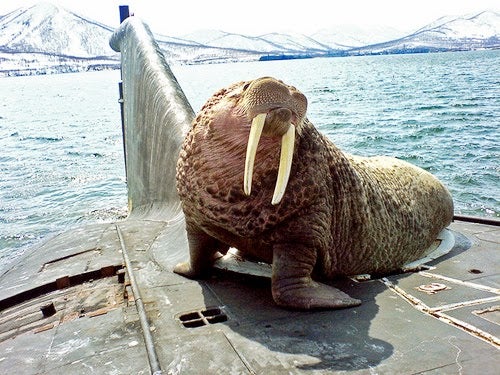
Walrus asleep on the deck of a Russian submarine (2013) image Imgur

image source: http://i.imgur.com/jct1HZt.jpg

Waking up

Waking up

http://i.kinja-img.com/gawker-media/image/upload/elisgw76tgzwtek7pti2.jpg

Gas from methane hydrates within a decade?

October 3, 2014

Gas production from the hydraulic fracturing (fracking) of shale is already well established (even booming) in the US. Huge amounts of gas and oil bearing shale (as much as all known reserves of natural gas) around the rest of the world are yet to be exploited. But the methane hydrates on the sea beds dwarf all the known fossil fuel reserves put together.

The sheer abundance of methane hydrates around the globe and the thought that much of this gas could soon be economically extractable is almost intoxicating for those involved.

“The worldwide amounts of carbon bound in gas hydrates is conservatively estimated to total twice the amount of carbon to be found in all known fossil fuels on Earth”.


Methane Hydrate Resources per Der-Spiegel

Methane Hydrate Resources per Der-Spiegel

Methane hydrate deposits are so widespread around the world’s coastlines that cartel formation will be almost impossible. The technology for extraction however could become a very hot property. The Japanese – who don’t have any shale but do have access to methane hydrate deposits – have been leading the charge for extraction of gas from methane hydrates and tests have been promising. The US and India and China are also active but the Japanese are probably closest to commercial production. Now 11 Japanese companies have formed a consortium to exploit the resource and conduct larger production tests following the successful extraction test carried out by the Japanese government in 2012. Japan could have commercial quantities of methane hydrate gas flowing within a decade.

Natural Gas Daily:

A group of 11 Japanese companies have formed a joint venture to conduct production tests of offshore methane hydrates – an unconventional resource seen as a potential game changer for the world’s largest LNG importer. 

Led by Japan Petroleum Exploration (Japex) and starting with a capital contribution of ¥300 million ($2.8 million), Japan Methane Hydrate Operating Co. (JMH) will provide contractor services and carry out field operations during the medium- and long-term production tests sponsored by the government. 

The JV partners will each share their expertise and technology to support the exploration and testing, JMH said in its first press release on Wednesday. 

“A substantial quantity of methane hydrate is estimated to be in the offshore areas around Japan. Serving as a new domestic energy source, with the potential to make a major contribution to a stable national energy supply for Japan, technological development is necessary for its commercialisation, including the establishment of production technologies,” the company said.

The Japanese government successfully produced the world’s first methane hydrates in March 2012, after drilling an experimental well in the offshore Nankai Trough and carrying out a production test that exceeded expectations (see Japan flows hydrates in landmark offshore test, 12 March 2013). 

That was followed two months later by a steady flow of gas from methane hydrates in Alaska’s North Slope, which a partnership between the United States Department of Energy (DOE), ConocoPhillips and Japan’s state-run JOGMEC called a “successful, unprecedented test of technology”.  ……. 

The government has said it expects to develop the technology needed to produce gas from methane hydrates by about 2018, although it remains to be proven whether the resource will be commercial (see Methane hydrates seen as the next big unconventional gas, 22 April 2013). 

Methane hydrates appear in Arctic sediments and below continental shelves as far apart as India and New Zealand. Worldwide deposits are estimated at up to 20,000 trillion cubic metres of gas – compared with 185.7 tcm of proven gas reserves in the world at the end of 2013, according to BP statistics. …… 

The JMH JV includes Japex (operator, 33%), Japan Drilling Co. (18%), Inpex (13%), Idemitsu Oil & Gas (5%), JX Nippon Oil & Gas Exploration (5%), Nippon Steel & Sumikin Engineering Co. (5%), Chiyoda Corp. (5%), Toyo Engineering Corp. (5%), JGC Corp. (5%), Mitsui Oil Exploration (5%) and Mitsubishi Gas Chemical Co. (1%). 

With new natural gas reserves being found in the Arctic and with all the shale gas yet to be extracted and, now, with the vast amount of methane hydrates available, “peak gas” is at least 1,000 years away.

Global warming (what else?) caused ISIS, spread Ebola and will change male-female ratio!

October 3, 2014

Global warming – which has now been absent for 18 years – has been blamed for many things. In fact projects – in any field – which have managed to claim a possible link with global warming have had a much greater probability of being funded. Now global warming is blamed for the rise of ISIS, the spread of Ebola and even for altering the male-female ratio among humans.

clip_image002


In just the last few days these articles have appeared and pass for serious commentary in supposedly serious media!

  1. Charles B. Strozier and Kelly A. Berkell, How Climate Change Helped ISIS
  2. Elijah Wolfson, Ebola and Climate Change: Are Humans Responsible for the Severity of the Current Outbreak?

  3. Rachael Rettner, Climate Change Could Alter the Human Male-Female Ratio

Not only are global temperatures not increasing (and maybe decreasing), but there is no linkage between observed “extreme” weather and global warming.

Climate Depot:

Hurricanes: 3,264 Days Without a Major (Cat 3 +) Hurricane Strike – ‘Nearly 9 years…the last being Wilma in October, 2005′

Tornadoes:U.S. Tornado Count Plummeting to Record Low Levels Three Consecutive Years

Droughts:New Research Confirms Human CO2 Not Causing A Global Drought Increase – ‘Droughts in the U.S. are more frequent and more intense during COLDER periods’

An unrepresentative Swedish parliament

October 3, 2014

There is a 90% under-representation of the over-65s in the Swedish parliament.

The older I get the more I seem to encounter “age discrimination”. I have the perception that wisdom, knowledge and experience – but not wealth – are given a diminishing value by society. But it is not just perception. The numbers don’t lie. But the numbers also suggest that the elderly themselves contribute to this perception by giving less value to their own hard-earned qualities.

The new Swedish Parliament has just convened and a new socialist/green government (a minority government) is being formed. The media touted that this was the youngest ever Swedish Parliament and possibly one of the youngest in the world – as if it was a good thing. Perhaps it is – though I doubt it. I found the election debates degenerated often into childish squabbles. Wisdom, knowledge and experience were conspicuous by their absence from many of the candidates.

Riksdag 2014

Riksdag 2014

The Numbers (from SCB and the Election Commission):

  1. The total population of Sweden is currently (31st July 2014) 9.7 million and 19.2% (1.9 million) are over 65 years old. By 2060 the population is expected to be 11.6 million with 25.3% (2.9 million) over 65 years old.
  2. Of the 7.33 million eligible to vote, 25.6% (1.87 million) were over 65.
  3. Of the 5,901 candidates, only 13.5% were over 65 (a 53% representation).
  4. Of the major parties only the Folk Party and the Centre Party had a representation of the over-65’s among their candidates which was higher than 75%.
  5. Of the 349 elected to parliament only 2.6% were over 65 (a 10% representation)
  6. Women (86% representation) are slightly underrepresented.
  7. Under 30’s ( 56% representation) are underrepresented.
  8. Over 65s are grossly underrepresented (10% representation)

“Age discrimination” is endemic in Sweden. To be labelled a “pensioner” in Sweden has the “kiss of death” about it. This is no doubt partly due to the elderly’s perception of themselves and their disinclination to be strident. Under-representation cannot be solved by quotas since quotas are fundamentally unjust and discriminatory in nature.. The skewed representation can only be addressed by greater participation of the over-65s through the entire chain.

But a 10% representation in Parliament is untenable. Perhaps the over-65s need to take to the streets.

NO TAXATION WITHOUT REPRESENTATION!!