Justice without balance as mass murderer Flink is to be released today

June 11, 2014

Mattias Flink (born March 8, 1970, in Falun, Sweden) is a Swedish mass murderer who killed seven people on June 11, 1994, in Falun, Sweden. He was 24 at the time and a second lieutenant in the Swedish Army. He is to be released today on the 20th anniversary of his killing Karin Alkstål, 22, Therese Danielsson, 20, Helle Jürgensen, 21, Lena Mårdner-Nilsson, 29, Jenny Österman, 22, Maths Bragstedt, 35 and Johan Tollsten, 26.

There is a fundamental lack of balance in a justice system where someone gets drunk and murders 7 people, is sentenced to life in prison and is released exactly 20 years after he went on his murderous spree. He will be given a protected identity and state support to “re-establish” himself in society. The lack of balance lies in that society does not consider what may be due to the 7 victims. The discussion is only whether the murderer is now rehabilitated and whether he is any longer a danger to society. His debt to society is considered quit. But what about his debt to the victims? He deprived his victims and society of almost 500 man-years of life.

But the rights of the victims – it seems – died with them. The Swedish Crime Victim Compensation and Support Authority (Brottsoffermyndigheten) is not known for its generosity to victims. A murder victim’s relatives can expect damages of about 50,000 kronor (about $8,000). For 70 years of life deprived! For example relatives of a woman who was crippled for life and where her attacker was sentenced to 12 years in prison were awarded all of 10,000 kronor ($1,500).

Capital punishment will not bring any better balance though. But surely the rest of his productive life must be in the service of his 7 young victims or their dependents or of society at large? His own objectives with his life and earnings are surely forfeit till the debt to his victims is paid off?

Swedish Radio: Today Mattias Flink will be released exactly twenty years to the day after he shot seven young people to death in Falun. Under the law he must be released exactly on the anniversary when he was arrested, said Maria Löfgren, Correctional Officer of Dalarna.

In September this year, Mika Kalevi Muranen a Finnish army soldier who murdered 3 people will also be released after serving 20 years of a life sentence.

Anders Behring Breivik in Norway killed 77 people. He deprived them and society of over 5,000 man-years of life. I wonder how long his life-sentence will actually last?

Justice? Perhaps, but without balance.

Ericsson’s headcount in India now exceeds that at HQ in Sweden

June 11, 2014

Ultimately, adding value as close to the customer as possible is not only inevitable but it is also going to be the critical criterion which determines which companies will survive.

Ericsson the Swedish manufacturer of telecommunications equipment has just passed a kind of milestone when its headcount in India has now exceeded the headcount at its headquarters in Sweden. This will be seen negatively in Sweden especially by the unions, but it is this readiness and ability to get close to the market which actually gives me confidence that they are on the right track. Ericsson, I think, have played this balancing act of changing roles at headquarters while growing close to the market rather well. (Which is why I have Ericsson in my portfolio).

Mobiletor: Ericsson which prides itself as a growing provider of communications technology and services, now has more employees in India than it does in its home country of Sweden, according to the company’s Facts & Figures web page. The headcount is 17,991 staff in India and 17,545 employees in Sweden, with about 80 percent of its workforce being male. In total, Ericsson has 111,383 employees from across the world working for it and has its headquarters in Stockholm, Sweden. …..

India is the fastest growing smartphone market on the globe and 4G LTE is still at its nascent stage, with few operators still appearing to be in the mood for testing the waters before diving right in. Going by an Ericsson report, the country’s mobile broadband users will grow in number to touch four times the present figures by the year 2020. This is directly tied to the 80 percent of consumers who still haven’t adopted smartphones and are yet to experience the mobileweb.

Ericsson have a fairly upbeat view of the mobile market in the latest Ericsson Mobility Report and their own prospects:

The number of mobile subscriptions worldwide grew approximately 7 percent year-on-year during Q1 2014. The number of mobile broadband subscriptions grew even faster over this period – at a rate of 35 percent year-on-year, reaching 2.3 billion. The amount of data usage per subscription also continued to grow steadily. Around 65 percent of all mobile phones sold in Q1 2014 were smartphones. Together, these factors have contributed to a 65 percent growth in mobile/cellular data traffic between Q1 2013 and Q1 2014.

By 2019, global mobile broadband subscriptions will exceed the world population.

Total mobile subscriptions are expected to grow from 6.8 billion in Q1 2014 to 9.2 billion by the end of 2019. Global mobile broadband subscriptions are predicted to reach 7.6 billion by 2019 and will gain an increasing share of the total mobile subscriptions over time.

Mobile broadband users in India will grow in numbers to reach four times the present figures by 2020. In 2013, people accessing data on their mobile devices reached 90 million. The smartphone penetration of 10% or 90 million devices will grow to 45% or 520 million mobile gadgets by 2020. The mobile subscriber base is expected to increase from 795 million last year to 1145 million by 2020.

2014 Scientific Art Competition

June 10, 2014

The winner of the 2014 Competition was this image created by Dr. David A. Barrow

“Don’t forget your umbrella”

This digital artwork was created with a fractal software program called Apophysis, which can generate “IFS fractal flames”. IFS stands for Iterated Function System, a relatively new branch of mathematics. Fractal patterns often resemble structures in nature, and many viewers enjoy identifying familiar plants or animals, similar to “cloud watching”. The delicate lines in this image are similar to the vein patterns found in leaves, and are typical of the Apophysis styles “Breach” and “Elliptic Splits”. With skillful and practiced command of the software, the fractal/digital artist can shape and enhance these similarities to approach traditional, representational art.

Don't forget your umbrella by David Barrow

Don’t forget your umbrella by David Barrow

In last years competition David Barrow had an image placed second

Never Neverland

Never Neverland – David Barrow


World Cup 2014 forecast

June 10, 2014

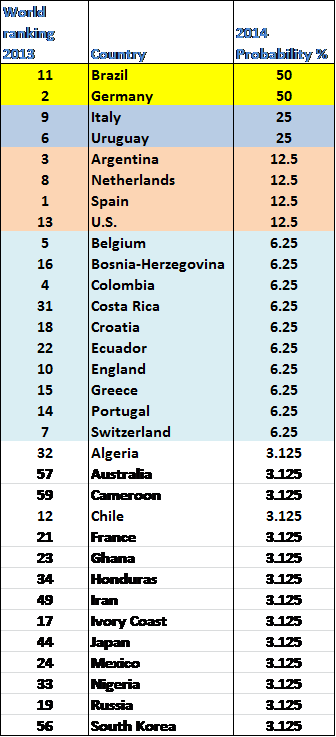
It’s that time again and there is no point in not sticking my neck out. It’s a mixture of “science”, wishful thinking and my prejudices. If I get one of the finalists and at least 8 of the last 16 correct I shall claim my system works!!!

My probabilities of winning for the 32 participants are:

WC 2014 Probabilities

WC 2014 Probabilities

And for the peace of the world and to avoid a full-blown revolution, Brazil will win.


Polar bears neither threatened nor endangered

June 10, 2014

It has become increasingly clear that polar bear numbers have been grossly (and probably intentionally) underestimated and that reality is beginning to displace the alarmist myth of the species being under threat. Canada has declined to classify the polar bears as being “threatened or endangered”.

This has not pleased the environmental priesthood  at all. The Center for Biological Diversity has lobbied heavily in the US against the Canadian decision not to toe the politically correct line. They appealed to an international NAFTA environmental panel to “investigate”  Canada’s failure to implement NAFTA rules by failing to classify the thriving polar bears as “threatened and endangered”.

This appeal has been rejected.

Polar bears remain unthreatened and unendangered in Canada.

An international trade panel has decided not to review whether Canada is enforcing its own environmental legislation to protect its polar bear population.

photo Geoff York/Reuters

cbcnews:

An international trade panel has decided not to review whether Canada is enforcing its own environmental legislation to protect its polar bear population.

The Commission for Environmental Co-operation voted 2-1 to reject a request for an investigation into why Canada has chosen not to designate the bears as threatened or endangered. A U.S. environmental group had filed a submission claiming that decision leaves the bears without protection, despite the ongoing loss of their sea-ice habitat and resulting projections of declining numbers.

Related:

Activists pressure tactics to force Canada to list polar bears as ‘threatened’ have failed June 7th, 2014

Canada under international pressure to list polar bears as threatened, so far holds out January 27, 2013

Canada again under international pressure to list polar bears as threatened November 24, 2013

Bad forecasts and grovelling apologies have become standard for the IMF

June 9, 2014

It’s not what you say but what you do that counts.

Economics is clearly not a science though many would like us to think it is. But with the IMF it is just apology followed by apology for wrong forecasts and bad advice. It smacks of forecasts made to suit a political agenda or just plain incompetence. Based on their track record nothing that is said by Christine Lagarde or the International Monetary Fund that she heads can be taken very seriously. She spends more time apologising than would seem to be healthy.

The latest apology by Christine Lagarde has been called “grovelling”:

‘Do I have to go on my knees?’: grovelling apology from IMF head for incorrect warnings on UK economy

Head of the International Monetary Fund, Christine Lagarde, accepts her organisation’s low growth forecasts for the UK economy were wrong.

Christine Lagarde has asked whether she needs to grovel on her knees before George Osborne over the IMF’s incorrect warnings on the UK economy, as she warned against raising taxes.

“Do I have to go on my knees?” Ms Lagarde, the head of the International Monetary Fund said, when asked whether she has apologised to George Osborne over the fund’s low growth forecasts and calls to adopt a ‘Plan B’ of less austerity – calls the body now accept it got wrong.

In a blow to Ed Miliband, who has called for higher rates of personal taxation and new levies on banks, Ms Lagarde said tax rises are “not recommendable”.

But this is not an isolated incident. Time after time the IMF announces that some country has got its economic policy wrong and warns of dire consequence if the country does not follow the advice of the IMF. Then – a few months later – they admit that the IMF got it wrong. And ususally by then they have caused much misery and wailing and gnashing of teeth.

12th January 2012: Does the EU-IMF Owe Ireland an Apology?

2nd June 2012: IMF apology to Greece after Lagarde remarks – YouTube

3rd January 2013: An amazing mea culpa from the IMF’s chief economist on austerity

6th June 2013: For hard-hit Greeks, IMF mea culpa comes too late

In any normal corporation Christine Lagarde and the IMF’s Chief Economist,  Olivier Blanchard would have been sacked a long time ago. And to think that some are suggesting Christine Lagarde for the top job in the EU only reduces my respect for the IMF and the EU.


Population Implosion? Even US fertility rates are at lower than replacement level

June 8, 2014

In Iran the Ayatollah Khamenei has announced his 14 point plan (or directive) to try and revive the fertlity rate which is at a potentially catastrophic low. In the US, Hispanic fertility rates have – in recent times – held the fertility rate up just above the replacement level of 2.1. In China the one-child policy has been withdrawn as population has reached its peak and will now decline significantly. In country after country, fertility rates are lower than the replenishment rate. In half the states in India the rate is already below 2.1. By 2050 the total Indian population will start to decline. Generally improvement in living standards with more attention to women’s rights are accompanied by a sharp decline in fertility rates. Now however, the recession is being blamed for the decline in the US.

Till 2100 the main demographic challenge is increasingly going to be the long term decline in fertility and the increasing proportion of the “aged” relative to the working population.

US TFR - Washington Examiner

US TFR – Washington Examiner

Washington Examiner:

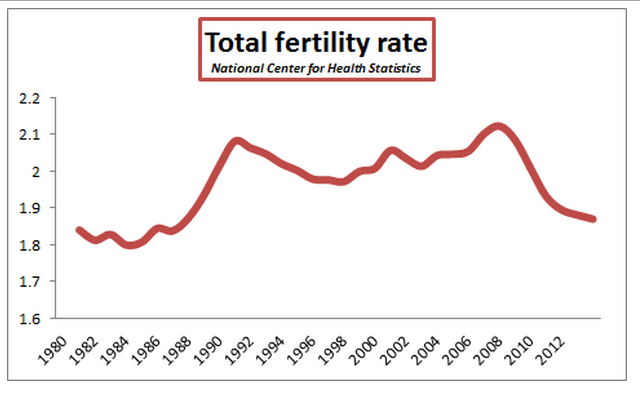
U.S. fertility is not recovering from the financial crisis — and demographers aren’t sure why. The fertility rate fell to a record low 62.9 births per 1,000 women aged 15-44 in 2013, according to the National Center for Health Statistics.

The total number of births, at 3.96 million, inched up by a mere 4,000 from 2012, the first increase since the financial crisis. But the total fertility rate, or TFR, the average number of children a woman would have during her child-bearing years, fell to just 1.86, the lowest rate in 27 years. TFR is considered the best metric of fertility. A TFR of 2.1 represents a stable population, with children replacing parents as they die off.

Demographers expected the fertility rate to fall during recession, as financially strapped families put off childbearing. But what has surprised some demographers is both the depth of the decline and the fact that fertility has continued to drop even over the course of the country’s five years of slow but steady recovery. The rate has fallen steadily each year since 2007, when it stood at 2.1 …….. 

One foreseen factor behind the dropoff in childbearing is the rapid decline in Hispanic-American fertility.

 For several decades, high Hispanic childbearing has been driving U.S. population growth. White fertility has been under the 2.1 replacement rate for decades, and ranged from 1.7 to 1.9 in the 2000s. The TFR for black Americans first fell below 2.1 in the early 2000s. 

But the number of children per Hispanic-American woman has plummeted from just under three in 1990 and 2.7 as recently as 2008 to 2.19 in 2012, just above the replacement rate.

That decline has been mirrored in other Hispanic countries. Mexico’s TFR has fallen precipitously, from 6.7 in 1970 to 2.2 in 2012, according to the World Bank. A similar decline has taken place in El Salvador, and to a lesser extent Honduras and Guatemala, all three prominent countries of origin for American Hispanics. ….


Preventing extremism: Why stop European jihadists from going to Syria?

June 8, 2014

The Financial Times (paywalled) reports that “Western intelligence agencies have handed Turkish authorities the names of nearly 5,000 people they fear are attempting to travel to Syria to join al-Qaeda linked groups, in a stark illustration of the escalating terror threat posed by homegrown jihadis”.

Turkey has already deported between 1,000 and 2,000 “jihadists” back to their home countries in Europe where they then become a virulent threat.

DailyBeast: It is a scenario that counter-terrorism experts have been warning about for the past two years: a European citizen who travelled to Syria in order to join up with jihadist groups returns to Europe in order to carry out a terrorist attack. It is something we all knew eventually would become a reality and, more worryingly, knew we could not prevent.

“Moderate Islam” in European countries is conspicuous by its complete absence in holding back the extremists and the idiot fanatics. I have no doubt that most Muslims are moderate. But they have been too passive for far too long against their own extremists.  In Europe, in Africa and even in China. They have – for example – allowed the extremists to take over parts of the school system in Birmingham in the UK. But it is not just “moderate Islam” which has abdicated its responsibilities. The political establishment in Europe (mainly) has to take its share of the blame. Political correctness in Europe involves allowing all fanatics and extremists – whether from the neo-Nazis as in Ukraine or Greece or from the religious Islamic fanatics in France and the UK or from the ecofascism of the hard-left green activists – to flourish unchecked.

But I wonder why the intelligence agencies don’t just let these jihadists reach Syria? Why warn Turkey and then have them all deported back to carry out their mayhem? If the US could revoke Snowden’s passport while he was travelling, surely it would be most effective for the US and EU countries to merely revoke those of the 5,000 known to be on their way to Syria? And concentrate on preventing their return? Like it or not, in the current situation Bashar al-Assad could be best equipped to handle these fanatics.

In the long run of course the alienated youth who are then radicalised have to be addressed at home. And the best bet is if “moderate Islam” is encouraged to defuse and neutralise their idiot fanatics. The position of the political centre defines the extremes. A passive centre allows the political spectrum to be skewed towards one extreme or the other or even to reach a bifurcation. The way to prevent unacceptable extremism lies then, I think, not in trying to prevent the extreme views from forming (which is futile) but in having a sufficiently pro-active centre which effectively starves the extremists of recruits.

California Chrome is a great horse but no Big Red

June 8, 2014

Well, California Chrome came up short. He is not the “tremendous machine” that Big Red was!

I am no horse racing fanatic but much of my lingering interest was first engendered by Big Red (Secretariat) and his exploits. Over the years my interest has declined but it was rekindled this year as the California Chrome “rags to riches” story has unfolded.

WaPo: His humble origins — born to an $8,000 mare, by a sire with a $2,000 stud fee — turned him into a cult figure and then a superstar following his wins in Louisville and Baltimore. But was he a “one-in-a-bazillion” champion, as co-owner Coburn called him this week? Or another Triple Crown pretender who lacked the stamina, sturdiness or stomach to win for the third time in five weeks against a pack of rivals?

Only 11 horses have ever won the Triple Crown. Big Red was the ninth winner after a gap of 25 years in 1973. Then Seattle Slew triumphed in 1977 and Affirmed won the Triple in 1978. And now it will be at least a gap of 37 years before there is another Triple Crown winner.  This year, California Chrome had won the Kentucky Derby and the Preakness and was attempting to be the 12th winner. He was the odds-on favourite, but yesterday he came up short and finished fourth in the Belmont Stakes.

Secretariat was special. When he died in 1989 his heart was found to be almost twice as large as “normal”. Big Red still holds the record for all the 3 races (the Kentucky Derby, the Preakness Stakes and the Belmont Stakes). Maybe he was a freak. In any case, in forty odd years of trying, genetics and horse breeding “science” have failed to produce a horse to match.

Wiki: Secretariat’s genetic legacy may be linked in part to the likelihood that he carried the “x-factor” (a trait linked to a large heart, carried only on the X chromosome) and thus, a trait Secretariat could only pass on via his daughters. However, it is yet to be proven whether the x-factor increases athletic ability.

I listened to the running of the 1973 Belmont Stakes on radio (live telecasts across the Atlantic were not around). It was not an exciting race in itself because Big Red was never threatened. It was enormously exciting as the culmination of a season. It was awe-inspiring in the manner and margin of his winning. At the finish line he was 31 lengths ahead and still going away.

But nowadays with the magic of YouTube, his majestic run is universally available.

“THE TREMENDOUS MACHINE”

Fat pigs are happy pigs

June 7, 2014

Caesar: Let me have men about me that are fat ..

A truth known already in Shakespeare’s day and a new paper seems to confirm the adage – even if only for pigs.

Annika Maria Juul Haagensen et al, High Fat, Low Carbohydrate Diet Limit Fear and Aggression in Göttingen Minipigs, PLOS One, DOI: 10.1371/journal.pone.0093821

Nordic Science:Most of us associate the words ‘fat’ and ‘cholesterol’ with overweight, cardiovascular disease and unhealthy lifestyles but we could all be wrong, according to researchers who argue that not even the infamous saturated fats are as bad as we think they are. 

A new Danish study reveals that a diet high in fat and cholesterol makes pigs more social, less aggressive and less fearful. According to the researchers behind the study, such behaviour is associated with good health. …….. 

Even though the study was done on pigs the results would most likely be applicable to humans as well, says Annika Maria Juul Haagensen, PhD in Veterinary Disease Biology at the University of Copenhagen, who authored the study.

“It’s definitely something we should consider,” she says. “The next step is to determine how much fat is optimal for our physical and psychological health.”

Associate professor Lotte Lauritzen from the Department of Nutrition, Exercise and Sports at the University of Copenhagen says that’s a reasonable assumption.

“Previous studies on monkeys and rodents support these findings,” she says. “We know that our brain cells need fat to make new connections and function optimally.”

For instance, she says, too little omega 3 fat affects the serotonin system which regulates our mood. …….. 

“There are several possible explanations to the changes in behaviour we observed in the pigs that were fed more fat,” she says.

One could be that the fat and cholesterol cause an increased release of serotonin. The higher levels of serotonin could’ve changed how aggressive, depressive and anxious the pigs were.

“At the same time a study shows that cholesterol increases the permeability between brain cells and blood. This means that more nutrients are transferred from the blood to the cells,” says Haagensen.

Fat and sugar and cholestorol are not all bad and don’t quite deserve the demonisation they have been subject to.