The pandemic has shown, globally and in Sweden, an utter failure of public health policy. Epedemiology is not a science. It may use scientific methods but science is a process which leads to knowledge. And the level of knowledge of pandemics and human behaviour is clearly not so very high. The media and governments – and the general public – have been incredibly gullible and have swallowed speculation as being knowledge. Health organisations (WHO and FHM) were not even certain to begin with whether to encourage the spread of the virus to get to herd immunity or to contain the spread. Even now, one year later, the only real advice is “avoid infection”. Social distancing, lockdowns, closed schools, closed shopping centres, isolation bubbles, face masks are no different to the advice available 500 years ago when infection was experienced.
The Lancet: “From the onset of the COVID-19 pandemic, the Public Health Agency, Folkhälsomyndigheten (FHM), embarked on a de-facto herd immunity approach, allowing community transmission to occur relatively unchecked”.
For every crazy proposal from the scientific community there was another scientist available to present the opposite view. For every crazy idea there was a politician available to promote it. Governments abdicated their own responsibility by relying on bureaucrats pretending to have knowledge. In the case of the Swedish government there was first denial followed by abdication of responsibility. The excuse given was that they were following the advice of “expert institutions” – except that the experts did not actually know very much.
In any case, all those old people who died were going to die anyway.
En misslyckande i folkhälsopolitiken
En sak är säker.
Pandemin har visat en misslyckande i folkhälsopolitiken globalt och i Sverige. Epedemiologi är ingen vetenskap. Det kan använda vetenskapliga metoder men vetenskap är en process som leder till kunskap. Och kunskapsnivån om pandemier och mänskligt beteende är uppenbarligen inte så hög. Media och regeringar – och allmänheten – har varit otroligt lättlästa och har svalt spekulation som kunskap. Hälsoorganisationer (WHO och FHM) var inte ens säkra på att börja med om de skulle uppmuntra spridningen av viruset för att komma till flockimmunitet eller att begränsa spridningen.
The Lancet: “From the onset of the COVID-19 pandemic, the Public Health Agency, Folkhälsomyndigheten (FHM), embarked on a de-facto herd immunity approach, allowing community transmission to occur relatively unchecked”.
Redan nu, ett år senare, är det enda riktiga rådet att “undvika infektion”. Social distansering, lockdowns, stängda skolor, stängda köpcentra, isoleringsbubblor, ansiktsmasker skiljer sig inte från de råd som fanns för 500 år sedan när infektion upplevdes. För varje galet förslag från det vetenskapliga värld fanns en annan forskare tillgänglig för att presentera motsatt uppfattning. För varje galen idé fanns en politiker tillgänglig för att marknadsföra den. Regeringar avstod från sitt eget ansvar genom att förlita sig på byråkrater som låtsas ha kunskap. För den svenska regeringen var det första förnekandet följt av avstående från ansvaret. Ursäkten var att de följde råd från “expertimyndigheter” – förutom att experterna faktiskt inte visste så mycket.
I vilket fall som helst skulle alla de gamla människorna som dog ändå dö.
The new challenge for the 22nd century, which will override almost all the perceived challenges and existential threats of today, will be population decline. How our intricately connected and interdependent world for food production, manufacturing, financial services, health services, education and leisure will be able to cope with a declining population, a declining work force and an increasing proportion of population (<20, >70) being non-productive, will be the dominating challenge faced by humanity. The pressure on some resources will clearly decrease. The further development and spread of automation will become an absolute must. The increasing use of “smart” contraptions with some embedded AI and the increasing interconnections between smart devices will be the primary means of compensating for the decline in humans available. Paradoxically, increasing automation and the increasing interconnections between our smart devices will probably lead to a decline in the interdependence of humans on each other. Each individual will be more dependent upon interconnected devices but less dependent upon other humans. Human independence – from other humans – could reach levels not seen since before the industrial revolution, but by choice rather than enforced.
The UN medium forecast based on the continuing decline in world fertility has the world reaching peak population at just over 11 billion just before 2100. But fertility rates are declining faster than the medium forecast.
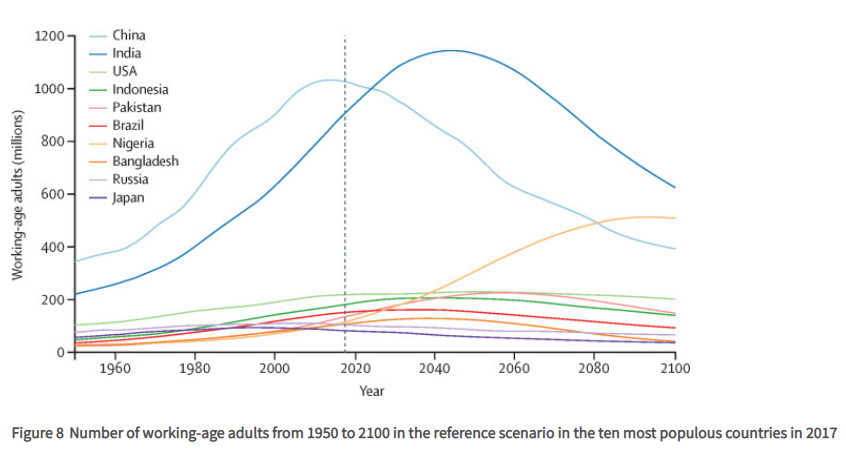
Global fertility is falling faster than any prediction. It has reached critical levels in Japan and parts of Eastern Europe. Iran is providing incentives for increasing birth rates. In most of the EU countries it is only immigration and its consequence on fertility which is delaying the inevitable decline in fertility rates. The increased fertility rates among immigrant communities declines within a generation to match the “indigenous” rates. The Chinese population is already in decline. The Indian population will peak before 2050 rather than around 2070. Even Nigeria where population was expected to peak after 2100 will now reach its maximum probably by 2090, or even earlier.
New studies (The Lancet, July 14, 2020, DOI:https://doi.org/10.1016/S0140-6736(20)30677-2 ) now put the global population reaching a peak of 9.7 billion by 2064 and declining to 8.8 billion by 2100.
The work force decline has already started in China. In India it will start declining by 2050. It has become blindingly apparent during the corona virus pandemic that it is the work force which is both the “blood” which circulates and keeps our societies alive, and it is the glue which holds our societies together. It is in compensating for these human functions that automation and “smart” devices with some AI will come increasingly into play. A natural consequence is that having smarter devices leads to a fundamental change in the classic centralised- distributed paradigm. More smarts locally leads to more and narrower specialisation centrally.
I see the growing independence of individuals as inevitable with a declining human population together with smarter devices serving us. Smarter diagnostics and basic, automated health care locally is then complemented by fewer, very specialised central hospitals. The catchment area has to increase as the specialisations become narrower. (As is already happening in Scandinavia). Increasing on-line learning (local) is then complemented by specialised learning at the – fewer – centres. (As is already happening in Japan). Manufacturing (including food production and even farming) is increasingly automated.
In the 22nd and 23rd centuries there will not be a shortage of resources (food or water or energy), and there will be no shortage of growth as smart machines take over the boring and the mundane jobs, and there will be no decline in human ingenuity and creativity. But there may be a shortage of human companionship.
There have been a number of sanctimonious platitudes about the dangers of vaccine nationalism from the usual suspects (UN Sec Gen, WHO Dir Gen, …). This has been virtue signalling at its worst. Any national government which did not first secure its own citizens would be failing in its primary task. It is again a case of people forgetting that international is not possible without first securing the national. Philanthropy between countries cannot happen unless there is first nationalism.
And so it is between India and Brazil.
Covishield is the brand name of the AstraZeneca/Oxford vaccine manufactured by the Serum Institute of India. So far India has despatched over 3 million doses of Covishield to Bangladesh, Nepal, Bhutan, Myanmar, Seychelles, Mauritius and Brazil. Brazil receives 2 million doses today. President Bolsanaro has invoked images from the Ramayana in his message of thanks. Sri Lanka and Afghanistan are to also receive vaccines in the next despatch. This vaccine can be transported and stored at between +2 and +8 degrees Celsius and has a shelf-life of 6 months. This vaccine philanthropy by India is only possible because sufficient stocks, greater than the rate of vaccination, are available for its own citizens.
The EU has not yet approved this vaccine but this approval is expected on 29th January. Neither has the US approved. I have my own theory that the EU delay in approval is not unconnected with protecting some market for the other, more expensive, more difficult to transport vaccines. Not quite a conspiracy theory but at least some unconscious collusion.
Surfing through my computer in these corona times, I came across this talk I gave 4 years ago. I might even have posted something about it but I can’t remember.
“My thesis tonight is that all our actions are much more dependent on faith, and less dependent on knowledge, than one superficially believes.
Of all that I claim is my knowledge, only a very small part is what I have observed or developed or proved myself. Most of my knowledge is actually the knowledge of others or part of humanity’s collective knowledge, along with my belief that it’s true.
I “know”, for example, that the earth is a flattened spheroid, not because I have personally observed this, but because I “believe” in all the people who have made such observations and have brought this truth into the knowledge of mankind. Most of our actions are then based, not on our own personal knowledge, but on the belief that everything that lies within the knowledge of the whole of humanity is true.
I would argue that faith goes even deeper. “To believe” is a necessary and integral part of “to live”. The future can never be in the field of knowledge. “Living” requires a basic belief that the future exists. Even when I take my last breath, I will do so in the belief that there will be another breath to take. This belief is deeper than thinking and comes far before knowledge. I claim that it is the deepest faith that exists. Believing in a future is existential.
Without this belief in a future, life does not exist. Every time I breathe, I do it in the belief that I have a future. And that day, when I take my last breath, that belief becomes false”.
Fake News is created just as much by excluding selected news as by inventing stories. Cancelling news also creates fake news.
Google’s “experiment” in Australia has been exposed recently. However, this is not the first such “experiment” and it won’t be the last. But exclusion is a tool used widely by every news outlet to try and control the narrative (and it is noticeable that every outlet does try to control the narrative). There is no news outlet anymore that does not have its own agenda which does not engage in excluding what is unpalatable. All social media platforms have self-serving agendas. They all indulge in “exclusion” as a tool. Sometimes it is simply to create a false (favourable) picture to increase revenues from advertising. Sometimes it is to be politically correct and avoid legal, political or social sanction. It is the same phenomenon which drives the “cancel culture”. We are all familiar with paid advertising always getting preference in Google searches. But Googles’s search algorithms are secret and supposedly untouched by human hand, but they are always changing. They know very well that few go beyond the second page of search results. The algorithms are constantly being tweaked. And in every tweak there is some new exclusion and some new Fake News.
Perceived reality has little to do with “facts” and is entirely about the current narrative. History has become (has always been) a servant of the current narrative. Google Search is primarily a tool for the creation of advertising revenue. The search is always biased in the algorithm. The perceived objectivity of the search is secondary to the revenue objective. Fake News has become a major part of the output of Mainstream Media and exclusion is just another tool for the creation of a false narrative.
I am now running WhatsApp and Signal in parallel with a view to dumping WhatsApp in due course. Of course WhatsApp has been desperately putting out clarifications about why there is no reason to leave them, but it seems they protest too much.
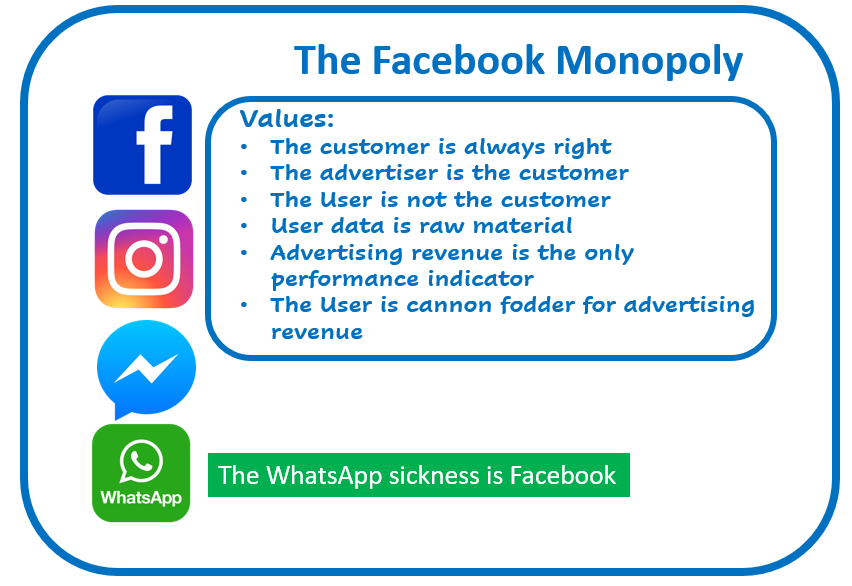
What is clear is that WhatsApp does share a great deal of data with its parent Facebook and from February 8th users will not be able to opt out.
WhatsApp does share the following:
phone number, name and other information provided on registration
information about the user’s phone, including make, model, and mobile company
internet protocol (IP) addresses, which indicate the location of a user’s internet connections
any payments and financial transactions made over WhatsApp
There is no way in which WhatsApp can resist any future demands from its parent. I expect that a critical mass of users switching out of WhatsApp will come within the next 3 or 4 weeks.
The biggest problem WhatsApp has is that it is owned by Facebook.
Mathematics today is classified into more than 40 different areas by journals for publication. I probably heard about the 3 R’s (Reading, Riting and Rithmetic) first at primary school level. At high school, which was 60 years ago, mathematics consisted of arithmetic, geometry, algebra, trigonometry, statistics and logic – in that order. I remember my first class where trigonometry was introduced as a “marriage of algebra and geometry”. Calculus was touched on as advanced algebra. Some numerical methods were taught as a part of statistics. If I take my own progression, it starts with arithmetic, moves on to geometry, algebra and trigonometry and only then to calculus and statistics, symbolic logic and computer science. It was a big deal when, at 10, I got my first “compass box” for geometry, and another big deal, at 13, with my first copy of trigonometric tables. At university in the 70s, Pure Mathematics was distinguished from Applied Engineering Mathematics and from Computing. In my worldview, Mathematics and Physics Departments were where the specialist, esoteric mysteries of such things as topology, number theory, quantum algebra, non-Euclidean geometry and combinatorics could be studied.
I don’t doubt that many animals can distinguish between more and less. It is sometimes claimed that some primates have the ability to count up to about 3. Perhaps they do, but except for in the studies reporting such abilities, they never actually do count. No animals apply counting, They don’t exhibit any explicit understanding of geometrical shapes or structures, though birds, bees, ants and gorillas seem to apply some structural principles, intuitively, when building their nests. Humans, as a species, are unique in not only imagining but also in applying mathematics. We couldn’t count when we left the trees. We had no tools then and we built no shelters. So how did it all begin?
Sometimes Arithmetic, Geometry and Algebra are considered the three core areas of mathematics. But I would contend that it must all start with counting and with shapes – which later developed into Arithmetic and Geometry. Algebra and its abstractions came much later. Counting and the study of shapes must lie at the heart of how prehistoric humans first came to mathematics. But I would also contend that counting and observing the relationship between shapes would have started separately and independently. They both require a certain level of cognition but they differ in that the study of shapes is based on observations of physical surroundings while counting requires invention of concepts in the abstract plane. They may have been contemporaneous but they must, I think, have originated separately.
No circle of standing stones would have been possible without some arithmetic (rather than merely counting) and some geometry. No pyramid, however simple, was ever built without both. No weight was dragged or rolled up an inclined plane without some understanding of both shapes and numbers. No water channel that was ever dug did not involve some arithmetic and some geometry. Already by the time of Sumer and Babylon, and certainly by the time of the Egyptians and the Harappans, the practical application of arithmetic and geometry and even trigonometry in trade, surveying, town planning, time-keeping and building were well established. The sophisticated management of water that we can now glimpse in the ancient civilizations needed both arithmetic and geometry. There is not much recorded history that is available before the Greeks. Arithmetic and Geometry were well established by the time we come to the Greeks who even conducted a vigorous discourse about the nobility (or divinity) of the one versus the other. Pythagoras is not happy with arithmetic since numbers cannot give him – exactly – the hypotenuse of a right triangle of sides of equal length (√2). Which he can so easily draw. Numbers could not exactly reflect all that he could achieve with a straight edge and a compass. The circle could not be squared. The circumference was irrational. The irrationality of the numbers needed to reflect geometrical shapes was, for the purists, vulgar and an abomination. But the application of geometry and arithmetic were common long, long before the Greeks. There is a great distance before counting becomes arithmetic and the study of shapes becomes geometry but the roots of mathematics lie there. That takes us back to well before the Neolithic (c. 12,000 years ago).
That geometry derives from the study of shapes and the patterns and relationships between shapes, given some threshold level of cognition, seems both obvious and inevitable. Shapes are real and ubiquitous. They can be seen in all aspects of the natural world and can be mimicked and constructed. The arc of the sun curving across the sky creates a shape. Shadows create shapes. Light creates straight lines as the elevation of the sun creates angles. Shapes can be observed. And constructed. A taut string to give a straight line and the calm surface of a pond to give a level plane. A string and a weight to give the vertical. A liquid level to give the horizontal. Sticks and shadows. A human turning around to observe the surroundings created a circle. Strings and compasses. Cave paintings from c. 30,000 years ago contain regular shapes. Circles and triangles and squares. Humans started not only observing, but also applying, the relationships between shapes a very long time ago.
Numbers are more mystical. They don’t exist in the physical world. But counting the days from new moon to new moon for a lunar month, or the days in a year, were also known at least 30,000 years ago. Ancient tally sticks to count to 29 testify to that. It would seem that the origins of arithmetic (and numbers) lie in our ancient prehistory and probably more than 50,000 years ago. Counting, the use of specific sounds as the representation of abstract numbers, and number systems are made possible only by first having a concept of identity which allows the definition of one. Dealing with identity and the nature of existence take us before and beyond the realms of philosophy or even theology and are in the metaphysical world. The metaphysics of existence remain mystical and mysterious and beyond human cognition, as much today as in prehistoric times. Nevertheless, it is the cognitive capability of having the concept of a unique identity which enables the concept of one. That one day is distinguishable from the next. That one person, one fruit, one animal or one thing is uniquely different to another. That unique things, similar or dissimilar, can be grouped to create a new identity. That one grouping (us) is distinguishable from another group (them). Numbers are not physically observable. They are all abstract concepts. Linguistically they are sometimes bad nouns and sometimes bad adjectives. The concept of one does not, by itself, lead automatically to a number system. That needs in addition a logic system and invention (a creation of something new which presupposes a certain cognitive capacity). It is by definition, and not by logic or reason or inevitability, that two is defined as one more than the identity represented by one, and three is defined as one more than two, and so on. Note that without the concept of identity and the uniqueness of things setting a constraint, a three does not have to be separated from a two by the same separation as from two to one. The inherent logic is not itself invented but emerges from the concept of identity and uniqueness. That 1 + 1 = 2 is a definition not a discovery. It assumes that addition is possible. It is also significant that nothingness is a much wider (and more mysterious and mystical) concept than the number zero. Zero derives, not from nothingness, but from the assumption of subtraction and then of being defined as one less than one. That in turn generalises to zero being any thing less than itself. Negative numbers emerge by extending that definition. The properties of zero are conferred by convention and by definition. Numbers and number systems are thus a matter of “invention by definition”, but constrained by the inherent logic which emerges from the concept of identity. The patterns and relationships between numbers have been the heady stuff of number theory and a matter of great wonder when they are discovered, but they are all consequent to the existence of the one, the invention of numerals and the subsequent definition that 1 + 1 = 2. Number theory exists only because the numbers are defined as they are. Whereas the concept of identity provides the basis for one and all integers, a further cognitive step is needed to imagine that the one is not indivisible and then to consider the infinite parts of one.
Mere counting is sometimes disparaged, but it is, of course, the most rudimentary form of a rigorous arithmetic with its commutative, associative and distributive laws.
Laws of arithmetic
The cognitive step of getting to count in the first place is a huge leap compared to the almost inevitable evolution of counting into numbers and then into an arithmetic with rigorous laws. We will never know when our ancestors began to count but it seems to me – in comparison with primates of today – that it must have come after a cognitive threshold had been achieved. Quite possibly with the control of fire and after the brain size of the species had undergone a step change. That takes us back to the time of homo erectus and perhaps around a million years ago.
Nearly all animals have shape recognition to some extent. Some primates can even recognise patterns in similar shapes. It is plausible that recognition of patterns and relationships between shapes only took off when our human ancestors began construction either of tools or of rudimentary dwellings. The earliest tools (after the use of clubs) were probably cutting edges and these are first seen around 1.8 million years ago. The simplest constructed shelters would have been lean-to structures of some kind. Construction of both tools and shelters lend themselves naturally to the observation of many geometrical shapes; rectangles, polygons, cones, triangles, similar triangles and the rules of proportion between similar shapes. Arches may also have first emerged with the earliest shelters. More sophisticated tools and very simple dwellings take us back to around 400,000 years ago and certainly to a time before anatomically modern humans had appeared (c. 200,000 years ago). Both rudimentary counting and a sense of shapes would have been present by then. It would have been much later that circles and properties of circles were observed and discovered. (Our earliest evidence of a wheel goes back some 8,000 years and is the application of a much older mathematics). Possibly the interest in the circle came after a greater interest in time keeping had emerged. Perhaps from the first “astronomical” observations of sunrise and sunset and the motion of the moon and the seasons. Certainly our ancestors were well-versed with circles and spheres and their intersections and relationships by the time they became potters (earlier than c. 30,000 years ago).
I suspect it was the blossoming of trade – rather than the growth of astronomy – which probably helped take counting to number systems and arithmetic. The combination of counting and shapes starts, I think, with the invention of tools and the construction of dwellings. By the time we come to the Neolithic and settlements and agriculture and fortified settlements, arithmetic and geometry and applied mathematics is an established reality. Counting could have started around a million years ago. The study of shapes may have started even earlier. But if we take the origin of “mathematics” to be when counting ability was first combined with a sense of shapes, then we certainly have to step back to at least 50,000 years ago.
Science is not knowledge. Science is the process of acquiring knowledge.
It is inevitable that the the bulk of scientific effort produces no new knowledge. Gullibility lies in blindly “following the science” rather than following the knowledge.
Following the knowledge and applying the scientific method has led to the remarkably quick production of a number of vaccines but the spread of the pandemic was, without doubt, due to “following the science” even when the science was leading down false and fruitless trails. Epidemiology is still primarily about theories of behaviour which are far removed from being knowledge. Epidemiology is still more art than knowledge. Merely following the scientific method does not bestow credibility to the field. Applying the method does not make alchemy or homeopathy or witchcraft or “social sciences” into sciences. Every crazy idea about treatment or preventing the spread of the virus was, in fact, proposed by a “scientist”.
Only a minority of supposed “scientists” (probably around 20% by the 80:20 rule) actually do original science. Only a minority of postulates become hypotheses and only a minority of those ever become theories. That is the nature of science. In a majority of cases “following the science” will inevitably lead down fruitless paths. But there has been very little effort by journalists or politicians to distinguish between “following the science” and knowledge. In the absence of knowledge skepticism has been suspended and fake science and junk science have been elevated to be knowledge.
Tags: covid-19 Posted in Health, Science | Comments Off on Science has delivered the vaccines but blindly “following the science” caused the pandemic to spread
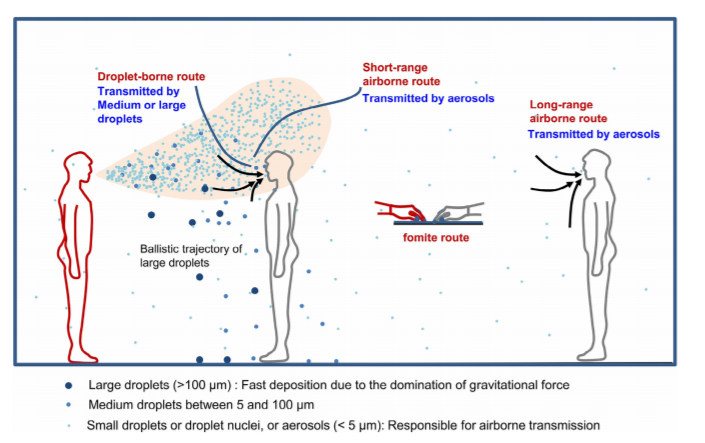
For airborne infections social distancing of 2m is not going to be enough. I presume the new London mutation of Covid-19 is particularly infectious because it is airborne. Face masks are not very helpful if the virus is airborne.
Airborne transmission is infection spread through exposure to those virus-containing respiratory droplets comprised of smaller droplets and particles that can remain suspended in the air over long distances (usually greater than 6 feet) and time (typically hours).
I take this to mean that to avoid infection you must avoid the space occupied by an infected person by 2m or by (say) 2 hours. Social distancing then has physical and temporal components.
But which also means that following in the footsteps of an infected person (for example in the supermarket checkout) does not have the necessary temporal distancing. Ventilation only shifts the virus further doing the time it stays “alive”/active. While ventilation to the the outside (on a plane, for example) will be helpful, airflow within an enclosed space only increases the distance needed in space to avoid infection.








 The k2p blog