Vatican — duping or duped about VSEL stem cells?

July 29, 2013

Vatican theologians have a long history of going to extraordinary lengths and convolutions to align theology with every new scientific advance. It has not been unknown for theologians to try and massage the facts and to direct new research along theologically “acceptable” paths.

The Vatican – and other religious organisations – consider the use of adult stem cells to be ethically quite acceptable whereas they consider the use of embryonic stem cells to be unethical since it involves the “murder” of the embryos. And they have put their weight behind VSEL (very small embryonic-like) stem cells. But they have gone overboard in promoting the possible benefits of the use of adult stem cells even to the extent of holding conferences about the potential benefits. But many researchers are appalled by theology overriding science and holding out false hopes.

Nature: April 2013

The Second International Vatican Adult Stem Cell meeting, held on 11–13 April in Vatican City, was a shamelessly choreographed performance. Sick children were paraded for television, sharing the stage with stem-cell companies and scientists desperate to hawk a message that their therapies must be speeded to clinical use. ….

A kilometre away at the Italian senate, meanwhile, parliamentarians further eroded protection for vulnerable patients targeted by stem-cell companies. On 10 April, they amended an already controversial ministerial decree (see Nature 495, 418–419; 2013) with a clause that would redefine stem-cell therapy as tissue transplantation, thereby releasing it from any regulatory oversight. If the second parliamentary chamber endorses this amendment, Italy will be out of step with the rules of the European Union and the US Food and Drug Administration, both of which define stem cells modified outside the body as medicines.

Many scientists around the world were appalled by the events in Rome, and rightly so. It is wrong to exploit the desperation of the disabled and the terminally ill and to raise false hopes of quick fixes, as some at the Vatican meeting tried to do. It is also wrong to try to use such patients as experimental animals by bypassing regulatory agencies, as the Italian parliament seems to want to do. ….

Now it seems that the Vatican has either been duped about very small embryonic-like stem cells or has been involved in perpetuating the myth that these cells even exist and offer an alternative.

RawStory:

Scientists at Stanford University School of Medicine issued a report this month that said a type of stem-cell alternative approved by the Vatican and other theologians has turned out to be a myth. According to an essay by bioethicist Arthur Caplan, Dr. Irving Weissman and his team have concluded that so-called very small embryonic-like (VSEL) stem cells are at best a laboratory error and at worst a deliberate fraud perpetrated on the scientific and religious communities.

In 2011, the Vatican called a press conference to present Polish stem cell biologist Mariusz Z. Ratajczak, who claimed that he had discovered heretofore unknown stem cells present in adult cells. These tiny cells, he claimed, could perform the same tasks as embryonic stem cells, including tissue regeneration and the miraculous capacity that embryonic stem cells have to mimic other types of cell tissue. Moreover, these VSEL cells, said Ratajczak, could be harvested from adult cells without harming human embryos or relying on them for cell material.

“The theologians,” wrote Caplan, “were delighted.” They believed that the new technology could halt what they see as the murder of unborn children. The Vatican took the unprecedented step of investing heavily in NeoStem, a company claiming to specialize in VSEL research and production, in hopes that the new technology would render the destruction of embryos for stem cells obsolete. ….. The trouble is, the cells don’t exist. At least, according to Weissman, who said that his team not only hasn’t been able to make VSELs perform their tissue-regenerative miracles in the laboratory, they can’t find them at all. …

….. Rüdiger Alt, head of research at Vita 34, an umbilical cord blood bank in Leipzig, Germany — whose team also failed to get results from Ratajczak’s methods — told the journal Nature, “Weissman’s evidence is a clincher — it is the end of the road for VSELs.”

Bioethicist Caplan wrote that supporters of VSEL research “say their peers just don’t have the techniques down for finding them. But it is just as likely that in their hope to find a solution to stem cell research acceptable to the Roman Catholic Church and other religious groups they have let themselves find something that is just not there.”

He concluded, “Until someone other then those tied to the power of VSELS for religious or business reasons can find them, be wary of any claims about their power to heal.”

Noted in Passing – 28th July 2013

July 28, 2013
two-kids-under-a-banana-leaf-in-the-rain-indonesia

Friends under a banana leaf: Photograph by Kendisan Seruyan (via twistedsifter)

I tend to take alarmist claims about the demise of species with a large grain of salt. As supported by this story about a species of North American bumblebee which virtually disappeared and which has now reappeared.

I don’t believe the scientists who say they know the secret of Usain Bolt and his speed.

Matt Ridley compares HS2 to Hadrian’s Wall.

For a “settled science”, there is a great deal which is still being found about how carbon dioxide affects plants. Wetland plants are found not only to absorb more carbon dioxide with high concentration of the gas but they also then emit less carbon dioxide.

John Hawks considers the Denisovans and the pre-Toba, post-Toba question.

Joschka Fischer who was German Foreign Minister and Vice Chancellor from 1998-2005 considers Egypt after Morsi.

Global population of polar bears keeps increasing (about 5,000 since 2001) even though some vested interests keep adjusting the numbers to try and show that there has been no significant change. They seem however to have abandoned efforts to show numbers declining.

That science is self-correcting may be true in the long term (more than a few decades) but it is largely a myth within the lifetime of scientists.

In the New Yorker, Atul Gawande considers the contrasting speeds at which anesthesia and the use of antiseptics spread and generally how ideas disseminate in the practice of medicine.

His involvement with Muammar Gaddafi is no great surprise but I suspect that we have not yet heard the full history of Tony Blair’s venality.

Any even natural number greater than 2 can be written as the sum of two prime numbers. Plus Maths on the Goldbach Conjecture.


Canada used indigenous children to “study” malnutrition

July 28, 2013

Yet another depressing story of how, in the name of “science”, the “establishment” made use of less “worthy” populations to carry out medical experiments.

This time in Canada from 1942 -1952.

There was no difference of principle and only one of degree between the medical experiments carried out in Nazi Germany and those carried out on native or disadvantaged populations in Australia, Canada, and the USA (among many other countries).

We may like to think that it does not happen any more. I am not so sure. The real story of Haiti and its cholera and the use of cheap, untested vaccines is yet to be told Similarly, some of the stories about the intentional “creation” of new strains of influenza and the subsequent discovery and dissemination of new vaccines for their cure may never ever become public.

Mosby, I. Social History 46, 145–172 (2013). Administering Colonial Science: Nutrition Research and Human Biomedical Experimentation in Aboriginal Communities and Residential Schools, 1942–1952

Abstract: Between 1942 and 1952, some of Canada’s leading nutrition experts, in cooperation with various federal departments, conducted an unprecedented series of nutritional studies of Aboriginal communities and residential schools. The most ambitious and perhaps best known of these was the 1947–1948 James Bay Survey of the Attawapiskat and Rupert’s House Cree First Nations. Less well known were two separate long-term studies that went so far as to include controlled experiments conducted, apparently without the subjects’ informed consent or knowledge, on malnourished Aboriginal populations in Northern Manitoba and, later, in six Indian residential schools. This article explores these studies and experiments, in part to provide a narrative record of a largely unexamined episode of exploitation and neglect by the Canadian government. At the same time, it situates these studies within the context of broader federal policies governing the lives of Aboriginal peoples, a shifting Canadian consensus concerning the science of nutrition, and changing attitudes towards the ethics of biomedical experimentation on human beings during a period that encompassed, among other things, the establishment of the Nuremberg Code of experimental research ethics.

Nature also reports:

Canadian government scientists used malnourished native populations as unwitting subjects in experiments conducted in the 1940s and 1950s to test nutritional interventions. The tests, many of which involved children at state-funded residential schools, had been largely forgotten until they were described earlier this month in the journal Social History by Ian Mosby, who studies the history of food and nutrition at the University of Guelph in Canada.

The work began in 1942, when government scientists visited several native communities in northern Manitoba and discovered widespread hunger and malnutrition. “Their immediate response was to study the problem by testing nutritional supplements,” says Mosby. From a group of 300 malnourished people selected for the tests, 125 were given vitamin supplements, and the rest served as ‘untreated’ controls. ….

Nancy Walton, a medical ethicist at Ryerson University in Toronto, Ontario, and former chairwoman of the university’s research-ethics board, says that such a project would never be allowed today, “but in the context of that time, it’s unfortunately not surprising”. Awareness of the need for informed consent in human studies was growing — informed consent was a central tenet of the Nuremberg Code, developed in the late 1940s — but the idea had not yet been adopted around the world.

“It’s not just bad ethics, it’s bad science,” Walton says of the Canadian government research. “They didn’t appear to try and prove or disprove any hypothesis that I can see, or make any statistical correlations.”

Indeed, says Mosby, very little of value came out of the research. He found no evidence that the northern Manitoba study was completed or published. The school experiments were presented at conferences and published, but they led to no important advances in nutritional science or improvements in conditions at the schools. “They mostly just confirmed what they already knew,” Mosby says. ….


The lunar nodal cycle and its effects on climate

July 27, 2013

A paper has just been published in the International Journal of Climatology showing that the lunar nodal cycle influences “the low-frequency summer rainfall variability over the plains to the east of subtropical Andes, in South America, through long-term sea surface temperature (SST) variations induced by the nodal amplitude of diurnal tides over southwestern South Atlantic (SWSA).”

Eduardo Andres Agosta, The 18.6-year nodal tidal cycle and the bi-decadal precipitation oscillation over the plains to the east of subtropical Andes, South America, International J of Climatology, DOI: 10.1002/joc.3787

Abstract: This work shows statistical evidence for lunar nodal cycle influence on the low-frequency summer rainfall variability over the plains to the east of subtropical Andes, in South America, through long-term sea surface temperature (SST) variations induced by the nodal amplitude of diurnal tides over southwestern South Atlantic (SWSA). In years of strong (weak) diurnal tides, tide-induced diapycnal mixing makes SST cooler (warmer) together with low (high) air pressures in the surroundings of the Malvinas/Falklands Islands in the SWSA, possibly through mean tropospheric baroclinicity variations. As the low-level tropospheric circulation anomalies directly affect the interannual summer rainfall variability, such an influence can be extended to the bi-decadal variability present in the summer rainfall owing to the nodal modulation effect observed in the tropospheric circulation. The identification of the nodal periodicity in the summer rainfall variability is statistically robust.

The lunar nodal cycle is not something that is very well known but it is another celestial cycle which is clearly not to be ignored. Naturally the IPCC takes no notice of solar cycles, planetary cycles or lunar cycles and all these are lumped into what could be considered “natural variability”.

(Sourced from Wikipedia)

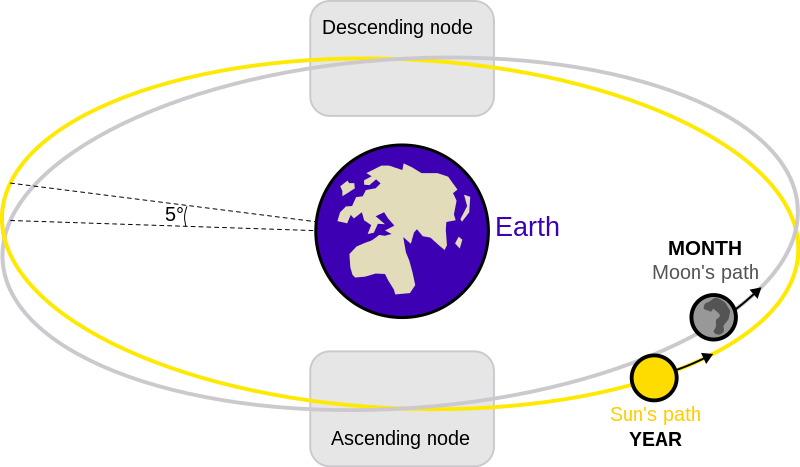
The lunar orbit is inclined by about 5 degrees on the ecliptic. The moon  therefore can lie up to about 5 degrees north or south of the ecliptic. The ecliptic is the plane of the apparent path of the Sun on the celestial sphere, and is coplanar with both the orbit of the Earth around the Sun and the apparent orbit of the Sun around the Earth.

File:Lunar eclipse diagram-en.svg

Lunar eclipse orbital diagram: wikipedia

The lunar nodes precess around the ecliptic, completing a revolution (called a draconitic or nodical period, the period of nutation) in 6793.5 days or 18.5996 years.

The effects of the 18.6 year lunar nodal cycle on climate on tides and geological sediments and on weather and climate have long been of interest (though not apparently for the IPCC).

Nanocycles Method is the English translation of the title of a book published in Russian by Professor of Geology S Afanasiev of Moscow University in 1991,ISBN 5–7045–0109–0.

From “Nanocycles Method” by S Afanasiev, 1991

The lunar node cycle, which is presently 18.6 years, affects the rainfall on a 9.3 year cycle and this shows up as varying thickness layers of deposits, or varves, in geological formations. 

However the moon’s orbit is gradually getting larger over time and so its period is slowing down. The rate of movement of the nodes is also decelerating and Prof Afanasiev has determined the accurate nodal cycle period for the whole of the last 600 million years.

The cycle of the lunar node is important in affecting the weather because it plays a part in determining tides in the atmosphere, oceans and solid body of the earth. The atmospheric tides affect rainfall which in turn affects river flows and hence the deposition of geological varves, or annual deposits in geological layers. ….. 

At the present time, with a nodal cycle of 9.3 years, successive nodal cycles begin 0.3 years later in the seasons each cycle. Therefore after 3 or 4 cycles the nodal cycle start return to the same time of year again. The average period of the cycle when the nodal cycle comes at the same time of year is 9.3/0.3 or 31 years. Specific occurrences of nearly the same season, within 0.1 year, will occur after 28, 65 and 93 years and so on. 

…. Because the lunar nodal cycle period has changed from 9.147 years to 9.298 years in the last 1.0 million years, the secondary cycle has varied from 62.12 years to 31.21 years. If this cycle can be measured in a deposit to an accuracy of 1 year then it allows the dating of the deposit to an accuracy of +/-0.03 million years.

A small selection of papers dealing with the effects of the 18.6 year lunar nodal cycle is given below:

Transylvanian Hypothesis lives again — Now lunar cycles found to affect sleep

July 26, 2013

Moon sickness is becoming all the rage. Hot on the heels of the report that cardiac surgery results are affected by the phases of the moon comes this study showing that lunar cycles do – in fact – also affect sleep. Our bodies it seems also dance to a lunar rythm and maybe it is time to revive the Transylvanian Hypothesis and revisit all the myths and legends about the effects of the moon (werewolves, induced lunacy, epileptic fits and even lunar effects on general practice consultancy rates!)

A new paper in Current Biology

Christian Cajochen, Songül Altanay-Ekici, Mirjam Münch, Sylvia Frey, Vera Knoblauch, Anna Wirz-Justice. Evidence that the Lunar Cycle Influences Human Sleep. Current Biology, 2013; DOI: 10.1016/j.cub.2013.06.029

from planetsforkids

EurekAlert: 

Many people complain about poor sleep around the full moon, and now a report appearing in Current Biology, a Cell Press publication, on July 25 offers some of the first convincing scientific evidence to suggest that this really is true. The findings add to evidence that humans—despite the comforts of our civilized world—still respond to the geophysical rhythms of the moon, driven by a circalunar clock.

“The lunar cycle seems to influence human sleep, even when one does not ‘see’ the moon and is not aware of the actual moon phase,” says Christian Cajochen of the Psychiatric Hospital of the University of Basel.

In the new study, the researchers studied 33 volunteers in two age groups in the lab while they slept. Their brain patterns were monitored while sleeping, along with eye movements and hormone secretions.

The data show that around the full moon, brain activity related to deep sleep dropped by 30 percent. People also took five minutes longer to fall asleep, and they slept for twenty minutes less time overall. Study participants felt as though their sleep was poorer when the moon was full, and they showed diminished levels of melatonin, a hormone known to regulate sleep and wake cycles.

“This is the first reliable evidence that a lunar rhythm can modulate sleep structure in humans when measured under the highly controlled conditions of a circadian laboratory study protocol without time cues,” the researchers say.

Cajochen adds that this circalunar rhythm might be a relic from a past in which the moon could have synchronized human behaviors for reproductive or other purposes, much as it does in other animals. Today, the moon’s hold over us is usually masked by the influence of electrical lighting and other aspects of modern life.

The researchers say it would be interesting to look more deeply into the anatomical location of the circalunar clock and its molecular and neuronal underpinnings. And, they say, it could turn out that the moon has power over other aspects of our behavior as well, such as our cognitive performance and our moods.


Rebranding of Narendra Modi is well under way

July 26, 2013

Back in 2011 I posted about the rebranding of Narendra Modi being orchestrated by Steven King and APCO Worldwide and which had started in 2009. His chances then of overcoming his Gujarat-riots reputation to become the BJP’s candidate for Prime Minister  were small at that time.

That has all changed now and the odds of his being the PM candidate are very high and his chances of becoming the next PM of India must be better than 50%.

Modi is not only the leading candidate to be the BJP’s candidate for PM for the 2014 elections, he has also been appointed the head of BJP’s campaign. He has started his efforts to gain acceptance across the country and regional parties are beginning to position themselves and even if they are not all rushing to show their support for him, they are certainly busy getting onto the fence so that they could support him if it becomes necessary or it could be beneficial. (Indian political parties all strictly follow the ideology of Opportunism).

Steven King – after his plagiarism fiasco – is no longer shown on APCO Worldwides’s website. If APCO are still working for Modi they are not doing it directly. During the floods in Uttarakhand a rather stupid effort was made to show Modi as a hero in the rescue of flood victims. This quickly backfired as in this article in the Times of India. The article mentioned APCO Worldwide  and led to APCO denying that they had anything to do with the rescue story or that they were working for Modi.

India is a big market for APCO and they are going to very careful in the run-up to the election to keep their ties to all political parties alive.  APCO India Brochure

Whatever the truth of APCO’s involvement (and I think the rescue story was a little crude for APCO) some PR group is certainly trying to orchestrate the rebranding of the Modi image. I would not be at all surprised that such a PR Group had – or has – links to APCO.

The latest story about 65 MP’s writing to Obama to ensure that Modi was not granted a US visa followed by 9 MP’s claiming that their signatures on the letter were forged is sufficiently convoluted to make me suspect the guiding hand of a well experienced PR exponent. The result of the circus is that the 65 MP’s look petty and vindictive and are all on the defensive. The Congress Party and the Left parties are busy distancing themselves from the writing of such a letter. Even the BJP has had to point out that they have no significant differences in foreign policy from that of the present government. Modi comes out very nicely with the faint glow of a halo beginning to appear.

Even the reports in the media that Nobel laureate Amartya Sen has stated that he does not believe in Modi’s economics and does not want him to be his Prime Minister are actually working to Modi’s advantage. (Sen’s attack on the real achievements in Gujarat is particularly silly – but I note in passing that it is not at all uncommon for Nobel laureates in Economics to make idiots of themselves). In fact, Sen now being “associated” in the public mind with Rahul Gandhi, is to Gandhi’s disadvantage. In my suspicious mind I see the hand of a skilled PR man again, who has successfully provoked Sen into making a silly – almost stupid – attack on Modi – to Modi’s eventual benefit. If Amartya Sen is really opposed to Modi, he has just scored an own goal – or three.

If the 2014 election becomes a personality contest between Narendra Modi and Rahul Gandhi, it would – I think – be a walk-over for Modi. The real skill of Modi’s PR strategists will show in their ability to marshall the diverse regional parties behind Modi. Exactly how they can mobilise and align the different caste groups will be particularly convoluted and fascinating to watch.

Yoghurt and Spice

July 26, 2013

Bowel disease found to be twice as common in Western Europe than in Eastern Europe.

Of course they don’t know why it should be  that “Crohn’s disease (CD) and ulcerative colitis (UC) are. twice as common in Western Europe as in Eastern Europe”.

I think it’s because there’s much more yoghurt in the Eastern European diet and not enough spice in the Western European diet!

Yoghurt and spice chicken image- health.com

 ScienceNordic  reports: 

A huge study with data from ten million people points towards a previously undescribed tendency. The bowel diseases Crohn’s disease (CD) and ulcerative colitis (UC) are twice as common in Western Europe as in Eastern Europe. The international study was headed by a group of researchers at the Digestive Disease Centre, Copenhagen University Hospital, Herlev, Denmark.

The researchers gathered data about CD and UC patients from 31 intestinal health centres from more than 20 countries throughout Europe. The centres covered a total of some ten million people.
”The whole point of setting up a project such as this one is that we want everyone to take part. We have approached as many of the relevant institutions as we could,” he says.

The reason why Burisch decided to focus on the incidence of these two diseases was that the number of patients started to increase in Eastern Europe, including Hungary and Croatia. …..

…. It turned out that the diseases were twice as common in the West as in the East. ….. 

An obvious reason for this difference could be that Western Europeans are generally better at examining and diagnosing, which means that there may well be a significant number of undiagnosed patients in Eastern Europe. ”But the Eastern European centres that we looked at were good at diagnosing. In fact, they appeared to be more in line with international guidelines than we are [in Western Europe].”

An alternative explanation is that the immune system can become lazy as the living standards improve.

”In Western Europe we have high standards of hygiene and we consume lots of controlled and processed foods, which may confuse and dull our immune system,” says the researcher, pointing out that the search for an explanation is still at the speculative stage. …

And since it is in the speculative stage I suggest it is due to more yoghurt in the East and not enough spice in the West!

2,000 year old thin film coating technology

July 25, 2013

Ancient gold and silversmiths used empirical methods with little knowledge of physics and chemistry to gild (silver and gold) statues and other works of art. It was an art – generally involving the use of mercury – which was also used by counterfeiters. Many of their techniques are still unknown. Some of the quality they achieved has still not been matched. A new paper is published in Accounts of Chemical Research (paywalled).

ACS Press Release: Gabriel Maria Ingo and colleagues point out that scientists have made good progress in understanding the chemistry of many ancient artistic and other artifacts — crucial to preserve them for future generations. Big gaps in knowledge remained, however, about how gilders in the Dark Ages and other periods applied such lustrous, impressively uniform films of gold or silver to intricate objects. Ingo’s team set out to apply the newest analytical techniques to uncover the ancients’ artistic secrets.

They discovered that gold- and silversmiths 2,000 years ago developed a variety of techniques, including using mercury like a glue to apply thin films of metals to statues and other objects. Sometimes, the technology was used to apply real gold and silver. It also was used fraudulently, to make cheap metal statues that look like solid gold or silver. The scientists say that their findings confirm “the high level of competence reached by the artists and craftsmen of these ancient periods who produced objects of an artistic quality that could not be bettered in ancient times and has not yet been reached in modern ones.

Gabriel Maria Ingo, Giuseppe Guida, Emma Angelini, Gabriella Di Carlo, Alessio Mezzi, Giuseppina Padeletti.Ancient Mercury-Based Plating Methods: Combined Use of Surface Analytical Techniques for the Study of Manufacturing Process and Degradation Phenomena. Accounts of Chemical Research, 2013; : 130705111206005 DOI: 10.1021/ar300232e


Abstract

Abstract Image

Fire gilding and silvering are age-old mercury-based processes used to coat thesurface of less precious substrates with thin layers of gold or silver. In ancient times, these methods were used to produce and decorate different types of artefacts, such as jewels, statues, amulets, and commonly-used objects. Gilders performed these processes not only to decorate objects but also to simulate the appearance of gold or silver, sometimes fraudulently. From a technological point of view, the aim of these workmen over 2000 years ago was to make the precious metal coatings as thin and adherent as possible. This was in order to save expensive metals and to improve the resistance to the wear caused by continued use and circulation.

Without knowledge about the chemical–physical processes, the ancient crafts-men systematically manipulated these metals to create functional and decorative artistic objects. The mercury-based methods were also fraudulently used in ancient times to produce objects such as jewels and coins that looked like they were made of silver or gold but actually had a less precious core. These coins were minted by counterfeiters but also by the official issuing authorities. The latter was probably because of a lack of precious metals, reflecting periods of severe economic conditions.

In this Account, we discuss some representative cases of gold- and silver-coatedobjects, focusing on unique and valuable Roman and Dark Ages period works of art, such as the St. Ambrogio’s altar (825 AD), and commonly used objects. We carried out the investigations using surface analytical methods, such as selected area X-ray photoelectron spectroscopy and scanning electron microscopy combined with energy-dispersive spectroscopy. We used these methods to investigate the surface and subsurface chemical features of these important examples of art and technology, interpreting some aspects of the manufacturing methods and of disclosing degradation agents and mechanisms. These findings may contribute to cultural heritage preservation, thus extending the applicability of the surface analytical techniques.


Successful owl species to be killed off to assist an unsuccessful owl species!

July 24, 2013

“Conservation” is fundamentally anti-evolution if human intervention is to protect unviable species while killing off the successful ones. And here it would seem that the intervention by the US Fish and Wildlife Service is more to atone for their past sins than for any sound principles. All in the name of “Conservation”.

Barred owl

A barred owl is seen near Index, Wash. The federal government is considering killing some of the owls in the Pacific Northwest to aid the smaller northern spotted owl in the area. (Barton Glasser / Associated Press)LATimes: 

LA Times: Federal wildlife officials have moved one step closer to their plan to play referee in a habitat supremacy contest that has pitted two species of owl against one another in the forests of the Pacific Northwest.

On Tuesday, the U.S. Fish and Wildlife Service released a final environmental review of an experiment planned in three states to see if killing barred owls will assist the northern spotted owls, which are threatened with extinction after a major loss of territory since the 1970s.

The agency’s preferred course of action calls for killing 3,603 barred owls in four study areas in Oregon, Washington and Northern California over the next four years. At a cost of $3 million, the plan requires a special permit under the Migratory Bird Treaty Act, which prohibits killing non-game birds.

“It’s a fair assessment to say that going after the barred owls is the plan we’d prefer to pursue,” Robin Bown, a federal wildlife biologist, told the Los Angeles Times.

The agency began evaluating alternatives in 2009, gathering public comment and consulting ethicists, focus groups and conduction scientific studies.

It will issue a final decision on the plan in 30 days.

…..

Repression of the bulk of the people, by some of the people for the benefit of others of the people

July 24, 2013

How the political tables do turn.

It seems more than a little ironic – but quite delicious nevertheless – that a Democratic President in the White House is trying to block an amendment by a Republican in the House which aims to restrict the unbridled spying by the Government on the bulk of the people, on the grounds that the amendment is a ” blunt approach” which ” is not the product of an informed, open, or deliberative process”.  

Business Insider: In a terse statement late Tuesday evening, the White House blasted the so-called “Amash Amendment” that would limit the National Security Agency’s ability to collect data on personal phone communications, calling the program crucial to national security. 

 “We urge the House to reject the Amash Amendment, and instead move forward with an approach that appropriately takes into account the need for a reasoned review of what tools can best secure the nation,” Press Secretary Jay Carney said.

The amendment is one of several the House of Representatives will consider to the 2014 Defense Appropriations Bill. It was introduced by Rep. Justin Amash, a libertarian Republican from Michigan, and has earned bipartisan backing from, among others, Reps. John Conyers (D-Mich.) and Jared Polis (D-Colo.). Conyers is a co-sponsor.

The amendment would “end authority for the blanket collection of records under the Patriot Act,” as well as prevent the NSA from using Section 215 of the Patriot Act to collect records, “including telephone call records, that pertain to persons who are not subject to an investigation under Section 215.” It is targeted at the first part of revelations by former NSA contractor Edward Snowden in disclosures to The Guardian’s Glenn Greenwald.

Tuesday’s statement clearly shows that the White House is worried about it passing. The NSA is also worried — it held a “top secret” meeting with members of Congress to lobby against the amendment. 

Here’s the full statement from Carney:

In light of the recent unauthorized disclosures, the President has said that he welcomes a debate about how best to simultaneously safeguard both our national security and the privacy of our citizens.  The Administration has taken various proactive steps to advance this debate including the President’s meeting with the Privacy and Civil Liberties Oversight Board, his public statements on the disclosed programs, the Office of the Director of National Intelligence’s release of its own public statements, ODNI General Counsel Bob Litt’s speech at Brookings, and ODNI’s decision to declassify and disclose publicly that the Administration filed an application with the Foreign Intelligence Surveillance Court.  We look forward to continuing to discuss these critical issues with the American people and the Congress.

However, we oppose the current effort in the House to hastily dismantle one of our Intelligence Community’s counterterrorism tools.  This blunt approach is not the product of an informed, open, or deliberative process.  We urge the House to reject the Amash Amendment, and instead move forward with an approach that appropriately takes into account the need for a reasoned review of what tools can best secure the nation.

It must be a little galling for President Obama that history will probably show a Democratic President as being more “repressive” of citizens than most Republican Presidents. But probably not as galling as having a US citizen who discloses his Administration’s repression of US citizens now receiving sanctuary and seeking asylum in Russia!