The profligacy of “green” power is not sustainable

July 16, 2013

Chasing “green” fantasies about renewable energy are proving to be among the most profligate of all the misguided policies which build on alarmist scenarios. Renewable energy has its place but it is the “green” belief that it could replace fossil fuels which has proven to be nonsense. And what is worse is that the pursuit of “low carbon” energy serves no purpose whatsoever. It is just waste which has cost Europe many millions of jobs and has unnecessarily prolonged the recession. Perhaps as many as 15 million jobs in Europe have been “lost” based on the growth that has been suppressed by high energy prices.

Financial Times: 
RWE npower became the first of the big six power suppliers publicly to warn that the government’s green policies will cost consumers more, saying energy bills would rise by more than 19 per cent by the end of the decade.

The Telegraph:

A household’s energy bill will rise from £1,247 today to £1,487 by 2020 in real terms – not taking into account inflationary increases – if usage remains static, npower warns in a report. Costs caused by government policies such as subsidies for new wind farms and energy efficiency schemes will be the main driver, adding £144, it claims.

…. The report finds that the costs of upgrading Britain’s ageing gas and electricity networks would be the next biggest driver of bills, adding £114, while the costs of the nationwide roll-out of “smart meters” that send automatic meter readings back to suppliers will add £24.

Profits will account for £71, or just under 5pc, of the bill by 2020, up £12 from today, but a significant jump from £18 in 2007.
What food crisis?

July 16, 2013

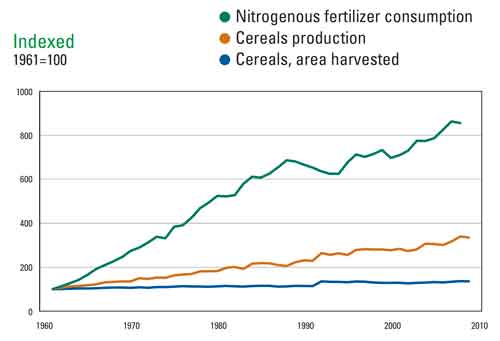
In 1961 the world population was just over 3 billion. Now it is 7 billion. The UN Food and Agriculture Organisation’s 2013 Statistical Year Book is now out and shows that during this period:

Agricultural production has increased  

  • Global crop production has expanded threefold over the past 50 years, largely through higher yields per unit of land and crop intensification.
  • Global per capita food supply rose from about 2 200 kcal/day in the early 1960s to over 2 800 kcal/day by 2009
  • Buoyed by high commodity prices, agriculture has demonstrated astonishing resilience during global economic turmoil. In 2010, agricultural value-added at the world level rose by 4 percent, in contrast to a 1 percent increase in overall GDP.

image UNEP/GEAS

So while population has increased by a factor of 2.3, the food available per person has increased by about 30%. Of course there are many millions who still suffer from malnutrition but this is primarily due to poverty and a failing of distribution systems. It is not the availability of food which has failed. The proportion of the population which is under-nourished continues to steadily decline.

Read the rest of this entry »

And so to bed…

July 15, 2013
Delhi street

Delhi street (Photo credit: April_May)

It has been a hectic week in Delhi.

A trip covering about 30 degrees of latitude and 60 degrees of longitude. From 58.7057° N, 15.7674° E to 29.0167° N, 77.3833° E and back.

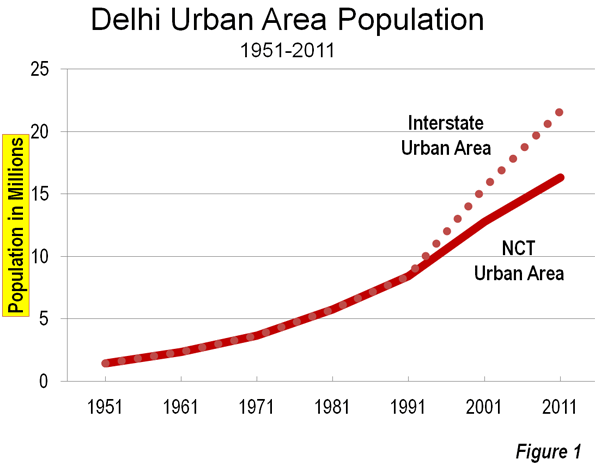
I first lived in Delhi in the 1950’s and the city has grown out of all recognition. Size and population and traffic have exploded. The infrastructure has only just about managed to keep pace. (Considering the rate of growth that itself is no mean achievement.) Every home boiled water then and uses water purifiers today. You were subject to sporadic loss of power then and now put up with regular “load shedding” (as demand side power management is called). But inverters and generators are common and the urban Delhi dweller can “make do”. He has to – he has no choice.

Delhi Urban population – newgeography.com

The same “standard meal” (a bowl of rice, 4 chappatis, a bowl of lentils, 2 servings of vegetables and a small bowl of yogurt) costs Rs 30 ($0.50) from the street vendor, Rs 60 from the roadside dhaba, Rs 70 from the office canteen and about Rs 800 at an upmarket hotel restaurant. But mangoes from Uttar Pradesh were in season and mangoes and papaya everyday for breakfast was refreshing. And my hosts were kind enough to pack 10kgs of mangoes I could bring back with me.

Read the rest of this entry »

That’s how to start a CV!

July 14, 2013

A CV needs to capture the interest of the reader within the first one or two paragraphs. ( Writing Your CV )

My congratulations to Professor Joachim Heberle of the Freie Universität Berlin who has this refreshing, compelling and exemplary start to his CV on his University web-page.

Heberle CV

Hi, my name is Joachim Heberle. My research interest is in the structure and function of membrane proteins and in the methodologies to investigate those … when I have time. Mostly, I am an adminstrative slave. The remainder of my time, I try hard to feed (i.e. raise funds) and comfort my coworkers (i.e. discuss science and give advice). I am not supposed to be a professor in Physics because I received my University education in Chemistry. However, my colleagues and students are so generous to tolerate my ignorance. If you are still interested in my professional CV, please click here.

Others in academia could do very well to follow his example.

“Now, gods, stand up for bastards!”

July 11, 2013

Shakespeare and Edmund – or Philip Sidney for that matter – could never have anticipated that by 2016 over half the children born in Great Britain (which country they knew not of) would be “bastards”.

The Telegraph:

The proportion of children born to unmarried mothers hit a record 47.5 per cent last year, according to the Office for National Statistics. The figure has risen from 25 per cent in 1988 and just 11 per cent in 1979.

If the trend continues at the current rate, the majority of children will be born to parents who are not married by 2016.

Four hundred years ago Shakespeare got Edmund to exclaim:

… Why “bastard”? Wherefore “base”?
When my dimensions are as well compact,
My mind as generous, and my shape as true
As honest madam’s issue? Why brand they us
With “base,” with “baseness,” “bastardy,” “base,” “base”—
Who in the lusty stealth of nature take
More composition and fierce quality
Than doth within a dull, stale, tirèd bed
Go to th’ creating a whole tribe of fops
Got ’tween a sleep and wake? Well then,
Legitimate Edgar, I must have your land.
Our father’s love is to the bastard Edmund
As to the legitimate.—Fine word, “legitimate”!—
Well, my legitimate, if this letter speed
And my invention thrive, Edmund the base
Shall top th’ legitimate. I grow, I prosper.
Now, gods, stand up for bastards!

But now 400 years on, “bastardy” continues in many shapes and forms even if “bastards” have all but lost their illegitimacy. I wonder what wonderful terms Shakespeare would have invented and what fun he would have had in describing the children of today. Children of two fathers, of two mothers, of one parent, of 3 parents, of the senior wife, of the junior wife and perhaps – in another 400 years – of no parents!

As long as there is even one parent we will of course continue to burden our children with our prejudices and foibles, with names not of their choosing, to brainwash them into our religions and “to suffer the slings and arrows” of our sins.
And without making any recourse to legitimacy, even 400 years from now some of them will still be “bastards” and “base”.

A week’s hiatus

July 8, 2013

Off on an assignment in monsoon country.

delhimonsoon

Very light blogging for a week or so.

Title – apostrophe added for the pedantic!

Bizarre in Brazil: Referee stabs player, crowd beheads referee

July 7, 2013

Of course in Brazil, football fanaticism is quite similar to the religious fanaticism seen elsewhere. But it does not bode well for the World Cup in 2014. After hosting the Confederation Cup – and fairly successfully – Brazil saw the street protests which have had the spending on the World Cup extravaganza in their sights. Along with the corruption that pervades politics and – of course – football. And violence is never far away when football is involved.

BBC: 

Football spectators in northern Brazil decapitated a referee after he fatally stabbed a player for refusing to leave the pitch, officials say.

An angry mob stormed the field during the amateur game in the state of Maranhao and stoned Otavio da Silva to death before severing his head.

Police said the murder was in retaliation for Mr Silva stabbing player Josenir dos Santos.

One man has been arrested over the killing and investigations continue.

The incident took place on 30 June in the remote town of Pio XII, but news of the event has been slow to emerge.

The state’s Public Safety Department said it started when the referee and Mr Santos got into fist fight after the player was sent off but refused to leave the pitch.

Map of Brazil

Mr Silva then pulled out a knife and wounded Mr Santos, who died on his way to the hospital.

The player’s friends and relatives rushed onto the field, stoned the referee to death and dismembered his body, the department said in a statement.

What’s in a name?

July 7, 2013

From Science is Beauty:

scientists

Now “peak-copper”- like “peak oil” and “peak gas” – disappears from view

July 6, 2013

Following peak oil and peak gas  it now seems that “peak copper” is also disappearing over the horizon. Researchers at Monash University show that known copper reserves with existing recovery technologies are sufficient at least for 100 years and not just 30.

The fundamental fault with the alarmist image of resources running out – following a classic M. King Hubbert curve – is that alternatives to the resource and new discoveries of the resource are not taken into account. Added to this is the changes to consumption patterns that come about with changes of technology and with changes of price as a resource dwindles in availability. In fact it is the price change which itself acts a spur to the finding of alternatives and new technologies which do not even need that particular resource. “Peak” scenarios are a consequence of using numbers without the exercise of mind.

MU Press ReleaseNew research shows that existing copper resources can sustain increasing world-wide demand for at least a century, meaning social and environmental concerns could be the most important restrictions on future copper production. 

Researchers from Monash University have conducted the most systematic and robust compilation and analysis of worldwide copper resources to date. Contrary to predictions estimating that supplies of this important metal would run out in around 30 years, the research has found there are plenty of resources within the reach of current technologies.

The database, published in two peer-reviewed papers, was compiled by Dr Gavin Mudd and Zhehan Weng from Environmental Engineering and Dr Simon Jowitt from the School of Geosciences. It is based on mineral resource estimates from mining companies and includes information vital for carbon and energy-use modelling, such as the ore grade of the deposits.

Dr Jowitt said the database could change the industry’s understanding of copper availability.

“Although our estimates are much larger than any previously available, they’re a minimum. In fact, figures for resources at some mining projects have already doubled or more since we completed the database,” Dr Jowitt said. 

“Further, the unprecedented level of detail we’ve presented will likely improve industry practice with respect to mineral resource reporting and allow more informed geological exploration.”

Dr Mudd said the vast volumes of available copper meant the mining picture was far more complex than merely stating there were ‘x’ years of supply left. …..

….. 

The researchers will now undertake detailed modelling of the life cycles and greenhouse gas impacts of potential copper production, and better assessment of future environmental impacts of mining.

They will also create similar databases for other metals, such as nickel, uranium, rare earths, cobalt and others, in order to paint a comprehensive picture of worldwide mineral availability.

The impact of fracking Eagle Ford shale in Texas

July 5, 2013

It is seen as a “game changer” and the numbers are persuasive. It is certainly a step-change – and what a step!

Oil: Production data for April show how fracking has shattered not only the shale rock in formations like Texas’ Eagle Ford and Permian Basin but also the myths of “peak oil” and petroleum as an energy source of the past.

As Mark Perry notes on his Carpe Diem blog, Texas produced an average of 2.45 million barrels a day (bpd) of crude oil in April, according to the Energy Information Administration (EIA). That’s the highest average daily output for Texas in any month since April 1985 — 28 years ago.

In only 2-1/2 years, the Lone Star State has doubled its crude output, making it what Perry dubs Saudi Texas and reversing a 23-year decline that fueled speculation that the maximum rate of petroleum extraction has been, or will soon be, reached.

In only 2-1/2 years, the Lone Star State has doubled its crude output, making it what Perry dubs Saudi Texas and reversing a 23-year decline that fueled speculation that the maximum rate of petroleum extraction has been, or will soon be, reached.

As of February, the most recent month for which international oil production data are available, Texas would be the 12th largest oil producer in the world if it were a separate country, only slightly behind Kuwait and Venezuela. This is due to an oil boom that’s added the equivalent of the Bakken formation in North Dakota to the state’s output in just the past 16 months.

At the current pace of output gains, Texas’ production will likely surpass 3 million bpd by year-end, pulling it ahead of Venezuela, Kuwait, Mexico and Iraq to become the equivalent of the ninth largest oil-production “nation” in the world.

The Eagle Ford shale formation, a 400-mile-long, 50-mile-wide, crescent-shaped field in the south central part of the state, is still brimming with crude. Its production in March rose 77% from a year earlier to 529,900 bpd, the Texas Railroad Commission reported.

This of course has contributed to a job boom, just as in North Dakota. Over the 12 months ended in May, Texas payrolls swelled by 325,000 positions, equivalent to a 3% annual increase. Every business day over the past year, almost 1,500 new jobs were created in the Lone Star State.

A report by the University of Texas, San Antonio, showed that in 2011 alone Eagle Ford supported 38,000 full-time jobs, generated $10.8 billion in gross regional product and poured millions into state and local tax coffers.

Read More At Investor’s Business Daily: http://news.investors.com/ibd-editorials/070213-662299-texas-eagle-ford-shale-sparks-boom.htm#ixzz2Y9R2M2wr