The reality of “climate change” for a gardener

June 8, 2013

Reality has this nasty habit of rudely intruding upon climate models – and the pronouncements of august bodies like the IPCC.

Reblogged from Bishop Hill:

A reader kindly points me to the blog of UK seed merchant Thompson and Morgan, where Emma Cooper is wondering what to plant this year:

Over the years in which climate change has been discussed in the media, there have been continual suggestions that it will be of benefit to gardeners – allowing us to grow fruit and vegetable crops that enjoy the continental climate, but fail to thrive in a traditional British summer. As those warm summer days have failed to materialise, and look increasing unlikely, I am eyeing up my new allotment with a view to planting crops that will enjoy our cool climate. ……

But 97% of the world’s “climate scientists” can’t be wrong – can they?

And yet another idiot study – this time about Facebook damaging relationships

June 8, 2013

The use of Facebook is spawning a great deal of idiot research.

Facebook is providing a fertile hunting ground for simplistic “researchby a new breed of “researchers”. Social psychology is still just a discipline and has yet to reach the level of a “science”. But I note that surveys of Facebook users is multiplying and seems to have  become a new field of social psychology. The surveys are easily done, usually include a sample size of just a few hundred (small enough to access on a University campus or in a town square) and draw fanciful conclusions to capture the headlines. They provide an easy way to publication. Such “Facebook research” is not “bad science” – if even “science” at all – but much of it is trivial and just provides a quick, cheap way of getting published.

And here comes another idiot “survey” described in this press release (a press release for this?) from the University of Missouri:

good grief

Excessive Facebook Use Can Damage Relationships, MU Study Finds

Facebook and other social networking web sites have revolutionized the way people create and maintain relationships. However, new research shows that Facebook use could actually be damaging to users’ romantic relationships. Russell Clayton, a doctoral student in the University of Missouri School of Journalism, found that individuals who use Facebook excessively are far more likely to experience Facebook–related conflict with their romantic partners, which then may cause negative relationship outcomes including emotional and physical cheating, breakup and divorce.

In their study, Clayton, along with Alexander Nagurney, an instructor at the University of Hawaii at Hilo, and Jessica R. Smith, a doctoral student at St. Mary’s University in San Antonio, surveyed Facebook users ages 18 to 82 years old. Participants were asked to describe how often they used Facebook and how much, if any, conflict arose between their current or former partners as a result of Facebook use. The researchers found that high levels of Facebook use among couples significantly predicted Facebook-related conflict, which then significantly predicted negative relationship outcomes such as cheating, breakup, and divorce. ..

 …… “Although Facebook is a great way to learn about someone, excessive Facebook use may be damaging to newer romantic relationships,” Clayton said. “Cutting back to moderate, healthy levels of Facebook usage could help reduce conflict, particularly for newer couples who are still learning about each other.”

This study is forthcoming in the Journal of Cyberpsychology, Behavior and Social Networking.

“Good Grief”!

Peer reviewed no doubt.

The insight this provides into relationships and behaviour is not less than profound.

(I must be feeling a little crabby this morning – I need to cut the grass!).

When this interglacial ends ….

June 7, 2013

This interglacial will end.

It may take another 100 years or 5,000 or it may already have ended. From whenever the end is reckoned  it could take about 4,000 years for full glacial conditions to set in.

interglacials

This interglacial will end

The ice sheets will advance again. New land will be exposed as sea levels fall – up to 120m.

The land mass of the world with the reduced sea levels might look like this (http://www.ngdc.noaa.gov/mgg/topo/globega2.html:

world map ice age image National Geophysical Data Center at NOAA

world map ice age image National Geophysical Data Center at NOAA

Geography will change. Islands will expand. Some seas will disappear as water gets locked up in the expanding ice sheets.  Greenland will expand. Siberia will connect to North America again. The United Kingdom will once again rejoin the continent. Indonesia and Australia will be extremely close. Japan will no longer be islands. The Baltic Sea will not exist. The Persian Gulf will disappear. Across the world coastlines will be “pushed out”. Ancient coastal city sites – long submerged – will reappear. The ice sheets will expand and will drastically reduce populations above 55 °N. The global population would have stabilised and may even fall. Populations will migrate. Nation states will  see their boundaries changing – physically not just by war. No doubt there will be new human conflicts as populations shift – though the shifts will be over hundreds of years and quite gradual in our terms. Average global temperatures will be about 2 – 4°C colder than today.

But this time the ice sheets will not stop humans from utilising the resources under some of the ice sheets. As during the last glacial period, human innovation and engineering will flourish and reach new heights as the challenges are met. New science and new technologies will appear. Art will take new forms. A new wave of exploration will occur – this time into space. And through all of this our energy needs will increase.

Time line of prehistoric inventions (pdf)

But it is the availability of abundant energy which will be the deciding factor, which allows growth to continue and which allows the continued  improvement of the human condition. And this energy will primarily be fossil energy and nuclear energy.  It will be nuclear energy for large central plants (> 1000 MW), fossil energy (coal, and gas) for medium sized plants (100 – 1000 MW)  and gas for municipal and domestic applications. Transportation will – largely as now – be electric or oil-based though the proportion of electric (charged from “cheap” nuclear power) vehicles will increase. Solar and wind and wave and tidal power will have their little place but will – as now – be of small impact.

It is fossil and nuclear power which will allow humanity to meet these new challenges. They will be a necessity for humans to flourish. Carbon dioxide emissions – as now – will be irrelevant. It is in the development of small nuclear, energy storage and more efficient gas- winning and utilisation that we should be concentrating.

Walking Eagles and carbon taxes

June 6, 2013

This is a couple of years old though I only just came across it.

Seems very apt – not only for carbon taxes but also for Tony Blair.

Tony 'Walking Eagle' Blair

Tony ‘Walking Eagle’ Blair

Osho News:

On a recent trip to the United States, Tony Blair, Ex. Prime Minister of the UK, addressed a major gathering of Native American Indians.

He spoke for almost an hour on his plans for a Carbon Trading Tax for the UK and Europe

At the conclusion of his speech, the crowd presented him with a plaque inscribed with his new Indian name – Walking Eagle.

A very proud Tony then departed in his motorcade, waving to the crowds.

A news reporter later asked one of the Indians how they came to select the new name given to Tony Blair.

They explained that Walking Eagle is the name given to a bird so full of sh1t that it can no longer fly.

Climate models stretch credulity

June 6, 2013

What is perplexing is the blind faith in the climate models and reluctance to revisit the assumptions on which the clearly fallacious models are based.

UPDATE!!

Dr. Spencer has also provided the “un-linearised” data  and writes:

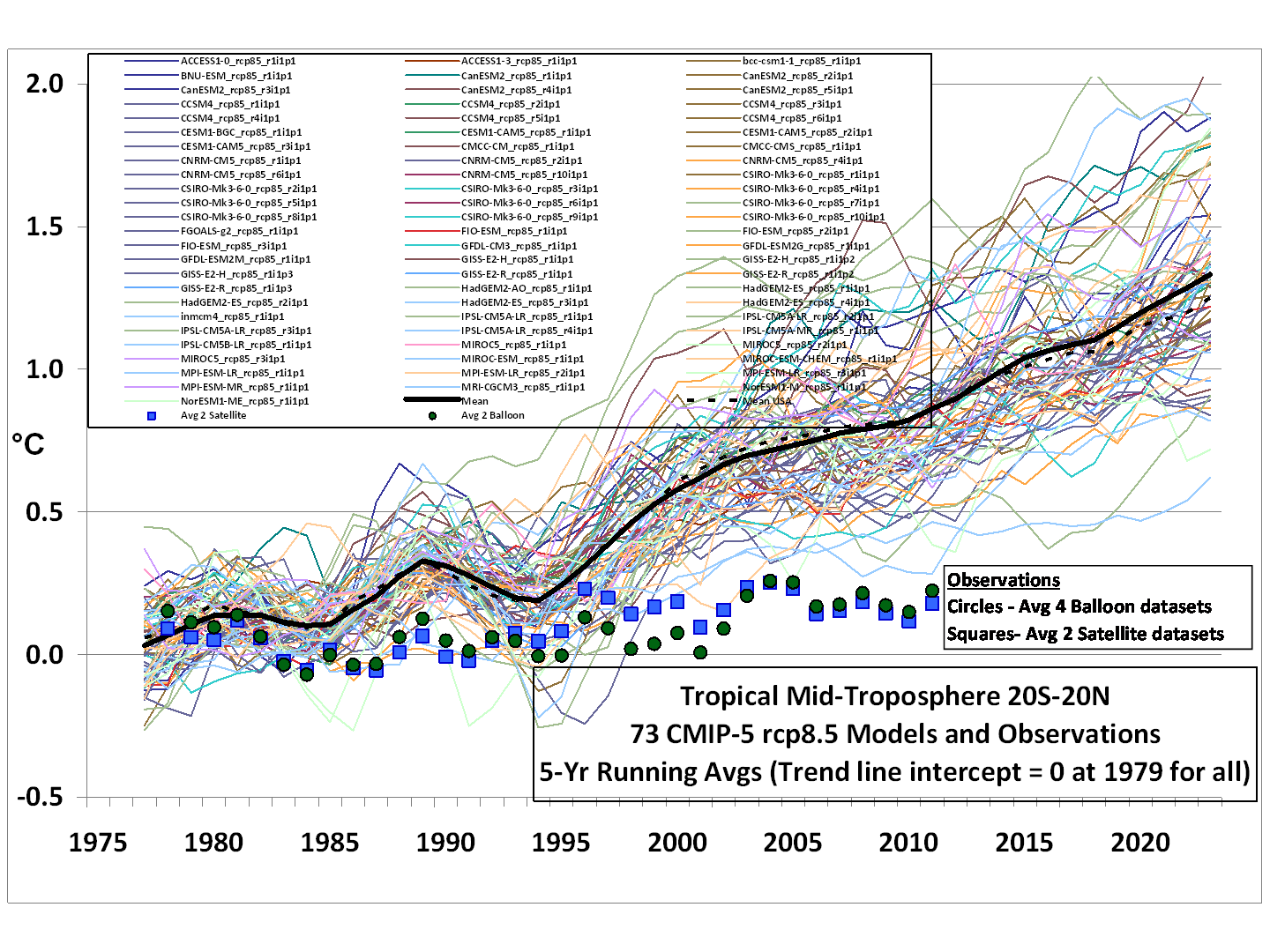
In response to those who complained in my recent post that linear trends are not a good way to compare the models to observations (even though the modelers have claimed that it’s the long-term behavior of the models we should focus on, not individual years), here are running 5-year averages for the tropical tropospheric temperature, models versus observations (click for full size):
CMIP5-73-models-vs-obs-20N-20S-MT-5-yr-means
In this case, the models and observations have been plotted so that their respective 1979-2012 trend lines all intersect in 1979, which we believe is the most meaningful way to simultaneously plot the models’ results for comparison to the observations.

In my opinion, the day of reckoning has arrived. The modellers and the IPCC have willingly ignored the evidence for low climate sensitivity for many years, despite the fact that some of us have shown that simply confusing cause and effect when examining cloud and temperature variations can totally mislead you on cloud feedbacks (e.g. Spencer & Braswell, 2010). The discrepancy between models and observations is not a new issue…just one that is becoming more glaring over time. ….

….

Reblogged from Dr. Roy Spencer

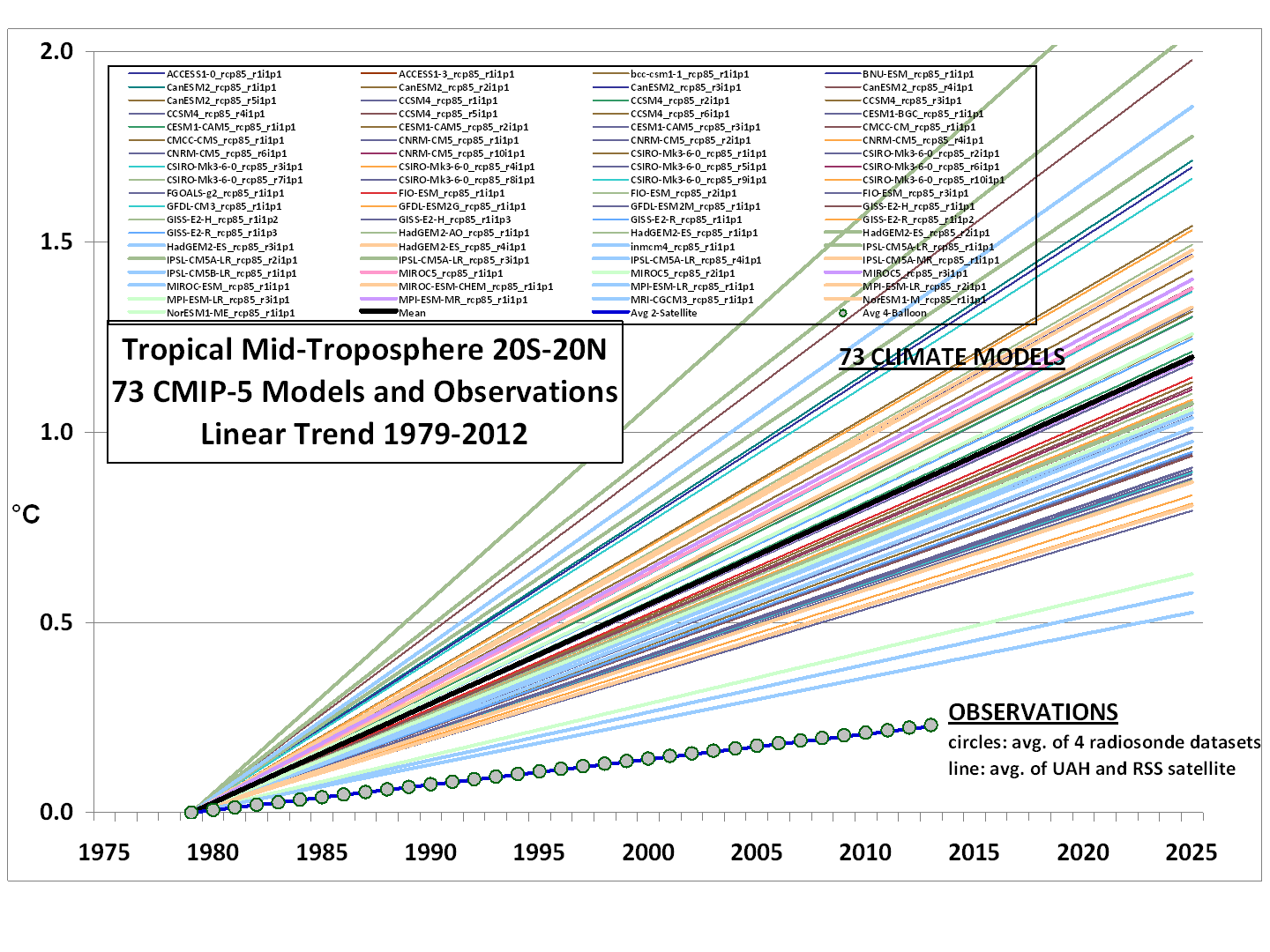
Courtesy of John Christy, a comparison between 73 CMIP5 models (archived at the KNMI Climate Explorer website) and observations for the tropical bulk tropospheric temperature (aka “MT”) since 1979 (click for large version):
CMIP5-73-models-vs-obs-20N-20S-MT
Rather than a spaghetti plot of the models’ individual years, we just plotted the linear temperature trend from each model and the observations for the period 1979-2012.

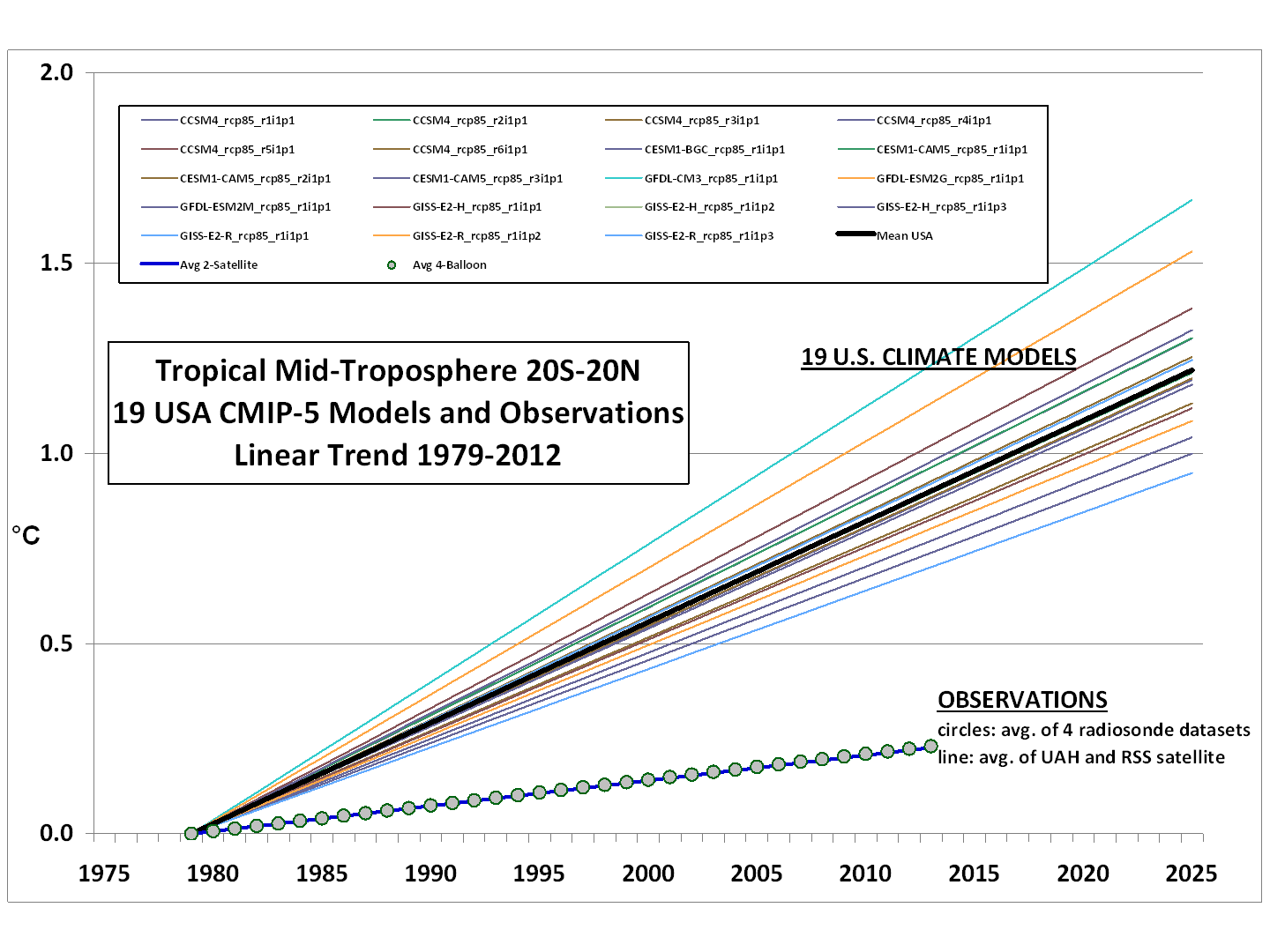
Note that the observations (which coincidentally give virtually identical trends) come from two very different observational systems: 4 radiosonde datasets, and 2 satellite datasets (UAH and RSS).

If we restrict the comparison to the 19 models produced by only U.S. research centers, the models are more tightly clustered:
CMIP5-19-USA-models-vs-obs-20N-20S-MT

Now, in what universe do the above results not represent an epic failure for the models?

I continue to suspect that the main source of disagreement is that the models’ positive feedbacks are too strong…and possibly of even the wrong sign.

The lack of a tropical upper tropospheric hotspot in the observations is the main reason for the disconnect in the above plots, and as I have been pointing out this is probably rooted in differences in water vapor feedback. The models exhibit strongly positive water vapor feedback, which ends up causing a strong upper tropospheric warming response (the “hot spot”), while the observation’s lack of a hot spot would be consistent with little water vapor feedback.

Future human evolution will be selection by deselection

June 6, 2013

io9 carries  a look at how science fiction treats evolution :The most ludicrous depictions of evolution in science fiction history.

Of course this begs the question as to how humans are likely to evolve over the coming generations?

Humans and chimpanzees ancestors split some 7-8 million years ago and it took some 350,000 generations after that divergence for evolution by natural selection to produce anatomically modern humans (AMH). (This of course raises the question as to how chimpanzee evolution proceeded to reach modern chimpanzees while humans were developing into homo sapiens?).

It has been only about 10,000 generations since AMH appeared and only some 6,000 generations or so since modern humans left Africa. A very short time in evolutionary terms yet in this period humans have evolved to exhibit the various races of man that exist today. This differentiation is primarily superficial and all humans existing are capable of mating and producing viable offspring with each other. In theory humans existing today would also be compatible and – in the main – capable of mating with the humans of 6,000 generations ago. In practice a meeting of modern humans with those from 120,000 years ago would be an exaggerated replica of modern man meeting with isolated tribes in the 20th century. These isolated branches of humanity generally had lower levels of immunity to the bacteria carried by their distant cousins and were ravaged by disease after such encounters. The bacteria we carry are probably greatly different to those that humans carried at the dawn of anatomically modern humans. Probably no such meeting or mating would be very successful and one or both would probably succumb to disease brought on by the other’s bacteria. Nevertheless the genomes of the two – even after 6,000 generations – would  not be so very different and probably still be compatible. In any primate species a generational distance of over 20,000 between individuals will probably disqualify any theoretical possibility of successful mating.

Read the rest of this entry »

IK leaves IKEA

June 5, 2013

Had to happen of course but he did bring a revolution to household furniture. For me personally IKEA furniture has provided a stable reference point for some 35 years in 5 countries as I have moved around the world and my children have grown up with the “installation” of familiar objects, with odd names from the IKEA flat-packs. IKEA  is an acronym comprising the initials of Ingvar Kamprad, Elmtaryd (the farm where he grew up) and Agunnaryd (his hometown in Småland, South Sweden.

Decoding the language of Ikea

Now IK is 87 and is handing over:

Ingvar Kamprad, creator of Swedish furniture retailer IKEA, is to take another step back from his company as the youngest of his three sons takes a key board role in a gradual handover of power. 

Kamprad, 87, who founded the business in rural south Sweden 70 years ago, stepped down in 1986 as chief executive of IKEA, which has become the world’s biggest furniture group, famous for its flat packs and do-it-yourself assembly. 

He will now leave the board of a key company within the business – Inter IKEA Group – and his youngest son Mathias will take over as its chairman. 

“I see this as a good time for me to leave the board of Inter IKEA Group,” Kamprad said in a statement on Tuesday, referring to the company which owns the IKEA brand and which collects 3 percent of IKEA stores’ sales worldwide each year.

Marc Hauser makes his comeback with “brain-training” for at-risk children

June 4, 2013

Marc Hauser who was terminated / resigned from Harvard for rather suspect data creation (the Hausergate affaire) is now making his comeback with a new enterprise called Risk-Eraser

Risk-Eraser transforms the learning and decision-making of at-risk children by building more effective programs. Our goal is to erase the risk in the lives of at-risk populations.

His program is touted as being evidence-based and involves critical thinking and “brain-training” to give a program which “helps students reach higher goals in both school and in their social lives, enables programs to run more efficiently, and empowers teachers to engage in the most exciting methods of pedagogy”. 

Google Maps: West Falmouth Hwy #376, W. Falmouth, MA, 02574

Some irony in his claim of being “evidence-based” and the line between “brain-training” and brain-washing is rather thin. Brain-washing – even in a good cause – and with vulnerable children would seem to raise a number of ethical issues.

Risk-Eraser, West Falmouth Hwy #376, W. Falmouth, MA, 02574​

Looks nice there.

Currently he is the only member of the team. A Technical team and an Advisory team are said to be “coming soon”.

Marc Hauser, PhD

I am the founder of Risk-Eraser. The company grew out of two passionate interests: to understand human nature and to improve the lives of those less fortunate.  My PhD is in the mind and brain sciences.  I was a professor at Harvard for 19 years.  I have published over 200 papers and six books. I have won several awards for my teaching, and am the proud mentor of some of the best students in my academic areas of interest; these individuals now hold distinguished professorships at major universities all over the world.

 His main transgression may have initially been due to confirmation bias and this may have led to the data “manipulation”.  I am quite sure that not everything Hauser did or does is tainted — but the real problem is that discerning what is or is not suspect is going to be difficult.

To implement any confirmation bias with “at-risk children” could I think be very destructive.  Applying “brain-washing” techniques on “at- risk” children seems itself not to be devoid of risk.

Perceptions of beauty

June 4, 2013

Science is Beauty

Science is Beauty

Perceptions of Beauty from  Philosophy of Beauty (Department of PhilosophyUniversity of Maryland)

Symmetry and asymmetry


Description: U:\newwebsite\Btynotes\Labrets.jpg

Labrets in tribal societies: are they considered beautiful? If not, why wear them?

Mathematical genius?

June 4, 2013

Retraction Watch reports on the retraction of a paper by a Turkish mathematician for plagiarism. The author did not agree with the retraction.

But what struck me was the track record of this amazing Assistant Professor at Ege University.

Ahmet Yildirim Assistant Professor, Ege University, Turkey

Editorial Board Member of International Journal of Theoretical and Mathematical Physics

  • 2009       Ph.D      Applied Mathematics, Ege University (Turkey)
  • 2005       M.Sc      Applied Mathematics, Ege University (Turkey)
  • 2002       B.Sc        Mathematics, Ege University (Turkey)

Since 2007 he has a list of 279 publications!

That’s an impressive rate of about 50 publications per year. Prolific would be an understatement.

All peer reviewed no doubt.