Unchanged seasonal variation shows that Carbon dioxide concentration increase is probably not due to fossil fuel combustion

May 5, 2013

Carbon dioxide concentration in the atmosphere varies seasonally with the May peak being about 6 ppm higher than the October low. These are very regular and are a reflection of biogenic and chemical interactions from plants, the soil and the oceans

This concentration is the net result following all the mechanisms by which carbon dioxide is produced and absorbed. Since 1960 the mean concentration has risen about 25% from about 320 ppm to just under 400 ppm now (399 as of yesterday) but the seasonal variation has remained virtually unchanged during this time.

from wikipedia

from wikipedia

This is not new and analyses the 25 year period from 1997 but I have only just come across it.

SOURCES AND SINKS OF CARBON DIOXIDE

CO2 seasonal variation

CO2 seasonal variation

The constancy of seasonal variations in CO2 and the lack of time delays between the hemispheres suggest that fossil fuel derived CO2 is almost totally absorbed locally in the year it is emitted. This implies that natural variability of the climate is the prime cause of increasing CO2, not the emissions of CO2 from the use of fossil fuels.

The annual increase of CO2 in the atmosphere is in sharp contrast with the annual change in the seasonal variations (last 25 years)

The mean values are:
Annual CO2 increase = 1.572 ± 0.013 ppm per year
Seasonal CO2 increase = -0.001 ± 0.013 ppm per year

The general assumption is that about 40% of man-made carbon dioxide shows up as this increase with the remainder being absorbed by the enhanced action of sinks.

The justification for this conclusion is supported by measurements of the falling proportion of  13C  in the atmosphere which is taken to signal the appearance of CO2 from fossil fuel emissions. …… 

The correlation of changes in δ13C with ENSO events and the comparison with a simple model of a series of cascades suggest that the changes in δ13C in the atmosphere have little to do with the input of CO2 emissions from the continuous use of fossil fuels.

Even though the combustion of fossil fuels only contributes less than 4% of total carbon dioxide production (about 26Gt/year of 800+GT/year), it is usually assumed that the sinks available balance the natural sources and that the carbon dioxide concentration – without the effects of man – would be largely in equilibrium.  (Why carbon dioxide concentration should not vary naturally escapes me!). It seems rather illogical to me to claim that sinks can somehow distinguish the source of carbon dioxide in the atmosphere and preferentially choose to absorb natural emissions and reject anthropogenic emissions! Also, there is no sink where the absorption rate would not increase with concentration.

Carbon dioxide emission sources (GT CO2/year)

  • Transpiration 440
  • Release from oceans 330
  • Fossil fuel combustion 26
  • Changing land use 6
  • Volcanoes and weathering 1

Carbon dioxide is accumulating in the atmosphere by about 15 GT CO2/ year. The accuracy of the amounts of carbon dioxide emitted by transpiration and by the oceans is no better than about 2 – 3% and that error band (+/- 20GT/year)  is itself almost as large as the total amount of emissions from fossil fuels.

SOURCES AND SINKS OF CARBON DIOXIDE

Conclusions:

During the 1977 to 2001 time period analysed:
Changes in the isotope ratio are discontinuous. The temporal peaks in 13C appear to correlate with the CO2 concentration changes. Further the temporal peaks in 13C and the CO2 peaks correlate with ENSO events.
The yearly increases of atmospheric CO2 concentrations have been nearly two orders of magnitude greater than the change to seasonal variation which implies that the fossil fuel derived CO2 is almost totally absorbed locally in the year that it is emitted.
A time comparison of the SIO measurements of CO2 at Mauna Loa with the South Pole shows a lack of time delay for CO2 variations between the hemispheres that suggests a global or equatorial source of increasing CO2. The time comparison of 13C measurements suggest the Southern Hemisphere is the source. This does not favour the fossil fuel emissions of the Northern Hemisphere being responsible for ther observed increases.
All three approaches suggest that the increase of CO2 in the atmosphere may not be from the CO2 derived from fossil fuels. The 13C data is the most striking result and the other two approaches simply support the conclusion of the first approach.

Baboons can tell “more” from “less” – but that is still a long way from counting

May 4, 2013

Being able to distinguish between “more” and “less” is – most likely – a capability that is a pre-requisite for the evolutionary development of the ability to count which itself must lead to the invention of numbers. Recent experiments with baboons demonstrates that they have a clear ability to make quite complex more/less distinctions.

Allison M. Barnard, Kelly D. Hughes, Regina R. Gerhardt, Louis DiVincenti, Jenna M. Bovee and Jessica F. Cantlon.Inherently Analog Quantity Representations in Olive Baboons (Papio anubis)Frontiers in Comparative Psychology, 2013 DOI: 10.3389/fpsyg.2013.00253

From the University of Rochester press release:

… Now a new study with a troop of zoo baboons and lots of peanuts shows that a less obvious trait—the ability to understand numbers—also is shared by man and his primate cousins.

“The human capacity for complex symbolic math is clearly unique to our species,” says co-author Jessica Cantlon, assistant professor of brain and cognitive sciences at the University of Rochester. “But where did this numeric prowess come from? In this study we’ve shown that non-human primates also possess basic quantitative abilities. In fact, non-human primates can be as accurate at discriminating between different quantities as a human child.”

“This tells us that non-human primates have in common with humans a fundamental ability to make approximate quantity judgments,” says Cantlon. “Humans build on this talent by learning number words and developing a linguistic system of numbers, but in the absence of language and counting, complex math abilities do still exist.” ……

……… The baboons’ choices, conclude the authors, clearly relied on this latter “more than” or “less than” cognitive approach, known as the analog system. The baboons were able to consistently discriminate pairs with numbers larger than three as long as the relative difference between the peanuts in each cup was large. Research has shown that children who have not yet learned to count also depend on such comparisons to discriminate between number groups, as do human adults when they are required to quickly estimate quantity. 
Studies with other animals, including birds, lemurs, chimpanzees, and even fish, have also revealed a similar ability to estimate relative quantity, but scientists have been wary of the findings because much of this research is limited to animals trained extensively in experimental procedures. The concern is that the results could reflect more about the experimenters than about the innate ability of the animals. ……..

……… To rule out such influence, the study relied on zoo baboons with no prior exposure to experimental procedures. Additionally, a control condition tested for human bias by using two experimenters—each blind to the contents of the other cup—and found that the choice patterns remained unchanged.

A final experiment tested two baboons over 130 more trials. The monkeys showed little improvement in their choice rate, indicating that learning did not play a significant role in understanding quantity.

“What’s surprising is that without any prior training, these animals have the ability to solve numerical problems,” says Cantlon. The results indicate that baboons not only use comparisons to understand numbers, but that these abilities occur naturally and in the wild, the authors conclude. …….

Book Burning to promote climate science!

May 3, 2013

Dr. Craig Clements and Dr. Alison Bridger demonstrating their methods for the advancement of science.

SJSU_bookfire

Drs. Bridger and Clements of San Jose State University burning a book to advance their cause

From WUWT

Fifty shades of fraud in Flanders

May 3, 2013

Following on from the publicity surrounding the Diedrik Stapel case, a new survey of medical researchers in Flanders confirms that fraud is fairly prevalent. This takes the form of making up data, manipulating data to make it match a hypothesis, plagiarism, double publishing (self-plagiarism), withholding undesirable research results, undeserved authorships or dividing research into as many separate science articles as possible (salami slicing). The article by Reinout Verbeke and Joeri Tijdink was produced with the support of the Pascal Decroos Fund for Investigative Journalism. One in twelve medical scientists admits to making up or ‘massaging’ data in order for it to match a hypothesis. And almost six in twelve see such fraudulent practices happening around them. They identify high publication pressure as one of the causes. Ivan Oransky of Retraction Watch points out that for the medical research fraternity the high rewards from pharmaceutical companies can also play a role.

In November and December 2012 Belgian  science journalist Reinout Verbeke (editor of Eos Magazine) spread an anonymous survey on fraud and pressure to publish among scientists of the Medical Science faculties of all Flemish universities. ……..  Psychiatrist and researcher Joeri Tijdink (VU University Medical Center Amsterdam) collaborated on the survey. He did another sounding in 2011 in the Netherlands, before the scandal surrounding Diederik Stapel had broken out – the social psychologist who had made up data and experiments. For years nobody had been on to him. Stapel and his unsuspecting doctoral students and co-authors even made top magazines with their fictitious studies. Luckily though, such large-scale fraud is rather rare. ……..

Fifty shades of fraud

Fifty shades of fraud

The results of the Flemish survey are striking. Of the 315 participating scientists, four (1.3%) admit to having made up data at least once in the last three years. If what they say is true, this probably concerns fraud that is still undiscovered. 23 respondents (7.3%) admit to having selectively removed data or results to make research match a hypothesis, so-called ‘data massaging’. Overall, about 8% of the Flemish medical scientists admits to recently having made up and/or massaged data. The figures are worse than the international average. A meta-analysis of 18 scientific studies on fraud by Daniele Fanelli showed that on average 2% of all scientists (from different fields of study) admitted to having done similar practices at least once (PloS ONE, 2009). Why are the results among Flemish respondents even worse? “That doesn’t surprise me, because we are talking about medical scientists”, says American journalist and fraud expert Ivan Oransky from RetractionWatch. com. “Cooperating with the pharmaceutical industry gains researchers financial rewards. That could pressurise scientists to cut corners.” André Van Steirteghem, a pioneer in reproductive medicine and secretary of the Committee on Publication Ethics (COPE), thinks there is something else at play. “There’s is a significant lack of openness on fraud and malpractice at Flemish universities. This survey asked scientists about their perceptions for the very first time. They were able to vent their feelings. I think that explains the high figures in Flanders.” We can even suspect malpractices in Flanders to be more wide-spread still. “Surveys have their limits”, says Daniele Fanelli. “Many cheaters won’t admit to having done it, or will falsely assume they have a clean conscience.” …… 

Scientific American reports on this story here.

“Bearing children has largely become the province of the lower classes”

May 2, 2013

The Daily Mail runs an article today about why the middle class are not breeding any more. It is not difficult to get a faint whiff of eugenics. But I can’t help feeling that some level of eugenics is not necessarily all bad as we move from natural selection to a world where artificial selection (IVF, surrogacy, sperm banks etc.) is increasing. And of course, even the availability of abortion on demand is in itself a form of selection.

  • Educated women deferring motherhood for so long they’re no longer fertile
  • Bearing children ‘has largely become the province of the lower classes’ 
  • TV historian Dr Lucy Worsley is poster girl for intentionally childless women

…. as author and demographic expert Jonathan Last observes in his controversial book What to Expect When No One’s Expecting:

‘The bearing and raising of children has largely become the province of the lower classes. It’s a kind of reverse Darwinism where the traditional markers of success make one less likely to reproduce.’

If “lower class” were a genetic trait then the middle and higher classes should fear extinction in due course. Fortunately “class” is just relative and subjective so no matter what the demographics are, distinctions of class will be introduced into any population that exists. But what is more interesting to consider is the fact that women with a higher level of education (which says nothing about native intelligence) have fewer children. This seems to be a global phenomenon. Data from 2010 in the extract below.

The full table is here. Primary School Enrollment and Total Fertility Rates, Latest Year (2000-2010)

Primary School Enrollment and Total Fertility Rates for Selected Countries, Latest Year 2000 – 2010

Rank Country

Primary School Enrollment

Total Fertility Rate

Percent

Number of children
per woman

1 Japan

100.0

1.3

2 Spain

99.8

1.5

3 Iran

99.7

1.8

4 Georgia

99.6

1.6

5 United Kingdom

99.6

1.9

181 Equitorial Guinea

53.5

5.3

182 Guinea-Bissau

52.1

5.7

183 Djibouti

40.1

3.9

184 Sudan

39.2

4.2

185 Eritrea

35.7

4.6

Note: Rankings are based on a list of 185 countries for which primary enrollment data are available.
Source: EPI from UNESCO

Fertility rates tend to be highest in the world’s least developed countries. When mortality rates decline quickly but fertility rates fail to follow, countries can find it harder to reduce poverty. Poverty, in turn, increases the likelihood of having many children, trapping families and countries in a vicious cycle. Conversely, countries that quickly slow population growth can receive a “demographic bonus”: the economic and social rewards that come from a smaller number of young dependents relative to the number of working adults.

For longer term population stability the goal is to reach replacement-level fertility, which is close to 2 children per woman in places where mortality rates are low. Industrial countries as a group have moved below this level. Some developing countries have made progress in reducing fertility, but fertility rates in the least developed countries as a group remain above 4 children per woman.

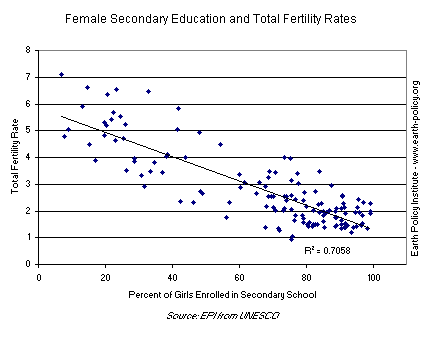
The trends with secondary education are also very clear:
Female Secondary Education and Total Fertility Rates

Of course the level of development in a country dominates and fertility rates around the world are reducing and converging. Whether this trend will continue even when all female children enjoy secondary education remains to be seen. The UK case where nearly all children do get secondary education would suggest that those with higher (university) education continue to show a declining fertility. But the real test of this hypothesis will only come when education levels around the world have equalised and fertility rates all lie around the same level.

So is the human population “dumbing down”? Not really. Education level is not intelligence. To what extent intelligence is a hereditary trait is uncertain. While it would seem that evolution should favour increasing intelligence, even this is not crystal clear. It is certainly a perception I have that “successful” people tend to be more intelligent but high intelligence does not ensure success. And success in life correlates with wealth but not so well with number of offspring.  “Success”, however we define it,  is not a genetic trait. There have been some suggestions that there may be some optimum level of intelligence for the genetic success of the species and that hunter-gatherers were actually somewhat more intelligent than we are now. Perhaps humans can be “too clever by half”!

But for some time to come, as the developing world catches up with the developed world, we can surely conclude that less-educated parents will have the higher fertility. Whatever that may mean for the long term evolution of humans, and that will be the result of the level to which we intentionally apply genetic selection.

Related: “Selection” lies in the begetting and evolution is just a result

100 Viking queens to be trapped and transported to England

May 1, 2013

It’s the first of May and May is when they emerge from hibernation and are most abundant in Skåne in southern Sweden. But for some of them the freedom they are enjoying will be short lived.

Trappers from the UK have been given permission to capture 100 queens, refrigerate them to induce an artificial hibernation for travel and then transport them to the UK to “rape and pillage” the country-side and hopefully repopulate parts of Kent. A programme was started in 2009 to reintroduce them to the United Kingdom with queens from New Zealand. However this was not a success as many of the queens died during hibernation. DNA analysis of the New Zealand queens showed they lacked genetic diversity.

The queens of the short-haired bumblebee, Bombus subterraneus, are the unfortunate creatures being hunted. It remains to be seen if the Viking queens fare any better than their Antipodean sisters.

Swedish Radio reports:

British scientists have been allowed to capture and bring home 100 Queens of the short-haired bumblebee, fairly common in Skåne but extinct in England. Bumblebees are needed to pollinate plants and vegetables, said Nikki Gammans from Natural England, who leads this unusual hunt, when she presented the project to a large press contingent  today outside Lund . When the British began this effort last year, it was not everybody who applauded, but the resistance was mainlydue to misunderstandings according to the provincial government in Skåne.

From Natural England:

Short-haired bumblebee (c) Nikki Gammans

Short-haired bumblebee (c) Nikki Gammans

After months of careful planning and negotiations, a team of experts led by Dr Nikki Gammans have embarked on a special mission to bring short-haired bumblebee queens back to the UK from the south of Sweden.

After a period of quarantine, It is hoped the bees can then be released on the RSPB Dungeness reserve in May 2012 and eventually colonise the surrounding area – see press release. …..

…. The Short-haired bumblebee, Bombus subterraneus, was last seen at Dungeness in Kent in 1988 and was officially declared extinct in 2000 after many repeated searches. We believe this bee species along with the other threatened bumblebee species have suffered due to the loss of flower-rich habitats such as meadows.

Over the last 60 years, the UK has lost over 97% of its wild flower meadows due to intensifying agricultural practices. It is also likely that the removal of hedgerows from the UK may have reduced the available nesting and hibernation sites for short-haired bumblebees.

While I can see that such a project could be fascinating and challenging, the purpose of the exercise as described by Natural England is rather vague and fuzzy and well-meaning and not at all very convincing. Vague claims of being “critical” to our farming economy read like a sales pitch. These bumblebees failed to adapt / evolve to survive in the UK. Yet they are being  re-introduced without any actions to make the species more likely – genetically – to survive in its new environment. All that has been done is to create some protected habitat (flower corridors). It seems to me that the “conservation” movement is far too backward-looking and must focus more on helping threatened species to evolve genetically rather than trying to prevent the changes to habitat which are inevitable:

Bumblebees pollinate many important agricultural crops and are critical to our farming economy. More bumblebees = better crop pollination – there is evidence that the shortage of pollinators is reducing crop yields. By creating corridors of flower-rich habitat across Romney Marsh area, we have seen an increase and spread in the numbers of bumblebee species in Kent. Five threatened species, which include England’s rarest bumblebee the shrill carder bee, have all increased their geographic range in this area after decades of decline.

“Consensus science” – by definition – is not “science” and is a dangerous thing

April 30, 2013

The internet is full of polls that I generally find irritating. How many believe that “A” will happen? or that “B will win? or that “C” is better than “D”? Whatever the result of the poll may be, they show nothing more than where the preponderance of belief  lies. The polls are evidence only of what people believe; they are not evidence of the subject being voted upon.

Either something is or it is not.

If we don’t know whether it is or is not, we can formulate it as a hypothesis and address it by the scientific method. The formulation is then as a falsifiable hypothesis and we then predict what data might be collectable if the hypothesis was false. We then collect data and where data is not available we design and carry out experiments to provide such data. These data and their analysis should be tested – for the classical scientific method – to see if the hypothesis is false (not – it should be noted – to show that the hypothesis is true). Where the data cannot show the hypothesis to be false it means only that the hypothesis is still unproven but the data set adds to the body of evidence in favour of the hypothesis in the particular circumstances in which that data-set was collected.

When we don’t know we can still suppose the hypothesis to be true or false. But that is just a supposition and lies in the realms of belief and religion. We can take a vote within some group and see how many believe it to be true or to be false. Commercial and other interests may be vested in the supposition. Lobbying and persuasion can be applied in favour of or against the supposition. Voters can be influenced and cajoled and persuaded to vote for or against. A completely democratic and transparent system of voting may be applied. And  the result may be overwhelmingly in favour or against the supposition. But even where a majority – even an overwhelming majority of say 97% – of some group believes the proposed hypothesis to be true, the vote adds not one iota of evidence in favour of or against the hypothesis. An overwhelming vote that a hypothesis is true when it is actually false makes it no less false. All the vote can show is the preponderance of belief (and belief – by definition – comes into play when and because evidence is lacking).

And all that democratic process to establish what people believe brings us no closer to answering the question of whether the supposition is true.

But it gets worse.

Once a “democratic” majority has confirmed its belief in a supposed “truth” of a supposition, then there is a immense societal pressure against proving the supposition to be false. Falsifiable hypotheses are reformulated to be no longer falsifiable. The scientific method is perverted – for reasons of the vested interests – to now produce anecdotal evidence trying to “prove the hypothesis” rather than trying to collect data to try and show the hypothesis to be false. Evidence against the majority belief is not collected because it is no longer expedient to do so. Not only is it not collected, it is ignored even when it is plain and obvious. The moment a scientific hypothesis invokes or has to invoke a majority vote or a consensus in its support it leaves the scientific arena and enters the  political universe. Truth becomes whatever the majority believes. Proper scientific effort directed to falsifying the supposition is not just discouraged, it is penalised and attracts sanctions in the form of reduced funding and rejection of publications. It becomes heresy. Even where the believed supposition is actually true, the supposition remains as belief and cannot easily be brought back into the rational world.

As Judith Curry wrote recently:

With genuinely well-established scientific theories, ‘consensus’ is not discussed and the concept of consensus is arguably irrelevant.  For example, there is no point to discussing a consensus that the Earth orbits the sun, or that the hydrogen molecule has less mass than the nitrogen molecule.  While a consensus may arise surrounding a specific scientific hypothesis or theory, the existence of a consensus is not itself the evidence. ……. 

Given the complexity of the climate problem, ‘expert judgments’ about uncertainty and confidence levels are made by the IPCC on issues that are dominated by unquantifiable uncertainties. It is difficult to avoid concluding that the IPCC consensus is manufactured and that the existence of this consensus does not lend intellectual substance to their conclusions.

“Consensus science” has no option but to become science by majority vote. Polls replace evidence. And where the belief is false, the belief itself prevents a return to the truth. “Consensus science” as belief cannot be “science”. The simple fact is that whenever a “scientific hypothesis” invokes a consensus in its support it is – per force – just a belief. It becomes religion and not science. And that is a dangerous thing.

Related: Climate change: no consensus on consensus

Plants produce biogenic aerosols and provide a negative feedback to warming climate

April 30, 2013

Another study showing a negative feedback to a warming climate. Needless to say such a negative feeback finds no place in climate models. (The lead author points out that this previous statement is erroneus). Needless to say I doubt if such negative feedback is included in all climate models.

 Paasonen, P., et. al. 2013. Evidence for negative climate feedback: warming increases aerosol number concentrationsNature Geoscience doi: 10.1038/NGEO1800

The International Institute for Applied Systems Analysis (IIASA) reports:

© Veronika Markova | Dreamstime.com

As temperatures warm, plants release gases that help form clouds and cool the atmosphere, according to research from IIASA and the University of Helsinki. 

The new study, published in Nature Geoscience, identified a negative feedback loop in which higher temperatures lead to an increase in concentrations of natural aerosols that have a cooling effect on the atmosphere. “Plants, by reacting to changes in temperature, also moderate these changes,” says IIASA and University of Helsinki researcher Pauli Paasonen, who led the study. 

Scientists had known that some aerosols – particles that float in the atmosphere – cool the climate as they reflect sunlight and form cloud droplets, which reflect sunlight efficiently. Aerosol particles come from many sources, including human emissions. But the effect of so-called biogenic aerosol – particulate matter that originates from plants – had been less well understood. Plants release gases that, after atmospheric oxidation, tend to stick to aerosol particles, growing them into the larger-sized particles that reflect sunlight and also serve as the basis for cloud droplets. The new study showed that as temperatures warm and plants consequently release more of these gases, the concentrations of particles active in cloud formation increase. 

“Everyone knows the scent of the forest,” says Ari Asmi, University of Helsinki researcher who also worked on the study. “That scent is made up of these gases.” While previous research had predicted the feedback effect, until now nobody had been able to prove its existence except for case studies limited to single sites and short time periods. The new study showed that the effect occurs over the long-term in continental size scales. 

The effect of enhanced plant gas emissions on climate is small on a global scale – only countering approximately 1 percent of climate warming, the study suggested. “This does not save us from climate warming,” says Paasonen. However, he says, “Aerosol effects on climate are one of the main uncertainties in climate models. Understanding this mechanism could help us reduce those uncertainties and make the models better.”  

The study also showed that the effect was much larger on a regional scale, counteracting possibly up to 30% of warming in more rural, forested areas where anthropogenic emissions of aerosols were much lower in comparison to the natural aerosols. That means that especially in places like Finland, Siberia, and Canada this feedback loop may reduce warming substantially. ….. 

Resentment and charges of misconduct and bias at the Delhi component of the International Centre for Genetic Engineering and Biotechnology (ICGEB)

April 30, 2013

It is not so easy to judge if the charges of bias and misconduct at the New Delhi component of the International Centre for Genetic Engineering (ICGEB) and Biotechnology are just because

  • some disgruntled junior researchers are envious about the much higher salaries of their seniors, or
  • it is because of resentment by mediocre scientists when their work is not considered of a quality and significance sufficient to earn them authorship of scientific papers, or
  • because senior scientists are exploiting junior post-doctoral researchers

The ICGEB is part of the United Nations System where of course officials tend to take care of their own.

But whatever the real reason a “scientific institution” which establishes and perpetuates  two classes of scientists where salary scales of the one are double that of the other seems a particularly ill thought-out scheme and – at best – just plain stupid. It not only invites resentment but also implies that the quality of the research done is judged by the salary paid to the researcher.

ICGEB-ND_Building

New Delhi Component of the ICGEB

The ICGEB is an international, nonprofit research organization. Established as a special project of UNIDO, it became fully autonomous in 1994 and now counts over 60 Member States. … With Components in Trieste, Italy, New Delhi, India and Cape Town, South Africa, the Centre forms an interactive network with Affiliated Centres in ICGEB Member States. The New Delhi component of the International Centre for Genetic Engineering (ICGEB) and Biotechnology is dedicated to advanced research and training in molecular biology, infectious disease biology, and biotechnology.

The Calcutta Telegraph reports: 

Allegations of discrimination, academic misconduct and lack of transparency over dramatic differences in researchers’ salaries have tainted a 25-year-old international research centre here that is hailed for its excellence in science.

Indian and foreign scientists are trying to resolve what they say is a dual crisis gripping the New Delhi component of the International Centre for Genetic Engineering and Biotechnology (ICGEB): loss of foreign funding and discontent among researchers.

A panel of Indian scientists set up by the department of biotechnology is examining options to resolve the issue of future funding. ICGEB director-general Francisco Baralle from Italy is expected to meet department of biotechnology secretary Krishnaswamy VijayRaghavan and the research institution’s staff here on April 30. ……

Twenty-four of the 30 senior scientists at the ICGEB, New Delhi, have asked Baralle to remove the Delhi director, Virander Chauhan, correspondence between the scientists and Baralle between September 2012 and February 2013 shows.

Also, a grievance committee report from within the ICGEB shows that two former researchers have complained that a senior scientist at the institution, Kanury Venkata Subba Rao, denied them authorship on a research paper.

Both Chauhan and Rao have denied any wrongdoing. ……. 

……. Some of the discontent appears to stem from differences in the salaries of scientists. The ICGEB has a two-tier pay structure — an international scale where a post-doctoral scientist could start at Rs 150,000 per month, paid in US dollars, and a national scale where a similarly qualified scientist would begin at about Rs 75,000 a month.

“The original idea at the ICGEB’s creation in 1988 was to draw the best from international faculty,” said a senior Indian scientist involved in the efforts to resolve the crisis.

“But all the 10 international-grade scientists’ positions there are now held by Indians. There seems to be discord now because sections of scientists feel there should not be huge salary differences between similarly performing and similarly qualified researchers.” ……

Why is the New York Times publicising fraudster Stapel’s book?

April 30, 2013

I would not have expected the New York Times to be an apologist and a publicist for a fraudster.

The case of Diedrik Stapel and all the data he faked by just making them up to fit his pre-determined results will always bring discredit to the field (not science) of social psychology. But Stapel is now busy creating a new career for himself where his fraud itself is to be the vehicle of his future success. He has written a book about his derailment and the adoring media have not only forgiven him but are now playing an active part in his rehabilitation: in  humanising him and publicisng his book. The con continues and the media are (perhaps unwitting) partners to the con.

The New York Times ran a long “analytical” article about Stapel and his fraud a few days ago. A long interview with Stapel and ostensibly a “neutral” piece the article is entirely concerned with humanising the “criminal”.  It seems to me that Stapel is very successfully continuing to manipulate the media which earlier used to idolise him for his ridiculous “studies” (eating meat made people selfish!). But if you look at the NYT piece as a piece of marketing material for a book written by a discredited author it all makes sense. In fact the NYT article might just as well have been commissioned by the publishers of the book

NYT:  …. Right away Stapel expressed what sounded like heartfelt remorse for what he did to his students. “I have fallen from my throne — I am on the floor,” he said, waving at the ground. “I am in therapy every week. I hate myself.” That afternoon and in later conversations, he referred to himself several times as tall, charming or handsome, less out of arrogance, it seemed, than what I took to be an anxious desire to focus on positive aspects of himself that were demonstrably not false. ….. 

Stapel did not deny that his deceit was driven by ambition. But it was more complicated than that, he told me. He insisted that he loved social psychology but had been frustrated by the messiness of experimental data, which rarely led to clear conclusions. His lifelong obsession with elegance and order, he said, led him to concoct sexy results that journals found attractive. “It was a quest for aesthetics, for beauty — instead of the truth,” he said. He described his behavior as an addiction that drove him to carry out acts of increasingly daring fraud, like a junkie seeking a bigger and better high. ….

The report’s publication would also allow him to release a book he had written in Dutch titled “Ontsporing” — “derailment” in English — for which he was paid a modest advance. The book is an examination of his life based on a personal diary he started after his fraud was made public. Stapel wanted it to bring both redemption and profit, and he seemed not to have given much thought to whether it would help or hurt him in his narrower quest to seek forgiveness from the students and colleagues he duped.

The New York Times : The mind of a con man Published: April 26, 2013

“The book is an examination of his life based on a personal diary he started after his fraud was made public.”  writes our intrepid NYT reporter.

Really? – and how much of this self-serving “diary” was faked or just made up?

Willingly or otherwise, the New York Times (and the reporter Yudhijit Bhattacharjee) are being duped and manipulated by a consummate fraudster.