Calculating Doomsday – An interesting but ultimately meaningless probability game

March 21, 2013

A new paper playing probabilistic games – this time about the Doomsday Argument.

Universal Doomsday: Analyzing Our Prospects for Survival, by Austin Gerig, Ken D. Olum, Alexander Vilenkin,  arxiv.org/abs/1303.4676 , Cosmology and Extragalactic Astrophysics (astro-ph.CO)

The full version of the paper (pdf) is here

Doomsday argument Gerig et al

Doomsday argument Gerig et al

The Doomsday Argument is the idea that we can estimate the total number of humans that will ever exist, given the number that have lived so far. The argument goes that since around 100 billion is the number of humans that have ever lived and assuming that there is a 95% probability that we are among the last 95% of humans who will ever live then there is a 95% probability that the number of humans who will ever live will lie between 1.4 and 2.0 trillion. A fairly trivial conclusion since any probability greater than 0 and less than 100% would be valid for the exercise.

In this paper the authors try to formalise the probability calculations and introduce the effect of known existential threats. Just like in Drake’s equation for the number of extra-terrestrial civilisations that may exist in the Milky Way, all the probabilities are unknown and could be assumed to be anything you like. The Doomsday Argument like Drake’s equation is really no more than a probability game, based on nothing at all. But it is fascinating to consider which terms are relevant and necessary in any such game.  And that is what makes these games interesting.

The author’s conclusions could be considered a trifle obvious and almost cliched – but none the less they are perfectly true!! The Earth will surely experience catastrophic events in the future which threaten human existence – whether by earthquake or volcanos or meteors and even if we survive all of these, eventually by the inevitable death of our sun.  In fact you could play another – and equally valid – probability game and calculate how many humans will have lived if humanity continues to survive till the death of our sun. And this probability is surely not zero.

To avoid Doomsday, humanity needs to make sure that asteroids don’t crash into earth and that catastrophic earthquakes, volcano eruptions or the like don’t occur until  such time as humanity has spread into space and  developed colonies on other planets.

From the Conclusions:

With the priors that we considered, the fraction of civilizations that last long enough to become large is not likely to exceed a few percent. If there is a message here for our own civilization, it is that it would be wise to devote considerable resources (i) for developing methods of diverting known existential threats and (ii) for space exploration and colonization. Civilizations that adopt this policy are more likely to be among the lucky few that beat the odds. Somewhat encouragingly, our results indicate that the odds are not as overwhelmingly low as suggested by earlier work. 

Abstract (Submitted on 19 Mar 2013)

Given a sufficiently large universe, numerous civilizations almost surely exist. Some of these civilizations will be short-lived and die out relatively early in their development, i.e., before having the chance to spread to other planets. Others will be long-lived, potentially colonizing their galaxy and becoming enormous in size. What fraction of civilizations in the universe are long-lived? The “universal doomsday” argument states that long-lived civilizations must be rare because if they were not, we should find ourselves living in one. Furthermore, because long-lived civilizations are rare, our civilization’s prospects for long-term survival are poor. Here, we develop the formalism required for universal doomsday calculations and show that while the argument has some force, our future is not as gloomy as the traditional doomsday argument would suggest, at least when the number of early existential threats is small.

Comet C/2013 A1 (Siding Spring) could impact Mars on 19th October 2014

March 21, 2013

Comet Shoemaker–Levy 9  broke apart and collided with Jupiter in July 1994, providing the first direct observation of an extraterrestrial collision of Solar System objects.

The collision provided new information about Jupiter and highlighted its role in reducing space debris in the inner Solar System.

But a much closer event could be in the offing for next year. A newly discovered comet has been found to have an orbit which takes it extraordinarily close to Mars in October 2014 and the possibility of an impact is 1 in 600. The size of the comet is still uncertain but some estimates are of the nucleus being 50 km in diameter. An impact crater on Mars – if an impact occurs – could then be about 500 km in diameter.

C/2013 A1 (Siding Spring) is a comet originating from the Oort cloud and was only discovered in January this year by Robert H. McNaught at Siding Spring Observatory in Australia,  using a 0.5-meter  Schmidt telescope. By looking at observations made before the comet was identified as a comet on 3rd January, NASA states “Pre-discovery observations located in the archives have extended the observation interval back to Oct. 4, 2012”.

NASA/JPL Near-Earth Object Program Office 
March 5, 2013

On Oct. 19, 2014, Comet 2013 A1 (Siding Spring) will pass extraordinarily close to Mars, almost certainly within 300,000 km of the planet and possibly much closer. Our current best estimate has it passing about 50,000 km from the surface of Mars. This is about 2.5 times the distance of Mars’ outermost satellite Deimos or less than twice the Earth close approach distance of 2012 DA14 on February 15, 2013. Since the observation span available for orbit determination is still relatively short, the current orbit is quite uncertain and the nominal close approach distance will change as additional observations are included in future orbit estimates. Currently, Mars lies directly within the range of possible paths for the comet and we can’t exclude the possibility that the comet might impact Mars. Our current estimate for the impact probability is less than one in six hundred and we expect that future observations will allow us to completely rule out a Mars impact.

This computer graphic depicts the orbit of comet 2013 A1 (Siding Spring) through the inner solar system. Image credit: NASA/JPL-Caltech

This computer graphic depicts the orbit of comet 2013 A1 (Siding Spring) through the inner solar system. Image credit: NASA/JPL-Caltech

Although the current heliocentric orbit is hyperbolic (i.e., eccentricity greater than one), the orbit is elliptic when expressed in the frame of the solar system’s barycenter. After more than a million year journey, this comet is arriving from our solar system’s distant Oort cloud. It could be complete with the volatile gases that short period comets often lack due to their frequent returns to the sun’s neighborhood.

During the close Mars approach, the comet will likely achieve a total visual magnitude of zero or brighter as seen from Mars-based assets. The attached illustration shows the comet’s approximate, apparent visual magnitude and its solar elongation angle as a function of time as seen from Mars. Because the comet’s apparent magnitude is so uncertain, the brightness curve was cut off at apparent visual magnitude zero. However, the comet may get brighter than magnitude zero as seen from Mars. From Earth, the comet will not likely reach naked eye brightness but it could brighten to visual magnitude 8 as seen from the southern hemisphere in mid-September 2014.

This illustration, prepared by Jon Giorgini, shows the apparent total visual magnitude and solar elongation angle as seen from the center of Mars

This illustration, prepared by Jon Giorgini, shows the apparent total visual magnitude and solar elongation angle as seen from the center of Mars image NASA

Atomic Rat strikes at Fukushima

March 20, 2013

You Dirty Little Rat, You!!!!

BBC: 

A rat may have caused this week’s power outage at Japan’s tsunami-hit Fukushima nuclear power plant, says the Tokyo Electric Power Co (Tepco).

The company suspects the rodent may have caused a short-circuit in a switchboard, triggering the power cut.

“We have deeply worried the public, but the system has been restored,” Tepco spokesman Masayuki Ono was quoted as saying by AFP news agency.

Two years ago a quake-triggered tsunami caused meltdowns at the plant.

This week’s outage was a reminder that the plant remains vulnerable despite the government’s claim that the reactors are in a “cold shutdown” state and no longer releasing high levels of radiation.

Reading habits change as “newspapers of record” have become my “sites of record”

March 20, 2013

English newspapers

There was a time when one or two newspapers in every country had the reputation of being the “newspaper of record”. The Times of London, The Daily Telegraph, The New York Times, Washington Post, Pravda, Frankfurter Allgemeine Zeitung, Le Monde, The Times of India, El Pais and Corriere della Sera to name but a few.  They had reputations for objective news reporting and separated news and opinion rigorously. Of course, this reputation was never fully deserved since they often also represented “political correctness” or the “establishment view”.  Financial news of any note had to be in The Financial Times or the Wall Street Journal. Reuters and AFP and AP and UPI were the wire services considered infallible. The coming of Radio added immediacy but did not change the power structure in news reporting very much except to add a few more names to the “media of record”. The BBC and the Voice of America led the way but while the BBC was perceived as being fairly objective, the Voice of America was always seen as being mainly factual but with an obvious propagandist agenda.

The advent of TV news started an irreversible change. As news-only channels and cable TV proliferated and as countries all developed their own wire-services, radio and TV stations (often state owned), the blending of factual reporting with opinion was both inevitable and unavoidable. Even the factual reporting became selective depending upon the opinion to be disseminated. All that has evolved further with the coming of the internet and the explosion of the blogosphere. “Factual news” devoid of opinion is almost impossible to find anymore though the wire services probably come closest. To make life even more confusing – but also more interesting – opinion now often masquerades as fact.  Fantasy can be presented as reality and opinion presented as science. Every medium has a political agenda. Journalism sometimes consists as much of making news as reporting it. Polls of how readers “think it should be” replaces “how it is”.  Consensus opinion is taken to be fact. It places an increasing demand on the reader to be discerning, to try and sort out fact from opinion and reality from propaganda.  And trying to be a discerning reader takes time.

The number of news sites available on-line is enormous and I only visit a selected few. No doubt my selection of sites itself represents and reinforces my biases. My selections do change – but not daily. There is no single site I completely trust to have separated fact from opinion. Sites with intrusive or aggressive advertising are irritating, tend to become very slow and lose my interest. I do go to some Murdoch sites but many are behind stringent pay-walls. They are all very strong on opinion and I perceive that they tend to “doctor” news – by omission – to suit their opinions. The Times has completely abdicated its former position and is no longer of much significance. The Times of India has become a nightmare of rather ineffective advertising and I don’t visit unless directed there for something specific. The Hindu has taken over from the ToI and is the only “quality” paper left in India. The Guardian and the Washington Post are  prone to omitting facts they don’t like or which don’t fit their opinions. They still see themselves as virtuous crusaders and they always know what is best for others. But I still do visit them to keep some balance. CNN on TV is just too flaky and some of their journalists are intolerably incompetent. I do watch CNN and Al Jazeera on hotel room TV’s when I am travelling but only if BBC is not available.  For on-line news CNN is eclipsed by the BBC and I visit CNN only for “breaking US news”. But the BBC itself is not immune to “political correctness” as they perceive it.

It used to take me not more than about 45 – 60 minutes every morning with 2 cups of coffee to go through 2 or 3 print newspapers (with the choice dependent upon where I was living) . It now takes me about 90 minutes and two cups of coffee every morning before I am ready to start doing “my own thing”. I usually start the morning 0n-line by scanning the world news starting with the BBC and then shifting to  Japan and moving around the world East to West. It takes me about 30- 45 minutes to scan my selected sites and bookmark some 5 – 8 articles for a further 30 – 45 minutes of reading. I usually go to specialist subject sites and the blogosphere only after that and when I have time during the day.  But this probably represents another 2 hours of my time every day. Compared to 30 years ago I probably spend 3 or 4 times as much time today on reading news. The news I cover is much wider in scope than it ever was. It is also deeper because trivia is more strictly ignored and subjects for further reading are selected with greater precision. I certainly have opinions on many more subjects today than I would have had 30 years ago. The sites where opinion masquerades as fact are the most time consuming. It is noticeable that though there is a large grey zone between the newspapers (on-line) and blogs, the blogs are much more transparently opinionated. I tend to balance many of the more blatantly biased blogs against each other (e.g. HuffPo against Drudge or Daily Kos against Red State) as a matter of course but I don’t avoid them.  But I still look for confirmation of blog information at the traditional newspapers or wire services. Blogs are a way for me to stop getting stuck in the rut of “political correctness” but the blogs alone do not serve.

So this is my current list of my “sites of record” which are my regular ports of call. They are – individually – not as authoritative or as objective as “newspapers of record” were perceived to be, but together – after eliminating opinion – they are probably a more accurate and more comprehensive “record” of happenings around the world than the newspapers of old ever were. And 30 years ago there was no way I could have covered the world news as I can do now. I perceive that I can choose to be as informed as I wish to be about any subject anywhere in the world and not – as 30 years ago – be restricted to whatever was dished up for my consumption.

Is Facebook a forum for narcissists (and maybe also for narcissistic researchers?)

March 19, 2013

Facebook is providing a fertile hunting ground for simplistic “research” by a new breed of “researchers”. Social psychology is still just a discipline and has yet to reach the level of a “science”. But I note that surveys of Facebook users is multiplying and seems to have  become a new field of social psychology. The surveys are easily done, usually include a sample size of just a few hundred (small enough to access on a University campus or in a town square) and draw fanciful conclusions to capture the headlines. They provide an easy way to publication. Such “Facebook research” is not “bad science” – if even “science” at all – but much of it is trivial and just provides a quick, cheap way of getting published. In this case the “research” has been done by someone from the School of Computing at the University of Portsmouth.

The University of Portsmouth has issued a press release  about a survey which finds that “Using Facebook to look at old photos of yourself and wall posts that you have written could be as soothing as a walk in the park” and this has received much coverage. But whereas the “researchers” find this beneficial, what they they seem to be describing is a sort of narcissistic – and not very healthy – behaviour. Narcissism is when a healthy self-esteem crosses over into being an unhealthy obsession with one’s self and I would have thought that the survey results are a warning sign. But of course the behaviour described would be considered beneficial – by another narcissist.

Using Facebook to look at old photos of yourself and wall posts that you have written could be as soothing as a walk in the park. Almost 90 percent of users access the site to look at their own wall posts, and three quarters look at their own photos when they are feeling low, new research has found.

A report by Dr Alice Good, of the University of Portsmouth, has found that this kind of ‘self soothing’ use of Facebook is actually beneficial to the user’s mood, especially if they are prone to feeling low. This directly contradicts previous research that has suggested that looking at Facebook can be bad for your mental health.

Dr Alice Good

Dr Good said: “We were very surprised by these findings, which contradict some recent reports.  Although this was only a small study, we will go on to study larger groups to see if the results remain consistent.”

Dr Good, of the School of Computing, quizzed 144 Facebook users and found that people often use the social network to reminisce, using old photos and wall posts as a form of comfort.

Looking back at older photos and wall posts is the main activity, and the one that made them happiest.

Psychologist Dr Clare Wilson, of the University of Portsmouth says:

“Although this is a pilot study, these findings are fascinating. Facebook is marketed as a means of communicating with others. Yet this research shows we are more likely to use it to connect with our past selves, perhaps when our present selves need reassuring.

“The pictures we often post are reminders of a positive past event. When in the grips of a negative mood, it is too easy to forget how good we often feel. Our positive posts can remind us of this.”

The survey also found that people who have experienced mental health issues are particularly comforted by the site. Dr Good said: “The results indicate we could use self-soothing as a form of treatment for low moods.”

The study has concluded that looking at comforting photos, known as reminiscent therapy, could be an effective method of treating mental health.

Scientists already know that reminiscent therapy helps older people with memory problems.

The use of old photos, items and films can provide a way for people with short-term memory loss to feel comforted by objects that are familiar to them.

This new research shows that it could also an effective treatment for people with depression or anxiety.

The act of self-soothing is an essential tool in helping people to calm down, especially if they have an existing mental health condition. If a patient self soothes there is less chance of a problem escalating.

The report also looked at ways of accessing Facebook, with phones being the most popular method and 94 per cent admitting they had their phone on them at all time, with around 70 per cent actually preferring to access Facebook using their phone over more conventional methods, such as a PC or laptop, suggesting people have a desire for immediacy, both in accessing the site as well as for viewing photos.

This study is part of a larger research project that looks at how applications can support wellbeing and effectively self soothe.

This research is published in the journal ‘Lecture Notes in Computer Science: Universal Access in Human-Computer Interaction’. Springer Berlin / Heidelberg.

Math and Reading gender differences are not affected by level of gender equality

March 18, 2013

A new paper suggests that  math and reading differences between the genders persist  regardless of a country’s “gender equality” level. Though I am not sure why there should be so much surprise about such a finding. That the genders are fundamentally different – I would have thought – was self-evident. That some of the biological differences between the sexes must lie in the brain also seems obvious. It has always confused me as to why legislation – which should be for ensuring the equality of opportunity between the genders – often tries to suppress or deny gender differences in futile attempts to try and make the genders “equal”. We will – I think – only achieve a real equality of opportunity when we truly understand and acknowledge all the inherent differences between the sexes. Legislation can surely help to address behaviour but it cannot do away with the inherent differences. As Prof. Geary states “Educational systems could be improved by acknowledging that, in general, boys and girls are different.” And I would add that equality of opportunity between the genders has to start by acknowledging that men and women are different. It could well be that “Swedish boys fall behind in reading more so than in most other highly developed nations” just because Sweden spends so much effort to create gender equality by suppressing gender difference.

Stoet G, Geary DC (2013) Sex Differences in Mathematics and Reading Achievement Are Inversely Related: Within- and Across-Nation Assessment of 10 Years of PISA Data. PLoS ONE 8(3): e57988. doi:10.1371/journal.pone.0057988

The University of Missouri has a press release:

… even in countries with high gender equality, sex differences in math and reading scores persisted in the 75 nations examined by a University of Missouri and University of Leeds study. Girls consistently scored higher in reading, while boys got higher scores in math, but these gaps are linked and vary with overall social and economic conditions of the nation. 

“Educational systems could be improved by acknowledging that, in general, boys and girls are different,” said David Geary, MU professor of psychological science. “For example, in trying to close the sex gap in math scores, the reading gap was left behind. Now, our study has found that the difference between girls’ and boys’ reading scores was three times larger than the sex difference in math scores. Girls’ higher scores in reading could lead to advantages in admissions to certain university programs, such as marketing, journalism or literature, and subsequently careers in those fields. Boys lower reading scores could correlate to problems in any career, since reading is essential in most jobs.”

Generally, when conditions are good, the math gap increases and the reading gap decreases and when conditions are bad the math gap decreases and the reading gap increases. This pattern remained consistent within nations as well as among them, according to the study by Geary and Gijsbert Stoet of the University of Leeds that included testing performance data from 1.5 million 15-year-olds in 75 nations. The top five percent of scores within nations generally showed girls to be lower in math and boys to be lower in reading. That pattern continued in lower scoring groups until reaching the lowest scoring students, where the math achievement of boys and girls evened out but the reading gap increased, according to Geary.

“The consistent pattern within nations suggests the sex differences are not simply related to socio-economic factors,” said Geary. Socio-economic and cultural factors are important in that they influence the performance of all students, but boys, as a group, respond more strongly than girls, perhaps due to a biological difference in sensitivity to wider conditions.”  For example, in nations with impoverished or violent conditions, boys’ scores tended to fall faster and further than girls. On the other hand, in wealthier, socially stable nations boys’ scores benefitted more than girls. This resulted in boys reducing the reading gap and widening the math gap.

“This finding has important implications for how we interpret the math gap of other countries,” said co-author Gijsbert Stoet of the University of Leeds. “For example, policy makers often take Sweden as an example of being particularly good for reducing the gender gap in science, technology, engineering and math, but they do not realize that Swedish boys fall behind in reading more so than in most other highly developed nations. This is a good example of the inverse relation between the math and reading gaps. This phenomenon urgently needs more attention.” ……

Life below the seabed which does not depend on photosynthesis

March 18, 2013

A new paper describes the finding of  live microbial communities in the earth’s crust deep below the seabed. Without recourse to sunlight and photosynthesis these bacteria seem to have found a different source of energy. “The bacteria feed on chemicals that are released when water seeps down through the rocks. The rocks contain iron ions that can react with sea water and produce hydrogen, which the bacteria can use as an energy source for producing their own organic matter,” says author Mark Lever. “This form of chemical synthesis, which is an alternative energy source to photosynthesis, also occurs elsewhere on Earth, for instance around warm springs in the seabed. But this is the first time that it has been found in the earth’s crust below the sea.”

M.A. Lever et al., “Evidence for microbial carbon and sulfur cycling in deeply buried ridge flank basalt,” Science, 339:1305-08, 2013. DOI:10.1126/science.1229240

The Scientist: Tiny fissures in 3.5-million-year-old rock hundreds of meters below the seabed are home to microbes that gain their energy from the rock itself, according to a paper published in Science today (March 14). The study suggests that the largest ecosystem on the planet depends on energy, not from the sun, but from chemical reactions.

“The fact that you can get viable microbes out of those rock samples—and they’re clearly indigenous; they’re not contaminants—that’s just tremendously exciting,” said Andy Fisher, a professor of earth and planetary sciences at the University of California, Santa Cruz, who was the lead scientist on the drilling vessel.

The oceanic crust of volcanic-derived basalt rock lies below the sedimentary seabed, covers approximately two thirds of the Earth’s surface, and is on average 7 kilometers thick. Although scientists have found evidence of life within this vast expanse of rock, the samples obtained were of crustal fluids, rather than the basalt itself, explained Mark Lever, an ecologist at Aarhus University in Denmark, who led the study. “Ours was the first direct study that conclusively showed that there is life within these rocks,” he said. …..

….. The thick layer of sediment “acts like a blanket” to keep the relatively young crust warm, around 64°C, explained Damon Teagle, a professor of geochemistry at Southampton University in the UK, who was not part of the team. It also largely prevents seawater from entering the rock from above, he said. There is, however, horizontal flow of water through the rock from distant sediment-free entry points created by small seamounts. But, by the time that water has reached the site where Lever’s rock samples were collected, “it’s suggested to be over 10,000 years old,” said Lever. The water in the samples is also free of oxygen and chemically quite distinct from seawater due to the filtering effect of passing through rock. …..

…… Back in his land-based lab, Lever and colleagues extracted DNA from the fissure samples and identified genes for methane and sulfur metabolism, consistent with microbes living in an oxygen-free environment. He also observed that the chemical composition of the rock samples was in line with methane and sulfur metabolism by resident microbes.

The presence of microbial genes and characteristic rock chemistry was not sufficient to confirm the existence of life, however. “The sulfur and carbon isotopes that were analyzed could, in theory, have been produced thousands or millions of years ago,” said Lever, and the microbial DNA could have been from fossils. But, he added, “we didn’t just find DNA.”

The team also found that rocks incubated for several years under conditions resembling the crustal environment exhibited rising methane levels. “[It’s] evidence that [the microbes] are active and directly gaining energy from reactions with the rocks,” Lever said. ….

Fire Ice (methane hydrate) success in Japan gets India all excited

March 17, 2013

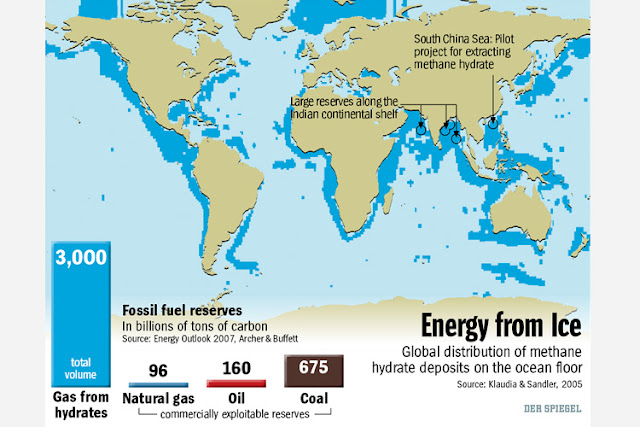
I get the impression that not only the oil and gas industry but also countries with limited energy resources have not been this energised about prospects for energy independence for a long time ( and perhaps not since the discovery of North Sea Gas). First came Shale gas and then Shale oil and now Fire Ice is catching the imagination. The sheer abundance of methane hydrates around the globe and the thought that much of this gas could soon be economically extractable is almost intoxicating for those involved.

“The worldwide amounts of carbon bound in gas hydrates is conservatively estimated to total twice the amount of carbon to be found in all known fossil fuels on Earth”.

I posted recently about the successful flow test for extracting gas from deep sea methane hydrate conducted in Japan. Of course commercialisation of this technology is still many years away (though Japan hopes this could be as early as 2016). Deposits of methane hydrate are known to be extensive and generally exist either under permafrost or under the sea. The deep sea deposits were laid down under conditions of high pressure (deep sea conditions). India is known to have substantial deposits and this is now getting some people very excited:

Types of methane hydrates deposits

Economic Times:

Estimates of global reserves are sketchy, but range from 2,800 trillion to 8 billion trillion cu.metres of natural gas. This is several times higher than global reserves of 440 trillion cu. metres of conventional gas. However, only a small fraction of hydrate reserves will be exploitable.

Methane hydrate is a mixture of natural gas and water that becomes a solid in cold, high-pressure conditions in deep sea-beds (where the temperature falls to 2 degrees centigrade). It is also found in onshore deposits in the permafrost of northern Canada and Russia. Heating the deposits or lowering the pressure (the technique used by JOGMEC) will release gas from the solid. One litre of solid hydrate releases around 165 litres of gas.

India has long been known to have massive deposits of methane hydrate. These are tentatively estimated at 1,890 trillion cu.m. An Indo-US scientific joint venture in 2006 explored four areas: the Kerala-Konkan basin, the Krishna-Godavari basin, the Mahanadi basin and the seas off the Andaman Islands. The deposits in the Krishna Godavari basin turned out to be among the richest and biggest in the world. The Andamans yielded the thickest-ever deposits 600 metres below the seabed in volcanic ash sediments. Hydrates were also found in the Mahanadi basin.

Formidable economic and environmental challenges lie ahead. Nobody has yet found an economic way of extracting gas from hydrates. Industry guesstimates suggest the initial cost may be about $30/ mmBTU, double the spot rate in Asia and nine times higher than the US domestic price. JOGMEC is optimistic that the cost can be cut with new technology and scale economies.

The Indian National Gas Hydrate Program (NGHP) Expedition was conducted together with the US Geological Service

The World’s Largest Potential Energy Resource
Released: 2/7/2008 9:21:21 AM

An international team led by the U.S. Geological Survey (USGS) and the Directorate General of Hydrocarbons, which is under the government of India’s Ministry of Petroleum and Natural Gas, conducted the expedition.

Highlights include:

  • gas hydrate was discovered in numerous complex geologic settings, and an unprecedented number of gas hydrate cores and scientific data were collected;
  • one of the richest marine gas hydrate accumulations ever discovered was delineated and sampled in the Krishna-Godavari Basin;
  • one of the thickest and deepest gas hydrate occurrences yet known was discovered offshore of the Andaman Islands and revealed gas hydrate-bearing volcanic ash layers as deep as 600 meters below the seafloor;
  • and for the first time, a fully developed gas hydrate system was established in the Mahanadi Basin of the Bay of Bengal.

“NGHP Expedition 01 marks a monumental step forward in the realization of gas hydrates becoming a viable energy source,” said USGS Director Mark Myers. “This partnership combines the expertise of two organizations dedicated to understanding gas hydrates, and research results provide new and exciting information about this important potential energy resource.”

Directorate General of Hydrocarbons Director General and NGHP Program Coordinator V. K. Sibal said, “The global gas hydrate resources are estimated to be huge. Although the exploration and exploitation of gas hydrates pose significant challenges, the opportunities are unlimited. The combined wisdom of the scientific community from across the world could provide the answers and solutions to many of these challenges. The Indian gas hydrate program has been fortunate in having the benefits of a truly global collaboration in the form of the first gas hydrate expedition in Indian waters. The results of the studies are not only encouraging, but also very exciting. I believe that the time to realize gas hydrate as a critical energy resource has come.”

Methane hydrate deposits around the world: Graphic Der Spiegel


The McIntyre – The Bane of Climate Dogma and Mighty Slayer of Hockey Sticks

March 17, 2013

Steve McIntyre is

known in particular for his statistical critique, with economist Ross McKitrick, of the controversial hockey stick graph, which shows a sharp, and arguably unprecedented, increase in late 20th century global temperature.

He is at his sleuthing best again and Science will soon have to retract this new “hockey stick” paper

A Reconstruction of Regional and Global Temperature for the Past 11,300 Years, by Shaun A. Marcott, Jeremy D. Shakun, Peter U. Clark and Alan C. Mix, Science 8 March 2013: Vol. 339 no. 6124 pp. 1198-1201 DOI: 10.1126/science.1228026

This paper is apparently based on Marcott’s PhD thesis but the thesis contains no hockey stick!

By the time the paper was published a hockey stick had appeared.  In the most generous interpretation  the paper was “modified” to fit in with global warming dogma before being published in Science. A less generous – but more likely –  interpretation is that this is just fraud instigated probably by the global warming pundits who were the reviewers of the Science paper.

McIntyre’s latest post is a breathtaking indictment of the paper:

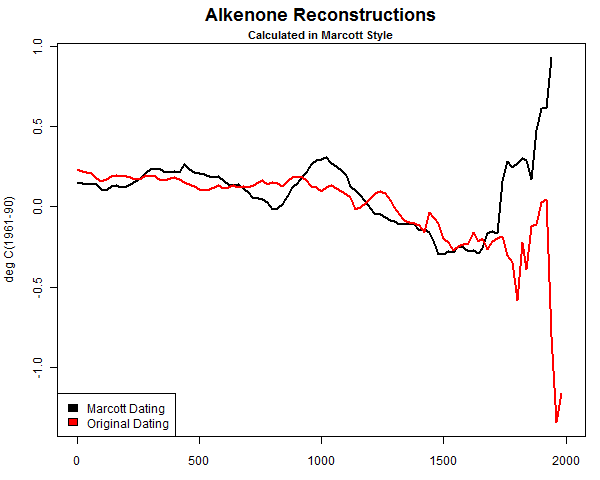
Marcott, Shakun, Clark and Mix did not use the published dates for ocean cores, instead substituting their own dates. The validity of Marcott-Shakun re-dating will be discussed below, but first, to show that the re-dating “matters” (TM-climate science), here is a graph showing reconstructions using alkenones (31 of 73 proxies) in Marcott style, comparing the results with published dates (red) to results with Marcott-Shakun dates (black). As you see, there is a persistent decline in the alkenone reconstruction in the 20th century using published dates, but a 20th century increase using Marcott-Shakun dates. (It is taking all my will power not to make an obvious comment at this point.)
alkenone-comparison
Figure 1. Reconstructions from alkenone proxies in Marcott style. Red– using published dates; black– using Marcott-Shakun dates.

Read More

The media went bonkers in reporting the Marcott paper  and this diagram will now go down in infamy:

marcott et al

This scandal is causing much attention ( here and here) but there is a deafening silence from the authors, from Science and from the – no doubt – anonymous reviewers.

I cannot draw but I have a clear image of a lone McIntyre battling against the Hockey Sticks. Perhaps a Josh can do justice to the image in my head.

The McIntyre slaying the Hockey Stick

The McIntyre slaying the Hockey Stick

Boeing’s PR upsets Japanese Civil Aviation Board – and this will delay the Dreamliner flying again

March 16, 2013

Boeing’s upbeat announcement that the Dreamliner could be flying in a matter of weeks has upset the Japanese Civil Aviation Board. It would seem that Boeing did not clear their PR blitz in Tokyo in advance with the CAB. Their optimistic statements about the Dreamliner flying again “in a matter of weeks” to try and reassure the market place may prove to be a PR blunder and could backfire.

ET: Japanese regulators immediately warned that the timetable was impossible to predict, in part because investigators still do not know what had caused lithium-ion batteries to overheat on two 787s. 

“At this time we are not yet in a position to say when flights will restart,” said Shigeru Takano, the air transport safety director at Japan’s Civil Aviation Board (CAB), which will assess and approve Boeing’sproposed fix. …

…. “If we look at the normal process and the way in which we work with the FAA, and we look at the testing that’s ahead of us, it is reasonable to expect we could be back up and going in weeks, not months,” the 787’s chief engineer, Mike Sinnett, said at an earlier briefing in Tokyo. 

But the CAB, the FAA’s counterpart in Japan, dismissed Sinnett’s prediction, saying it was too early to predict when 787 operations could resume, since regulators in the United States and Japan are still investigating. Takano, the air transport safety director at the CAB, said Sinnett’s comment on the battery probe was “inappropriate.”

To call Boeing’s statement “inappropriate” is tantamount to an outright rejection. I think Boeing has shot itself in the foot since the CAB clearly perceives their role being usurped by Boeing’s PR pronouncements. There is now no way that the CAB can or will allow any “fast-tracking” of approvals.

Reuters: Japan is Boeing’s biggest customer for the fuel-efficient aircraft, which has a list price of $207 million. JAL and ANA combined account for almost half the global Dreamliner fleet. Japanese firms also build 35 of the aircraft.

And until the CAB approves, other countries will also hold off their approvals. It is going to be at least 2 months now before Dreamliners fly again commercially.